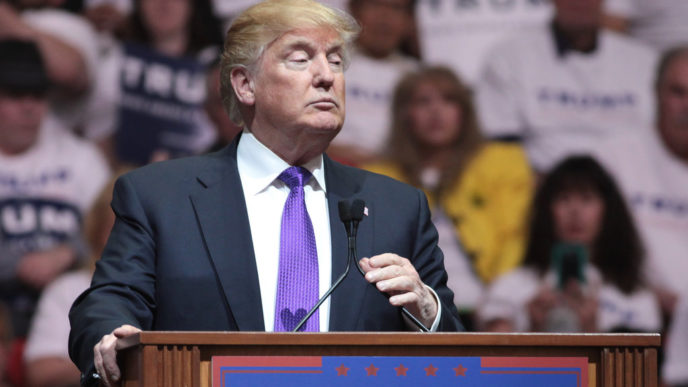
By Washington Times. Donald Trump Jr. weighed in Monday on House Democrats’ “amen and a-woman” prayer, calling it “insane.”
Rep. Emanuel Cleaver, Missouri Democrat, delivered Sunday the opening prayer of the 117th Congress, ending it with the traditional “amen” and then tacking on “a-woman,” drawing rebukes from stunned Republicans and others.
“Amen means ‘So Be It’ in Latin,” tweeted the president’s eldest son. “It isn’t a gendered word but that didn’t stop them from being insane. Is this what you voted for?”
The prayer to open the 117th congress ended with “amen and a-woman.”
Amen means “So Be It” in Latin.
It isn’t a gendered word but that didn’t stop them from being insane.
By The Federalist. House Democratic Rep. Emanuel Cleaver of Missouri ended the opening prayer for the 117th Congress Sunday with “amen and a-woman,” in an apparent effort to be gender- and deity-inclusive while omitting “aperson.”
The term “amen” is not even a reference to the two sexes, however, as Pennsylvania Republican Congressman Guy Reschenthaler pointed out on Twitter along with a clip of the pointless passive-progressive virtue signaling.
The prayer to open the 117th Congress ended with "amen and a-women."
Cleaver, an ordained United Methodist pastor who appears clueless about basic biblical knowledge such as the meaning of the Hebrew word “amen,” offered the House prayer as Democrats in the lower chamber have prioritized removing references to the two sexes in House business in an effort to “promote inclusion and diversity.”
I was honored to deliver the opening prayer for the 117th Congress. May God bless each and every Representative with the courage and wisdom to defend our democracy and the liberties we all hold so dearly. https://t.co/z3vkWOk7lc
https://joemiller.us/wp-content/uploads/43859963370_5d604e10c4_b.jpg6831024Joe Millerhttps://joemiller.us/wp-content/uploads/logotext.pngJoe Miller2021-01-04 20:24:582021-01-04 20:25:58‘Insane’: Donald Trump Jr. Blasts House Democrats’ Prayer That Ended With ‘a-Woman’
“Jesus” has been banished from a prayer to open New Zealand’s parliamentary sessions.
The traditional prayer for decades has ended with “through Jesus Christ our Lord,” the Christian Post reported.
The Labour Party-led government proposed a new version of the prayer that leaves out Jesus and initiated a consultation process.
But Speaker Trevor Mallard used the prayer before the period of consultation ended.
The Christian Post said an even more radical proposed change to the prayer was rejected by members of the parliament that removed all religious references. (Read more from “‘Jesus’ Dropped From Official Prayer” HERE)
https://joemiller.us/wp-content/uploads/Bible_paper.jpg7681024Joe Millerhttps://joemiller.us/wp-content/uploads/logotext.pngJoe Miller2017-11-26 23:56:162017-11-27 01:19:04‘Jesus’ Dropped From Official Prayer
Surrounded by members of the clergy, President Donald Trump signed a declaration Friday designating Sunday as a day of prayer for the victims of Hurricane Harvey.
“From the beginning of our nation, Americans have joined together during times of great need to ask for God’s blessing and God’s guidance,” Trump said.
“It’s going to be a very special day. I don’t know when this was done last, but it’s been a long time ago,” Trump said to the clergy with him in the Oval Office.
Before signing the declaration, Trump praised the response to the crises caused by the hurricane.
“Friend helping friend, neighbor helping neighbor, stranger helping stranger: We’ve seen it perhaps more so than at any time so vividly, at least during Hurricane Harvey,” Trump said.
“When we look at Texas and Louisiana, we see the American spirit of service embodied by countless men and women. Brave first responders have rescued those stranded in drowning cars and rising water,” he said.
Trump singled out the Coast Guard for praise.
“And I have to tell you, I’ve watched the Coast Guard; thousands of lives have been saved by our great Coast Guard. They have done incredible work in the most vicious seas.”
The proclamation urged all Americans to join in prayer on Sunday.
“As response and recovery efforts continue, and as Americans provide much needed relief to the people of Texas and Louisiana, we are reminded of scripture’s promise that ‘God is our refuge and strength, a very present help in trouble.’ Melania and I are grateful to everyone devoting time, effort and resources to the ongoing response, recovery and rebuilding efforts. We invite all Americans to join us as we continue to pray for those who have lost family members or friends and for those who are suffering in this time of crisis,” the proclamation said.
The nation has been united in the effort to support Texas and Louisiana, Trump added in the proclamation.
“Individuals of every background are striving for the same goal: to aid and comfort people facing devastating losses. As Americans we know that no challenge is too great for us to overcome — no challenge,” he wrote.
“We invite all Americans to join us as we continue to pray for those who have lost family members and friends and for those who are suffering from this great crisis,” he wrote.
In his proclamation, Trump noted that Americans uniting in a day of prayer is a tradition older than the nation itself.
“This tradition dates to June 12, 1775, when the Continental Congress proclaimed a day of prayer following the Battles of Lexington and Concord, and April 30, 1789, when President George Washington, during the Nation’s first presidential inauguration, asked Americans to pray for God’s protection and favor,” the proclamation said.
On Thursday, Texas Gov. Greg Abbott declared a day of prayer in Texas.
His proclamation noted that “throughout our history, Texans have been strengthened, assured and lifted up through prayer,” adding that “it is right and fitting that the people of Texas should join with their fellow residents and with others from across the country and around the world to seek God’s wisdom for ourselves and our leaders and ask for His merciful intervention and healing in this time of crisis.” (For more from the author of “Trump Declares Sunday Day of Prayer: ‘God Is Our Refuge and Strength'” please click HERE)
https://joemiller.us/wp-content/uploads/Trump_signs_financial_regulation_executive_order.jpg7401200Joe Millerhttps://joemiller.us/wp-content/uploads/logotext.pngJoe Miller2017-09-02 00:31:552017-09-02 00:31:55Trump Declares Sunday Day of Prayer: ‘God Is Our Refuge and Strength’
Two federal appeals courts are considering whether elected leaders throughout the Midwest and mid-Atlantic regions must abandon the 200-year-old practice of opening local meetings with an invocation.
Both cases could end up before the Supreme Court by Christmas time.
In one case, a self-described pagan sued the board of commissioners of Jackson County, Michigan, arguing that its tradition of beginning monthly board meetings with an invocation violates the Constitution’s Establishment Clause, the First Amendment provision disallowing government from establishing an official religion.
In 1983, the Supreme Court in Marsh v. Chambers examined Nebraska’s practice of employing a salaried Christian chaplain who offered the Legislature’s invocations for 16 years, and held that “legislative prayers” at policymaking-body meetings are constitutional.
The court noted that the first Congress wrote the Establishment Clause in the same week it passed laws to create a House chaplain and Senate chaplain, whose public duties included offering invocations every day that Congress is in session.
Over the next three decades, some lower courts and academics speculated that Marsh might be a one-off exception to normal Establishment Clause rules. Some argued that invocations must be generic, and therefore mentioning Jesus Christ or making other sectarian references would be unconstitutional.
In 2014, the Supreme Court addressed this confusion by taking another case concerning a New York town where the invocations are offered by local volunteer clergy—all of whom were Christian.
In Town of Greece v. Galloway, the court held that these invocations, too, are constitutional, even if all the prayer-givers happen to be Christian and include sectarian content from a single faith.
But litigation persisted, now focusing on the identity of the prayer-givers.
Plaintiffs argued that invocations given by government officials are unconstitutionally coercive because they might imply that lawmakers will use their official powers against those who refuse to participate in the invocations.
The U.S. Court of Appeals for the 4th Circuit rejected that argument when a three-judge panel ruled 2-1 for the government in Lund v. Rowan County, North Carolina.
However, the Richmond-based appeals court reheard the case in March in a rare en banc proceeding in which all 15 judges participated. It is very possible the en banc court will invalidate Rowan County’s invocations in the next few weeks.
The opposite situation is currently unfolding in Michigan in the case of Bormuth v. County of Jackson.
There, a Clinton-appointed district judge upheld the county’s practice of allowing each of its nine commissioners to rotate having an opportunity to deliver an invocation, each according to his or her personal faith.
Because all nine commissioners are Christian, the plaintiff argues that the resulting Christian invocations violate the Establishment Clause.
A three-judge panel of the U.S. Court of Appeals for the 6th Circuit reversed the lower court’s ruling in a divided 2-1 decision, ruling that such practices are unconstitutional.
But on June 14, attorneys with First Liberty Institute will present arguments as all 15 judges of the Cincinnati-based appeals court rehear that case en banc.
It is very possible that by late this year, a “circuit split” situation could occur between en banc appeals courts.
If that happens, one or both of these cases will become prime candidates for the U.S. Supreme Court to hear in 2018 as a major religious liberty case.
Legislator-led invocations fall within a broad historical tradition going back to the founding of the republic. The Town of Greece decision made clear that the Establishment Clause must be interpreted consistently with what the framers of the Constitution understood to be establishing religion.
Because these invocations do not establish an official religion, as “establishment” has been historically understood, and because the invocations do not require or coerce anyone to participate, they are perfectly constitutional.
If the Supreme Court means to enforce its decision in Town of Greece that centuries-old prayer traditions do not violate the Establishment Clause, then these cases may be at the forefront of a fundamental restoration of religious liberty in America. (For more from the author of “2 Cases Threaten to Shut Down Public Prayer. Why the Supreme Court May Need to Act.” please click HERE)
https://joemiller.us/wp-content/uploads/Leisure-Girl-Outdoors-Beach-Praying-Person-1868772.jpg640960Joe Millerhttps://joemiller.us/wp-content/uploads/logotext.pngJoe Miller2017-06-14 22:12:342017-06-14 22:12:342 Cases Threaten to Shut Down Public Prayer. Why the Supreme Court May Need to Act.
“Maybe,” says Liberty Council’s Jeremy Dys, “we will get through this year without receiving reports of city leaders going to their national day of prayer celebrations in their towns and being threatened with lawsuits as a result.”
Maybe Dys will get his wish this year. But even as America observes a National Day of Prayer, people’s right to pray in public is under attack across the country. In one case, police denied a person’s right to pray in her own home.
Today, President Donald Trump signed an executive order today protecting religious freedom. He said, “We will not allow people of faith to be bullied.” The Family Research Council’s Tony Perkins says that “the open season on Christians and other people of faith is coming to a close in America.”
The Rundown
In the meantime, though, people across the country have to fight in the courts for their right to pray. Here are a few of the cases.
In 2015 in Seattle, a high school football coach was suspended and then fired for praying on the field after games. Coach Joe Kennedy merely said a silent prayer. He did not instruct the players to join him. Yet for merely saying a silent prayer as he’d done for many years, this beloved coach lost his position. A federal court will finally hear his case this summer.
In Kansas, a police officer threatened to arrest a woman for praying in her own home. Mary Ann Sause is a retired Catholic nurse on disability. The officers came to her home and demanded entry without telling her why. When she began praying, one of the officers told her he would arrest her if she didn’t stop.
First Liberty is representing her in a lawsuit against the police department. A federal district court ruled that being ordered by armed officers not to pray “may have offended her, it does not constitute a burden on her ability to exercise her religion.” The U.S. court of appeals for the 10th Circuit is now hearing the case.
And More Cases
In Texas, The Freedom From Religion Foundation filed a lawsuit against Montgomery County Justice of the Peace Wayne Mack. He is facing ethics charges for allowing a chaplain to open court sessions in prayer. Yet a sign clearly says people are not required to attend the prayer. Texas Attorney General Ken Paxton issued an opinion stating the prayers are constitutional. The Supreme Court upheld the practice in Town of Greece v. Galloway, he argues.
Similarly, in Pennsylvania, Americans United for the Separation of Church and State is suing the state legislature. The legislature permits religious leaders to say a prayer at the start of sessions.
The Freedom From Religion Foundation threatened to sue the Harrison School Board in Arkansas for saying prayer before meetings. So far, the board is defying its threat.
A Cherished Tradition of Public Prayer
The U.S. has a long, cherished tradition of prayer in the public sphere. There is a reason we enjoy an annual National Day of Prayer.
But many people disagree. They try to use the law and the courts to empty our public life of any recognition of God. State legislatures around the country already protect public prayer, and Congress should do the same. (For more from the author of “Public Prayer in America Facing Serious Threats” please click HERE)
When a Louisiana state chaplain announced he was going to pray before a town hall meeting in Metairie, liberal protesters yelled and jeered at him, overpowering his prayer with cries of “separation of church and state,” among other slogans. CBN identified the protesters as members of the liberal activist group Indivisible.
The group also booed a veteran as he tried to say the Pledge of Allegiance. They refused to stand for the pledge and as he spoke yelled “do your job” and “get on with it.”
Some Shouted, Others Screamed
Republican Sen. Bill Cassidy called the town hall meeting to discuss immigration, healthcare and the economy, reported The Washington Free Beacon. When Dr. Michael Sprague announced that he would begin with prayer, the liberal group Indivisible in attendance protested loudly.
Some shouted, “church and state!” Others screamed, “Pray on your own time!” One woman even yelled “Lucifer!” One shouted as the chaplain tried to start, “Amen. Shut up. We’re done.”
When Sprague said, “in Jesus’ name,” the group screamed angrily again. In a Christianity Today interview, Sprague said the idea of booing Jesus was nothing new. “We need to remember that Jesus has been booed many, many times and He will be booed again. But when I was praying in the name of Jesus, I was not praying a political prayer or a religious prayer; I was simply praying in the name of a very real person named Jesus who says to love your enemies, care for the poor, and turn the other cheek.”
According to Indivisible’s website, the group “energizes and informs Americans about government’s potential and enlists them to imagine and create the government we need for all to have a safe, healthy, just and prosperous future.” It is unclear how yelling over a town hall prayer accomplishes that purpose.
Sprague said he wasn’t angry at the protesters for their behavior during the town hall. “So I’m not mad. In fact, with every single person there, I would love to pray with them that that if they get tired of this old life, they would hear Jesus say the words, ‘Come to Me, all of you who are weary and burdened, and I will give you rest.’”
Watch the video below:
(For more from the author of “Liberal Protesters Interrupt Town Hall Prayer With Jeers When Chaplain Prays in Jesus’ Name” please click HERE)
https://joemiller.us/wp-content/uploads/praying-hands-1379173656P80-1.jpg12711920Joe Millerhttps://joemiller.us/wp-content/uploads/logotext.pngJoe Miller2017-02-28 18:48:222017-02-28 18:48:22Liberal Protesters Interrupt Town Hall Prayer With Jeers When Chaplain Prays in Jesus’ Name
At Thursday morning’s National Prayer Breakfast, President Trump said the whole world has a duty to stop the “genocide” of Christians in the Middle East.
He blasted the terrorism that religious minorities face in some parts of the world, said we “must never, ever” stop asking God for wisdom, and declared that America will flourish “when religious liberty can flourish.”
“Freedom of religion is a sacred right,” President Trump said. He promised his administration “will do everything in its power to defend and protect religious liberty in our land” and around the world.
He outlined the severity of threats to religious freedom around the world: “We have seen peace-loving Muslims brutalized, victimized, murdered, and oppressed by ISIS killers. We have seen threats of extermination against the Jewish people. We have seen a campaign of ISIS and genocide against Christians, where they cut off heads. Not since the Middle Ages have we seen that. We haven’t seen that – the cutting off of heads. Now they cut off the heads, they drown people in steel cages…Nobody’s seen this for many, many years.”
“All nations have a moral obligation to speak out against such violence,” he said. “All nations have a duty to work to confront it and to confront it viciously if we have to. So I want to express clearly today to the American people that my administration will do everything in its power to defend and protect religious liberty in our land. America must forever remain a tolerant society where all faiths are respected and where all of our citizens can feel safe and secure. We have to feel safe and secure.” (Read more from “President Trump: America ‘Must Never, Ever’ Stop Asking God for Wisdom” HERE)
https://joemiller.us/wp-content/uploads/24949501440_8f88d1f08c_b-2.jpg6831024Joe Millerhttps://joemiller.us/wp-content/uploads/logotext.pngJoe Miller2017-02-02 17:22:022017-02-02 21:25:07President Trump: America ‘Must Never, Ever’ Stop Asking God for Wisdom
Family Research Council President Tony Perkins, a Marine veteran, and eight year member of the Louisiana House of Representatives, is also an ordained minister. He preaches frequently in churches across America. In early 2009, Tony preached on “The Quest for Change” at a large evangelical church in Southern California. At the time, the term “change” was fresh in the popular mind of Americans. President Barack Obama had highlighted the word “change” in his presidential campaign theme – “Hope and Change.”
Yet Tony’s message was not a call to political change; but to a central message of the Bible: Repentance. It is a message found in the Law and the Prophets (2 Kings 17:13; Acts 28:23), Jesus in his earthly ministry (Matt 4:1), John the Baptist (Matt 3:2), the Disciples (Mark 6:12), Peter (Acts 2:38), Paul (Acts 17:30-31); the New Testament churches (Jude 1:3 ff; and the risen Christ in his apocalyptic warning to the churches of Asia Minor (Rev. 2-3).
Tony’s text was Matthew 4:17, Jesus’ call to “repent” (i.e., change) for “the kingdom of heaven is at hand.” His call to action was from 2 Chronicles 7:14 “If My people, who are called by My Name, will humble themselves and pray, and seek My face, and turn from their wicked ways, then will I hear from heaven, forgive their sins and heal their land.”
Birth of the Call2Fall
In several services that Sunday morning, over 50 people had made professions of faith in Christ. Afterward, church folks lined up to greet Tony. An elderly woman came up to Tony and said: “You have the message that the Church needs to hear. You have the answer to what we are facing.”
She went on to say that when she had come in that morning, the Holy Spirit had told her to get on her knees during the worship, but she didn’t. She didn’t want to be embarrassed. She said she had to later repent for being disobedient. Her focus was on the bowing of the knee. She said, “You need to call churches across the nation to get on their knees, literally, before God.”
Tony writes, “I politely told her I would pray about it. She then became insistent that this message was “of the Lord” and “the Church needed to respond.”
Later that evening while Tony was flying home, he picked up a book he had been reading earlier – a biography of Samuel Adams by Ira Stoll. “I was at the place where the Continental Congress passed a resolution calling for a day in July of 1775 for “public humiliation, fasting and prayer; that we may, with united hearts and voices, unfeignedly confess and deplore our many sins; and offer up our joint supplications to the all-wise, omnipotent, and merciful Disposer of all events; humbly beseeching him to forgive our iniquities, to remove our present calamities, to avert those desolating judgments, with which we are threatened…”
Responding to the results of that day in 1775, Patriot James Warren wrote his friend, Founding Father Samuel Adams: “Three millions of people on their knees at once, supplicating the aid of Heaven, is a striking circumstance, and a very singular one in America.”
“At that point I remembered my earlier conversation with the elderly lady and my request of God earlier that morning for an answer to the dilemma America faces… For weeks I studied and meditated upon the book of Joel, which is 2 Chronicles 7:13-14 in book form.”
Both the book of Joel and the passage in 2 Chronicles speak of God’s temporal judgments on a sinful nation. Are we not facing similar threats in America today? There are natural calamities as well as man-made calamities and a list of sins too numerous to list. Then there is an over-reaching big government that robs our families via profligate spending, borrowing and confiscatory taxes; government’s scandalous violation of our constitutionally guaranteed rights, including religious liberty, and our sacred liberty of conscience. These are massive cosmic and systemic societal problems that require the direct intervention of Almighty God. Bottom line: America’s problems cannot be fixed without God’s help.
Tony asks, “What if on one Sunday in churches all across the nation, Christians literally fell on our knees before God as an act of humility, acknowledging our absolute dependence upon God’s mercy, crying out for the nation in intercession and confessing our sins? Would God not hear such prayers from His people, forgive our sin and heal our land?”
We already have a National Day of Prayer on the first Thursday in May, but Call2Fall reminds us that we need a national day of prayer in our churches, during Sunday worship and indeed every day. That is what God is looking for: A repentant people who are seeking His face daily in church, at home, at work and at all times. He wants men to pray everywhere, “lifting up holy hands without wrath and doubting” (1 Tim 2:8).
Call2Fall is a token, an honest symbol, a church-oriented prayer meeting where every church in America can take a step toward becoming a “house of prayer for all people” – pointing toward a nation-changing Joel 2:12-18 style solemn assembly.
When Tony shared with FRC’s Pastors Council what God had shown him, some of those present argued for extended times of prayer and fasting, but the oldest, wisest members said: No, we need something every church can participate in, even at an entry level, to move people toward prayer and seeking God. Consequently, at minimum, we are calling on churches to spend at least 5 minutes on their knees, but they can do much more as the Holy Spirit leads them. Some spend just 5 minutes, but others spend their whole worship services crying out to God for America. Still others have set aside a week for fasting, prayer and the seeking of God’s face for our nation. We have marveled as members of hundred plus-year-old churches have gotten on their knees before God for the first time in their church’s history.
Last year nearly 1.5 million believers participated. Can we double that number during the next 4 weeks and match the number of Americans who bowed before the Lord on that Sunday in 1775 which was the precursor to the Declaration of Independence and victory in the Revolutionary War? Can we begin to win back our nation for the God our forefathers sought and for whom they gave their lives? Before we celebrate on July 4th, let’s gather on our knees across America to re-consecrate our nation to Him who Alone gives freedom. May we consecrate our churches and homes as Houses of Prayer on Sunday, June 30th for that purpose. May God hear the cry of our hearts and answer our prayers.
Please pray constantly between now and June 30th. Talk to your pastor and use social media to tell everyone you know about Call2Fall! Thank you for praying! (“FRC’s Call2Fall to Save the Nation Using Our Founders’ Incredible Example: Drop to Our Knees by the Millions, Repent”, originally posted HERE)
https://joemiller.us/wp-content/uploads/logotext.png00Joe Millerhttps://joemiller.us/wp-content/uploads/logotext.pngJoe Miller2015-06-19 03:45:142016-04-11 10:59:50Family Research Council Says We Must Save the Nation, Use Founders’ Example: Drop to Our Knees by the Millions, Repent [+video]
Photo Credit: WSFA The faith of a little boy was on full display at the Waffle House at the Prattville-Millbrook exit one night a few weeks ago. It’s the story of 5-year-old Josiah Duncan and his mom, Ava Faulk.
“We saw a man who was dirty holding a bag with his bike outside,” Faulk recalled.
Josiah was so troubled by the man’s appearance, he started peppering his mom with questions.
“He’s homeless,” the little boy’s mother explained. “What does that mean?” he responded. “And I said, “”Well, that means he doesn’t have a home,”” Mom continued. And apparently, the unnamed man didn’t have any friends to lean on, either.
Faulk wrote an email to WSFA 12 News about her son’s actions, and it included many of the questions the young child had. “Where is his house? Where is his family? Where does he keep his groceries?” But mom said one thing troubled him above all. (Read more from “5-Year-Old Boy Prays out Loud With Homeless Man in Waffle House: ‘The Man Cried, Everybody Cried'” HERE)
https://joemiller.us/wp-content/uploads/logotext.png00Joe Millerhttps://joemiller.us/wp-content/uploads/logotext.pngJoe Miller2015-05-20 00:29:592016-04-11 11:00:585-Year-Old Boy Prays out Loud With Homeless Man in Waffle House: ‘The Man Cried, Everybody Cried’ [+video]
This year marks not only the 70th anniversary of D-Day, but also the 70th anniversary of some of General George S. Patton’s greatest exploits as a commander during World War II. This week marks the anniversary of the General’s call for all the soldiers in his Third Army to pray, just as the last major Nazi offensive of World War II was about to begin.
Patton’s Third Army led the Allied break-out of Normandy in late July 1944. By the end of September, it stood poised to enter Germany after liberating much of France during its drive across Europe. However, what the Nazi Army could not do, the weather did. Europe’s unusually wet fall bogged down the Third Army and the rest of the Allied forces for the next two months, as they waited for the roads to dry.
The situation became so frustrating to Patton that on another rainy day in early December, he asked the Third Army head chaplain, James O’Neill, for a weather prayer. By O’Neill’s account, the General said the weather would need to change if they were going to win the war. The chaplain composed and delivered this prayer to Patton a short time later:
“Almighty and most merciful Father, we humbly beseech Thee, of Thy great goodness, to restrain these immoderate rains with which we have to contend. Grant us fair weather for battle. Graciously harken to us as soldiers who call upon Thee that armed with Thy power, we may advance from victory to victory, and crush the oppression and wickedness of our enemies, and establish Thy justice among men and nations. Amen.”
Patton liked it and ordered O’Neill to print 250,000 copies on prayer cards to distribute to the entire Third Army. On the reverse side of the cards was a Christmas greeting from the General. He then questioned the chaplain as to how much praying the Army was doing. O’Neill believed not much: when there’s fighting, everybody prays; but when it’s quiet, everyone just sits around and waits for things to happen.
Patton responded, “Chaplain, I am a strong believer in prayer. There are three ways that men get what they want; by planning, by working, and by praying. Any great military operation takes careful planning, or thinking. Then you must have well-trained troops to carry it out; that’s working. But between the plan and the operation there is always the unknown. That unknown spells defeat or victory, success or failure. It is the reaction of the actors to the ordeal when it actually comes. Some people call it getting the breaks; I call it God. God has His part, or margin in everything. That’s where prayer comes in.”
He added, “A good soldier is not made merely by making him think and work. There is something in every soldier that goes deeper than thinking or working—it’s his ‘guts.’ It is something that he has built in there: it is a world of truth and power that is higher than himself.” Patton referred to the account of Gideon in the Bible who, despite being greatly outnumbered, fought bravely and prevailed because the Lord was with him. (Judges, Chapters 6-8). The General observed that his men should be praying, wherever they were—or eventually they would “crack up.”
Patton instructed O’Neill to put out a training letter for all the chaplains in the Third Army on the importance of prayer. It was circulated to the Third Army’s 486 chaplains and to every organizational commander down to the regimental level—3,200 letters. Recounting how God aided Gideon’s army, O’Neill exhorted his fellow chaplains, “We must urge, instruct, and indoctrinate every fighting man to pray as well as fight. In Gideon’s day, and in our own, spiritually alert minorities carry the burdens and bring the victories.”
O’Neill’s training letters and prayer cards went into the Third Army’s ranks starting December 12, 1944. Events on the battlefield turned dramatically on December 16.
Nearly one hundred miles to the north of Patton’s Third Army sector, Adolf Hitler pulled some of his best units from battling the Russians to participate in a bold strike which he hoped would both dishearten the Allies and buy him time to strengthen Germany’s defenses. Under thick cloud cover with snow falling, Hitler’s 200,000 troops advanced through Belgium’s Ardennes Forest. The Allies could not employ their air cover because of the weather. The massive German thrust enveloped thousands of Allied soldiers—including 11,000 from the 101st Airborne Division in Bastogne. The German commander ordered the surrounded unit to immediately surrender—to which the American commander, General Anthony McAuliffe, famously replied, “Nuts.” The German Army tried to break the hold on Bastogne while also pushing west, creating a 50-by-30-mile-wide bulge in the Allied lines.
Credit: History Dept., USMA, West Point
Prior to the Ardennes Offensive, Patton had his staff working on a contingency plan because he sensed the Germans might counterattack in the Bastogne region. Patton amazed all in the Allied planning meeting called by General Dwight D. Eisenhower by saying that his Army could attack with three divisions in seventy-two hours in the Bastogne region. His forces were currently eighty-five miles to the south, with a portion already engaging the enemy—and the muddy roads were now icy and snow packed. Eisenhower gave the unrelenting Patton the green light to implement his plan.
On the same day the German commander demanded the 101st Airborne’s surrender (December 22), Patton’s forces hit the southern edge of the bulge—still over thirty miles from the besieged city. Allied air cover remained grounded until the following day, December 23. That morning, around the time many of the Third Army’s soldiers had received the prayer cards, the weeks-long cloud cover finally broke to a clear, sunny, and crisp ten-degree Fahrenheit day. The clear weather meant the hard-pressed defenders of Bastogne could finally be re-supplied with ammunition and food by parachute airdrop while Allied fighter aircraft could strike German ground forces. Experiencing nearly three hundred casualties per day, the 101st could only hope to hold out a few more days.
Finally on December 26, a beautiful sight appeared in the distance: a Sherman tank bearing the American star. The advanced elements of Patton’s Third Army were on their way, carving a tenuous, narrow corridor to the 101st that would widen the next day.
The Third Army continued attacking the enemy throughout the sector. With the help of Allied units to the north, by the end of January they had completely pushed back the Bulge, continuing into Germany. Around this time General Patton saw Chaplain O’Neill and cracked him on the side of his steel helmet with his riding crop, saying to him, “Well, Padre, our prayers worked. I knew they would.” The chaplain knew it was Patton’s way of saying, “Well done.”
————————————————————————-
Randy DeSoto is a West Point graduate. While in the Army, he served as an armor officer in the 4th Infantry Division. The article is excerpted from his book We Hold These Truths, which focuses on how leaders have appealed to faith in God and the rights He grants during some of the nation’s most defining moments. Portions of this article first appeared in the Officers’ Christian Fellowship Quarterly newsletter Connected in the winter 2007-08 edition.
Listen to Randy DeSoto discuss Patton’s Prayer in a radio interview with Gregg Jackson:
https://joemiller.us/wp-content/uploads/logotext.png00Joe Millerhttps://joemiller.us/wp-content/uploads/logotext.pngJoe Miller2014-12-13 22:08:382014-12-13 22:08:38The 70th Anniversary of General Patton's Famous Prayer