Posts

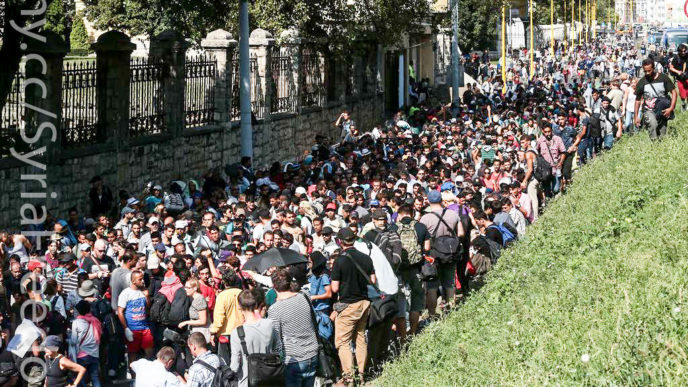
Refugee Admissions Lowest in Recent Years Thanks to Trump Immigration Crackdown

The U.S. admitted significantly fewer refugees in the first three months of fiscal year 2018 as the Trump administration implemented tougher vetting procedures and banned refugees from countries generating most of them.

The Wall Street Journal reported that 5,000 refugees were admitted to the country during the months of October, November and December. The figure is far below similar periods in recent years – with 25,671 refugees admitted in the same period during the Obama administration.

If the current rate of admission continues, the number of people given asylum in the U.S. will not reach the 2018 refugee ceiling of 45,000 set up by President Trump last year. The limit is already at its lowest since the program to resettle the refuges was started in 1980.

The downfall of the number of refugees admitted indicate the broader effect of the administration’s crackdown on immigration, including the controversial decision to suspend admission from 11 countries such as Iran, Iraq, Syria, and creating tougher screening process of applicants.

The administration said the figures reflect its attempt at trying to find a balance between protecting “legitimate” refugees and the need to protect the country’s security. (Read more from “Refugee Admissions Lowest in Recent Years Thanks to Trump Immigration Crackdown” HERE)

Follow Joe Miller on Twitter HERE and Facebook HERE.

Look Who’s Donating $5 Million to Resettle Refugees

The Church of Jesus Christ of Latter-Day Saints has donated $5 million worth of aid to the nine federal refugee resettlement agencies in the U.S., according to the Deseret News.

The donation comprises $1.2 million in cash and $3.8 million in commodities to be used during 2018, and it marks the second straight year the church has made such a donation.

Each of the nine organizations will receive a different amount. Episcopal Migration Ministries, for example, received $50,000 in cash and $200,000 of in-kind donations.

“The support from the LDS church has allowed Episcopal Migration Ministries to grant support projects for housing and health issues focused on homelessness prevention and intensive services for refugee cases with medical needs,” the organization said in a statement. “We are thankful for LDS church leadership in support of refugee resettlement.”

The Hebrew Immigrant Aid Society, meanwhile, received $40,000 in cash and $160,000 in in-kind donations. (Read more from “Look Who’s Donating $5 Million to Resettle Refugees” HERE)

Follow Joe Miller on Twitter HERE and Facebook HERE.

Trump’s ‘Extreme Vetting’ Sparks Dramatic Refugee Shift

President Donald Trump has radically changed the U.S. refugee program, as a lower admissions cap and tighter vetting procedures have led to a sharp decline in both the number of people admitted and the share of Muslims in the refugee population.

The Trump administration restarted refugee admissions in late October after the end of a 120-day suspension that was part of the revised travel ban. In the five weeks since the suspension was lifted, the U.S. admitted 40 percent fewer people than it did in the final five weeks the ban was in effect, reports Reuters, citing State Department data.

The figures show how the administration’s new vetting procedures have slowed refugee admissions to a relative trickle compared to the situation under former President Barack Obama’s administration.

U.S. immigration officials are collecting more biographical data, in addition to running applicants through law enforcement and intelligence databases, according to new guidelines laid out in October. Officials also comb through applicants’ social media posts to look for discrepancies between what they have said publicly and what they reveal during their personal interviews.

The new process includes a 90-day review period for 11 countries — Egypt, Iran, Iraq, Libya, Mali, North Korea, Somalia, South Sudan, Sudan, Syria and Yemen. During that period, which began Oct. 25, refugee admissions from those countries are allowed on a case-by-case basis only, a slowdown that has contributed to the decline in overall admissions. (Read more from “Trump’s ‘Extreme Vetting’ Sparks Dramatic Refugee Shift” HERE)

Follow Joe Miller on Twitter HERE and Facebook HERE.
Somali Charged in Bloody Stabbing at Mall of America

For the second time in just over a year, a Somali “refugee” has stabbed shoppers with a knife at a Minnesota mall.

The first case, on Sept. 17, 2016, was a clear act of jihad when Dahir Adan injured 10 people in the Macy’s at the Crossroads Center Mall in St. Cloud after asking his victims, chosen at random, if they were Muslim.

But on Sunday night, a man identified as Mahad Abdiaziz Abdirahman, 20, of Minneapolis stabbed two men at the Mall of America after they tried to stop him from stealing clothes inside the dressing room at Macy’s.

His middle name, Abdiaziz, means “the slave of Allah the master,” a native Arabic speaker told WND.

His first name, Mahad, means “the one who preaches and invites people to Islam.” (Read more from “Somali Charged in Bloody Stabbing at Mall of America” HERE)

Follow Joe Miller on Twitter HERE and Facebook HERE.
Raw-Meat Eating Somali ‘Refugee’ Terrorizes Townspeople With Knife Threats

Another Somali “refugee” has managed to strike fear into the hearts of Minnesotans by threatening to kill townspeople with a knife.

This time, it was the small town of Faribault, population 23,000 about 50 miles south of Minneapolis, that was terrorized.

In a July 25 article, the Faribault Daily News reports that a complaint filed in Rice County Court alleges that Somalia native Abdinzak Ahmed Farah, 29, was in the Third Street NW area in downtown Faribault on July 12, pointing a knife and threatening to kill anyone who called police . . .

According to an eye witness, Farah was eating raw beef with the knife and holding it out to patrons, asking them to “play games.”

Farah was asked to leave the area, which he did, only to return pointing the same knife at people as he spoke with them. Witnesses told police Farah was told to leave a second time, but later began chasing several people and threw the knife at them. (Read more from “Raw-Meat Eating Somali ‘Refugee’ Terrorizes Townspeople With Knife Threats” HERE)

Follow Joe Miller on Twitter HERE and Facebook HERE.

Former Muslim Refugee: Think ‘Rationally’ About Dangers of Radical Islam

A former Muslim refugee is asking her fellow American citizens to think “rationally” about the dangers of radical Islam.

“I know what it’s like to fear rejection, deportation and the dangers that await you back home,” Ayaan Hirsi Ali, a former Muslim of Somali origin, writes in the Huffington Post.

Ali writes that she became an American citizen after escaping an arranged marriage and working in the Netherlands at a factory and as an interpreter for abused Muslim women. Overtime, she says she made the decision to leave the religion of Islam because it was “too intolerant of free thought.”

She was “excited” when she heard Trump’s August 2016 speech about combatting the underlying ideology of radical Islam which oppresses women, the LGBT community and other religions. She was also encouraged by his promise to help moderate Muslims who strove to combat radicalism.

Four Types of Muslim Immigrants

“In the course of working with Muslim communities over the past two decades, I have come to distinguish between four types of Muslim immigrants: adapters, menaces, coasters and fanatics,” Ali says.

The adapters are those who adapt to the customs and embrace the freedoms of Western civilization; menaces are often young men who are subject to and then commit crimes of domestic violence; coasters are those who want to take advantage of welfare without working; and fanatics “use the freedoms of the countries that gave them sanctuary to spread an uncompromising practice of Islam.”

Ali writes that some people move from one category to the other over time, which makes it more difficult to distinguish between adapters and troublemakers.

“[T]he problem of Islamist terrorism will not be solved by immigration controls and extreme vetting alone,” she writes. “That’s because the problem is already inside our borders.”

Ali cites surveys which reveal majorities of Sharia-supporting Muslims in Pakistan, Bangladesh and Iraq — whence most Muslim immigrants are expected to come to the U.S. in the coming decades — agree with the death penalty for those who leave Islam.

Ali writes:

Such attitudes imply a readiness to turn a blind eye to the use of violence and intimidation tactics against, say, apostates and dissidents — and a clear aversion to the hard-won achievements of Western feminists and campaigners for minority rights. Admitting individuals with such views is not in the American national interest.

While Ali says she was disappointed in the clumsy implementation of Trump’s temporary travel ban, she still supports the president’s longterm plan of rejecting any would-be immigrants who support terrorist groups or believe in Sharia law over the Constitution.

“American citizens — including immigrants — must be protected from that ideology and the violence that it promotes,” she writes. “But the threat is too multifaceted to be dealt with by executive orders. That is why Trump was right to argue in August for a commission of some kind — I would favor congressional hearings — to establish the full magnitude and nature of the threat.”

“Until we recognize that this ideology is already in our midst, we shall expend all our energies in feverish debates about executive orders, when what is needed is cool, comprehensive legislation,” Ali writes. (For more from the author of “Former Muslim Refugee: Think ‘Rationally’ About Dangers of Radical Islam” please click HERE)

Follow Joe Miller on Twitter HERE and Facebook HERE.

Globalist Koch Brothers Attack Trump’s Islamic Refugee Ban

By Solange Reyner. An official representing the Koch brothers on Sunday called Donald Trump’s refugee and travel ban “counterproductive.”

“We believe it is possible to keep Americans safe without excluding people who wish to come here to contribute and pursue a better life for their families,” said Brian Hooks, co-chairman of the Koch network. “The travel ban is the wrong approach and will likely be counterproductive . . .

Trump on Friday signed an executive order banning travelers from seven majority-Muslim countries associated with terrorism from entering the country for 90 days. The countries are Iraq, Syria, Iran, Sudan, Libya, Somalia and Yemen. (Read more from “Globalist Koch Brothers Attack Trump’s Islamic Refugee Ban” HERE)

_________________________________________

Gingrich Criticizes Roll-Out of Trump Refugee Plan

By Cathy Burke. A rocky rollout of President Donald Trump’s ban on travelers from seven Muslim-majority nations is making the first test of the new administration’s immigration policy look like an “off-Broadway” performance, according to Newt Gingrich.

In comments to the Washington Post, President Trump’s informal adviser and former House Speaker weighed in on the reported conflict within the administration about the executive order that has triggered widespread protests.

“The problem they’ve got is this is an off-Broadway performance of a show that is now the No. 1 hit on Broadway,” Gingrich told the newspaper.

According to the Post, another area of heated debate within the administration is over the Deferred Action for Childhood Arrivals program, which grants legal protection to illegal immigrants brought to the United States as children. (Read more from “Gingrich Criticizes Roll-Out of Trump Refugee Plan” HERE)

Follow Joe Miller on Twitter HERE and Facebook HERE.
Experts Debate Whether Trump’s Refugee Order Will Make America Safer

With an executive order signed Friday, President Donald Trump delivered on his campaign promise to impose a restrictive U.S. policy toward refugee resettlement and other forms of legal immigration.

By preventing Syrian refugees from entering the U.S. indefinitely, imposing a 120-day suspension on all refugee admissions from anywhere in the world, and temporarily blocking visas from seven Muslim-majority countries, Trump took a different approach than his predecessor with a stated aim to keep extremists out of America.

While some security experts welcome the orders as a short-term way to evaluate and improve U.S. vetting procedures, others worry that limiting American assistance to the most vulnerable of immigrants is detrimental to the fight against terrorism.

“It’s a good short-term measure that allows us to take a step back and look more holistically at immigration and refugee policy, but this is by no means a long-term fix and it would undermine our interests and values if this becomes the new norm,” said Andrew Bowen, a visiting scholar at the American Enterprise Institute, in an interview with The Daily Signal.

Throughout his campaign, Trump targeted the U.S. refugee resettlement program, arguing the government’s vetting system needed to be tougher, especially for Syrians fleeing war and attempting to come to the U.S. His executive order calls for “extreme vetting” of refugees.

The U.S. admitted 84,995 refugees in fiscal year 2016, the most since 1999. The total included more than 12,000 Syrians, making them the second-largest origin group.

“We are establishing new vetting measures to keep radical Islamic terrorists out of the United States,” Trump said Friday at the Pentagon during a ceremony for James Mattis, the new defense secretary. “We want to make sure we aren’t admitting to our country the threats our soldiers are fighting overseas. We only want to admit those to our country who will support our country and love deeply our people.”

Trump’s predecessor, President Barack Obama, countered that the current vetting process for refugees is the most stringent screening for any category of legal immigrant. The process for Syrians has additional layers, and can take up to two years.

There is no known case of a Syrian refugee being involved in a terror plot in the U.S.

“The people who come to the U.S. from Syria are not walking over borders like in Europe,” said Robert Ford, a former ambassador to Syria in the Obama administration who is currently a senior fellow at the Middle East Institute and Yale University.

“They are not taking trains without passports and visas,” Ford told The Daily Signal in an interview. “They are getting on airplanes and screened ahead of time. The public perception that these Syrian refugees are like illegal immigrants sneaking across the border does not pertain to America. We have an ocean between the U.S. and Middle East. There is a whole level of control. I am not saying it’s perfect, but compared to other security risks, it’s manageable.”

But in recent congressional testimony, critics note, FBI Director James Comey said Syrian refugees are particularly hard to screen because the war-torn country has few criminal terrorist and criminal databases to check.

“If we don’t know much about somebody, there won’t be anything in our data,” Comey said, although he assured the screening process has “improved dramatically” over time. “I can’t sit here and offer anybody an absolute assurance that there’s no risk associated with this.”

What the Order Does

Trump’s order imposes an immediate 90-day pause to the legal admission of people seeking visas—for business, family reasons, humanitarian emergencies, or tourism—from Iraq, Iran, Sudan, Libya, Somalia, Yemen, and Syria.

The refugee resettlement program is shut down for four months, and when it returns, Trump proposes to cut the maximum number of refugees allowed into the U.S. in fiscal 2017 from 110,000—as Obama proposed—to 50,000. In 2011 and 2012, Obama admitted less than 60,000 refugees, before ramping up the numbers in recent years.

In addition, once the Trump administration eases restrictions on visas and the refugee program, the government will prioritize those claiming religious persecution, “provided that the religion of the individual is a minority religion in the individual’s country of nationality.” Some observers say this means Trump will prioritize Christian refugees over Muslim ones, but the president is fighting that characterization.

According to the Pew Research Center, the U.S. admitted almost as many Christian refugees (37,521) as Muslim refugees (38,901) in the 2016 fiscal year.

A relatively small number of Syrian Christians have been admitted. Pew reports that about one-half of 1 percent of the refugees admitted in calendar year 2016 from Syria are Christian, even though they make up about 5 percent of the Syrian population.

“To be clear, this is not a Muslim ban, as the media is falsely reporting,” Trump said in a statement Sunday night. “This is not about religion—this is about terror and keeping our country safe. There are over 40 different countries worldwide that are majority Muslim that are not affected by this order.”

Even so, Ford, the former U.S. ambassador to Syria, said blocking immigration from certain Muslim-majority nations legitimizes ISIS’ propaganda that aims to turn Muslims against the West.

“On the one hand, the Trump administration is talking about eradicating radical Islam,” Ford said.

“He is promising a hard-fisted military approach. On the other hand, measures like this will paint the American administration as at best indifferent, and more likely, hostile, to Sunni Muslims in places like Syria and Iraq who feel like they are already under attack. That will fuel jihadi recruitment, whether from individuals living in bombed out cities in Syria or in Lebanon refugee camps.”

‘Improved US Security’

Edward Alden, a senior fellow at the Council on Foreign Relations, told The Daily Signal that since 9/11, the U.S. has implemented enhanced security procedures to a degree that European countries have not.

Today, visa applicants from overseas are fingerprinted and photographed to check their identities against terrorist databases.

The government is better able to ensure identity by intercepting phony passports and inadequate identification, Alden said. It created a comprehensive database of people across the world with known or suspected terrorist history, and it targets people with suspicious travel or other patterns, such as how they communicate and who they are communicating with, including internet conversations.

Alden said information-sharing among allies is the most important factor underlying these security procedures, and he worries Trump’s executive order will harm that effort.

“One of the most important elements in the improved U.S. security we have seen since 9/11 is intelligence cooperation from allied governments and cooperation in particular from moderate Muslims in the United States, and around the world,” said Alden, who is author of “The Closing of the American Border: Terrorism, Immigration, and Security Since 9/11.”

“By targeting a handful of Muslim countries in this fashion, and targeting the most vulnerable segment of this population, this will undermine our ability to solicit cooperation.”

In his executive order, Trump expresses concerns over information-sharing, and threatens to withhold visas from countries deemed insufficiently cooperative.

The president directs the relevant Cabinet agencies to review the vetting process for citizens of all countries where visas are required to travel to the U.S.

If those nations don’t improve their cooperation, they will be added to the list of countries whose citizens are barred from entry to the U.S.

Alden notes that because visa programs are supposed to be reciprocal, many of the affected countries could decide to respond to Trump’s aggressive approach by restricting American travelers.

Already, leaders in Iran and Iraq, two of the countries targeted by Trump’s order, vowed to take retaliatory action against the U.S.

‘Preparing’ for Life After ISIS

James Carafano, a national security expert at The Heritage Foundation, disagrees with this characterization and says that prudency is necessary at a time when the U.S.-led military coalition is making major gains against ISIS in Iraq and Syria.

“What the Trump administration is doing is taking a perfectly practical measure preparing for the time when ISIS is defeated in the Middle East and all those foreign fighters in the region will outflow, potentially targeting the United States,” said Carafano, who was on the Trump transition team. “Trump got elected to look at these things and get ahead of the threat by making sure the American people are adequately protected.”

Ford, and Bowen of the American Enterprise Institute, acknowledge the foreign fighter risk, but they consider the list of targeted nations to be flawed.

The list does not include Muslim-majority countries like Saudi Arabia, where most of the 9/11 hijackers were from. The other hijackers were from United Arab Emirates, Egypt, and Lebanon, none of which are on Trump’s list.

“That list could have been put together better,” Bowen said. “It’s a bit haphazard in that countries like Saudi Arabia and Tunisia, and even European countries like Germany, France, and Belgium, have individuals fighting in Syria and Iraq. If you are going to take this action, individuals from those countries should also be strongly vetted.”

The targeted countries do share common traits.

The U.S.-led military coalition is conducting airstrikes against terrorists in five of the seven targeted countries: Iraq, Syria, Libya, Yemen, and Somalia.

The U.S. government considers three of those countries to be sponsors of terrorism (Iran, Sudan, and Syria), and the Obama administration designated the others as countries of concern (Libya, Somalia, Iraq, and Yemen).

Of 161 people charged with jihadist terrorism-related crimes or who died before being charged, 11 were identified as being from Syria, Iraq, Iran, Libya, Yemen, Sudan, or Somalia—the countries specified in Trump’s order—The Wall Street Journal reported.

Experts note that in recent jihadist terrorist attacks, from San Bernardino to Orlando, American citizens or green card holders have been the perpetrators.

“The biggest threat to our nation is not someone coming from across the border with a visa or as a refugee,” said Mustafa Tameez, who has worked as a consultant for the Department of Homeland Security and State Department on counterterrorism issues. “The threat is from homegrown terrorists, someone who is radicalized over the internet and latches on to ISIS’ message that Islam is incompatible with Western democracy,” Tameez told The Daily Signal in an interview.

The Trump administration has adjusted the refugee policy since its rollout was heavily criticized.

On Sunday night, it said that green card holders would be exempt from the new policy. And the Pentagon reported Monday that it is compiling a list of Iraqis who have aided the U.S. military to determine if they should be exempted from Trump’s order.

“The executive order is not a policy,” said Mark Krikorian, the executive director of the Center for Immigration Studies, in an interview with The Daily Signal. “It’s just hitting the pause button so we can see what policy changes we need to make America safer. That’s what people aren’t getting. This isn’t the end point.” (For more from the author of “Experts Debate Whether Trump’s Refugee Order Will Make America Safer” please click HERE)

Follow Joe Miller on Twitter HERE and Facebook HERE.

Terror Attack in Germany Puts Spotlight on Refugee Policy

Before this year, Germany was not used to Islamist terrorists striking on its home soil. A lot has changed since.

The terror threat that haunts Germany seemingly culminated—at least for 2016—in the outrage that occurred in Berlin this week. At present, 12 are dead and dozens more were injured in a truck attack that mirrored the one that took place in Nice, France, this past summer.

It comes as no surprise that the Islamic State, also known as ISIS, has claimed credit for the attack in Berlin, although the actual perpetrator is yet to be arrested.

Intelligence services clearly had an idea that something like this was possibly coming. A State Department travel alert from November warned of a “heightened risk of terrorist attacks throughout Europe, particularly during the holiday season.”

The travel alert went on to say, “U.S. citizens should exercise caution at holiday festivals, events, and outdoor markets.” It stated that “credible information” indicated that ISIS or al-Qaeda could be likely perpetrators of an attack.

Such target-rich environments appeal to terrorist groups aiming to cause death and carnage during the holiday season. Even before the plot targeting Berlin, a 12-year-old boy radicalized by an ISIS operative tried to blow up a Christmas market in Ludwigshafen on Nov. 26. Fortunately, his bomb failed to detonate.

On the same day, arrests were made in Strasbourg and Marseille, which disrupted an ISIS plot targeting a Christmas market in Champs-Elysees, Paris.

Yet the threat does not begin and end with ISIS. Those trained by al-Qaeda have also planned to attack a Christmas market in Strasbourg. That plot was disrupted in December 2000 and four Algerians were subsequently jailed for between 10 and 12 years.

Al-Qaeda has also launched terrorist attacks on aviation during the holiday season—in 2001, via shoe bomber Richard Reid, and in 2009, via underwear bomber Umar Farouk Abdulmutallab.

With the Berlin assailant still on the loose (at the time of this writing), German authorities will be working with counterterrorism partners domestically and internationally to try and stop another attack from taking place. In the short-term, this involves finding whoever was responsible, what networks they were connected to, and any ties to foreign terrorist groups.

It may be that there were ties to terrorists based in Germany. For example, it is worth remembering that “Charfeddine T”—a 24-year-old Tunisian—was arrested just days ago on the suspicion that an attack was being planned in Berlin. Whether there are any ties is unknown, although the timing is worth noting.

Presumably, whoever carried out the attack will be caught relatively quickly. Even so, there is much to reflect on for Chancellor Angela Merkel and for German society generally.

This is the fourth terrorist attack that has taken place there this year, and there have been a host of other attempted attacks thwarted. Several of these plots have been planned by refugees recently settled into the country.

Clearly the vast majority of the 1 million-plus refugees to have entered Germany are not terrorists. Yet the numbers that Germany took in were so large that even a small minority has led to a very big issue.

So, the problem is clear. Whether the German political class has adequate solutions, much less so. (For more from the author of “Terror Attack in Germany Puts Spotlight on Refugee Policy” please click HERE)

Follow Joe Miller on Twitter HERE and Facebook HERE.

How This Red State Is Grappling With Influx of Refugees

Greg Haney is able to capture the change happening in the largest city of this small state better than most.

Haney shoots school photographs for his father’s 39-year-old local company, chronicling increasingly diverse student bodies that span Fargo, North Dakota, and Moorhead, Minnesota, twin cities in bordering states separated only by the Red River.

Haney is a Republican-leaning, Breitbart-reading veteran of the Navy, born and raised in Moorhead, but residing since 2003 in a house he owns in Fargo.

He came to appreciate cultural differences during his tours in the Navy, and he can just as easily translate “how are you” into Arabic as he can exclaim the uniquely folksy word “jeepers” in everyday conversation.

“This area seems to act together as cities and states first, and that goes to both sides of the river,” Haney, 43, tells The Daily Signal in a recent phone interview, adding:

We don’t concern ourselves as much with what the rest of the country is doing. So when I see refugees and immigrants coming to this area, I don’t get caught up in the rhetoric. I think of them as equals because they have the same freedoms I do. You have to live, you have to work, you bear children, and your child will have the same rights as mine.

Haney’s pictures serve as a lens through which to see the diversification happening over time here—and accelerating since the oil boom—in a place that is far from the nation’s borders, but intimately a part of the nationwide debate occurring over immigration—both legal and illegal—and refugees.

From 2010 to 2014, North Dakota’s population of immigrants, including legal and illegal, increased at a larger percentage rate—45 percent—than any other state in the country.

Over the fiscal years 2014 and 2015, no other state took in more refugees per capita than North Dakota, with about 80 percent of those making their home in the state’s largest county, Cass, which includes the state’s most populous city, Fargo.

While the absolute number of immigrants and refugees moving to North Dakota—a state with less than 1 million residents—is far less than bigger, more traditionally diverse states such as California and Texas, the change occurring is significant. And, according to local officials, not by accident.

Though North Dakota has a long history of resettling refugees, the pace of that effort, and of immigration through other means, promises to increase in the coming years, especially in a city like Fargo that’s starving for workers to serve its booming job market.

“In order for our economy to survive in the 21st century, we have to become a multidimensional city,” Fargo Mayor Tim Mahoney says in an interview with The Daily Signal, ticking off job opportunities in health care, hospitality, and technology—including at Fargo’s Microsoft campus, the company’s second-largest hub in the country.

“Millennials who are increasingly working in these jobs like to have a multicultural area that has differences in people,” Mahoney says. “We really need a diverse population to be more like a normal American city.”

Tensions Rise

During its transition to “normal,” Fargo has experienced tensions that have defined the national conversation, especially surrounding the issue of refugee resettlement.

North Dakota Gov. Jack Dalrymple, a Republican, is one of more than half of the nation’s governors who have called for the Obama administration to halt the resettlement of refugees from war-torn Syria until the government improves vetting procedures to their liking.

The state’s at-large member of the House of Representatives, Republican Kevin Cramer, co-sponsored legislation that would give Congress final approval over the number of refugees the executive branch decides to resettle each year.

“To me, this is about good old Midwestern common sense,” Cramer tells The Daily Signal in an interview. “There are two main things we ought to be concerned about. One is the cost, and the fact that regardless of how compassionate states and local communities may be, the local residents don’t get a say in that. And the other concern is public safety.”

The congressman adds:

I am not advocating Fargo, and North Dakota, stop taking refugees. By and large refugee resettlement has been a real success story here. But as the demand grows, we should be more diligent, and someone in government ought to have something to say about the numbers.

Meanwhile, more than 3,000 people have signed on to a Change.org petition asking for a moratorium on refugee resettlement to Fargo. And a Fargo city councilman, Dave Piepkorn, has demanded the city’s leaders reveal the financial cost of resettling refugees.

Piepkorn, in an interview with The Daily Signal, declares himself a supporter of robust immigration and a product of immigrant grandparents from Norway. But he says he’s worried that terrorists will try to infiltrate the nation’s refugee resettlement system.

Piepkorn notes that a 20-year-old Somali man suspected in a September stabbing attack at a mall in St. Cloud, Minnesota, originally settled in Fargo with his family in the mid-1990s before they moved to Minnesota.

He says elected officials—and local taxpayers—like himself should have a say in determining the city’s commitment to resettling refugees.

“We have a shortage of workers, and from that side we love having immigrants come here,” Piepkorn says, adding:

The majority are very productive and help out the city. But as a fiscally conservative commissioner, my job is to make sure the city is spending its money carefully. We want to know how much [refugee resettlement] costs us, and it should be up to us, as elected officials, to determine who is coming. To have us not know what is going on here is unacceptable.

‘Being There for Your Neighbor’

A nonprofit faith group, Lutheran Social Services of North Dakota, is the driver of the state’s rich legacy of helping refugees.

Assisting foreign-born individuals escaping persecution is only a part of the mission of this “social ministry,” which also helps locals find affordable housing and assists in providing services from disaster recovery to therapy.

Yet the refugee component of its work has drawn the most attention, especially because Lutheran Social Services is the only resettlement agency in North Dakota. Working with national volunteer agencies, the ministry determines the capacity of North Dakota and its cities to absorb refugees.

Jessica Thomasson, the CEO of Lutheran Social Services, says her organization’s outreach to refugees is born from generosity, and an understanding that North Dakota, especially Fargo, has the infrastructure—jobs, family ties, and a diverse Muslim population—to accommodate immigrants and be a place where they can thrive.

“Certainty we live in a complicated time, and there’s a lot of information to take in nationally and around the world that is causing a lot of people to self-examine and ask questions,” Thomasson tells The Daily Signal in an interview. “But I really believe helping people in need, and being there for your neighbor, are American values and part of who we are as a country.”

Thomasson says North Dakota’s dedication to assisting refugees is nothing new, and its success in integrating them into wider society is relatively seamless.

She says her nonprofit aims to resettle about 450 refugees annually, but that number has neared 500 in recent years. Since January 2002, a total of 3,677 refugees have come to live in Fargo as of Oct. 6, most of them from Bhutan, a small Buddhist kingdom in South Asia.

Fargo also has resettled large numbers of refugees from Somalia and Iraq, two countries plagued by terrorism. Thomasson says only one Syrian family has found refuge in North Dakota, but she expects more to come from that Middle East country as the war there continues.

About 90 percent of refugees arriving in North Dakota already have family living in the state, Thomasson says, providing a support structure that helps fulfill the ultimate goal of her agency—to facilitate self-sufficiency.

Lutheran Social Services distributes two forms of grant money from the federal government to refugees in North Dakota. Each individual refugee gets a one-time startup grant of $1,125 to fund initial needs such as a deposit for housing, clothing, kitchen supplies, and furniture.

The refugees, for a maximum of eight months, also receive monthly cash assistance—$335 for an individual or $685 per four-person family. Once a refugee finds work and can cover expenses, the monthly payments stop, even if that occurs in less than eight months. Thomasson says most refugees in North Dakota can support themselves after three to four months.

Refugees emigrate to the U.S. with varying skill sets, and North Dakota’s economy caters to both the low- and high-skilled ends of the spectrum. Thomasson says refugees tend to work in the hospitality, restaurant, retail, and manufacturing industries.

A June 2015 study conducted by TIP Strategies and cited by city staff found that the number of new jobs in the Fargo-Moorhead region increased by 24 percent from 2004 to 2014. The region has more than 5,000 job openings, and is projected to have more than 30,000 in the next five years.

Opportunities exist for whoever wants to work hard, city officials say, no matter if they are native- or foreign-born. In fact, international migration to Fargo—and wider North Dakota—pales in comparison to domestic immigration. The trend accelerated in 2008 as part of the oil boom, when people from other states arrived to work in that industry and in supporting jobs in hospitality, homebuilding, and food services.

Kevin Iverson, manager of North Dakota’s Census Office, says 1 in 6 jobs in 2014 were held by people from other states—or countries.

“The reality is people come to North Dakota for work,” Iverson says in an interview with The Daily Signal. “The motivating factors to be here are the right ones.”

A Refugee’s Story

Maryam Mohammed, a recent arrival in Fargo-Moorhead from Iraqi Kurdistan, is eager for her piece of the American dream.

In February, Mohammed, 23, was the first in her immediate family to arrive as a refugee, leaving behind her parents and four younger brothers, who are awaiting action on their own applications.

Though Mohammed was not directly threatened by terrorists of the Islamic State, or ISIS, in the city of Zakho where she lived, she says their destruction wasn’t far away, and she personally knew some of their victims. Home also offered few job opportunities for a young woman like herself.

So Mohammed lives in the Fargo-Moorhead area with an aunt. Her father’s sister moved there with her husband and children as refugees from Iraqi Kurdistan 18 years ago.

Mohammed speaks with The Daily Signal in her native Kurdish language through a translator, her 22-year-old first cousin Fatima Amedi.

Amedi is an American citizen and has known Fargo-Moorhead to be her home since she was 3 years old. She is trying to assist Mohammed in navigating all that is new—helping her cousin to purchase a winter coat for the first time, to appreciate the pop music of Adele, and to apply for jobs.

Mohammed, who graduated high school before leaving Iraq, aspires to be a teacher. For now, while she takes English classes, she figures she can work at Wal-Mart, stocking shelves in the back until she has the skills to interact with customers. She has applied to work there but has not heard back.

“I don’t think refugees should be seen as different than anybody else,” Mohammed says. “They come here to make a better life for themselves. They don’t cheat. They just try to make an honest living like anybody else.”

If Mohammed got the Wal-Mart job, or one similar to it, she would be following the path of Amedi, who worked her way up to become a manager of a grocery store and no longer endures curious comments about the hijab she wears over her hair.

‘We Have the Same Problems’

To adjust to a new culture and city—Mohammed had never heard of Moorhead before she arrived there—she relies on things that make her comfortable, like her Muslim faith.

Mohammed, staying with her aunt, and Amedi, married and residing with her husband, live in Moorhead but spend much of their time across the Minnesota border in Fargo.

There they find the familiar in the region’s only mosque, the Islamic Center of Fargo-Moorhead.

Mohammed is teaching Sunday school there, among many worshipers who came to the region as refugees from different parts of the world.

“It’s nice to know I am not alone,” Mohammed says.

Dr. Mohammed Sanaullah is one of the mosque’s trustees. A physician and American citizen living in Fargo who emigrated to America from India 13 years ago, Sanaullah seeks to help refugees like Mohammed reconcile their dedication to faith with their new culture.

Sanaullah, in an interview with The Daily Signal, says of the 4,000 to 5,000 Muslims who attend his mosque, the majority arrived in the region as refugees. He acknowledges some of the local skepticism about new arrivals from overseas, and says the mosque is hosting more interfaith events, so people of other religions can learn about Islam and interact with refugees.

“We have the same problems like any other church or community would have,” Sanaullah says. “The same problems affect our children, like them getting too much into video games, and we worry about maintaining our family values.” He adds:

What we are telling people who attend the mosque is, city leadership is on our side, the police is on our side, and if you work harder, and do what you are doing better, that will reflect on you and your boss will say, ‘Thank God we took in a refugee.’ People will see you for your value and your work and appreciate you for that. You can live the American dream—even in a small town like Fargo, North Dakota.

(For more from the author of “How This Red State Is Grappling With Influx of Refugees” please click HERE)

Follow Joe Miller on Twitter HERE and Facebook HERE.