Posts

Repeal 17th Amendment to Revive the 10th

Between 1913 and 1920, Progressives were feverishly rewriting the U.S. Constitution. Within a seven-year period, they enacted four Constitutional amendments – for the federal income tax, Prohibition, women’s suffrage and direct election of senators.

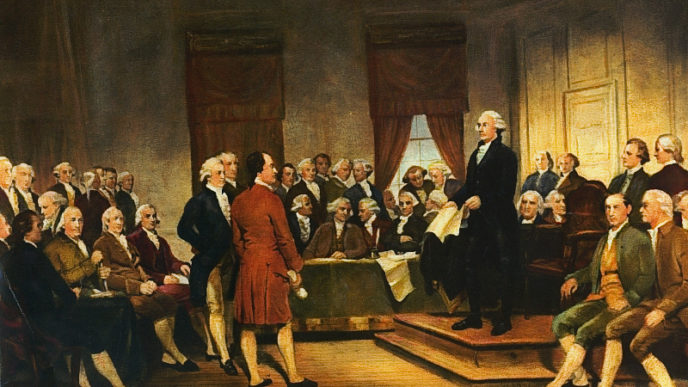
Before the 1914 elections, U.S. Senators were elected by the 48 state legislatures. That sounds bizarre to the modern ear after a century of direct election of U.S. Senators. But it was part of the genius of the Founding Fathers to give the states powerful political leverage in the law-making branch of the national government. It was one of the original checks and balances.

The reason all the states got two senators apiece, regardless of population, is that the U.S. Senate was originally intended to represent states, not populations. Now that it’s directly elected, it represents populations.

But is California’s population sufficiently represented in the U.S. Senate? Their two senators represent a lot more people than Wyoming’s two senators. California’s registered voters now outnumber the population of 46 states, combined. Shouldn’t California have more U.S. Senators than those states?

Yes, if the Senate is just another chamber of directly-elected national legislature, like the House of Representatives. No, if the Senate is a bulwark of states’ interests, a barrier to runaway central government authority.

Thus the 17th Amendment, which voided and replaced the original language in the third section of Article I, introduced structural schizophrenia into the elegant Constitutional scheme. We now have a system in which states have no say-so in the membership of the U.S. Senate, which is designed and empowered to frustrate popular legislation on their behalf.

The Constitutional provision for election of U.S. Senators by state legislatures played a crucial role in ratification. It reassured Anti-federalists like Patrick Henry that the Constitutionally empowered central government could be prevented from running roughshod over states, swallowing up their powers and prerogatives.

It’s clear today that Henry’s darkest suspicions were justified. The 10th Amendment, proposed in 1789 and ratified in 1791, is in tatters. It guarantees that “powers not delegated to the United States by the Constitution, nor prohibited by it to the States, are reserved to the States respectively, or to the people.” That means that if the Constitution doesn’t grant a power to the national government, it doesn’t have that power. It belongs to us, in the states.

The 10th Amendment remains in the Constitution as a quaint remnant, but perhaps no Constitutional provision has been more thoroughly and stubbornly disregarded in 20th and 21st Century practice. Whether it’s Obamacare or the federal Department of Education or the EPA, most modern presidents and U.S. Senators have never met a 10th Amendment violation they didn’t like.

Although the federal judiciary claims the mantle of Constitutional protector for itself, it has abdicated any meaningful role in defending the 10th Amendment. If Patrick Henry were alive today, he might tell us that the doom of the 10th Amendment was sealed when the 17th Amendment stripped it of institutional protectors.

I’m with Mark Levin and Mike Huckabee, who have called for repeal of the 17th Amendment. Paradoxically, indirect election could make the Senate more democratic, more sensitive to the grass roots, less beholden to shadowy cash-flushed PACs, less reliant on big media buys and therefore less preoccupied with campaign fundraising. Washington insiders would lose their grip on Senate campaigns, which would revert to pragmatic, down-to-earth state legislatures.

It’s time to end this reckless Constitutional frolic that second-guessed the Founding Fathers, and guessed wrong. It’s debatable whether repeal would give us our country back, but at least it might give us our states back.

Follow Joe Miller on Twitter HERE and Facebook HERE.

Serious Talk of Repealing Obamacare Now Surfacing

Photo Credit: Natural News During the recent government shutdown, both Democrats and Republicans who disagreed with the Tea Party tactic of defunding Obamacare said it couldn’t be done because, hey, Obamacare is the law of the land.

Shortly after the 2012 presidential election, House Speaker John Boehner said in an NBC News interview, “It’s pretty clear that the president was reelected, Obamacare is the law of the land.”

Health and Human Services Secretary Kathleen Sebelius, head mistress over the worst website roll-out ever, has said: “This is no longer a political debate; this is what we call the law. It was passed and signed three years ago. It was upheld by the Supreme Court a year ago. The president was re-elected. This is the law of the land.”

That’s all we’ve heard since Obamcare was declared “constitutional” and “upheld by the Supreme Court,” so it’s the “law of the land.”

That is, until it gets repealed, which sometimes happens to bad laws.

Read more from this story HERE.

Sen. Mark Begich Vows Obamacare Will Never Be Repealed (+video)

Photo Credit: SenateDemocrats

Photo Credit: SenateDemocrats

Alaska Senator Mark Begich (D-AK) held two town hall meetings in Anchorage earlier this week and pledged his unwavering support for the unpopular Affordable Care Act (“Obamacare.”) The Obamacare raiment will prove a heavy weight to bear as he enters the re-election season of 2014.

A question regarding the measure at the first town hall held Wednesday night at Campbell Elementary School drew the most lively response from the crowd. Despite the strong sentiment expressed against the law, Senator Begich emphatically promised those in attendance, “If you’re thinking it’s going to get repealed. Whoever tells you that ain’t giving you the truth. It’s not going to get repealed.”

Begich went on to state he would work to repair or replace unpopular portions of the ACA such as the tax on “Cadillac” plans and that he had already voted to repeal a tax on manufacturers of medical devices.

The Senator will have his work cut out for him taking this approach however because the Affordable Care Act itself is very unpopular. A recent CBS News poll found 54 percent of Americans disapprove of the law, while only 36 percent approve.

Begich sought to identify with those in attendance saying, “Just as you do, I [will] join the exchange come October 1st. I have to join it just like everyone else.” What he failed to mention is that members of Congress and their staffs have generous healthcare premium support plans already in place covering much of the cost, thereby exempting themselves from the rate shock most Americans will feel.

The overall estimated cost of Affordable Care Act to American taxpayers over the first 10 years has ballooned from the $0.9 trillion promised by President Obama in 2009 to a CBO projected cost of $2.6 trillion earlier this year.

The high cost is not the only thing causing grave misgivings about Obamacare among the American people. At a second town hall event at the Anchorage Senior Center, a grandmother expressed a concern many have regarding the ACA’s employer mandate, which dictates that businesses with fifty or more employees must fulfill all the law’s requirements. She believes Obamacare will make it harder for her grandchildren and others to find full-time employment.

The evidence appears to be on her side. A CNBC poll of small business owners earlier this summer found 41 percent have frozen hiring because of the law and 38 percent indicated they have pulled back on plans to expand. Begich admitted at the town hall that the ACA incentivizes underemployment by moving people from full to part-time.

At both town hall events, Begich took great pains to point out he is doing everything he can to fix what ails Obamacare. He ballyhooed legislation he introduced last month to delay the employer mandate for two years rather than the one year promised by the President. In other words, the Senator wants to pass legislation to save Alaskans (temporarily) from the ill-effects of the law he voted whole-heartedly to pass. Of course, this magnanimous gesture by the first-term senator would conveniently push the job-killing effects of the ACA until after next year’s re-election cycle.

Senator Begich knows he is vulnerable in 2014. His seat is among those judged to be in-play. A recent survey by the liberal leaning Public Policy Polling showed his job approval at a paltry 42 percent, down from 49 percent in February. This precipitous drop comes in spite of a statewide paid media push over the last several months and before the first salvo of the 2014 campaign has even been fired.

A vital measure of congressional leadership must be foresight: the ability to see a train wreck before it happens. By this standard, Senator Begich misses the mark. Rather than accepting the Senator’s small gestures of Affordable Care Act relief, Alaskans would do well to relieve themselves entirely of his services come next November.