Posts

The Left’s Sanctuary Cities Hurt Americans’ Safety

Attorney General Jeff Sessions’ announcement on Monday that the Justice Department will bar all sanctuary cities from receiving any grants or other federal funds from the department should be welcome news to Americans—especially those whose families have been victimized by criminal illegal aliens released by sanctuary cities like San Francisco.

As Sessions pointed out, Kate Steinle, a resident of San Francisco, was shot and killed two years ago by an illegal alien as a direct result of San Francisco’s policy of refusing to honor federal detainer warrants.

The killer, Francisco Sanchez, had seven previous felony convictions and the city released him from custody despite the fact that Immigration and Customs Enforcement (ICE) had filed a detainer with San Francisco asking that he be kept in custody until immigration agents could pick him up.

Sanchez even admitted to a television reporter that the only reason he came to San Francisco was because of the city’s sanctuary policy.

Sessions also mentioned another such incident that happened just within the last two weeks.

According to the attorney general, Ever Valles, another illegal alien, was charged with the murder and robbery of a man at a light rail station.

The only reason he was on the street was because the city of Denver refused to honor a detainer that ICE had filed with the city and released him from the Denver jail in December.

Valles is just one of many such criminal aliens who are being loosed on the American public by the reckless policies of sanctuary cities.

ICE recently released the first of its weekly reports on cities that have refused to honor ICE detainer warrants, as mandated by President Donald Trump’s executive order, “Enhancing Public Safety in the Interior of the United States.”

The report details all of the local jurisdictions across the country from Florida to New York to Washington state that refused ICE detainers from Jan. 28 to Feb. 3 and released criminals from their jails rather than turn them over to the federal government for deportation.

The crimes committed by these illegal aliens, as outlined in a report covering just a single week, include: domestic violence, arson, aggravated assault, burglary, forgery, intimidation, possession of a dangerous weapon, intimidation, drug trafficking, sexual assault, homicide, and a host of other crimes. This is also no surprise.

As I have outlined before, prior reports by the Government Accountability Office that have reviewed the criminal histories of illegal aliens in federal, state, and local jails show a path of destruction and repeated criminal behavior by criminal aliens that is truly shocking.

There are literally millions of Americans like Steinle who have been victimized by crimes committed by illegal aliens that should not have happened and would not have happened if we actually enforced our immigration laws and if local jurisdictions cooperated with federal authorities instead of trying to obstruct them.

Sessions said that the American people “are justifiably angry” about these sanctuary policies that endanger them. They understand something that irresponsible local officials don’t seem to care about: “When cities and states refuse to help enforce immigration laws, our nation is less safe.”

The failure to deport criminal aliens like Valles puts “whole communities at risk—especially immigrant communities in the very sanctuary jurisdictions that seek to protect the perpetrators.”

The amount of federal grant money at stake is more than $4.1 billion, which the Justice Department distributes through its Office of Justice Programs.

Sessions said that all jurisdictions applying for such grants will have to certify that they are in full compliance with 8 U.S.C. Sec. 1373, which bans local and state jurisdictions from prohibiting their employees—including law enforcement—from exchanging information with the federal government over the citizenship status of any individual.

The American people certainly agree with what Trump and Sessions are doing. Sessions cited a poll in which 80 percent of Americans agreed that illegal aliens arrested by cities should be turned over to immigration authorities.

Sessions urged state and city officials to “consider carefully the harm they are doing to their citizens by refusing to enforce our immigration laws, and to rethink these policies.”

Hopefully, the added incentive of losing access to billions of federal dollars will help them “rethink” their rash sanctuary policies. (For more from the author of “The Left’s Sanctuary Cities Hurt Americans’ Safety” please click HERE)

Follow Joe Miller on Twitter HERE and Facebook HERE.

3 Different Ways State GOP Lawmakers Are Fighting Sanctuary Cities

In states across the country, Republican lawmakers are aiming to combat sanctuary cities and counties, and in some cases banding together to develop new ways to prod local jurisdictions into helping enforce federal immigration law.

While these efforts are not unique—18 states introduced legislation to limit sanctuary policies in the 2016 state legislative session—they are taking a stronger force at a time when the Trump administration has begun reviewing how to punish sanctuary cities by withholding federal grant funding.

At the same time, states, cities, and counties that provide protection to immigrants living illegally in their communities have refused to back down.

According to the National Conference of State Legislatures, at least 29 states and Washington, D.C., are considering legislation in 2017 regarding sanctuary jurisdictions or noncompliance with immigration detainers.

Of these states, 25 states would prohibit sanctuary policies and 8 states and Washington, D.C., would support them. Five states have legislation on both sides of the issue.

“The role of state and local law enforcement in federal immigration policy has returned to the forefront of public debate,” Ann Morse of the National Conference of State Legislatures wrote in her synopsis of state-level legislative action.

Here are three strategies states are proposing to challenge sanctuary cities.

1. Criminal Prosecution

The Republican-controlled Texas Senate last month passed legislation that subjects leaders of sanctuary cities and counties to criminal prosecution if they refuse to honor requests, known as detainers, from federal immigration officers to hand over illegal immigrants in custody for possible deportation.

“If elected officials want to flaunt state law there will penalty,” said state Rep. Charlie Geren, a Republican who is finalizing a similar bill in the Texas House that may include a criminal liability component.

Colorado’s state Rep. Dave Williams, a Republican, has been rebuffed by Democrats in advancing legislation that would allow people to file civil suits and criminal complaints against “lawless politicians.”

Democrats alleged it would be unconstitutional to subject local politicians to a lawsuit or criminal prosecution.

Despite his bill’s quick demise in a state where Democrats control the House and governorship, Williams, a freshman of Mexican descent, has touted his Colorado Politician Accountability Act on national television, and like-minded lawmakers in other states have cited his efforts as inspiring them.

“My bill may be effectively dead, but this effort will continue to make elected officials think twice before implementing sanctuary policies that endanger the public,” Williams told The Daily Signal.

Heeding this call for action, Ohio state Rep. Candice Keller, a freshman Republican, is drafting a bill—her first ever—to ban sanctuary cities, and she is consulting with Williams in considering whether to include a civil and criminal liability element.

“Last month, I called Dave and I said, ‘Do you care if I take off on this sanctuary city bill?’” Keller told The Daily Signal. “He’s been supportive and he periodically checks in on me.”

2. Imposing Fines and Blocking Funds

In Florida, Republican lawmakers emboldened by the results of November’s election have introduced bills that would impose an array of penalties on cities and counties that have sanctuary immigration policies.

The Rule of Law Adherence Act, authored by state Sen. Aaron Bean, contains a provision that would would impose a fine of up to $5,000 a day on any government entity that is found to have a sanctuary policy. It would also withhold state grant funding for five years from any government entity that violates the act.

Bean acknowledges there is no formal definition of a sanctuary policy and that a law enforcement agency would have to demonstrate a “practice” of declining detainer requests to qualify for punishment.

“If a jurisdiction were to decline one or two detainers, that would not qualify,” Bean said. “We don’t really want to fine anyone. We really just want to say, ‘Work with federal immigration authorities.’”

The law does not go as far as others in that it does not leave politicians open to criminal prosecution—only civil liability.

It would allow government agencies to be sued should a person who is in the country illegally injure or kill someone as a result of an entity having a prohibited sanctuary policy.

“If any one agency or entity engages in sanctuary policies, it puts our entire state at risk, and so we are going to act, take away your immunity, and hold you accountable,” Bean told The Daily Signal.

Bean admits he faces an “uphill battle” to turn his legislation into law, even in a state that is fully controlled by Republicans. A similar bill to outlaw sanctuary policies failed last year even with a GOP-led legislature.

But the threat of action has already prompted Miami-Dade County to eliminate its sanctuary protections.

Acting on a order from Mayor Carlos Gimenez, a Republican, the Miami-Dade County Board of County Commissioners last month adopted a resolution to fully cooperate with requests from federal Immigration and Customs Enforcement (ICE).

Gimenez acted one day after President Donald Trump issued his executive order threatening to crack down on sanctuary cities. The mayor said he didn’t want to put the county at risk of losing $355 million a year that it receives in federal funding.

Miami-Dade’s previous policy, codified in a 2013 resolution, limited what kind of ICE detainers it would honor to include only suspects convicted of serious, violent crimes.

Over recent years, local governments across the U.S. began to resist fully complying with detainers, which are requests by ICE to hold an arrested individual beyond their normally scheduled release so federal immigration officers can take custody of them.

U.S. appeals courts have ruled that cooperating with detainer requests is voluntary—not required—for local jurisdictions.

The courts have said ICE detainers violate the Fourth and Fifth Amendments. A Miami-Dade judge ruled Friday that holding inmates for ICE is unconstitutional.

Jean Monestime, a Miami-Dade County commissioner who authored the 2013 resolution limiting cooperation with ICE detainers, told The Daily Signal he would continue to fight efforts that mandate sanctuary jurisdictions to change their policies.

“This is an issue of fairness, it’s an issue of due process, and it’s an issue of protecting our community to allow undocumented folks to not be afraid to report crimes to law enforcement,” said Monestime, who opposed the mayor’s order restoring full cooperation with ICE . “I don’t think this position helps make our community safer.”

3. ‘A Warning Shot’

Some Republican lawmakers opposing sanctuary cities are taking a more cautious approach.

In Iowa, where Republicans have total state control for the first time since the 1990s, bills introduced in the House and Senate would dictate that all cities and counties must help enforce federal immigration law.

But state Rep. Steven Holt said his legislation would not impose fines or withhold funding from jurisdictions that don’t comply with the law’s provisions.

“My legislation is an important statement that rule of law matters and protection of Americans should come first,” Holt said. “But it has no teeth in it in terms of financial penalties. We thought that would be a bridge too far. This is a warning shot.”

No city or county in Iowa formally recognizes itself as a sanctuary, although the City Council in Iowa City adopted a policy in January that denies allocation of local resources to federal immigration enforcement.

“We all know the vast majority of people without documentation are here for a better life, but it just takes one bad case of a violent criminal being released to harm Americans,” Holt said.

Eleanor Dilkes, the city attorney in Iowa City, told The Daily Signal that the council will not change its policy, even if Holt’s bill becomes law.

“Iowa City’s reaffirmation that city resources will continue to be used for public safety and not the enforcement of federal immigration law would not be affected if this bill were to become law,” she wrote in an email.

Questions Remain

In Tennessee, a state with full Republican control, there is already a law on the books prohibiting local governments or law enforcement officials from making policies that prevent compliance with federal immigration requests.

That law, like the ones proposed in Iowa, does not contain financial penalties for noncompliance.

There aren’t any official sanctuary cities in Tennessee.

Yet state Sen. Mark Green, a Republican, says it’s important to be proactive, and he boasts about legislation he recently introduced that withholds state funding from jurisdictions that resist immigration enforcement.

“There was a sanctuary city bill that passed a few years ago that made these policies illegal, but it had no teeth,” Green said. “We are putting teeth with the bill.”

But Green is running into roadblocks. The office of Tennessee Gov. Bill Haslam, a Republican, recently notified Green that the state constitution prohibits the withholding of education funding to communities. So Green is amending his legislation to say the state cannot block education funds.

“We want to make sure the legislation is foolproof against legal challenges,” Green said.

Even so, legal experts say sanctuary states and localities likely will challenge state and federal laws requiring compliance in enforcing federal immigration law.

“It’s one thing for a state to ask local law enforcement officers to enforce state law,” said Pratheepan Gulasekaram, a Santa Clara University immigration law professor, in an interview with The Daily Signal. “These debates are interesting, odd, and different, because they are proposed state laws that create penalties for nonparticipation in federal law enforcement. This will make these laws subject to due process litigation.”

Other law experts say states have wide authority that even protects tougher proposed policies such as those in Texas and Colorado that threaten criminal prosecution against sanctuary cities.

“It would be legal for states to impose criminal liability on their own officials for refusing to cooperate with federal immigration authorities, as the Texas bill would do,” said Michael Dimino, a constitutional law professor at Widener University.

“That does not mean that the bills will be free from constitutional challenge,” Dimino wrote in an email to The Daily Signal. “On the contrary, I think it is clear that suits will be brought alleging that they violate the immigrants’ rights. But if state law requires state officials to cooperate with federal immigration officials, I cannot see any decent argument that those state officials would have for refusing to comply with the law.” (For more from the author of “3 Different Ways State GOP Lawmakers Are Fighting Sanctuary Cities” please click HERE)

Follow Joe Miller on Twitter HERE and Facebook HERE.

The Truth About Sanctuary Cities and Crime Rates

If restricting local law enforcement from cooperating with Immigration and Customs Enforcement (ICE) detainer requests is supposed to make communities safer, as some immigration advocates and law enforcement officials suggest, I’d like to hear them reconcile their beliefs with the actions of Texas’ Travis County Sheriff Sally Hernandez.

Hernandez, sworn in as the newly elected head of the Travis County Sheriff’s Department last month, almost immediately adopted an anti-cooperation policy prohibiting her department from honoring nearly all ICE detainer requests.

“The public must be confident that local law enforcement is focused on local public safety, not on federal immigration enforcement,” Hernandez said.

Detainer requests are notices sent by ICE to local jurisdictions informing them of its desire to take physical custody of an individual in local custody.

The sheriff’s new policy stipulated that only four exempted crimes—murder, capital murder, aggravated sexual assault, and human trafficking—would be grounds for her department to honor an ICE detainer.

Unfortunately for the alleged victim of Hugo Javier Gallardo-Gonzalez and the community at large, accusations of repeatedly sexually abusing a child did not meet the criminal standard for ICE cooperation set by the sheriff.

Gallardo-Gonzalez was arrested this past Sunday, accused of sexually assaulting his girlfriend’s young daughter beginning in 2014. The abuse is alleged to have continued for over a year.

Immigration and Customs Enforcement submitted a detainer request to the Travis County Sheriff’s Office in order to take custody of Gallardo-Gonzalez, but their request was denied.

Gallardo-Gonzalez subsequently made bail the next day and is now waiting to be released once outfitted with a GPS monitor.

The decision by Hernandez to deny the ICE detainer request was reckless and borders on malfeasance.

Whose well-being is served by the decision to dismiss this ICE detainer request and release into the public an individual accused of a particularly heinous crime? Is the public safer as a result? Is the community of illegal individuals safer?

The answers to those questions seem clear enough. No one, save perhaps the accused man, is better off for the decision by the sheriff to deny assistance to ICE.

But this reality doesn’t conform to the narrative repeated by many that suggest law enforcement cooperation with federal immigration authorities hurts public safety and erodes police and community relations.

Mayor Javier Gonzales of Santa Fe, New Mexico, argued only months ago that sanctuary cities have no impact on crime, stating, “Study after study have shown that sanctuary cities do not lead to an increase in crime because of the presence of people that are undocumented.”

But a 2014 draft study conducted by ICE doesn’t support the mayor’s notion that sanctuary cities have no impact on crime.

The study found that during the observation time frame (January 2014 to August 2014), 8,145 individuals were released from jail after arrest due to their respective jurisdictions declining an immigration detainer request from ICE.

Of the 8,145 individuals released, 1,867 were subsequently re-arrested a total of 4,298 times and accumulated a staggering 7,491 charges.

So much for the argument that sanctuary cities have no impact on crime.

The notion that local law enforcement cooperation with ICE will somehow also destroy police and community relations—specifically relations between the police and communities of illegal immigrants—is tenuous.

No community of decent people—citizens, illegal immigrants, or otherwise—wants to live in a society beset by violence and social dysfunction. Stripping local law enforcement of the ability to merely cooperate with their federal counterparts on issues as plain as the removal of a dangerous criminal jeopardizes the safety of all law-abiding individuals.

Hernandez and her refusal to cooperate with ICE on the removal of an individual accused of sexual assault against a child demonstrates the absurdity of those devoted to a dogmatic faith in sanctuary cities. Clarity and perspective should rule the day, especially when public safety is at stake. (For more from the author of “The Truth About Sanctuary Cities and Crime Rates” please click HERE)

Follow Joe Miller on Twitter HERE and Facebook HERE.

California to Consider Enacting Statewide Sanctuary

California may prohibit local law enforcement from cooperating with federal immigration authorities, creating a border-to-border sanctuary in the nation’s largest state as legislative Democrats ramp up their efforts to battle President Donald Trump’s migration policies.

The legislation is scheduled for its first public hearing Tuesday as the Senate rushes to enact measures that Democratic lawmakers say would protect immigrants from the crackdown that the Republican president has promised.

While many of California’s largest cities — including Los Angeles, San Francisco and Sacramento — have so-called sanctuary policies that prohibit police from cooperating with immigration authorities, much of the state does not.

The Democratic legislation, written by Senate President Pro Tem Kevin de Leon of Los Angeles, comes up for debate less than a week after Trump signed an order threatening to withdraw some federal grants from jurisdictions that bar officials from communicating with federal authorities about someone’s immigration status.

The Senate Public Safety Committee considers SB54 Tuesday morning. The Judiciary Committee will also consider fast-tracked legislation that would spend state money, in an amount that has not been disclosed, to provide lawyers for people facing deportation. (Read more from “California to Consider Enacting Statewide Sanctuary” HERE)

Follow Joe Miller on Twitter HERE and Facebook HERE.
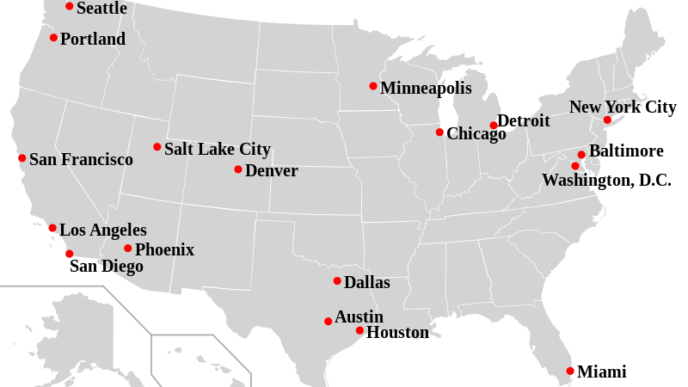
The Showdown over Sanctuary Cities

In the 1940s, Jan Ting’s parents faced a difficult path to American citizenship following a U.S. immigration ban on Chinese workers that lasted 61 years.

Today, Ting is a law professor at Temple University—after serving as a top immigration official under President George H.W. Bush. Ting is also a strong opponent of sanctuary cities that shield illegal immigrants from deportation. That includes Philadelphia, where Temple University is located.

“I think that it is wrong, I think it endangers public safety, I think it endangers our law enforcement officers, and it’s just short-sighted,” he says.

This week on “Full Measure,” we examine the debate over sanctuary cities, which face a loss of federal funding following President Donald Trump’s directive Wednesday. Watch the story to learn more about what’s at stake. (For more from the author of “The Showdown over Sanctuary Cities” please click HERE)

Follow Joe Miller on Twitter HERE and Facebook HERE.

In Texas, Republicans Fight New Sanctuary Cities in Wake of Trump Victory

In the border state of Texas, the Republican governor and state Legislature are promising to combat a new trend since the election of Donald Trump, in which cities and localities vow to limit how much they assist federal authorities with removing immigrants living illegally in their communities.

Sally Hernandez, the Democratic sheriff-elect in Travis County, home to the liberal state capital of Austin, ran on a platform opposing cooperation with U.S. Immigration and Customs Enforcement (ICE) when it seeks to deport illegal immigrants held in the county jail.

“The sheriff’s office will not be part of a deportation force that sacrifices hundreds and thousands of people, our neighbors, to a broken federal immigration system,” Hernandez said during a Nov. 17 press conference.

She and other city and county elected officials told reporters they wanted to address residents’ “safety concerns” since Trump’s election.

If Hernandez fulfills her pledge, Austin would become the state’s first official sanctuary city, a move that would put her at odds with Texas Gov. Greg Abbott and the Republican-led Legislature. Both plan to pursue policies punishing localities that won’t help the federal government enforce immigration law.

“Governor Abbott looks forward to signing a bill banning sanctuary cities in the state of Texas,”John Wittman, Abbott’s press secretary, said in an interview with The Daily Signal.

The fight in Texas shows how states and cities are defining their own policies in anticipation of Trump’s fulfilling his aggressive campaign promises to crack down on immigration enforcement—including his vow to block federal funding from sanctuary cities.

Withholding Funds

Local governments of cities such as the District of Columbia, Los Angeles, New York City, Chicago, and Boston have said they will not change policies that limit their cooperation with immigration-related requests from the federal government.

The Daily Signal previously reported that Trump has broad tools to encourage localities to play a more proactive role in immigration enforcement.

Republican governors and legislators, emboldened by Trump’s victory, also have ways to coerce cities and counties into working with ICE.

Last year, Abbott announced a policy of withholding certain criminal justice grants from sheriff’s offices that do not fulfill requests from ICE to help federal authorities deport illegal immigrants in local custody.

Wittman said that since the policy’s implementation in November 2015, the governor has not blocked any funding because all local jurisdictions in Texas complied with his order.

But that hasn’t stopped state Republican lawmakers from trying to pass laws punishing sanctuary cities.

Last month, state Sen. Charles Perry filed legislation that would deny state grants to local jurisdictions that do not help the federal government enforce immigration law.

Previous versions of the bill failed to make it out of the Senate, but Perry’s latest legislation is supported by Abbott and Lt. Gov. Dan Patrick, also a Republican.

“I have no doubt this will be one of the earliest bills passed by the Senate this session [beginning Jan. 10],” Perry told The Daily Signal in an interview. “Federal and state politicians should have a remedy of reducing or removing discretionary funding if local jurisdictions are found to have policies explicitly harboring criminal aliens.”

Local Backlash

Yet Trump’s victory has inspired some local Texas leaders to guard against his potential policies.

In Harris County, where Houston is located, Sheriff-elect Ed Gonzalez, a Democrat, campaigned on ending his county’s participation in an ICE program known as 287(g).

That program permits local law enforcement to alert federal authorities when they have suspected illegal immigrants in the county jail, and ask about the immigration status of those they arrest.

Javier Salazar, the newly elected Democratic sheriff of Bexar County, which includes San Antonio, also hinted during his campaign that he would forbid deputies from inquiring about immigration status.

The 287(g) program is controversial, and there are just 32 jurisdictions across the country currently involved with it, but Trump has expressed support for bolstering these partnerships.

In 2012, the Obama administration scrapped an aspect of the program that essentially deputized state and local law enforcement as immigration agents who are allowed to make arrests related to immigration status.

Trump has called 287(g) a “popular” program that he would like to “expand and revitalize.”

“I expect the Trump administration’s Department of Homeland Security to strengthen and expand the 287(g) program,” said David Inserra, a policy analyst at The Heritage Foundation, who supports the program. “Because that program is a memo of understanding from DHS to state and local governments, there is nothing holding the Trump administration back from expanding 287(g) to as far as the budget will allow, and they could request more funding for it.”

Immigration experts have speculated that Trump could bring back another contentious local enforcement program, called Secure Communities, as a way of expanding deportations.

In Secure Communities, federal immigration agents asked local law enforcement agencies to keep illegal immigrants in custody for 48 hours longer than usual so they could be picked up and deported. These requests were known as detainers.

The Obama administration revamped Secure Communities in 2014, asking that local authorities notify ICE only when they plan to release someone from jail whom the government seeks to deport.

It also limited who ICE targets for deportation to illegal immigrants considered to be threats to national security and public safety, those convicted of a felony or multiple misdemeanors, and recent border crossers.

Split Sanctuary

Adrian Garcia, a Democrat who was Harris County’s sheriff from 2009 to 2015, said local law enforcement is not legally obligated to help ICE enforce immigration law.

Garcia warns that state politicians using the threat of withholding money to encourage local assistance with immigration enforcement are putting communities at risk.

“It makes no damn sense, you would hinder agencies from doing their job and catching the people we’re all worried about,” Garcia told The Daily Signal in an interview, adding:

This is a bogus position by the governor and others. A sanctuary implies if you do something wrong, nothing happens to you. In Harris County, if you hurt somebody or rob somebody, you go to jail and you are held accountable. There is no sanctuary in that. So they ought to let law enforcement do their jobs and decide on policies best for their communities.

But A.J. Louderback, the Republican sheriff of Jackson County and legislative director of the Sheriffs’ Association of Texas, said law enforcement shouldn’t risk releasing people ICE wants to deport.

“Any sheriff who has a jail needs to work with the federal government on deporting criminal foreign-born individuals who are in the country illegally,” Louderback told The Daily Signal in an interview. “I hope sincerely that each of the new sheriffs that come in will do their job and take their constitutional oath seriously. Our responsibility is to protect our public from criminal activity.” (For more from the author of “In Texas, Republicans Fight New Sanctuary Cities in Wake of Trump Victory” please click HERE)

Follow Joe Miller on Twitter HERE and Facebook HERE.

Federalism When It Works for Them: Why Liberals Are Wrong About Sanctuary Cities

When it comes to nullifying federal immigration statutes, the most foundational powers of a national government, liberals suddenly develop an affinity for localism. With Trump promising to finally crack down on sanctuary cities, liberals are now fanning the flames for nullification and disobedience. In fact, they are somehow trying to suggest that it is arduous or unconstitutional for the federal government to punish sanctuary cities. As always, liberals have the Constitution exactly backwards.

Amber Philips, a writer for the Washington Post, penned a piece examining (and advocating for) “why Donald Trump may not be able to close sanctuary cities.” Citing “immigration experts,” she asserts that Trump will be confronted with “constitutional, geographic and even legal challenges.”

First, she notes that most sanctuary cities are geographically in blue states where state governments won’t cut off funding to those localities. But conservatives, for the most part, are not counting on states to do it. Rather they are asking Congress and the Department of Justice to crack down on those lawless cities — two entities that have jurisdiction over immigration in all 50 states.

So why can’t Congress simply cut off funds?

Philips suggests that GOP leaders might not be so excited about the proposal. Well, Ms. Philips, you just discovered America. Yes, GOP leaders stink. They couldn’t care less about national sovereignty. There’s nothing new there. While they are likely to be an obstacle against many sweeping reforms, including on the topic of immigration, it is very unlikely they will fight against one of Trump’s biggest mandates. The sitting party in control almost always defers to the president (when he is of the same party) regarding his key agenda items, unless they are clearly unpopular. With regards to stopping sanctuary cities, the public overwhelmingly favors national sovereignty and the rule of law.

Philips goes on to suggest the DOJ might sue in the courts to get sanctuary cities to comply with immigration officials. She knocks down that option but rightly noting that the courts are certainly unreliable for conservatives. But that is exactly the point. The courts will never be an easier route than Congress, which is why we don’t need to grovel to the lawless courts to respect the Constitution. Congress can simply pass a law or include those provisions in must-pass budget bills.

So it’s now unconstitutional for the federal government to defend national sovereignty?

Next, Philips quotes law professors saying that somehow even Congress can’t force states to cooperate with federal immigration officials because it is unconstitutional. So while the unelected branch of the federal government can crush the states on internal issues that are manifestly within the purview of the state — and evidently there is nothing states can do to fight back — these same scholars believe that states can thwart a foundational enumerated federal power and that there is nothing the stronger legislative and executive branches can do about it.

Opponents of punishing sanctuary cities cite past court cases where the courts have limited the power of the federal government to place conditions on grants to the states in order to induce them to accept specific policies. For example the court has ruled that the conditions must be unambiguous “so that states can knowingly decide whether or not to accept those funds.” Moreover, the condition must not be “so coercive as to pass the point at which pressure turns into compulsion” akin to “a gun to the head.”

However, the comparison to these court cases doesn’t get off the ground. Although this point requires an article in itself, here are some key points:

In South Dakota v. Dole, the federal government was leveraging an enumerated spending power to induce states into raising their minimum age for alcohol assumption, a power that does not belong to the federal government and should be left to the states. In Pennhurst, the federal government was forcing states into a costly and burdensome disability program full of extra costs and regulations. In the case involving Medicaid expansion (NFIB v. Sebelius), the federal government was placing a massive unfunded liability on the states — which accounts for the single-largest expenditure for a state. These are instances when it is appropriate, within certain limits, for states to tell the federal government to get off their lawns.

Immigration, on the other hand, is one of the most foundational enumerated powers and responsibilities of the federal government to the entire union of states. [4] The federal government has the right to send out agents anywhere at any time to apprehend and deport illegal aliens. Furthermore, the federal government isn’t foisting upon the states implementation of a cumbersome, officious, and costly spending or regulatory regime. All they are asking for is the minimum cooperation needed for the federal government to protect the sovereignty and security of all the states, which merely requires states to communicate with ICE and detain illegal immigrants in jail until they are picked up by the feds. At the very least, they are asking that states don’t take active steps to undermine, thwart, and downright prohibit police from cooperating with ICE, as required by law [8 U.S.C. 1373]. There is no practical way for the federal government to exercise this solemn responsibility if states are active accomplices to the assault on the national sovereignty.

Federalism flipped upside down, inside out

Finally, Amber Philips suggests that this entire priority of cracking down on sanctuary cities is somehow an anathema to the typical conservative preference for state and local control.

Here is where liberals have no understanding of our Constitution and republican form of government. We have a dual track system: states and the national government. Then there are three branches of the federal government, each with distinct roles, powers, and responsibilities. While there have always been and will always be gray areas of jurisdiction and/or disagreements over jurisdiction and policies, most of the basic powers are incontrovertibly vested in one of the branches. Conservatives are not “pro-states” or “anti-federal government” or pro-Congress and anti-courts. Conservatives are for keeping what is rightfully vested to the federal government in federal hands and what is rightfully vested in the hands of state governments in state hands.

When it comes to immigration — who gets to enter or remain in the country — power, beyond a shadow of a doubt, is given over exclusively to the United States Congress, which represents the sovereignty of the whole federal union. Just like the federal government has absolutely no legal right to nullify local zoning decisions, something the Obama administration had done, states have no right to nullify immigration law, which stems from an unambiguous enumerated power of Congress.

Liberals might disagree vehemently with Trump’s immigration policies. They might want an unlimited number of illegal aliens, Muslim immigrants, and refugees. They have the right to hold that view and advocate strongly for their convictions. But none of them can say with a straight face that federal immigration law and national sovereignty is unconstitutional. Nobody has the right to enter this country without the consent of the people, as reflected through congressional statutes. The framers vested the power over immigration in the hands of the federal government precisely for the purpose of precluding the sanctuary city mindset.

Roger Sherman, among the greatest of all the Founders, noted during the House debate on the Naturalization Act of 1790 that “it was intended by the Convention, who framed the Constitution, that Congress should have the power of naturalization, in order to prevent particular States receiving citizens, and forcing them upon others who would not have received them in any other manner.” Sherman was emphatic that federal control was designed to “guard against an improper mode of naturalization,” and prevent individual states from flooding the country with immigrants based on “easier terms.”

Thus, states have absolutely no right to disobey the most foundational sovereignty laws of the nation. If liberals in blue states disagree with these policies, they must win congressional and presidential elections.

But don’t conservatives want states to ignore federal usurpations?

While I have encouraged states to fight back against the tyranny emanating from the federal judiciary, I have never advocated that states nullify statutes duly passed by Congress. Moreover, once again, the devil is in the details of the particular issue and how it relates to the Constitution. It is settled law that states have plenary power over marriage, legislative districts, and methods and procedures of elections. The federal judiciary has no right to nullify state laws in those spheres of policy. If they do so, states have the right to interpret the Constitution as they clearly understand it. After all, state officials swear the same oath to uphold the federal constitution as federal judges do.

Contrast those issues to sanctuary cities and immigration law and there are no similarities to be observed. While individual states and cities might be repulsed by certain immigration laws, they cannot suggest that those laws are unconstitutional.

Yet, ironically, the Left somehow believes that when states like Arizona affirm, defend, augment, or enable implementation of federal immigration law, they are interfering with federal power. But states like California openly nullifying immigration law is just fine and even a righteous exercise of conscience-based decision-making.

We have a very polarized and diverse country that has boiled over into widespread acrimony in recent years. However, if we respected the constitutional processes of law-making even as we disagree on individual policies, it would go a long way in healing the divide. This is not a matter of whether states should predominate or whether the Feds should rule; whether Congress should reclaim more power or whether the other branches should remain strong. This is an issue of constitutional supremacy. We all must follow the rules of the Constitution in pursuing our diverse policy ideas. Process matters. And in the case of loosening our immigration laws, there is only one legitimate process to pursue: getting Congress to pass amnesty. Until then, liberals have no one to blame but themselves. (For more from the author of “Federalism When It Works for Them: Why Liberals Are Wrong About Sanctuary Cities” please click HERE)

Follow Joe Miller on Twitter HERE and Facebook HERE.