Critics said he was out of his element in conducting White House press briefings, but he steadily continued for nearly five months into the new presidential administration, frequently having a rocky ride and clashes with the press. Finally, the president ordered a shakeup, and moved him to another job.
This was the Clinton administration in 1993, and the briefer was White House communications director George Stephanopoulos, who had shared time sparring with reporters with press secretary Dee Dee Myers.
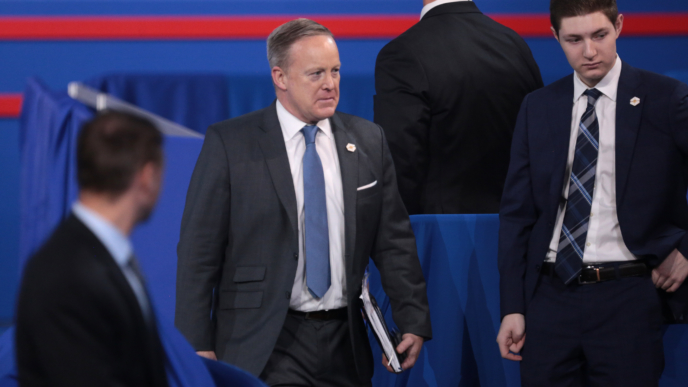
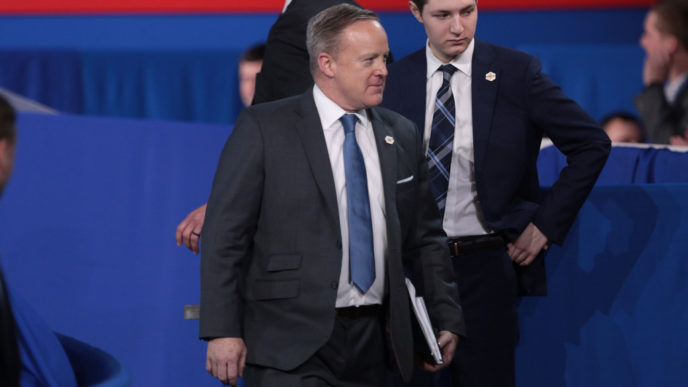
As of Wednesday afternoon, 24 years later, President Donald Trump’s White House press secretary, Sean Spicer, will have outlasted Stephanopoulos at the lectern in the briefing room.
When Spicer showed up 30 minutes late for Tuesday’s briefing, though, reporters had reason to wonder whether he would be the one taking questions.
For months, there’s been plenty of speculation that Trump might move Spicer, known for dramatic tangles with reporters, to another job. This notion gained more steam after White House communications director Mike Dubke resigned in late May, leaving the position open.
Deputy press secretary Sarah Huckabee Sanders fueled some of that speculation Monday, giving a less than direct answer on their futures after a reporter asked, “Where is Sean?”
After some give and take, in which Sanders noted, “He’s here today,” the same reporter asked: “Has his position changed, then?”
Sanders answered: “It’s probably upgraded at this point, given that we don’t have a communications director.”
The reporter, April Ryan of American Urban Radio Network, followed up: “So you will be the new press secretary here?”
Sanders replied:
I did not say that at all. I’m just filling in for the day, April. There are a lot of demands on his schedule, particularly given the fact that there’s not a communications director, and this is part of my job as well. And when I’m needed, I’ll step in.
If Spicer is elevated to communications director, he actually would be taking on a larger role compared with Stephanopoulos, who became a political adviser in Bill Clinton’s White House and reportedly moved to a smaller office. At the time, Stephanopoulos was 32. Today, Spicer is 45.
But, if Trump makes Spicer both communications director and press secretary, the former Republican National Committee communications official could hit the same problems Stephanopoulos had in 1993, said George Condon, now a White House reporter for National Journal.
Condon, then a reporter for Copley News Service, was president of the White House Correspondents’ Association during the shakeup in the early months of the Clinton administration.
“He made the mistake that they all make at first of not realizing how much work it is to brief. You can’t do both jobs and he was determined to do both jobs,” Condon told The Daily Signal, recalling what happened with Stephanopoulos:
A communications director is supposed to be big picture, making sure the government is speaking with the same voice, the agencies, the overall communications strategy, that’s a lot of work. Just preparing for the briefing takes several hours every day. Stephanopoulos got clobbered in his first briefing. He just got clobbered.
“He liked the attention of briefing,” Condon said of Stephanopoulos. “He liked the spotlight. But he wasn’t very good at it because you can’t do both jobs.”
The communications director position began with the Nixon administration in the 1970s, Condon noted.
“The only administration that tried to combine the duties is Clinton, and it was a miserable failure. And if they try to do that here, it will be again,” Condon said. “You can’t have two voices in the administration. That’s problematic. If you want Sarah to do it, pick Sarah as press secretary.”
For a time, Clinton in effect had two functioning press secretaries, Condon suggested, and that didn’t work—even without today’s Twitter factor.
Stephanopoulos’ final press briefing was June 4, 1993, according to the American Presidency Project at the University of California Santa Barbara.
He would continue to work for Clinton before taking a job as a commentator on ABC News in 1997, after Clinton’s re-election, and then becoming an anchor for the network’s Sunday morning program, “This Week.”
Today, Stephanopoulos, 56, is ABC’s chief news anchor and chief political correspondent and co-anchor of “Good Morning America” as well as host of “This Week.”
Clinton, a Democrat, hired senior adviser David Gergen, who had worked for Presidents Richard Nixon and Ronald Reagan, both Republicans.
On June 7, Gergen announced a shuffle in which Mark D. Gearan replaced Stephanopoulos as communications director.
Stephanopoulos also became a senior adviser to the president. Myers remained press secretary, but with an expanded role so she was in charge of briefings.
The New York Times, in a story by Gwen Ifill, reported at the time:
[Gergen] ordered the reopening of the door linking the White House briefing room with the offices occupied by Administration communications officials. The closing of the door in January had sent relations between the reporters and Mr. Clinton off to a bad start …
Two weeks ago, the briefing room had been a hostile place, full of questions and strained answers about Presidential haircuts, travel office dismissals and razor-thin victories in the House. That changed for at least an hour today as Mr. Gergen took a break from moving into his office to begin a new effort at outreach.
“When they brought in Gergen and he shoved Stephanopoulos off the briefing, Dee Dee [Myers] really came into her own after that. But before that, Jan. 20 through May 30, were terrible,” Condon said.
Putting the timeline aside, Spicer’s early months might be more comparable to the tenure of Myers or to that of President George W. Bush’s second press secretary, Scott McClellen, said John Gizzi, a veteran Washington correspondent now covering the White House for Newsmax.
One reason Stephanopoulos was doing so many briefings concurrently with Myers is because of her “poor performance,” Gizzi said.
Eventually, the Clinton White House made another change by naming Mike McCurry as press secretary in January 1995, two years after Clinton assumed the presidency.
“Mike McCurry came in and he was considered the gold standard until Tony Snow came along [under George W. Bush],” Gizzi said, adding:
McClellen was a very good person. He was not always brought into the confidence of the president or Karl Rove, and he said so in his book, which cost him their friendship. He was a good man and an honest person and well intentioned. But when you don’t tell someone things and they go out and they are contradicted by events, it hurts.
Press secretaries do have a tendency to grow on the job, Gizzi said.
“Josh Earnest, because he was the No. 2 [as deputy press secretary], was ready for the top job when he came in,” Gizzi said of President Barack Obama’s third and final press secretary. “But if it weren’t for him filling in on those briefings the way he did, I don’t think he would have been effective. Dana Perino filled in for Tony Snow when he was ill, and then when he finally retired. She was ready for the [press secretary] job. So, it doesn’t hurt to play in the minor leagues before you go pro.” (For more from the author of “Spicer Outlasts Stephanopoulos in White House Press Room” please click HERE)
Follow Joe Miller on Twitter HERE and Facebook HERE.