Posts

Treasury Secretary Reveals What the Next Coronavirus Relief Package Will Look Like

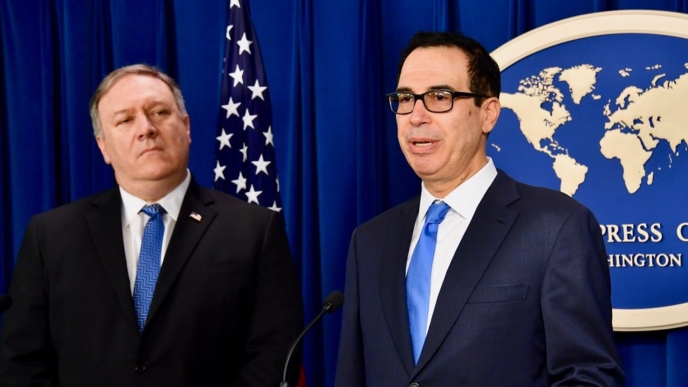
Treasury Secretary Steven Mnuchin on Saturday said the next phase of the Wuhan coronavirus relief package is ready to be rolled out on Monday. Republicans are expected to announce a $1 trillion proposal which would include another round of stimulus checks.

According to Mnuchin, Americans can anticipate a $1,200 stimulus check sometime in August. The same stipulations will take place as the first round of stimulus payments. Individuals making $75,000 or less will receive $1,200. Those making more than $75,000 will receive some type of stimulus but it won’t be the full amount. Those making $100,000 or more per year will not qualify. . .

Republicans in the House and Senate, along with President Donald Trump, are all working together on this proposal. Mnuchin reportedly called Democratic Leadership – including House Speaker Nancy Pelosi (D-CA) and Senate Minority Leader Chuck Schumer (D-NY) – before negotiations begin next week. (Read more from “Treasury Secretary Reveals What the Next Coronavirus Relief Package Will Look Like” HERE)

Follow Joe Miller on Twitter HERE and Facebook HERE

Five-Year Anniversary of Obama’s Stimulus Renews Partisan Fight Over Jobs, Economy

Photo Credit: REUTERSThe five-year anniversary Monday of President Obama’s stimulus package has prompted Democrats and Republicans to spar again over the economy and whether the roughly $800 billion in spending created the number of jobs promised.

The White House hailed the measure, known as the American Recovery and Reinvestment Act, in a 70-page report released Monday stating it and other fiscal measures saved or created 1.6 million jobs through 2012 and eventually ended the country’s 18-month-long recession in June 2009.

“The recovery act … helped to avert a second Great Depression and made targeted investments that will pay dividends long after the act has fully phased out,” said Jason Furman, chairman of the White House Council of Economic Advisers, which produced the report. “The U.S. economy is undoubtedly in a stronger position than when President Obama took office.”

However, Republicans were quick to criticize the spending — arguing that it was rammed through Congress by Democrats and created far fewer than the 3.3 million jobs touted.

“The ‘stimulus’ has turned out to be a classic case of big promises and big spending with little results,” said House Speaker John Boehner, R-Ohio. “Millions of families are still asking ‘where are the jobs?’

Read more this story HERE.

How the Fed’s Pullback of Stimulus Could Affect You

Photo Credit: Andrew Harrer | Bloomberg | Getty

Photo Credit: Andrew Harrer | Bloomberg | Getty

Consumers will likely pay more for home loans. Savers may earn a few more dollars on CDs and Treasurys. Banks could profit. Investors may get squeezed.

The Federal Reserve’s move Wednesday to slow its stimulus will ripple through the global economy. But exactly how it will affect people and businesses depends on who you are.

The drop in the Fed’s monthly bond purchases from $85 billion to $75 billion is expected to lead to higher long-term borrowing rates. Which means loan rates could tick up, though no one knows by how much.

The move could also weigh on stock markets from the United States to Asia, even though the early response from investors was surprisingly positive.

Just keep in mind: The impact of the Fed’s action is hard to predict. It will be blunted by these factors…

Read more from this story HERE.

Gold Price Stumbles to 6-Month Low After Fed Stimulus Trim

Photo Credit: Zeenews.com

Photo Credit: Zeenews.com

London: Gold slid more than 1 percent on Thursday to its lowest since late June after the U.S. Federal Reserve took its first step away from the ultra-loose monetary policy that had helped drive bullion prices to record highs in recent years.

The Fed said on Wednesday that the U.S. economy was finally strong enough for it to start scaling back its massive bond-buying scheme, winding down the era of easy money that saw gold rally to USD 1,920.30 an ounce in 2011.

Spot gold was down 1.2 percent at USD 1,203.85 an ounce at 1000 GMT, having earlier touched a low of USD 1,200.25. U.S. gold futures for February delivery were down USD 32.00 an ounce at USD 1,203.00.

That move came despite the Fed blunting its taper with a continued dovish message on interest rates – that tapering was not tightening.

“This is another sign of increasing normalisation for the world economy,” Macquarie analyst Matthew Turner said. “Gold’s insurance function is less desirable in that environment.”

Read more from this story HERE.

Obamanomics in Action: Feds Spend $2.5 Million per Stimulus Job

Photo Credit: APIt’s more than a little disheartening when the chief executive officer of one of America’s most storied Fortune 500 corporations is “comfortable” with the fact that his company created a mere 10 jobs with a $25 million grant under President Obama’s economic stimulus program in 2010. The CEO in question is Honeywell’s David Cote, and the stimulus grant involved came from the Department of Energy to advance Obama’s green energy agenda. The funds were to be used by Honeywell’s UOP subsidiary to build a biofuels technology demonstration plant in Oahu, Hawaii, supposedly creating 85 construction jobs and 40 permanent positions in each succeeding year.

The Energy Department further envisioned a facility producing biomass fuels “on a commercial scale … with the potential to create approximately 800 construction jobs and 1,000 permanent jobs, including in biomass production.”

The problem now is that it appears to be all but impossible to determine whether those rosy projections will come to pass. An April 2012 news report by Honolulu Civil Beat, a trade publication, quoted James Rekoske, Honeywell UOP’s vice president for renewable energy, saying only “about 10 jobs” had been created at that point. (The Energy Department refused to provide Civil Beat with a copy of Honeywell’s grant application.)

Read more from this story HERE.

Report: Federal Stimulus Used to Lobby for Higher Taxes

At least seven U.S. communities that received stimulus money as part of a $373 million government program to educate Americans about obesity and tobacco use potentially violated federal law by using the funds to lobby for higher taxes and new local laws, according to a report by the nonpartisan group Cause of Action.

The findings are part of a 19-month investigation by the nonprofit group on the Centers for Disease Control and Prevention’s “Communities Putting Prevention to Work Program.”

Beyond potentially breaking federal law, the communities also appear to have violated CDC guidelines, according to the 36-page report titled “How the Centers for Disease Control and Prevention’s … Grant Program Became a Front for Lobbying, Government Propaganda and Cronyism.”

Congressional hearings in 2011 and follow-up letters to Health and Human Services Secretary Kathleen Sebelius addressed a potential violation in a South Carolina community.

However, the April 16 report found seven other potential violations and states the CDC’s one recorded violation “was worse than disclosed.”

Read more from this story HERE.

Germany Defies Calls For Stimulus

Photo Credit: European University Institute

Germany has ignored calls from its eurozone partners for more economic stimulus by tabling plans to cut spending and balance its budget ahead of schedule on the eve of an EU summit dedicated to growth.

Wolfgang Schäuble, German finance minister, said on Wednesday that his budget for 2014, involving spending cuts of more than €5bn to trim the total below €300bn, was “a strong signal for Europe”.

The plan means Germany will reach budget balance in 2015, a year earlier than required under the “debt brake” written into its constitution.

He described the 2014 spending plan as “growth-friendly consolidation”, intended to prove to the rest of the eurozone that “consistent sustainable budgeting and growth are not mutually exclusive”. Philipp Rösler, economy minister, said Germany’s public finances were the “envy of the world”.

Publication of the budget was deliberately brought forward by a week to bring out the figures before the EU summit, according to German officials. In spite of tough cuts for health, social security and environment, the plan was rushed through the cabinet well ahead of schedule.

Read more from this story HERE.

CH2M Hill Confesses to Widespread Fraud, Settles with Feds for $18.5 Million; Received $1.3B Stimulus Contract

Photo Credit: AP

A politically connected engineering company that received massive stimulus contracts has admitted that workers committed widespread fraud under the encouragement of its executives while working on a major taxpayer-funded nuclear cleanup effort.

Employees of CH2M Hill routinely inflated hours worked on the cleanup effort at the Hanford nuclear waste site in Washington state between 1999 and 2008. Company executives sanctioned those violations in order to obtain bonuses that required certain performance benchmarks, according to an agreement between the company and the Justice Department filed in federal court on Friday.

Subsidiary CH2M Hanford Group Inc. (CHG) agreed to pay $18.5 million to resolve civil and criminal allegations brought by the federal government. The civil charges were initially filed by a company whistleblower.

According to a DOJ press release, CHG “routinely overstated the number of hours they worked, and CHG management condoned the practice and submitted inflated claims to the Department of Energy that included the fraudulently claimed hours.”

Members of CHG’s “upper management” facilitated and encouraged that fraud in order to preserve corporate bonuses that required the company meet certain performance measures, according to the court agreement. The timecard fraud took place between 1999 and 2008 when CH2M was servicing a Department of Energy contract worth $2.2 billion. A different CH2M subsidiary was awarded an additional $1.3 billion in 2009 for the Hanford cleanup.

Read more from this story HERE.

Federal Reserve Grappling With When To End Stimulus Program

Photo Credit: DonkeyHotey New minutes from the Federal Reserve show central bank officials grappling with exactly when and how the Fed should exit from its massive stimulus efforts.

The minutes detailing talks of the Fed’s meeting at the end of January show officials trying to decide whether to continue monthly bond purchases of $85 billion, and with what exactly the Fed should be doing to support a steady but slow economic recovery.

“Several” members of the Federal Open Market Committee (FOMC) argued in January that the Fed should be prepared to vary the speed at which it is buying bonds in response to the trajectory of the economy or the effectiveness of the policy.

Currently, the Fed has committed to buying $85 billion of bonds a month until it sees either substantial improvement in the labor market or a spike in inflation. To be more precise, the FOMC has said its policies would likely remain in place until the unemployment rate fell below 6.5 percent or inflation climbed above two percent.

But the minutes show a number of participants warning that the Fed may be forced to reduce or halt those purchases well below those thresholds if further evaluation of the policy’s effectiveness and risks were to change.

Read more from this story HERE.

Obama’s Anti-Stimulus: His Energy Policies Take Money Out Of Economy

Photo Credit: Win McNamee“I have to tell you that there are some Democrats, for example, who represent states or districts that are heavily reliant on old power plants and are more heavily manufacturing based,” President Obama said during a Google online chat session with the public on Friday. “And the truth is that if you produce power using old power plants, you’re going to be emitting more carbon, but, to upgrade those plants means energy is going to be a little more expensive, at least on the front end.”

Naturally, Obama understated the costs involved in upgrading power plants and switching to new sources of energy. But his remark is true in its essentials: In exchange for very modest reductions in carbon emissions, his policies require consumers to pay higher upfront prices for electricity.

Now compare Obama’s statement to the theory behind his stimulus package — both the $800 billion package he championed and signed in 2009 and the additional stimulus he has since asked Congress to enact. The assumption underlying his proposed and enacted deficit spending, expansion of entitlements (such as food stamps) and demand-side tax breaks as stimulus is that Americans have a temporary cash-flow problem. The idea is that because people don’t have enough money in their pockets, commerce is suffering, causing hiring to lag. So by providing a small pay increase to workers and extra business for contractors, the Recovery Administration was supposedly alleviating this temporary cash crunch so as to ease the economy back onto the road to recovery.

Read more from this story HERE.