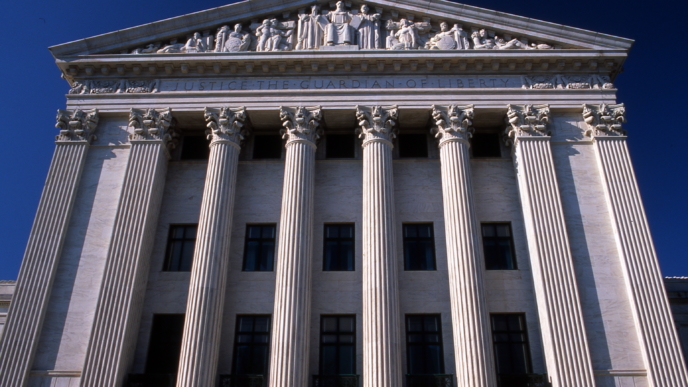
FOR ONCE AND FOR THE WRONG REASONS, THE LEFT WAS RIGHT: The Supreme Court Was and Still Is Illegitimate
Introduction: Conflicting Perspectives
Although the left and right have opposite definitions of “legitimate,” like the proverbial stopped clock that is right twice per day, with one caveat, leftists were right on one point, judicial illegitimacy. The caveat involves time. When leftists screeched that confirmation of Donald Trump’s nominees would make the judiciary illegitimate in their eyes, what really concerned them was that confirmations would convert the judiciary from practices the right thought were illegitimate to what the right thinks are legitimate.
For decades, leftists relied upon dishonest Supreme Court authoritarians to impose unwanted policies on an unwilling public. In Equal Justice for Victims,* I documented why the Supreme Court has been “the last best hope of democracy’s losers” (214) – “miserable merchants of unwanted [and unsold] ideas,” to use the words of Justice Douglas. Thus, if Trump’s judicial nominees were confirmed, leftist ideologues feared the judiciary would cease to be in their pocket; they would no longer achieve undemocratically what they could not achieve in the marketplace of ideas. That is their notion of legitimacy.
As in the past, leftists lost the battles but won the wars. (Does anyone remember David Souter?) It did not take long for Trump’s Supreme Court appointees to validate two of the central points of my book: (1) The United States Supreme Court is an illegitimate, destructive institution unworthy of public respect; (2) The harm it has done cannot be remedied – or further harm prevented – by appointing so-called originalist judges.
On December 11, 2020, a mere 45 days after Amy Coney Barrett took office, she, Neil Gorsuch and Brett Kavanaugh joined leftists to declare that a President of the United States lacked “standing” to have a day in any court. They manifested contemptuous disrespect in a brief 51-word Order stating an unelaborated and unexplained conclusion without the full opinion often accorded the most cruel and depraved rapists and murderers. The justices did not, because they could not, address any of the detailed arguments presented by some of the country’s best lawyers. Trump’s justices not only stabbed their benefactor in the back and, more importantly, his 75 million voters; they also enabled shredding of the remnants of the very Constitution they took oaths to apply and defend.
Denying a sitting President a day in court reveals the Ugly Naked Truth. The Supreme Court and the entire judicial system are rife with dishonesty, corruption and hypocrisy. Moreover, Justice Scalia, after but six months on the Court, realized “[t]he irony … that [unknown, un-affluent, unorganized individuals suffer] injustice at the hands of a Court fond of thinking itself the champion of the politically impotent.”
And so it remains today. The judiciary protects the strong against the weak; the unlawful against the lawful; vicious predators against their prey; those who inflict suffering against the suffering; 300-pound rapists against the 8-year-old little girls they rape; the greedy against the generous; the corrupt against the honorable; the politically powerful against the politically powerless who have no one to fight for them; etc.
Rich as he is, Donald Trump understood and fought for the “little guy” and will continue to do so, hopefully for a long time.
Legitimacy: In the Eyes of the Beholder
A substantial part of Equal Justice for Victims documents the “utter illegitimacy of the Supreme Court” (194). But leftists need not have worried. Their iron grip on the judiciary is as strong as ever; the judiciary remains illegitimate.
To paraphrase Bill Clinton, what is “legitimate” depends on one’s definition. To secure its unpopular agenda, the left sees it as legitimate for dictator-judges to ignore and misstate facts, and to rewrite and disregard law written in plain, even pellucid, English. A “legitimate” leftist court undemocratically and unconstitutionally rams through policies that the left cannot persuade the public to support in fair, open debate and elections. The left relies upon judges to vitiate “democratic self-government” and design a Constitution for an unrecognizable country.
The right’s idea of legitimate adjudication is honest application of written law to honestly stated facts. In this view, a legitimate judge decides cases based on the Constitution, law and evidence rather than politically or personally desired outcomes.
For those on the right, a legitimate judiciary is a judiciary that applies the law faithfully, as written by the people who have the Constitutional authority to write the law. Outcome-oriented leftists believe that “the end justifies the means”; for the right, a legitimate judiciary is an honest judiciary – regardless of results.
The following are examples, from Equal Justice for Victims, show what leftists consider legitimate and those on the right see as illegitimate:
With nary a second thought, judges routinely sacrifice the lives of the innocent to save the lives of the guilty (109).
U.S. Supreme Court justices repeatedly lie about the Constitution, the law and the facts (e.g., 37-41; 225).
Most people probably would be aghast if they knew that, after 19 decades, five justices abruptly claimed (178-181) that
(1) some rapes are “unharmful”;
(2) the Framers, as a reward exclusively for the most depraved criminals in our midst, precisely because they are the most depraved, created a Constitutional right to commit rape and other depravity without any punishment whatsoever; and
(3) Any five lawyers on the Supreme Court could find Constitutionally “unacceptable” and ban criminal punishments legislated by the People’s elected representatives, a power grab Justice Scalia found “laughable.”
Five justices have turned capital sentencing review over to anti-death penalty psychiatrists (251).
The Supreme Court’s role in creating and promoting massive illegal immigration has received little notice (342-343).
Finally, while clearly guilty murderers live for decades (257-321), with judges endlessly splitting hairs over death sentences in lengthy opinions, and while most Americans have been raised to believe that “everyone is entitled to a day in court,” seven US Supreme Court justices, as noted, used but 51 words to make a significant exception for the President of the United States, who could not get federal judges to hear his federal case.
Trump’s Gallery of Federalist Society Judicial Rogues
Notwithstanding former President Trump’s dedication to appoint originalists, he failed. The unrestrained judicial assault on American values, documented and explained throughout Equal Justice for Victims, will continue. If he had succeeded, his appointees would have applied the original Constitution – and he would still be the president. The 2020 election is just the latest example of leftist “miserable merchants” using corrupt judicial dictators to force upon the American people what they do not want.
In his February 28 CPAC speech, the former president accused Supreme Court justices of lacking “guts” and “courage.” But he omitted his own role. Had his three appointees joined dissenting Justices Alito and Thomas, Trump would now be president and the left would not be on a manic mission to destroy the American Greatness he had restored.
Amy Barrett has not been a justice long enough to come to a firm conclusion. It surely would be understandable if she decided not to put her large family at risk of harm by violent leftists (to use a redundancy) without support by Justices Gorsuch and Kavanaugh. But the latter two have been around long enough to say they are unmitigated disasters.
If, as Trump told CPAC, “[t]hey should be ashamed of themselves,” he owes his voters an apology for appointing them.
It is widely accepted that Trump would not have won in 2016 without: (1) the Supreme Court’s dishonest defiance of and flagrant contempt for representative self-government (now likely to continue); and (2) Trump’s vow to appoint judges from a list prepared by the ostensibly originalist Federalist Society.
While the Federalist Society list may have contributed to Trump’s 2016 victory, it surely cost him victory in 2020. In my view, if the former president ever miraculously returns to the White House, he should avoid Federalist Society nominees like the plague. Two points are noteworthy:
Bad Federalist Society advice did not start in 2016. Many judicial scoundrels have had Federalist Society support. I well remember conservatives’ elation over the John Roberts nomination. They have been disappointed repeatedly by this politician posing as an impartial judge (211).
Three months before Election Day, a Federalist Society co-founder joined the years-long Trump-Deranged leftist drive to impeach the object of their hatred.
As a businessman lacking detailed knowledge of judicial skullduggery, Trump relied on “experts.” He thought he was appointing honest originalists who, unlike conservative-turncoat-politician John Roberts, would apply the law as written, But the Gorsuch and Kavanaugh betrayals were predicted and no surprise.
In September 2019, Gorsuch gave his first public interview as a justice; he stressed his two rules: (1) “Don’t make it up — follow the law”; (2) even under enormous pressure to disregard rule #1.
However, in June 2020, Gorsuch wrote an opinion on behalf of the Court’s leftist politicians. Justice Alito dissented, describing Gorsuch’s opinion as “deceptive … legislation” that could not get through Congress. Alito also accused Gorsuch sailing under a false flag like a pirate, in an opinion that would have been “excoriated” by Justice Scalia.
In April 2018, Gorsuch joined the sure leftist Court cadre (Kagan, Ginsburg, Sotomayor and Breyer) to rescue from deportation an alien felon whom even the Obama Administration wanted to throw out of the country. His vote not needed by the Court’s leftist politicians, Roberts dissented, supported by Justices Kennedy, Thomas and Alito.
Significantly, conservatives, who have a habit of wishful thinking, were warned in advance about Gorsuch’s leftist potential. His flimflammery is partially documented here.
Celebrating Kavanaugh’s confirmation, one conservative Supreme Court activist declared that “[A]fter decades of judicial rule …, democracy is effectively pushing back through the judicial appointments ….” (Emphasis added.) I disagree.
As noted, there were warnings before his confirmation. Conservative Joe Miller revealed Kavanaugh to be what he turned out to be on the on the Supreme Court: a “lackluster” hypocrite who, as a prosecutor, abused power and an Establishment-Bush acolyte. In addition, Kavanaugh once clerked for, and was sworn in by, Justice Anthony Kennedy (346), who joined four leftist justices on multiple occasions and whose opinions once caused Justice Scalia to contemplate hiding his head in a bag (41). Above all, when Kavanaugh approved the denial of a remedy for election theft, he pushed back against democracy’s “pushback.” (Before confirmation, in his defense, I allowed my hopes, that Justice Kennedy’s clerk would not emulate his former boss, to cloud my judgment. I was wrong; I apologize.)
Good Cop-Bad Cop; Don’t Be Fooled by Conservative Poseur Role-Reversals
Equal Justice for Victims (41ff.) explains how, to fool the public into believing they are “moderate conservative” or conservative, duplicitous left-leaning judicial politicians frequently vote with truly honest justices when their votes are not necessary to help leftist ideologues win. John Paul Stevens was a master (41). Chief Justice Roberts has been another example, pretending to be a non-political neutral umpire who does not favor either side. Justices Kavanaugh and Gorsuch have joined him, as they back or strongly dissent from various prevailing leftist rulings. When needed, they often join the sure votes (42) for leftist causes: Breyer, Sotomayor and Kagan. But, like the hyper-political Chief Justice, they also write strong dissents to burnish their “originalist” reputations. Prior to Justice Ginsburg’s death, only one “conservative,” usually Kennedy or Roberts, was needed to join leftists. The other was free to write or support strong dissents. Without Ginsburg, the Court’s leftist ideological politicians can often count on getting two or even three “conservatives.” Leftist-at-heart Roberts likely will less often be able to pose as a conservative. For an example of his duplicity, compare here (vital to 5-4 leftist majority) and here (“conservative” when leftists lacked the votes).
Justice Thomas joined Alito’s June 2020 dissent accusing Gorsuch of false-flag piracy. However, his vote unnecessary for the leftists, Justice Kavanaugh wrote a separate dissent, less harsh than Alito’s but agreeing that Gorsuch usurped the legislative function that belongs to elected representatives. This deprived the winners of democratic victory, Kavanaugh contended.
No one should fall for last June’s Kavanaugh dissent from Gorsuch’s pirate opinion. On March 25, 2021, Kavanaugh joined Roberts and the pro-criminal leftists to provide a necessary fifth vote to vacate a lower court pro-victim ruling. Predictably feigning fealty to the meaning of words, Gorsuch wrote a vigorous dissent. (Barrett did not participate.)
On April 5, Kavanaugh joined Gorsuch (and Roberts) to reverse a lower court ruling against leftist Google. As unanimously agreed, Google simply stole what it could not buy. Had Gorsuch and Kavanaugh sided with Justices Thomas and Alito, the lower court decision would have stood; and had Roberts joined them, the Court leftists would have lost on the merits. (Again. Barrett did not participate.) In any event, Gorsuch and Kavanaugh supported what Thomas called a “fundamentally flawed … analysis … to eviscerate Congress’ considered policy judgment.”
Too many good cop-bad cop examples exist to analyze now. But for a few more, compare here and here; here and here; and here and here.
No Day in Court for a Sitting President
That “everyone is entitled to a day in court” is a principle deeply embedded in American values and culture. Even after the presidency was stolen with the approval of Trump appointees, a major fake-news, anti-Trump network referred [19′:42″], to a lawyer defending an unpopular client as “doing … a very noble thing … He believes everybody deserves their day in court.” “Everybody,” that is, but Trump!
On February 3, 2021, having voted to deny a sitting President a chance to present his case in court, Kavanaugh joined the leftists and Roberts, casting a critical deciding vote to grant appellate review to an unknown litigant. Four justices pointed out that the “doubly incorrect” grant was based on an irrelevant statute. This appellate review grant came nine days after Kavanaugh had doubled down and 19 days before he tripled down to deny Trump any hearing at all, even initial review.
Why did Trump’s justices vote to violate one of the most fundamental tenets of American law and culture? Only they know for sure. But speculated possibilities are fraught with irony.
(1) If Trump’s justices feared seeming political, they failed to realize the irony that any decision to avoid a political image is itself a political decision.
The 2020 election offered one of the sharpest political choices in American history: between (a) those who love and are proud of their country and think it is exceptional; and (b) those who are ashamed of their country and will do (and are doing) all they can to make their county unexceptional. When the judiciary sided with the latter, they made the ultimate in political choices. In any event, for a long time, the United States Supreme Court has been stacked with politicians (42-47) who do not hesitate to make political decisions. To quote Andrew McCarthy: “Let’s Drop the Charade: The Supreme Court Is a Political Branch, Not a Judicial One.”
(2) If justices cowered in fear of “Court-Packing,” sooner or later, probably sooner, they will be repeatedly tested. Und this threat, they will be forced to confront multiple challenges to the constitutionality of the Biden-Schumer-Pelosi march toward the total evisceration of self-government. The ultimate irony would be if the “court packing” threat succeeds without actual leftist enactment of court-packing.
Mummification Spurned: Structural vs. Harmless Defects
Nothing could better illustrate the hypocrisy and dishonesty of federal judges than their leftist disregard of a 30-year-old precedent in order to reject a day in Court for a President of the United States, while giving decades in court to all manner of vicious villains (246-249, 302). Justice Arthur Goldberg (96) surely would have labeled as “liberal” this disregard of long-standing precedent.
Equal Justice for Victims includes a section (221-227) arguing that the conservative judicial obsession with adhering to erroneous “precedent,” solely because it is precedent, is nothing but “The Mummification of Justices’ Constitutional Fairy Tales.”
According to Senator Susan Collins, Brett Kavanaugh was “the first Supreme Court [justice] to express the view that precedent is not merely a practice and tradition but rooted in Article III of our Constitution itself.” Kavanaugh is thus the first justice ever to assert that dishonestly invented judicial precedents – fairy tales – are part of the United States Constitution.
Even so, Kavanaugh had no trouble disregarding valid precedents in order to stab in the back the President who strongly supported him during the smear campaign he suffered. Thirty years ago, the Supreme Court – including the real Justice Scalia rather than the current fake-Scalia, Justice Gorsuch – distinguished between harmless errors and “structural defects” that so affect the “entire conduct” of a proceeding as to make the outcome unconstitutionally unreliable. Although the 1991 case involved a criminal trial, it clearly applied to the 2020 election.
Perhaps the oldest cited structural defect is the right to an impartial judge. James Madison famously wrote: “No man is allowed to be a judge in his own cause, because his interest would certainly bias his judgment, and … corrupt his integrity.” On this ground alone, Trump’s rogue justices were cowardly and dishonorable. They were derelict in their duty to provide a remedy for the blatantly unconstitutional insistence, by the federal judge-sister of a feral Trump opponent, upon deciding Georgia election litigation. If Trump’s sister, also a federal judge, had obstinately decided a case involving her brother, we would never hear the end of it.
Kavanaugh (and fellow “conservative” rogues) also disregarded well-established precedent that fraudulent votes “debase or dilute” lawful votes.
Trump’s campaign had enormous evidence of fraud (stopping vote-counting simultaneously in eight states while Trump was leading by a huge margin; ejection of all his poll watchers from witnessing fraud; affidavits and videos showing massive dumping of out-of-state paper ballots; ballots lacking signatures; Biden and other Democrats boasting of vote-fraud plans for election theft using mailed paper ballots; myriad paper ballots confined to presidential votes; brazen recusal refusal; etc., etc., etc.)
Despite all this evidence, Democrats and their judicial puppets denied Trump and his voters a day in court on the ground that there was no evidence. While focus here is on Supreme Court rogues, Third Circuit Judge Stephanos Bibas, another Federalist Society Trump appointee, deserves dishonorable mention.
With the characteristic (334) pompous (187-188) arrogance to be expected from many, if not most, federal judges, Bibas condescendingly lectured: “Free, fair elections are the lifeblood of our democracy. Charges of unfairness are serious. But calling an election unfair does not make it so. Charges require …. proof … [we don’t have].” It apparently did not occur to Bibas and dishonest Trump Supreme Court justices that the purpose of providing a day in court is precisely to allow presentation of evidence.
Judges often dismiss evidence as “insufficient,” but only after hearing that evidence. However, Trump was not allowed to submit evidence on the ground that he had no evidence to submit. That is arrant nonsense.
Although evidence of massive 2020 election fraud continues to mount, in the end, evidence adequacy is a red herring. There was one glaring indisputable fact making moot the entire issue of fraud: enough states to enable Biden’s henchmen to steal the election so fundamentally violated the Constitution as to render the election inherently (i.e., structurally) unconstitutional and its purported results unreliable. The Supreme Court’s cowards should not have allowed electoral votes from states that violated the Constitution. The high court has reversed myriad decisions for far less egregious violations.
Conclusion: The Federal Judiciary Is Still Illegitimate
Notwithstanding former President Trump’s determination to appoint conservative originalists, he failed spectacularly. If he had succeeded, Trump would still be president because his judicial appointees would have applied the original Constitution as written.
Federalist Society appointees will solidify leftist judicial illegitimacy for decades. Its unrestrained assault on the American way of life and American values, documented and explained throughout Equal Justice for Victims, will continue.
The 2020 election was structurally unfair and its results unreliably inaccurate. An illegitimate Supreme Court politically ratified an illegitimate election and saddled the nation with an illegitimate President. Trump’s rogue justices, together with the rogue Chief Justice, illegitimately violated Constitutionally guaranteed rights they had sworn to uphold: (a) to a due process day in court; (b) to the impartial adjudication essential to due process; and (c) to presidential electors selected in a manner prescribed by state legislators – in other words, what Justice Hugo Black called “the most fundamental individual liberty …to participate in … self-government ….”
*Available here. Unless otherwise indicated, all numbers in parentheses are page numbers in Equal Justice for Victims.
Due to computer malfunction, links to government documents (e.g., court opinions) do not work. The author requests that anyone interested contact him directly.
____________________________________________________________________
Lester Jackson is author of numerous articles about capital Punishment, the Supreme Court and American politics. The full title of his book is: Equal Justice for Victims: A Blueprint for the Rightful Restoration of Capital Punishment. Reviews are here.
Copyright © 2021 by Lester Jackson, Ph.D.
Delete Facebook, Delete Twitter, Follow Restoring Liberty and Joe Miller at gab HERE.