The dark side has entered the surveillance debate.
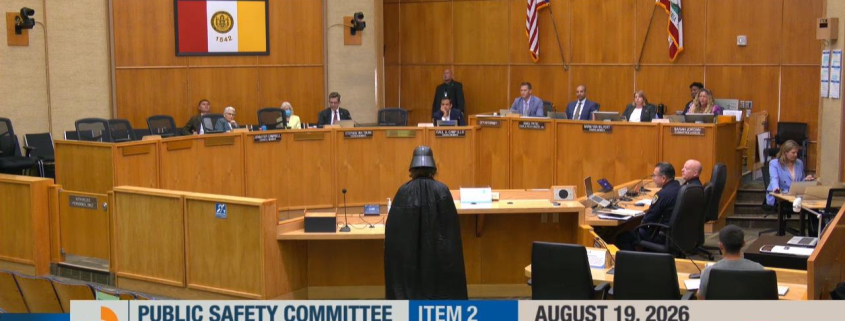
A man dressed as Darth Vader crashed a San Diego City Council hearing Wednesday and delivered a bizarre, Star Wars-themed defense of the city’s controversial Flock cameras, complete with the Sith Lord’s trademark heavy breathing blasting through the council microphone.
The council addressed the masked man simply as “Darth Vader” as he took the podium during a Public Safety and Livable Neighborhoods Committee meeting.
“This is what the emperor needs. This technology will help us find the rebel scum and the hidden base on Hoth,” he said, invoking the frozen planet from “The Empire Strikes Back.”
Then things got even stranger.
The costumed speaker urged officials to use the cameras to track “rebel scum” as they moved “from playground to playground, from playground to pool, from pool to gymnasium.” (Read more from “Darth Vader Crashes San Diego Hearing to Defend Flock Spy Cams: ‘This is what the emperor needs’” HERE)
https://joemiller.us/wp-content/uploads/man-dressed-darth-vader-delivered-138018248.jpeg7201280Joe Millerhttps://joemiller.us/wp-content/uploads/logotext.pngJoe Miller2026-08-20 17:31:542026-08-20 17:26:19Darth Vader Crashes San Diego Hearing to Defend Flock Spy Cams: ‘This is what the emperor needs’
The Department of Homeland Security (DHS) has announced that it has developed a four-legged robot designed to jam the wireless transmissions of smart home devices. The robot was revealed at the 2024 Border Security Expo and is called NEO. It is built using the Quadruped Unmanned Ground Vehicle (Q-UGV) and looks a lot like the Boston Dynamics Spot robot.
According to the transcript of the speech by DHS Federal Law Enforcement Training Centers (FLETC) director Benjamine Huffman, acquired by 404 Media, NEO is equipped with an antenna array that is designed to overload home networks, thus disrupting devices that rely on Wi-Fi and other wireless communication protocols. It will thus likely be effective against a wide range of popular smart home devices that use wireless technologies for communications.
Aside from taking out smart devices, law enforcement can also use the robot to communicate with subjects in the target area, and to provide remote eyes and ears to officers on the ground. “NEO can enter a potentially dangerous environment to provide video and audio feedback to the officers before entry and allow them to communicate with those in that environment,” says Huffman. “NEO carries an onboard computer and antenna array that will allow officers the ability to create a ‘denial-of-service’ (DoS) event to disable ‘Internet of Things’ devices that could potentially cause harm while entry is made.”
(Read more from “Dog-Like Robot Jams Home Networks and Disables Devices During Police Raids — DHS Develops Neo Robot for Walking Denial of Service Attacks” HERE)
https://joemiller.us/wp-content/uploads/6134889_e945596e1f_b.jpeg6831024Joe Millerhttps://joemiller.us/wp-content/uploads/logotext.pngJoe Miller2024-07-23 23:23:592024-07-23 23:21:45Dog-Like Robot Jams Home Networks and Disables Devices During Police Raids — DHS Develops Neo Robot for Walking Denial of Service Attacks
A new poll found a surprising percentage of Gen Z Americans supporting the idea of the government placing cameras in every home in order to prevent crime and abuse.
The finding was a part of a poll of 2,000 Americans by the Cato Institute.
The poll asked whether Americans supported “the government installing surveillance cameras in every household to reduce domestic violence, abuse, and other illegal activity.”
Overall, very few Americans supported the idea, about 14 percent, or one out of every seven respondents. A large majority, 75%, opposed the idea, and only 10% said they weren’t sure.
But among those aged below 30 years, 29% said they supported the idea, almost a third of respondents in that age group. (Read more from “Nearly a Third of Gen Z Americans Say Government Should Put Cameras in Every Home to Prevent Crime and Abuse” HERE)
Delete Facebook, Delete Twitter, Follow Restoring Liberty and Joe Miller at gab HERE.
https://joemiller.us/wp-content/uploads/7670892420_a9fcf496c6_w.jpg266400Joe Millerhttps://joemiller.us/wp-content/uploads/logotext.pngJoe Miller2023-06-05 22:04:522023-06-05 21:06:49Nearly a Third of Gen Z Americans Say Government Should Put Cameras in Every Home to Prevent Crime and Abuse
Plans by the city of Houston to require businesses to install surveillance cameras – and then give police access – has drawn a warning letter from a second civil-rights organization.
WND reported in May when the Institute for Justice warned city officials the spy plans were unrealistic and illegal, because they would be in violation of the 4th Amendment.
Now the Rutherford Institute is raising related concerns.
The civil and religious rights organization said the city’s “Exterior Security Cameras Ordinance” is nothing more than a “thinly veiled attempt to evade oversight and accountability for Fourth Amendment violations.”
The ordinance was adopted in April and demands businesses install a citywide digital surveillance system that can be accessed by police without a search warrant. (Read more from “Major U.S. City’s Plan to Spy on Citizens Draws Fierce Opposition” HERE)
Delete Facebook, Delete Twitter, Follow Restoring Liberty and Joe Miller at gab HERE.
https://joemiller.us/wp-content/uploads/7670889680_2ef260ab0f_b.jpeg6801023Joe Millerhttps://joemiller.us/wp-content/uploads/logotext.pngJoe Miller2022-06-13 21:21:312022-06-19 02:01:43Major U.S. City’s Plan to Spy on Citizens Draws Fierce Opposition
By The Blaze. A Mississippi mom bought a Ring camera in order to stay in touch with her three daughters, but she returned it after four days because of a creepy occurrence with a stranger that hacked into her system. . .
A few days after they put up the camera, her daughter Ashley heard strange music coming from her room.
“At first what happened, I was in the hallway with my sisters and I heard some music, so I came upstairs and I hear some banging noise and I was like ‘who is that?'” the daughter said.
She says that someone’s voice then came through the camera. The voice of a man can be heard on the recording from the camera.
“I’m your best friend! I’m Santa Claus!” the voice said. (Read more from “Disturbing Details: Parents Say Someone Hacked Into Camera in Their 8-Year-Old Daughter’s Room” HERE)
Mississippi Mother Says Ring Camera in 8-Year-Old Daughter’s Room Was Hacked, Hacker Attempted Conversation
By ABC 7. . .The Ring camera was a way for Ashley LeMay to keep an eye on her three daughters and seem close by while working her overnight nurse shifts. . .
“At first what happened, I was in the hallway with my sisters and I heard some music, so I came upstairs and I hear some banging noise and I was like ‘who is that?'” said Alyssa LeMay. . .
“I’m Santa Claus, don’t you want to be my best friend,” the voice said.
Ashley says the mysterious voice taunted Alyssa and encouraged destructive behavior before her dad came into the room and disconnected the camera. (Read more from “Mississippi Mother Says Ring Camera in 8-Year-Old Daughter’s Room Was Hacked” HERE)
https://joemiller.us/wp-content/uploads/energy-video-cameras-security-camera-7108.jpg600800Joe Millerhttps://joemiller.us/wp-content/uploads/logotext.pngJoe Miller2019-12-12 19:47:182019-12-12 19:45:41Disturbing Details: Parents Say Someone Hacked Into Camera in Their 8-Year-Old Daughter’s Room
Forget the fact, that minsters, priests, rabbis, etc., are secretly spying on worshipers. Forget the fact that places of worship want their own police force. And, finally, forget the fact that places of worship are paying the government a $100 dollars a month to spy on families.
Because, now, Big Brother has convinced places of worship to install surveillance cameras to spy on their followers.
Big Brother’s surveillance of religions would make the old NKVD blush with envy.
A recent article in The Advocate, warns that Project NOLA plans to install more than 100 surveillance cameras in places of worship.
ProjectNOLA, an independent, nonprofit crime camera network, has been seeking — and has begun to find — financial support for a plan that would place such cameras on more than 100 places of worship… (Source)
Project NOLA’s first phase is to spend $1 million dollars on surveillance cameras in places of worship.
A key component of the partnership’s $1 million first phase is a plan to expand the nearly nine-year-old ProjectNOLA camera network.
Big Brother wants surveillance cameras in every place of worship.
Equipping every church in New Orleans with a surveillance camera is one of the goals of the NOLA Partnership for Public Safety and Peace. (Source)
Just think about that for a moment, soon every place of worship will have surveillance cameras. Even Orwell’s book 1984 wasn’t that grim.
Who needs God’s all-seeing eye, when the police can do it for him in real-time?
The above video shows how law enforcement has been using Project NOLA to spy on citizens in real-time since 2011.
Church surveillance cameras, combined with license plate readers, will give Big Brother unimaginable real-time spying capabilities.
It appears that Project NOLA is mirrored after DHS’s ‘See Something Say Something’ program that encourages businesses and homeowners to spy on one another.
As I mentioned two months ago, Project NOLA has been so successful that it appears DHS has copied it and renamed it “Virtual Block Watch” (VBW).
Virtual Block Watch is law enforcement’s latest national surveillance program that encourages the public to use surveillance cameras to spy on one another.
Nothing says police state quite like Project NOLA making $200,000 annually on surveillance camera maintenance fees.
First off, Project NOLA was designed by former police officer Bryan LaGarde who charged homeowners and businesses $346.00 dollars for a “crime camera kit.”
A surveillance network designed by a police officer? Nothing suspicious about that, right?
Project NOLA also claims to be “the largest networked HD city-wide crime camera system in America.”
And just like Project NOLA, VBW wants businesses and residents to purchase and install their own surveillance cameras.
But VBW has taken police spying to a whole new level.
Police are asking homeowners and businesses to install four surveillance cameras.
Police suggest that three houses in each block have surveillance cameras and each house has a set of four cameras.
Cameras are attached to houses on each end of a city block and then a third house in the middle. (Source)
Do police really need another surveillance system to spy on everyone?
FYI: NVIDIA is planning on turning police vehicles into 360 degree facial recognition cameras.
Please don’t be fooled by whatever names law enforcement calls them. Hopefully, most of us know what their real names are: ‘Project DHS’ and ‘Police Surveillance Watch.’
Americans need more privacy not less. (For more from the author of “Big Brother Installing Surveillance Cameras in Places of Worship” please click HERE)
A new study shows that knowledge of government surveillance causes people to self-censor their dissenting opinions online. The research offers a sobering look at the oft-touted “democratizing” effect of social media and Internet access that bolsters minority opinion.
The study, published in Journalism and Mass Communication Quarterly, studied the effects of subtle reminders of mass surveillance on its subjects. The majority of participants reacted by suppressing opinions that they perceived to be in the minority. This research illustrates the silencing effect of participants’ dissenting opinions in the wake of widespread knowledge of government surveillance, as revealed by whistleblower Edward Snowden in 2013.
The “spiral of silence” is a well-researched phenomenon in which people suppress unpopular opinions to fit in and avoid social isolation. It has been looked at in the context of social media and the echo-chamber effect, in which we tailor our opinions to fit the online activity of our Facebook and Twitter friends. But this study adds a new layer by explicitly examining how government surveillance affects self-censorship.
Participants in the study were first surveyed about their political beliefs, personality traits and online activity, to create a psychological profile for each person. A random sample group was then subtly reminded of government surveillance, followed by everyone in the study being shown a neutral, fictional headline stating that U.S. airstrikes had targeted the Islamic State in Iraq. Subjects were then asked a series of questions about their attitudes toward the hypothetical news event, such as how they think most Americans would feel about it and whether they would publicly voice their opinion on the topic. The majority of those primed with surveillance information were less likely to speak out about their more nonconformist ideas, including those assessed as less likely to self-censor based on their psychological profile. (Read more from “Mass Surveillance Silences Minority Opinions, According to Study” HERE)
00Joe Millerhttps://joemiller.us/wp-content/uploads/logotext.pngJoe Miller2016-03-29 01:33:572016-04-11 10:50:59Mass Surveillance Silences Minority Opinions, According to Study
During one of my political campaigns, I struck up a conversation with a woman from a former Soviet bloc country who, while recanting the horrors of communism, began to unexpectedly quiver and cry. It was an emotional moment for both of us and, although there were a number of people at the event waiting to talk, I spent an extended period of time with the woman. There is no better advocate for liberty and freedom than a witness to history who has been forced to live under the yoke of communism.
I think about that interaction often because it’s difficult for people who have always been free to understand the deep psychological trauma caused by living under communism. We all have a “private self” and a “public self.” It’s no secret that we all act and communicate differently when we are alone or in a setting with people with trust. In a free country, the decision to transition from that private self to the public self is largely within the control of the individual. When a free man or woman is home spending time with family he or she inhabits the private self. Typically one transitions to a public self when they grab the car keys and open the front door to head to work. There are things you may do or say while you were acting as that private self that you will no longer do or say at work, in your car, in an email, or on a business conference call.
Now, imagine living in a place where there is no distinction between the private self and the public self. Imagine a place where only the government has the key that unlocks the door between the private self and the public self. When I recall that emotional conversation with that woman at the campaign event, who had been subjected to the horrors of communism, I realized the psychological damage that an all-powerful government was capable of when it doesn’t recognize a private self. What must it be like to live under a system where your family, friends, and neighbors are encouraged, and even rewarded, for reporting on any of your activities which could be considered subversive to the government tyrants in charge? Having never lived in such a system, I can only guess at the psychological damage caused by living in a country where you are constantly questioning the motives of each and every person you come into contact with. Heavy government-surveillance ensures that you are never certain that you are really alone.
As a former federal agent, an activist for liberty and freedom, a father, and a patriot, it is this almost casual erasing of the distinction between the private self and the public self, right here in the United States, which frightens me. Governments rarely make liberty disappear in one clean cut; they typically bleed you out slowly. Watching allegedly conservative, liberty-loving, politicians and candidates defend the NSA’s metadata program—a program which collects private information transmitted by you as your private self—is beyond disturbing.
I’m not willing to sacrifice my liberty, or yours, for a false sense of security, Ironically, those defending this egregious, government-enforced evaporation of the line between the private and public self cannot provide any evidence of this metadata collection process intercepting even one terror plot. This doesn’t surprise me. Throughout my career as a federal agent who worked on a major counter-terror/financial crimes investigation as a member of a New York inter-agency task force, this is not how serious counter-terrorism investigators initiate quality investigations. Good federal investigations, which crack terrorism plots before they result in carnage, are put together by hard-working agents who spend their entire careers, not in front of a computer screen, but on the streets developing and cultivating informants and sources. These invaluable sources are typically developed through an immersion in the communities in which these agents work. Agents develop relationships and informant networks within these respective communities by turning low-level criminal “worker-bees” into sources of information to use against their higher-level criminal or terror overseers.
Being a true conservative requires a willingness to make the right decisions, not the easy ones. It’s easy to pander to the American people and promise them safety in exchange for small pieces of their liberty bartered away after each terror attack. But these trades are not only costing you control over the point at which the private self and the public self begin to overlap. They are forfeiting away your safety in misguided attempts for quick, TV-ready talking points which are themselves designed to make you believe that there is some counter-terrorism magic-pill out there. And if you just allow the government to slowly place it in your mouth, and gently talk you into swallowing it, the pill will make all of the bad guys just magically go away. (For more from the author of “The Creep of Government Surveillance” please click HERE)
https://joemiller.us/wp-content/uploads/logotext.png00Joe Millerhttps://joemiller.us/wp-content/uploads/logotext.pngJoe Miller2015-12-21 23:29:002016-04-11 10:54:48The Creep of Government Surveillance
Photo Credit: AP News My Way By Jack Gillum, Eileen Sullivan and Eric Tucker. The FBI is operating a small air force with scores of low-flying planes across the country carrying video and, at times, cellphone surveillance technology — all hidden behind fictitious companies that are fronts for the government, The Associated Press has learned.
The planes’ surveillance equipment is generally used without a judge’s approval, and the FBI said the flights are used for specific, ongoing investigations. In a recent 30-day period, the agency flew above more than 30 cities in 11 states across the country, an AP review found.
Aerial surveillance represents a changing frontier for law enforcement, providing what the government maintains is an important tool in criminal, terrorism or intelligence probes. But the program raises questions about whether there should be updated policies protecting civil liberties as new technologies pose intrusive opportunities for government spying.
U.S. law enforcement officials confirmed for the first time the wide-scale use of the aircraft, which the AP traced to at least 13 fake companies, such as FVX Research, KQM Aviation, NBR Aviation and PXW Services. Even basic aspects of the program are withheld from the public in censored versions of official reports from the Justice Department’s inspector general.
“The FBI’s aviation program is not secret,” spokesman Christopher Allen said in a statement. “Specific aircraft and their capabilities are protected for operational security purposes.” Allen added that the FBI’s planes “are not equipped, designed or used for bulk collection activities or mass surveillance.” (Read more from “FBI Behind Mysterious Surveillance Aircraft Over US Cities” HERE)
Police Arrest Robbery Suspect After Tracking With Drone
By Cassidy McDonald. The robbery suspect who was arrested with the help of a police drone on Sunday also stole a running car from a Near West Side coffee shop, police said.
Marquis Meki Isiah Phiffer, 21, of Monroe, was arrested on tentative charges operating a car without the owner’s consent, eluding an officer and robbery.
Around 1:15 p.m., a 50-year-old Madison man told police he stopped at EVP Coffee, 555 S. Midvale Blvd., and left his Subaru Outback running in the parking lot because he only planned to be inside for a few minutes. (Read more from this story HERE)
By Dustin Volz. An exasperated White House on Tuesday ratcheted up pressure on the Senate to pass surveillance-reform legislation before intelligence tools considered crucial to national security expire at the end of the month—while appearing to throw a direct barb at Sen. Rand Paul for gumming up the process.
Though he didn’t call out Paul by name, White House press secretary Josh Earnest seemed to accuse the Kentucky senator of using the debate over the Patriot Act’s sunsetting spying powers to bolster his presidential campaign.
“At some point, the political ambitions of individual members of the United States Senate are going to have to come second to the national security of the United States,” Earnest said.
Earnest’s comments come after the Senate failed to forge a path forward on dealing with the June 1 sunset of the Patriot Act’s spy provisions following a late-night round of votes Friday night into Saturday morning. Those authorities include the controversial Section 215, which the National Security Agency uses to justify its bulk collection of U.S. call data.
House-passed reform legislation known as the USA Freedom Act, which would effectively end the NSA’s phone dragnet, failed to advance Saturday, coming three votes short of the 60 necessary to clear a procedural hurdle. A bill to extend the provisions unchanged also failed. (Read more from “Exasperated White House Pushes Senate to Pass Surveillance Reform Bill” HERE)
____________________________________________________
Obama Claims Bill is Necessary to Keep Nation “Safe and Secure”
Photo Credit: APBy Erica Werner. President Barack Obama called on the Senate Tuesday to extend key Patriot Act provisions before they expire five days from now, including the government’s ability to search Americans’ phone records.
“This needs to get done,” he told reporters in the Oval Office. “It’s necessary to keep the American people safe and secure.”
But with the May 31 deadline fast approaching, there was scant evidence Tuesday of a search for a deal on Capitol Hill. The House and Senate stood in recess for the week, and a House GOP leadership aide said there were no talks happening between the two chambers. The aide spoke on condition of anonymity, because the aide was not authorized to discuss the issue on the record.
The Senate adjourned for its Memorial Day break early Saturday after a chaotic late-night session during which senators failed to pass a White House-backed House bill reforming the phone collection program. Attempts by GOP leaders to extend current law also repeatedly fell short, amid objections from presidential candidate Sen. Rand Paul, R-Ky., and others.
Senate Majority Leader Mitch McConnell is calling the Senate back into session on Sunday, May 31, just hours before the midnight deadline, but it’s not clear lawmakers will have any new solution. (Read more from “Obama Urges Senate to Renew Phone-Records Program” HERE)
https://joemiller.us/wp-content/uploads/logotext.png00Joe Millerhttps://joemiller.us/wp-content/uploads/logotext.pngJoe Miller2015-05-28 02:15:302016-04-11 11:00:42Exasperated White House Pushes Senate to Pass Surveillance Reform Bill