Posts

Chinese Man Tests His Crazy Homemade Roller Suit in Rush-Hour Traffic

The internet is a strange and wonderful place sometimes because without it, how would we ever find out about people like this guy who built a remote-controllable wheel suit and took it out in Chinese rush-hour traffic?

. . .

As you can see in the video, there are plenty of opportunities for this guy to get turned into roadkill by a truck or an absent-minded driver, but somehow the fun only ends when the cops show up and arrest him. (Read more from “Chinese Man Tests His Crazy Homemade Roller Suit in Rush-Hour Traffic” HERE)

Follow Joe Miller on Twitter HERE and Facebook HERE.

New Browser Created That Can Hide All Your Personal Info

. . .TraceFree Corp. has announced the creation of the “first web browser that makes it impossible for any site, including Google, to see or share a user’s personal data.” . . .

The company says the technology “leapfrogs, and will ultimately replace, a virtual private network by giving complete anonymity and security while also hiding browsing activity from the internet provider.”

The promotion explained the recent Facebook controversy and new government data regulations have forced companies to update their website privacy policies.

“However, there is still NO WAY a user can be sure their data does not continue to be shared or sold improperly. TraceFree eliminates this fear by NOT allowing a website to see, capture, share or track their personal data.” (Read more from “New Browser Created That Can Hide All Your Personal Info” HERE)

Follow Joe Miller on Twitter HERE and Facebook HERE.

Wearable Technology Aims to Predict Relationships, Intervene When Computer Detects Trouble

Predictive behavior technology is all the rage in everything from advertising to policing to medicine, and is something that we have covered extensively at Activist Post (see our archives here). Technocrats everywhere believe that the supreme being of the universe should be a computer algorithm; because, after all, in its perfection it knows us better than we know ourselves.

The following research from the University of Southern California is a chilling example of how the State could easily employ this technology for literal interventions where potential violence could occur. Beyond the micromanagement of adult relationships, note the final direction at the end of the article: parent-child relationships.

Are we really this lazy to turn over our most intimate interactions to the advice of a computer and hope that it can help manage our every emotion? Are we really that eager to completely eradicate human free will?

Mobile sensing system developed by joint USC Dornsife and USC Viterbi team could give couples the power to anticipate each other’s emotional states and adapt behavior

Your partner comes in and slams a door. What was that about? Something you did? What if you knew to anticipate it because you were notified in advance from an automated text message that he/she didn’t have a great day at work? Might that change the dynamic of your interactions?

You had a bad day. The last thing you need is to get into an argument when you get home because your partner also had a bad day. What if technology could automatically send you a notification advising you to do a short meditation module to restore your mental state? How might this affect the quality of your interactions with your partner?

In the near future, researchers from the USC Viterbi School of Engineering and the USC Dornsife College of Arts, Letters and Sciences believe technology might be employed to help de-escalate any potential conflicts among couples. In a collaboration between the Signal Analysis and Interpretation Laboratory (SAIL) in the Ming Hsieh Department of Electrical Engineering and the Family Studies Project in the Psychology Department at USC Dornsife, researchers employed multi-modal ambulatory measures to develop a system in order to detect if conflict had occurred between a couple—a sort of seismometer of the shakes, rattles and rolls in a relationship.

The research, documented in “Using Multimodal Wearable Technology to Detect Conflict among Couples,” by Adela C. Timmons, Theodora Chaspari, Sohyun C. Han, Laura Perrone, Shrikanth S. Narayanan, and Gayla Margolin, is published by the IEEE Computer Society this month.

In order to detect intra-couple conflict, the researchers with support from the National Science Foundation, developed algorithms to assess whether conflict was present among couples. This algorithm pulled together data from various sources including wearables, mobile phones, and physiological signals (or bio-signals) to assess couples’ emotional states. Data collected included body temperature, heart activity, sweat, audio recordings, assessment of language content and vocal intensity. The algorithm analyzing this data has proved to be up to 86 percent accurate in its ability to detect conflict episodes (based on participants’ hourly self-reports of when conflict occurred). The authors of the study believe it is the first instance in which passive modal computing is being collected and employed to detect conflict behavior in daily life.

Theodora Chaspari, an Electrical Engineering Ph.D student in Shri Naryanan’s SAIL lab at USC Viterbi, speaks of why this particular collaboration appealed to her and the SAIL group: “We could help beyond pure engineering domains, providing a more quantitative measures of human behavior.”

Lead author Adela C. Timmons, a psychology Ph.D student in Gayla Margolin’s Family Studies Project team at USC Dornsife, together with Chaspari runs the USC Couple Mobile Sensing Project with “the eventual goal of developing interventions to improve couple functioning.” In addition to the notion of helping couples who can’t often replicate the interventions and behavioral strategies they learn and practice in therapist’s office, Timmons spoke about the importance of this research in detecting and perhaps having couples minimize conflict in their relationships. She indicates that negative relationships (or the absence of positive relationships) have long been recognized as a health risk. The quality of relationships, Timmons said, can provide health benefits. Further, she indicates that research has shown that those with healthy relationships have less stress and that chronic stress is known to cause “wear and tear” on the body.

The authors say that the next step in the research is using such unobtrusive, passive technologies to anticipate conflict —perhaps five minutes before it might occur, by letting computer software determine the likelihood that conflict will occur. The other part of anticipating conflict is developing early interventions—possible real-time interventions or behavioral prompts such as text notifications of a partner’s psychological state or to guide an individual to meditate before bringing that conflict home.

Chaspari acknowledges that this is not a one-fits-all approach. Machine learning software can learn what is most useful in an individual. For example, for any given person, certain factors might have more weight in predicting conflict.

Once this system has been proven, the authors anticipate that it can be employed to other important relationships such as a parent-child dynamic. (For more from the author of “Wearable Technology Aims to Predict Relationships, Intervene When Computer Detects Trouble” please click HERE)

Follow Joe Miller on Twitter HERE and Facebook HERE.

Stingray Technology Shows Ongoing Tension Between Privacy Rights and Safety

Law enforcement is always looking for the best new technology to stay one step ahead of increasingly sophisticated criminal agents, not to mention terrorist sympathizers.

In the pursuit of this goal, new surveillance equipment makes tracking actual criminal suspects easier and faster each year. Each advance in the field of surveillance stretches the boundaries of Fourth Amendment protections against undue search and seizure, creating grey areas where the legitimate pursuit of public safety may conflict with individuals’ immediate privacy and right to be presumed innocent. In these cases, there should be a robust public debate to decide where to set that line.

Enter the Stingray. Properly known as an international mobile subscriber identity (IMSI) catcher, Stingray is the brand name of such a device that basically collects communications data over a wide area by tricking mobile devices into thinking that the Stingray is actually a cellphone tower. Stingrays can thus be used to track all nearby phones — and the creatures that carry them — in real time. Not only can this track your location, but it can also collect your metadata, such as what numbers are calling into the device. Furthermore, some Stingray devices appear to be able to collect actual content – i.e., your phone conversations, text messages, and the like.

Clearly this is powerful technology and was originally developed for military use overseas. However, the FBI began acquiring the devices for its agents as well as helping local and state law enforcement units acquire them, too.

It is not hard to imagine the legitimate usefulness of such a device in the case of an actual real-time crime investigation or a stakeout. However, the ability of these devices to track and intercept data from these devices en masse also raises due process concerns, especially if they are used for passive, ongoing surveillance. rather than targeted use at the behest of a court order.

Rather than have a debate over how these devices should be employed in public, a congressional inquiry released late in 2016 reveals that the FBI arranged for law enforcement to acquire these Stingray devices in secret. The FBI even conditioned the transfer of these devices on signing non-disclosure agreements — to the point of demanding that the departments using these devices refuse to acknowledge their existence in court!

As the Cato Institute’s Adam Bates documents in a major new study, many of the agencies that bought Stingrays did not have any formal guidelines for how to use them legally in the field until a series of leaks began tipping civil liberties activists to their existence. More disturbingly, there have been documented instances where law enforcement was forced to drop cases against a suspect to avoid revealing the evidence collected via Stingrays, and the FBI has even been caught directing police to invent alternate ways that Stingray data might have been collected constitutionally (a practice known as “parallel construction”).

Just as concerning is the acquisition and use of Stingrays by executive branch agencies outside of the FBI. The most ridiculous example pointed out by the Oversight report is the IRS, which owns two Stingray devices and admitted to using them in 37 investigations so far. Yep, the tax man can track you and listen to your phone calls. Interestingly, the IRS devices have thus far been used mostly in cases involving non-tax crimes, leading one to wonder why such investigations aren’t just being handed off to the FBI or other actual law enforcement bodies.

The combination of the massive potential for these devices to be used unconstitutionally to conduct mass surveillance, combined with the eyebrow-raising secrecy with which they have been acquired and used, merits congressional action.

It seems redundant to have to pass a federal law to specify that law enforcement needs to have a valid warrant to collect and use surveillance data against Americans in the U.S., but such is the state of the Fourth Amendment in the age of technology. Fortunately, a number of high-exposure uses of Stingrays, such as their use by the IRS and the revelation that the Baltimore police used airplane-borne cell tower simulators to monitor protest crowds, has ensured bipartisan interest in setting forth strong guidelines for their use.

It will be the task of lawmakers and civil liberties advocates to ensure that these guidelines are sufficient and that they do not continue to provide avenues for yet another form of legally justified, unconstitutional government mass surveillance. (For more from the author of “Stingray Technology Shows Ongoing Tension Between Privacy Rights and Safety” please click HERE)

Follow Joe Miller on Twitter HERE and Facebook HERE.

Deep Learning: Teaching Computers to Predict the Future

Using algorithms partially modeled on the human brain, researchers from the Massachusetts Institute of Technology have enabled computers to predict the immediate future by examining a photograph.

A program created at MIT’s Computer Science and Artificial Intelligence Laboratory (CSAIL) essentially watched 2 million online videos and observed how different types of scenes typically progress: people walk across golf courses, waves crash on the shore, and so on. Now, when it sees a new still image, it can generate a short video clip (roughly 1.5 seconds long) showing its vision of the immediate future.

“It’s a system that tries to learn what are plausible videos — what are plausible motions you might see,” says Carl Vondrick, a graduate student at CSAIL and lead author on a related research paper to be presented this month at the Neural Information Processing Systems conference in Barcelona. The team aims to generate longer videos with more complex scenes in the future.

But Vondrick says applications could one day go beyond turning photos into computer-generated GIFs. The system’s ability to predict normal behavior could help spot unusual happenings in security footage or improve the reliability of self-driving cars, he says.

If the system spots something unusual, like an animal of a type it hasn’t seen before running into the road, Vondrick explains that the vehicle “can detect that and say, ‘Okay, I’ve never seen this situation before — I can stop and let the driver take over,’ for example.” (Read more from “Deep Learning: Teaching Computers to Predict the Future” HERE)

Follow Joe Miller on Twitter HERE and Facebook HERE.
Biohackers Implant Computers, Earbuds and Antennas in Their Bodies

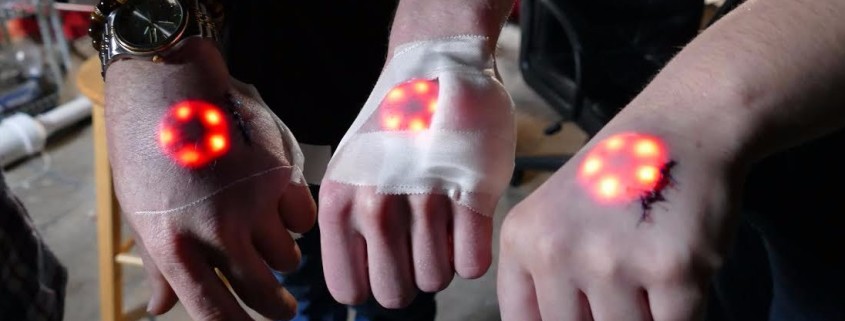
Photo Credit: Ryan O’Shea/Grindhouse WetwareBody implants are a staple of science fiction. They turn members of futuristic societies into super-humans, making them stronger, smarter and more capable than an average person . . .

As amazing as body implants sound, though, how close are we normal humans to getting one of those? In other words, are contemporary science, medicine and technology advanced enough to allow us to seamlessly meld with the technology and actually improve our lives? Keep reading to find out.

We’ll start by introducing Northstar, a subdermal LED sensor that lights up when it’s in the vicinity of a magnet. It can be used to detect the magnetic north and act as a compass. Implanting such a basic device may sound like a silly and needlessly dangerous procedure to go through, but these biohackers did it anyway . . .

If you think having LEDs in your forearm is silly, you may like this better: an antenna implanted in the skull. In 2004, Neil Harbisson had the device implanted in his cranium in an effort to fight color blindness. A camera at the far end of the device records whatever he is seeing and converts the image color data into a series of sound waves, which he has memorized. Instead of seeing various hues, he “hears” them with the help of a camera he calls Eyeborg. (Read more from “Biohackers Implant Computers, Earbuds and Antennas in Their Bodies” HERE)

Follow Joe Miller on Twitter HERE and Facebook HERE.

Bill Gates Monitored Microsoft Employees’ Work Hours by Memorizing Their License Plates

Microsoft co-founder Bill Gates used to memorize employees’ license plate numbers so that he could keep track of when they were arriving at work and leaving.

Gates, who is now co-chair of the Bill and Melinda Gates Foundation, described his intense management style from Microsoft’s early days during an interview on the BBC Radio 4 program “Desert Island Discs.”

“I had to be a little careful not to try and apply my standards to how hard [others at the company] worked. I knew everybody’s licence plate so I could look out the parking lot and see, you know, when people come in,” he said. “Eventually I had to loosen up as the company got to a reasonable size” . . .

The philanthropist also described his relationship with Apple co-founder and tech icon Steve Jobs during the radio interview.

“Steve really is a singular person in the history of personal computing in terms of what he built at Apple,” he said. “For some periods, we were completely allies working together – I wrote software for the original Apple II. Sometimes he would be very tough on you, sometimes he’d be very encouraging. He got really great work out of people.” (Read more from “Bill Gates Monitored Microsoft Employees’ Work Hours by Memorizing Their License Plates” HERE)

Follow Joe Miller on Twitter HERE and Facebook HERE.
Marc Andreessen: ‘In 20 Years, Every Physical Item Will Have a Chip Implanted in It’

The hype around the Internet of Things has been rising steadily over the past five years. In tech analyst Gartner’s Hype Cycle for Emerging Technologies report in 2015, the IoT is at the peak of “inflated expectations”, particularly for areas like the smart home, which involve controlling your lights, thermostat or TV using your mobile phone.

But the era of sensors has only just dawned, according to renowned technology investor and internet pioneer Marc Andreessen. In 10 years, he predicts mobile phones themselves could disappear.

“The idea that we have a single piece of glowing display is too limiting. By then, every table, every wall, every surface will have a screen or can project,” he told the Telegraph. “Hypothetically you walk upto a wall, sit at a table and [talk to] an earpiece or eyeglasses to make a call. The term is ambient or ubiquitous computing.”

Which is why he has invested $25m into Californian startup Samsara, which is the first of a new generation of “internet of things” devices that solves huge industrial problems, rather than turning your fridge or your toothbrush into a portal to the web.

“This second wave of companies, they don’t want to just do “internet of things”,” Andreessen said. “They are showing up three years later, saying ok I know exactly how this is going to get used. It’s for real businesses in industrial environments.” (Read more from “Marc Andreessen: ‘In 20 Years, Every Physical Item Will Have a Chip Implanted in It'” HERE)

Follow Joe Miller on Twitter HERE and Facebook HERE.

Billionaire Jeff Greene Says Technology Will Kill White-Collar Jobs, Hosts Conference on Inequality

Touch-screen ordering at fast food restaurants, robots welding car parts at Tesla factories, apps like Uber taking a bite out of the taxi and limo industry: They’re all good for innovation but perhaps not so great for the workers whose jobs are on the line, according to real estate billionaire Jeff Greene.

“What globalization did to blue collar jobs and the working class economy over the past 30 or 40 years, big data, artificial intelligence and robotics will do to the white collar economy — and at a much, much faster pace,” says Greene.

It’s a problem that will only exacerbate the growing gap between the rich and the poor, he claims, because we’ve left ourselves unprepared for the inevitable automation of many jobs traditionally done by humans.

“I realized that that is the greatest threat we have in our country today,” says Greene. “So I thought, ‘Let’s convene some of the greatest minds from academia, government, business and the nonprofit sector to come together to talk realistically about what’s happening.’”

What he devised is a two-day conference spanning Monday and Tuesday dubbed “Closing the Gap: Solutions for An Inclusive Economy,” hosted by Greene at Palm Beach’s Tideline Ocean Resort & Spa. Speakers include former British Prime Minister Tony Blair, author Thomas Friedman, former Apple and Pepsi CEO John Sculley, lawyer and TV personality Star Jones and boxing legend Mike Tyson. (Read more from “Billionaire Jeff Greene Says Technology Will Kill White-Collar Jobs, Hosts Conference on Inequality” HERE)

Follow Joe Miller on Twitter HERE and Facebook HERE.
Your Smart Home Knows a Lot About You

How much does your smart home know about you? That was the question that Charles Givre, a data scientist at Booz Allen Hamilton, set out to answer in a recent experiment. Givre has an account on Wink, a platform designed to control, from a single screen, his Internet-connected home devices, such as door locks, window shades and LED lights. He wanted to learn what could be learned from his usage behavior. It turned out it was a little too much.

Earlier this month, at a big data conference in New York, Givre presented his results. By accessing his Wink account, he (or anyone with his login information) could identify his social media accounts, the names of his devices (like “Charles’s iPad) and his network information. An app that monitors his grill’s propane tank recorded the tank’s latitude and longitude, thus revealing the exact location of his house. From his Nest thermostat, he could figure out when his house was occupied and when it was not.

The goal of his experiment, Givre said, was not to demonstrate security flaws in his devices, but to document the wealth of information that they amass through everyday use. To access his usage history, some accounts required verification keys; others only asked for Givre’s email address and password. He wrote programs to “ping” his devices to gather new information about what was going on in his home in real time, and to find patterns there. He noted that his smart devices seemed to transmit information securely on its way to the companies’ servers, “but most of the interesting stuff was in the cloud anyway.”

As the trend toward networked “smart homes” and “connected cars” continues, security precautions are more important than ever. The Federal Trade Commission put out a report this year with best practices about how companies should notify their customers about data retention. Device makers say that customers can opt in or out of sharing their personal information with developers and third-party apps. But customers may not always be aware of just how much information their devices are collecting about them in the first place. (Read more from “Your Smart Home Knows a Lot About You” HERE)

Follow Joe Miller on Twitter HERE and Facebook HERE.