Posts

US Economy Could Be In Dire Straits As Hormuz Slams Shut

. . .Brent crude, the oil blend that sets worldwide prices, has jumped 24% to over $90 a barrel since Operation Epic Fury began. The highest Brent price of Trump’s second term is already impacting U.S. gasoline prices.

Despite the U.S.-backed war risk insurance that President Donald Trump offered all maritime operators in the Strait of Hormuz, traffic remains down 90% since Iranian retaliatory strikes began. Refineries have no way to ship their oil, and some are halting extraction as storage facilities hit capacity.

U.S. gasoline prices move in tandem with Brent crude. For every $10 Brent increase, U.S. gas prices rise roughly 24 cents per gallon. Since striking Iran, the AAA national gas average price increased from $2.98 to $3.32. Gasoline prices haven’t risen comparably since the Russia-Ukraine War began in March 2022.

A sustained 25-cent-per-gallon increase in gas prices raises inflation by about 0.25 percentage points, according to the Federal Reserve. If the Strait of Hormuz is reopened and oil exports resume, prices could return to pre-war levels.

Very Large Crude Carriers, ships capable of carrying roughly 2 million barrels of oil, saw their daily rental prices skyrocket from $206,000 to over $480,000 since markets opened Monday. The rate-doubling results from continued war risk insurance issues and a dearth of vessels willing to brave the increasingly dangerous Strait. (Read more from “US Economy Could Be In Dire Straits As Hormuz Slams Shut” HERE)
Job Market Cools: U.S. Misses Expectations in July Hiring Slowdown

The red-hot American labor market just hit a summer speed bump.

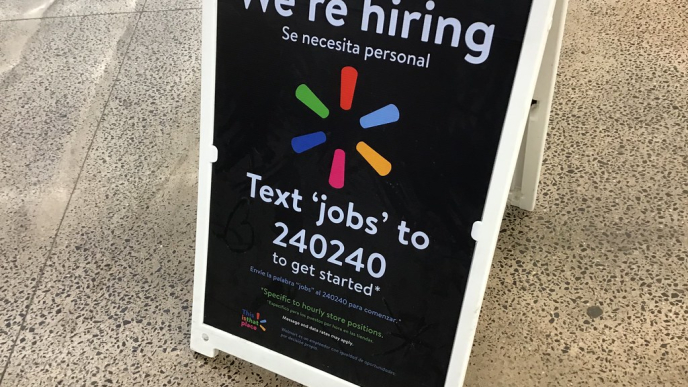
According to new data released Friday morning by the Bureau of Labor Statistics (BLS), the U.S. economy added just 73,000 nonfarm jobs in July, falling short of the projected 100,000 and marking a notable deceleration after stronger-than-expected gains in June.

The unemployment rate ticked up slightly to 4.2%, from 4.1% the month before, a small shift — but one analysts say could signal deeper cooling in the economy’s most-watched indicator: jobs.

“This is a soft landing — if you’re lucky,” said one market analyst reacting to the numbers. “But it’s also a warning sign.”

Despite the jobs miss, other economic signals suggest mixed momentum. The U.S. GDP grew at 3.0% in Q2, according to Wednesday’s advance report from the Bureau of Economic Analysis. Meanwhile, manufacturing output ticked up in June and jobless claims fell for a fifth consecutive week — down 7,000 to 221,000 — showing some resilience in pockets of the economy.

Still, July’s hiring pullback could strengthen concerns that employers are becoming more cautious amid elevated borrowing costs and global uncertainty.

President Donald Trump’s team was quick to pivot, emphasizing the bigger picture. In a statement Wednesday, White House Press Secretary Karoline Leavitt said:

“Americans trust in President Trump’s America First economic agenda that continues to prove the so-called ‘experts’ wrong.”

The administration has framed Trump’s second-term policies as critical to restoring long-term growth and curbing inflation without collapsing the labor market.

On Wednesday, the Federal Reserve held interest rates steady, choosing not to cut despite mounting political pressure — including from Trump himself — to ease monetary policy. With job growth softening, some economists now believe rate cuts may come sooner than expected.

“The Fed is watching,” said an economist at the American Enterprise Institute. “Today’s numbers may shift the conversation.”

Photo credit: Flickr

Immigrants Took Nearly 90% of New Jobs Since 2020

The U.S. economy has netted 5.4 million jobs over the past five years, with 90% of that growth going to immigrants, according to new government data Friday.

That works out to 4.7 million net new jobs filled by immigrants compared with January 2020, or just before the pandemic and before the Biden border surge.

By contrast, U.S.-born employment is up just 645,000.

In just the past year, immigrants netted 1.9 million new jobs, or 72% of the total growth.

Steven Camarota, research director at the Center for Immigration Studies, said 60% of the new immigrant-held jobs went to those in the country illegally. (Read more from “Immigrants Took Nearly 90% of New Jobs Since 2020” HERE)

Largest Hedge Fund Founder on Why U.S. Is on Brink of Economic ‘Heart Attack’

The United States is currently in a “death spiral” of debt that could lead to an economic “heart attack” if both parties do not work together to start cutting immediately, according to Ray Dalio, the founder of the world’s largest hedge fund.

During a recent conversation on “The All-In Podcast” with co-host David Friedberg, Dalio noted that a “death spiral” typically refers to when a company or government has too much debt and must borrow to service it. According to Dalio, investors are acutely aware of this, which is causing credit to get worse and interest rates to increase.

Dalio, the Chief investment officer of Bridgewater Associates, says this is the worst thing that can happen to a heavily indebted entity. He notes that the key question is whether the debt creates a large enough income to mitigate this issue.

“That’s like, I don’t know, eating vegetables or something. It’s a healthy process. And if not, credit begins to build up this debt, it begins to become like plaque in the arteries. And you can measure it just like you could measure it in the arteries, and you can see how it constricts that circulatory system,” Dalio told “All-In.”

If interest and debt service continuously constrict a government’s money supply, Dalio claims this can lead to an “economic debt heart attack.” (Read more from “Largest Hedge Fund Founder on Why U.S. Is on Brink of Economic ‘Heart Attack’” HERE)

Why America Won't Have Enough Money to Battle ISIS

Photo Credit: AP / U.S. Air Force, Staff Sgt. Shawn NickelPresident Obama says that it may take the U.S. and its allies three years to defeat Islamic State of Iraq and Syria militants, with heavy dependence on stepped up U.S. airstrikes. And some defense experts say it could cost the government an additional $15 billion to $20 billion a year to pursue this hazardous mission.

The fight against ISIS is already expensive. As of late August, the United States had spent $560 million fighting the group, and continues to spend $7.5 million daily on operations in Iraq. Last week Congress authorized the administration to spend an estimated $500 million to equip and train so-called moderate Syrian rebels to help counter the fast growing threat of ISIS.

But what if the mission mushrooms into a much bigger, more intensive and considerably longer operation than Obama has outlined — one that eventually forces the U.S. to send in combat troops into Iraq again? Will there be enough money in the defense budget to achieve Obama’s goal of “degrading and destroying” ISIS while preserving a strong armed forces?

Probably not, short of a major downsizing of the military and its gold-plated retirement and health care programs or a massive increase in deficit spending, according to economist Eugene Steuerle, a budget expert with the Urban Institute.

Steuerle, author of Dead Men Ruling: How to Restore Fiscal Freedom and Rescue Our Future, argues that years of accumulated tax cuts, discretionary budget policy, and entitlement programs have set so much of federal spending in concrete that lawmakers and the administration have little flexibility to respond to major crises or problems such as natural disasters or the upheaval in the Middle East.

Read more from this story HERE.

Manipulating Growth: Data Shift to Lift US Economy 3%

The US economy will officially become 3 per cent bigger in July as part of a shake-up that will see government statistics take into account 21st century components such as film royalties and spending on research and development.

Billions of dollars of intangible assets will enter the gross domestic product of the world’s largest economy in a revision aimed at capturing the changing nature of US output.

Brent Moulton, who manages the national accounts at the Bureau of Economic Analysis, told the Financial Times that the update was the biggest since computer software was added to the accounts in 1999.

“We are carrying these major changes all the way back in time – which for us means to 1929 – so we are essentially rewriting economic history,” said Mr Moulton.

The changes will affect everything from the measured GDP of different US states to the stability of the inflation measure targeted by the Federal Reserve. They will force economists to revisit policy debates about everything from corporate profits to the causes of economic growth.

Read more from this story HERE.