Posts

Putin’s Russia in Biggest Arctic Military Push Since Soviet Fall

The nuclear icebreaker Lenin, the pride and joy of the Soviet Union’s Arctic great game, lies at perpetual anchor in the frigid water here. A relic of the Cold War, it is now a museum.

But nearly three decades after the Lenin was taken out of service to be turned into a visitor attraction, Russia is again on the march in the Arctic and building new nuclear icebreakers.

It is part of a push to firm Moscow’s hand in the High North as it vies for dominance with traditional rivals Canada, the United States, and Norway as well as newcomer China.

Interviews with officials and military analysts and reviews of government documents show Russia’s build-up is the biggest since the 1991 Soviet fall and will, in some areas, give Moscow more military capabilities than the Soviet Union once had.

The expansion has far-reaching financial and geopolitical ramifications. The Arctic is estimated to hold more hydrocarbon reserves than Saudi Arabia and Moscow is putting down a serious military marker. (Read more from “Putin’s Russia in Biggest Arctic Military Push Since Soviet Fall” HERE)

Follow Joe Miller on Twitter HERE and Facebook HERE.

Who’s the Real Threat to the West: Putin or the EU?

Vladimir Putin is far from a saint. No Russian leader can really be one and rule for long. (The principled democratic socialist Alexander Kerensky lasted just a few months in 1917.) The political history of Russia is tragic for complex historical reasons. If you want to understand that great but troubled country, undertake some extensive reading. A short list would include:

Richard Pipes’ magisterial Russia Under the Old Regime,
Simon Sebag Montefiore’s The Romanovs,
Dominic Lieven’s The End of Tsarist Russia, and
Alexander Solzhenitsyn’s brilliant series of historical novels, The Red Wheel.

You need not delve into Russia’s history to ask yourself: Does it really serve America or the West to cast Russia as our permanent enemy, as Senate anti-Russia hawks John McCain and Lindsey Graham insist to the point of obsession?

Don’t forget that these two pro-immigration globalists were among the leading champions of our invasion and occupation of Iraq. If they’d had their way in Syria, U.S. planes would have been risking dogfights with Russian jets, all to help al Qaeda’s Islamist allies conquer the country and repress a million Christian Syrians. The “moderate Syrian rebels” were merely a fig leaf, with no more presence or power than Iraqi “moderates” and “democrats” had in 2003. Remember neocon savior Ahmed Chalabi? Iraqis don’t.

Who Threatens Our Vital Interests in Europe More: Putin or Merkel?

What vital interests of ours does Russia threaten? Yes, it invaded Crimea, to take back disputed territory full of Russian speakers that was only transferred to Ukraine in the 1950s. Russia has violated the sovereignty of Ukraine, which was part of Russia since before the U.S. annexed Texas. As I said back in 1992, Ukraine should have secured its independence permanently by holding on to the nuclear weapons it inherited from the Soviets. But Bill Clinton convinced Kiev to trade those vital safeguards for a piece of American paper. As sympathetic as we should be to the people of Ukraine, who suffered their own Holocaust at the hands of the Soviet government in the 1930s terror famine, the battle over the border between Ukraine and Russia is none of America’s business.

Those who’d make it our business are busybodies, globalist utopians who dream of imposing their own ideological solutions on other countries — meddling in elections from Israel to Armenia, provoking resentment against America all around the world, then huffing and puffing with outrage because Russia may have helped leak authentic, damning emails about Hillary Clinton’s campaign.

Just how long do they think that the U.S. can pretend it knows how to manage and police the entire world, before we suffer some push back? We don’t even know if Russia was trying to swing the election from Clinton — who looked unbeatable to most Americans in the know — or simply to weaken and humiliate her before she got into office. Putin may get more than he bargained for: a president who is much tougher, more nationalistic, and free of financial and personal ties to the Saudis, Qatar, and the Muslim Brotherhood.

What Russia Wants

Russia craves excessive influence over the Baltic states, which rightly won their independence in the 90s, but which we brought into NATO, taking advantage of Russia’s post-Communist chaos to create a tripwire for possible nuclear war right on its doorstep. Step back for a moment, and put yourself in Russia’s shoes. Imagine if during the Civil War, while we fought for our survival, Great Britain had recruited Mexico as its military ally, even stationing troops and ships there. When we got back on our feet, we would have rightly resented that. I don’t think that President U.S. Grant would have let that stand for long.

Russia violates human rights, and Putin persecutes his critics, it’s true. But how sincere are critics of Russia on these subjects who breeze past far worse offenses in countries like Saudi Arabia, China, and Turkey? When McCain and Graham start demanding that the Saudis stop torturing rape victims, that China stop forcing women to have abortions, and that Turkey release hundreds of dissident journalists from prison, then and only then should we listen to their complaints about Vladimir Putin. (To Marco Rubio’s credit, in his Senate grilling of Trump nominee Rex Tillerson, he did survey Saudi abuses.)

The EU Wants to Silence Its Patriotic Critics

What Putin really threatens is not so much NATO as the EU — because he funnels money to patriotic parties across the Continent that oppose the oligarchs in Brussels, who are stealing sovereignty from voters, trying to impose legal abortion and gay marriage on Catholic countries from Poland to Ireland, and encouraging the mass colonization of Europe by Jew-hating Islamists of military age whom Turkey ships across the porous southern EU border.

The real threat to the West comes not from the economically stalled, oil-dependent Russia, with its shrinking demography and limited regional ambitions. The EU itself is the greatest danger to our allies in Europe, and hence to America. Its reckless embrace of a single currency, its destruction of internal borders, its suicidal acceptance of limitless Muslim refugees — these are acts of sabotage that Putin’s secret service could never dream of pulling off. The EU has gravely weakened major NATO countries such as France, Germany, and Britain — filling them with potential terrorists and endangering their banking systems. Smaller, poorer EU countries like Greece and Italy suffer the twin assaults of German austerity measures, and Angela Merkel’s delusional refugee policies.

The only hope for those Western nations is that their patriotic parties succeed in wresting power from sterile, aging elites, and restoring in each a healthy regard for its national interests — as Britain began to display with its embrace of Brexit, and the U.S. did by electing Donald Trump. If those parties do succeed, they won’t be Putin’s puppets, any more than Trump will be. But they will see as he sees that we have far graver threats facing us than border conflicts on the Dnieper.

We face a mass colonization of the cradle of Western civilization by millions of real or potential religious fanatics, tied to Saudi fundamentalism by a thousand financial strings. The polity responsible for imposing that threat on the West is the Soviet European Union, and its thousands of unelected apparatchiks. When that monstrosity collapses, there won’t be a Berlin Wall we can dismantle, but perhaps patriotic Westerners can converge on its headquarters in Brussels with sledgehammers and pickaxes, in the spirit of 1989. (Read more from “Who’s the Real Threat to the West: Putin or the EU?” HERE)

Follow Joe Miller on Twitter HERE and Facebook HERE.
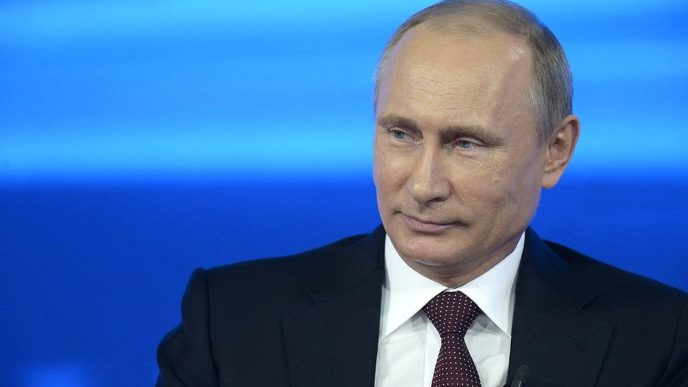
PUTIN THE PUNDIT: Tells Dems Why They Lost, Reaches out to Trump

Russian President Vladimir Putin followed up a warm letter to Donald Trump with a more terse message for U.S. Democrats Friday: Don’t blame me for your November drubbing.

President-elect Trump on Friday released the Dec. 15 note from Putin, who Democrats blame for tilting the election Trump won against Hillary Clinton, and called it a “very nice letter.”

In it, Putin wished Trump “warmest Christmas” greetings and expressed hope that Trump would “bring our level of collaboration on the international scene to a qualitatively new level” . . .

But Putin, in a year-ending address from Moscow Friday, had a different message for Democrats as he offered his analysis of the American political scene.

“Democrats are losing on every front and looking for people to blame everywhere,” he said. “They need to learn to lose with dignity. (Read more from “PUTIN THE PUNDIT: Tells Dems Why They Lost, Reaches out to Trump” HERE)

Follow Joe Miller on Twitter HERE and Facebook HERE.

Hillary’s Secret Ties to Putin Will Undermine American Interests

Russia’s malignant influence on American foreign policy is finally becoming a relevant issue in the 2016 presidential election, and that is definitely a positive development. Based upon their actions and associations, neither candidate has shown a sufficient understanding of — or worse, they have ignored — the nature of the Russian regime and its threat to America’s national interest. These deficiencies ought to be of grave concern to the American people.

As the Government Accountability Institute lays out in a recent report, Hillary Clinton’s dealings with Russia while serving as secretary of State appear to represent the worst kind of cronyism: sacrificing America’s national interest for her own and Russia’s benefit. As the Executive Summary of the report explains:

A major technology transfer component of the Russian reset overseen by Hillary Clinton substantially enhanced the Russian military’s technological capabilities, according to both the FBI and the U.S. Army.

Russian government officials and American corporations participated in the technology transfer project overseen by Hillary Clinton’s State Department that funnelled (sic) tens of millions of dollars to the Clinton Foundation.

The report also notes that Hillary’s presidential campaign chairman, Tony Podesta, had dubious ties with the Russian regime:

A Putin-connected Russian government fund transferred $35 million to a small company with Hillary Clinton’s campaign chairman John Podesta on its executive board, which included senior Russian officials.

John Podesta failed to reveal, as required by law on his federal financial disclosures, his membership on the board of this offshore company.

Podesta also headed up a think tank which wrote favorably about the Russian reset while apparently receiving millions from Kremlin-linked Russian oligarchs via an offshore LLC.

Building upon Peter Schweizer’s work in his book, “Clinton Cash,” The New York Times revealed another alleged quid pro quo detrimental to America’s national interest — but again, benefitting Hillary and Russia — with the infamous Uranium One deal.

Recall that the Russians took control of Uranium One and thus one-fifth of all U.S. uranium production capacity through three separate transactions between 2009 and 2013. Given the strategic importance of uranium, authorizing Russian control required the approval of various government agencies, including Hillary’s State Department.

Meanwhile, the Clinton Foundation received contributions totaling more than $100 million from Uranium One’s chairman and several of its shareholders in addition to those with ties to Uranium One or UrAsia, which had originally acquired Uranium One’s valuable Kazakh mine assets. Secretary Clinton also received $500,000 for a speech she gave at Renaissance Capital — a Kremlin-linked investment bank, which had recommended purchasing Uranium One stock soon after the Russians announced their intent to acquire a majority stake in the company.

Just how far back does the Clinton-Kremlin connection go? It’s worth investigating.

Concerning Donald Trump, even if we were gracious and excused his praise of Vladimir Putin as mere rhetoric (intended as a dig at Barack Obama and by extension Hillary), or just “Trump being Trump,” his substantive actions and associations are more troubling.

Even though the Trump campaign contributed little to the 2016 Republican Party platform changes, despite protestations to the contrary it did intervene regarding language about American support for Ukraine against Russian aggression. Trump officials reportedly watered down a portion of the platform calling for GOP support of “providing lethal defensive weapons” to the Ukrainians in the face of Russian intervention, replacing the phrase with the softer provision, “appropriate assistance.”

Previously, Trump wavered on whether the U.S. would fulfill its North Atlantic Treaty Organization (NATO) obligations to defend Baltic nations against Russian aggression, giving a standoffish response to The New York Times that amounted to the following: I would not tell Vladimir Putin what we would do in the event of Russian intervention in the Baltics, but we cannot ignore the fact that irrespective of our own treaty obligations, NATO members must fulfill their obligations in terms of funding NATO.

Again, we could charitably chalk this up to mere rhetoric, consistent with Trump’s narrative on globalism and deal-making. By Trump’s logic, NATO is just another international deal in which America has gotten ripped off by freeloader nations, and Trump will be the only negotiator that drives a hard enough bargain to fix the deal — including threats to not fulfill its terms.

Leaving aside the not-so-small issue of honoring treaties, the central problem here is that NATO’s purpose is, in large part, to counter Russia. And Trump’s advisors have significant ties to that nation, casting a pall over everything Trump says and does relating to it.

Trump campaign chairman, Paul Manafort, has done substantial work for Viktor Yanukovych — former president of Ukraine and backed by Putin. That Yanukovych pulled Ukraine closer into Putin’s orbit is well-documented. Manafort has also partaken in business dealings with oligarchs loyal to Putin.

Trump’s advisor on Russia, Carter Page, is a big investor in Gazprom, an energy company and one of the crown jewels of Putin’s kleptocracy. Page has railed against U.S. foreign policy towards Russia with all manner of calumnies — notably at times while in Russia — and called for the easing of sanctions against Russia that affected Gazprom and other companies.

Trump’s personal and professional ties to Russia, though worthy of scrutiny, raise fewer red flags than those of Hillary.

What does Russia itself actually want out of the 2016 presidential election?

On its face, it would appear that Russia seeks to damage Hillary, while promoting Trump. (For more from the author of “Hillary’s Secret Ties to Putin Will Undermine American Interests” please click HERE)

Follow Joe Miller on Twitter HERE and Facebook HERE.

Putin May Be on the Verge of Launching ‘Open War’ on Ukraine, Experts Warn

Russian President Vladimir Putin’s latest accusations against Ukraine and military mobilizations on the Crimean-Ukrainian border is causing alarm among Western analysts.

“Preparations for conventional conflict between Russia and Ukraine are accelerating and the likelihood of open war is increasing rapidly,” The Institute for the Study of War (ISW) noted Thursday. The think tank’s stark warning comes after Russia’s state security service accused Ukraine of sponsoring terrorism plots inside occupied Crimea that killed two Russian soldiers in separate incidents.

Putin escalated the accusation, saying ominously, “We obviously will not let such things slide by,” according to the New York Times. Ukraine’s government has denied any incursion into Crimea and dismissed Putin’s claims, but the country did put its troops on the highest state of readiness.

“Putin may be seeking to trigger a political crisis in Kyiv designed to topple Ukrainian President Petro Poroshenko,” ISW further speculated. “The situation for now, however, is moving clearly in the direction of open conflict between Ukrainian and Russian forces in Donbas or elsewhere in Ukraine.”

Russia illegally annexed Crimea in 2014, taking advantage of civil unrest in Ukraine. Russia also sponsors an active separatist movement in eastern Ukraine, and has deployed its own troops under false uniforms to fight the Ukrainian military. Russia is under international sanction by the U.S. and EU for its behavior in Ukraine. (Read more from “Putin May Be on the Verge of Launching ‘Open War’ on Ukraine, Experts Warn” HERE)

Follow Joe Miller on Twitter HERE and Facebook HERE.

How Putin Hoodwinked the Political Right

It’s easy to see why Vladimir Putin has emerged as the lodestar of certain elements of the political right across the West. Russia’s president poses as the champion of nationalism vs. rampant transnationalism, of Christianity vs. secularism, and of European identity in general.

These are battles that set conservatives’ teeth on edge. The political left in the West has for decades been relentless in its support for global governance, for limiting Christianity’s moral imprint on policymaking, and for stigmatizing the West in general.

But conservatives can certainly find a better champion for these causes than the former KGB agent who publicly pines for the supranational Soviet Union, presides over a society replete with social ills, and does not miss an opportunity to promote Russia not as a Western power but as an Asian one.

It is an astonishing trifecta that Putin has worked very hard to accomplish.

On transnationalism, for example, Putin has posed as an enthusiastic supporter of the United Kingdom leaving that most dysfunctional of supranational organizations, the European Union. “No one likes to feed and subsidize weaker countries and be a caretaker all the time,” Interfax quoted Putin as saying.

On Christianity, when Metropolitan Hilarion of the Russian Orthodox Church pleaded with Putin to become the defender of the Christian faith around the world, Putin reassured him that “you needn’t have any doubt that that’s the way it will be,” according to Russia’s Interfax.

With religion, Putin is relying on more than his own propaganda. Since the 1500s, Russia has put forward the vague notion that it is the “Third Rome”—the rightful successor to Rome and Byzantium as the center of Christianity. The claim was supposedly first made by the monk Filofei of the Pskov-Eliazarov monastery in two epistles which, unsurprisingly for Russia, have gone missing.

Fast forward five centuries, and Putin’s vow to Hilarion was enthusiastically endorsed by Washington evangelical outlet Christian Post, which explained that “Putin has long been a supporter of Christianity and Christian values within Russia.”

When visiting Hungary’s Prime Minister Victor Orban this year, Putin praised his anti-immigrant positions by stating that what Orban was doing was “to defend European identity.” That, he said according to a translation by RT, “is likable to us.”

Small wonder perhaps that Europe’s right-wing leaders are smitten with Putin, seeing in him the leader who will defend Europe from the spiritual decadence they accuse the United States of spreading. The leader of France’s anti-immigrant National Front, Marine Le Pen, recently said of Putin that “we are defending common values … the Christian heritage of European civilization.”

Even Putin’s main protégé in the Mideast, the Syrian dictator Bashar Assad, says piously that “Vladimir Putin is the sole defender of Christian civilization one can rely on.”

At home, Putin uses this international support to show his conservative bona fides. “We know that there are more and more people in the world who support our position on defending traditional values that have made up the spiritual and moral foundation of civilization in every nation for thousands of years: the values of traditional families, real human life, including religious life, not just material existence but also spirituality,” he told the federal assembly in 2013. “Of course, this is a conservative position.”

When it suits him.

As the Tory policy adviser Peter Franklin puts it, “If Putin wants to be seen as a defender of ‘traditional values’ and ‘spirituality,’ then why the diplomatic coziness with the likes of China, Cuba, and North Korea? There’s nothing spiritual about a communist dictatorship.” Or the butcher Assad, for that matter.

“The whole thing is a joke,” said David Kramer, a Russian expert who served as former assistant secretary of state for democracy, human rights and labor. “The only thing that matters to Putin is staying in power.”

Putin in fact seems more of the school of Kremlin leaders who feel more the gravitational pull of the other half of Russia’s identity—the Asian part, like Joe Stalin telling a Japanese diplomat once, “Russia is an Asiatic country, and I am myself an Asiatic.”

Thus Putin has pursued a “Eurasian Union” that brings together European former Soviet republics such as Belarus and Armenia with non-European ones such as Kazakstan, Kyrgyzstan, and Tajikistan. It’s been envisioned as a customs union, but Putin has more grandiose plans. “We suggest a powerful supranational association capable of becoming one of the poles in the modern world,” he wrote in 2011.

The union has foundered, but that has only made Putin reach further east. Last month he actually proposed to Beijing to expand the Eurasian Union by including China, India, Iran, and Pakistan.

Even the Putin-controlled RBTH observed five years ago that “he seems more comfortable at Shanghai Cooperation Organization and BRICS meetings than he is at the G8. ‘The West treats us like we just came down from the trees,’ Putin once remarked.”

At home, Putin presides over a nation that is hardly puritanical. Russia has the world’s highest divorce rate, the highest rate of injecting drug users, and one of the highest rates of alcoholism in Europe, while abortions last year reached almost a million. Unsurprisingly, Russia population has declined under Putin.

Observers point out that the support Putin receives from some quarters may have less to do with policy than with the fact he finances many of these parties. In France, Le Pen’s Front National has received at least 40 million euros from Russian-controlled banks. According to a paper, far-right parties from Hungary to Bulgaria to Austria all receive funding from Putin-controlled entities.

Equally, it comes in handy that Russian disinformation campaigns have succeeded in spreading Moscow’s propaganda throughout the West, through such outlets as RT. (For more from the author of “How Putin Hoodwinked the Political Right” please click HERE)

Follow Joe Miller on Twitter HERE and Facebook HERE.

Putin: Russia Will Consider Tackling NATO Missile Defense Threat

(Editor’s note: the original publisher of this article, RT News, is funded by the Russian government) Russia is being forced to look for ways to neutralize threats to its national security due to deployment of the NATO anti-missile shield in Europe, Russian President Vladimir Putin said after the alliance launched a missile defense site in Romania.

“Now, after the deployment of those anti-missile system elements, we’ll be forced to think about neutralizing developing threats to Russia’s security,” Putin said.

The US missile shield in Europe is a clear violation of Russian-American arms treaties, Putin said at a meeting with Russian military officials, adding that the anti-missile facilities can be easily repurposed for firing short and midrange missiles.

The US anti-missile shield in Europe is yet another step in increasing international tensions and launching a new arms race, he stressed.

“We’re not going to be dragged into this race. We’ll go our own way. We’ll work very accurately without exceeding the plans to finance the re-equipment of our Army and Navy, which have already been laid out for the next several years,” Putin said. (Read more from “Putin: Russia Will Consider Tackling NATO Missile Defense Threat” HERE)

Follow Joe Miller on Twitter HERE and Facebook HERE.

Trump Dodges on Whether He’s Met With Vladimir Putin: ‘I Don’t Want to Say’ [+video]

Presumptive Republican presidential nominee Donald Trump wouldn’t say Wednesday whether he had ever met with or spoken to Russian president Vladimir Putin.

CNN’s Wolf Blitzer asked him about Russian fighter jets buzzing U.S. ships, the latest in a series of military provocations by Russia . . .

“Have you ever met with Putin? Have you ever spoken with him?” Blitzer asked.

“Uh, I don’t want to say,” Trump said. “But I think I’ll have a good relationship with him. Now, I may not. I’ll know pretty quickly, but I would call him and say, ‘Don’t ever do it again. Don’t ever do that again’ . . .

Putin and Trump have exchanged pleasantries through the media. Putin called Trump “bright and talented” late last year, and he responded on Morning Joe that Putin is a “leader” and the compliment meant a lot coming from someone who “heads up Russia.” That statement even puzzled MSNBC host Joe Scarborough, who pointed out Putin’s authoritarianism and reported history of killing journalists. (Read more from “Trump Dodges on Whether He’s Met With Vladimir Putin: ‘I Don’t Want to Say'” HERE)

Follow Joe Miller on Twitter HERE and Facebook HERE.
Obama Did Not Press Putin on Recent Military Provocations

Vladimir PutinPresident Obama did not raise Russian military provocations against a Navy warship and Air Force intelligence jet last week during a Monday phone call with Russian President Vladimir Putin, the White House disclosed Monday.

White House Press Secretary Josh Earnest said the president had “an intense discussion” by telephone with Putin, but not about two dangerous aerial actions by Russian warplanes.

The conversation instead was limited to Russian activities in Ukraine, where Moscow has militarily annexed Ukraine’s Crimean Peninsula, and the conflict in Syria.

“We have ample opportunities to express our concerns about these kinds of provocative actions to the Russians and it did not necessitate a presidential level conversation,” Earnest told reporters at the White House.

Two Russian Su-24 jets buzzed the guided missile destroyer USS Donald Cook in the Baltic Sea on April 14, flying dangerously close to the ship as it was conducting operations. (Read more from “Obama Did Not Press Putin on Recent Military Provocations” HERE)

Follow Joe Miller on Twitter HERE and Facebook HERE.

Vladimir Putin: Russia’s Army is Unstoppable

By Paul Hosford. Russia’s President Vladimir Putin has said that his country’s military is unstoppable.

Interfax quotes Putin as making the remark in the buildup to next week’s Defenders of the Fatherland Day.

“No one should have the illusion that they can gain military superiority over Russia, put any kind of pressure on it.

“We will always have an adequate answer for any such adventures.”

He said that the country’s soldiers had proven themselves. (Read more about Putin saying the army is unstoppable HERE)

_______________________________________________________

Putin the ‘Wife Beater’

By Allan Hall. Russian President Vladimir Putin is ‘terrified’ of growing old and has undergone a facelift to give him a ‘young, dynamic appearance’, according to a documentary.

The German programme also claims that the 62-year-old beat his former wife Lyudmila, and has ‘incredible delusions [of] control’ after surviving five assassination attempts in recent years.

Other more bizarre claims include how he sleeps in late and works only in the afternoon after breakfasting on cottage cheese.

He then takes hot and cold baths, followed by a session in a gym filled with expensive American sports equipment to hone his figure.

Biographer Ben Judah told the documentary: ‘Putin is afraid of physical decay, he is afraid of ageing.’ (Read more from this story HERE)

Follow Joe Miller on Twitter HERE and Facebook HERE.