Posts

Massive Volcano Eruption in Spain Causes Thousands To Flee

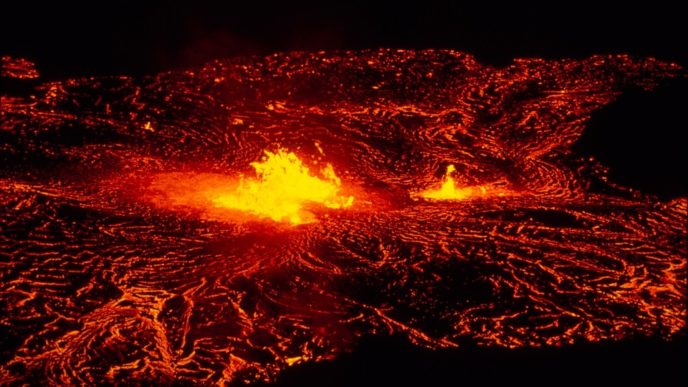
A volcano erupted on Spain’s Atlantic Ocean island of La Palma on Sunday afternoon — forcing the evacuation of about 5,000 people from their homes that were threatened by lava flows.

Some of the homes have already been destroyed following the 3 p.m. eruption on the southern end of the island that sent huge red plumes of magma into the sky.

New eruptions continued into the night and came after a weeklong buildup of seismic activity in the area.

About 5,000 people evacuated from their homes, according to Victor Torres, president of the Canary Island. . .

La Palma has a population of 85,000. It is one of eight volcanic islands in Spain’s Canary Islands archipelago off Africa’s western coast. (Read more from “Massive Volcano Eruption in Spain Causes Thousands To Flee” HERE)

Delete Facebook, Delete Twitter, Follow Restoring Liberty and Joe Miller at gab HERE.

Volcano Mystery: Researchers Were Baffled by ‘Supervolcano’ Discovery in Alaska

Alaska has been in the headlines in recent days after its Great Sitkin volcano erupted last week. Last Thursday, the US Geological Survey said a red warning had been raised – indicating that significant emission of volcanic ash into the atmosphere is likely. The Alaska Volcano Observatory said a “short-duration” explosive eruption of one-two minutes occurred at 5:04 GMT on Thursday, resulting in an ash cloud up to 15,000 feet above sea level. . .

Researchers have been compelled by volcanic activity in the region and were stunned when they found what could be a supervolcano in Alaska’s Aleutian islands.

The cluster of volcanic islands could be a single giant volcano similar to that of the Yellowstone Caldera, an American Geophysical Union study said in December last year.

John Power, a geophysicist at the US Geological Survey’s Alaska Volcano Observatory, said the super-volcano would be so big, it could have disrupted civilisations around the world.

Diana Roman of the Carnegie Institution for Science in Washington, DC, co-author of the study, added: “We’ve been scraping under the couch cushions for data. (Read more from “Volcano Mystery: Researchers Were Baffled by ‘Supervolcano’ Discovery in Alaska” HERE)

Delete Facebook, Delete Twitter, Follow Restoring Liberty and Joe Miller at gab HERE.

Volcanic Region Gets Hot After Being ‘Inactive for Many Centuries’

A region of Iceland is erupting for the first time in 800 years, raising concern of disruptions in air travel for centuries to come.

The Guardian of London reported that since Jan. 21, the Reykjanes peninsula southwest of Iceland’s capital, Reykjavik, has experienced more than 8,000 earthquakes. About 10 centimeters of land has risen due to magma intrusions underground, the paper said.

“It seems that after being relatively inactive for many centuries, this region is waking up,” Lancaster University volcanologist Dave McGarvie told the Guardian.

The area is fed by five volcanic systems, the Guardian said, “which seem to come to life in a coordinated way roughly every 1,000 years.” . . .

Meanwhile, Indonesia’s Krakatoa volcano erupted over the weekend, sending ash almost 10 miles into the sky. (Read more from “Volcanic Region Gets Hot After Being ‘Inactive for Many Centuries'” HERE)

Follow Joe Miller on Twitter HERE and Facebook HERE

Scientists: Supervolcano Risks High, Would Guarantee Mass Starvation, Worldwide; But NASA Has ‘Solution’

Government officials have been closely monitoring the activity in the Yellowstone caldera. However, scientists at NASA have now come up with an incredibly risky plan to save the United States from the supervolcano.

A NASA scientist has spoken out about the true threat of super volcanoes and the risky methods that could be used to prevent a devastating eruption. Lying beneath the tranquil and beautiful settings of Yellowstone National Park in the US lies an enormous magma chamber, called a caldera. It’s responsible for the geysers and hot springs that define the area, but for scientists at NASA, it’s also one of the greatest natural threats to human civilization as we know it.

Brian Wilcox, a former member of the NASA Advisory Council on Planetary Defense, shared a report on the natural hazard that hadn’t been seen outside of the agency until now. Following an article published by BBC about super volcanoes last month, a group of NASA researchers got in touch with the media to share a report previously unseen outside the space agency about the threat Yellowstone poses, and what they hypothesize could possibly be done about it.

“I was a member of the NASA Advisory Council on Planetary Defense which studied ways for NASA to defend the planet from asteroids and comets,” explains Brian Wilcox of Nasa’s Jet Propulsion Laboratory (JPL) at the California Institute of Technology. “I came to the conclusion during that study that the supervolcano threat is substantially greater than the asteroid or comet threat.”

Yellowstone currently leaks about 60 to 70 percent of its heat into the atmosphere through stream water which seeps into the magma chamber through cracks, while the rest of the heat builds up as magma and dissolves into volatile gasses. The heat and pressure will reach the threshold, meaning an explosion is inevitable. When NASA scientists considered the fact that a supervolcano’s eruption would plunge the earth into a volcanic winter, destroying most sources of food, starvation would then become a real possibility. Food reserves would only last about 74 days, according to the UN, after an eruption of a supervolcano, like that under Yellowstone. And they have devised a risky plan that could end up blowing up in their faces. Literally.

Wilcox hypothesized that if enough heat was removed, and the temperature of the supervolcano dropped, it would never erupt. But he wants to see a 35% decrease in temperature, and how to achieve that is incredibly risky. One possibility is to simply increase the amount of water in the supervolcano. As it turns to steam, the water would release the heat into the atmosphere, making global warming alarmists tremble.

“Building a big aqueduct uphill into a mountainous region would be both costly and difficult, and people don’t want their water spent that way,” Wilcox says. “People are desperate for water all over the world and so a major infrastructure project, where the only way the water is used is to cool down a supervolcano, would be very controversial.”

So, NASA came up with an alternative plan. They believe the most viable solution could be to drill up to 10km down into the supervolcano and pump down water at high pressure. The circulating water would return at a temperature of around 350C (662F), thus slowly day by day extracting heat from the volcano. And while such a project would come at an estimated cost of around $3.46 billion, it comes with an enticing catch which could convince politicians (taxpayers) to make the investment.

“Yellowstone currently leaks around 6GW in heat,” Wilcox says. “Through drilling in this way, it could be used to create a geothermal plant, which generates electric power at extremely competitive prices of around $0.10/kWh. You would have to give the geothermal companies incentives to drill somewhat deeper and use hotter water than they usually would, but you would pay back your initial investment, and get electricity which can power the surrounding area for a period of potentially tens of thousands of years. And the long-term benefit is that you prevent a future supervolcano eruption which would devastate humanity.”

Of course, drilling into a supervolcano comes with its own risks, like the eruption that scientists are desperate to prevent. Triggering an eruption by drilling would be disastrous.

“The most important thing with this is to do no harm,” Wilcox says. “If you drill into the top of the magma chamber and try and cool it from there, this would be very risky. This could make the cap over the magma chamber more brittle and prone to fracture. And you might trigger the release of harmful volatile gases in the magma at the top of the chamber which would otherwise not be released.”

The cooling of Yellowstone in this manner would also take tens of thousands of years, but it is a plan that scientists at NASA are considering for every supervolcano on earth. (For more from the author of “Scientists: Supervolcano Risks High, Would Guarantee Mass Starvation, Worldwide; But NASA Has ‘Solution'” please click HERE)

Follow Joe Miller on Twitter HERE and Facebook HERE.

Is Mount St Helens About to Erupt?

Its scarred and jagged crater is a reminder of the terrible devastation that Mount St Helens wrought over the Washington countryside 35 years ago.

Now a new study of the volcanic plumbing lurking beneath the 8,363ft (2,459 metre) summit suggests the volcano could yet again blow its top in an explosive eruption.

Geologists studying the volcano, which is responsible for the most deadly eruption in US history, have discovered a second enormous magma chamber buried far beneath the surface.

This giant pool of molten rock, which lies between seven to 25 miles (40km) below the surface, is connected to a slightly smaller chamber that lies directly beneath the mountain . . .

They said a series of distinct earthquakes in the months leading up to the massive eruption on 18 May 1980, which killed 57 people, may have been caused by the pumping of magma from the lower to the upper chamber. (Read more from “Is Mount St Helens About to Erupt?” HERE)

Follow Joe Miller on Twitter HERE and Facebook HERE.

Signs of the Times: Data Proves Earthquake and Volcano Activity IS Increasing

a-eruptionsThe Costa Rica News (TCRN) – If it seems like earthquakes and erupting volcanoes are happening more frequently, that’s because they are. Looking at global magnitude six (M6) or greater from 1980 to 1989 there was an average of 108.5 earthquakes per year, from 2000 to 2009 the planet averaged 160.9 earthquakes per year: that is a 38.9% increase of M6+ earthquakes in recent years.

The conspiracy theorists have been sounding alarms for some time about this with fingers pointing to HAARP technology, geo-engineering, electromagnetic waves in the ionosphere, etc. Mainstream scientists simple say they are hand-picking data sets and that in reality our monitoring systems have become better as well as the fact that there is more media reporting so it only appears to be an increasing number of seismic events on the globe.

The image below shows statistics from the United States Geological Survey’s (USGS) Earthquake Hazards Program showing a significant increase M6 and greater events:

earthquake-data2

The graph below shows the cumulative number of earthquakes M3 or greater in the mid-continental United States. The number of M3 or greater earthquakes increases steadily at about 21 events per year until around 2000, when it increases about 50% to 31 events per year. By 2008, the number increased sharply to about 151 events per year . . .

earthquake-data3

Unrest also seems to be growing among the worlds super-volcanoes. Iceland (which is home to some of the most dangerous volcanoes on the planet), Santorini in Greece, Uturuncu in Bolivia, the Yellowstone and Long Valley calderas in the U.S., Laguna del Maule in Chile, Italy’s Campi Flegrei – almost all of the world’s active super-volcanic systems are now exhibiting some signs of inflation, an early indication that pressure is building in these volcanic systems. (Read more from “Yes, Earthquake and Volcano Activity IS Increasing” HERE)

______________________________________________________

Shift: Volcanic Eruptions Increasingly Becoming More Aggressive and Violent

By The Extinction Protocol. We are beginning to witness more aggressive activity from the world’s eruptive volcanic systems. Chile’s Calbuco, Peru’s Ubinas volcano, Indonesia’s Mt. Sinabung volcano, Mexico’s Colima volcano, and Costa Rica’s Turrialba volcano are not the only volcanoes ejecting high altitude ash plumes in more powerful eruptions these days – the list of volcanoes across the globe now experiencing similar simultaneous activity is growing. Volcanic activity as documented for April 27, 2014:

Karymsky (Kamchatka): (27 Apr) An explosion occurred this morning that was strong enough to produce an ash plume to approx. 10,000 ft (3 km) altitude (VAAC Tokyo).

Sakurajima (Kyushu, Japan): (27 Apr) Strong activity continues from the volcano. This morning (14:24 local time), an explosion at the Showa crater sent a plume to 15,000 ft (4.5 km) altitude that drifted north.

Manam (Papua New Guinea): (27 Apr) Eruptive activity is taking place at the volcano. VAAC Darwin reported an ash plume to 8,000 ft from the volcano this morning. A pronounced SO2 plume can be seen on satellite data as well.

Dukono (Halmahera): (27 Apr) The volcano continues to produce significant ash emissions – a plume extending 20 nautical miles E was observed Saturday (Darwin VAAC).

Barren Island (Indian Ocean): (27 Apr) A pilot reported an ash plume rising to 10,000 ft from the volcano. Likely, eruptive activity which had produced a new lava flow in March is still going on or has resumed.

(See “Shift: Volcanic Eruptions Increasingly Becoming More Aggressive and Violent”, originally posted HERE)

Follow Joe Miller on Twitter HERE and Facebook HERE.

Alaska Volcanic Eruption Intensifies; Lava Advances in Hawaii

Photo Credit: LA Times

Photo Credit: LA Times

A volcano in the Alaska Peninsula launched an ash plume 30,000 feet into the air on Saturday morning, while officials in Hawaii say lava continues to advance on a town that has been sitting in the path of a slow-moving molten slide since June.

Mt. Pavlof, which has been erupting since Wednesday, continues to see intense seismic activity, and pilots in the area were reporting ash clouds as high as 30,000 feet above sea level, according to the state’s volcano observatory.

The Federal Aviation Administration has yet to impose flight restrictions in the area, according to spokesman Ian Gregor, but the agency did issue several notices to pilots regarding the eruption.

Read more from this story HERE.

Alaska Volcano Erupts with New Intensity, Prompting ‘Red’ Alert

Photo Credit: REUTERS / PAUL HORN / ALASKA DEPARTMENT OF FISH AND GAMEAn Alaska volcano that has been spewing ash and lava for years began erupting with new intensity this week, pushing a plume of smoke and ash as high as 24,000 feet (7,315 meters) and prompting scientists to issue their highest volcanic alert in five years, authorities said on Tuesday.

But the intense action at the Pavlof Volcano, located in an uninhabited region nearly 600 miles (966 km) southwest of Anchorage, has so far not disrupted any regional air traffic, thanks to favorable weather that has made it easier for flights to navigate around the affected area.

Still, the eruption was intense enough for Alaska Volcano Observatory scientists to issue their first red alert warning since 2009, when the state’s Mount Redoubt had a series of eruptions that spewed ash 50,000 feet (15,240 meters).

Read more from this story HERE.

How Did the Pakistan Earthquake Create a Mud Island?

Photo Credit: Gwadar Government/AP

Photo Credit: Gwadar Government/AP

On Tuesday, a 7.7-magnitude earthquake struck a remote part of western Pakistan, killing more than 260 people and displacing hundreds of thousands. It also triggered formation of a new island off the coast, which has quickly become a global curiosity.

But scientists say the island won’t last long.

“It’s a transient feature,” said Bill Barnhart, a research geophysicist with the U.S. Geological Survey. “It will probably be gone within a couple of months. It’s just a big pile of mud that was on the seafloor that got pushed up.”

Indeed, such islands are formed by so-called mud volcanoes, which occur around the world, and Barnhart and other scientists suspect that’s what we’re seeing off the Pakistani coast.

News organizations have reported that the Pakistani island suddenly appeared near the port of Gwadar after the quake. The island is about 60 to 70 feet (18 to 21 meters) high, up to 300 feet (91 meters) wide, and up to 120 feet (37 meters) long, reports the AFP.

Read more from this story HERE.

Alaska Volcano’s Ash Prompts Flight Cancellations

Photo Credit: APAn Alaska volcano eruption is prompting regional airlines to cancel flights to nearby communities, including a town that reported traces of fallen ash.

Pavlof Volcano released ash plumes as high as 22,000 feet over the weekend, according to the Alaska Volcano Observatory. Clouds obscured the volcano Monday, but U.S. Geological Survey scientists said seismic instruments at the volcano show continuing tremors.

“Seismically, it’s been pretty steady over the last 12 hours,” geologist Chris Waythomas said late Monday morning.

The abrasive ash has not risen enough to threaten international air traffic passing over the volcano-rich Aleutian arc, Waythomas said. Ash emissions have gone high enough, however, to affect flights of some smaller planes.

Anchorage-based regional carrier Penair has canceled a dozen passenger and cargo flights to several remote communities since Sunday afternoon. The communities include Sand Point, which reported a dusting of ash Sunday.

Read more from this story HERE.