The State Department can find no emails to or from a former Hillary Clinton aide who worked for the agency and also managed Clinton’s private computer server while she served as secretary of state, the government told a Republican party group in a court filing made public Monday. The agency insisted later that some messages to and from the ex-aide were recovered and turned over in other inquiries.
The government’s revelation in U.S. District Court in Washington came in answer to a lawsuit by the Republican National Committee. The committee had sued over its public records request for all work-related emails sent to or received by Clinton’s former aide, Bryan Pagliano, between 2009 and 2013, the years of Clinton’s tenure. The lawsuit also pressed for other State Department records from the Clinton era.
The RNC’s filing said lawyers for the agency had informed them in discussions that “the State Department has represented that no responsive records exist” for any Pagliano emails. Pagliano was hired at the agency after reportedly setting up Clinton’s server in 2009, but the lack of any official State Department emails raises the question whether he limited his email traffic using a private account, much like Clinton did during her four years as secretary, or whether his government emails were deleted. (Read more from “Emails From Clinton’s Former IT Director at State Department Appear to Be Missing” HERE)
https://joemiller.us/wp-content/uploads/maxresdefault-11.jpg7201200Joe Millerhttps://joemiller.us/wp-content/uploads/logotext.pngJoe Miller2016-05-10 01:10:302016-05-10 01:10:30Emails From Clinton’s Former IT Director at State Department Appear to Be Missing
A former North Korean military chief who Seoul had said was executed is actually alive and in possession of several new senior-level posts, the North’s state media said Tuesday.
The news on Ri Yong Gil marks yet another blunder for South Korean intelligence officials, who have often gotten information wrong in tracking developments with their rival. It also points to the difficulties that even professional spies have in figuring out what’s going on in one of the world’s most closed governments.
Ri, who was considered one of North Korean leader Kim Jong Un’s most trusted aides, missed two key national meetings in February. Seoul intelligence officials later said that Kim had him executed for corruption and other charges. (Read more from “Back From the Dead: Former North Korean General Believed Executed Turns up Alive” HERE)
https://joemiller.us/wp-content/uploads/maxresdefault-38.jpg7201280Joe Millerhttps://joemiller.us/wp-content/uploads/logotext.pngJoe Miller2016-05-10 00:33:172016-05-10 03:34:53Back From the Dead: Former North Korean General Believed Executed Turns up Alive
The Trump media surrogates have a quandary. They’re not sure whether to compare their man Donald Trump to Ronald Reagan, distinguish him from Reagan, or dismiss Reagan. It depends on the day and the subject. So they spin, and spin, and spin.
One area in which Trump can be nailed down is his overall view of trade. As I explained at Conservative Review, when it comes to Trump’s own financial dealings, he is an unrepentant globalist, from which he has made a fortune. But these days, as he runs for president, the billionaire is a radical protectionist who has repeatedly declared his intention to impose massive tariffs aimed at the economies of other countries, such as Japan and Mexico, and a forty-five percent tariff on products from China. Such broad tariffs would most certainly result in retaliation by the targeted countries. This is a sure job-killer that would also drive up costs of everyday products to low- and middle-class Americans. The net result: economic misery, not just for those hard-working, tax-paying Americans who work in industries that rely on international commerce and trade, but mostly everyone.
This is not Reaganism but Herbert Hooverism. And besides the economic impact, this would lead to empowering further centralized government — politicians, courts, and bureaucrats — and weakening further the private sector and individual liberty. This is precisely what occurred during the Great Depression. The federal government always gets more powerful under these conditions, which is among the reasons constitutional conservatives resist it.
Trump has also threatened Ford Motor Company, should it move forward with building a plant in Mexico. He has warned Apple Inc. against continuing to manufacture iPhones in China. Should he become president, Trump does not have the constitutional authority to manage and control private companies as if they are his own. But the Hugo Chavez-like rhetoric alone should concern freedom-loving Americans.
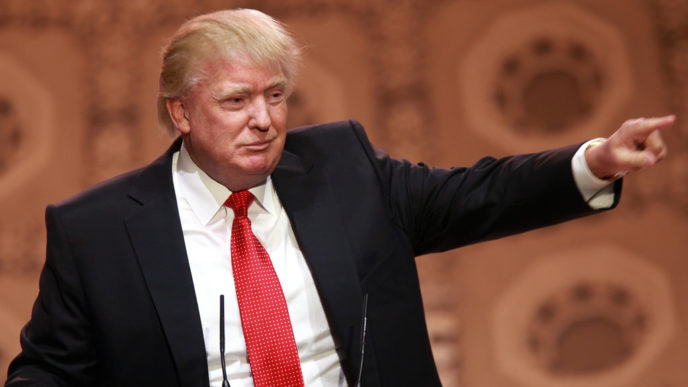
None of this seems to matter to professional Trump media surrogates, including Julia Hahn at Breitbart. Not only does she ignore these stunning Trump proclamations, she insists, for now anyway, that there really is no light between what Trump is saying and proposing and what Reagan said and did. Her premise is so thoroughly preposterous and her “arguments” so thin, I thought it worth a brief examination. Indeed, the opposite is true. Trump’s position on trade is more akin to socialist Bernie Sanders. As Trump explained to ABC’s George Stephanopoulos on Sunday, “I’m going to get Bernie [Sanders] people to vote, because they like me on trade.”
First, let’s look at the bogeyman, the trilateral agreement with the United States, Canada, and Mexico known as the North American Free Trade Agreement (NAFTA). Trump has said, “We will either renegotiate it or we will break it.” He has called it “a disaster.” Not only was Reagan a powerful advocate for such a trade arrangement, he is credited with giving it birth when he announced his candidacy for president in 1979. Reagan called for a “North American accord.” Indeed, in 1984, as a result of Reagan’s efforts, Congress passed the Trade and Tariff Act, giving the president “fast-track” authority to negotiate free trade agreements. And in 1988, the Canada-U.S. Free Trade Agreement, the predecessor to NAFTA, was signed. (It has since been overtaken by NAFTA, which includes Mexico.)
Reagan was so passionate about free trade generally, and NAFTA in particular, on September 13, 1993, he penned an op-ed for The Wall Street Journal, titled “Tear Down The Trade Wall,” urging the passage of NAFTA. Below is an excerpt, but I would encourage you to read it in full here. I raise this op-ed because of the extensive propaganda campaign underway to justify Trump’s protectionism by comparing him to Reagan:
For decades America has led freedom-seeking people around the world in their struggles to destroy and dismantle the oppressive barriers that divide countries and restrict liberty. Today, many of those battles have been fought and won — the barricades that once stood between countries no longer exist and their citizens are able to live together in freedom and prosperity. With this in mind, we, as Americans — as North Americans — are faced with a new challenge. The Cold War is over, and now we must break down the tariff walls that restrict the free flow of trade on our continent. The North American Free Trade Agreement can bring us that victory.
The reason for a free trade agreement is simple: Throughout history, whenever and wherever trade barriers have been lowered, the participating economies have flourished. Through Nafta, we will most certainly see a boost to the economic vitality of the U.S., Canada and Mexico. It will help mature and expand the North American economy, keeping us globally competitive.
Presidents of both political parties have embraced the North American Free Trade Agreement in order to forge a powerful bloc to compete in today’s global economy. Its history goes back even further. When I announced my candidacy for president in 1979, I believed in the potential for the world’s largest free trade zone and called for the creation of such a North American Accord.
We took a major step forward in 1988, when we were able to forge a historic trade agreement between the U.S. and Canada. This agreement cut tariffs and eliminated other trade barriers and, as a result, the world’s longest undefended border got a lot busier. Back then objections were raised, but the critics were proven wrong and our trade grew to a world record $175 billion — and our two-way investment also reached record levels.
Moreover, on August 6, 1983, in a radio address to the nation, Reagan spoke about the benefits of trade and the dangers of protectionism. He said, in part:
I’d like to talk to you today about trade — a powerful force for progress and peace, as you well know. The winds and waters of commerce carry opportunities that help nations grow and bring citizens of the world closer together. Put simply, increased trade spells more jobs, higher earnings, better products, less inflation, and cooperation over confrontation. The freer the flow of world trade, the stronger the tides for economic progress and peace among nations.
I’ve seen in my lifetime what happens when leaders forget these timeless principles. They seek to protect industries and jobs, but they end up doing the opposite. One economic lesson of the 1930’s is protectionism increases international tensions. We bought less from our trading partners, but then they bought less from us. Economic growth dried up. World trade contracted by over 60 percent, and we had the Great Depression. Young Americans soon followed the American flag into World War II.
No one wants to relive that nightmare, and we don’t have to. The 1980’s can be a time when our economies grow together, and more jobs will be created for all. This was the spirit of the Williamsburg summit in May. The leaders of the industrialized countries pledged to continue working for a more open trading system. But sometimes that’s easier said than done.
In 1986, under the General Agreements on Tariffs and Trade (GATT), Reagan started the Uruguay Round of multilateral trade negotiations. It culminated in lowering tariffs throughout the world and eventually the World Trade Organization. Over one hundred countries were signatories.
The Reagan record of promoting trade, through words and actions, abounds. Yet, not a single word of any of this was relayed to Hahn’s readers in her Breitbart piece comparing Trump to Reagan. In fact, she doesn’t quote Trump’s famous words either, when he told The New York Times, in part, “I would tax China on products coming in. I would do a tariff, yes — and they do it to us.” He said he’s “a free trader,” but that “it’s got to be reasonably fair.” “I would do a tax. And the tax, let me tell you what the tax should be … the tax should be 45 percent.” Forty-five percent on what? Not a single product or some products. But on all products coming from China and other unspecified tariffs aimed at Japan and Mexico.
Instead, Hahn cherry picks the occasions when Reagan did impose tariffs, which were rare and specific. For example, Hahn writes:
Reagan did not hesitate to impose duties, tariffs, and other trade fairness measures to enforce trade rules — the same measures which they now criticize Trump for supporting. Indeed, Reagan was harshly rebuked by so-called ‘free traders’ for taking ‘protectionist’ actions such as a 45% tariff on Japanese motorcycles to save the Harley-Davidson Motor Company of Milwaukee, Wisconsin. Reagan’s action seems similar to Trump’s call for a 45% tariff on Chinese imports.
Obviously, I’m familiar with these actions. I’ve even mentioned on my radio program that Reagan imposed certain tariffs. In fact, I’ve gone further. I have pointed out several times that the federal government imposes over 12,000 tariffs on products and the Federal Reserve manipulates our currency as well through a variety of techniques, most especially quantitative easing. I don’t believe much of this has been beneficial to our nation’s economy or hard-working low- and middle-income Americans. For all the attacks on free trade by the protectionists and Big Labor, the problem is the lack of it. More trade and commerce, along with cuts in regulations and individual and corporate income taxes, would contribute mightily to the nation’s economic expansion and job creation.
But a trade war is triggered when one country directs broad-based tariffs at another country, resulting in retaliation. And that’s what Trump is promoting. Again, as Reagan put it, referring to the 1930s,”No one wants to relive that nightmare, and we don’t have to.” Even when Reagan lifted the special tariff imposed on Japanese motorcycles, on May 16, 1987 he addressed the nation and emphasized the importance of trade and commerce, condemning protectionist legislation and warning of its consequences.
In 1985, and at other times, Reagan warned that he would veto protectionist legislation bouncing around Congress. He stated, “[S]o-called protectionism is almost always self-destructive, doing more harm than good even to those it’s supposed to be helping. … Protectionism almost always ends up making the protected industry weaker and less able to compete against foreign imports. … From now on, if the ghost of Smoot-Hawley rears its ugly head in Congress, if Congress creates a depression-making bill, I’ll fight it.” Indeed, Reagan was true to his word. In 1985, he vetoed legislation imposing tariffs on textiles, shoes, and copper.
In 1986, when the Democrat House passed another protectionist bill, the New York Daily News reported:
Employing some of his strongest language to date against the House-passed trade bill, President Reagan Thursday called the measure ‘kamikaze legislation’ and warned that it could send the economy ‘into the steepest nosedive since the Great Depression.’ Speaking to the National Association of Manufacturers, Reagan renewed his threat to veto the bill if it emerges from Congress in the same form that passed the House last week on a vote of 295-115. The measure would impose import restraints on countries such as Japan that maintain large trade surpluses with the United States.
It was killed in the Senate.
In 1987, as Congress was readying more protectionist legislation, Reagan warned against it. In 1988, as promised, Reagan vetoed another textile protectionist bill over Democrat Party objections.
Reagan said, in part, “It would impose needless costs on American consumers, threaten jobs in our export industries, jeopardize our overseas farm sales and undermine our efforts to obtain a more open trading system for U.S. exports. This bill represents protectionism at its worst.”
Now, let’s return to the premise of Hahn’s Breitbart piece. She launched her essay with this:
The members of the #NeverTrump movement cite, in part, Donald Trump’s position on trade as a reason why they cannot support their party’s presumptive nominee, chosen by Republican voters. They argue that Trump’s position on trade represents a betrayal of the Ronald Reagan legacy that defines virtually all thinking and rhetoric among the professional conservative class in Washington, D.C. However, there is one significant problem with this line of attack: namely, Reagan’s record on trade far more closely resembles Trump’s position than it resembles the view of those in the #NeverTrump movement. In fact, by their own definition, Reagan would have been a radical “protectionist”—meaning professional conservatives who are #NeverTrump would also have been for #NeverReagan.
The absurdity of Hahn’s piece is now clear, as is her rhetoric. Reagan’s approach to trade and commerce has very little in common with Trump’s positions. It is another weak effort to tie Trump to Reagan, the latter being an enormously popular and successful president. Her leader is no Reagan. He’s actually more Sanders, as he reaches out to the latter’s supporters. Perhaps Hahn will turn her attention to that? Don’t count on it.
Finally, some clean up. Hahn cites a CATO Institute piece condemning the Reagan trade record. Well, here’s a link to a CATO Institute piece praising it. So what? Then Hahn takes offense at my interview of Marco Rubio, throwing some red-meat out there for obfuscation purposes. What does that have to do with anything? Nothing. Chalk that up to immaturity. And among all the real experts and scholars she can cite for authority about the Great Depression, who’ve written at great length about the subject, she chooses Pat Buchanan as her source. At least she didn’t use Pat to defend Trump’s position on Israel, whatever it is.
As Trump apparently feels the Bern, moving left on the minimum wage, taxes, and trade, I would encourage liberty-loving Americans to insist that he demonstrate to us his worthiness to be president. He can count on his media surrogates no matter what, that’s quite obvious. But he has to persuade millions of others. Meanwhile, we will keep the pressure on him to support more freedom and less government. (For more from the author of “TRUMP ON TRADE: More Sanders Than Reagan” please click HERE)
https://joemiller.us/wp-content/uploads/25697590636_ea28f0ca4e_b.jpg6831024Joe Millerhttps://joemiller.us/wp-content/uploads/logotext.pngJoe Miller2016-05-10 00:25:452016-05-10 00:25:45TRUMP ON TRADE: More Sanders Than Reagan
TThis 80-year-old great-granny got a gun and wasn’t afraid to use it.
Barb Moles shot and killed a home intruder who beat her husband with a crowbar and stabbed him with a knife. She now tells a local televison station she is “not just the typical granny.”
“You know, never in my whole life did I ever anticipate having to take another life — especially at age 80,” Moles told KOMO-TV in Seattle, Wash., last week. “Give me a break here!”
Moles grabbed her gun, a .38-caliber pistol, when she saw her 75-year-old husband bleeding on the floor during a home invasion in their rural Sultan home around 8:30 p.m. on April 28.
"I just did what I had to do:" 80-year old great-grandma breaks silence after shooting & killing intruder. #KOMOnewspic.twitter.com/KRbTkU6NtT
Deputies said Steven Sheppard, 25, attacked Leland Moles after breaking into the couple’s home to steal drugs. (Read more from “Great-Granny, 80, Got a Gun, Kills a Home Intruder Who Attacked Husband” HERE)
https://joemiller.us/wp-content/uploads/maxresdefault-37.jpg10801920Joe Millerhttps://joemiller.us/wp-content/uploads/logotext.pngJoe Miller2016-05-10 00:10:172016-05-10 01:31:05Great-Granny, 80, Got a Gun, Kills a Home Intruder Who Attacked Husband
America’s restroom controversy won’t seem to go away. North Carolina has come under fire after it passed a law prohibiting city governments from passing “gender-neutral” bathroom laws.
What’s Going On?
As an earlier report at CR detailed, the city of Charlotte, N.C., moved to pass legislation that would have mandated a city-wide “gender-neutral” restroom policy for places of public accommodation. Citing safety and privacy concerns, the N.C. General Assembly passed a measure in March 2016 to prohibit local governments in the state from doing so. It was later signed by Governor McCrory.
Since then, PayPal said it is canceling plans to open an operating center in Charlotte, the National Basketball Association threatened to pull its 2017 All-Star Game from the state, and the United Kingdom issued a travel warning for LGBT Brits considering a visit to the area.
What Are the Safety Concerns?
While opponents have called North Carolina’s HB2 and South Carolina’s S.1203 “sweeping anti-LGBT” measures, proponents of the legislation have said the laws are based on safety concerns.
Some fear predators will use these gender-neutral policies to infiltrate restrooms of the opposite sex with ill intentions. Such instances have already occurred, many in places that do not have gender-neutral policies.
In 2015, a Virginia man was arrested and charged with three counts of unlawful filming of a non-consenting person and three counts of peeping after he allegedly dressed as a woman to gain access to women’s restrooms and changing rooms at local stores.
In February of 2016, a Seattle suburb was outraged after a man wearing nothing but board shorts walked into the women’s bathroom of a public pool. When she attempted to remove him from the facility, he refused, saying “the law has changed and I have the right to be here.”
Most recently, an undercover video captured by Project Veritas purportedly shows university officials at a North Carolina University ignoring undercover journalists’ claims of using such policies to peep on members of the opposite sex in multiple use facilities.
Why are People Asking to Use Different Restrooms in the First Place?
This question, the most misunderstood portion of the debate, requires a nuanced understanding of psychology, “gender dysphoria,” philosophy, and the distinction between the treatment of people and the treatment of ideas and policies.
The American Psychiatric Association defines “gender dysphoria” as having a “marked difference between [someone’s] expressed/experienced gender and the gender others would assign him or her.” Furthermore, the condition must “continue for at least six months” to reach the threshold of diagnosis.
Psychologists disagree about how to best treat this condition, which most LGBT advocates argue is a natural condition. Some say the only way to address it is to allow and encourage people to dress and act in accordance with their “expressed/experienced gender.” This includes using the restroom of the perceived gender, undergoing treatments that alter the human body, gender reassignment surgery, hormone therapy, and/or having government documents changed to indicate the expressed gender as fact.
Regardless of conservatives’ thoughts about the implications of these demands and the ongoing debate, there will continue to be people who represent themselves contrary to their biological sex in public, and they will have to use the facilities at some point.
What Does the N.C. “Bathroom Bill” Actually Do?
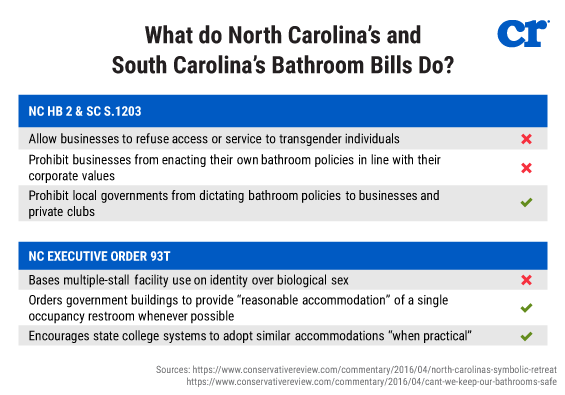
HB2 prohibits local governments in North Carolina from forcing places of public accommodation to allow people to use restrooms and changing facilities that do not align with their biological sex. Contrary to popular belief, it does not ban gender neutral facilities from private businesses, but merely puts a legislative fence around municipal governments.
An executive order issued by Gov. Pat McCrory clarifies that “when readily available and practicable in the best judgement of the agency, all cabinet agencies shall provide a reasonable accommodation of a single occupancy restroom, locker room or shower facility upon request, due to special circumstances.”
In essence, this makes a practical concession similar to the policies listed above, while still avoiding the concerns generated by removing biological sex regulations from multiple occupancy facilities.
What Does the Public Think?
A Reuters poll found a marked decline in the popularity of such policies following the recent firestorm over the issue, which includes a move to boycott Target retail stores over their self-imposed restroom policies.
Ethics and Public Policy Center’s Mona Charen—citing separate research—writes:
We’ve become so discombobulated that perfectly intelligent people will say, without noticing the contradiction, that homosexual behavior is an inborn trait, but the “male/female binary” is a socially constructed fiction.
The Fourth Circuit Court of Appeals has now ruled that a “transgender” 17-year-old must be permitted to use the bathroom of her imagined “gender identity” rather than her sex. “It’s easy to forget that these debates are about personal dignity,” scolded the New York Times.
There is nothing dignified about ratifying an unhappy person’s tragic misperception. What if the young person considered herself African American like Rachel Dolezal? Should she get preferences in college admission? Or what about Danny Almonte, who was 14 when he starred in the 2001 Little League tournament? If he felt 12, does that make it ok?
Furthermore, Kaely Triller, a rape survivor writes:
While I feel a deep sense of empathy for what must be a very difficult situation for transgender people, at the beginning and end of the day, it is nothing short of negligent to instate policies that elevate the emotional comfort of a relative few over the physical safety of a large group of vulnerable people.
Don’t they know anything about predators? Don’t they know the numbers? That out of every 100 rapes, only two rapists will spend so much as single day in jail while the other 98 walk free and hang out in our midst? Don’t they know that predators are known to intentionally seek out places where many of their preferred targets gather in groups? That perpetrators are addicts so committed to their fantasies they’ll stop at nothing to achieve them?
Do they know that more than 99 percent of single-victim incidents are committed by males? That they are experts in rationalization who minimize their number of victims? Don’t they know that insurance companies highlight locker rooms as a high-risk area for abuse that should be carefully monitored and protected?
Finally, a father of a six-year-old girl wrote of Target’s recent decision:
In response to the major retailer’s latrine call, hundreds of thousands of people pledged to boycott the store in just a few days.
Many people opposed to these policies have legitimate concerns about about how politicians are making laws about a psychological condition — especially when treatments have not been agreed upon — and the specifics of the policies.
What have other cities done?
Charlotte is far from the first American city to address the question of how people who identify and represent themselves as another sex are allowed to use public facilities. In fact, Philadelphia, Washington, D.C., West Hollywood and others have all adopted similar policies.
The approaches taken outside of Charlotte and Houston have managed to simultaneously satisfy recommendations made by both the Occupational Safety and Health Administration and the pro-LGBT Human Rights Campaign without sparking massive safety concerns that have been cited by opponents of the Charlotte/Houston model.
What’s Next?
The Charlotte/Houston model offers little benefit other than the implied societal acceptance of something that only seems to be agreed upon by LGBT activists. That being said, communities, municipalities, city councils, who are considering adopting such a public accommodation policy, might be to look and see what’s already been done in other cities to find a working model.
Either way, recent boycotts on the State of North Carolina, as well as counter-boycotts on businesses like Target will likely continue until public the issue reaches a point of “critical mass” that requires a compromise, or it will go the way of other similar controversies (remember the Chick-Fil-A boycott?) and fade into a distant memory. (For more from the author of “What You Need to Know About America’s Bathroom Controversy” please click HERE)
https://joemiller.us/wp-content/uploads/14045486678_2a249d6f86_b.jpg7681024Joe Millerhttps://joemiller.us/wp-content/uploads/logotext.pngJoe Miller2016-05-10 00:07:232016-05-10 01:32:27What You Need to Know About America’s Bathroom Controversy
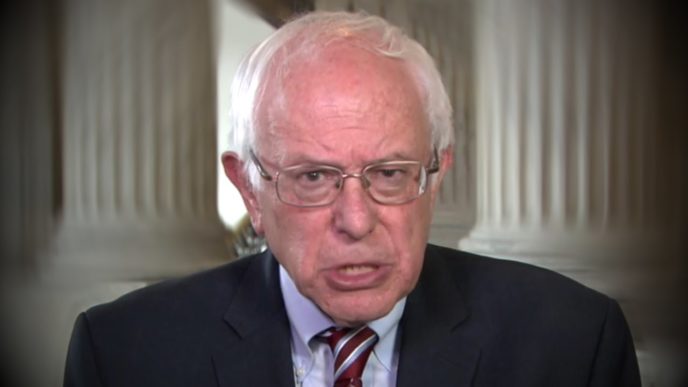
I agree with Bernie Sanders. That’s right. I said it. Never thought I would, did you?
I agree with Bernie Sanders when he rails against the corruption of big banks. I, like Bernie, opposed the government bailout of politically-connected Wall Street investment banks in 2008. At the time, it was a lonely and brave stance to take inside the Washington Beltway.
I also agree with Bernie Sanders that these politically-juiced banks are too big to fail; that TARP made the risky, over-leveraged ones bigger still. I agree with Bernie when he says that these banks pose a major threat to our economy.
I agree with Bernie Sanders’ demand that we audit the Federal Reserve, and I applaud his work with Rand Paul to demand accountability from this quasi-government, big bank slush fund. Bloomberg News reports that the Fed floated some $1.2 trillion to banks and other businesses from 2007 to 2010. That’s T-R-I-L-L-I-O-N. (And we wonder why Millennial Berners are now looking for a student loan bailout?) The manipulation of the value of the dollar and interest rates by the Federal Reserve is the most insidious kind of tax, transferring purchasing power from the working class to the most moneyed, politically-connected Americans.
I, like Bernie, worry about the political influence of big corporations. I am opposed to crony capitalism, the growing collusion of big businesses with big government. There’s nothing “free enterprise” about using politics to divide and reallocate taxpayer spoils to the benefit of particular corporations. We should always oppose regulatory favors, spending earmarks, and special access used to gain advantage over other business competitors.
I agree with Bernie Sanders’ critique of Hillary Clinton. I too worry about her cozy relationship with the well-heeled donors to the Clinton Foundation. What exactly did she and Bill promise them in return? What is the quid pro quo for, say, the Kingdom of Saudi Arabia?
Like Bernie Sanders, I oppose Hillary Clinton’s naive, bellicose, neoconservative approach to foreign intervention and nation-building. As a senator, Hillary voted to invade Iraq in 2002. I, like Bernie, opposed invading Iraq then, in the heat of the moment, believing that regime change there would be bad for American security. More recently, Hillary’s war in Libya has absolutely, unequivocally created more chaos in the region. Taking out Muammar Gaddafi, dirt bag that he was, has destabilized Libya, empowered our enemies, and made America less safe.
I absolutely agree with Bernie Sanders on the question of mass incarceration. Like Bernie, I know that federal meddling in our justice system, particularly imposing mandatory minimum prison sentences for nonviolent drug offenders, has been a disaster. Federal prison populations have exploded, fueled in large part by Bill (and Hillary) Clinton’s “tough on crime” bill in 1994. It was political posturing, not real justice reform, and now the United States jails more people per capita than any nation, save communist hell hole North Korea.
I agree with Bernie Sanders on all of these things, but he loses me when he moves beyond symptoms to solutions. The above listed problems are all examples of the unintended consequences of a political process that concentrates too much power and money in Washington, D.C. And yet Bernie consistently says the solution to virtually every real or perceived social problem can be achieved by giving politicians more power and more of your hard earned money.
Wait. What?
The answer to problems created by the abuse of government power is… more concentrated government power? This is where I part ways with Bernie Sanders. Every single flavor of socialism involves more government ownership, more government control. Figuring out how to expand political power without abusing it—without the disastrous unintended consequences that are inevitable whenever government designers try to rearrange complex social interactions from the top, down—has always been the fantasy unicorn of democratic socialism.
There’s no good way to wield unlimited power. When dividing the spoils of politics, the insiders—the crony capitalists, the defense contractors, the prison and police unions, the politically-connected investment bankers and their lobbyists will always get a seat at the table first.
Respectfully, I say to Bernie Sanders: the only way to achieve your best intentions is through liberty, not government power. The answers to America’s many problems will be solved by voluntary cooperation, and individual entrepreneurship, and free market competition, and communities working together locally to solve problems that no planner in Washington ever could. (For more from the author of “Just Like Unicorns, Sanders’ Policy Solutions Aren’t Real” please click HERE)
North Carolina has sustained unrelenting and coordinated attacks from big business, the entertainment industry, the American Civil Liberties Union, and now the federal government over its commonsense bathroom policies.
Gov. Pat McCrory and the North Carolina Legislature have had enough of this bullying and filed separate lawsuits against the Department of Justice Monday in the reasonable expectation that a federal judge will order the ideologues at the Department of Justice to back off.
The Department of Justice filed its own suit in response hours later. At stake is up to $4.5 billion in federal education funding under a 1972 law known as Title IX, and a sea change in employment relations if the Department of Justice prevails under a 1964 law known as Title VII.
I must say, I’m very disappointed in my former colleagues at the Civil Rights Division at the Department of Justice. They know very well that when Congress banned discrimination “on the basis of sex” in 1964 and 1972, it did not mean “gender identity.”
It disrespects the very notion of the rule of law for them to hold otherwise, but that is exactly what they have done by threatening North Carolina with lawsuits, fines, and revocation of federal funds because they dared to write in law what most people consider simple common sense—that biological men should not be given unfettered access to public bathrooms, showers, and locker rooms set aside for the needs, safety, and privacy of biological women.
But if you thought the latest front in the bathroom wars was limited to North Carolina, you’d be mistaken.
Laws from the 1960s and 70s designed mostly to protect girls and women from rampant sexism and harassment at work and in schools are now being used by the Department of Justice to cow school districts to grant boys the right to undress in the girls’ locker room (and vice versa), all in the name of psychological comfort and acceptance. When President Barack Obama said he still has a pen and a phone this is apparently what he meant.
These developments prove that same-sex marriage was merely the start, not end, of the left’s LGBT agenda. The radical left is using government power to coerce everyone, including children, into pledging allegiance to a radical new gender ideology over and above their right to privacy, safety, and religious freedom.
The people of North Carolina did not pick this fight. It was thrust upon them by the city of Charlotte after it passed an ordinance requiring private businesses and schools to change their bathroom policies to allow men in the women’s bathrooms. Charlotte was the aggressor and North Carolina restored the status quo that let businesses decide their own bathroom policies.
To see how radical the left’s agenda is, consider that North Carolina law allows accommodation of people who identify as transgender with single-occupancy facilities in government facilities, so people who identify as transgender will have more options than those who don’t. But the left and the Department of Justice have rejected this reasonable approach, and insist on nothing less than total victory by total affirmation.
To add to the problems, the definition of gender identity changes about every three months, so the rules we are supposed to live by are constantly moving. Under proposed rules from the Department of Health and Human Services, sex would mean not just male or female, but also “neither, both, or a combination of male and female.”
Indeed, a few months after the federal government forced a neighboring school district to allow boys into the girls’ locker rooms or lose federal education funds, Chicago Public Schools discovered that sex is merely “a label a person is assigned at birth” and that the reality lies in one’s internal “psychological knowledge” of their own gender “regardless of the[ir] biological sex.”
This includes “male/man/boy, female/woman/girl, trans/transgender, gender variant, gender nonconforming, agender, gender non-binary, or any combination of these terms.” According to the left and some corporations, there are 60 possible gender identities.
The people of North Carolina should not be blamed for resisting such radical changes when there are real victims on the other side. Students in school districts facing these novel bathroom policies have spoken out against them and in favor of privacy.
Female victims of sexual abuse have explained that, while they are careful not to associate transgender people with predatory behavior, they cannot deny that seeing any stranger of the opposite sex undressing in intimate settings can be traumatizing and trigger memories of past abuse. Their voices deserve to be heard, too. And we are already seeing allegations of men not even identifying as women taking advantage of laws that have mandated access to locker rooms and bathrooms based on gender identity. That these laws will be abused are not unfounded fears:
-Virginia, Nov. 17, 2015, a man dressed as a woman arrested for spying into mall bathroom stall.
-California, April 2016, Fullerton man arrested on suspicion of filming people in a Chapman University bathroom.
-Maryland, Feb. 10, 2016, Maryland teacher charged with filming sex videos in school bathroom.
-Ohio, March 22, 2016, teen arrested after videotaping a 13-year-old girl in the bathroom and forwarding the video to other students.
-Iowa, Feb. 16, 2016, University of Iowa Police locate suspect videotaping in women’s shower.
-Pennsylvania, April 21, 2016, Pennsylvania man arrested for taking photos of a 10-year-old girl in a public restroom.
These are a sampling of examples found here and here.
But whatever one thinks about gender identity, safety, and modesty, it is not the Department of Justice’s role to make up the law on this issue simply because it thinks it is lacking. Can we really still speak of it as “law” when one administration’s ideologically driven “guidance” and reinterpretations can potentially lead to overruling duly-enacted state laws?
If the next administration revokes the Department of Justice’s guidance, will the allegedly unlawful behavior instantly become lawful?
Our Constitution was designed to prevent this sort of arbitrary concentration of power and North Carolina was right to push back against the federal government’s unprecedented overreach. (For more from the author of “DOJ’s Lawsuit Against North Carolina Is Abuse of Power” please click HERE)
https://joemiller.us/wp-content/uploads/maxresdefault-9.jpg14112267Joe Millerhttps://joemiller.us/wp-content/uploads/logotext.pngJoe Miller2016-05-09 23:01:512016-05-09 23:01:51DOJ’s Lawsuit Against North Carolina Is Abuse of Power
There have been rumors about former Massachusetts governor and 2012 GOP Republican presidential nominee Mitt Romney jumping into the presidential race since late last year . . .
Longtime conservative stalwart William Kristol, founder of the Weekly Standard, confirmed to CNN that he met with Romney on Thursday to discuss third-party options.
Kristol, who is leading the charge to find an alternative to presumptive Democrat nominee Hillary Clinton and presumptive Republican nominee Donald Trump, joins many other prominent conservatives who have pledged to not support Trump’s bid for president under any circumstances, a movement that has now become known as #nevertrump.
The meeting, Kristol said, was to gauge Romney’s thoughts about the logistics of running a strong third-party candidate, who it might be and whether or not he “might be the candidate himself” . . .
For his part, not only has Romney said he would not seek the GOP nomination, he says he will not run as a third party, either.
However, it is worth wondering whether the former Massachusetts governor will ultimately change his mind now that Trump has all but won his party’s nomination. After all, it was Romney, the last man to run for president under the Republican banner, who delivered a blistering speech in March, in which he strongly derided Trump, calling him a “phony,” a “fraud,” and that he did not have the judgment or temperament necessary to be president. (Read more from “Secret Meeting Suggests Ex-GOP Nominee May Try Third-Party Run” HERE)
The federal government has wasted billions on energy projects promising to usher in a new energy future.
Why? Because revolutions don’t come from the government—they come from the people, and the same holds true for energy.
Despite many attempts to force it, the next energy revolution won’t come from Washington. All Washington can do is play favorites when picking energy options (think Solyndra).
It does this through providing grants, loans, loan guarantees, mandates (like the use of biofuels), and tax subsidies to specific energy technologies—to only name of a few.
Another way in which the government intervenes in the energy market is the annual budget of the Department of Energy. Programs within the Department of Energy supposedly recognize that there’s great potential for wind, solar, fusion, geothermal, biofuels, carbon capturing technology for coal, and much more. These energy sources and technologies themselves may very well be worthy of investment, but that’s not the point. The problem is the government meddling in what is clearly not its role.
The mantra from proponents of government spending on energy is generally the same. To borrow from President Barack Obama, “Rather than subsidize the past, we should invest in the future.”
Half of that statement is correct. Taxpayers shouldn’t subsidize the past. Nor should they “invest” (read: subsidize) in the future. In fact, that’s why the market has investors: to take chances, using their own money, on promising new endeavors. From basic research to full-scale commercialization for any energy technology, every step of the way should be driven by the private sector.
Free enterprise will spur the next energy revolution, just as it has the latest oil and gas revolution that’s lowering the cost of living for Americans. Competition will provide incremental improvements in energy, for conventional natural resources and for renewable technologies.
As energy prices rise and fall, markets respond accordingly. Higher prices at the pump, for instance, incentivize companies to extract more oil and invest in technologies to produce the oil more cheaply and efficiently. Higher prices encourage exploration into alternative power sources for vehicles, whether it is biofuels, batteries, natural gas, or something entirely different.
Markets shift to more efficient and cost-competitive technologies when they make economic sense and meet consumer preferences. In the 1800s, wood was the dominant energy source for families because it was abundant and convenient. Over time, coal replaced wood because it provided more heat per pound and was easier to store and to transport.
Furthermore, the evolution of rail power from steam to diesel occurred even faster because the transition significantly reduced costs and increased productivity. Though legislation encouraged the use of diesel locomotives on a small scale, the dramatic shift mostly happened because of market forces. The cost-effectiveness and increased productivity of diesel-powered trains largely eradicated the use of steam locomotives in just over two decades.
The reality is that Washington isn’t needed to drive energy innovation, which is a difficult pill to swallow for some politicians and special interests. Because those are the folks who want to keep the money flowing to their preferred energy sources because they stand to benefit.
It’s more difficult for politicians to take credit for the successes guided by the invisible hand. But the free market will actually trigger successful investments and reward disruptive technologies, providing more choice and better options for families.
On the surface, their reasons for government funding energy projects may sound appealing to the public. For years, policymakers stressed the need to develop alternative energy sources to reduce dependence on foreign energy sources. Lately, the justification for Department of Energy spending is that America needs to combat global warming, reduce greenhouse gas emission, and be a leader in green tech.
But intentions and results are two very different things. Decades of the federal government trying to commercialize specific energy technologies have left Americans with nothing more than empty promises and squandered money.
Instead of continuing to fund energy programs almost without hesitation, policymakers should trust that the market will determine the true value of potentially innovative technologies. We know what works and what doesn’t. It’s time for Congress to stop dumping money into failed programs and expecting different results. Instead, they should live by this mantra:
A penny saved is a penny earned and a taxpayer dollar spent on energy is a taxpayer dollar wasted.
(For more from the author of “How Washington Politicians Wasted Billions Trying to ‘Invest in Our Future'” please click HERE)
https://joemiller.us/wp-content/uploads/maxresdefault-8.jpg10801920Joe Millerhttps://joemiller.us/wp-content/uploads/logotext.pngJoe Miller2016-05-09 01:53:462016-05-09 02:04:18How Washington Politicians Wasted Billions Trying to ‘Invest in Our Future’
As Americans prepare to choose their next president, Mitt Romney said Thursday neither of the likely major party nominees meets the standards he has set for giving his support.
Romney, the 2012 Republican presidential nominee who in March declared himself part of the #NeverTrump movement in the GOP, made his comments at the American Friends of The Hebrew University dinner Thursday night.
“I don’t intend on supporting either of the major party candidates at this point,” Romney said. Donald Trump this week became the presumptive Republican nominee; Hillary Clinton is leading the race for the Democratic nod.
“I see way too much demagoguery and populism on both sides of the aisle, and I only hope and aspire that we’ll see more greatness,” he said.
Romney said he will not enter the presidential race as an independent, but he seemed to hold out hope someone else will . . .
“I think it happens to be an inflection point in our history as we go through this dramatic change economically and militarily, socially, all those things. … And I happen to think that the person who is leading the nation has an enormous and disproportionate impact on the course of the world, so I am dismayed at where we are now. I wish we had better choices, and I keep hoping that somehow things will get better, and I just don’t see an easy answer from where we are.” (Read more from “Mitt Romney Makes It Clear Where He Stands on Clinton vs. Trump” HERE)
https://joemiller.us/wp-content/uploads/23414519610_0e0f3ff0cf_b.jpg6831024Joe Millerhttps://joemiller.us/wp-content/uploads/logotext.pngJoe Miller2016-05-09 01:47:102016-05-09 08:09:17Mitt Romney Makes It Clear Where He Stands on Clinton vs. Trump