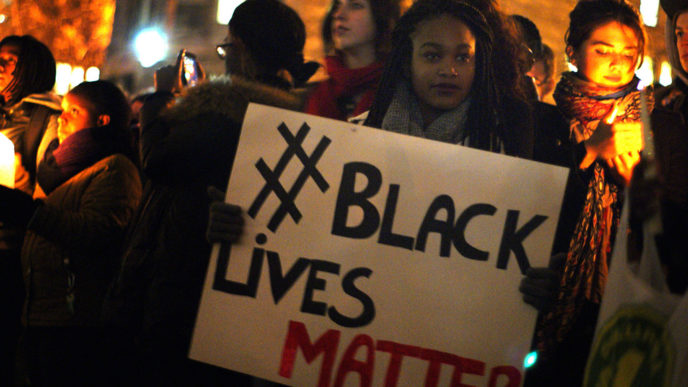
Separating the Value of Black Lives From the Black Lives Matter Movement

Did you know that if you support the Black Lives Matter movement — as in the official, BlackLivesMatter.com website — you are not only standing with black Americans but also standing with a radical social agenda including queer and transgender activism along with the disrupting of the nuclear family?

Before I demonstrate this to you, allow me to explain the purpose of this article. I write with the goal of standing with my African-American brothers and sisters for true and full equality in America while encouraging them to distance themselves from leaders and movements who do as much harm (if not much more harm) than good.

NFL quarterback Colin Kaepernick, whom I recently addressed over this very issue, would do well to heed this warning.

But first, a moment of personal background for those who do not listen to my daily talk radio show, the Line of Fire.

For several years now, God-fearing, law-abiding African-Americans have called the broadcast and, with great respect and humility, told me that I have no idea what it’s like to be a black American, that I have no idea how much racial prejudice still exists in our country, and that I have no idea how many obstacles black Americans still face.

I for one don’t doubt what they’re saying, which is why I spoke of the “very real challenges faced by African-Americans” in my open letter to Kaepernick, also mentioning the “very real problems that do exist in America, including issues of racial discrimination and injustice.”

The perspective of my callers was echoed by Dr. Brian Williams, one of the doctors who tried to save the lives of the Dallas policemen who were assassinated by an African-American shooter in July. Speaking as both a doctor and a black American, Dr. Williams said, “This is much more complicated for me personally.”

As he explained, “There’s this dichotomy where I’m standing with law enforcement, but I also personally feel that angst that comes when you cross the path of an officer in uniform and you’re fearing for your safety. I’ve been there, and I understand that.”

And yet there he was in anguish, trying to save the lives of these officers, men whom, in a different setting, he would have unduly feared.

As a white American, I cannot relate to this personally, although I grew up in the most open-minded household you could imagine, with my first organ teacher being openly gay (he and his partner would often stay for dinner with the family) and my second organ teacher being a black man who was married to a white woman, which cost both of them dearly in the 1960s.

The fact is that I have never been racially profiled and I have not faced some of the challenges that many of my black brothers and sisters have faced, all of which brings me to say this: I am glad that we are revisiting the question of racial injustice in America but I believe that movements like Black Lives Matter are hurting the cause more than helping it.

In similar fashion, as stated in my open letter, I have no issue with Kaepernick wanting to take a stand for his beliefs. I simply believe he’s using the wrong setting and putting an emphasis on the wrong issue.

Has he himself been negatively influenced by Black Lives Matter?

According to FoxNews.com, “NFL quarterback Colin Kaepernick’s conversion to social activism coincided with his romancing of a hip hop DJ of Egyptian descent [Nessa Diab] who has frequently spoken about perceived racial injustices and ‘Islamaphobia’ in the U.S.” (There are also reports that he has converted to Islam, but these have been disputed.)

Diab is popular on MTV and is associated with Islamic activism and with the Black Lives Matter movement, which would help to explain the change in Kaepernick’s Instagram account in the four months it has been in existence.

Initially, most of his posts centered on him playing football. “But 31 of his last 42 posts have strong social justice connotations, often featuring quotes from radical Nation of Islam leader Malcolm X, Black Panthers founder Huey Newton and cop killer Assata Shakur. During a Sunday news conference about the flag flap, Kaepernick dressed in a black hat with a large, white ‘X’ and a T-shirt that featured photos of Cuban despot Fidel Castro and Malcolm X.”

What about the Black Lives Matter movement itself? Not only is it allegedly supported by extreme leftists like George Soros, and not only have some of its foundational myths been exposed, but it forthrightly proclaims its radical social agenda on its website for everyone to see. How many have taken notice?

Under its guiding principles page, along with subjects like Loving Engagement (which does not overtly call for non-violent resistance but does make a positive statement), there are also headings like this: Black Villages: “We are committed to disrupting the Western-prescribed nuclear family structure requirement by supporting each other as extended families and ‘villages’ that collectively care for one another, and especially ‘our’ children to the degree that mothers, parents and children are comfortable.”

So, this movement opposes the very structure which is most under attack in black America today — namely, the nuclear family — also failing to mention “fathers” by name (note the references to mothers, parents, and children, but not fathers). What kind of social madness is this?

Other guiding principles include being Queer Affirming, under which heading it is affirmed that, “… When we gather, we do so with the intention of freeing ourselves from the tight grip of heteronormative thinking …” There is also the call to be Transgender Affirming, where it is explained that, “… We are committed to being self-reflexive and doing the work required to dismantle cisgender privilege and uplift Black trans folk ….”

Is this really a movement that can represent African-Americans nationwide? I think not.

That’s why it’s essential for those who really want to address questions of social injustice — be it the effects of the Democrat-led welfare system or apparent disparities in prison sentences or other apparent injustices — to distance themselves from the Black Lives Matter movement and take a reasoned stand for righteousness.

As you do, I’m standing with you, shoulder to shoulder, as best as I can. (For more from the author of “Separating the Value of Black Lives From the Black Lives Matter Movement” please click HERE)

Watch a recent interview with the author below:

Follow Joe Miller on Twitter HERE and Facebook HERE.

A 12-Step Plan for Global Economic Freedom

In the decades since The Heritage Foundation began publishing its annual Index of Economic Freedom in 1995, the world has witnessed profound advances in economic freedom.

Open economies have led the world in a startling burst of innovation and economic growth, and political authorities have found themselves increasingly held accountable by those they govern.

Unfortunately, the United States has drifted downward in the index rankings—propelled by reckless government spending that has spiraled out of control and led to unprecedented budget deficits. The long U.S. slide has been marked by stagnant economic expansion and extremely sluggish employment growth.

So, in this important election year, The Heritage Foundation has dedicated its annual “Global Agenda for Economic Freedom” to a detailed examination of ways to improve Americans’ economic freedom and America’s positive impact on the global economy.

Here are 12 steps the next U.S. president can take in 2017 for more economic freedom in America and the rest of the world:

1. American workers and consumers have benefitted from international trade, but global barriers to the free flow of goods and services and investment (e.g. nontariff barriers and nontransparent investment regimes) grew under President Barack Obama. The next administration must promote economic freedom by reducing them and opening new markets.

2. China faces huge economic challenges that, if unaddressed, will drag down the global economy. As a start, the next U.S. president should push China’s leadership to sign a bilateral investment agreement to make doing business there easier.

3. The price and availability of one of the most important production inputs—energy—will benefit from further liberalization of American and global energy markets.

4. Export financing subsidies from the U.S. Export-Import Bank and elsewhere are unnecessary and distort the U.S. and global economies. The Export-Import Bank should be shut down.

5. American economic growth will be enhanced by better, U.S.-led international policy coordination. The next president should downgrade the ineffective G-20 process and create a new, informal G-9 group of the world’s top nine economies.

6. The International Monetary Fund was created to bring stability to the international financial system. The IMF must return to basics by promoting rules-based monetary policies instead of bailing out countries that fail to follow those rules.

7. Many countries’ economic freedom scores would be substantially higher if not for the prevalence of government corruption. The next administration should make the fight against corruption a key component of U.S. development assistance programs.

8. The next president should evaluate all foreign aid programs for effectiveness and insist Congress update the 1961 Foreign Assistance Act to put the United States Agency for International Development directly under State Department control.

9. Massively subsidized state-owned enterprises are a main factor restraining development. The next president should review U.S. state-owned enterprises, remove the U.S. government from activities best left to the private sector, and push other countries to do likewise.

10. The next president must confront rogue states pursuing deliberately harmful policies that threaten global security and commerce by creating a sanctions strategy that targets troublemakers and prioritizes reforms that enhance economic freedom.

11. Climate change policies are another area where government decisions have created opportunities for rent-seeking cronyism and have harmed economic growth while doing nothing that actually affects global temperatures. The next administration should take immediate action to withdraw from the redistributionist and ineffective United Nations Framework Convention on Climate Change and end U.S. payments to the U.N. Green Climate Fund.

12. Government-sponsored corporate socialist cronyism, often under the guise of promoting corporate social responsibility, increased greatly under Obama. The next president must assess the risks of cronyism-related CSR rent-seeking and end federal “corporate excellence” awards, “green” tax credits, “public-private partnerships,” and all other forms of corporate welfare.

The revitalizing policies in the “2017 Global Agenda for Economic Freedom” will create good, new jobs for Americans and a freer flow of capital, goods, services, and ideas around the world. (For more from the author of “A 12-Step Plan for Global Economic Freedom” please click HERE)

Follow Joe Miller on Twitter HERE and Facebook HERE.

Use These 3 Strategies to Talk to a Liberal About Income Inequality

The phrase “income inequality” has a lot going for it. It’s catchy and memorable, and “inequality” breeds an immediate emotional response—contempt for the existence of an unfair policy and outrage that people might support it.

Those who cry out in favor of ending it have successfully packaged their indignation as a pep rally for the masses; those who cry out against the existence of “income inequality” are seen as selfish and uncaring.

That’s quite a narrative to change, but it’s not impossible. They might have a good phrase, but you have a great argument.

Building on the strategies we’ve outlined in previous weeks, here’s how you can have a conversation with a liberal about “income inequality”:

1. Common Ground

It may be easy to dismiss someone who is preaching from an economic handbook that’s a few shades closer to socialism than you’ll ever be. But don’t throw the baby out with the bathwater when talking with someone about “income inequality.”

More than likely, the common ground here is that you, on both sides of the argument, want everyone to have an equal chance at living the American dream. That’s a good, solid piece of common ground if your aim is to see that no one is unfairly disadvantaged.

2. Examples

Most important is to expose the myth that the pie is only so large and the rich get rich at the expense of the poor. The best way to do so is by using examples with a focus on the issue of income mobility—or, in other words, are we making it easier for all people to climb the economic ladder?

Those beating the drum of income inequality to the tune of the rich paying their “fair share” often neglect the fact that the “rich” includes small business owners (by the way, usually not millionaires or even close). The more money small business owners have to pay in taxes to the government, the less money they can pay their employees, which leads to layoffs and/or the closing of businesses. And fewer jobs help no one, least of all those struggling to make ends meet. If you know of a business in your community that’s closed its doors because of too-high taxes, talk about it. It will resonate with those who want to stand up for local businesses.

Another good example points to the real reason the poor remain poor—burdensome regulations that make it difficult to start businesses. The Daily Signal highlighted this issue a couple of weeks ago. All Lata Jagtiani wanted to do was make an honest living using her skill of eyebrow threading, but due to unnecessary regulations in her state requiring hours of training for something she already knew how to do, she was ultimately prevented from serving her clients. In the name of “safety,” Jagtiani wasn’t able to make a living and a valuable service was withheld.

3. Words

While the words “income inequality” aren’t threatening on a piece of paper, we know the phrase means something entirely different in political conversation since being hijacked by the big government side. Using this short phrase in a void isn’t a bad thing—but we all know we aren’t in Kansas anymore, Toto.

If you’re trying to fight the bad policy that stands behind the phrase “income inequality,” a good place to start is to use different language—language that speaks to the heart of what you’re trying to say.

Use phrases like “equal opportunity,” “hard work,” or “achieve the American dream” to better illustrate your point—it’s more effective to give someone the opportunity to succeed instead of handing out freebies. Also, talk about making it easier for all people to climb the economic ladder (ahem—income mobility) as a way to help your audience better visualize what you are talking about.

So, don’t shy away from a topic that can be tricky to navigate. Embrace the common ground of the American dream, use examples that show government interference is causing the poor to stay poor, and use the right words to unify instead of polarize. (For more from the author of “Use These 3 Strategies to Talk to a Liberal About Income Inequality” please click HERE)

Follow Joe Miller on Twitter HERE and Facebook HERE.

John Kerry Is Wrong Again: Not Talking About Terrorism Won’t Make It Go Away

In the latest episode of “ridiculous things U.S. Secretary of State John Kerry says about terrorism,” the former senator and presidential candidate thinks that the media needs to stop reporting so much on terrorism — because that will help stop it.

“Remember this: No country is immune from terrorism,” Kerry said in Bangladesh on Tuesday. “It’s easy to terrorize. Government and law enforcement have to be correct 24 hours a day, 7 days a week, 365 days a year.”

“But if you decide one day you’re going to be a terrorist and you’re willing to kill yourself,” he continued, “you can go out and kill some people. You can make some noise. Perhaps the media would do us all a service if they didn’t cover it quite as much. People wouldn’t know what’s going on.”

There are two major problems with this.

Firstly, not talking about something doesn’t make it less terrible. Jihadist terror has become such a widespread global problem that if one wants to spend the time aggregating and reporting news of terror attacks all over the world it is more than a full-time job. And no matter how much reporters, bloggers, and columnists try, they cannot adequately report on the sheer scale of the problem. Even if they were able to, the average reader would quickly go from enflamed to inured — as many already have regarding ISIS atrocities — at the constant influx of horror and destruction.

Yes, if the media reported less on the effects of the global jihadist threat, people might not be as concerned or enraged by their government’s utterly feckless approach to dealing with it, but to do so would be a gross disservice to the truth.

Secondly, Obama’s State Department clearly has a problem understanding what actually motivates terrorism, as evidenced by previous statements by Kerry and others on the subject. Jihadists aren’t motivated by headlines; they are, and have always been, motivated by jihad.

While Kerry’s proposed approach is nonsensical, it’s just the latest in a long line of statements by Obama administration officials desperate to associate terror attacks with anything but radical Islam. Just a few weeks ago, Kerry claimed that chemicals used in refrigerators and air conditioners were just as big a threat as ISIS.

“As we were working together on the challenge of [the Islamic State], and terrorism,” Kerry said last month at an international meeting in Vienna to amend the 1987 Montreal Protocol, which deals with said substances. “It’s hard for some people to grasp it, but what we — you — are doing here right now is of equal importance because it has the ability to literally save life on the planet itself.”

The president has also taken this line. As CR’s Tom Borelli points out, President Obama has repeatedly equated jihadist terror with climate change or other factors that have nothing to do with jihad.

And who can forgive the dynamite “jobs for jihadis” interview that State Department Spokeswoman Marie Harf gave last year on MSNBC when she claimed that the best way to combat the centuries-long issue of jihadism in the Middle East is to “help countries work at the root causes of [terrorism]” and ask “what makes these 17-year-old kids pick up an AK-47 instead of trying to start a business?”

Well, Ms. Harf, seeing as poverty is a problem in almost every society — including the ones that AREN’T breeding grounds for terror organizations — it might just be a pervasive ideology that has been in the region for centuries.

The kind of “terrorism” that is most often experienced (with very few notable exceptions) throughout the world is motivated by jihadist ideologies carried out by international organizations, or militants affiliated/inspired therewith, holding a clearly-defined worldview with a centuries-long history.

As laid out in greater detail by Sebastian Gorka in his book, “Defeating Jihad: The Winnable War,” modern global jihadism (what some Republican politicians like to insufficiently label as “radical Islamic terrorism”) is the product of over 1,000 years of theological and strategic thought.

“Just as one must study Clausewitz, Machiavelli, and Napoleon to understand the modern Western way of war,” explains Dr. Gorka, “so one must be intimately acquainted with certain key jihadi writers and thinkers if one wishes to defeat our current enemy.”

The terrorists to which John Kerry is referring — the guys who just want to “make some noise” — see themselves in the same line as the mujahideen who took on the Soviets and the foot soldiers of the original Ottoman caliphate. While groups like ISIS and al-Qaeda may vary greatly in their strategic approaches, the overarching goal remains the same: the establishment of a global caliphate run by a medieval interpretation of sharia law.

These guys are not teenage delinquents calling in bomb threats to high schools, they are militants appealing to an ancient, barbaric tradition of oppression and terror. Nor are they just guys looking to get a hand up; they see themselves being on a divine mission to subvert our way of life. The sooner the Obama administration realizes this, the better. (For more from the author of “John Kerry Is Wrong Again: Not Talking About Terrorism Won’t Make It Go Away” please click HERE)

Follow Joe Miller on Twitter HERE and Facebook HERE.

Trump Heads to Mexico, but Someone’s Lying About That Border Wall

Mexican president Enrique Peña Nieto disputed remarks made by Republican candidate for president Donald Trump regarding the construction of a wall along the U.S-Mexico border.

Having Mexico pay for the construction of a wall along the border has been a key theme of Mr. Trump’s campaign, since his announcement last year. His campaign website features a detailed plan titled “compelling Mexico to pay for the wall.”

When asked if he discussed his plans with the Mexican president in their meeting today, Mr. Trump said the topic was not broached.

“Who pays for the wall? We didn’t discuss,” Trump said when asked by a reporter during the follow-up questions to their statements. “We did discuss the wall. We didn’t discuss payment of the wall. That’ll be for a later date.”

President Peña Nieto has disputed that account of their meeting. According to Peña Nieto, he flat out told Mr. Trump Mexico will not pay for a wall at the very beginning of their meeting.

“At the beginning of meeting with Donald Trump, I made it clear Mexico will not pay for the wall.”

One of these two men seems to be lying. (For more from the author of “Trump Heads to Mexico, but Someone’s Lying About That Border Wall” please click HERE)

Follow Joe Miller on Twitter HERE and Facebook HERE.