Refugees Are Getting Obamacare Subsidies While Your Premiums Skyrocket

There’s been a lot of talk about how many refugees we’re letting into our country; in fiscal year 2016 alone, the Obama administration let in 85,000 refugees into the United States. Almost half of them were Muslim refugees, according to Pew Research. In 2017, the plan is to let in at least 110,000 total refugees.

But, on top of the countless other concerns that come with refugees (assimilation, terrorism, taxpayer dollars, etc.), did you know that these refugees are also eligible for Obamacare?

Well, they are. You don’t need to be a citizen to be eligible to buy Obamacare through a marketplace exchange or to receive tax credits and subsidies. Rather, you just need to be “lawfully present.”

What does that mean? According to a recent Congressional Research Service report, the term “lawfully present” generally includes refugees and foreign nationals. But because the ambiguous term means different things to different government agencies, the Department of Health and Human Services had to create a program to determine which “lawfully present” people are eligible for the Affordable Care Act when the health care law took effect.

None of the information the federal government discovers in the course of determining a person’s eligibility is used in any immigration enforcement either. So if someone is illegally in the United States and applies for Obamacare, and the federal government then discovers their illegal status in the process, the government will take no action to deport that person.

Here’s where it gets downright unfair: A lawfully present noncitizen who isn’t eligible for Medicaid can be eligible for Obamacare tax credits and subsidies, while “[s]imilarly situated U.S. citizens and lawfully present noncitizen who are eligible for Medicaid could technically participate in an [Obamacare] exchange, but they would be ineligible for the premium credits and cost-sharing subsidies.”

This means that there are struggling citizens who may not get help with the ever-more expensive health care costs, but certain non-U.S. citizens — in a comparable financial situation — are getting extra help from the federal government to purchase Obamacare.

As Obamacare gets more and more expensive (premiums are shooting through the roof) and refugees come flooding into this country, it would be prudent for policymakers to close this unfair loophole. It’s not right that non-citizens are given preferential treatment, when so many struggling, tax-paying Americans are closed off from the same help.

While we don’t have any numbers yet on how many refugees are on Obamacare, we do know that some cities and states will be disproportionally affected. As The New York Times reported recently, Detroit, Chicago, San Diego, Dallas, Houston, Atlanta, Baltimore, New York, and Philadelphia, among other cities, have each received a few hundred Syrian refugees since 2012. Some smaller cities are also feeling the brunt of the Obama administration’s refugee policies. For example, Boise, Idaho, has accepted more refugees than Los Angeles and New York combined, according to the Times.

In addition to thousands and thousands of refugees becoming eligible for government health care, California recently became the first state to apply for a waiver from the federal government to allow illegal aliens to get ACA coverage. If the waiver is granted, nearly 400,000 illegal aliens in California would be covered through Obamacare — despite President Obama’s 2009 promise that illegal aliens would not be eligible.

Premiums are up, enrollment is down, thousands of refugees are being put on Obamacare, and Obama’s promise to keep illegal aliens off Obamacare looks like another broken promise.

In other words, we’re getting closer and closer to the cliff. (For more from the author of “Refugees Are Getting Obamacare Subsidies While Your Premiums Skyrocket” please click HERE)

Follow Joe Miller on Twitter HERE and Facebook HERE.

Why Kansas Conservatives Are Pushing Voters to Reshape the State’s Highest Court

It’s typically a no-drama affair. Every six years, Kansans vote whether to retain the state’s sitting Supreme Court justices.

The question is the last item on the ballot. In Kansas history, voters never have voted out a justice on the state’s highest court.

But this year, the judicial elections in Kansas—known as retention elections—are especially contentious and political, mirroring shifts in other states as the public reckons with what the role of the court should be.

“It is political in Kansas right now, but I believe the court brought this environment upon themselves,” state Senate President Susan Wagle, a Republican, said in an interview with The Daily Signal. “The information you want to get from a court ruling is whether a law fits within the [state] constitution, and by all appearances, we have a number of justices making decisions based on personal convictions rather than state law and the state constitution.”

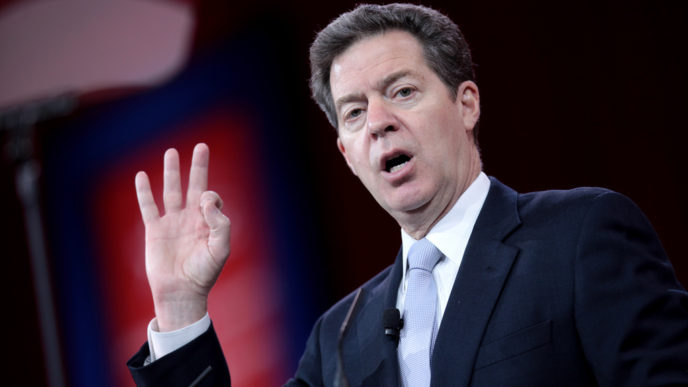
Kansas Gov. Sam Brownback and other conservative Republicans in the Legislature have not been shy about wanting to reshape the state’s Supreme Court.

Conservatives have accused justices of overstepping their authority, and have expressed outrage over rulings that overturned death penalty verdicts and struck down abortion restrictions. In another controversial ruling, the court determined the Republican-led Legislature has not adequately and equitably funded public schools.

In response, the Kansas Legislature has proposed bills to change the way justices are selected in the state, giving the governor more power in appointing them. That effort so far has failed.

In 2014, the Legislature passed and Brownback signed an appropriations bill that weakened the state Supreme Court’s administrative authority over local courts. Last year, the state Supreme Court ruled that measure unconstitutional.

The criticism of the seven-member court by conservative politicians has elevated the judicial elections into the public discourse. Outside groups are campaigning—and spending heavily on the election. And the Kansas Republican Party for the first time took a formal position on judicial retention.

“The Republican base in Kansas is not comfortable with a lot of decisions the court makes,” Clayton Barker, executive director of the state Republican Party, told The Daily Signal. “The state party is more involved this year because the court is going beyond judicial power and these justices don’t seem to have the wisdom of self-control.”

Chief Justice Lawton Nuss and four other justices face a retention vote: Marla J. Luckert, Carol A. Beier, Dan Biles, and Caleb Stegall.

Groups opposing retention specifically aim to oust four of the five—all but Stegall, the only one appointed by Brownback. The others were appointed by Democratic and Republican governors who preceded him.

These anti-retention groups include Kansans for Life—the state’s most vocal organization opposing abortion—and Kansans for Justice.

The latter group was created by family and friends of the victims in a notorious multiple-murder case. Brothers Jonathan and Reginald Carr were sentenced to death in 2002 after being convicted of robbing, raping, kidnapping, and shooting five people—four of whom died—in Wichita in 2000.

The Kansas Supreme Court vacated the Carrs’ death sentences in 2014, and required new trials. The U.S. Supreme Court overruled the state court’s decision, and reinstated the death sentences.

Two prominent groups, meanwhile, support retention of the justices targeted by conservatives. Kansans for Fair Courts says it represents “thousands” who believe conservative politicians unfairly have rebuked the court and unethically politicized the judicial process.

Four former Kansas governors—Republicans Bill Graves and Mike Hayden and Democrats Kathleen Sebelius and John Carlin—also urge voters to keep the justices in their seats.

“As former governors we understand the unique roles of the three branches of government,” Graves said during a media tour on the topic in September. “We may not have always agreed with them but we respected that the judicial branch is a nonpolitical branch accountable to the constitution. The courts provide a critical check and balance on the other two branches and we want to keep this constitutional balance.”

Alicia Bannon, who monitors state courts at the Brennan Center for Justice at New York University School of Law, says outside groups advocating on the subject of retention elections are not subject to financial disclosure requirements under Kansas law.

But in one measurement of the scale of spending, she said, she has reviewed television contracts filed with the Federal Communications Commission that show outside groups on both sides have spent roughly $600,000 combined on ads related to the judicial elections.

In 2010, Bannon says, she began noticing increasing outside interest and spending related to retention elections in the 18 states that use such a method as part of their judicial systems.

“We are seeing a number of retention elections attracting a lot of spending, and generally becoming more politicized—sometimes linked to a particular decision on the bench and sometimes linked more to a general interest in shifting the ideological position of the court,” Bannon told The Daily Signal in an interview.

Bannon named Iowa, Florida, Tennessee, and Illinois as states that had contentious Supreme Court retention elections in recent years.

Bannon says she worries that the politics surrounding such races affect how judges make decisions, and undermine the faith in courts as a nonpartisan arbiter.

“One of the troubling aspects of this whole development is that because judges are focusing on their re-election while sitting on the bench, their decisions are up for criticism,” Bannon said, adding:

There is a lot of evidence that job security concerns are bearing on decisions. More generally, if judges start to see themselves as simply politicians, than it becomes harder for them to approach cases putting all politics aside. And ultimately, that’s their job.

The Kansas judicial system is conditioned so as not to be vulnerable to political winds, supporters say.

As authorized by the state constitution, justices of the Supreme Court are selected by a nonpartisan nominating commission and appointed by the governor.

“The Kansas Constitution is set up to keep these type of politicized things from happening,” Kerry Gooch, executive director of the Kansas Democratic Party, said in an interview with The Daily Signal, adding:

We as Kansas Democrats like our judges to not be political, and we hate the fact that Governor Brownback and conservative lawmakers have tried to change that. That makes it hard for the court to do its basic job, which is to follow and enforce the law, and not take into account public opinion, feeling, and emotions.

The Kansas Democratic Party has not taken a formal position on the retention elections, Gooch said, because party leaders don’t think it’s appropriate for a political body to influence the judiciary.

Conservatives, however, argue that the current system for selecting judges isn’t fair.

Lawyers who belong to the Kansas Bar Association select five of the nine members of the nominating commission. The other four members must be nonlawyers selected by the governor.

The Republican-led state Senate has twice voted for a constitutional amendment that would change the judicial selection system to be like the one at the federal level, so that the governor appoints justices and the Senate confirms them. Those measures failed in the House.

Jeff King, a Republican who is Senate vice president, contends that unless the selection system changes, politicians like himself are not wrong to involve themselves proactively in judicial elections and to make the public more aware of court decisions.

“It’s healthy that the public has more information about the influence that the Supreme Court has on their daily lives,” King, who is retiring, told The Daily Signal in an interview. He added:

I would rather have something else than the politicized retention elections we see now, but our system doesn’t allow for anything else to allow the broader voice of 2.9 million Kansans to be heard. This is not about one justice. It’s about taking the system we have in Kansas and making sure it works vibrantly and is representative of the people’s will.

(For more from the author of “Why Kansas Conservatives Are Pushing Voters to Reshape the State’s Highest Court” please click HERE)

Follow Joe Miller on Twitter HERE and Facebook HERE.

National Debt Will Hit $20 Trillion After Next President Is Sworn In

The next president will face a nation debt of $20 trillion, nearly double what it was when President Barack Obama took office.

The national debt likely will reach the staggering $20 trillion figure in 2017, according to the Bipartisan Policy Center, a Washington think tank.

On March 16, the new president and Congress will have to reach an agreement on the debt limit—which will likely be $20.1 trillion, according to the center’s projection. That will last until mid-summer, before another negotiation will ensue on borrowing more to pay the government’s bills.

“There are a number of uncertainties between now and then and we don’t know exactly what the revenues and outlays will be, but we project the total gross debt will hit $20 trillion sometime in February,” Shai Akabas, director of fiscal policy for the Bipartisan Policy Center, told The Daily Signal in a phone interview.

“February is typically a bad month for the national debt because a lot of tax refunds go out then.”

The national debt currently stands at $19.8 trillion. When Obama came into office in January 2009, the national debt was $10.6 trillion. The spending agreement Obama reached with Congress in late 2015 allowed the Treasury Department to borrow another $1.5 trillion before he leaves office in January 2017.

To put the $20 trillion figure in perspective, MarketWatch reported in September the combined valued of all 500 major corporations in the S&P 500 were valued at $19.1 trillion as of the summer of 2016. These companies include Apple Inc., Exxon Mobil Corp., Facebook, and other giants.

Further, the U.S. national debt is more than all of the world’s physical currency, gold, silver, and bitcoin, according to MarketWatch. The combined value of every dollar, euro, yen, pound, and other physical currency is $5 trillion. The world’s physical gold is worth $7.7 trillion and the world’s physical silver is valued at $20 billion.

The Congressional Budget Office projects that gross debt in 2017 will reach $20.16 trillion, but did not have a month-by-month breakdown as of deadline. The budget office’s 10-year debt projection estimates the national debt will reach $28.19 trillion in 2016. The amount of debt held by the public will be 77.2 percent of the gross domestic product in 2017.

By 2026 the publicly held debt will be 85.5 percent of the economy, according to the budget office.

Treasury Department spokesman Rob Runyan told The Daily Signal that the department does not have a projection to share.

For the next president and Congress, the challenge will be to slow the rate of debt’s growth. This is because a cut in the national debt won’t come unless there is a budget surplus, which no one projects, Akabas said.

Akabas thinks a deal for bipartisan entitlement and tax reform is possible over the next two or four years, while both parties will have areas where they want to spend more.

“Health care is the biggest driver of government spending with Medicare and Medicaid,” Akabas said. “But, Republicans are concerned about defense and Democrats are worried about domestic [spending]. There will be some dialogue about giving back in those areas.”

While divided government can lead to gridlock, Akabas also has some optimism.

Congress and the new president could reach a bipartisan plan to tackle the debt in a way that wouldn’t cause one party to be blamed. Further, he said he anticipates such a debt plan—that would require some unpopular actions—could be offset with popular items such as more infrastructure spending.

There are actions that Congress and the next president can take to rein in the debt, but the problem might be what realistically will be done, said Romina Boccia, deputy director of the Thomas A. Roe Institute for Economic Policy Studies at The Heritage Foundation.

“A lot can be done in the next administration’s budget proposal and with Congress’s follow up,” Boccia told The Daily Signal. “Neither candidate for president has a strong plan for addressing the debt.”

She said there is still potential to control the debt.

“The House Budget Committee has presented a plan that can make a real difference,” Boccia said. “Any plan will have to include entitlement reforms, health care spending reforms, and Social Security reform.” (For more from the author of “National Debt Will Hit $20 Trillion After Next President Is Sworn In” please click HERE)

Follow Joe Miller on Twitter HERE and Facebook HERE.

Planned Parenthood Arms Spend Over $38 Million to Elect Democrats

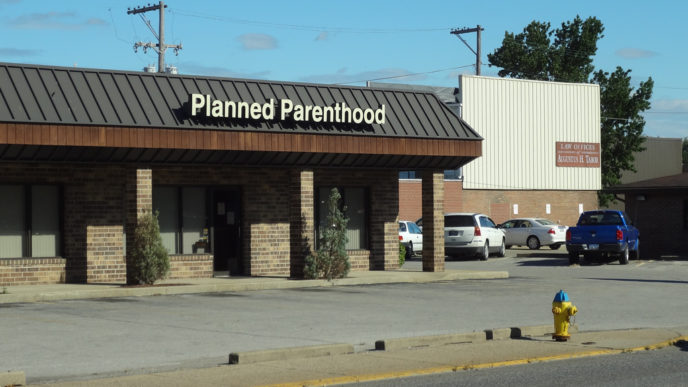
In the past three election cycles, Planned Parenthood’s advocacy and political arms, employees, and their families have spent over $38 million to elect or defeat candidates for federal office who decide how much taxpayers subsidize the nation’s largest abortion provider.

From the 2012 election cycle through the 2016 cycle so far, the political action entities, employees, and families of employees of Planned Parenthood and its affiliates devoted $33.9 million to outside spending mostly related to electing Democrats, according to data compiled by the OpenSecrets project of the Center for Responsive Politics.

Because Planned Parenthood is a 501(c)(3) tax-exempt organization, it cannot endorse or donate to a candidate in its own right.

In addition, individuals and entities associated with Planned Parenthood contributed a total of $4.7 million over the same four years to candidates, party committees, other political action committees, and outside spending groups or nonprofit “527” groups created to influence elections.

In the 2016 cycle, Planned Parenthood’s affiliated organizations, political and advocacy arms, employees, and their family members gave $5.5 million to Democrats, but nothing to Republicans. They spent $10.4 million against Republicans, according to the most current data, compared with less than $7,000 against Democrats.

OpenSecrets ranks Planned Parenthood at 307 among 18,081 organizations profiled whose political arms, employees, and their families contributed money to candidates, party committees, PACs, or other groups in the 2016 cycle.

The Center for Responsive Politics, a nonpartisan organization, tracks the influence of money in politics.

About the distinction between Planned Parenthood Federation of America (a 501(c)3 tax-exempt nonprofit) and its lobbying arm Planned Parenthood Action Fund (a 501(c)4 tax-exempt nonprofit), Sheila Krumholz, executive director of the Center for Responsive Politics, said in an email to The Daily Signal:

Our practice is to use the name of the organization when presenting their political financial activity, whether it’s lobbying expenditures, or PAC or individual (employees and non-wage earning family members’) contributions to candidates, other PACs, super PACs or parties.

“You can’t divide it up,” Casey Mattox, senior counsel at Alliance Defending Freedom, a nonprofit Christian legal organization, told The Daily Signal. “Ultimately, Planned Parenthood itself is bringing in well over half a billion dollars a year from taxpayers and they want to make sure that the politicians stay in office who will keep that money coming. So, they spend money to elect those politicians.”

Planned Parenthood receives approximately $500 million from federal taxpayers each year for Medicaid and Title X Family Planning, both programs intended for low-income Americans.

“Planned Parenthood stands alone as a major recipient of taxpayer funding that is also a major participant in elections,” Mattox said.

Among other findings by OpenSecrets:

In the 2016 election cycle, Planned Parenthood Action Fund and the super PAC Planned Parenthood Votes each contributed over $350,000 combined.

Also contributing were political arms of Planned Parenthood Mar Monte, Planned Parenthood of the Heartland, Planned Parenthood of Wisconsin, Planned Parenthood Votes NW, Planned Parenthood/North Texas, and Planned Parenthood/Rocky Mountains.

Also for the 2016 election cycle, individuals and entities connected with Planned Parenthood poured over $15.9 million into outside spending, defined by the Center for Responsive Politics as “independent expenditures or electioneering communications.”

Of that, $14.02 million went to Planned Parenthood Votes, the super PAC. Other outside spending went to Planned Parenthood Action Fund, a Planned Parenthood/Michigan super PAC, Planned Parenthood/Los Angeles, Planned Parenthood of San Diego, Planned Parenthood Votes Northwest, Planned Parenthood/Minnesota, Planned Parenthood Shasta Pacific Action Fund, Nevada Advocates for Planned Parenthood, Planned Parenthood of Nassau County Action Fund, Protecting Choice in California, and Planned Parenthood/Santa Barbara.

As a result, OpenSecrets ranks Planned Parenthood at No. 21 among 180 organizations the center said did such outside spending.

Planned Parenthood Federation of America did not respond to an email from The Daily Signal requesting comment on the accuracy of the spending figures and other details.

In the 2012 election cycle, President Barack Obama was one of the top recipients of related contributions, at around $71,000, according to OpenSecrets.

The four top recipients so far this election cycle are Priorities USA Action, a Democratic super PAC that supports Hillary Clinton ($133,034); Planned Parenthood/ Michigan ($100,000); Clinton herself ($97,268); and Planned Parenthood Votes ($88,496).

In January, Planned Parenthood Action Fund endorsed Clinton in the organization’s first-ever endorsement during the primary season.

Planned Parenthood is “becoming even more political than they have in the past,” Mattox said. “That should be deeply troubling to a lot of people.”

In November 2015, Planned Parenthood Action Fund announced a $20 million campaign against pro-life candidates and a $30 million door-to-door field campaign targeted at millennial voters across six states.

Dawn Laguens, executive vice president of Planned Parenthood Action Fund, said in a written statement at the time:

Today we have a clear message for every politician who has threatened access to reproductive health care, who has said having to drive hundreds of miles to safely access a legal abortion wasn’t a ‘burden,’ and who has made offhand comments about eliminating basic health care for millions across the country: You’re about to be in for a very rude awakening.

And in a related video, Cecile Richards, who heads up Planned Parenthood Action Fund as well as the Planned Parenthood Federation of America, said:

Extremists made the 2016 election about attacking reproductive rights. Enough is enough. With our supporters, we’re launching ‘I Vote Planned Parenthood Action.’ We will organize and mobilize to elect lawmakers who are in our corner.

Conservative lawmakers repeatedly have called for ending U.S. taxpayer subsidies to Planned Parenthood.

“I think there’s really a lot of reasons why Planned Parenthood should not be funded, but the fact that they are so politically active and spending so much money on elections should be at the top of the list,” Mattox said.

Individuals and entities connected with Planned Parenthood contributed over $700,000 to Democratic congressional candidates so far this election cycle and less than $15,000 to Republican congressional candidates, according to OpenSecrets.

“They have pledged over $20 million in this election cycle alone,” Mattox said. “This is an organization that held up funding for Zika, for example, demanding their share of the money. All the while, they’re managing to find $20 million to spend to support politicians that they want to keep in office.”

Individuals and entities connected with Planned Parenthood also spent $2.2 million on lobbying during the 2016 election cycle, according to OpenSecrets, ranking it at 372 among 3,619 organizations in 2016. Eight out of 14 lobbyists in 2015-2016 previously held government jobs.

In its 2014-2015 annual report, Planned Parenthood Federation of America said it provided 1.2 million pregnancy tests; 3.5 million tests for sexually transmitted infections for women and men; 363,803 breast exams and care; 271,539 Pap tests; 24,063 vaccinations for human papillomavirus infection; and 17,419 prenatal services.

Planned Parenthood said affiliates spent $782.3 million on medical services, and a similar amount the previous year.

The government gave Planned Parenthood $553.7 million in health services grants and reimbursements for the organization’s fiscal year ending June 30, 2015.

“If Planned Parenthood wants to provide Zika services or mammograms or anything else, they are awash in cash. They don’t need taxpayer dollars to do it,” Mattox said. (For more from the author of “Planned Parenthood Arms Spend Over $38 Million to Elect Democrats” please click HERE)

Follow Joe Miller on Twitter HERE and Facebook HERE.

Did Wikileaks Just Uncover Hillary’s Mole Within the DOJ?

Today’s 25th installment of the WikiLeaks emails contained a blockbuster. The assistant attorney general for congressional relations, Peter Kadzik, used his Gmail account to inform John Podesta of next steps in the DOJ Clinton email investigation. Kadzik is now reportedly heading up the “review” of documents and emails seized from Anthony Weiner’s computer.

Here’s what the May 19, 2015 email from Kadzik said:

There is a HJC oversight hearing today where the head of our Civil Division will testify. Likely to get questions on State Department emails. Another filing in the FOIA case went in last night or will go in this am that indicates it will be awhile (2016) before the State Department posts the emails.

kadzik-email

There you have it. An assistant attorney general gave the campaign chair of a presidential candidate under investigation by the FBI a heads up on next steps related to that investigation.

On top of that, Kadzik is the one who sent a letter to Democratic congressmen saying that the Department of Justice was adding additional resources to the Weiner computer investigation.

Who is Kadzik? We have learned in WikiLeaks emails that he is a very good friend of Clinton campaign chair Podesta. Here’s how the Daily Caller reported their relationship last month.

The day after Hillary Clinton testified in front of the House Select Committee on Benghazi last October, John Podesta, the Democrat’s campaign chairman, met for dinner with a small group of well-connected friends, including Peter Kadzik, a top official at the Justice Department.

The dinner arrangement, revealed in hacked Podesta emails released by WikiLeaks, is just the latest example of an apparent conflict of interest between the Clinton campaign and the federal agency charged with investigating the former secretary of state’s email practices.

According to the Washington Free Beacon, Kadzik has previously donated to several Clinton initiatives, including Hillary’s 2008 campaign.

Up until now, Wikileaks emails between Podesta and Kadzik only showed a friendship. And the fact that Podesta claims Kadzik, “kept me out of jail.” Today’s dump by Wikileaks shows that Kadzik was, in fact, providing the Clinton inner circle with information regarding the email investigation.

Not only was Kadzik providing this information, but he did it through his personal, not governmental email address —likely to hide it from the National Archives.

Kadzik should immediately be taken out of his role in this investigation. The American people deserve an impartial Department of Justice. (For more from the author of “Did Wikileaks Just Uncover Hillary’s Mole Within the DOJ?” please click HERE)

Follow Joe Miller on Twitter HERE and Facebook HERE.

Families Struggling With Socialism: Obamacare Tripled My Costs for Much Less Coverage

Obamacare is ubiquitously regarded as an utter failure. However, when viewed through the lens of its supporters, it is a smashing success. The goal of Obamacare was to ensure that no average-income family (or even upper-middle income family) could live in dignity without government subsidies for health insurance. By that measure, the leviathan has achieved its goal. Will we the people let them get away with it?

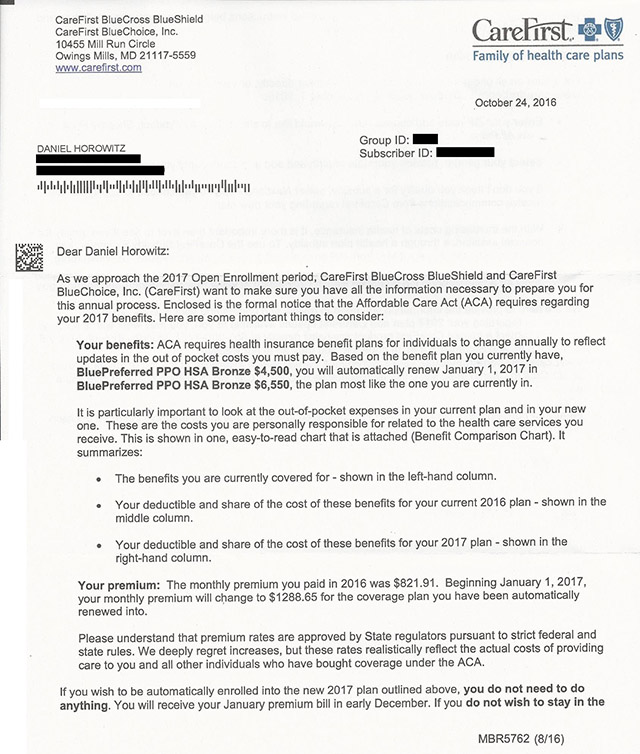
Like millions of other Americans, my wife and I just got the dreaded Obamacare letter in the mail, and it ain’t pretty:

obamacare-letter

My monthly premium for the HSA Bronze plan under CareFirst Blue Cross Blue Shield of Maryland will be going up from the already astronomical $821.91 a month to $1288.65. Worse, the deductible, which was already high, is going up to $13,100. It is an incredible testament to our broken political system the fact that the Republican Party has barely made this an issue during the past two presidential elections. The Obamacare crisis is a once-in-a-generation opportunity for conservatives to win the fight over government intervention once and for all.

To begin with, the price of health care and health insurance was always distorted and inflated thanks to a myriad of government regulations, the employer-based tax exemption (what I refer to as fourth party coverage), and other cultural trends of over-utilizing and over-insuring health care. Nonetheless, there was enough choice and competition in the market for most Americans to find a tailor-made plan that more or less worked for the family at a price that would not place a crushing burden on the family budget.

My Pre-Obamacare Plan

Prior to enactment of Obamacare regulations, my family of five had a plan with a monthly premium of $425. The “Healthy Blue” plan from CareFirst of Maryland had a $5,000 deductible, but it covered most of the basic necessities for absolutely free, even before meeting the deductible. All sick and well visits to the primary care physician were covered 100% without copay, as were generic prescription drugs. Specialists were covered with just a $40 co-pay before meeting the deductible. For a healthy family with three young kids in which ear infections are the most common ailment, this plan worked out perfectly because sick PCP visits and generic drugs account for most of the expenses.

Even under this relatively high deductible plan, I was able to have surgery to remove two Lipomas from my abdomen for just $40 because it was done in the office of the surgeon. Hospitalization was obviously not covered, but that was a worthwhile calculated risk given the money we saved on the premiums. Plus, the deductible, although relatively high (now we’d die for it!), would be met by the time potential extended health costs would surpass the sum we were saving from the cheaper premiums. Those are the decisions that smart families make every day on an array of goods and services when there are actually market-based forces allowing competing offers from which to choose.

The crushing increase in costs in just a few years

Now, take a look at this graphic for a vivid demonstration of what Obamacare has done to our budget:

pay-more-get-less-chart

Our premium has tripled to a crushing cost of $1,288 per month, over $15,000 a year. Just this year’s increase alone will be $467 a month, $5,600 a year. Remember, my entire premium was less than $5,000 before Obamacare. And what do we get for the crushing cost? We pay money in order to pay money. The deductible has gone from $5,000 to $13,100, and unlike with our previous plan, nothing but the dubious “annual well visits” are covered prior to meeting the deductible. That means one must shell out roughly $28,000 in a given year before one red cent of routine or emergency medical care is even partially covered.

Thanks to the overutilization and no market forces in healthcare, even a perfectly healthy year for a family of five — with no costs beyond typical sick visits and basic antibiotics for standard ailments (no hospitalizations or ER visits) — we must shell out $3,000-$5,000 in out-of-pocket-costs. Add that to the $10,000 increase in premiums from Obamacare and my family must pay a minimum of $13,000 more a year in health expenses thanks to the stupidity of those who voted for Obama and the perfidy of the Republicans who have no plans to fight it.

Once you let that sink in, take note of the fact that this is just the third year of implementation. What does the price tag look like 3-4 years from now?

This issue is potent enough for a true opposition party to win

A party that was actually committed to sound conservative policy would utilize this as a teachable moment, irrespective of who becomes president. My story is undoubtedly the story of so many families. Whereas most prior big government interventions took longer to inflate the cost of the private sector, and the deleterious effects were not apparent enough to the public, everyone recognizes that Obamacare is the culprit for the health crisis and they know who is to blame. This is one case where families unambiguously feel the cost of regulation and government intervention.

$13,000 is real money. That is a lot more than what we spend on food a year for a family of five. The $467 increase in monthly premiums just from last year’s increase is more than my monthly car payment for our Toyota Sienna. I could by a new minivan for that cost. Recently, we replaced our heating and air conditioning with a top-of-the-line system and I’m only paying about $260 a month for a zero-interest loan. Heck, it’s a lot more than what we pay for our son’s playgroup.

This issue alone could sink the entire Democrat Party in the long run. Yet, the Chamber of Commerce has already made it their official policy to “fix Obamacare” instead of ending it. Watch for Hillary (if elected) to call for single-payer and Republicans to use that as the new baseline to define the contours of their opposition. They will oppose single-payer but offer nothing more than what the Chamber and insurance companies are looking for — a bailout and a preservation of the coverage mandates, such as pre-existing conditions and community rating — the very mandates that have made insurance actuarially insolvent. That has already been the official policy of GOP leaders for years, even though they run on repealing the law.

Rarely do conservatives have an opportunity to demonstrate why unconstitutional government interventions are not just costly for the federal budget (most people don’t understand how the debt affects them) but also for the family budget. This is an opportunity for a new movement to rise up and pledge to fight this law until the bitter end. This issue was responsible for two landslides in midterm elections that were not overpowered by personality issues, as was the case in 2012 and this election.

Republicans will still have control of the House and very possibly the Senate after next week’s election. If every elected Republican — not just Ted Cruz, R-Texas (A, 97%) shouting from the wilderness — would use the power of the purse to put an end to this problem, even a Democrat president could not overcome the pain crying out from the family budget of millions of Americans. And in fact, Hillary Clinton, who will likely enter the presidency as the most illegitimate and unpopular persona since John Quincy Adams, is the most beatable opponent on this issue. If only we had a real second party ..

Democrats better be careful what they wish for. The people are not with them on a single major issue, Obamacare first and foremost. This issue will only deteriorate for them in the coming months and Hillary is the polar opposite of Obama’s likable “Teflon” personality. The only thing saving them is a fake Republican Party committed to “governing” with them instead of exposing and defeating them. That will not always be the case. It will change one day. The fight will continue, irrespective of what happens next week. Remember, our republic will not rise or fall on your vote for president alone, but whether you acquiesce to this corrupt system or take your own destiny into your hands. (For more from the author of “Families Struggling With Socialism: Obamacare Tripled My Costs for Much Less Coverage” please click HERE)

Follow Joe Miller on Twitter HERE and Facebook HERE.

Here’s Why Chelsea Clinton May Be a Huge Problem If Hillary Becomes President

In late August, with Election Day still over two months away, former President Bill Clinton wrote in a blog post that “[w]hile it would be presumptive to assume a victory in November, now that Hillary is her party’s nominee, it would be irresponsible not to plan for it.” He was announcing that changes would take place at the Clinton Foundation should his wife Hillary win the presidency.

Some of the planned changes to the foundation included:

A name change from the official Bill, Hillary & Chelsea Clinton Foundation title to the Clinton Foundation;

A policy change to accepting “contributions only from U.S. citizens, permanent residents, and U.S.-based independent foundations”;

Bill stepping down from the foundation’s board and his ceasing of fundraising activities.

So far, these changes sound much better than the sheer veil they draped over the Clinton Foundation when Hillary became secretary of state. During that time, the Clinton Foundation continued to receive money from foreign governments, and Hillary’s chief aide, Huma Abedin, simultaneously worked for both the State Department and Clinton Foundation — a glaring conflict of interest.

Even The Washington Post admits that “[r]arely, if ever, has a potential commander in chief been so closely associated with an organization that has solicited financial support from foreign governments.”

So while the potential changes to Bill’s role at the Clinton Foundation might sound good on paper (no more donations from foreign governments!), here’s the unsaid: Chelsea Clinton will remain on the global foundation’s board.

Here’s why this is a problem: Chelsea is very, very close to her parents (if you need proof, check out her leaked emails), and as The Wall Street Journal previously reported, “the foundation and Ms. Clinton don’t intend to say whether she would raise money for the foundation until after the election.”

According to the Congressional Research Service, while executive branch employees are “subject to criminal penalties if they personally and substantially participate in matters in which they (or their immediate families, business partners or associated organizations) hold financial interests[,]” this does not include the president and the vice president.

In fact, “there is no current legal requirement that would compel the President to relinquish financial interest because of a conflict of interest.”

How can someone never consider past financial donations — in the millions of dollars, no less — from countries like Saudi Arabia and Qatar to a family-run foundation when making foreign policy decisions? How can someone be totally divorced from her namesake organization when her only child is on the board and fundraising for it?

Finally, how can someone ever be truly divorced from an organization that will surely expand and continue to take money from foreign governments once out of office?

You can’t. That is why the existence of the Clinton Foundation was always problematic (especially during Hillary’s tenure as secretary of state), and will remain problematic should the Democratic nominee become president.

So what can be done about it? Honestly, not much. The Congressional Research Service determines that putting more restrictions on a president other than requiring campaign finance disclosures and disclosures of “personal assets, investments, interests, and income upon entering office,” to require any other disclosures “may require a constitutional amendment.”

Should we enter another Clinton presidency, that means the citizens and media will be especially responsible for holding Hillary Clinton accountable.

Conservative media, in particular, will have to rise to the challenge and be more robust, ethical, and meticulous than ever. (For more from the author of “Here’s Why Chelsea Clinton May Be a Huge Problem If Hillary Becomes President” please click HERE)

Follow Joe Miller on Twitter HERE and Facebook HERE.

8 Instances of Voter Fraud in 2016, and It’s Not Even Election Day Yet

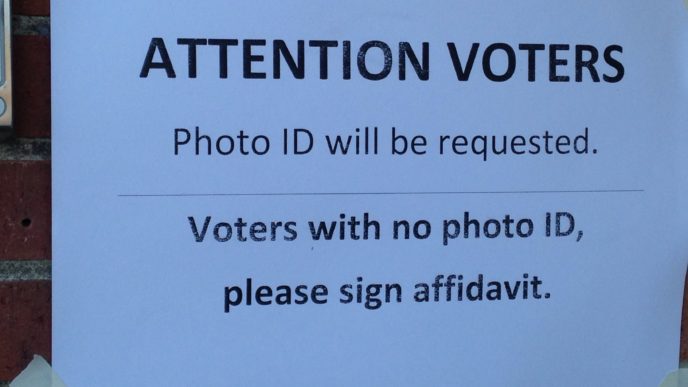
In just the last week, prosecutors pursued three voter fraud-related charges in three major battleground states—Florida, Iowa, and Virginia.

Numerous other election irregularities such as voting beyond the grave, voting more than once, voting without citizenship, and registrations by nonexistent people have occurred throughout 2016. While some cases have been prosecuted, others were discovered through various news reports.

Here’s a sampling of election irregularities that have already taken place well in advance of Nov. 8.

1. ‘Fictitious’ Voter Registration

On Oct. 28, Vafalay Massaquoi, 30, of Alexandria, Virginia, was arraigned on two felony charges of voter registration fraud and two felony counts of forging a public record, according to the Alexandria Commonwealth’s Attorney’s Office.

Massaquoi worked for New Virginia Majority, a progressive community organizing group, earlier this year when he allegedly fabricated names on voter registration forms. The Alexandria Office of the General Registrar, which oversees elections in the city, flagged the matter and reported it to prosecutors in June.

“Given the recent public attention to claims of election fraud, I think it is important to note that there is no allegation that any illegal vote was actually cast in this case,” Bryan L. Porter, Alexandria Commonwealth’s attorney, said in a public statement, adding:

Furthermore, since the fraudulent applications involved fictitious people, had the fraud not been uncovered, the risk of actual fraudulent votes being cast was low. However, any such offense is extremely serious and can degrade the confidence we as citizens justly have in our system of elections.

Massaquoi left Alexandria before police could make an arrest in July, authorities said. After what Porter called a “lengthy search,” police arrested him near Philadelphia in early October and extradited him to Alexandria on Oct. 27 to face arraignment the next day.

2. Double Trumper

In another battleground state, Terri Lynn Rote, 55, of Des Moines, Iowa, was arrested on charges of voting twice for Republican presidential candidate Donald Trump.

Rote was charged with first-degree election misconduct, a Class D, or less serious, felony in Iowa. She reportedly was booked in the Polk County Jail Oct. 27 and released the next day.

The Des Moines Register reported that Rote cast an early ballot at the Polk County Election Office and another at a county satellite office in Des Moines.

Rote was among three suspects reported to police by Polk County Auditor Jamie Fitzgerald. Others were accused of casting mail-in votes, then early voting in-person, but neither was charged, according to the Des Moines Register.

Rote’s court appearance is set for Nov. 7, one day before the election.

3. Florida Busts Two for Election Fraud

Miami-Dade State Attorney Katherine Fernandez Rundle announced Oct. 28 that two women were charged with election violations. One was charged with registering phony or dead voters, the other with changing votes on mail-in ballots.

Tomika Curgil, 33, was a canvasser for People United for Medical Marijuana, where she was hired to register voters. However, the Miami-Dade Elections Department couldn’t verify much of the voter information, or whether the names submitted were of people eligible to vote.

Authorities said they believe Curgil never left her home before returning completed and falsified voter registration forms. They said discrepancies include registering dead voters, according to the Miami-Dade prosecutor’s office.

Curgil was charged with five counts of submitting false voter registration information, which is a third-degree felony in Florida.

In the other Florida case, Gladys Coego, 74, was hired as a temporary election worker for the Miami-Dade Elections Department to open absentee ballots. A co-worker reported that Coego marked some of the ballots.

According to the prosecutor’s office, Coego admitted to investigators she marked several absentee ballots for mayoral candidate Raquel Regalado when that race was left blank.

Coego was charged with two counts of marking or designating on the ballot of another person, a third-degree felony.

“Anyone who attempts to undermine the democratic process should recognize that there is an enforcement partnership between the [Miami-Dade] Elections Department and our Prosecution Task Force in place to thwart such efforts and arrest those involved,” Rundle said in a written statement. “Now we need to move forward with the election.”

4. Dead and Double Voting in Colorado

CBS4, a TV station in Denver, conducted a broad voter fraud investigation that found numerous cases of dead voters and people voting more than once. The report aired in September.

The station cross-referenced databases to find a particular problem in El Paso County and Jefferson County, and the findings triggered a criminal investigation, CBS4 reported.

In one case, the station noted a woman who died in 2009 apparently managed to vote in 2010, 2011, 2012, and 2013. In another case, a man who died in 2009 was recorded to have voted in an election nine months later. A man who died in 2004 had a recorded vote in the 2006 election.

CBS4 aired a follow-up piece Oct. 25 noting six cases in which records show people voting twice in Colorado elections during the same election cycle, while six others voted in Colorado and another state’s elections. Five of the cross-state votes cast a vote in Kansas as well as Colorado, the station reported.

5. 19 Dead Re-Registered to Vote in Virginia

In another Virginia case, the FBI and Virginia law enforcement found in late September that at least 19 dead people were re-registered to vote in the state. All 19 were registered in the city of Harrisonburg, The Washington Post reported.

The investigation commenced after family members of some of the deceased received voter registration notifications. The forms reportedly were filled out by a group trying to sign up voters on the James Madison University campus in Harrisonburg.

Not all of the alleged fraud is taking place in swing states. New York and California have had problems as well.

6. Dead Registered Voter From New York

In at least one case, a dead person is being encouraged to vote by the state of New York. Unlike elsewhere, a lack of pulse kept one individual from casting a ballot.

Michelle Dimino, of Queens, doesn’t want her father to be registered to vote any longer. That’s because he died in 2012. Yet, the New York Board of Elections keeps sending Anthony Baldomir absentee ballots.

Dimino informed the board numerous times that her father died and was no longer eligible to vote, but the ballots keep coming.

So she went public with the complaint, the New York Post reported in October.

Baldomir was a registered Democrat.

“In 2013, 2014, 2015, and again this year, I received absentee ballots for my father. I could have fraudulently voted with those ballots, but I shredded them instead,” Dimino told the Post.

Baldomir was ill in 2012 and was receiving medical care when he requested an absentee ballot, the Post reported.

New York Board of Elections spokeswoman Valerie Vazquez confirmed to the newspaper that Baldomir was still on its “permanent absentee ballot list.”

7. Switching Voter Registration

In July, Riverside County, California, District Attorney Mike Hestrin announced that online tampering with voter registration information resulted in the switching of voters’ party affiliations.

Complaints reportedly came primarily from Republicans, but voters in both parties were affected, Hestrin said. Party affiliation mattered for the June 7 primary, where numerous Republicans cast provisional ballots. Any impact on the Nov. 8 election remains to be seen.

The incident exposes security problems, since someone was able to access voter information and change it in at least one California county. But it wasn’t the only issue in California.

8. Voting Dead in L.A.

In May, another TV station affiliated with CBS found hundreds of dead voters in Southern California, most of them from Los Angeles County.

CBS2 compared millions of voting records from the California secretary of state’s office with death records from the U.S. Social Security Administration. Based on this, the station determined that 265 people voted from beyond the grave. At least one individual who died in 2003 is recorded to have voted in 2004, 2005, 2006, 2008, and 2010. (For more from the author of “8 Instances of Voter Fraud in 2016, and It’s Not Even Election Day Yet” please click HERE)

Follow Joe Miller on Twitter HERE and Facebook HERE.

Miller’s Statewide Ads Go After Murkowski Dynasty and Chairmanship

The Joe Miller campaign today discussed a television ad and radio ad currently running statewide in Alaska, which confronts head-on the issue of Lisa Murkowski’s seniority, as well as her position as chair of the Senate Energy Committee: two of the centerpieces of her campaign messaging.

In Miller’s television ad, Lisa Murkowski: Imperial Senator, which began running over the weekend, the candidate charges, “The 36-year Murkowski dynasty has led Alaska down a dead end road.” The reference is to her father Frank Murkowski first winning the seat in the U.S. Senate in 1980 and then appointing his daughter Lisa to fill it, when he became governor in 2002.

In the ad, Frank can be seen raising Lisa’s hand in her senate office, announcing, “Hey, hey, hey, pay tribute to Caesar.”

Miller counters in the ad, “The government is the servant, not the master.”

The ad also highlights that while Murkowski has touted “fighting for Alaska,” much more of the state has been closed to resource development, and just during the last several months the federal government seized wildlife management control of 100 million acres of Alaska land, over one quarter of the state.

This has happened while Murkowski was chair of the Energy and Natural Resources Committee, and chair of the Subcommittee on Appropriations for Interior and the Environment.

In fact, Congressional Quarterly reported that Murkowski specifically stated she was not willing to use the power of the purse to reign in rogue federal agencies: “The top Senate Republican appropriator for the EPA indicated Thursday that she won’t write a spending bill for the agency that rolls back regulations — an approach that she hopes will win Democratic backing.”

Murkowski has not used the power she has to confront federal overreach.

A Miller radio ad currently playing in the state features Murkowski screaming, “I’m the chairrrrmmmmaaaannnn!,” at a 2014 election night event as she held a chair over her head.

The narrator states, “That’s exactly what we’re afraid of . . .” and goes on to point out the big government mindset she brings to the position, which is doing more harm than good for Alaskans.

“Lisa Murkowski has used the Energy Committee to push policies that will only end in fewer jobs, a weaker economy, and higher energy costs for all Alaskans,” the narrator states.

Murkowski is also hit for her support of cap-n-trade, carbon taxes, and increased federal mandates that create barriers to economic growth.

The ad further criticizes Murkowski for her past and present support of cutting Alaskans’ Permanent Dividend Fund (PFD) payments to fund bureaucrats and special interests, without seriously addressing the state’s budget. Miller has called the decision to cut the PFD in half, “The most regressive tax in Alaska state history, and perhaps the most regressive tax in American history.” In response, he initiated the “Save-The-PFD” recall petition in July.

“The feedback from both our television and radio ads has been phenomenal,” said campaign spokesman Randy DeSoto. “Many voters have been enlightened to how Lisa Murkowski’s rhetoric about fighting for and being the ‘Conservative Voice for Alaska’ in Washington does not match reality.”

Follow Joe Miller on Twitter HERE and Facebook HERE.

THE EPIC #NEVERTRUMP FAIL: Drudge, Breitbart See Massive Traffic Surges as NRO, Weekly Standard Melt Down

Whatever you might think of Donald Trump as a candidate, it’s clear there’s a significant chunk of the American population with whom his message resonates.

For ostensibly conservative- and/or Republican-leaning sites like National Review and Weekly Standard to utterly reject Mr. Trump is curious, to be sure. For the pro-life constituency, embracing the #NeverTrump position is to, in effect, support partial-birth abortions. That is because rejecting Trump is tacit support for the ultra-progressive Obama/Clinton doctrine that states a baby can be ripped to pieces in the womb one second before birth.

Aside from being completely illogical, championing #NeverTrump also appears to be a very, very bad business decision.

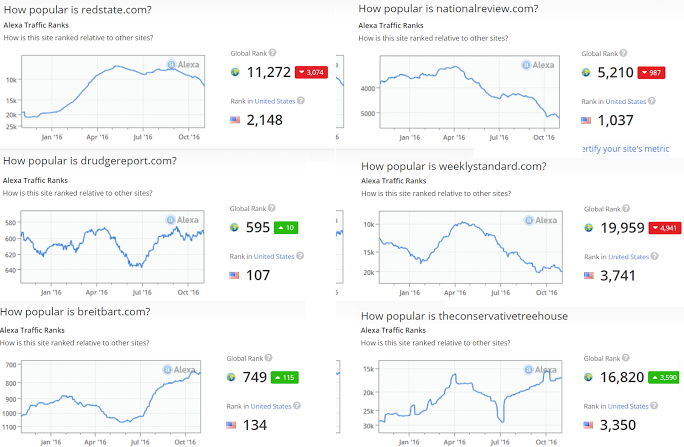
According to the Alexa traffic analysis service, the leading #NeverTrump websites are hemoragging visitors and, by extension, ad revenue. For digital properties focusing on politics, this meltdown is especially damaging because the last few months should have been advertising bonanzas.

Instead, the last few months have been catastrophes.

Meanwhile, pro-GOP/pro-Trump sites like Drudge Report, Breitbart, Gateway Pundit and The Conservative Treehosue are seeing — in some cases — astonishing traffic spikes.

161102-never-trump-fail

It’s clear that the #NeverTrump position isn’t just illogical, it’s also bad business. (For more from the author of “THE EPIC #NEVERTRUMP FAIL: Drudge, Breitbart See Massive Traffic Surges as NRO, Weekly Standard Melt Down” please click HERE)

Follow Joe Miller on Twitter HERE and Facebook HERE.