What to Know About the Fiscal Hawk Trump Chose as Budget Director

President-elect Donald Trump chose one of the most outspoken fiscal conservatives in Congress, Rep. Mick Mulvaney, to be director of the Office of Management and Budget.

Mulvaney, a South Carolina Republican, is a founding member of the House Freedom Caucus, the most conservative group in Congress. He has pushed to cut both domestic and defense spending since being elected to the House in 2010 as part of the tea party wave.

“It is a great honor to be appointed director of the Office of Management and Budget,” Mulvaney said in a statement. “The Trump administration will restore budgetary and fiscal sanity back in Washington after eight years of an out-of-control, tax-and-spend financial agenda, and will work with Congress to create policies that will be friendly to American workers and businesses.”

If the Senate confirms Mulvaney, 49, as budget director, he will help shepherd Trump’s agenda through Congress, including drafting the president’s first budget, guiding repeal of Obamacare, enacting tax reform, and potentially, passing a major infrastructure spending package.

“We are going to do great things for the American people with Mick Mulvaney leading the Office of Management and Budget,” Trump said in a statement. “Right now we are nearly $20 trillion in debt, but Mick is a very high-energy leader with deep convictions for how to responsibly manage our nation’s finances and save our country from drowning in red ink.”

Here are four things to know about Mulvaney.

1. Not Afraid to Fight the Establishment

In 2011, as the U.S. was on the brink of default, Mulvaney voted against raising the debt ceiling, insisting that its passage be paired with “Cut, Cap and Balance,” a measure that would have slashed spending and imposed a constitutional amendment to balance the budget.

He also helped lead an effort to defund Obamacare that resulted in a 16-day government shutdown in 2013.

At the start of his second term in 2013, Mulvaney declined to support the re-election of then-House Speaker John Boehner, abstaining from the vote in protest.

2. Founder of the Freedom Caucus

After he lost his campaign in 2014 to become chairman of the Republican Study Committee—the largest group of House Republicans—Mulvaney helped organize a splinter group, the Freedom Caucus, to push the chamber further to the right.

The Freedom Caucus attracted national attention in 2015 when it pushed Boehner into early retirement.

As budget director, Mulvaney will be a key figure in repealing federal regulations implemented by the Obama administration.

Recently, the Freedom Caucus released a list of 232 regulations that it wants Trump to repeal, including ones dealing with climate change, nutrition, immigration, labor, and energy.

3. Willingness to Work With Leadership, Democrats

Mulvaney has allied with Republican leaders and Democrats on some issues.

On defense issues, he has opposed the use of a separate war funding account known as overseas contingency operations, a budgetary maneuver used to avoid spending caps to fund military and anti-terror operations abroad, such as the military campaign against ISIS.

He’s called the account a “slush fund.” Trump, meanwhile, has promised to invest more in the military and escalate the fight against ISIS.

Mulvaney, who speaks Spanish, has also worked on immigration reform, and he said that he supports legal status for some of the estimated 11 million immigrants living in the U.S. illegally.

He’s friendly with House Speaker Paul Ryan, R-Wis., and was among three members who gave nominating speeches for Ryan in the House GOP leadership election last month.

During his run for Republican Study Committee chairman, Mulvaney told The Daily Signal how he balances his rabble-rousing instincts with dealmaking on issues he cares about.

“I don’t think it’s the role of the RSC chair to be a shill for leadership,” Mulvaney said. “This is not a leadership position. This is separate and apart from that. So I think it’s incumbent upon the chairman to walk that fine line between working with leadership sometimes and pushing back at them at others. And I think I’ve shown the ability to do that. You have to have that credibility. What’s the best way to move the larger conference to the right?”

4. Personal, Professional Background

Mulvaney serves on the Financial Services Committee and the Oversight and Government Reform Committee. He first entered politics in 2006, when he was elected to the South Carolina House. Before that, he was a private-practice lawyer and businessman, working in his family’s home-building business, and helping run a regional restaurant chain.

Mulvaney has a degree in international economics from Georgetown University and a law degree from the University of North Carolina at Chapel Hill.

He was born in Alexandria, Virginia, but grew up in Charlotte, North Carolina, before moving to South Carolina.

His House office is decorated with South Carolina sports memorabilia. Mulvaney is Roman Catholic. He is married with three children, a set of triplets. (For more from the author of “What to Know About the Fiscal Hawk Trump Chose as Budget Director” please click HERE)

Follow Joe Miller on Twitter HERE and Facebook HERE.

It’s Not Islamophobia to Recognize That Sharia Is Incompatible with the Constitution

The Washington Post is trying to pathologize as “Islamophobia” normal, human responses to the worldwide explosion of Islamic supremacism and jihad violence, including recent savage terrorist attacks in America by Muslims our government foolishly welcomed. In a recent column, William McCants tries to cast Donald Trump, Stephen Bannon, Newt Gingrich, Frank Gaffney, and anyone who agrees with them about the danger of Islamist radicalism as tinfoil-hat-wearing hatemongers or fools. That would have to include the scholars of the Claremont Institute, who issued this erudite warning of the grave threat posed to America by Islamist ideology and organizations — such as the many-tentacled Muslim Brotherhood.

No one knows the rules better than the Post: If you want to crush someone in America, link him somehow to racism, if only by some lame analogy. If you want to silence debate about your reasons for crushing him, suggest that he is frothing with hatred, to the point that his condition is a kind of moral disease. If anyone defends him, accuse that defender of that same disease and suggest that if he won’t throw his friend under the bus he could share his fate. Find out where he works, and look into getting him fired.

That’s how opinion is policed in America, where thanks to our Constitution elites don’t have the option of simply throwing dissenters in jail — as the Dutch establishment has jailed patriotic politician Geert Wilders, simply for opposing further Muslim immigration. That’s right, Wilders was sentenced to prison for making a policy argument. Fear not: Opinion polls suggest that he might be elected Prime Minister, at which point even EU minions would probably feel the need to let him out.

Or maybe not. The scorn which European elitists feel for mere citizens is so overpowering, that the Dutch might just leave Wilders to rot and annul the election — as EU satraps in Britain are trying to overturn the Brexit vote, and some Democrats are attempting to nullify the election of Donald Trump with wild charges of Russian “hacking.”

We can scent here the sniffy contempt that Clinton felt for “Deplorables,” which is shared by the Washington press corps. What’s funny is that this sense of superiority is absolutely groundless, built on wishful thinking and ignorance — in this case about what Islam really teaches and what it demands.

Communism was “pseudo-Islam.” The real thing is worse.

The brilliant economist and social philosopher Wilhelm Röpke — the very first professor fired by the Nazis for his ideas — once summed up Communism as a “pseudo-Islam.” A powerful insight: They are both creeds of conquest and domination. For a few generations, people were willing to lay down their lives for the sake of a future “socialist paradise,” but their fervor quickly faded. If you don’t believe in an afterlife, martyrdom is a pretty hard sell.

Islam, by contrast, from the very beginning offered rewards both in this life and the next one. Muhammad recruited warriors by promising them the three things which young men most crave: plunder, power, and pleasure. Those who followed him and his heirs would have Allah’s blessing in stealing loot from the unbeliever, subjugating him, and taking his wife or daughters as sex slaves. Here’s just one of the relevant verses from the Quran:

Quran (33:50) – “O Prophet! We have made lawful to thee thy wives to whom thou hast paid their dowers; and those (slaves) whom thy right hand possesses out of the prisoners of war whom Allah has assigned to thee”

As The Religion of Peace explains: “This is one of several personal-sounding verses ‘from Allah’ narrated by Muhammad — in this case allowing a virtually unlimited supply of sex partners. Other Muslims are restricted to four wives, but they may also have sex with any number of slaves, following the example of their prophet.” And of course if jihad warriors died in battle against the unbeliever, they would go straight to paradise and enjoy a harem in heaven.

Sharia is an ideology, aimed at world domination.

Islamic sharia law is intrinsically political, oriented toward imposing Islam by force if necessary upon every nation on earth, keeping non-Muslims in a servile state, and defending masculine “honor” by savagely policing women’s sexual behavior. In every Muslim-dominated country, sharia does just these things. And every orthodox Muslim must accept sharia — including all its provisions about warring against unbelievers, with the goal of converting, killing, or enslaving every last non-Muslim on earth.

Imagine if rules for burning witches or torturing heretics were mandated in the New Testament, and put into practice in virtually every Christian country on earth, to this very day. Picture evangelicals hounding and killing witches in Alabama, and Pope Francis burning a hundred heretics or so each year in the Vatican. Don’t you think that non-Christian countries would be cautious about admitting Christian immigrants? Not just Christians with actual ties to witch-hunters and inquisitors, but any Christian who wouldn’t clearly renounce such violent practices?

In the center of Sunni Islam, Saudi Arabia, which seeds lands around the world with shiny new mosques and handpicked radical imams, all the most violent practices of primitive Islam are still in effect—from polygamy to blasphemy flogging, from cutting off hands of thieves to executing ex-Muslims for “apostasy.” The Islamic pressure groups funded by Saudi money, such as the Council on American-Islamic Relations, have close links to sponsors of terrorist groups like Hamas, as a U.S. federal judge concluded in 2009.

Time to Change Our Immigration Laws

Given these facts, it is folly to pretend that sharia is compatible with the American experiment. It is not. We need a change to our immigration laws requiring that every potential immigrant renounce the use of force to compel or restrain religious freedom — with provisions for deporting any newcomer who later expresses support for sharia or anything like it. We can model such a law on the perfectly constitutional, decades-long ban on immigration for members of Communist parties.

None of the recent jihadi attackers, in Florida, California, or Ohio, had any provable connection with terrorist groups. The Boston Marathon bombers grew up here since early childhood. What did each of these terrorists have in common? They were simply orthodox Muslims, steeped in sharia — thus primed by their creed and culture to turn against their non-Muslim neighbors. All it took was some piece of bad news, a personal setback, or the right imam spouting on the right message board, to light the spark. It is not Islamophobic to recognize this fact, and to take measures to protect ourselves and our loved ones from it. It is Islamo-realism. (For more from the author of “It’s Not Islamophobia to Recognize That Sharia Is Incompatible with the Constitution” please click HERE)

Follow Joe Miller on Twitter HERE and Facebook HERE.

The Most Important Cabinet Member You’re Not Paying Attention To

President-elect Trump is nearly finished filling out his Cabinet. One of the remaining spots — and in my opinion, the most important — remains undecided. The position in question? The director of the Office of Management and Budget (OMB).

The individuals who serve in Trump’s Cabinet will get the opportunity to oversee the agency or department within their specialized domains, like, for example, the Department of Defense, or the Environmental Protection Agency. But unlike those positions, the director of OMB gets the opportunity to keep tabs on each individual government agency.

That’s because OMB is specifically tasked with allocating the federal budget to the various agencies, as well as monitoring agency performance and providing financial management. OMB is also required to, “coordinate and review all significant Federal regulations by executive agencies,” — no easy task for a government that loves to spend money and promulgate never-ending regulations.

Since OMB is also responsible for drafting and formatting the President’s budget, this also allows this office to be intimately involved in all the policy and spending priorities for the entire federal government.

Although the director of OMB is not treated with the same eminence as those who run the State Department or the Department of Defense, few Cabinet positions are as important as the individual in charge of the budget office for these very reasons.

Some of the individuals chosen to join Trump’s Cabinet are controversial. For example, Trump’s choice for the deputy secretary of state postition, John Bolton, has been met with consternation by many in the liberty movement, such as Senator Rand Paul, R-Ky. (A, 92%) for his stance on issues like bombing Iran and supporting the Iraq war.

Still, conservatives and small-government Republicans should be optimistic about the names currently being floated for director of OMB. The first name floated was former Senator Tom Coburn. Coburn was an astute study of the budget during his days in the Senate, and was referred to by CNN as “a former US Senator from Oklahoma, who turned his Senate career into a crusade against government spending.”

He was also the champion of eliminating government waste, even in programs considered sacrosanct, like the military; he was a long-time advocate of fixing the Pentagon’s broken budget by demanding an audit. But Coburn also made that his mission government-wide, and was well known for publishing detailed reports on government waste.

Another promising name, and small government warrior, that has been mentioned is Congressman Mick Mulvaney, R-S.C. (A, 94%). One of the more conservative members of Congress, he is a member of the Freedom Caucus.

This often means that Mulvaney stands on principle against his own party. For example, when Republican leaders proposed the Bipartisan Budget Act — a bill to hamstring spending restraints by $63 billion — it was Mulvaney that spearheaded opposition to the deal.

In addition, Mulvaney has long advocated for a balanced budget, lower taxes, and eliminating corporate cronyism, like the Export-Import bank.

Among some of the other promising names that have been mentioned is David Malpass, a strong conservative economist by training, and a former high-ranking Reagan and George H.W. Bush official. Malpass also shares the list of names with Eric Ueland, a long-time budget staffer on the Senate Budget Committee.

The current list of conservative individuals under consideration for this position deserves more attention than perhaps any time since President Truman took office. That’s because this OMB director will have a daunting challenge in controlling government spending and debt, more than ever before. Consider the article by the Committee for a Responsible Federal budget, titled, “Trump Will Face Highest Debt-to-GDP Ratio of Any New President Since Truman.”

By our estimates, the national debt will total about 77 percent of Gross Domestic Product (GDP) when Trump takes office, compared to 103 percent when Truman took office at the end of World War II, 58 percent when Eisenhower took office, and 46 percent when Clinton took office.

And yet, it’s not even fair to compare the debt under Truman with that of Obama. The debt that materialized under Franklin D. Roosevelt and Harry Truman was almost solely related to the one-time expenses of fighting World War II. As you can see in the graph, once the war was over, the debts were quickly whittled away. That’s not the case today. Instead, our debts are becoming increasingly structural; the result of promised entitlement spending like Social Security and Medicare.

So really, the task that confronts today’s budget head will be far more daunting than anything that faced Truman. Consider this; by 2021, Social Security and Medicare alone will consume half of every dollar the government brings in. Whereas Truman could allocate surplus dollars to paying down the debt instead of buying tanks, post WWII, the budget director under Trump must decide between taking on more debt and tackling the acrimonious challenge of entitlement reform.

Still, conservatives deserved a good list of names to run what may become the most important office in the White House, and Trump has made a wise selection so far. This is what conservatives fought for. This is where we can make the government small again, and scale back Obama’s absurd regulations. (For more from the author of “The Most Important Cabinet Member You’re Not Paying Attention To” please click HERE)

Follow Joe Miller on Twitter HERE and Facebook HERE.

SHOCKER: U.S. Deportations Fall to Lowest Level in 10 Years

Unexpectedly:

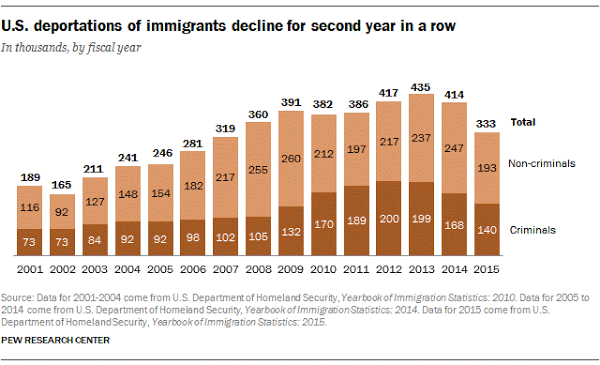
The Obama administration deported 333,341 unauthorized immigrants in the 2015 fiscal year, a decline of about 81,000 (or 20%) from the prior year, according to newly released data from the Department of Homeland Security. The number of deportations fell for the second year in a row and reached its lowest level since 2007…

ft_16-12-15_deportations_removals_fy20151

…Deportations of immigrants with a criminal conviction fell 17% between fiscal 2014 and 2015, from 168,000 to 140,000. It is only the third time that the number of deportations of immigrants with a criminal conviction has fallen since at least 1981.

Kate Steinle could not be reached for comment. (For more from the author of “SHOCKER: U.S. Deportations Fall to Lowest Level in 10 Years” please click HERE)

Follow Joe Miller on Twitter HERE and Facebook HERE.
Busted: Deceitful Media Lied About Trump’s Speech in 3 Racially Charged Headlines

With all the recent consternation from the mainstream media over the prevalence of “fake news,” and the constant grumblings about the dangers that low-information voters present, you’d think the media would take care extra care in their reporting these days.

Wrong.

The Chicago Tribune published a piece covering President-elect Donald Trump’s Thursday rally in Hershey, Pa. And, as it turns out, the story’s headline is a complete lie. The Tribune’s headline:

“Trump calls on Pennsylvania crowd to cheer African-Americans who ‘didn’t come out to vote.’”

Again — a complete falsehood. It says to the reader that Trump encouraged the crowd to cheer for black people who stayed home on Election Day — an overtly racially-charged act. But Trump did not say what the Tribune claims.

Watch for yourself (The comment in question is at the 6:48 mark. Trump begins his discussion of the black vote at the 6:20 mark):

“They didn’t come out to vote for Hillary,” Trump said.

Trump was not asking people to applaud the non-participation of black citizens; he was commending those who did not vote for his opponent — a corrupt, lying, nasty woman.

But the media has a narrative to sell to the people who don’t read past headlines. And so the New York Daily News writes:

“SEE IT: Donald Trump on ‘Thank You’ tour thanks ‘smart’ African-Americans for not voting in 2016 election.”

And Raw Story says:

“Trump tells Pennsylvania fans they can thank African-Americans for not voting in November election.”

And “journalists” push that narrative.

In their hatred of Donald Trump, the mainstream media are perfectly willing to fabricate news (or blatantly mislead, at the very least) if it makes the president-elect look like the evil, racist, monster that they insist he is. And the media does this despite the ease with which relevant facts disprove their narratives.

What is most confounding of all, though, is that the gaffe-prone Donald Trump says enough stupid things that they shouldn’t have to make up “news.” For instance, Trump recently said that African-American voters not showing up to the polls was “almost as good” as those who showed up to vote for him.

“The African American community was great to us,” Trump told a crowd in Grand Rapids, Mich., last week. “They came through, big league. Big league. And frankly if they had any doubt, they didn’t vote. And that was almost as good because a lot of people didn’t show up. Because they felt good about me.”

See, there in Grand Rapids was when Trump said something similar to what the media are implying Trump said this week. They didn’t have to lie about Trump’s comments in Pennsylvania to make their point. But they did lie in their headlines. In their efforts to spread misinformation, The Chicago Tribune and company have embarrassed themselves at the height of this fake-news hysteria.

I don’t consider myself a journalist; I’m a commentator. And so I’ll offer this comment: The point of journalism, it seems to me, is to simply report the facts and truth. It is to inform people of “the real story” when others attempt to spread lies or hide the truth.

The reason people are falling for “fake news” is because the self-proclaimed truth-tellers in MSM are willfully spreading lies. If you are a member of the mainstream media and you want people to believe in you again, stop twisting the facts. Stop pushing narratives.

Start telling the truth. (For more from the author of “Busted: Deceitful Media Lied About Trump’s Speech in 3 Racially Charged Headlines” please click HERE)

Follow Joe Miller on Twitter HERE and Facebook HERE.

Fake News and FEMINISM! How a Liberal Feminist Learned the Media Sucks

Fake news! Celebrity tantrums! FEMINISM! This week’s “Louder with Crowder” had it all.

Feminist filmmaker Cassie Jaye stopped by to talk about her new documentary, “The Red Pill,” a film that documents the Men’s Rights Movement. She also talked about how her views on feminism have changed since learning about the ways men are disadvantaged and discriminated against.

She shared how the liberal media have viciously gone after her for not conforming to the progressive view on feminism.

For his part, Steven Crowder shared how he was kicked in the nards in grade school.

Yes, he cried.

Also, liberal CNN commentator Sally Kohn came on the program to debate your host (and have fun doing it!). And Not Gay Jared on the shelf is still trying to ruin Christmas. (For more from the author of “Fake News and FEMINISM! How a Liberal Feminist Learned the Media Sucks” please click HERE)

Follow Joe Miller on Twitter HERE and Facebook HERE.

Electors: Don’t Let Has-Been Actors Convince You to Flout the Will of the People

For eight long years, the Democratic party has cheered the abuse of executive authority by the president it elected — including executive orders that flouted our immigration laws, and mandates from federal agencies such as the Dept. of Health and Human Services that shredded religious liberty. Democrats confirmed three far-left judicial activists to the U.S. Supreme Court, who duly rewrote the Constitution to invent a “right” to same sex marriage. Indeed, whenever they can muster five votes on the Court, the left turns SCOTUS into a permanent Constitutional convention, making up new rights as it goes along, in the teeth of the will of the voters and the text of our founding document.

Democrats led the way in crippling Congress via “continuing resolutions,” which strip the House of Representatives of its power of the purse, preventing the up-or-down votes on specific pieces of funding that should restrain executive abuses. Instead, the Republicans faced only two choices: pay for Obama’s policies, or shut down the whole government and face the blame when seniors don’t get their Social Security checks.

Suddenly, We Have a Constitution. Who Knew?

But eight long years later, the left lost an election that was supposed to give it the chance to fully pack the Supreme Court to carve in stone the will of elites from Harvard to Hollywood, then open wide the borders to flood the country with newly minted Democrats. So leftists have discovered that the United States actually has a written Constitution. Some have started reading it. The same men and women who claim that this document should be strained and stretched like saltwater taffy when it suits the sexual Zeitgeist have become Antonin Scalia-style “originalists.” They have learned — perhaps from reading the playbill for the musical Hamilton — that at one point some of our Founders intended the Electoral College to serve a deliberative purpose.

The Electoral College That Never Was.

And yes, that is true. Both Alexander Hamilton and James Madison expected the electors chosen by each voting district in the nascent United States to meet in their states’ capitals and calmly, reflectively choose from a list of candidates the person they thought best suited to serve as president. After all, how would ordinary voters from Maine to Georgia know enough about the candidates, in those days of horses and buggies traveling bad roads threatened by Indians?

However, this deliberative step was not specifically mandated in the Constitution, and the rise of political parties right after the retirement of George Washington replaced its function: Now Federalists or Democratic Republicans would deliberate in advance, and nominate qualified candidates. The states, jealous of their influence, soon started passing laws that made elections winner-take-all: instead of congressional districts picking electors, most were elected statewide as early as the 1830s. At no point since the election of John Adams have the electors in fact exercised the role of debating and choosing the president. Instead they are simply a mechanism for enacting the voters’ will. That may not be what Hamilton or Madison had in mind, but it’s perfectly Constitutional. Has been for more than 200 years. And it’s the assumption on which millions of voters in 2016 cast their ballots.

Martin Sheen is Now a Constitutional Scholar… So is that Shrink from Law & Order.

And now some fading actors have made a video to put pressure on members of the Electoral College, asking them to overturn the result of the recent U.S. election because … well, Donald Trump is unfit for office, in their considered thespian judgment.

Of course this is nothing more than the latest dirty trick by the Democrats to attempt to hijack this election. Having run through a long list of scapegoats, from the American FBI to the Russian FSB, the Clinton machine has one more “Hail Mary” pass to throw: Try to sway the electors who were chosen to support Donald Trump — in all but a few states electors’ names don’t even appear on the ballot — to do something else, despite what voters wanted.

Tell the People to Shut Up and Follow Orders.

That’s a very strong impulse nowadays, as John O’ Sullivan wrote in National Review — where he notes that in posh European circles the very word “populist” is treated as an obscenity. It reeks of the grubby “people.” In Britain, Eurocrats are grabbing at every possible obstacle to stop the march of Brexit — even blaming the referendum on … guess who? Vladimir Putin! In Switzerland, that nation’s highest court has overturned a national referendum on policies toward Muslims — a staggering abuse of power in the most democratic country on earth, which is virtually run by plebiscite. Elites in Europe that strong-armed their countries into the European Union now want to arrogate power to unelected bodies within the EU, and take more and more areas of policy out of the hands of voters.

That was not the intent of our Founding Fathers when they crafted the Electoral College. Instead, what they meant to accomplish was to distribute power widely, to guarantee that each state in the Union would receive a voice of its own, and prevent the people of a single populous state (back then it was Virginia — today it’s California) from imposing its will on every corner of the country. The system they created works admirably well, so long as electors remember that they were not chosen for their knowledge or expertise. They were picked to back the candidate chosen by the people who voted for them on election day. To do anything else for any reason would be a simple betrayal of trust. (For more from the author of “Electors: Don’t Let Has-Been Actors Convince You to Flout the Will of the People” please click HERE)

Follow Joe Miller on Twitter HERE and Facebook HERE.

Saturday’s ‘Peace in the Womb’ Christmas Caroling to Shine Light on the Darkness of Abortion

Warm up your voice. A pro-life group is organizing Christmas caroling nationwide in front of abortion clinics to bring the “Christmas message of peace and joy to the darkness of the abortion clinic.” Pro-Life Action League’s “Peace in the Womb” caroling will be held tomorrow, December 17, in 60 cities across 28 states. This year marks the 14th anniversary of the event, initiated by executive director Eric Scheidler, son of Pro-Life Action League founder Joe Scheidler.

In an interview with The Stream, Eric Scheidler said that one of the motivations for the caroling event is the great sorrow he feels at the thought of a woman getting an abortion at Christmas. “It’s a weight they could carry around every Christmas,” he said. “At the same time, what a wonderful time of year to choose life.”

“We gather to sing carols, reminding abortion-bound mothers that the salvation of the world came through an unplanned pregnancy. … We want to offer hope, help and alternatives to assist women in choosing life for their children,” Scheidler said. “We’re there to really put the emphasis on the image of the Christ-child being born in Bethlehem so many years ago.”

The Christmas carols are selected specifically to “evoke this Christmas image that really is so powerful of the hope and the joy that came in the world through the birth of a child during a difficult time,” Scheidler explained. “Quite the unexpected pregnancy. And it’s a great example to all parents — saying ‘yes’ to life, even when there’s a tremendous challenge to it, there’s a great hope still available to people.”

The caroling elicits a much more positive response than any other activity the group does. “There’s something about Christmas carols, people — even the people who escort the pregnant women into the center for the abortion — enjoy the Christmas caroling,” said Scheidler. “The most powerful reaction is when women have decided not to go through with the abortion.”

Scheidler told the story of one year’s caroling in Chicago when logistics made their singing heard quite easily from inside the abortion center. The group sang “Silent Night,” and afterwards, a woman emerged from the clinic and told them she’d decided not to have the abortion because she heard the song and imagined Mary and the baby Jesus. “We’ve seen it again and again,” said Scheidler.

Forty groups participated last Christmas, and this year’s event will be much bigger. Thousands of carolers are expected to show up nationwide. Scheidler believes that the release of the undercover Planned Parenthood videos has contributed to the uptick in participants. He also believes that, now that the election is over, people want to be involved in something other than politics — to get out on the streets and make a difference.

In addition to Christmas caroling and depending on location, participants could hold Pro-Life Action League signs, provide sidewalk counseling and stand around an empty cradle — symbolizing the anticipation of birth as well as what would happen if an abortion takes place.

Scheidler prays this years’ event will make a difference for women and their unborn babies this Christmas season. “What we hope will happen is that a woman will choose not to abort a child because she hears the carols, or maybe the father hears the carols and thinks about what abortion really means, especially at Christmas time.” (For more from the author of “Saturday’s ‘Peace in the Womb’ Christmas Caroling to Shine Light on the Darkness of Abortion” please click HERE)

Follow Joe Miller on Twitter HERE and Facebook HERE.

Are We Entering a Post-Liberal Era?

In his December 9th article “Has the Trumpian Revolution Begun?,” long-time conservative commentator Patrick Buchanan dared to say that, with the Trump presidency, “we may be entering a post-liberal era.” Could it be true?

According to Buchanan, “Liberalism appears to be a dying faith. America’s elites may still preach their trinity of values: diversity, democracy equality. But the majorities in America and Europe are demanding that the borders be secured and Third World immigrants kept out.”

But it is not just political liberalism whose demise Buchanan is tentatively predicting. He also suggests that moral and cultural liberalism could be on the wane as well. He writes, “As Hegel taught, in the dialectic of history the thesis calls into existence the antithesis. What we seem to be seeing is a rejection, and a counterreformation against the views and values that came out of the social and political revolutions of the 1960s.”

What? A counterreformation against the radical cultural shifts and moral changes that came out of the counterculture revolution of the 1960s, a revolution that birthed radical feminism, gay activism, and sexual anarchy?

For years we have been told that liberalism had triumphed and that conservative morality was a thing of the past.

For years we have been told that “progressivism” owned the future and that traditionalists were a dying breed, soon to be replaced irrevocably by a younger, enlightened generation.

Could it be that America’s future is not as set in stone as we have been told? Could it be that the Trumpian triumph is part of a much larger social and cultural shift?

On the one hand, it is clear that Trump’s victory, along with that of the Republican party, was not primarily driven by moral issues as much as it was driven by other national concerns. Americans didn’t like the way their country was going — politically, socially, economically — and they wanted to regain control.

They wanted a greater sense of security, a greater sense of strength — Trump’s line that “we never win anymore” certainly resonated with millions — and a greater sense of Americanism, meaning, they didn’t want to lose the unique qualities that, in their minds, have made America what it is over the decades and centuries.

And while white evangelicals also turned out in large numbers to vote for Trump because they were concerned about their religious freedoms and about the makeup of the Supreme Court, with pro-life issues front and center for many of these voters, it would be wrong to think that the election of Donald Trump represented some kind of moral imperative — unless we look at things from a little bit different angle.

A Different Angle

Let’s focus on LGBT issues for a moment. While Trump did make overturning Roe v. Wade a consistent part of his message, he did not make overturning the Obergefell decision a consistent part of his message, actually saying recently that same-sex “marriage” was the law of the land. And the fact that he featured openly gay PayPal founder Peter Thiel at the Republican National Convention and that Thiel is playing a key role in his transition team indicates that he is hardly an opponent of LGBT goals.

At the same time, the vote for Trump was a way for millions of Americans to say “enough is enough” to extreme political and social agendas — even if they were not singled out by name — and leading the way in those extreme agendas is LGBT activism.

In a remarkable interview conducted at New York City’s famous Stonewall Inn, where the gay revolution burst on the national scene in 1969, Attorney General Loretta Lynch spoke with MSNBC’s Rachel Maddow about the Trump election and its potential effect on the LGBT movement.

As reported by the Advocate, Maddow “asked Lynch if Trump and his homophobic potential cabinet were a backlash to marriage equality, hate-crimes legislation, and open military service.”

They genuinely feared that many of the victories they had won during the last eight years under the Obama administration could be undone by the Trump administration, and they perceived the vote for Trump to be a vote against LGBT activism.

Could it be that they rightly sensed a larger cultural shift?

In their minds this is all grim and negative, but could it be that Americans have had it with a small minority — whoever that minority may be — imposing their will on the rest of the country? Could it be that many Americans are sick and tired of having their rights subsumed to the rights of a radical sub-section of the populace?

The operative word for Maddow and Lynch was “backlash,” and that for good reason.

Speaking to Fox’s Tucker Carlson, Tammy Bruce, the openly gay, staunchly conservative radio host, stated that leftists, whom she called fascists, “now want Christians to preemptively prove that they pay allegiance to conforming to secular society.” She pointed to the recent liberal attack on Chip and Joanna Gaines, the popular reality TV stars, simply because they attend a gospel-preaching, Bible-believing church, a church that does not believe in same-sex “marriage.”

Bruce noted that the “great news” was that the attack on Chip and Joanna failed, also stating, “I think the election itself was a message about our rejecting of political correctness and the culture of intimidation.”

Precisely. And that is the heart of the matter.

Enough

It is not that tens of millions of Americans suddenly became homophobic or Islamophobic or xenophobic, as much as that tens of millions of Americans rejected the left’s “political correctness and the culture of intimidation.”

In fact, these three articles on National Review, written respectively in May, November, and December of this year, detail the progression well. First, by David French, “Identity Politics Are Ripping Us Apart”; next, by Kevin D. Williamson, “An End of Identity Liberalism?”; and then, by Kay Hymowitz, “Why Identity Politics Are Not All-American.”

Inevitably, at some point, the radical leftist agenda has always been doomed to fail, and there is now a push back against the left’s overplaying of its hand, which includes: forcing transgender activism into our children’s schools; declaring that phrases like “ladies and gentlemen” are transphobic and sexist; students at the University of Pennsylvania replacing “a hallway portrait of William Shakespeare with a photograph of lesbian activist Audre Lorde” — apparently Shakespeare was just too white and too male; and Oregon State University offering a course on “African American resistance to Trump.”

These radical agendas can only go so far before the people begin to push back, and that it is partly what happened with the recent elections.

Enough with the divisive ways of identity politics. Enough with the attack on traditional American values. Enough with the assault on our religious freedoms. Enough.

So, in that sense, yes, we are witnessing a larger moral and cultural backlash, even if some of these issues were not front and center in the Trump campaign. And to the extent we can make the case for a biblically-based, moral conservatism, one that treats everyone fairly but that recognizes that certain boundaries are healthy and good, we can turn the hearts of the younger generation as well as recapture the hearts of the older generation.

As my close colleagues and I have said for the last 15-plus years, on with the revolution. (For more from the author of “Are We Entering a Post-Liberal Era?” please click HERE)

Follow Joe Miller on Twitter HERE and Facebook HERE.

Cyberattacks Are a Major Security Threat. Here’s How to Deter Them.

Nearly two years ago, North Korea launched a cyberattack against Sony that nearly crippled the movie giant. The U.S. responded by imposing yet another round of feckless sanctions against the Hermit dynasty.

But ironically, if members of the North Korean army had landed in Los Angeles and blown up Sony’s studios with dynamite, they would actually have done less damage to the company—but there likely would have been a greater outcry in the U.S. for a more forceful response.

Cyberattacks are incredibly destructive, but because they are subtle, they often attract far less attention than overt attacks.

North Korea’s attack against Sony, along with a host of other state-sponsored cyberattacks, raises important questions for U.S. policymakers. How should we deter cyberattacks? And how should we respond when our deterrence fails?

Unlike the early days of the Cold War, we do not have a modern-day George Kennan (who wrote the strategically vital article “Sources of Soviet Conduct“) or a Paul Nitze (the primary author of the influential NSC-68) for the cyber age. Instead, we are left with the strategic equivalent of trying to pour old wine into new recyclable water bottles.

In order to develop a cyberdeterrence doctrine, we need to unpack what is necessary in order for deterrence to be successful—and how to respond when deterrence fails.

One of the most difficult hurdles to overcome is defining what constitutes a cyberattack. Several federal agencies disagree over what is, and is not, a cyberattack.

An informal consensus is contained in a report issued by RAND Corp. in 2009, which defined a cyberattack as “the deliberate disruption or corruption by one state of a system of interest to another state.” (Spying is not considered to be a cyberattack because it does not deny users access to a system, even though spying may be a prelude to an attack.)

At first glance, this is a reasonable definition. It doesn’t account, however, for one group of people: nonstate actors.

If a group such as the Islamic State, al-Qaeda, or Hezbollah were to disrupt the electrical grids in the United States or Israel, surely this would count as a cyberattack, would it not?

This brings us to the second problem: attribution—that is, correctly identifying where a cyberattack has come from.

It is fairly straightforward to determine who fired a gunshot or a rocket. However, when it comes to cyberattacks, attribution is a critical component of deterrence. Without attribution, we do not know who to retaliate against.

In the 2008 war between Russia and Georgia, hackers operating from Russian soil launched cyberattacks against Georgian installations. However, there was little evidence to directly tie then-Prime Minister Vladimir Putin’s Kremlin to the attacks.

While the attacks benefited Russia’s military efforts, there was no proof that Putin or then-President Dmitry Medvedev had hit the “enter” key—or created the code.

This lack of proof complicates efforts at the third problem: retaliation.

In order for deterrence to be credible, states not only have to be able to attribute attacks, they have to be able to retaliate. States may deter in one of two ways: deterrence by denial and deterrence by punishment.

We can think of deterrence by denial as erecting a large fence where cyberattacks would be deflected (or, building a wall that is so tall, enemies would not bother to attack it in the first place).

Deterrence by punishment, on the other hand, means retaliation. It is in essence saying to the enemy, “If you kill my mainframe, I’ll melt every one of your servers.”

These two options are not necessarily mutually exclusive. States can build cyberdefenses that protect against attacks by making the costs of attack exceed any of the benefits. States can also adopt retaliatory postures in response to attacks, provided they can determine who was responsible for an attack.

This leads us to the next issue: proportionality.

In his classic book “Strategies of Containment,” historian John Lewis Gaddis differentiated between two types of containment: symmetrical and asymmetrical.

Symmetrical containment emphasized maintaining the balance of power between the U.S. and the Soviet Union. It also suggested that if the Soviets attempted to breach our sphere of influence, we should respond proportionately.

This was the strategy adopted by the Truman, Kennedy, Johnson, and Carter administrations.

By contrast, asymmetrical containment suggested the U.S. climb the ladder of escalation in response to Soviet provocation.

In order to make Soviet expansion costly, the U.S. should push the Soviets behind the “Iron Curtain”—the term coined by Winston Churchill to describe the dividing line between the free states of Western Europe and the Soviet-dominated member nations of the Warsaw Pact. Presidents Ike Eisenhower, Richard Nixon, Gerald Ford, and Ronald Reagan all adopted this posture.

While retaliation against cyberattacks is necessary, whatever posture we adopt, the key question we need to ask ourselves is: “What next after retaliation?” Our hope, of course, is that with a symmetrical posture, our enemies will learn their lesson.

But, what if they don’t? What if they see a symmetrical posture as a sign of weakness, a lack of resolve, or a sign of low capabilities?

Similarly, the aim of an asymmetrical posture is to demonstrate our resolve while increasing the costs of cyberconflict for our opponents. But what if we are facing an opponent like Saddam Hussein, who lacked the ability to update his beliefs in the face of discrepant information, and any retaliation on our part is not taken seriously?

Or, what if we face a defensively motivated opponent whose intentions are not nefarious, but are driven by an interest in national security? Here, an asymmetric posture could lead to an unnecessary spiral of conflict.

Furthermore, we need to discuss whether our responses should be restricted to the cyber domain or include more conventional means of retaliation, such as economic sanctions or military strikes.

Some pundits and scholars have written of a “new” strategic triad: space, nuclear, and cyber. To be successful, it is necessary to develop a doctrine for cyberdeterrence that defines what a cyberattack is, how to attribute attacks from state-based and nonstate actors, and the appropriate degree of retaliation.

Before we develop a new cyber doctrine by the seat of our pants, it is worth allowing our cyber experts and decision-makers to take a breath and sift through the laborious conceptual work that is needed to make cyber-deterrence successful in the 20th century. (For more from the author of “Cyberattacks Are a Major Security Threat. Here’s How to Deter Them.” please click HERE)

Follow Joe Miller on Twitter HERE and Facebook HERE.