Texas AG: Banning Christmas Poster Violates First Amendment

“She said my poster is an issue of separation of church and state. She said the poster had to come down because it might offend kids from other religions or those who do not have a religion.”

That is how Dedra Shannon, an aide in the school nurse’s office at Patterson Middle School in Killeen, Texas, explained the confrontation she had with the school’s principal concerning the poster she had used to decorate the door to the nurse’s office in the school, depicting a famous scene from the traditional Christmas TV show A Charlie Brown Christmas.

In the scene, a frustrated Charlie Brown asks if anyone knows what Christmas is all about. At that point, his friend Linus quotes the biblical passage about the birth of Christ found in the second chapter of Luke’s gospel, including the words, “For unto you is born this day in the city of David a savior who is Christ the Lord.” Linus then tells Charlie Brown, “That’s what Christmas is all about, Charlie Brown.”

Inspired by that scene from the TV program that has run for almost half a century, Shannon used the image of Linus, a scrawny Christmas tree, plus the Bible verse that Linus cited, in a six-foot poster on the door of the nurse’s office . . .

Texas Attorney General Ken Paxton weighed in on the controversy, declaring the actions of the school district a violation of both the First Amendment and Texas law. He argued that Shannon’s display is specifically protected by the “Merry Christmas Law,” which was enacted in 2013 by the Texas Legislature. “We passed that law precisely because of this type of discrimination against people of faith,” stated Paxton, adding, “No school official in Texas can silence a biblical reference to Christmas. This is an attack upon religious liberty.” (Read more from “Texas AG: Banning Christmas Poster Violates First Amendment” HERE)

Follow Joe Miller on Twitter HERE and Facebook HERE.

In Tillerson, Trump Nominates ‘Greatest Ally Liberals Have’ in the Cabinet, Says Christian Conservative Leader

“The ExxonMobil executive may be the greatest ally liberals have in the Cabinet for their abortion and LGBT agendas,” Christian conservative leader Tony Perkins said of Donald Trump’s nominee for Secretary of State, Rex Tillerson. He wrote on Monday before the nomination was officially made. He had been a strong Trump supporter during the election campaign.

Tillerson, the CEO of ExxonMobil, is “among the most accomplished business leaders and international deal makers in the world,” Trump said when nominating him. His career “is the embodiment of the American dream.”

The head of the Family Research Council noted in his Washington Update that Tillerson “not only led the charge to open the Boy Scouts to gay troop leaders but [his] company directly gives to Planned Parenthood.” Perkins continued:

FRC knows Tillerson all too well, having worked for years to put the brakes on his reckless agenda for a scouting organization that was already dealing with staggering numbers of sexual abuse cases. Unfortunately, the BSA, under Tillerson, ultimately caved to the pressure of the far-Left, irreparably splitting the Scouts and destroying a proud and honorable American tradition.

Tillerson served as president of the Boy Scouts from 2010 to 2011 and pushed for the acceptance of homosexual scouts and scoutmasters. However, when questioned by the Daily Caller, ExxonMobil said that it gave to Planned Parenthood through its employee matching gift and volunteer programs. The giving “does not reflect ExxonMobil’s philanthropic priorities or support for community causes.”

Support For the LBGT Agenda

Perkins also noted that while Tillerson led the ExxonMobile, its 2017 score on the homosexual lobby Human Rights Campaign’s Corporate Equality Index “skyrocketed to 87 percent.” (It’s actually a score of 85 out of 100.) It had been only 40 last year.

The company had perfect scores in practices like providing medical and “soft” benefits to homosexual partners and “non-discrimination standards” for its contractors and vendors. It got good scores in prohibiting “discrimination” against homosexual and transgender people and “positively” engaging the “external LGBT community.”

However, the HRC criticized Trump for his four nominees with “troubling anti-LGBTQ records.” They are Rex Perry (Energy), Tom Price (Health and Human Services), Ben Carson (HUD) and Jeff Sessions (Attorney General). It strongly opposes vice president-elect Mike Pence.

Perkins noted that under President Obama and Secretary of State Hillary Clinton, “the State Department lead the global parade for the slaughter of innocent unborn children and the intimidation of nations with natural views on marriage and sexuality.” He worried that Tillerson will continue their policies.

Whether Tillerson will press these issues as secretary of state is unknown, notes Religion News Service’s David Gibson. “He would be serving at the pleasure of a president who has vowed to enshrine the social conservative agenda in his policies,” Gibson writes. However, Perkins’ opposition may “augur an unexpectedly early end to the honeymoon with evangelical Christians — Perkins was one of Trump’s most vocal supporters on the religious right during the campaign.” (For more from the author of “In Tillerson, Trump Nominates ‘Greatest Ally Liberals Have’ in the Cabinet, Says Christian Conservative Leader” please click HERE)

Follow Joe Miller on Twitter HERE and Facebook HERE.

Oklahoma Supreme Court Overturns Pro-Life Law That Raised Abortion Center Standards

An Oklahoma law requiring abortionists to have admitting privileges at nearby hospitals is unconstitutional, according to the state’s highest court. The 2014 law, called SB1848, included protections for the women’s health and safety and required an abortion facility to have a doctor there who could admit patients to a hospital not more than thirty miles away.

Claiming that the requirement was passed “under the guise of the protection of women’s health,” the Oklahoma Supreme Court declared the law unconstitutional “because it creates an undue burden on a woman’s access to abortion, violating protected rights under our federal Constitution.”

U.S. Supreme Court Precedent

The Court cited both the U.S. Supreme Court’s decision this summer overturning Texas abortion center standards that included abortionist admitting privileges. The U.S. Supreme Court said the Texas law was an “undue burden” on the health of women, in part because the number of abortion centers in the state dropped by about half once it and another law were implemented.

The Oklahoma Supreme Court noted that there are two licensed abortionists in the state. One of them and the plaintiff in the case, Dr. Larry Burns, said he faced possible heavy fines and/or the closure of his center after being unable to get admitting privileges at nearby hospitals. According to the court, the risk to his abortion center’s existence meant women would risk not having access to abortion.

The Court also said that Burns’ practice was safe for women who are getting abortions:

In 41 years of private medical practice, Burns has only called an ambulance one time for a patient who was simply observed and released from a local emergency room. We find there is no evidence to support defendants’ position that this legislation protects and advances women’s health.

The court also claimed that the law violated a state constitutional requirement that laws have a “single subject.” The law includes new provisions that “are so unrelated that many of those voting on the law would be faced with an unpalatable all-or-nothing choice.”

“Women are in Danger in Many Abortion Clinics”

Conservative Oklahoma activist and blogger Jamison Faught told The Stream that he was “not surprised that the state Supreme Court once again tossed out a pro-life law. For some reason, Oklahoma has a very liberal state judiciary. One of their favorite strategies in striking down pro-life legislation is their very inconsistent application of the single-subject rule in the state Constitution.”

Governor Mary Fallin said in a statement distributed to the press: “I’m disappointed to see another pro-life law struck down by the courts. Like many bills passed in Oklahoma, this bill was designed to protect the health and welfare of the mother along with the life of the unborn, which always should be among our society’s priorities.” Oklahoma Attorney General Scott Pruitt did not immediately respond to request for comment.

The Oklahoma ruling came hours after Americans United for Life (AUL) released a report, Unsafe Conditions, detailing over 1,400 health and safety violations by 227 abortion centers in 32 states around the nation since 2008. In a National Review Online op-ed, AUL Vice President of Legal Affairs Denise Burke wrote that her organization’s report

convincingly demonstrates that the Supreme Court’s claim that abortion clinics are ‘safe’ qualifies as the lie of the year. The report documents that in Texas alone, at least 17 abortion providers have recently been cited by state officials for violations of health and safety standards, including, ironically, five clinics operated by Whole Woman’s Health, the lead plaintiff in the Supreme Court case.

AUL spokesperson Kristi Hamrick told The Stream that “It is clear that women are in danger in many abortion clinics. We can document that. Any court that refuses to see this is not looking at the facts at hand.”

She added: “When the Supreme Court threw out Texas’ health and safety standards, they said at that time that it could be constitutional to have such standards if they were proven to be necessary. Here’s your proof.” (For more from the author of “Oklahoma Supreme Court Overturns Pro-Life Law That Raised Abortion Center Standards” please click HERE)

Follow Joe Miller on Twitter HERE and Facebook HERE.

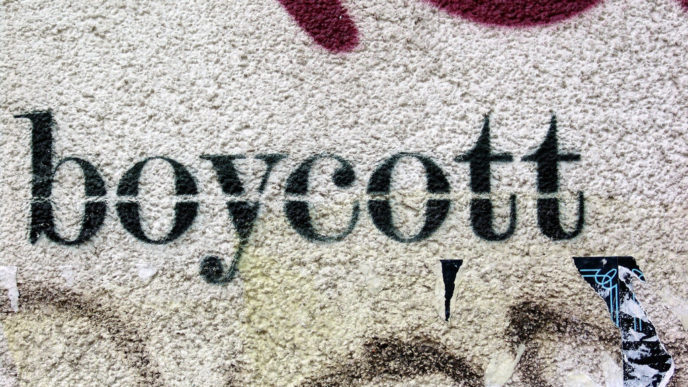
Do Boycotts Actually Work? Yes, but There’s a Right Way … And a Wrong Way

Advocates of government regulation of business frequently represent corporations as holding too much power. They have lots of money, and if their product is good, many loyal customers continue to feed their operations regardless of any moral or ethical violations.

Such people usually take a pessimistic view of the ability of consumers to regulate business via the threat of withholding their money. The implication is that people care more about low prices and convenience than they do about social causes, and that, therefore, businesses can get away with murder.

There is a certain amount of truth to this, in that in most cases, the cause du jour is only important to a small but vocal minority, while the rest of us are happy to continue shopping at our favorite stores. But if we don’t care enough about an issue to shop elsewhere, why should we care enough to impose government sanctions, paid for by all of our tax dollars whether we approve of the regulation or not?

But let’s not be too hasty to dismiss the power of the boycott. Companies have shareholders to answer to, and bad publicity coupled with declining sales never sits well with stockholders whose chief concern is profit. This is far from a theoretical argument; there are plenty of examples of effective boycotts.

The most prominent example from this year is the boycott of Target for its announcement that transgendered shoppers are permitted to use any bathroom they choose. Social conservatives fear that this opens the door to predatory behavior and decided to withhold their business in protest of the policy.

The boycott has had a significant effect on business, reducing sales by 7.2 percent and costing the company $20 million. While Target has yet to reverse its transgender policy, the company has responded by installing larger bathrooms with more privacy in an effort to appease critics, proving that the boycott is working, at least to an extent.

Target is far from the only example. After Mozilla CEO Brendan Eich donated to a campaign to protect traditional marriage, a large Internet backlash resulted in his being removed from his position.

Similarly, the blogger and professional liar known as Food Babe succeeded in whipping up enough ill-informed outrage about an ingredient called carrageenan to convince a major producer of natural foods to stop using it.

There’s a lesson here that it matters what the customer base of a company looks like. Target is suffering because a large number of its customers hold traditional values. Mozilla primarily serves younger, more progressive users. And while companies that rely on the left-leaning, nutrition-focused demographic have to worry about bad publicity, other companies with more conservative customers were immune to the criticism about food additives.

The most striking example of this comes from addictive chicken purveyors Chick-fil-A, which drew outrage for a statement opposing gay marriage. But Chick-fil-A is located in primarily in the South and one of the few places that still closes on Sundays. Far from condemning the restaurant, the majority of Chick-fil-A’s customers redoubled their support, and the company actually saw an increase in sales as a result of the boycott.

The moral of the story is that boycotts work, but you have to know your target. You can’t get Whole Foods customers to boycott by claiming the company employs illegal immigrants, and you can’t get Cracker Barrel customers to boycott over the use of GMOs. It has to be something the existing customer base already cares about.

Consumers have a lot of power to influence corporate behavior if they are willing to use it. It’s worth remembering that no company, however large, can make you buy something you don’t want. And once people stop wanting their products, they will be forced to change or else face the prospect of bankruptcy. (For more from the author of “Do Boycotts Actually Work? Yes, but There’s a Right Way … And a Wrong Way” please click HERE)

Follow Joe Miller on Twitter HERE and Facebook HERE.

Trump Must Fire Swamp Monsters Comey, Koskinen, and Other Obama Holdovers Immediately!

“You’re Fired!”

If there was ever a president who has the mandate, public expectation, and personal style to drain out the bureaucratic swamp and fire every Obama holdover within the executive branch, it’s Donald Trump. He should exercise this mandate as liberally as he did on Celebrity Apprentice.

Tackling the “fourth branch of government”

Historically, even when Republicans win the White House, the various departments and agencies that actually run government serve as a collective fourth branch and a fifth column, countermanding any semblance of the conservative agenda. Democrat presidents never have these problems because the inherent ideological balance in most of these public policy fields is already oriented towards implementing the Left’s priories. And after eight years of Obama, every nook and cranny of the executive branch will be contaminated with hostile elements. Obama has left no stone unturned in orienting each department, agency, and office towards the execution of a cross-sectional portfolio of liberal priorities.

Trump must be the first GOP president to break the failed streak of Republican presidents to completely drain the swamp. To that end, he must immediately ask for the resignation of every agency head within the executive branch, including those agency heads that don’t automatically turn over with new administrations.

First and foremost, he should get rid of James Comey as FBI director and John Koskinen as IRS commissioner. Both of those individuals have clearly lost the public trust to serve in their positions. Democrats will try to claim that they are tenured in, pursuant to congressional statute, for 10 and five year terms respectively. However, those laws are only as strong as the president wants to make them because a president has plenary power over the personnel he chooses to run executive agencies. The same liberals who believe the executive and judicial branches could run rogue shot over Congress’ authority over broad public policy issues will now suddenly make the case that Congress can force a president to accept a particular individual to head an agency. They are dead wrong and Trump should challenge this assertion.

President controls executive personnel, Congress controls policy

While the legislature is clearly the dominant branch of government in terms of setting public policy and the federal budget, the president gets to determine who will serve in executive positions. To be clear, Congress can always eliminate an agency, completely regulate the scope of its jurisdiction, defund the agency or the office of the agency head, place reasonable qualification conditions on those who serve (e.g. requirement to obtain a security clearance), and, of course, refuse to confirm any presidential picks. But Congress does not have the authority to force the president to maintain any one individual as head of the agency so long as that agency still exists through statute.

The Supreme Court ruled long ago that because the president has the power to appoint [U.S. Const., art. II, §2, cl. 2] executive ministers and councils, he has the power to remove them. After all, if a president can, within reason, appoint anyone he desires to head an agencies, he certainly cannot be boxed in by Congress to only choose or maintain any particular individual. Again, the Senate is very powerful and can defund and abolish an office or refuse to confirm a presidential replacement if they are upset with him firing an FBI director or an IRS commissioner. But they lack the power to directly force a president to keep people like Comey and Koskinen.

Madison explained the distinction in separation of powers very clearly in a letter to Thomas Jefferson [see page 196]:

[Congressional tenure laws] overlook the important distinction between repealing or modifying the office and displacing the officer. The former is a legislative, the latter an Executive function; and even the former, if done with a view of re-establishing the office and letting in a new appointment, would be an indirect violation of the theory and policy of the Constitution.

Although it is widely believed, based on previous activist court decisions, that the president cannot fire commissioners of independent multi-body commissions (such as the Securities and Exchange Commission or Federal Trade Commission )[2] that engage in quasi-legislating and quasi-judicial functions, a president can definitely fire the FBI director and the IRS commissioner in middle of their tenures. As Andy McCarthy wrote in November, given that the FBI is an executive agency and part of the Justice Department, “the FBI director is subordinate to the attorney general in the chain-of-command,” and is therefore subject to termination by the chief executive.

What about the congressional statute creating a 10-year tenure?

“This is a preference, it is not binding on the president,” writes McCarthy. “Presumptively, after being confirmed, the FBI director is retained by subsequent presidents. If the president decides to make a change, however, the president is constitutionally authorized to remove the director and does not need cause — at least not legally.”

Indeed, Bill Clinton, at the recommendation of then-Attorney General Janet Reno, fired the sitting FBI Director, William Sessions, in 1993.

There is no reason the same logic shouldn’t apply for the IRS commissioner who serves under the secretary of treasury.

Additionally, Trump should fire Richard Cordray as the director of the Consumer Financial Protection Bureau (CFPB). The CFPB is an unaccountable agency created by Dodd-Frank and operates autonomously within the Federal Reserve. It is essentially the “death panel” of the financial sector, with control over bank accounts, mortgages, and student loans, and serves to limit the choices of consumers in financial markets, making it harder and more expensive to obtain credit. Ideally, Congress should abolish the CFPB, but until such repeal is signed into law, Trump must appoint a new director. The U.S. Court of Appeals for the District of Columbia has already ruled that the only way this agency can be constitutional is if it is under the executive stewardship of the president with its director being subject to removal by the president.

The same theory should apply to Mel Watts as director of the Federal Housing Finance Agency (FHFA). Although an independent agency, the FHFA completely oversees executive policy related to Fannie Mae and Freddie Mac — and by extension — the entire mortgage industry. Mel Watt, who was sworn in at the beginning of 2014 for a five-year term as director, is promoting the same affordable housing mandates that led to the original subprime mortgage crisis. Trump should immediately ask for his resignation.

Trump was elected president — despite his personal unpopularity — precisely because many people who don’t like him view him as the political Drano to clear out the federal sewer. The lesson from past administrations is that ALL of the agency heads must be fired and fired immediately. Once they are left in place initially, any subsequent decision to fire them is perceived as a scandal. But if Trump waltzes into the White House on January 20 and immediately tells all of Obama’s holdovers they are fired, it will resonate. That is exactly what people expect of The Donald. (For more from the author of “Trump Must Fire Swamp Monsters Comey, Koskinen, and Other Obama Holdovers Immediately!” please click HERE)

Follow Joe Miller on Twitter HERE and Facebook HERE.

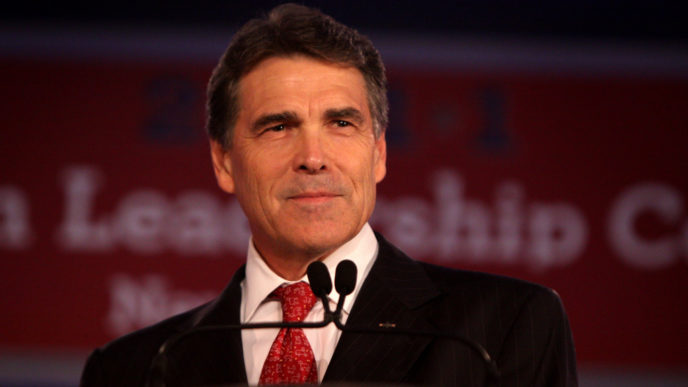
Rick Perry Once Wanted to Cut the Department of Energy. Now Trump Wants Him to Lead It

More Trump transition team news broke late Monday night, as Fox News’ Bret Baier reported that “an informed source” close to the transition team claimed President-elect Donald Trump will nominate former Texas Governor Rick Perry to lead the government agency responsible for unleashing a trans-dimensional man-eating beast on an unsuspecting Indiana town — err, the Department of Energy.

As the former governor of Texas — one of the nation’s largest oil producing states — Rick Perry makes sense to lead the department in charge of overseeing energy production, energy conservation, and related research and development. The U.S. Department of Energy is also responsible for America’s nuclear weapons program and nuclear energy.

Observers quickly noted, however, that the DOE was one that then-presidential candidate Perry forgot in his pledge to eliminate three federal agencies during a 2012 Republican primary debate. That “oops” moment more or less ended his 2012 presidential campaign.

But Perry was right, there is certainly plenty to cut. President Obama has funneled billions of dollars into the department to subsidize black-hole green energy projects that would never be sustainable otherwise, without the cronyist backing.

Remember Solyndra? American taxpayers lost as much as $850 million to the green-project boondoggle at President Obama’s direction. But Solyndra, of course, is but one example in the rigged, ideologically driven market.

It is not the role of the federal government to step into the marketplace and aid an industry that cannot compete on a level playing field. Perry can go a long way toward ending the green-energy crony capitalism so prevalent under the Obama administration.

If the former Texas governor indeed becomes the secretary of energy, he also has the opportunity to end Obama’s war on nuclear power. The Obama administration proposed defunding the Savannah River plutonium mixed oxide recycling plant in its 2017 fiscal year budget, while increasing funding for green energy investment. Rick Perry as secretary of energy could redirect the department’s resources away from wasteful projects, and toward clean nuclear power. (For more from the author of “Rick Perry Once Wanted to Cut the Department of Energy. Now Trump Wants Him to Lead It” please click HERE)

Follow Joe Miller on Twitter HERE and Facebook HERE.

How Texas Can Lead the Charge on Education Choice

The debate around school choice has shifted from whether states should enact education choice to how best to accomplish that goal.

In a special report released on Monday—co-published by The Heritage Foundation and the Texas Public Policy Foundation—we discuss how this question will be especially important in Texas, which is considering adopting education savings accounts, becoming a leader in the education choice movement.

What will now be critically important for Texas as it works to create education choice is that policymakers avoid adopting a flawed version of accountability.

More Choice, More Accountability

The best way for policymakers in Texas and elsewhere to expand access to a high-quality education for all children is to provide all families with education savings accounts that give them the maximum possible freedom to choose the education providers that work best for their children.

In “Recalibrating Accountability: Education Savings Accounts as Vehicles of Choice and Innovation,” we outline ways in which policymakers can ensure parent-centered accountability is a key feature of education savings accounts in Texas.

Education savings accounts enable families to access a variety of educational options beyond the traditional classroom.

In addition to, or even instead of, enrolling at a private school, students using education savings accounts might learn from tutors, take a course online or at a local college, study from a homeschool curriculum, or use some combination of these. Education savings accounts both empower parents to completely customize their child’s education and provide a platform for innovation.

Education savings accounts expand students’ opportunities and make education providers more directly accountable to parents. But this new model of education will require rethinking the way we hold education providers accountable. And it’s a rethinking that couldn’t come soon enough. For far too long, parents have been deprived of genuine accountability.

That’s because a lack of accountability is a hallmark of monopolies. District schools operate like monopolies because many parents have no viable alternatives. District schools are primarily accountable to politicians and unelected bureaucrats, not parents, and they receive funding regardless of their performance or whether they are meeting the needs of families.

And because district schools are not held directly accountable to parents, some policymakers have attempted to impose accountability through top-down government regulations. Yet decades of attempts to regulate district schools into quality have had little effect.

Without question, parents and taxpayers have a legitimate interest in the accountability debate.

Parents should have robust, contextual information about how their children are performing, and whether their education providers are setting them up to achieve their life goals and aspirations. Taxpayers, meanwhile, deserve transparency about how their dollars are being spent.

Unfortunately, too many policymakers have still come to see centralized government regulations as synonymous with “accountability” rather than an inferior alternative to direct accountability to parents, and have therefore sought to impose similar regulations on choice programs.

At the center of the technocratic approach to “accountability” is the standardized testing mandate. Yet research has demonstrated that over-reliance on standardized math and reading tests has the propensity to narrow the curriculum.

As a result, a uniform, statewide testing mandate can limit the supply of high-quality schools and education providers willing to participate in an education choice option as well as create an incentive for participating providers to teach to the test.

Parents and students can be better served by the numerous other market mechanisms that channel expert knowledge and user experience in order to make an informed decision. The plethora of college ratings providers is a good example of the types of information market eagerly provides.

Reviews such as U.S. News & World Report, Princeton Review, Forbes, Kiplinger’s, and Business Insider are examples of that. Sites like College Times, Students Review, Rate My Professors, and Get Educated provide a platform for students to share information about their actual experiences at the college they attended.

Because the market for K-12 education is still relatively small, there are fewer ratings providers. Nevertheless, websites like GreatSchools.org and Niche.com are already providing parents with vital information as well as platforms for parents and students to share their experiences.

As the market for K–12 education grows, we should expect to see even more expert reviewers and platforms for user reviews to fill the growing demand for such information.

Holding education providers directly accountable to parents through market-based mechanisms creates a feedback loop that does not exist in more centralized, top-down systems like the district schools. This process builds on strengths and corrects errors more effectively than regulatory fiat.

Universal Access

In addition to creating parent-driven accountability, policymakers must also consider the scope of program eligibility.

“Universality”—the policy of allowing all children to be eligible for an education savings account, in addition to ensuring every child can match learning options with their unique education needs—can create broad public support for an education choice initiative to increase its likelihood of long-term viability.

Moreover, universality breaks the link between where children live and what school they attend, creating competition among all schools to catalyze improvements for all children.

A robust education market will also require education providers to have the freedom to innovate and parents to have the freedom to choose the providers that best meet their child’s needs.

States therefore should avoid well-intentioned but misguided regulations such as open admissions requirements, price controls, state testing mandates, and excessive reporting requirements.

Although intended to guarantee access and accountability, these regulations produce consequences that can reduce the effectiveness of education savings accounts and even undermine their goals.

It’s time for America’s education system to catch up to the 21st century. Our institution-centric system of district schools built for the industrial age is not well equipped to educate children in the information age.

What’s needed now is a student-centric system that empowers parents to customize their child’s education. Education savings accounts are the most effective way yet designed to achieve that goal.

Texas should seize the opportunity to lead the way. (For more from the author of “How Texas Can Lead the Charge on Education Choice” please click HERE)

Follow Joe Miller on Twitter HERE and Facebook HERE.

How a Billionaire Democrat Running for Governor Won in Trump Country

As results rolled in on election night, most political consultants and commentators were caught off guard by the victory of Republican presidential nominee Donald Trump.

But in West Virginia, a state where Trump trounced Democratic nominee Hillary Clinton, another wealthy businessman also claimed victory after capturing the attention of voters for his outsider perspective.

In the race for governor, Jim Justice, a Democrat who is West Virginia’s only billionaire, defeated Republican opponent Bill Cole by 7 percentage points.

Though they may be on opposite sides of the political spectrum—at least in party affiliation this year—the similarities between Trump and Justice are evident.

Justice, however, wasn’t the only candidate to win a governor’s race in a state where voters split the ticket.

In Montana and North Carolina, voters also elected Democrat governors, but supported Trump at the top of the ticket. By contrast, Vermont and New Hampshire voters elected Republican governors but supported Clinton.

Still, in none of those states was the support for Trump as overwhelming as it was in West Virginia.

There, the president-elect bested Clinton by 42 percentage points—a margin second only to Wyoming.

On its face, it’s difficult to see how Democrat Justice could have won the state against Republican Cole, especially given West Virginia’s support for Trump.

But to those who have watched the state move from a Democratic stronghold to one where Republicans hold majorities in the House of Delegates and the state Senate, Justice’s rise to the governor’s mansion didn’t come as much of a shock.

“Jim Justice was just an iconic candidate,” Rex Repass, CEO of Repass Research and Strategic Consulting, and director of the MetroNews West Virginia Poll, told The Daily Signal. “He’s the savior of the Greenbrier hotel. He’s well known in the state, and he’s a business person.”

“Plus, he relates to West Virginians very well,” Repass said. “He just comes across as one of them.”

And Trump’s popularity in the state actually may have helped Justice, 65.

“Jim Justice is the most Trump-like person running for office whose name isn’t Donald Trump,” Geoff Skelley, associate editor of Larry Sabato’s Crystal Ball at the University of Virginia’s Center for Politics, told The Daily Signal.

‘Hero’ in West Virginia

It’s difficult to ignore the parallels between the governor-elect and the president-elect.

“Trump and Justice, the two of them together winning in the same year, makes a lot of sense, especially the way things are going in West Virginia,” Skelley said. “It’s a state that’s suffered immensely in recent times, so it doesn’t shock me that voters really took to a renewal message regardless of the party label of the two candidates.”

Both Trump and Justice are wealthy businessmen with no political experience who used their positions as outsiders to woo voters.

Justice’s net worth tops $1.6 billion, according to Forbes, and he is the only billionaire in West Virginia.

His wealth made it possible for him to self-fund his campaign, as Trump did. According to campaign finance reports, Justice loaned his campaign more than $2.6 million.

Over the course of their lives, both men have pledged allegiance to both political parties, with Justice most recently changing his affiliation from Republican to Democrat in February 2015.

And they both campaigned on the promise of economic prosperity.

Now that they’ve won their respective offices, each man plans to collect a salary of just $1.

But though both Justice and Trump have been successful in business, they’re not without their troubles.

In October, one month before Election Day, NPR reported that Justice’s mining companies owed $15 million in taxes and fines.

Still, Justice’s success as a candidate, like Trump’s, can be tied to his personality.

“Personality matters immensely with these kinds of things,” Skelley said. “The idea of ‘Make America Great Again’ for Trump wasn’t dissimilar for Justice. He’s that ‘West Virginia First’ kind of guy.”

In West Virginia, Justice is considered a hero, and a hero for one reason in particular: Justice saved the Greenbrier resort.

The Greenbrier, located in White Sulphur Springs and dubbed “America’s Resort,” has been in operation since 1778. But by 2009, it was on the verge of bankruptcy.

That year, Justice made national news when he beat Marriott Corp., which thought its effort would be a slam dunk, to buying the resort.

In the 18 months following the purchase, the billionaire was able to return the Greenbrier to profitability, according to The Washington Post.

And six days after buying the Greenbrier, Justice hired back the more than 600 employees who were laid off when the resort was hemorrhaging money.

Justice then convinced the PGA to replace the Buick Open, held in Flint, Michigan, with a golf tournament at the Greenbrier—creating the Greenbrier Classic—and persuaded the New Orleans Saints football team to hold its training camp on the resort’s campus.

In June, after deadly floods hit West Virginia, the Greenbrier closed to the public. But Justice opened the resort free of charge to flood victims in need of a place to stay.

Defeating the guy who restored the Greenbrier to its former glory would be a tall task for any challenger, said Repass, who has conducted the MetroNews West Virginia Poll since 1980.

“He’s done so much, and he’s perceived as someone who can open doors and build positive economic momentum in the state,” Repass said, adding:

Bill Cole ran a strong campaign, but I think he was really behind the eight ball from the beginning. You buy the Greenbrier, and you’re a hero in West Virginia for a long time.

A ‘Coal Man’

Republicans in West Virginia for years have used the “war on coal” as an easy line of attack against Democrats competing at the state and national levels.

But it was nearly impossible for that line to stick to Justice.

Justice made his money in the coal industry, inheriting Bluestone Industries and Bluestone Coal Corp. from his father after his death in 1993.

In 2009, Justice sold Bluestone Coal Corp. to OAO Mechel, a Russian company, for $568 million.

In February 2015, the billionaire bought the coal company back for $5 million—less than 1 percent of what he sold it for—a dramatic indication of how much the price of coal had fallen.

“It’s ridiculous to think a coal man is wanting to support the war on coal,” William Gorby, a history professor at West Virginia University, told The Daily Signal.

During the campaign, Justice distanced himself from Clinton and said he couldn’t support the Democratic presidential nominee because of her energy policies.

“The reason I can’t be [a supporter] is her position on coal is diametrically, completely wrong in many, many different ways,” Justice said in an interview with the MetroNews radio network.

But the billionaire businessman’s record as a coal operator isn’t clean, detractors note.

“He’s screwed every coal operator in West Virginia at one time or another,” Dave “Mudcat” Saunders, a Democratic political strategist, told Politico in September.

In 2014, NPR reported that Justice had nearly $2 million in unpaid fines to the federal government.

Justice’s mining companies still owe a total of $15 million in fines and taxes in six states, according to a second NPR investigation published in October.

But Justice’s troubles in running his coal mines didn’t motivate voters to support Cole.

After the second of two gubernatorial debates, Repass conducted a focus group with 12 voters and found that though Justice’s tax issues “raised a red flag,” they largely still trusted him.

“It was about overall trust and feeling like he would work hard for the state,” Repass said, adding:

People understood that successful business people who have multiple companies from time to time have challenges with basically dealing with tax issues and having to appeal tax issues and having to work with vendors.

Typical Democratic Candidate

Gorby, who studies West Virginia and Appalachian history, said Justice is no different than other Democrats who have run for governor in the Mountain State and won.

Since the 1970s, West Virginia’s Democratic Party has made a habit out of nominating gubernatorial candidates who are independently wealthy or political outsiders, Gorby said. Think Jay Rockefeller, governor from 1977 to 1985, and Gaston Caperton, governor from 1989 to 1997.

“[Caperton] ran on the idea that you need an independently minded figure to run and make some structural reforms, and was able to get elected,” Gorby said. “Justice used that same language and was using that same mentality.”

But this year’s governor’s race didn’t exactly pit an outsider against a political insider.

Like Justice, Republican candidate Cole is a businessman; he owns several car dealerships in West Virginia and Kentucky.

Cole served just seven months in the state House of Delegates in 2010, when he filled a vacant seat. In 2012, Cole was elected to the state Senate and became president of the chamber last year.

During Cole’s tenure, the Senate passed a litany of bills that should’ve bolstered his conservative bonafides, including a ban on abortions after 20 weeks, a right-to-work bill, and a measure allowing residents to carry concealed handguns without a permit.

But Rob Cornelius, who used to work with the state party and currently chairs the Wood County Republican Party, said Cole’s political consultants ended up burying his record and distancing him from Trump.

“[Voters] didn’t know Cole, they didn’t perceive him to be conservative, and they enjoyed Jim Justice’s ‘Mayberry’ act,” Cornelius told The Daily Signal.

Gorby, though, said Justice was able to use Cole’s record against him.

During this year’s legislative session, lawmakers were forced to reconvene in Charleston for a 17-day special session to work out budget issues, which provided Justice with fodder on the campaign trail.

“Bill Cole wasted over a half a million dollars of your money on a special session to pass a budget that solved nothing,” the Democrat candidate said in an ad in September. “What West Virginia needs is jobs—good jobs that increase state revenue and decrease unemployment. That’s how you balance the budget.”

In a radio interview, Cole attempted to shift the blame for the special session to Justice and accused the Democrat’s campaign of pushing House delegates to slow down budget negotiations because “it’ll make the Republicans look bad.”

But Justice’s ability to use the special session against Cole had the desired effect, Gorby said.

“There were a lot of issues that came up during the campaign and during the debates where Justice was able to effectively criticize some of the policies that had been pushed by Cole,” he said. “Jim Justice made a persuasive argument by blaming a lot of that on the Senate president that we had to have a special session, that we spent several hundred thousand dollars, and we didn’t really solve a lot of the long-term budget issues.”

Some say one more legislative change may have hurt Cole.

During the 2015 session—Cole’s first as Senate president—the Republican-controlled state Legislature decided to eliminate “straight-ticket” voting, which allows voters to select a party’s entire slate of candidates.

According to the secretary of state’s office, 27 percent of West Virginia voters took advantage of the straight-ticket option during the 2014 general election. Of those who voted straight ticket, 53 percent voted Republican.

“That was a curious move to make for Republicans controlling both houses of the state Legislature to decide to do that,” Skelley said of the decision to eliminate straight-ticket voting.

Gov. Earl Ray Tomblin, a Democrat, perhaps “had some foresight saying this is a good thing to do,” Skelley said.

“I wonder if that hurt Cole to some degree.”

Justice may be faced with an early test as he assumes office Jan. 16.

According to reports, Trump has considered U.S. Sen. Joe Manchin, D-W.Va., for one or more positions in his administration.

If the president-elect taps Manchin, himself a former West Virginia governor, Justice would be responsible for filling the vacancy. (For more from the author of “How a Billionaire Democrat Running for Governor Won in Trump Country” please click HERE)

Follow Joe Miller on Twitter HERE and Facebook HERE.

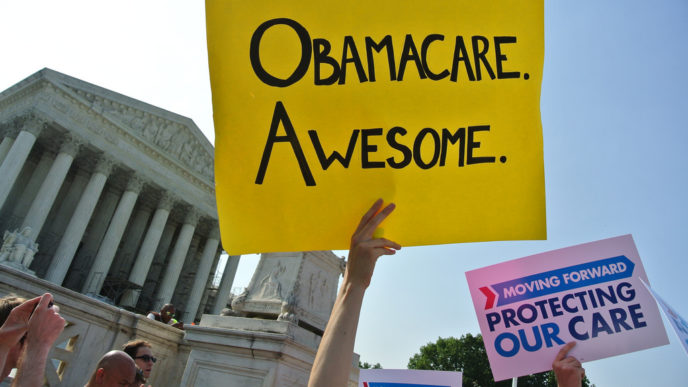
Obamacare May Soon Be Over. Here’s What Americans Have Thought of the Law Since 2010.

In the midst of open enrollment for Obamacare, there is plenty of bad news for health law supporters, from skyrocketing premium rates to diminished insurer participation. Public opinion remains steadily opposed to the law.

While some tracking polls try to highlight satisfaction with individual components of the law, Obamacare as a whole has largely been unpopular.

After a fluid first few months in 2009 as the plan got underway in Congress, public opinion of Obamacare settled into a consistent trend in early 2010, with opposition outweighing support—often by a sizable margin.

Gallup’s tracking, for instance, shows that since the law took effect in 2013, a majority of Americans have consistently disapproved of it, ranging from a low of 48 percent in July 2015—just after the Supreme Court’s ruling upholding the law’s federal subsidies—to a high of 56 percent.

Gallup shows disapproval averaging at 51.4 percent for this time period, an average of nine points higher than the law’s average approval rating of 42.6 percent.

In the world of political polling, inconsistency among polls is an occasional hazard to be grappled with, but not in the case of Obamacare polling. Pew Research Center’s tracking of the law’s approval ratings tells a remarkably similar story to Gallup’s.

Disapproval averages at 49.5 percent since 2013, and approval comes in at 42.3 percent, an average of seven points lower.

Disapproval soars around the time of the botched rollout late in 2013, and dips after the Supreme Court ruling that upheld a key component of the law in July 2015. Disapproval rebounded in 2016 to 54 percent, while approval fell again to 44 percent, leaving a 10-point gap.

Even Kaiser’s monthly tracking study, which is one of the more positive measures of the health law, shows that unfavorability usually outranked favorability at an average of 44 percent over 40.1 percent.

(One of the few exceptions was shortly before the 2012 presidential election when President Barack Obama was re-elected—the only point at which Gallup showed approval for the law rising above disapproval.)

Kaiser started monthly tracking of the law in early 2010—earlier than Gallup and with more regularity than Pew—shedding some light on the period before the law went into effect.

Before public opinion settled into consistent disapproval, there was a more fluid period in 2010. Favorability spiked in April after the Senate, lacking the 60th vote needed to end debate and pass the bill, did so with a simple majority using the process of budget reconciliation.

Approval spiked again mid-year and then in September as some of the more popular aspects of the law, including the measure protecting access to insurance for those with pre-existing conditions, began to take effect.

Yet, in October, favorability dropped down to 42 percent, where it would largely remain over the next six years.

Given the proliferation of polls on this controversial law, a few news aggregation sites have produced tracking averages based on multiple poll sources.

RealClearPolitics shows average disapproval of the law fluctuating right around the 51 percent mark, while the average in favor of the law comes out around 40 percent, consistent with Gallup and Pew. The Huffington Post’s average against the law fluctuates around 49 percent, while average approval for the law varies around 41 percent.

Moreover, all of the trend lines show that the gap between disapproval and approval is gradually widening—that in fact, a law that has never received popular support is actually growing more unpopular with time.

The American people don’t like Obamacare and never have, and it’s not hard to see why. Pew and Gallup both report that year after year, more Americans say the law has had a negative effect on them and their families (31 percent and 29 percent in 2016, respectively) than a positive effect (23 percent and 18 percent).

Pew reports even worse numbers for the law’s effect on the country as a whole—44 percent believe it has been negative. In addition to soaring premium costs, Obamacare has led to rising out-of-pocket costs, shrinking networks and accessibility, and fewer options.

Given these numbers and the negative effects Obamacare has had on the system as a whole, it’s time for a new direction. Now is the time to repeal Obamacare and focus on solutions that Americans want. (For more from the author of “Obamacare May Soon Be Over. Here’s What Americans Have Thought of the Law Since 2010.” please click HERE)

Follow Joe Miller on Twitter HERE and Facebook HERE.

Key Questions About Russia’s Alleged Hacking of the US Election

A Central Intelligence Agency report that Russian operatives intervened in the U.S. election to help President-elect Donald Trump win has roiled Capitol Hill, producing a bipartisan call for congressional investigations.

But there is skepticism within the U.S. government, particularly at the Federal Bureau of Intelligence, that the evidence definitively proves that the Russians had the specific goal of influencing Americans to vote for Trump.

This split, amplified by Trump’s expressed disbelief in the CIA’s conclusion, sets up an early test for the next president, who will likely come into office as lawmakers—including Republicans—are investigating what happened.

At the same time, Trump, who has vowed a closer relationship with Russia, will have to deal with a range of policy challenges dealing with the Kremlin’s military interventions in wars in Syria and Ukraine.

The Daily Signal below explains the many questions of the Russian hacking controversy, and what consequences may come from it.

What Happened and When?

In early October, the Obama administration confirmed what the intelligence community had long expected, formally accusing Russia of trying to interfere in the 2016 elections, including by hacking the computers of the Democratic National Committee and other political organizations, and releasing the information to WikiLeaks.

In its announcement, the Obama administration noted Russia had previously attempted to interfere in other countries’ political processes, using other techniques to influence public opinion in Europe.

The White House, at this point, was considering potential responses, including economic sanctions, but it did not mount an offensive reply.

In the weeks before the presidential election, The New York Times reported that American spy and law enforcement agencies were united in the belief that the Russian government had deployed computer hackers to sow chaos into the campaign.

But last week, as The Washington Post first reported, the CIA produced a formal assessment to lawmakers concluding that Russia did not just intend to disrupt the election, but intervened with the primary goal of electing Trump as president.

“It doesn’t appear that there is any real uncertainty here about the origins of the attacks,” said Michael O’Hanlon, director of research for the foreign policy program at Brookings Institution, in a response to emailed questions from The Daily Signal. “I see the differences as ones of interpretation—who can really be sure of Russian motives based on observation of their actions?”

The FBI has not affirmatively concluded the Russians’ intent.

It is unclear why the CIA waited until after the election to reveal its judgment.

Intelligence officials also believe that Russia hacked the databases keeping Republican National Committee data, but chose to release only documents from the Democrats. The committee has denied that it was hacked.

How Have Politicians Reacted?

Trump dismissed the CIA’s report, referencing the agency’s faulty 2002 conclusion that the Iraqi leader, Saddam Hussein, had weapons of mass destruction.

“I think it’s ridiculous. I think it’s just another excuse. I don’t believe it,” Trump said on Sunday in an interview on Fox News.

Republicans in Congress have also been careful about supporting the CIA’s assertion that Russia tried to throw the election to Trump—and that the Kremlin’s influence impacted the result. But many lawmakers in Trump’s party have been forceful in calling for investigations into what happened.

“I don’t believe any member of Congress should summarily dismiss an assessment from the intelligence community with respect to Russian interference in an American election,” Rep. Charlie Dent, R-Pa., told The Daily Signal in an interview, adding:

We must take this seriously and investigate it. I have not seen any evidence thus far that the outcome of the presidential election was impacted by Russia’s actions. But with that said, it disturbs me greatly that Russia is attempting to interfere with our democratic process, not only in the U.S., but throughout Europe as well.

Senate Majority Leader Mitch McConnell, R-Ky., said on Monday that he supported congressional investigations of possible Russian cyberattacks, which will be led by the Intelligence Committee and Armed Services Committee.

McConnell said the investigations would occur through the normal committee process, and he did not endorse the creation of a special select committee probe.

House Speaker Paul Ryan, R-Wis., seemed to suggest Monday he backs a similar investigation of Russian “state-sponsored cyberattacks.”

“Throughout this Congress, the Intelligence Committee [has] been working diligently on the cyber threats posed by foreign governments and terrorist organizations to the security and institutions of the United States,” Ryan said in a statement. “This important work will continue and has my support.”

Democrats also want a congressional probe, and Hillary Clinton’s campaign even said it supports a request by members of the Electoral College for an intelligence briefing on foreign intervention in the presidential election, Politico reported.

President Barack Obama, meanwhile, has ordered a full review into Russia’s hacking to capture “lessons learned” to be concluded before Trump’s inauguration.

Is It Normal for Intelligence Agencies to Disagree?

David Shedd, a former director of the Defense Intelligence Agency who has worked for the CIA, said it’s normal for the FBI to take a more cautious view of intelligence assessments because of its law enforcement obligation.

“The bureau [FBI] will be more conservative,” said Shedd, who is now a visiting fellow at The Heritage Foundation. “They are evidence driven. They are about making a court case, determining what will stand up in court. The intelligence community is not about making evidentiary conclusions rising to the level of a court action, but making a judgment that falls considerably short to what the FBI would need to make a similar call.”

Despite the CIA’s lower burden of proof, Patrick Eddington, a Cato Institute policy analyst in homeland security and civil liberties and former CIA analyst, said it’s wrong to assume the agency’s conclusions are flimsy.

“The reality is the CIA does not always get it wrong, and I think because of the track record of the agency, people naturally have a level of skepticism on whether this is real,” Eddington told The Daily Signal in an interview. “That makes it all the more important for everything surrounding this judgment—all the raw intelligence it is based on—to be made public so everyone can make their own conclusions.”

How Can the US Respond?

If Obama elects not to take action, the Trump administration will have a range of options on how to respond to Russia.

These include imposing economic sanctions for “malicious cyber-enabled activities,” a new executive branch tool that Obama created last year, but hasn’t used yet.

The Justice Department could indict Russian actors for hacking. The National Security Agency may also retaliate with its own cyber tools against the Kremlin.

Shedd suggested the U.S. take broader actions to discourage Russia aggression not only in cyberspace, but in other foreign policy endeavors.

“If I were sitting again in the Situation Room, I would be making a very strong case that our response needs to be asymmetrical to the cyberattack,” Shedd said. “Why in the world would we do cyber on cyber as our only response? My advice is to look at what [Russian President Vladimir] Putin’s other objectives are. That could be getting him out of Syria and Ukraine—something that fits into our larger relationship with that country.”

Eddington suggested more caution, noting Putin’s unpredictability.

“You have to start with appropriate defensive measures, making sure our systems from a political and social engineering standpoint can’t be hacked,” Eddington said. “When we start talking about offensive measures, we have to be careful and calculated about what we do. At the end of the day, you need to make sure the response is such that Putin cannot afford a repeat, pays some sort short-term to medium-term cost, but at the same time, do not put Russia and the U.S. at the brink of confrontation. We are in uncharted territory in so many ways.” (For more from the author of “Key Questions About Russia’s Alleged Hacking of the US Election” please click HERE)

Follow Joe Miller on Twitter HERE and Facebook HERE.