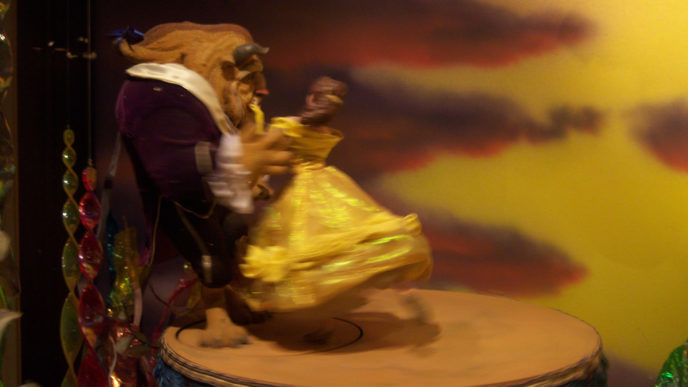
By Sexualizing Male Friendship, Disney Makes a Mockery of the Original Tale

The New York Times, Vanity Fair, Attitude Magazine and others have celebrated Disney’s decision to modernize the new Beauty and Beast film with a more feminist Belle and first ever “exclusively gay” character. Emma Watson wants the main character, Belle, not simply to be a reader of books but an assertive, feminist inventor who wears riding boots. The newly added character of LeFou, for his part, struggles with his identity and same-sex attraction toward Gaston, the boorish frat boy that tries to woo Belle.

Adding such politically fashionable themes has indeed generated press and gained the praise of cultural elites. But the new Beauty and the Beast reveals some dark truths about Hollywood. Film makers claim to view art as a form of “resistance.” But in this case ideology, political posturing and publicity stunts trumped doing justice to the original story.

It Fails as Art

The biggest problem with adding shock value to the film is that it is just bad storytelling. Despite powerful cinematography and impressive graphics, what we end up with is not art but kitsch. Disney could have wrestled with the challenge of conveying the powerful original tale — written by Gabrielle Suzanne Villanueve de Barbot in 1740 and famously abridged in 1756 by Madame de Beaumont. Instead, Disney used as its source text … its own animated version from 1991. The original version doesn’t even have the characters Gaston and LeFou, which were added by Disney in the 1991 version.

The original fairy tale is rich in meaning and human struggle. It explores:

the virtue and sacrifice of Belle
her struggle to see beyond appearances
Belle’s love for her father and willingness to take responsibility for the consequences of her desires
the effects of wealth and poverty on the family
the vices of envy and avarice
jealousy and struggles among the sisters
the agony of making decisions in the face of an impossible situation
the redemption that comes from sacrificial, other-directed love.

Little of this survived in the Disney cartoon, a garish romance whose shallowness was disguised with fireworks of sentimental tunes and computer graphics.

For the new, live version, Disney “updated” the old timey 1991 version by adding a character with same sex attraction. The story thus becomes a tool to shock audiences and promote a political agenda. Story and art are sacrificed on the altar of political fashion. The actors and producers get a chance to virtue signal, as Emma Watson does in a recent Vanity Fair article showing off her feminism. It takes very little courage to be applauded as sophisticated by one’s peers.

Bumper Sticker Feminism

The other artistic failure is the portrayal of Belle as the assertive feminist. This misses the point of her character and power as heroine of the story. In contrast to her superficial and materialist sisters, who care for nothing but themselves and their own advancement, Belle is serious and scholarly. She has interior resolve, integrity, profound courage and love that enable her to sacrifice her life for her father, to see beyond appearances and redeem the beast.

Her power is revealed in her character and her actions — not in exterior assertiveness and a willingness to buck convention by wearing riding boots. Her whole life bucks the convention of mediocrity and selfishness, which is why she is the protagonist. Instead of all the authentic character virtues Belle exhibited in the original tale, we get bumper sticker feminism and “girl power.”

The original story and the famous 1756 version, written by women, were more authentically affirming of women than this dumbed-down 2017 production.

Distorting Male Friendship

Beyond the obvious problem of sexualizing everything, the relationship between Gaston and LeFou also distorts and undermines authentic male friendship. This not only hurts boys and young men. It also hurts women because it relegates their brothers and future husbands to a frat boy “bro” culture.

As C.S. Lewis notes in The Four Loves, friendship often begins with mutual appreciation of some thing, idea or activity. It is directed toward something. Aristotle explains that while friendship can be grounded in utility or having a good time, authentic friendship is grounded in virtue and a desire to live a life of excellence.

Men need these authentic friendships that challenge and inspire them. It is quite normal for a young man, especially one entering manhood, to admire and look up to other, often older men. They see their masculinity and seek to emulate it — especially if it is in an area they lack, but desire to excel in. While this attraction and admiration often includes the physical, it is rarely sexual. This is the stuff of growing up, of friendship and camaraderie. It is a normal way a man learns to become himself.

Beauty and the Beast distorts this natural pattern by sexualizing it. Director Bill Condon comments that “LeFou is somebody who on one day wants to be Gaston and on another day wants to kiss Gaston. … He’s confused about what he wants.”

Men are confused about a lot of things, especially when they are young. Disney exploits it. Beauty and the Beast’s decision to sexualize the male friendship of LeFou and Gaston undermines real friendship and creates confusion in young men — who might now begin to wonder if their “attraction” to a man is somehow sexual. The upshot of this will be to create further barriers to real male friendship and encourage the insipid and dehumanizing “bro” culture of the frat boys whose shared activities are narrowed to sports, drunkenness and reducing women to sexual conquests.

Any genuine sensitivity to the arts, to deep human emotion or to authentic love that respects a woman in her integrity is looked upon as effeminate, an sign of homosexual tendency. This is bad enough. But the problem is made even worse by Beauty and the Beast, which portrays the heterosexual man as a predator and womanizer. The distortion of male friendship into same sex attraction not only denies boys real friendship. It harms women by creating weak men whose only friendships are based on use or pleasure.

The new Beauty and the Beast could have been a real work of art that addressed the depth of human love and redemption. Instead it is a political puff piece. When the shock wears off, it will be forgotten. But hey, at least it made the headlines and gave the actors and writers a chance to preen to political fashion. And as we’ve seen lately, isn’t that what Hollywood is all about? (For more from the author of “By Sexualizing Male Friendship, Disney Makes a Mockery of the Original Tale” please click HERE)

Follow Joe Miller on Twitter HERE and Facebook HERE.
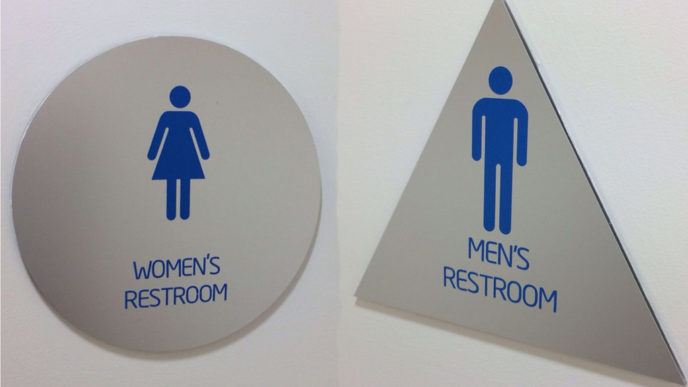
The Man in the Women’s Room, and Why He Can Stay There

“He wasn’t even peeing, washing his hands or doing anything else that you’d do in a restroom. He was just standing off to the side looking smug … untouchable … doing absolutely nothing.” This would be weird enough in a men’s room, but he was doing it in a women’s room.

At Disneyland, of all places, whose women’s rooms are filled with young mothers with small children. Then, writes Kristin Quintrail, the man “did a lap around the restroom walking by all the stalls. You know, the stalls that have 1 inch gaps by all the doors hinges so you can most definitely see everyone with their pants around their ankles and vagina clear as day.”

Do you know where this kind of thing leads? It leads to families being pushed out of public spaces. It leads to giving a tiny minority what it wants by taking it away from the majority.

Transgressing Boundaries

The man, apparently a fairly large man, wasn’t a man “transitioning” to try to be a woman. The “very progressive” Quintrail would have been fine with that. He was a predator. His way of being a predator was to transgress a boundary — the women’s room door — so that he could intimidate women and their children.

“Everyone was visibly uncomfortable,” says Quintrail, who is writing for a blog called The Get Real Mom. “We were all trading looks and motioning our eyes over to him … like ‘what is he doing in here?’ Yet every single one of us was silent.”

They stayed silent, she says, because they all worried that he might respond by claiming to identify as a woman. Then (she believes) they would look like jerks. Just five years ago, the women in the room would have told him to leave, but not now. They can’t, because “We don’t know what gender is anymore.”

We must know, she insists. “Gender just can’t be a feeling,” she says at the end of the blog article. “There has to be science to it. DNA, genitals, amount of Sephora make up on your face, pick your poison. … I’m sorry it can’t just be a feeling when there’s but a mere suggestion of a door with a peep hole separating your eyes from my vagina or my children’s genitals.”

Quintrail doesn’t seem to have thought of calling security, and I think we know why. Suppose security came and the man claimed to identify as a woman? Would the officers remove him anyway? Not likely. That way lies a p.r. nightmare. Disney does not like p.r. nightmares. Especially when the company makes such a big deal of having annual “gay days.”

There’s No Science

There has to be a science to it, says Quintrail. We need some objective way to tell men (however defined) from women if transgendered people can use the private space of their choice. She says this as someone “very progressive” who will comfortably share a women’s room with a man who believes he’s really a woman.

But what science can you have when the society and the law treat sex and gender as choices? You can’t have a science when the choices have no agreed outward signs.

The predator in the women’s room might claim to identify as a woman who likes to dress like a man. Who’s to say he’s not? He might say he stood in the women’s room because he felt safe there among other women. Who can deny it? Even a judge who thought the man was gaming the system for his own perverse reasons would have no legal grounds for telling him to stay out of women’s rooms.

This kind of thing makes even a restroom a contested space. It makes the classic “safe space” unsafe. Treating “gender” as choice makes some people powerless to guard that which they must guard, like husbands their wives, or mothers their children. It leaves Quintrail and the other women in that women’s room feeling they can’t eject a pervert who wants to watch them.

What Will a Father Do?

Imagine the father who sends his thirteen-year-old daughter into the women’s room and then sees a man go in. He knows he can’t call security. If he goes in, he can’t make the man leave. If he tries force, he’ll get arrested. The father has to accept that the women’s room his daughter uses may have a predatory male standing off to the side looking smug. Or worse, walking around and peering into the stalls. And there’s nothing he can do about it.

What will that father do? The only thing he can do. He’ll retreat from the public space and never come back to Disneyland, or anywhere else with similar policies. A space that his family should be able to enjoy has been taken away. It’s an amusement park, for heaven’s sake. But it’s no longer safe, not when a man can hang out in the women’s room and stare at the women and children.

If transgender laws continue to spread, more families will find themselves excluded from public places. That’s the inevitable practical result of enforcing an idea of sex and gender as personal choice. (For more from the author of “The Man in the Women’s Room, and Why He Can Stay There” please click HERE)

Follow Joe Miller on Twitter HERE and Facebook HERE.

YouTube’s Glaring Double Standard

In the last two years, YouTube, which is owned by Google, removed the trailer for a Christian movie about homosexuality, removed a video about the persecution of Christians in the Middle East, and removed some Prager University videos about Islam (while restricting access to some of their other videos). Yet when David Duke, former Grand Wizard of the Knights of the Ku Klux Klan, released a virulently anti-Semitic video, YouTube found nothing wrong with it. For good reason, even political leaders are outraged over the double standard.

Before we get to the David Duke video, let’s look at these other examples of YouTube censorship.

The Audacity of Pulling Audacity

In July, 2015, the trailer for a Ray Comfort-produced movie called Audacity was removed from YouTube after quickly receiving 130,000 views. On what basis? “This video has been removed as a violation of YouTube’s policy against spam, scams, and commercially deceptive content.”

In reality, neither the trailer nor the movie contained any spam, scams, or commercially deceptive content — not a hint or trace of any such thing — and the most likely reason it was pulled was because a number of viewers protested the content of the video. Heaven forbid you share a biblical view of homosexuality on YouTube!

For the record, anyone watching the movie — let alone the trailer — would know there was not an ounce of hateful or disparaging or deceptive content in the video, which made this act of censorship all the more bizarre.

Thankfully, after vigorous protests, the video was restored, but it should never have been removed in the first place.

Christian Persecution Video Pulled

In February, 2016, TheBlaze carried a headline which announced, “Christian Filmmakers Ask if YouTube Is Targeting Their Worldview After Their Video Was Pulled and Branded ‘Inappropriate’.”

The video in question “included no nudity, profanity or explicit onscreen violence,” yet it “was removed by YouTube, which called the film ‘inappropriate’ and in violation of YouTube’s Community Guidelines.

“The video presents the scenario of what it might look like were the persecution of Christians in the Middle East and elsewhere to arrive in the U.S., including scenes that hinted of the Islamic State group. The film does, however, include several Bible verses being read.”

Within minutes of the video going public, Josh Troester, the director and producer of the movie Chased, states that “we received notice that our video was ‘flagged for inappropriate content.’ YouTube’s notice stated that ‘after reviewing the content, we’ve determined that the videos violate our Community Guidelines.’”

The article also notes that, “Other video producers working to educate the West about violence and incitement in the Middle East have experienced YouTube removing their videos or shutting down their channels, including the Middle East Media Research Institute (MEMRI) and Palestinian Media Watch. Both groups translate the Arabic-language videos of jihadist leaders and others as an educational service.”

Prager U Censored

Despite all this, however, it was still quite a shock when some of the Prager U videos were put on restricted access and others were removed.

Videos on this YouTube channel are professionally done, fairly presented (with some of the lecturers including respected professors and Pulitzer Prize winners), and are viewed by millions. Yet in October, 2016, YouTube removed or restricted access to 16 videos on the site (originally it was 21). On what basis?

In a petition that was launched to protest YouTube’s actions, “PragerU claims that YouTube has entirely removed PragerU’s new video with Kasim Hafeez, a British Muslim who is a pro-Israel activist.” In the video, Hafeez explains how he overcame the anti-Semitic indoctrination that radicalized him from an early age.

“Within hours of the video’s release Monday morning, YouTube flagged it for ‘hate speech’ and took it down.”

This is utterly outrageous, and the petition caught fire for good reason.

It is against this backdrop that YouTube’s latest actions are completely indefensible.

But David Duke’s Anti-Semitic Rage Stays

The David Duke video is titled “Jews admit organizing White Genocide,” yet YouTube claims it does not contain “hate speech,” despite ridiculous and incendiary statements like, “the Zionists have already ethnically cleansed the Palestinians, why not do the same thing to Europeans and Americans?”

Duke refers to the “Zionist racist” state of Israel and claims that “comparing Israel to apartheid is like comparing an atomic bomb to a bee-bee gun,” adding, “Unlike Israel, South Africa never dropped tens of thousands of bombs that have burnt children alive while they slept in their beds.”

No, there’s nothing hateful about this content at all, nothing that violates YouTube’s community guidelines, nothing worthy of removal from their site. Right. Yet the video of a pro-Israel, British Muslims explaining “how he overcame the anti-Semitic indoctrination that radicalized him from an early age” violates YouTube’s standards and must be removed.

What hypocrisy.

Trends like this are deeply disturbing and deserve our attention and our action, and while Google-YouTube can run its company however it pleases, it must be called to account for its double standards.

Please write to me if you feel you were the victim of unfair treatment on YouTube (thus far, my own experience with YouTube has been fair), and let’s redouble our efforts to get the truth out — as long as we have the opportunity.

This is how we keep our freedoms intact. (For more from the author of “YouTube’s Glaring Double Standard” please click HERE)

Follow Joe Miller on Twitter HERE and Facebook HERE.

Tillerson: No ‘Strategic Patience’ With North Korea, Maybe War

On his way to China, Trump’s secretary of state, Rex Tillerson, stopped off in South Korea.

During a visit to the demilitarized border, Tillerson dissed the Obama administration. He said its policy of “strategic patience” has run its course and all “all of the options are on the table.”

Tillerson said “obviously if North Korea takes actions that threatens South Korean forces or our own forces, that would be met with (an) appropriate response. If they elevate the threat of their weapons program to a level that we believe requires action that option is on the table.”

Trump sent out a tweet to underscore the new policy. He went so far as to take a swipe at China, already irritated by the US position on its activity in the South China Sea.

It looks like the Trump administration is dead serious about starting a war with North Korea if it continues to build and test missiles and nukes.

Although it is probably unlikely Trump will be able to start a war with North Korea—additional draconian sanctions seem more likely—the residents of Seoul, 35 miles from the border, might want to prepare a go-bag. North Korea has tens of thousands of missiles aimed at them. (For more from the author of “Tillerson: No ‘Strategic Patience’ With North Korea, Maybe War” please click HERE)

Follow Joe Miller on Twitter HERE and Facebook HERE.

For the First Time Ever, the Federal Government Is Referring to Marijuana as Medicine

Editor’s note: this article is posted for the purpose of encouraging dialogue on a controversial issue. Restoring Liberty’s position is that the the federal government has no constitutional right to regulate marijuana within a state; however, the states – under the 10th Amendment – may choose prohibition or legalization.

A profound shift in the federal government’s stance on cannabis was marked by subtle changes made this month to one webpage. The National Institute on Drug Abuse (NIDA), part of the National Institutes of Health, now has a webpage titled Marijuana as Medicine. Prior to March 2017, it was titled Is Marijuana Medicine?

Apparently, they feel the question has been answered. The timing of NIDA’s update is very curious, as there are signs from the Trump administration that a crackdown may be coming on states’ cannabis legalization progress made over the last few years.

The Department of Justice is now headed by rabid prohibitionist Jeff Sessions, who cites falsehoods and Reefer Madness propaganda when discussing cannabis. Only a few days ago, Sessions said cannabis “is slightly less awful” than heroin – a mind-boggling display of ignorance. Trump chose to keep Chuck Rosenberg as head of the Drug Enforcement Agency (DEA), who said medical cannabis is “a joke” and oversaw the department’s decision to keep the plant as a Schedule 1 drug with “no medicinal use.”

Perhaps this stunning level of denial – in the face of overwhelming scientific evidence of cannabis’ ability to treat a variety of ailments – prompted NIDA to make their change. Twenty-eight states have legalized medical cannabis in some way, eight more have legalized its recreational use, and more states are set to join the list. They aren’t doing this on a whim; decriminalizing medical use is an acknowledgment of cannabis’ power as medicine.

Some would argue that the U.S. Dept. of Health and Human Services 2001 patent 6630507 called “Cannabinoids as antioxidants and neuroprotectants” was a tacit acknowledgement of medial cannabis. But still, no government agency admitted the obvious conclusion.

In 2015, the federal government unwittingly admitted cannabis is medicine in 2015 when the National Cancer Institute supported a study finding that cannabis kills cancer cells. Now, with the revised webpage title, NIDA appears to have moved beyond a reasonable doubt.

The term medical marijuana refers to using the whole, unprocessed marijuana plant or its basic extracts to treat symptoms of illness and other conditions. The U.S. Food and Drug Administration (FDA) has not recognized or approved the marijuana plant as medicine.

However, scientific study of the chemicals in marijuana, called cannabinoids, has led to two FDA-approved medications that contain cannabinoid chemicals in pill form. Continued research may lead to more medications.

Because the marijuana plant contains chemicals that may help treat a range of illnesses and symptoms, many people argue that it should be legal for medical purposes. In fact, a growing number of states have legalized marijuana for medical use.

The webpage now has an informational box on CBD and Childhood Epilepsy. This is a rather dramatic inclusion, as cannabidiol (CBD) has become a very promising treatment for childhood epilepsy. At the Dec. 2015 meeting of the American Epilepsy Society, the largest study presented there confirmed the astounding benefits of medical cannabis to treat seizures.

There is now a better explanation of cannabinoids, making a distinction between those naturally derived from the plant and those manufactured in a lab. NIDA also acknowledges the “state-approved medicinal use of marijuana,” and says “continued research [on cannabinoids] might lead to more medications.”

Indeed, we are only just beginning to unlock the secrets of the body’s endocannabinoid system, and using cannabis to stimulate this system for relieving inflammation which is thought to be the cause of many diseases.

Interestingly, the NIDA update also removed a link to WhiteHouse.gov regarding state laws, because the Trump administration removed the White House page explaining state cannabis laws. It appears that talk of respecting states’ rights may be just another Trump lie.

Kudos to NIDA for taking a step in the right direction and being the first federal entity to explicitly acknowledge cannabis as medicine. (For more from the author of “For the First Time Ever, the Federal Government Is Referring to Marijuana as Medicine” please click HERE)

Follow Joe Miller on Twitter HERE and Facebook HERE.

NY Supreme Court Signals Support for Transparency on Cellphone Surveillance

The opposition to “stingray” cellphone surveillance, and the support of transparency are both experiencing growth throughout the United States. Recent bills passed in Arizona and New Hampshire are part of a trend that has been steadily increasing in the United States. The public and the political class are becoming aware of the true level of intrusion possible as a result of arming local, state, and federal police with military grade surveillance equipment, with very little oversight.

In New York a new bill was recently introduced in the New York Assembly which would ban the use of “stingrays,” the brand name of a popular cell phone surveillance tool manufactured by the Harris Corporation. Stingrays are a brand name of an IMSI (International Mobile Subscriber Identity) Catcher targeted and sold to law enforcement. They are also known as cell-site simulators because they work by masquerading as a cellphone tower – to which your mobile phone sends signals to every 7 to 15 seconds whether you are on a call or not – and tricks your phone into connecting to it. As a result, whoever is in possession of the Stingray can figure out who, when, and to where you are calling, the precise location of every device within the range, and with some devices, even capture the content of your conversations.

Now the New York State Supreme Court is poised to make an important judgement on the legality of the devices. On Wednesday, one judge showed support for allowing New Yorkers to be made aware of how the city officials have spent tax dollars on Stingrays. Recent reports indicate that the NYPD has deployed stingrays more than 1,000 times without a warrant.

“Sunshine is the best medicine for our society,” Judge Shlomo Hagler said Wednesday, according to Courthouse News. For the last several years, the New York Civil Liberties Union has attempted to use open records laws to access information regarding the NYPD’s use of stingrays. Now they are attempting to convince the state Supreme Court that the people deserve to know where their money is being spent.

“This is about the council members and the public having very basic information about how much the NYPD has been spending and what tools,” Mariko Hirose, an attorney for the New York Civil Liberties Union, argued Wednesday before the Manhattan County Supreme Court. Hirose is attempting to get the judge to order the release of purchase orders, contracts and agreements related to the technology.

New York City’s Law Department attorney Neil Giovanatti told the court that “nobody knows what devices the NYPD actually has” and that the stingrays they use might not have the capability to monitor people’s information. Courthouse News reported that Judge Hagler was doubtful of this premise, stating that “NYPD has the biggest budget for law enforcement than any city in the world.”

Judge Hagler indicated that he might force city to reveal the cost of the devices, but not necessarily the full contracts and agreements. The City is arguing that the release of the information could put NYPD officer in harm’s way or limit their ability to fight crime and terrorism.

The judge will examine the city’s records in a closed-door hearing on March 22 before meeting with attorneys from both groups and making a final ruling. (For more from the author of “NY Supreme Court Signals Support for Transparency on Cellphone Surveillance” please click HERE)

Follow Joe Miller on Twitter HERE and Facebook HERE.

30 Countries Are Refusing to Take Back Illegal Aliens Convicted of Serious Crimes

Approximately 30 countries are refusing to accept the deportations of illegal immigrants who have committed serious crimes in the U.S., according to Texas Rep. Henry Cuellar.

While these countries are refusing to accept the deportations of these criminals, the U.S. government is still issuing visas and student visas to citizens of those countries, according to the Texan congressman. There is already a law on the books which allows the U.S. to hold visas from a country that is not taking back its criminals, but according to Cuellar, the U.S. is not enforcing it.

“We’re not enforcing it, which is amazing. So now my intent is to go back to our committee on appropriations and affect their funding until they do that,” Cuellar told Sharyl Attkisson, host of Full Measure, in an interview.

Cuellar, a Democratic member of the House Committee on Appropriations, told Attkisson that the Supreme Court has ruled that illegal immigrants arrested for criminal activity can only be held for a certain period of time before they must be released.

“That means you’re releasing criminals into our streets because those countries refuse to take back those criminal aliens,” said Cuellar. “That’s wrong. And especially I think it’s even worse that this is already on the books, and we’re still issuing business tourist visas and student visas to countries that refuse to take back their criminal aliens. That’s wrong, and we’re hoping to change that.” (Read more from “30 Countries Are Refusing to Take Back Illegal Aliens Convicted of Serious Crimes” HERE)

Follow Joe Miller on Twitter HERE and Facebook HERE.

Three US Soldiers Wounded in Afghan ‘Insider Attack’

Three American troops were wounded Sunday when an Afghan soldier opened fire in southern Helmand province, officials said, in the first known “insider attack” on international forces this year.

No insurgent group has so far claimed responsibility for the attack in Camp Antonik in Washer district, which highlights long-simmering tensions between Afghan and foreign forces.

“Three US soldiers were wounded this afternoon when an Afghan soldier opened fire on them at a base in Helmand province. Coalition security forces on the base killed the soldier to end the attack,” a spokesman for US forces in Afghanistan told AFP.

“The US soldiers are receiving medical treatment at this time and we will release more information when available.”

An Afghan soldier was also killed in the shootout, provincial spokesman Omar Zwak told AFP. (Read more from “Three US Soldiers Wounded in Afghan ‘Insider Attack'” HERE)

Follow Joe Miller on Twitter HERE and Facebook HERE.

How Neil Gorsuch’s Senate Confirmation Process Compares to Recent Ones

On Monday, the Senate Judiciary Committee will begin its hearing on the confirmation of Neil Gorsuch to be an associate justice of the Supreme Court. Senate Majority Leader Mitch McConnell is confident that the Senate will confirm Gorsuch before the Easter recess, which is set to begin April 10.

As Senate Democrats have scrambled to find reasons to object to Gorsuch, scores of people across the political spectrum have spoken out in support of the nominee. Thus, if Sen. Dianne Feinstein, ranking member of the Judiciary Committee, and other Democrats want to stop Gorsuch’s nomination, they will face an uphill battle during the hearings.

As the hearing starts, how has this process compared to other Supreme Court confirmations in recent years?

The Bush Years

President George W. Bush’s first chance to make a Supreme Court nomination came in July 2005 when Justice Sandra Day O’Connor announced her intention to retire. This was the first vacancy on the court in over a decade. Bush nominated D.C. Circuit Judge John Roberts on July 19, 2005. While his nomination was pending, Chief Justice William Rehnquist, who had been battling thyroid cancer, died Sept. 3.

With Rehnquist’s death, Bush rethought his strategy for filling two vacancies on the Supreme Court. He decided to withdraw Roberts’ nomination to be an associate justice and announced him Sept. 5 as nominee for chief justice of the United States.

The Senate Judiciary Committee met Sept. 12-15 for Roberts’ confirmation hearing, and one week later, on Sept. 22, the committee voted 13-5, with three Democrats joining the Republicans, to send his nomination to the full Senate. The Senate voted to confirm Roberts on Sept. 29, 2005, just in time for him to join the court before the start of its 2005-2006 term the next week.

After deciding to nominate Roberts to be chief justice, Bush first tapped White House counsel Harriet Miers, a Texas lawyer who served as Bush’s personal lawyer before he became president, as the nominee for associate justice. He made the announcement Oct. 3.

As a result of a campaign by conservatives who wanted a nominee with a demonstrated conservative record and judicial experience, Miers withdrew her nomination weeks later and Bush announced his pick of 3rd Circuit Judge Samuel Alito on Oct. 31.

Alito’s hearing was not held until Jan. 9-13. Less than two weeks later, on Jan. 24, the Senate Judiciary Committee voted 10-8 to send him to the full Senate. Then-Sen. Barack Obama, D-Ill., and 23 other senators attempted to lead a filibuster to block Alito’s confirmation, but they were unsuccessful.

The Senate ultimately confirmed Alito by a vote of 58-42 on Jan. 31, 2006, with four Democrats joining the Republicans in confirming Alito.

As president, Obama later expressed regrets about this filibuster attempt when Senate Republicans signaled that they would not confirm a nominee for the vacancy left by Justice Antonin Scalia’s death Feb. 13, 2016, during Obama’s final year in office.

The Obama Years

Obama’s first opportunity to pick a Supreme Court justice came when David Souter announced his retirement in 2009. Obama selected 2nd Circuit Judge Sonia Sotomayor, and he made the announcement on May 26, 2009. Sotomayor’s hearing was held July 13-16.

Highlights from the hearing included Republican senators grilling Sotomayor about her controversial views, including her claim that appellate courts “make policy” and that she believed “a wise Latina woman” would “reach a better conclusion than a white male” judge. Two weeks later, the Judiciary Committee voted 13-6 to send her to the full Senate.

Sen. Lindsey Graham, R-S.C., joined Democrats in that vote. Nine days later, on Aug. 6, 2009, the Senate voted to confirm Sotomayor by a vote of 68-31, with nine Republicans voting for her.

The following year, Obama had another chance to nominate a Supreme Court justice. He chose his solicitor general, Elena Kagan, to replace Justice John Paul Stevens, announcing the nomination on May 10, 2010.

Obama administration senior adviser David Axelrod recounted the story of Scalia’s approaching him at an event shortly after Souter announced he would retire in 2009. As Axelrod tells it, Scalia said, “I have no illusions that your man will nominate someone who shares my orientation … But I hope he sends us someone smart.”

Scalia continued, according to Axelrod: “Let me put a finer point on it … I hope he sends us Elena Kagan.” Scalia got his wish the second time around.

Kagan’s hearing took place June 28-July 1 (and notably included testimony by Heritage Foundation scholar Robert Alt). Three weeks later, the Judiciary Committee voted 13-6 to send her to the full Senate—with Graham joining the Democrats again. The Senate voted 63-37 to confirm her two weeks after that, on Aug. 5, 2010. Five Republicans and two independents joined the Democrats.

As the Obama administration came to a close, it seemed unlikely that another vacancy would occur on the Supreme Court—notwithstanding a not-so-subtle campaign to encourage Justice Ruth Bader Ginsburg to step down. Then on Feb. 13, 2016, the nation was stunned by the sudden death of Scalia.

The upcoming presidential election took on a new level of significance as Senate Republicans vowed to keep the seat open so that the next president, and by extension, the American people, could fill it. Nevertheless, Obama nominated Merrick Garland, chief judge of the D.C. Circuit. Senate Republicans, however, refused to allow the nomination to move forward.

Confirmation Process by the Numbers

That brings us to Neil Gorsuch. President Donald Trump announced his nomination on Jan. 31, so if Gorsuch is confirmed before the Easter recess, the process will have taken 10 weeks.

That’s slightly quicker than recent nominees but by no means out of the ordinary. Sotomayor clocked in at 11 weeks, Kagan and Alito both took 14 weeks, and Roberts was confirmed within 11 weeks from his first nomination.

Gorsuch enjoys perhaps the broadest bipartisan support of any nominee in recent history, and he is eminently qualified to join the Supreme Court. Though there has been some talk of Democrats attempting to mount a filibuster, these are rare for Supreme Court confirmations.

Thus, Gorsuch is likely to be confirmed on the timetable McConnell laid out. And Republicans appear prepared to play hardball if necessary—to limit Senate debate by invoking the nuclear option—to ensure Gorsuch is confirmed. (For more from the author of “How Neil Gorsuch’s Senate Confirmation Process Compares to Recent Ones” please click HERE)

Follow Joe Miller on Twitter HERE and Facebook HERE.

Yes, Liberals, We Can Deny Entry to Any Immigrant and for Any Reasons

What is happening in the courts right now goes beyond any debate over a “ban” on Muslim immigration. The courts have denuded the president of his plenary power over setting the refugee cap, which Trump applied evenly to every country included in his new executive order. Obviously, all the national security problems we have are from predominantly Muslim countries in the Middle East. But let’s put that aside for a moment. Even if this was a ban on Muslim immigration, it would be legal. That is settled law of a sovereign nation state.

Let’s also ignore political considerations for a moment. From a legal standpoint, a nation can set any criteria for letting in any group of people. Through our elected representatives, we can decide to only bring in people with brown hair. We can shut off immigration to those with green eyes or those who are left-handed. The prudence of such a law would have to be dealt with on a political level. Any legal limitation placed on our sovereignty, by definition, means we are not a sovereign nation and that foreign nationals can forcibly control our destiny. This is a principle deeply rooted in the social compact, the preamble of the Declaration of Independence (governance by consent), and the sovereignty of a nation state. Even one who is politically a supporter of loose immigration laws should be alarmed by courts creating a legal limitation to restricting immigration.

We have already cited from endless case law and statements from our founders on the plenary right of a nation to determine who enters the country. I’d like to add some new source material that speaks to the current constitutional crisis:

In Knauff v. Shaughnessy (1950), the Supreme Court made it clear that there is no right whatsoever to immigrate:

At the outset, we wish to point out that an alien who seeks admission to this country may not do so under any claim of right. Admission of aliens to the United States is a privilege granted by the sovereign United States Government. Such privilege is granted to an alien only upon such terms as the United States shall prescribe. It must be exercised in accordance with the procedure which the United States provides.

And yes, the exclusion could be because any consideration, even race. Remember, we are talking about law and Constitution, not politics, prudence, or morality. From Ju Toy v. United States (1905):

That Congress may exclude aliens of a particular race from the United States, prescribe the terms and conditions upon which certain classes of aliens may come to this country, establish regulations for sending out of the country such aliens as come here in violation of law, and commit the enforcement of such provisions, conditions, and regulations exclusively to executive officers, without judicial intervention are principles firmly established by the decisions of this Court. [emphasis added]

Thus, not only is the right to exclude — even for bad reason — deemed settled law in the most emphatic terms, resting on the most foundational principles of sovereignty, but it is not reviewable by the courts. Two years prior, in “The Japanese Immigrant Case,” the court used the exact same language and declared that, based on an uninterrupted stream of near-unanimous decisions, the constitutionality of such an exclusion “is no longer open to discussion in this Court.”

In 1904 (Turner v. Williams), the court made it clear that it is facially absurd to assert a religious liberty, equal protection, or freedom of speech right to affirmatively immigrate to this country. This case speaks directly to what the modern courts are ignoring:

We are at a loss to understand in what way the act is obnoxious to this objection. It has no reference to an establishment of religion, nor does it prohibit the free exercise thereof; nor abridge the freedom of speech or of the press; nor the right of the people to assemble and petition the government for a redress of grievances. It is, of course, true that if an alien is not permitted to enter this country, or, having entered contrary to law, is expelled, he is in fact cut off from worshipping or speaking or publishing or petitioning in the country; but that is merely because of his exclusion therefrom. He does not become one of the people to whom these things are secured by our Constitution by an attempt to enter, forbidden by law. To appeal to the Constitution is to concede that this is a land governed by that supreme law, and as under it the power to exclude has been determined to exist, those who are excluded cannot assert the rights in general obtaining in a land to which they do not belong as citizens or otherwise.

It’s amazing how liberals worship the concept of stare decisis (court precedent) once a single liberal court overturns years of common sense case law and the plain meaning of the Constitution. But they have no respect for case law that is most firmly embedded in our sovereignty in the most emphatic language, including the courts own admission that they have absolutely no jurisdiction over the issue. All of this case law remains unsettled and unexplained by the civil disobedience of today’s modern judiciary. As I’ve noted before, this case law survived even the liberal Warren-era right up to this generation.

Some critics might suggest that we can’t draw any conclusions from the exclusion acts of the late 1880s because that’s when America was evil and racist. “Just like the courts upheld slavery and were wrong they are wrong about this,” some might suggest. “What about when the courts upheld the internment of the Japanese in the Korematsu case?”

There is a one-word answer to these questions: Sovereignty.

What liberals are missing is that there is a difference between abridging the rights of Americans or even immigrants and a right to affirmatively enter someone else’s country. Of course, we can’t just throw people into labor camps and indefinitely detain them without due process. But we don’t have to allow people into our country. Immigration is quite a different issue than indefinite detention. It’s like saying because you are not allowed to kidnap a visitor of your house and lock him in your attic you must allow anyone into your house in the first place.

As I’ve cited many times, Justice Robert Jackson, the famous Nuremberg prosecutor who was a champion of due process rights and wrote the dissent in Korematsu v. United States, said that “Due process does not invest any alien with a right to enter the United States, nor confer on those admitted the right to remain against the national will.” Shaughnessy v. Mezei, 345 US 222-223 (1953) (Jackson, J., dissenting).] Scalia, in his Zadvydas dissent, made this same distinction between indefinite detention and the right to enter or remain in the country against the national will. Even the majority opinion at the time only granted relief because the individual legal permanent resident was being held longer than six months in prison (but only because his home country would not repatriate him).

Some might feel uncomfortable with the notion that there are no limitations on discriminatory, absurd, or “mean” immigration selection criterion. But those are political or sensibility arguments, not legal arguments. By definition, any limitation whatsoever on the power to exclude necessarily means that a foreign national has some sort of affirmative claim to assert jurisdiction and adjudicate his way into entry. As John Marshall, the judicial strongman himself, said:

The jurisdiction of the nation within its own territory is necessarily exclusive and absolute. It is susceptible of no limitation not imposed by itself. Any restriction upon it deriving validity from an external source would imply a diminution of its sovereignty to the extent of the restriction and an investment of that sovereignty to the same extent in that power which could impose such restriction. All exceptions, therefore, to the full and complete power of a nation within its own territories must be traced up to the consent of the nation itself. They can flow from no other legitimate source.

But again, we are not even talking about a complete shutoff of Muslim immigration. We are no longer a sovereign nation and a sovereign people when courts, relatives of foreign nationals, taxpayer-funded refugee groups, and states can proactively demand any form of immigration they so desire. (For more from the author of “Yes, Liberals, We Can Deny Entry to Any Immigrant and for Any Reasons” please click HERE)

Follow Joe Miller on Twitter HERE and Facebook HERE.