Trump Not First President to Call HUD’s Block Grants Wasteful

The president’s budget called for slashing funding for a block grant program primarily because it was difficult to determine whether it was getting the desired results.

That was President Barack Obama’s budget proposal for fiscal year 2012. It justified the $3.7 billion cut in the Department of Housing and Urban Development’s Community Development Block Grant program by asserting:

While flexibility may be one strong characteristic of the CDBG program, the use of funds and how states and communities distribute their funds lead to resources spread across many activities, diverse constituencies, and geographies without clear or focused impact. This makes the demonstration of outcomes difficult to measure and evaluate.

The Trump administration budget blueprint, issued Wednesday, calls for eliminating funding for HUD’s $3 billion Community Development Block Grant program.

“It isn’t just us who wanted this on the chopping block. Obama didn’t say get rid of it, but he did say it’s difficult to measure the outcomes,” Tom Schatz, president of Citizens Against Government Waste, said in a phone interview with The Daily Signal.

“Eligibility is so broad, [a block grant] has gone to Greenwich, Connecticut, one of the richest cities in America,” Schatz said.

Democrats and media commentators almost immediately criticized the Trump move, however. A Washington Post analysis framed it as:

The program provides cities with money to address a range of community development needs such as affordable housing, rehabilitating homes in neighborhoods hardest hit by foreclosures, and preventing or eliminating slums and community blight. It also provides funding for Meals on Wheels, a national nonprofit that delivers food to homebound seniors.

Liberal advocacy groups and entertainers also raised alarm about Meals on Wheels.

However, Forbes reported that only 3.3 percent of funding for Meals on Wheels comes from the federal government.

Meanwhile, Reason, a libertarian magazine, reported that cities are routinely spending the block grants on recreational centers, auditoriums, and gardens rather than alleviating poverty.

As a private program, states could kick in funding for the meals program for seniors, said Robert Rector, a senior research fellow specializing in poverty at The Heritage Foundation, who called the Community Development Block Grant program a “slush fund for urban mayors.”

Rector said the program is “barely a rounding error” in $1.1 trillion spent annually in 80 federal programs for the poor. Local governments are also less likely to look at results if the money is coming from the federal government, he said.

“To pretend that this program or that program is just one step between the poor and destitution is ridiculous,” Rector told The Daily Signal in a phone interview.

The Trump budget proposal states that eliminating funding for the CDBG program would save $3 billion, and used language similar to Obama’s.

“The federal government has spent over $150 billion on this block grant since its inception in 1974, but the program is not well-targeted to the poorest populations and has not demonstrated results,” the Trump proposal says. “The budget devolves community and economic development activities to the state and local level, and redirects federal resources to other activities.”

The Government Accountability Office determined in a 2012 report that some funding isn’t targeted to the cities in most need:

The distribution of grant funding per person in poverty in cities was not consistently aligned with overall poverty rates. Most cities, with the exception of those cities with the highest poverty rates, received roughly the same amount of economic development funding per person living in poverty. Further, when we examined how grant funds are distributed to cities based on their unemployment rates, we also found that some cities with higher unemployment rates received less funding per unemployed person than other cities with lower unemployment rates. However, we did find that a small number of cities (17 out of a total of 465 cities) with the highest unemployment rates received funding that was roughly 40 percent higher than the average for unemployed populations in all cities.

(For more from the author of “Trump Not First President to Call HUD’s Block Grants Wasteful” please click HERE)

Follow Joe Miller on Twitter HERE and Facebook HERE.
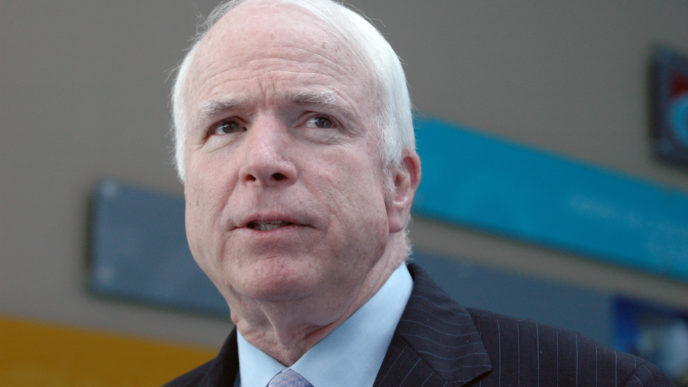
Warmonger John McCain Says This Huge Politician Is Working for Putin

Ever since Trump took the White House, the establishment has been dredging up old Russophobic fears to attack anyone who doesn’t toe the party line. It seems like anyone in power who offers a different opinion is immediately labeled a Russian agent and accused of having ties to Putin. These accusations are now being thrown around so flippantly that they are losing their power and meaning.

Take for instance what recently happened on the Senate floor between Rand Paul and John McCain. While McCain was arguing in favor of letting the nation of Montenegro join NATO, which obviously would stoke more tensions between the US and Russia, he criticized Senator Paul for not backing the bill by saying that “You are achieving the objectives of Vladimir Putin,” and that if anyone opposes the bill, “they are now carrying out the desires and ambitions of Vladimir Putin and I do not say that lightly.”

Rand Paul responded by raising an objection, and leaving the room without saying a word. McCain then doubled down on his hysterical rhetoric. “The only conclusion you can draw when he walks away is he has no argument to be made. He has no justification for his objection to having a small nation be part of NATO that is under assault from the Russians. So I repeat again, the senator from Kentucky is now working for Vladimir Putin.”

Methinks this doddering old warmonger needs to be put out to pasture. (For more from the author of “Warmonger John McCain Says This Huge Politician Is Working for Putin” please click HERE)

Follow Joe Miller on Twitter HERE and Facebook HERE.

Two Things Government Wants Desperately to Control – Gold and People

Yes governments can steal your gold and kill the people, that doesn’t mean they can control either. Look at what is happening in India…

Prime Minister Narendra Modi’s government spent 16 months trying to persuade Indians to deposit their jewelry in the bank to earn interest, in an effort to curb soaring imports of the precious metal. But the program has only lured a tiny fraction of the $900 billion of gold that families and temples are estimated to have stashed away. On the other hand, Modi’s controversial decision to withdraw all high-value banknotes did the job instead. Source

Taking away their cash has not worked. People are still acquiring gold. Maybe not as much, especially of the “official” persuasion, but they are still adding to their stack every single day.

Gold doesn’t pay interest, remember? It is a barbarous relic held by central banks as a “tradition,” so I am little confused as to why the Indian government wants the 20,000+ tons of gold held by the people. Oh yeah, gold is money and represents freedom and independence – two things all governments hate. The Indians like their gold and want to keep it to protect themselves from thieving government officials.

“The government tried, but the people are not coming forward,” Devendra Kumar Pant, chief economist at India Ratings & Research Pvt., the local unit of Fitch Ratings, said by phone from New Delhi. The government is under less pressure to fix it because “the position right now on the current-account side is relatively comfortable.” Source

The Modi government thieves are demanding the people take their gold to an official assay company with a promise to return the gold or cash equivalent at the end of a specified “loan” period. Needless to say the Indians want nothing to do with this latest scheme to steal their gold.

Under Modi’s plan, holders hand over that jewelry, or at least part of it, to a bank in return for interest payments on the value of the precious metal and a promise to return the equivalent amount of gold or cash at the end of the loan term.

The customer first has to take the jewelry to an independent assay office nominated by the bank to verify its purity. The bank then sends the gold to a refiner before finding a buyer for the resulting bullion. At the moment, there are only about 440 assayers and 10 refiners across the country approved by the Bureau of Indian Standards. [Emphasis added] Source

This is truly a scheme operating in plain sight and the sad part is, the government thieves believe the people are going to fall for this nonsense. The Indians have not trusted paper currency for hundreds, if not thousands, of years. What makes Modi and his ilk think that today that is going to suddenly change? What an idiot.

As if the scheme, that was unleashed on the people in 2016, when Modi announced the government would be eliminating 86% of all cash in the country was some type of confidence builder for the people. Did they really think the people would see this vicious act as a sign the government was now going to represent the people instead of the bankster criminals? Seriously?

This latest scheme is going to fail just like all the other recent schemes have failed. The Indians will continue acquiring gold any way possible. The Indians will not trust the government to treat them with the respect they deserve nor will they believe anything the government says, especially about gold and currency. Why should they? With a track record like the one Modi is running on, it is a wonder the people listen at all. Oh, that’s right, they’re not. (For more from the author of “Two Things Government Wants Desperately to Control – Gold and People” please click HERE)

Follow Joe Miller on Twitter HERE and Facebook HERE.

Trump’s Disastrous Pick for National Intelligence Director

It looks like Indiana Sen. Dan Coats will be confirmed by the Senate for the national intelligence director slot. On Wednesday, the Senate voted 88-11 to confirm Coats.

Coats advocates violating the Constitution, specifically the Fourth Amendment. He supported reauthorizing Section 702 of the Foreign Intelligence Surveillance Act. 702 is used by the NSA to justify mass collection of phone calls and emails by collecting a huge amount of data directly from the physical infrastructure of communications providers without a warrant.

As a senator, Coats voted against the USA Freedom Act. The legislation would have outlawed the bulk collection of data. He also believes law enforcement should be able to bypass encryption.

Despite this hardline, some members of Congress doubt he is tough enough.

“I absolutely understand that this role demands someone who can stand up to the pressures that will be placed upon him,” Coats said during his confirmation hearing. “Given the situation that we are facing worldwide in terms of these threats, we don’t have time just to be the nice guy.”

Or defend and protect the Constitution, apparently.

Coats also supports the continuation of the Guantanamo Bay torture center. He characterized a 2014 Senate report condemning the US torture program as “unconstructive.”

“I support that detention, which I think is done in a lawful way,” he said.

He disagrees with Trump on Russia. “Russia’s assertiveness in global affairs is something I look upon with great concern, which we need to address with eyes wide open and a healthy degree of skepticism,” he said during his confirmation hearing before the Senate Select Committee on Intelligence.

He also disagrees with Trump on the absurd contention Russia somehow influenced the election. “It’s publicly known and acknowledged and accepted that Russia definitely did try to influence the campaign,” he said.

It should be obvious by now to even the most inattentive American that Donald Trump represents more of the same—more war, more out of control federal spending, and a continuation and expansion of the surveillance state. (For more from the author of “Trump’s Disastrous Pick for National Intelligence Director” please click HERE)

Follow Joe Miller on Twitter HERE and Facebook HERE.

2 Federal Judges Block New Trump Travel Ban

Federal judges in Hawaii and Maryland blocked President Trump’s “travel ban” executive order from taking effect as scheduled on Thursday, saying that the order discriminates against Muslims.

The rulings in Hawaii late Wednesday and in Maryland early Thursday excited civil liberties groups and advocates for immigrants and refugees, who complained that a temporary ban on travel from six predominantly Muslim countries violated the First Amendment. The Trump administration argued that the ban was intended to protect the United States from terrorism, as the countries temporarily banned have the largest population of jihadists.

In Greenbelt, Maryland, U.S. District Judge Theodore Chuang — who was appointed by then-president Barack Obama — called Trump’s statements about barring Muslims from entering the United States “highly relevant.” The second executive order removed a preference for religious minorities from the affected countries, among other changes that the Justice Department argued would address the legal concerns surrounding the first ban, which was also blocked in court. (Read more from “2 Federal Judges Block New Trump Travel Ban” HERE)

New SD Law Protects Religious Freedom of Private Child-Placement Agencies

South Dakota governor Dennis Daugaard on Friday signed into law a bill that protects the religious freedom of private child-placement agencies that won’t place children with unmarried or same-sex couples in violation of their beliefs.

Daugaard said that he believed the bill would protect private adoption agencies from lawsuits against policies based on their religious beliefs, reported the Argus Leader.

“I’m worried that a child placement agency may make what is in the best interest of the child a correct decision but be subject to a lawsuit by someone who has a little bit of a leg up by virtue of being in a protective class,” said the governor. “And if we can forestall that with this legislation then I’m willing to do that.”

Bill 149 provides that:

No child-placement agency may be required to provide any service that conflicts with, or provide any service under circumstances that conflict with any sincerely-held religious belief or moral conviction of the child-placement agency that shall be contained in a written policy, statement of faith, or other document adhered to by a child-placement agency.

It forbids the state government from acting against a child placement agency that declines to provide a service that conflicts with its religious or moral convictions. The state also can’t enter into a contract with an agency that conflicts with its convictions.

Without Fear of Being Sued

The Human Rights Campaign, a pro-LGBTQ activist group, claims that “These children could now wait longer to be placed in a safe, loving home at the whim of an [sic] state-funded adoption or foster care agency with a vendetta against LGBTQ couples, mixed-faith couples or interracial couples — all while being taxpayer-funded.” It called Bill 149 the “right to discriminate bill.”

However, SB No. 149, Sec. 15 specifically states that another child-placement agency can provide the services those covered by the bill decline to provide and “shall not be a factor in determining whether a placement in connection with the service is in the best interest of the child.”

Daugaard wants to place as many children as possible and hopes the new law will allow religious and faith-based child-placement agencies to operate without fear of being sued. “Whether it’s the state acting directly or through an agency, we need to do everything we can to encourage those agencies to stay in this business and help us find those placements.” (For more from the author of “New SD Law Protects Religious Freedom of Private Child-Placement Agencies” please click HERE)

Follow Joe Miller on Twitter HERE and Facebook HERE.

True Romance Is a Powerful Weapon Against the Gay Lobby

As a child, I spent countless hours watching classic Disney princess movies, Errol Flynn swashbucklers, and other such old-fashioned boy-meets-girl affairs. I rooted for the hero to slash his way through whatever thorn thickets, dragons or evil sheriffs of Nottingham stood in his way to reach his Aurora, his Maid Marion, his one true lady love. I didn’t know it at the time, but these timeless tales were shaping my heart and my imagination by teaching me what true love looks like. Were they often fantastical and idealized? To be sure. But then, I was six years old. And already, a most powerful weapon against all distortions of love’s true nature had been placed in my hands: romance.

A Different Take

Fellow millennial Liberty McArtor recently made waves hereabouts with her piece, “Let’s Be Honest: Disney Has Been Sexualizing Its Characters For a Long Time.” Her take on classic Disney fare like Snow White, Cinderella and Sleeping Beauty was rather different from mine. She highlighted the fact that the princesses were wasp-waisted, buxom beauties often in their teens. This casts wakeup kiss scenes from doting princes in a more disturbing light: “Perhaps parents should think about the message it sends their little girls that when they are 16, a man they don’t know will save them with a kiss on the lips.”

By contrast, she praised the stories of tomboyish princesses like Merida and Elsa, where romance was sidelined by action/adventure or family drama. This jibed with her own personal experience of being that little girl who always wanted to skip the kissing scenes. Her memo to Disney: More of this and less of that. “That” being romance, of all varieties, not merely the gay sort. Meanwhile, she thinks conservative Christian parents should be “wary of the message their daughters are receiving when they constantly watch portrayals of teen girls who are hyper-sexualized and focused on Prince Charming.”

I see Disney’s legacy films quite differently. Yes, Sleeping Beauty’s Aurora in particular is exaggeratedly thin and buxom. And yes, she occasionally sports an era-appropriate dress that bares more than I would approve of. But she’s no Playboy bunny. Some of her outfits are even buttoned up to the collarbone. And what of the shy loveliness of Cinderella, or the child-like innocence of Snow White? Miley Cyrus is hyper-sexualized. Beyoncé is hyper-sexualized. Hyper-sexualized, ye olde Disney princesses are not.

Moreover, I think the fairytale genre holds much promise for conservatives. As millennials, we should tread thoughtfully when evaluating the literary heritage of the West that has been passed down to us. There’s an all-too-prevalent temptation to evaluate every cultural artifact through a 21st century lens, leading to conclusions that are less relevant than we think.

For example, girls as young as 14 were regularly married off to older men in the eras depicted in such tales. Though this did result in sadly arranged unions, it also resulted in many happy ones. And while we’re talking about teen girls’ readiness for marriage, look no further than the Virgin Mary herself, than whom no purer exemplar of feminine virtue can be conceived.

But to the main point: I don’t think the sweet, innocent sentiments expressed by Snow White in a song like “Someday My Prince Will Come” is something for parents to be “wary” of with their children. Cinderella’s “So This is Love” and Aurora’s “Once Upon a Dream” are likewise free of guile. Certainly, there is pop media that can create unrealistically high expectations for young girls, or give them an unhealthily twisted image of romantic affection. See: Twilight.

However, we should waste no chance to point our children toward the Good, and healthy romance is certainly a component of that. We should celebrate the wondrous natural beauty of the male/female bond in front of children at every stage of their development, in age-appropriate ways. This is precisely the goal early Disney accomplished through their romantic fairytales. By using such tools to teach young boys and girls early and often what love is, Christian parents can prepare them to recognize what it isn’t.

Nature Abhors a Vacuum

Liberty admits that second-wave feminist considerations are driving her thesis to a certain extent. She doesn’t want Disney to put feminine princesses on a pedestal, because not every girl is waiting for her prince to come. She wants Disney to encourage girls to find their own path in life, whether it involves a Prince Charming or not.

The problem with even such second-wave sentiments is that nature abhors a vacuum. I submit that the very liberals and feminists who raised red flags about Aurora, Snow White et alia were leaving such a vacuum for LeFou and Gaston to rush in. Liberty rightly notes that as cultural romantic mores shift, so too will Disney’s. But the solution is not for Disney to get out of the romance business, any more than the solution to government-sanctioned gay marriage is for government to get out of the marriage business. Indeed, Disney just offered up a lovely picture of romantic innocence with its last live-action princess adaptation, Cinderella. (Memo to Disney: More of that.)

The gay lobby wants to begin indoctrinating children as young as possible, because they want to warp a child’s perception of what is natural and normal. All the more reason for Christian parents not to treat love and marriage as “delicate” matters to be “broached” at leisure. Children may not be able to grasp sexuality, but they see the man and the woman kiss, and they know that it is good. The little girl who tucks her dolly in at night may not understand where babies come from, but she knows they are of the utmost importance, and when she grows up she will (she will!) have her own.

Of course, none of the above is meant to belittle those who are ordained to singleness, whether literally or figuratively. As St. Paul notes, some people have a special calling to a vocation that would be hampered by the demands of marriage. But we should encourage marriage-mindedness in those who are not among that select few. There’s a reason why God looked down and thought to Himself that it was not good for man to be alone. At the end of the day, I like to think Wayne Fontana and the Mindbenders said it best: “The purpose of a man is to love a woman, and the purpose of a woman is to love a man.” (For more from the author of “True Romance Is a Powerful Weapon Against the Gay Lobby” please click HERE)

Follow Joe Miller on Twitter HERE and Facebook HERE.

UK Grants 1st License to Make Babies Using DNA From 3 People

Britain’s Newcastle University says its scientists have received a license to create babies using DNA from three people to prevent women from passing on potentially fatal genetic diseases to their children — the first time such approval has been granted.

The license was granted Thursday by the country’s fertility regulator, according to the university.

In December, British officials approved the “cautious use” of the techniques, which aim to fix problems linked to mitochondria, the energy-producing structures outside a cell’s nucleus. Faulty mitochondria can result in conditions including muscular dystrophy and major organ failure. (Read more from “UK Grants 1st License to Make Babies Using DNA From 3 People” HERE)

Follow Joe Miller on Twitter HERE and Facebook HERE.

Long Before Neil Gorsuch, Judges Had to Be Liberal Enough for Chuck Schumer

Senate Minority Leader Charles Schumer arguably telegraphed his opposition to Neil Gorsuch as the next Supreme Court justice almost 16 years ago when, as a freshman Democrat from New York, he broke what he called a taboo to say the Senate publicly should make ideology a factor in confirming judges.

Today, Schumer is the Senate’s top Democrat and is leading the charge against President Donald Trump’s first high court nomination.

Schumer not only is the Senate minority leader but a senior Democrat on the Judiciary Committee that will begin hearings Monday on Gorsuch and decide whether to send his nomination to the Senate floor for a confirmation vote.

The New York Democrat applied the ideology test during the two terms of President George W. Bush’s administration. He also made his opposition to Gorsuch clear in a press conference March 15, where he and other Senate Democrats invited plaintiffs to accuse Gorsuch, a judge on the 10th U.S. Circuit Court of Appeals, of making the wrong ruling.

But Schumer, elected to the Senate in 1998, introduced his philosophy on using ideology in a New York Times op-ed in June 2001.

“For one reason or another, examining the ideologies of judicial nominees has become something of a Senate taboo,” the new senator wrote. “In part out of a fear of being labeled partisan, senators have driven legitimate consideration and discussion of ideology underground. The not-so-dirty little secret of the Senate is that we do consider ideology, but privately.”

He contended that ideological considerations aren’t new, noting the defeat of President George Washington’s nominee for Supreme Court, John Rutledge.

“If the president [then George W. Bush] uses ideology in deciding whom to nominate to the bench, the Senate, as part of its responsibility to advise and consent, should do the same in deciding whom to confirm,” Schumer wrote. “Pretending that ideology doesn’t matter—or, even worse, doesn’t exist—is exactly the opposite of what the Senate should do.”

In another Times op-ed just last month, Schumer criticized Gorsuch for not saying during a private meeting what his opinion was of certain cases, and asserted that, with Trump as president, Gorsuch will have to clear a higher hurdle than previous Supreme Court nominees:

Given the administration’s disdain for the judiciary, any nominee to the Supreme Court, particularly by this president, must be able to demonstrate independence from this president. The bar is always high to achieve a seat on the Supreme Court, but in these unusual times—when there is unprecedented stress on our system of checks and balances—the bar is even higher for Judge Neil M. Gorsuch to demonstrate independence.

Schumer, along with 11 other Democrats still in the Senate today, voted to confirm Gorsuch in 2006 to the appeals court position.

Schumer wrote that Gorsuch “refused to answer” his questions about past cases such as Citizens United and Bush v. Gore, and his view on the Emoluments Clause of the Constitution, because such answers might bias him in cases going forward.

“Judge Gorsuch must be far more specific in his answers to straightforward questions about his judicial philosophy and opinions on previous cases,” Schumer added. “He owes it to the American people to provide an inkling of what kind of justice he would be.”

Schumer applied his ideology test regarding specific issues to numerous times during the Bush administration.

“Schumer engineered the Democrats’ unprecedented campaign of filibusters against President George W. Bush’s appellate nominees,” Ed Whelan, president of the Ethics and Public Policy Center, told The Daily Signal in a phone interview. “Schumer deserves credit or blame—depending on your perspective—for escalating the judicial confirmation wars.”

In 2003, Schumer accused Bush’s nominee to the 5th U.S. Circuit Court of Appeals, Charles Pickering, of opposing civil rights. The Senate Judiciary Committee in March 2002 voted 10-9 to block the nomination, when the Senate was under Democratic control. Bush renominated Pickering in January 2003 after Republicans recaptured the Senate, but Democrats filibustered the nomination. Even after Bush eventually recess appointed Pickering in January 2004, Democrats continued the filibuster, and Pickering withdrew his name from consideration in December 2004.

“This administration wants the courts to become the sword that destroys those rights,” Schumer said in a statement at the time. “And don’t think this stops with Judge Pickering. He’s just the tip of the iceberg.”

Bush nominated Miguel Estrada in 2001 to serve on the U.S. Circuit Court of Appeals for the District of Columbia. Schumer filibustered the nomination seven times. After 28 months, Estrada withdrew.

Schumer called Estrada “a stealth missile—with a nose cone—coming out of the right wing’s deepest silo.”

A Democratic staffer for the Senate Judiciary Committee told the left-wing magazine The Nation in 2002: “Estrada is 40, and if he makes it to the circuit, then he will be Bush’s first Supreme Court nominee. He could be on the Supreme Court for 30 years and do a lot of damage.”

Schumer voted against confirming Chief Justice John Roberts and Justice Samuel Alito, but later said he didn’t think he did enough.

“Charles Schumer is one of the people who weaponized the filibuster against judicial nominees, so it is no surprise he opposes a well-qualified nominee with bipartisan support like Judge Gorsuch,” Carrie Severino, chief counsel and policy director for the Judicial Crisis Network, told The Daily Signal in a phone interview. “Sen. Schumer has a longer history of this.”

In early 2016, after the Feb. 13 death of Justice Antonin Scalia, Schumer said the Senate had a duty to vote on whoever President Barack Obama nominated to fill the vacancy. He said:

Well, the job, first and foremost, is for the president to nominate and for the Senate to hold hearings and go through the process. … [Sen.] Ted Cruz holds the Constitution, you know, when he walks through the halls of Congress. Let him show me the clause that says [the] president’s only president for three years.

Does this mean we don’t hold hearings on anything? The president shouldn’t nominate Cabinet ministers? It certainly might mean the Republicans shouldn’t repeal Obamacare in the fourth year. And so, our job is to go forward with the process and then we’ll see what happens.

(For more from the author of “Long Before Neil Gorsuch, Judges Had to Be Liberal Enough for Chuck Schumer” please click HERE)

Follow Joe Miller on Twitter HERE and Facebook HERE.

After Paul Ryan Admits Obamacare Plan Needs Changes, Conservatives Hope to Strike Deal Uniting Party

Conservatives in the House are proceeding with cautious optimism as they continue negotiating the bill that repeals and replaces Obamacare following an admission from House Speaker Paul Ryan that the legislation needs to undergo necessary “improvements and refinements.”

The concession from Ryan comes just a week after the Wisconsin Republican told his fellow Republicans the bill, called the American Health Care Act, was the “closest we’ll ever get to repealing and replacing Obamacare.”

But following the release of a report from the Congressional Budget Office that predicted premiums would initially rise under the proposal and 14 more million people would be without insurance next year, conservatives say they believe the door is now open for them to unite the conservative and moderate wings of the conference.

“We don’t want to completely ignore moderate members of the House,” Rep. Raúl Labrador, R-Idaho, told reporters Thursday at a monthly Capitol Hill gathering. “That would be bad negotiating.”

“The final product has to be representative of every member of Congress,” he continued.

Labrador and members of the House Freedom Caucus are drafting an amendment to the House GOP’s Obamacare replacement plan they say is designed to “find reasonable middle ground.”

The conservative lawmakers wouldn’t share the details of the plan, which will be presented to Republican leadership and members of the House Rules Committee next week.

But Rep. Jim Jordan, R-Ohio, said their amendment would be “consistent with the promise to the American people.”

“We’re focused on repealing Obamacare and bringing down the cost of premiums,” he said. “And that’s what our amendment is designed to reflect.”

Members of the Freedom Caucus have frequently criticized the insurance regulations and mandates implemented under Obamacare for raising the cost of premiums, and have called on GOP leaders to repeal those provisions.

The conservative lawmakers say they are vehemently opposed to the proposal rolled out by House leaders last week.

“The problem with this bill is that everything is wrong with it,” Labrador said Thursday.

But conservatives aren’t willing to abandon Ryan yet, and are instead saying they hope that the House speaker and the chamber’s right flank can begin negotiations.

“The rollout and the way it was rolled out was not indicative of an open process,” Freedom Caucus Chairman Mark Meadows, R-N.C., said of the Obamacare replacement plan. “Is it an indictment on his speakership? No, I don’t see that. I think we’re going to move on and end up finding a way to get this done.”

Since the House GOP revealed its long-awaited plan to repeal and replace Obamacare last week, Ryan has been fielding complaints from all sides of the House Republican conference.

Conservatives are concerned the bill will cause health insurance premiums to rise, and their fears were compounded by the CBO’s analysis of the legislation.

The nonpartisan agency, which works for Congress, estimated that under the Obamacare replacement plan, premiums would increase by 15 percent to 20 percent over the next two years before dropping 10 percent by 2026.

More liberal Republicans, meanwhile, say they want to ensure those newly enrolled in the Medicaid expansion are able to retain their coverage. Those lawmakers oppose any efforts to repeal the Medicaid expansion before 2020, a change conservatives have advocated.

The opposition from both wings has left Ryan trying to strike a delicate balance.

The speaker needs 216 votes—there are currently five vacant seats in the House—for the Obamacare replacement plan to pass. Republicans control 237 seats, and opposition from 22 GOP lawmakers would sink the bill in the lower chamber.

Initially, Ryan stressed the GOP’s proposal was a “binary choice.”

But after a closed-door meeting with his fellow Republican lawmakers Wednesday, Ryan conceded that the bill needed to be changed for it to pass the House and attributed the strategy shift to the CBO’s report.

“Now that we have our score … we can make some necessary improvements and refinements to the bill,” Ryan told reporters.

For conservatives, who have been meeting with President Donald Trump and administration officials frequently, the change of heart from the speaker was “welcome news.”

“I welcome the fact that Speaker Ryan is now talking about the fact that we’re going to actually negotiate in good faith, to come up with something that serves the American people,” Meadows said Wednesday night. (For more from the author of “After Paul Ryan Admits Obamacare Plan Needs Changes, Conservatives Hope to Strike Deal Uniting Party” please click HERE)

Follow Joe Miller on Twitter HERE and Facebook HERE.