A Graduation Reminder: Our Children Need Christian Teachers

My friend is the old professor out of the movies. White-haired, white-bearded, a bit portly, almost always to be found wearing a tweed jacket and a tie. His home is stuffed with old furniture and books. He says grace at meals in Latin. (He teaches classics.) You’d spot him as a professor a hundred yards away.

Tomorrow he goes to his last commencement. I bring him up because I think the way he taught shows us why young people need Christian teachers. Not secularists, not even fair-minded secularists. Christians.

The Obvious Reason for Christian Teachers

There’s the obvious reasons. First, Christians teach the Christian story more fairly. They don’t teach the long history of Christianity as the age of ignorance and superstition and bigotry. They don’t treat the Enlightenment as the time man threw off the blindfold of religion and finally saw the truth, and brought all good things to the world, like science, and deodorant.

That’s the story my public school teachers taught me. The story’s almost complete rubbish, but I believed it for years, because that’s all I heard.

Second, Christians will teach the whole story. The story of our civilization includes a lot of Christianity, which secularists tend to leave out.

You can major in philosophy at some good colleges without reading a Christian philosopher. You might get a bit of St. Augustine and St. Thomas in the intro course, but after that, no Christians. You don’t know philosophy if you go from Aristotle to Descartes, with a glance at a couple guys in between.

We need Christian teachers to make sure our children get the whole story and get it right. Few secular teachers will give them that. But there’s another reason — not so obvious — we need Christian teachers.

The Not So Obvious Reason

Christian teachers teach their students how to see the world as a Christian. They show their students how to think as Christians should. Students only learn this by seeing it done over time.

Yes, not every professed Christian who teaches, teaches like this. Some of them do what the secularists do, only in reverse. Yes, some very secular teachers will teach like this. But many more Christians than secularists will teach like this, I think. The good Christian teachers like my friend do it, and there are a lot of them around.

They teach like that because they exercise the Christian intellectual virtues. They go the extra mile to be fair to an opponent, and work hard to dig for the truth. They’ve learned to listen before judging. They have a sense of their own sins and how blind they can be to the truth. They do unto other thinkers as they’d have those thinkers do unto them.

Such teachers don’t do this consciously. They do it because that’s who they are. Specifically, that’s who they are as Jesus’s serious disciples. As He works to make them holier, He also makes them wiser.

Take my friend. He’s a good example. I know this partly because I’ve learned from him myself. Think of a bunch of bright, opinionated guys at dinner. Someone declares Thinker X wrong and the other guys start to agree.

If he knows the subject, my friend will break in. He’ll say either that the matter is complicated, for these reasons, or that X is saying something we need to think about, for these reasons. If he doesn’t know the subject, he’ll ask probing questions. He wants to be fair, and he wants to know the truth. The rest of us may feel a little chastened.

Here’s How He Changes Students

Here’s one hugely important way Christian teachers like him change students. They’ll pick up his attitude to the work of the mind and to truth itself. That becomes part of how they see and think. These students will have learned something of the intellectual virtues because they’ve seen them exercised by the white-haired guy in the tweed jacket twice a week for fourteen weeks.

It may be, for example, that the student once inclined to respond to something new with “That’s dumb” now says, “I better see if there’s anything to it.” He’ll never realize that instinctive act of intellectual maturity came from ol’ Dr. Smith. But he’s still a different man, and a better thinker, than he would have been without the professor’s example.

It may be that he never reads the classics again, but he may listen to the old codger at work that everyone else ignores, because he suspects he knows something no one else does. He won’t know he learned that wisdom from his classics prof.

The student may start to say at dinner with bright, opinionated friends, “Well, you know,” about to lay down the law, and stop talking because he sees that he doesn’t know. He will have learned that from Dr. Smith.

Education is Implication

Students need Christian teachers who will present the material fairly and completely. They also need Christian teachers who will teach them by their example. Young people learning to think need to see Christians thinking and speaking like Christians. They need examples of wisdom in practice.

The world doesn’t teach them that. Secular education won’t teach them that. They need this not just to be better Christians but to be good thinkers.

G. K. Chesterton put it nicely. “Education is implication,” he said. “It is not the things you say which children respect; when you say things, they very commonly laugh and do the opposite. It is the things you assume that really sink into them. It is the things that you forget even to teach that they learn.” (For more from the author of “A Graduation Reminder: Our Children Need Christian Teachers” please click HERE)

Follow Joe Miller on Twitter HERE and Facebook HERE.

Removal of Confederate Icons Stirs Nuanced, Varied Reactions

The statue of the Confederacy’s president had been hoisted from its stone pedestal in the pre-dawn hours and the blue glint of police lights was still visible two blocks away outside the corner laundromat where Carol Patterson sat as diverted rush-hour traffic rolled by.

“It’s entertaining,” Patterson, 74, said of the hubbub surrounding the Thursday morning removal of the statue from the busy New Orleans street that still bears the name Jefferson Davis Parkway. Police on horseback stood sentry nearby, in the event of demonstrations.

Patterson, who is white, has taken part in demonstrations and doesn’t share the reverence some white Southerners hold for Confederate figures. But she thinks Mayor Mitch Landrieu’s initiative to remove four monuments to Confederate-era figures was a mistake. (Read more from “Removal of Confederate Icons Stirs Nuanced, Varied Reactions” HERE)

Follow Joe Miller on Twitter HERE and Facebook HERE.

ICE Spent Tens of Thousands of Dollars Sending Officials to Tolerance Seminar

Immigration and Customs Enforcement spent tens of thousands of dollars to send its officials to a “tolerance seminar” put on by the Simon Wiesenthal Center, a group known for opposing immigration control efforts.

Documents provided by ICE to the Immigration Reform Law Institute in response to a Freedom of Information Act request indicate that several dozen ICE officials attended a Simon Wiesenthal Center seminar in Los Angeles. The documents state that the training cost about $1,500 for each official.

The PowerPoint presentation officials viewed at the three-day “Tools for Tolerance” seminar discusses ICE’s own goals regarding “workplace demographics” and the agency’s “diversity and inclusion strategic plan.”

And yet, the documents also show that ICE’s workforce, comprised of more than 200,000 employees, is already in full alignment with American racial demographics. What’s more, in some areas, ICE even far exceeds diversity requirements. More than 50 percent of Border Patrol agents are Hispanic.

“The training was intended to develop “greater cultural awareness” and designed for agents to “recognize their own inherent cultural biases,” as The Daily Caller News Foundation exclusively reported in August 2016. (Read more from “ICE Spent Tens of Thousands of Dollars Sending Officials to Tolerance Seminar” HERE)

Follow Joe Miller on Twitter HERE and Facebook HERE.

Here’s How Far Behind Trump Is on Political Appointments Compared to Obama, Bush

President Donald Trump has begun to move on naming federal judges and will eventually be naming a new FBI director, but more broadly, he remains slow in filling political appointments compared to his predecessors.

Trump has made 85 nominations to the Senate at this point in his presidency as of Friday, according to the Center for Presidential Transition, which tracks presidential appointees. In that same period of his first term, President Barack Obama made 212 nominations, President George W. Bush made 161 nominations, President Bill Clinton made 182 nominations, and President George H. W. Bush made 135 nominees by this point.

Trump, so far, is leaving key management positions unfilled, said Mallory Barg Bulman, vice president of research and evaluation at the Partnership for Public Service, the parent organization to the Center for Presidential Transition.

“Leadership matters a lot, as does having the right people in place,” Bulman told The Daily Signal. “You can’t start the game until the whole team is on the field.”

Trump has no nominee for 460 of the 557 key leadership positions, as of Friday, according to Partnership for Public Service. Trump has nominated 49, announced the nomination of 19, and 29 people have been confirmed.

Earlier this week, White House press secretary Sean Spicer said the administration is taking time to vet employees.

“We’re actually going through the Office of Government Ethics and FBI clearances before announcing most of these individuals,” Spicer said at the Monday press briefing. “And so, there’s a little bit of a difference in how we’re doing this. But we are well on pace with respect to many of these [appointments] to get the government up and running.”

Trump has not yet even named a director to run the Office of Personnel Management, which manages the federal workforce, noted Robert Moffit, a former assistant OPM director under President Ronald Reagan.

“The bottom line is that the president can’t run the federal government out of the White House and secretaries can’t run giant agencies huddled in an executive suite,” Moffit, now a senior fellow for health policy at The Heritage Foundation, told The Daily Signal. “Unilateral disarmament is a victory for the swamp. The swamp creatures have won the fight. Unless you control the bureaucracy, the bureaucracy controls you.”

Moffit, who also worked in the Reagan administration’s Department of Health and Human Services, said Reagan took control of the federal bureaucracy shortly into his presidency.

He said congressional relations is a key area where political appointees should be working, instead of leaving it to career civil service employees in some cases. That’s because, Moffit stressed, it’s the job of the career civil service employees to execute administration policy but the job of political appointees to advocate and explain those policies to Congress.

The president can name about 4,000 political appointees.

Out of that, 1,242 are key leadership positions that need Senate confirmation, according to the Partnership for Public Service. Another 472 political appointees—largely White House staff—don’t require Senate confirmation, according to the partnership. Further, 761 non-career senior executive positions can be filled throughout the executive branch—though not all are presidential appointees. Finally, 1,538 non-career federal employees report directly to a presidential appointee.

The partnership did not have a final number on how many of these positions are filled or unfilled, because it only tracks key leadership positions—most of which require Senate confirmation.

The White House Transition Project measures a different metric, but still finds Trump well behind other presidents going back through Reagan. Trump officially fell behind in March, said Terry Sullivan, a political science professor at the University of North Carolina, Chapel Hill, and the executive director of the project.

Rather than measuring 4,000 jobs, which includes all U.S. marshals, U.S. attorneys, and every inconsequential U.S. ambassador, the White House Transition Project looks primarily at 221 government appointments that are required for the essential function of government, have policy roles, and have the potential to be controversial, Sullivan said.

“This is not a result of a policy predisposition to shrinking government,” Sullivan told The Daily Signal. “He wants a tax cut but he isn’t staffing up the Treasury Department. He doesn’t want more EPA regulations, but he isn’t moving slower or faster with that agency than Veterans Affairs or Health and Human Services, things he cares about.” (For more from the author of “Here’s How Far Behind Trump Is on Political Appointments Compared to Obama, Bush” please click HERE)

Follow Joe Miller on Twitter HERE and Facebook HERE.

Students Sue Professor for Scrubbing out Pro-Life Chalk Messages

Students at the University of California, Fresno sued a professor Thursday for wiping away pro-life chalk messages that were approved by the university.

The Students for Life group at Fresno and the group Alliance Defending Freedom are suing Dr. Gregory Thatcher, who teaches public health at the university, for scrubbing out pro-life messages the group had chalked on a walkway earlier in May, according to a press release obtained by The Daily Caller News Foundation . . .

“You had permission to put it down,” said Thatcher while scrubbing out a message. “I have permission to get rid of it. This is our part of free speech.”

The professor noted that Fresno State has a designated “free speech area,” but a Fresno State free expression policy obtained by TheDCNF and effective June 2015 shows that students can engage in free expression “in all outdoor spaces on campus.”

“Fresno State Students for Life received full permission to chalk pro-life messages near the library. Rather than countering with his own message, Dr. Thatcher took the illegal approach of censoring speech and inciting students to help in this,” stated Kristan Hawkins, Students for Life of America’s president, in the press release. “No students should have to endure this kind of intimidation and harassment for simply expressing their views, but especially not those who want to help the women betrayed, and the preborn children killed, by the abortion industry.” (Read more from “Students Sue Professor for Scrubbing out Pro-Life Chalk Messages” HERE)

Follow Joe Miller on Twitter HERE and Facebook HERE.
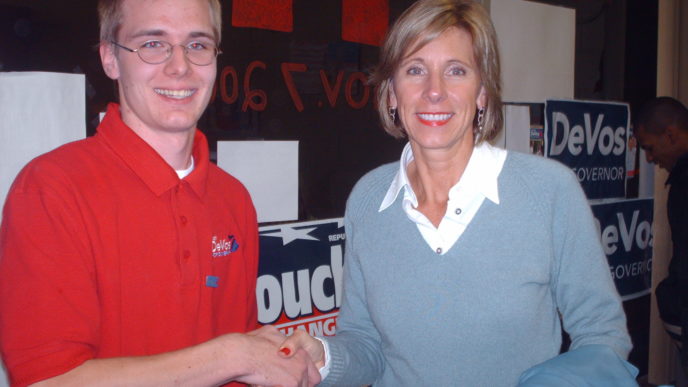
Betsy DeVos Says We Should ‘Start Fresh’ on Higher Ed. Here’s Where to Start.

Secretary of Education Betsy DeVos stated during a speech in Salt Lake City on Tuesday that instead of reauthorizing the Higher Education Act, lawmakers should consider a “fresh start.”

Yes, Congress should consider alternatives to the Higher Education Act, which authorizes all federal higher education spending such as student loans and grants.

Enacted in 1965 under President Lyndon Johnson, the Higher Education Act has undergone countless amendments that pass problems on to future generations. As the secretary said, “Why wouldn’t we start afresh and talk about what we need in this century and beyond for educating and helping our young people learn?”

Indeed, higher education badly needs to be adapted to the changing requirements of the American workforce. Here are just a few ways that Congress can give the higher education sector the fresh start it so badly needs.

Decouple Federal Financing From Accreditation

The federal government’s control over our accreditation system is not a particularly popular topic, but it has dramatic consequences on the ability of American universities to thrive and innovate.

The federal government currently has sole discretion in the recognition of accreditors, who then serve as gatekeepers of federal student aid and other institutional financing. This solidifies the federal government’s ability to determine which education is worthy of accreditation and which is not. Unfortunately, this de facto federal system of accreditation has limited the ability of the higher education sector to grow and adapt to the changing needs of our workforce and the economy.

Sen. Mike Lee, R-Utah, and Rep. Ron DeSantis, R-Fla., have put forward the Higher Education Reform and Opportunity Act (HERO), which would allow states to opt out of the current federal accrediting structure.

States could recognize their own accreditors, including members of the business community. The legislation would also allow states to break apart the current binary accrediting model, and let the business community, trade groups, nonprofits, and other entities to put their stamp of approval on individually credentialed courses or curricula.

These reforms would give students a better idea of the market value of the education they are receiving, grant more flexibility with student loan dollars, and create a pipeline between the universities and the job market.

Consolidate Federal Lending

Under the Obama administration, the federal government dramatically increased its role in originating and servicing student loans. The near-monopoly that the federal government now has over the student loan market presents many problems, the most pressing of which is mounting evidence suggesting federal aid leads to increases in college tuition.

As my colleague Jamie Hall and I discuss in our recent report, the five current federal loan programs should be collapsed into a single loan option under the current terms of the Graduate Stafford Loan. Additionally, Congress should place an annual and lifetime cap on student lending, thereby restoring fiscal responsibility to the loan program. We anticipate such reforms would lead to savings of $33 billion over the next 10 years.

Remove Burdensome Regulations

Under the Obama administration, several burdensome regulations were placed on institutions of higher education, particularly those in the for-profit sector.

Regulations should at the very least be sector neutral in their application, but a better approach would be to remove these barriers to innovation altogether.

Borrower defense to repayment, for example, opens institutions up to being sued by students who feel they have been defrauded by their university (a potentially slippery slope in the future). While longstanding institutions with large endowments may be better insulated from this regulation, new actors who are trying to build their business will have trouble coming up with the line of credit required to protect against such suits.

This is just one example of the many ways that burdensome regulations drain resources from universities and distract from the business of educating students.

In considering the reauthorization of the Higher Education Act, policymakers should follow DeVos’ advice and develop new policy proposals that will help improve the quality of higher education while putting downward pressure on prices. These reforms would be a significant step in achieving that goal. (For more from the author of “Betsy DeVos Says We Should ‘Start Fresh’ on Higher Ed. Here’s Where to Start.” please click HERE)

Follow Joe Miller on Twitter HERE and Facebook HERE.

Here Are 12 Possible Comey Replacements at FBI

There’s no shortage of familiar names floating to be the next FBI director, after President Donald Trump’s controversial firing of James Comey earlier this week.

But it appears former Republican Rep. Mike Rogers of Michigan could be an early favorite among current and former agents.

Other names in the mix are Rep. Trey Gowdy, R-S.C.; Judge Merrick Garland; former Secretary of State Condoleezza Rice; New Jersey Gov. Chris Christie; and former New York City Police Commissioner Ray Kelly.

The FBI Agents Association, or FBIAA, a group of more than 13,000 current and former FBI agents, endorsed Rogers to replace Robert Mueller for the post in 2013, but President Barack Obama instead nominated Comey.

While the agents group hasn’t made another official endorsement, members “still believe” Rogers meets the principles of what the association is looking for, said Joshua Zive, outside general counsel for the FBIAA, to The Daily Signal.

Rogers was a former FBI special agent from 1989 through 1994. After serving in the Michigan state Senate, he was elected to the U.S. House in 2000. While serving in House of Representatives, he was the chairman of the House Permanent Select Committee on Intelligence. He didn’t seek re-election in 2014. He has also been a regular commentator on CNN.

Zive said he believes Rogers would have credibility with the bureau’s agents. Additionally, he would know how to communicate effectively to the public about the scope of issues the FBI deals with, according to Zive.

Andrew McCabe, the acting FBI director who was the deputy director under Comey, testified on Capitol Hill Thursday. He is also reportedly a contender for the job, but could be challenged due to potential conflicts.

McCabe served as an FBI special agent since 1996, and was elevated to the No. 2 spot in 2016. However, while he was moving up in the FBI during the investigation of Hillary Clinton’s private email server, his wife Dr. Jill McCabe ran for the Virginia state Senate in 2015, with a financial boost of almost $500,000 from Common Good VA. The political action committee is controlled by longtime Clinton ally Gov. Terry McAuliffe.

In a statement to The Wall Street Journal last year, the FBI said, “Months after the completion of [his wife’s] campaign, then-Associate Deputy Director McCabe was promoted to deputy, where, in that position, he assumed for the first time, an oversight role in the investigation into Secretary Clinton’s emails.”

“It needs to be somebody independent,” said Ron Hosko, the FBI’s former assistant director of the criminal investigative division and now president of the Law Enforcement Legal Defense Fund. “With McCabe, this day and age, even the appearance of impropriety is a problem … An appearance can be fatal—maybe not to a career—but to advancement.”

This is certainly true of political figures being rumored for the job, Hosko said.

One big name who has taken himself out of the running is former New York Mayor Rudy Giuliani, a Trump supporter in the 2016 race. Giuliani was formerly a U.S. attorney and was known for reducing crime as mayor.

Christie, also a former U.S. attorney known for prosecuting public corruption cases, is reportedly in the running. After ending his own presidential campaign in 2016, Christie quickly endorsed Trump.

“It’s no disrespect to these individuals, but the president shouldn’t nominate anyone who has a clearly partisan background,” Hosko said. “A Christie or Giuliani pick could give the impression that it’s cooked and they will not find anything on Russia.”

Here are other names being discussed as a potential replacement for Comey, according to former FBI agents and news reports:

John Pistole: Not a household name but prominently talked about, Pistole is getting mentioned by news accounts and by former agents as a contender with potentially bipartisan backing. He also has close ties to Vice President Mike Pence, said Nancy Savage, executive director of the Society of Former Special Agents of the FBI, a separate organization from the FBIAA.

“He was a deputy director of the FBI, head of the TSA, and president of a college in Indiana, and maybe close to Pence,” Savage, an agent for more than three decades, told The Daily Signal. “He would be very familiar to all of the issues.”

Pistole, now the president of Anderson University, formerly served in top law enforcement roles for both parties. He was the administrator of the Transportation Security Administration for President George W. Bush and deputy FBI director for Obama. He served for more than 20 years in the FBI before the Senate confirmed him as TSA chief in July 2010.

Condoleezza Rice: The former secretary of state and national security adviser under Bush would seem unlikely, but Savage said her name is being talked about. Such an appointment could come at an interesting time, while the FBI is investigating Russia’s alleged interference in the 2016 election.

“She is a Russian expert, and fiercely independent,” Savage said. “It would be a different move for her.”

Merrick Garland: Another longshot is the D.C. Circuit Court chief judge whom Obama nominated to serve on the Supreme Court. Sen. Mike Lee, R-Utah, opposed Garland’s Supreme Court nomination, but has touted Garland for FBI director.

Savage said the name was being floated, with the thought it would be a consolation for Garland.

“There is a sentiment about Garland after the Supreme Court, and he does have a strong record as a prosecutor,” Savage said.

President Bill Clinton named Garland as deputy assistant attorney general in the criminal division in 1993. In 1995, Garland led the investigation of the Oklahoma City bombing, and other domestic terrorism cases. Clinton nominated him to serve on the D.C. Circuit Court of Appeals in 1997.

Patrick Fitzgerald: The former U.S. attorney for the Northern District of Illinois became famous and somewhat controversial for investigating both the Valerie Plame leak case as a special prosecutor during the Bush administration and later for his prosecution of Illinois Gov. Rod Blagojevich, a Democrat, on charges of corruption.

Hosko immediately brought up Fitzgerald’s name as a top choice because of his track record for going after both parties.

“Prosecuting Democrats and Republicans is a badge of honor,” Hosko said.

Chuck Rosenberg: The acting administrator of the Drug Enforcement Administration in 2015 would also be a strong candidate with bipartisan appeal, Hosko said. Over his career, he was a federal prosecutor in both Texas and Virginia. He previously served as U.S. attorney for the Southern District of Texas, and later was named as U.S. attorney for the Eastern District of Virginia before working as chief of staff and senior counselor to Comey as FBI director.

Rep. Trey Gowdy: The South Carolina Republican was a former federal prosecutor and is reportedly under consideration. Gowdy chaired the House select committee investigating Benghazi and he has been a member of the House Oversight and Government Reform Committee.

Ray Kelly: Kelly served as the New York City police commissioner following the 9/11 terrorist attacks. He held that job longer than anyone else, and is reportedly under consideration for the FBI job. He backed policies such as stop-and-frisk to reduce crime. (For more from the author of “Here Are 12 Possible Comey Replacements at FBI” please click HERE)

Follow Joe Miller on Twitter HERE and Facebook HERE.

Faith-Based Film Filled With F-Bombs

An upcoming faith-based film is attempting to go where no previous movie from the genre has ever gone.

Generational Sins — directed by Spencer T. Folmar and written by Folmar, Dax Spanogle, Jason Spanogle, Casey Salviano and Fernando Salviano — is overflowing with profanity, including multiple uses of “f—,” “s***,” “b****,” “d***” and “ass.” . . .

Movieguide, a yearly report on the entertainment industry from a Christian perspective, breaks down films into several categories, and it will be giving Generational Sins its lowest ranking when it comes to language, given there are 32 uses of profanity in the film. “The movie won’t do well if it’s advertised as faith-based,” says Movieguide editor Tom Snyder . . .

Chris Stone, founder of Faith Driven Consumer, an advocacy group for Christians, says he’ll be recommending Generational Sins, but to adults and not families. “It’s more graphic than I’m comfortable with, but it’s not unrealistic,” he says. “It’s an accurate portrayal of brokenness and sin, and some Christians will opt out.” (Read more from “Faith-Based Film Filled With F-Bombs” HERE)

Follow Joe Miller on Twitter HERE and Facebook HERE.

Liberals Boo God and Natural Rights at GOP Town Hall

At a rambunctious town hall in his district, Rep. Dave Brat, R-Va., ran into something he probably never expected to see in his district: voters booing the concept of fundamental, God-given rights.

“As a seminary graduate, do you believe in the separation of church and state?” the questioner began. “Would it be acceptable for you for churches to support specific candidates?”

The question was in reference to the Johnson Amendment, which President Trump recently gutted somewhat with his lackluster order on religious liberty.

“Absolutely,” Brat initially answered, cautioning that he was asked “a loaded question.”

“It’s in the Constituiton. They got it pretty good,” Brat said amidst the crows of hecklers.

“The politics shouldn’t establish any religion, right?” Brat added, to a response of claps and cheers. “But you should all, under the First Amendment, have the free expression thereof.”

But he took the argument deeper, asking an enthusiastic audience if they wanted a “total separation of state,” and cautioning that he did not think such an arrangement would be a good thing.

“Some of you have said that health care is a right,” the congressman explained. “And in the Western tradition, rights come from God. The role of government is to protect those rights.”

The hecklers responded with a chorus of sustained boos.

The question and its response came during a Tuesday night event – his first since the House’s most-recent health care vote – and was attended by hundreds, and fraught with jeers.

In an op-ed published the day after, the Richmond-Times Dispatch’s editorial board lauded the congressman for attempting to engage in civil discourse while excoriating the crowd’s “astonishing rudeness.”

“People have every right to rage at their congressmen, their president, or anybody else they care to,” the board stated. “After a while, though, the emotional vomiting gets old … when did banging on a high chair with a spoon ever lead to a solution?

(The below clip shows most of the townhall with Rep. Brat:)

Brat’s answer about rights was not wrong, of course. This republic was founded by men of different faiths who had a common understanding that their rights came from a transcendent, pre-political source, and established a system of government to ensure that these inalienable rights would be protected, rather than metered out by kings and demagogues.

Our denominationally neutral Declaration of Independence reflects this, appealing to the “Laws of Nature and Nature’s God” as the font from which our fundamental liberties and inherent equality spring.

Apparently, the concept of rights coming from God – or civil discourse in general – just wasn’t what Rep. Brat’s constituents showed up to hear that night. (For more from the author of “Liberals Boo God and Natural Rights at GOP Town Hall” please click HERE)

Follow Joe Miller on Twitter HERE and Facebook HERE.

Good Trump: Budget Rumored to Contain Entitlement Reform

President Trump’s White House is reportedly building a fiscal 2018 budget proposal that aims to balance the federal budget in 10 years and cut $800 billion from entitlement programs.

According to Paul M. Krawzak, reporting for Roll Call, Social Security and Medicare will remain untouched. The president campaigned against spending cuts to entitlement programs. However, sources that spoke to Roll Call said the proposal will seek to cut a “wide array of means-tested, mandatory spending programs including Medicaid” over the next 10 years.

Food stamps, Temporary Assistance for Needy Families, Supplemental Security Income, child nutrition programs, and the Pell Grant program are potential welfare programs that the budget may address.

“The budget will include proposals to reduce the cost of the Social Security Disability Insurance program, which is not means-tested,” Krawzak reports.

If true, these proposed reforms are a good step in the right direction. Federal entitlement programs account for 60 percent of the budget and 12 percent of GDP. Social Security, Medicare, and Medicaid are the biggest contributors to the national debt, which is rapidly approaching $20 trillion. In March, the Congressional Budget Office (CBO) estimated the federal debt will reach 150 percent of gross domestic product – that’s all the wealth produced in the U.S. – by 2047 at its current rate of growth. This is unsustainable.

Entitlement reform is necessary to America’s fiscal stability. But do Republicans have the political will to address this problem?

Consider the widely praised Paul Ryan budget plan of FY 2013. When push came to shove, Republicans capitulated to the Democrats, and Paul Ryan, R-Wisc., struck a deal with Senator Patty Murray, D-Wash., that increased spending and failed to reform entitlements. Conservatives were told to wait for a Republican-controlled Senate and a Republican president to achieve real spending reform.

Well, conservatives waited. And when President Donald Trump revealed a “skinny budget” proposal, it did not propose reforms to entitlements. While compensating defense spending increases with domestic spending cuts, the Trump skinny budget still carried a $488 billion deficit. And congressional Republicans blasted those few spending victories as “draconian” cuts to their favorite government programs.

If Republicans, in the majority, were unwilling to support Trump’s budget proposal then, why should we expect them to support more spending cuts in the future? Further, assuming that there are enough Republicans in Congress who will go along with the president’s proposal, what happens when the Democrats threaten a government shutdown? Why should conservatives expect them to fight when last time they surrendered?

President Trump should be encouraged to fight for every penny of this rumored $800 billion entitlement reform. The evidence suggests congressional Republicans won’t. (For more from the author of “Good Trump: Budget Rumored to Contain Entitlement Reform” please click HERE)

Follow Joe Miller on Twitter HERE and Facebook HERE.