Michigan Vietnam Vet Is Trump’s 1st Medal of Honor Recipient

Members of Army medic James McCloughan’s unit in Vietnam called him “Doc.”

Now, those soldiers, several of whom McCloughan saved during the ferocious, dayslong Battle of Nui Yon Hill in 1969, will have a new name for him: Medal of Honor recipient.

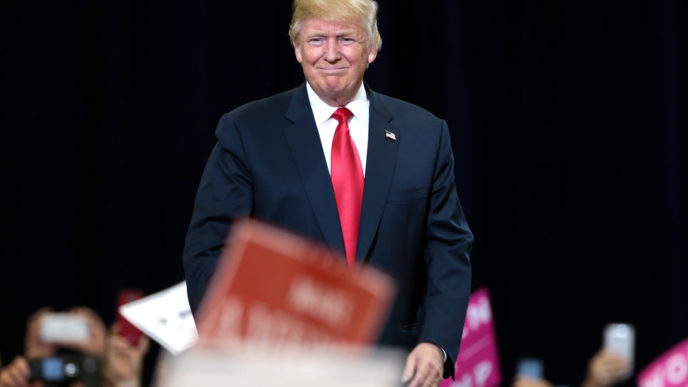
Army spokeswoman Valerie L. Mongello said Tuesday that the 71-year-old from South Haven, Michigan, will become the first person to be awarded the nation’s highest military honor by President Donald Trump. (Read more from “Michigan Vietnam Vet Is Trump’s 1st Medal of Honor Recipient” HERE)

Follow Joe Miller on Twitter HERE and Facebook HERE.

Trump Will Be Impeached If Republicans Lose the House

The 1998 midterm election was a debacle for Republicans, particularly then-Speaker of the House Newt Gingrich. Since Reconstruction, no president had seen his party gain seats in the House in a midterm election six years into his presidency. Gingrich, who made the election a referendum on impeaching President Bill Clinton, resigned after the loss. Clearly, voters had sent the signal, “Don’t do it” . . .

House Minority Leader Nancy Pelosi has cautioned against making the midterms a referendum on impeachment. But that is an electoral strategy, not a plan for when she gets the speaker’s gavel. And even if she declines to go straight to impeachment hearings on Day 1, a Democratic-controlled House would still be a nightmare for the White House. Any hope of passing a conservative agenda would die instantaneously. Worse, once Democrats gained the power to subpoena documents and compel testimony from members of the administration, the Hobbesian internal politics of today’s White House would look like a company picnic by comparison.

In short, the only hope for the Trump presidency is for the GOP to maintain control of the House.

According to various reports, the GOP thinks it can hold on by running “against the media” in 2018. As pathetic as that would be, it might work. Though I doubt it. A better strategy would be to actually get things done.

And the only way for that to happen is for both houses of Congress to get their act together. Voting bills out of the House may be enough to justify a Rose Garden party, but it will do little to sway voters who’ve been told for years that the GOP needs control of all three branches to do big things. Trump won’t be on the ballot in 2018, but his presidency will hang in the balance. (Read more from “Trump Will Be Impeached If Republicans Lose the House” HERE)

Follow Joe Miller on Twitter HERE and Facebook HERE.

Pro-Choicer Appointed to Key Vatican Pro-Life Think Tank

Imagine how we would feel if Planned Parenthood appointed to its board of directors someone who:

Opposed late term abortion.

Affirmed that unborn children are full human persons at some point during pregnancy.

Used her credibility as a pro-choice feminist to discredit the central pro-abortion arguments.

How would we feel about that? I think we’d be excited. We’d see that as progress. We’d think that public pressure was moving the needle a bit in our direction. Even more encouraging if Planned Parenthood had fired the rest of its board. Purged it of purists. If empty spots on that board looked like they might go to other “moderates.”

Unexplained Purge at the Vatican’s Pro-Life Thinktank

Now flip that situation around, to see what is really happening. Pope Francis has purged the entire faculty of the Pontifical Council for Life. It was founded by Pope John Paul II as a thinktank and action center to combat what he called the “Culture of Death.” One of its first appointees (and its leader) was the great Dr. Jerome Lejeune. That pioneering researcher had discovered the genetic basis of Downs Syndrome. But Lejeune had been purged from mainstream academia and starved of research funds. Why? Because he opposed what he called the “genocide” aimed at unborn handicapped children. The Council for Life offered him a haven, a place full of allies, a nerve center where the fight for human life could be mapped out throughout the world.

Pro-Choice Philosopher Appointed

All wiped out. Gone. For reasons that are not public, the pope made a clean sweep of the Council for Life. Now he’s filling its positions again from scratch. So far he has reappointed a few of the solid people who were (for unknown reasons) dismissed. But he has made one pick so far that deeply troubles prolifers. As LifeSiteMews reported:

Among the 45 new members Pope Francis has appointed to the Pontifical Academy for Life is an Anglican minister who has argued that abortion should be legal until “18 weeks after conception.”

University of Oxford Professor Nigel Biggar, who was appointed to the Academy for a five-year term, stated in a 2011 dialogue with pro-infanticide ethicist Peter Singer that a preborn baby is “not … the same kind of thing as an adult or a mature human being” and therefore does not deserve “quite the same treatment.”

“I would be inclined to draw the line for abortion at 18 weeks after conception, which is roughly about the earliest time when there is some evidence of brain activity, and therefore of consciousness,” he said as reported by Standpoint magazine.

Then, one year later, when he was the keynote speaker for an event at the Mayo Clinic in Minnesota, he said that “it is not true that all abortion is equivalent to murder.”

Pope Francis began his overhaul of the Academy last year by creating new statutes, that among other things, no longer required that members sign a declaration to uphold the Church’s pro-life teachings. The Pope’s next move was to then remove all of the academy members while promising to make new appointments himself.

Former academy member Judie Brown wrote in an article earlier this year that she was shocked by what she called Francis’ move to “deconstruct” the Academy that was once considered a bastion of orthodoxy.

“The Pontifical Academy for Life is undergoing an overhaul by Pope Francis and his political operatives within the Vatican’s hierarchy, and it is one of the most heartbreaking events I have seen in my lifetime. But given the politics of the Vatican, it is not surprising,” she wrote at that time.

A Moderate on Abortion

Now, Biggar is not an extremist. (Unlike Paul Ehrlich, the population crank invited to a recent Vatican conference on biodiversity.) Biggar doesn’t favor abortion for all nine months, or forced sterilization. Biggar is well-known for opposing assisted suicide. That’s good to hear.

On abortion, he dates the beginning of life by the presence of brainwaves. That’s the same criterion we use for the end of life. If we protected all babies with brainwaves, many thousands would be saved. Many women do not even realize that they are pregnant by 18 weeks. For a secular intellectual unconvinced that man is made in the image of God, there is a certain internal logic here: Make brainwaves the “bookends” that mark off what’s fully human and alive from what is not yet or not any longer. Yes, it’s wrong. But it’s a long way from the Democratic Party’s support for abortion for all nine months for any reason.

So if Biggar got appointed to the Planned Parenthood board, that would be progress. It would mean that those leaders in the fight for untrammeled “reproductive rights” were losing confidence. They were responding to public pressure. Maybe they were ready to offer some compromise. Prolifers would rightly see it as blood in the water.

Of course, those pro-abortion groups are making no such appointments. Planned Parenthood, instead, is shoveling money to politicians like Kamala Harris. Before she was a U.S. senator, Harris prosecuted journalists. Why? For documenting Planned Parenthood’s crass trade in unborn baby parts.

A Loss of Nerve or Change of Direction?

No, it is the Vatican that is purging its ranks and appointing “moderates.” This institution under previous popes stood prophetically (and almost alone) against the destruction of unborn children for our sexual convenience. Catholic laymen led the fight against abortion. We were thrilled when millions of evangelicals discovered the issue and joined the fight. Even now, public opinion seems to be swinging in our direction.

But the Vatican under Francis wants to strike a different note of prophecy. Instead of resisting the culture of death, with his actions with the Pontifical Academy of Life the pope has struck a note of compromise. But not on all issues. He also boldly stepped forward … and condemned the very same things that secular progressives like to condemn:

An “unrestricted capitalism” that doesn’t even exist.

A future apocalypse caused by Westerners using our air conditioners.

A wave of “xenophobia” among nations already overwhelmed by immigrants and led by multiculturalists.

Without invoking (or imperiling) the infallible authority that Catholics believe a pope has, he can still make policy decisions that are very damaging indeed. (For more from the author of “Pro-Choicer Appointed to Key Vatican Pro-Life Think Tank” please click HERE)

Follow Joe Miller on Twitter HERE and Facebook HERE.

Manhunt Sparked by Slaying of Prison Guards, Inmates’ Escape

Two Georgia inmates serving long prison sentences and “dangerous beyond description” overpowered and killed two guards on a prison bus before fleeing in a stolen car, authorities said.

The deadly escape happened about 6:45 a.m. Tuesday as the guards drove 33 inmates between prisons, and it set off a massive manhunt involving local, state and federal officers, Putnam County Sheriff Howard Sills said . . .

Donnie Russell Rowe, serving life without parole, and Ricky Dubose, who has prominent tattoos on his face and neck, overpowered, disarmed and killed Sgt. Christopher Monica and Sgt. Curtis Billue and then carjacked a driver who happened to pull up behind the bus on a rural highway, Sills said. (Read more from “Manhunt Sparked by Slaying of Prison Guards, Inmates’ Escape” HERE)

Follow Joe Miller on Twitter HERE and Facebook HERE.

Trump, Ryan Emphasize Importance of Unity After Shooting of House Majority Whip Steve Scalise

President Donald Trump called for unity after House Majority Whip Steve Scalise, R-La., was shot and wounded Wednesday morning when a man opened fire at Republican lawmakers and staff during a practice for a congressional baseball game.

“Congressman Scalise is a friend, and a very good friend. He’s a patriot and he’s a fighter,” Trump said, adding:

He will recover from this assault. And, Steve, I want you to know that you have the prayers not only of the entire city behind you, but of an entire nation and, frankly, the entire world. America is praying for you and America is praying for all of the victims of this terrible shooting.

Later, House Speaker Paul Ryan and House Minority Leader Nancy Pelosi both made statements of common cause as Americans on the floor of the House.

At least four others, including two Capitol Police officers, were wounded in the shooting that began about 7:10 a.m. at the ball field in Alexandria, Virginia, just outside Washington.

The members of Congress were preparing for the annual congressional baseball game between Republicans and Democrats, scheduled for Thursday at Nationals Park in Washington.

In his remarks, Trump did not speculate or comment on the motive of the shooter, first reported by The Washington Post to be James T. Hodgkinson, 66, of Belleville, Illinois.

Rep. Mark Walker, R-N.C., said the shooter’s action was deliberate.

Trump, who delivered his remarks in the Diplomatic Room of the White House, said the incident reinforces the unity of the nation’s political parties, despite differences.

“We may have our differences, but we do well, in times like these, to remember that everyone who serves in our nation’s capital is here because, above all, they love our country,” Trump said.

Ryan, R-Wis., encouraged members to pursue unity and thanked his Democrat colleagues for their support.

“My colleagues, there are so many memories from this day that we will want to forget and there are so many images that we will not want to see again,” Ryan said. “But there is one image in particular that this House should keep. And that is a photo I saw this morning of our Democratic colleagues gathered in prayer this morning after hearing the news.”

The shooting, Ryan said, is a reminder for members to focus on what is important, despite differences.

“You know, every day we come here to test and challenge each other,” Ryan said.

Ryan challenged fellow lawmakers to remember the reason they serve.

We feel so deeply about the things that we fight for and the things that we believe in. At times, our emotions can clearly get the best of us. We are all imperfect. But we do not shed our humanity when we enter this chamber. For all the noise and all the fury, we are one family.

Sen. Bernie Sanders, I-Vt., issued a statement after news outlets reported that the shooter had volunteered for Sanders’ presidential campaign.

Pelosi, D-Calif., voiced concern for her colleagues caught in the incident and thanked Capitol Police for their response.

Democrat Gov. Terry McAuliffe, a Democrat, called for increased gun control at a press conference in response to the shooting.

“Let me say this, I think we need to do more to protect all of our citizens,” McAuliffe said. “I have long advocated—this is not what today is about, but there are too many guns on the street. We lose 93 million Americans a day to gun violence.”

After a reporter questioned McAuliffe’s statistic, the Virginia governor corrected it.

“Ninety-three individuals a day,” McAuliffe said.

Rep. Mo Brooks, R-Ala., who was present at the shooting, said it hadn’t altered his view on the Second Amendment.

“The Second Amendment right to bear arms is to ensure that we always have a republic,” Brooks said, according to the Washington Examiner.

“And as with any other constitutional provision in the Bill of Rights, there are adverse aspects to each of those rights that we enjoy as people,” he said. “And what we just saw here is one of the bad side effects of someone not exercising those rights properly.”

In his remarks, Trump asked Americans to work together.

“We can all agree that we are blessed to be Americans, that our children deserve to grow up in a nation of safety and peace, and that we are strongest when we are unified and when we work together for the common good,” the president said. (For more from the author of “Trump, Ryan Emphasize Importance of Unity After Shooting of House Majority Whip Steve Scalise” please click HERE)

Follow Joe Miller on Twitter HERE and Facebook HERE.

Mattis Is Punting the Military Buildup to 2019

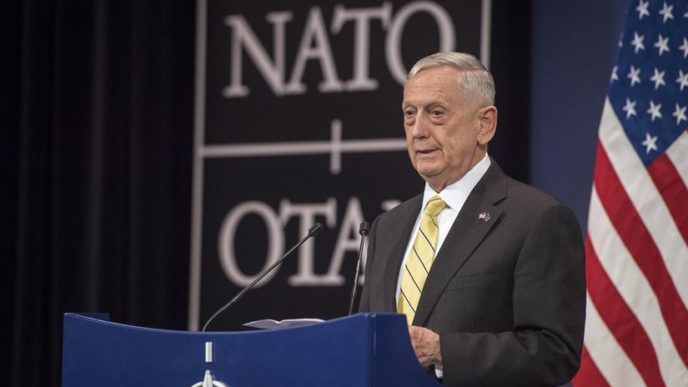
Secretary of Defense James Mattis has news for Congress and for the nation: The military buildup will have to wait until next year.

Mattis delivered that message in a back-to-back series of appearances before Congress, one of them taking place in a rare prime-time hearing on Monday night.

During both testimonies—which were delivered before the House and Senate armed services committees, respectively—Mattis told the Congress that the military buildup promised by President Donald Trump will have to wait until next year. He stressed that while rebuilding the size and capabilities of the military is important, the 2018 defense budget request will focus primarily on addressing near-term readiness problems.

Mattis’ message to both the House and Senate contained two themes: that the 2018 budget is simply intended to fill holes in readiness, and that the promised rebuilding of the military will not take place until 2019.

Responding to multiple questions from lawmakers, Mattis stated that the proposed budget for 2018 will start to “fill the holes and achieve program balance before beginning to significantly grow capacity in future years.”

Testifying alongside Mattis, Joint Chiefs of Staff Chairman Gen. Joseph Dunford explained that there are severe readiness shortfalls in every single branch of the military.

Due to limited resources in recent years’ defense budgets, the services have been forced to prioritize short-term readiness while decreasing the long-term preparedness and modernization of America’s armed forces.

Dunford pointed out, for instance, that the Marine Corps has delayed planned investments in multiple elements, from infrastructure to aircrafts, all to preserve the immediate proficiency of that service’s currently deployed forces.

Mattis pointed out that the readiness crisis is a result of high operational tempo—over 16 years of war—but also of consistent failure by Congress to support the military. That failure is reflected in nine years of continuing resolutions and four years of funding under the budget caps adopted in the Budget Control Act of 2011.

In a dramatic moment in one of the hearings, Mattis stated, “We did not get into this situation in one year, and we won’t get out of it in a year either.”

It will take many years of sustained budgetary growth to rebuild the military—an assessment that is shared by The Heritage Foundation.

Mattis stated multiple times that the next five budgets will have to show considerable increases—he mentioned growth rates of at least 5 percent—in order to rebuild the military to the degree Trump has said is necessary.

Mattis, speaking of the future budget request, made a clear projection:

The fiscal year 2019 budget, informed by the National Defense Strategy, will grow the all-volunteer force. The department will work with President Trump, Congress, and this committee to ensure the budget request we present for fiscal years 2019-2023 is sustainable and that it provides the commander-in-chief with viable military options in support of America’s security.

Mattis indicated he expects the defense budget to grow by 3 to 5 percent over the next five years in order to accommodate necessary increases in personnel and procurement.

Nonetheless, these projections for 2019 and beyond were not part of the president’s budget request for this coming year. In fact, the five-year projection typically included in defense budget requests, referred to as the “Future Years Defense Plan,” was absent.

Instead, Department of Defense officials have stated that future projections included in the 2018 request are not representative of their planning, but rather are just projected growth in light of inflation.

>>> Defense Leaders Agree: US Military Readiness Is at a Dangerous Low

The Heritage Foundation has outlined in multiple documents that there is a need to start rebuilding our military immediately. Heritage’s Index of U.S. Military Strength has highlighted for three years the need for Congress to make the defense budget a priority.

Congress should heed the warnings being issued by both Mattis and Dunford to prioritize our national defense.

Now that the president’s budget request is public, it is Congress’ responsibility to address how to increase defense spending. There is widespread agreement that the military needs resources to rebuild both immediate readiness and the long-term health and capacity of the military.

Mattis starkly highlighted the legislative branch’s role in funding the military, stating, “Congress as a whole has met the present challenge with lassitude, not leadership.”

Congress now has a chance to show the leadership that the secretary called for and that the country needs. It can do so by increasing spending for defense this year and into the future.

The lists of unfunded requirements that the military services by law were required to submit are excellent places to start. (For more from the author of “Mattis Is Punting the Military Buildup to 2019” please click HERE)

Follow Joe Miller on Twitter HERE and Facebook HERE.

2 Cases Threaten to Shut Down Public Prayer. Why the Supreme Court May Need to Act.

Two federal appeals courts are considering whether elected leaders throughout the Midwest and mid-Atlantic regions must abandon the 200-year-old practice of opening local meetings with an invocation.

Both cases could end up before the Supreme Court by Christmas time.

In one case, a self-described pagan sued the board of commissioners of Jackson County, Michigan, arguing that its tradition of beginning monthly board meetings with an invocation violates the Constitution’s Establishment Clause, the First Amendment provision disallowing government from establishing an official religion.

In 1983, the Supreme Court in Marsh v. Chambers examined Nebraska’s practice of employing a salaried Christian chaplain who offered the Legislature’s invocations for 16 years, and held that “legislative prayers” at policymaking-body meetings are constitutional.

The court noted that the first Congress wrote the Establishment Clause in the same week it passed laws to create a House chaplain and Senate chaplain, whose public duties included offering invocations every day that Congress is in session.

Over the next three decades, some lower courts and academics speculated that Marsh might be a one-off exception to normal Establishment Clause rules. Some argued that invocations must be generic, and therefore mentioning Jesus Christ or making other sectarian references would be unconstitutional.

In 2014, the Supreme Court addressed this confusion by taking another case concerning a New York town where the invocations are offered by local volunteer clergy—all of whom were Christian.

In Town of Greece v. Galloway, the court held that these invocations, too, are constitutional, even if all the prayer-givers happen to be Christian and include sectarian content from a single faith.

But litigation persisted, now focusing on the identity of the prayer-givers.

Plaintiffs argued that invocations given by government officials are unconstitutionally coercive because they might imply that lawmakers will use their official powers against those who refuse to participate in the invocations.

The U.S. Court of Appeals for the 4th Circuit rejected that argument when a three-judge panel ruled 2-1 for the government in Lund v. Rowan County, North Carolina.

However, the Richmond-based appeals court reheard the case in March in a rare en banc proceeding in which all 15 judges participated. It is very possible the en banc court will invalidate Rowan County’s invocations in the next few weeks.

The opposite situation is currently unfolding in Michigan in the case of Bormuth v. County of Jackson.

There, a Clinton-appointed district judge upheld the county’s practice of allowing each of its nine commissioners to rotate having an opportunity to deliver an invocation, each according to his or her personal faith.

Because all nine commissioners are Christian, the plaintiff argues that the resulting Christian invocations violate the Establishment Clause.

A three-judge panel of the U.S. Court of Appeals for the 6th Circuit reversed the lower court’s ruling in a divided 2-1 decision, ruling that such practices are unconstitutional.

But on June 14, attorneys with First Liberty Institute will present arguments as all 15 judges of the Cincinnati-based appeals court rehear that case en banc.

It is very possible that by late this year, a “circuit split” situation could occur between en banc appeals courts.

If that happens, one or both of these cases will become prime candidates for the U.S. Supreme Court to hear in 2018 as a major religious liberty case.

Legislator-led invocations fall within a broad historical tradition going back to the founding of the republic. The Town of Greece decision made clear that the Establishment Clause must be interpreted consistently with what the framers of the Constitution understood to be establishing religion.

Because these invocations do not establish an official religion, as “establishment” has been historically understood, and because the invocations do not require or coerce anyone to participate, they are perfectly constitutional.

If the Supreme Court means to enforce its decision in Town of Greece that centuries-old prayer traditions do not violate the Establishment Clause, then these cases may be at the forefront of a fundamental restoration of religious liberty in America. (For more from the author of “2 Cases Threaten to Shut Down Public Prayer. Why the Supreme Court May Need to Act.” please click HERE)

Follow Joe Miller on Twitter HERE and Facebook HERE.

Exposing the EPA’s Gold King Mine Cover-Up

Does the Environmental Protection Agency care more about its image than it does about the environment?

Its behavior in response to the massive 2015 Gold King Mine disaster in Colorado would suggest a very clear “yes.”

The Environmental Protection Agency is hiding its incredible recklessness in the affair by giving official accounts that are clearly contradicted by ample evidence in the government’s possession.

As the new EPA administrator, Scott Pruitt has an opportunity to drain a bit of the swamp by exposing the EPA’s cover-up.

An Environmental Disaster

In August 2015, an EPA crew inexplicably dug out the rock and rubble “plug” to the long abandoned Gold King Mine, triggering a massive blowout that flooded the Animas River with 3 million gallons of acid mine drainage and, according to the EPA, over 550 tons of metals.

Had the EPA actually been doing what it claims it did, the disaster would never have happened. However, it seems the EPA could not allow its reputation to be tarnished with the truth.

The EPA has put forth the fiction that its crew had simply removed backfill that was blocking access to a mine tunnel, but did not disturb the natural plug that had formed in the tunnel’s opening that was holding back a sea of acid mine drainage.

The EPA claims its crew planned to wait for experts who would address the plug. It says its team was just further cleaning up the site when, through some inexplicable bad luck, the plug eroded, causing a blowout that turned the Animas River bright orange.

In essence, the agency wants us to believe that this was an accident that could have happened to anybody.

The truth the EPA is concealing is that its team did not stop after excavating to the tunnel’s opening, and never had any intention of stopping.

The EPA crew began removing the plug as it had planned, even though it anticipated acid mine drainage would flow out and that the drainage could be pressurized.

The EPA’s actions could be likened to poking a balloon with a pin to let out just a little air. At best, the EPA’s actions were incredibly reckless.

Numerous federal officials in and outside the EPA turned a blind eye to the truth, and never challenged the fiction that the EPA maintains to this day and that was just repeated Monday by the EPA’s inspector general.

For an agency more concerned about its own welfare than its environmental mission, the almost unfathomable incompetence is sufficient motive to cover up what really happened.

There are other reasons as well. Some grossly negligent acts can be criminally prosecuted under provisions the Clean Water Act—a measure the EPA has used against private parties in the past. Additionally, New Mexico has already brought a lawsuit seeking damages.

Further, the EPA’s dishonest actions after the fact likely provide even more impetus to continue the deception.

Given the contradictory assertions they have made in public and the bogus reports they have produced for public and congressional consumption, it is difficult to imagine how the EPA officials involved could have possibly been honest with the inspector general investigators.

Pruitt’s team has inherited a tangle of half-truths, misdirection, and deceit. Like the Gold King Mine disaster itself, this is a mess the agency needs to clean up.

A Prelude to Disaster

Years before the Gold King Mine disaster occurred, there had been a collapse within a tunnel (an adit) used to access, ventilate, and drain the mine’s inner content.

Water can naturally accumulate within mines, and if there has been a collapse, fine solid matter like clay can eventually fill all the spaces between the collapsed rock, forming a natural plug. Eventually a pool of water forms behind the plug, and with enough time there can be so much water that it becomes pressurized.

In 2009, after this collapse, a pipe had been inserted into the mine in an attempt to prevent the accumulation of water. Then, the old structure at the entrance to the adit (posts and timbers supporting a roof to protect from debris sliding down from the slope above) was demolished, and the area in front of the mine opening was backfilled, burying all except the end of the drainage pipe.

Subsequently, water flowing from the mine had slowed to a trickle, a possible indicator that the mine was plugged.

When the EPA crew came to the mine in 2015, it came specifically to address the concern about conditions that could lead to a blowout.

The crew, however, was operating under outlandish assumptions that the agency had made one year before, which are covered in greater detail by a congressional committee report.

In brief, based on almost no evidence, the EPA had concluded during a visit in 2014 that the floor of the mine was 6 feet lower than the ground immediately outside the mine.

It assumed that water in the mine would have to be over 6 feet deep before it would flow out of the pipe. Seeing little flow out, it conjectured the backfilled mine was only half-full and not pressurized.

This conclusion was contrary to available old photographs, documents from the Colorado’s Division of Reclamation, Mining and Safety, and the basic fact that the tunnel was designed in part to drain the mine—so recessing the floor 6 feet would make no sense.

The ground immediately outside the mine was made of the waste rock removed to create the tunnel. Why and how would a tunnel be dug so it couldn’t drain or be accessed?

An additional clue should have been clear to the crew: During a 2014 visit, the EPA removed a stinger—a pipe that is used to drive through a collapse to drain impounded water.

This is especially true given that when the crew yanked the stinger from the rubble, it found the front section mangled, indicating there had possibly been an unsuccessful attempt to penetrate a blockage.

In any case, whether the mine was full or not could have been determined by drilling to test for hydrostatic pressure. However, because drilling was difficult and expensive, the EPA chose to rely on faulty assumptions rather than data.

In 2015, the EPA crew set about removing unconsolidated backfill (material that was not holding back water) to reach the plugged tunnel opening cut into the mountain’s rock face. This was accomplished the first day of digging.

The crew’s outlandish assumptions were proven to be just that when it reached the tunnel’s opening. It had exposed the entire plug from the bottom to the top of the tunnel, not just the upper half.

With the tunnel not recessed as anticipated, the crew should have realized, and likely did, that the basis of its assumption that the mine was not full of water had evaporated.

In what appears to have been a hopeless effort to account for this, the following day, the EPA crew reburied all but the very top portion of the plug. It built a large mound of earth (a berm) in front of the tunnel opening and constructed a makeshift channel to the side.

The crew apparently anticipated that when it dug a hole into the top of the plug, any water that came out would calmly flow through the channel and to a pre-existing ditch that ran down the mountain to settling ponds.

Hope springs eternal.

Although the EPA fails to mention the reburying of the plug in any of its reports, several executive branch reports, along with an EPA inspector general report released this week, described what supposedly happened next.

All these reports are wrong, and most, if not all, are intentionally deceitful.

Rewriting History

First, the EPA produced a report that asserted its crew was just digging to clear the bedrock face, but not touching the plug. Then, somehow, the lower bedrock crumbled and the mine just blew out.

The Department of the Interior produced the next report, a bureaucratic treatise that says the EPA crew discussed a plan, but then ambiguously states “the contractor continued to excavate.”

Exactly what the crew was excavating—the dirt above the tunnel opening (which in fact had already been removed) or the plug itself—is left unsaid. The report asserts that the EPA crew planned to insert another stinger through the now-exposed plug to drain the mine.

The crucial fact omitted by the report is that the EPA did not have a stinger. So, the plan was pure fiction.

In fact, the Department of Interior report was so short on details that an Army Corps of Engineers peer-reviewer made his signature conditional on including additional text in the executive summary.

He included the line:

The report discusses field observations by EPA (and why they continued digging), but does not describe why a change in EPA field coordinators caused the urgency to start digging out the plug rather than wait for [Bureau of Reclamation] technical input as prescribed by the EPA project leader.

Unlike the Corps reviewer’s comments, the remainder of the Interior report is nebulous.

Then, the night before a congressional hearing on the Interior report, the EPA issued an addendum to its first report, stating that the report was based on an unrecorded, untranscribed, simultaneous interview of the two EPA on-scene coordinators in charge of the site.

According to the addendum, the on-scene coordinator who was on vacation at the time of the blowout had handed supervision off to the other, along with an emailed list of instructions.

Curiously, this critically important email was not mentioned in the narrative of the two earlier reports. The email provides explicit instructions on steps to take to remove the upper portion of the plug.

The EPA’s midnight addendum also asserts that its crew was following these instructions with one exception. Without any supporting evidence whatsoever, the report claims that after he sent the email, the on-scene coordinator who would be on vacation told his replacement not to remove the plug, something inconsistent with his instructions.

Even if this supposed “clear verbal direction” was ever given, it definitely wasn’t followed.

The report goes on to repeat the fiction that the EPA crew was digging high above the tunnel opening and preparing the site for when the experts would arrive when, somehow, the mine inexplicably burst open.

Finally, the EPA Inspector General’s Office released its report this Monday that at best demonstrates an inability to uncover the truth by repeating the fiction.

After omitting any serious discussion of the outlandish assumptions from the EPA’s 2014 site visit, the EPA inspector general repeats the official EPA line, stating that:

According to the [on-scene coordinator] on-site, the team stopped excavation in front of the blockage on Aug. 4, 2015, after they reached material that was compacted, well consolidated, and considered by the [on-scene coordinator] on-site to be the blockage.

The EPA inspector general goes on to state that the next day, “[t]he excavator operator built a ramp to enable reaching higher.” This was reportedly done so the excavator operator could “scratch” above the mine entrance where the plug was.

Like the other reports, the inspector general omits any mention that the plug that had been unearthed the day before was reburied—as is demonstrated in this series of photos—and that the rock face had already been “scratched” clean before the blowout, as demonstrated in this series of photos.

Time for Truth and Accountability

All these reports are clearly refuted by an email from the Department of Interior recently released by the House Committee on Natural Resources, which states:

On 8/5/2015, the EPA was attempting to relieve hydrologic pressure behind a naturally collapsed adit/portal of the Gold King Mine. The EPA’s plan was to slowly drain and treat enough mine water in order to access the inner mine working and assess options for controlling its discharge. While removing small portions of the natural plug, the material catastrophically gave-way and released the mine water.

This document, site photographs, and other information clearly contradict the fiction that the EPA has spun. The cover-up is so bold it fits the old saying, “Who you going to believe, me or your lying eyes?”

While the EPA crew did not snap a photo of the excavator bucket that was digging the last fateful scoop of the plug, it might as well have.

There are enough people inside the agencies that know the truth, and a trail of pictures and papers show that they know it.

It is time the cover-up be uncovered, and the EPA be exposed for caring more about its own institutional interests than protecting the quality of the environment. (For more from the author of “Exposing the EPA’s Gold King Mine Cover-Up” please click HERE)

Follow Joe Miller on Twitter HERE and Facebook HERE.

Results of Virginia’s Primary Hint at Future for Trump, Sanders Movements

In one of the first major primary races after the 2016 presidential election, a Republican candidate for governor who campaigned on a pro-Trump platform nearly pulled off an upset, while a Democrat candidate who cast himself in Bernie Sanders’ progressive mold lost.

Candidates perceived by some as establishment won in both the Democratic and Republican primaries for Virginia governor Tuesday. But another takeaway is that the polls—which predicted a nail-biter for Democrats and a blowout on the Republican side—were as wrong as the polls for the Nov. 8 general election.

“The real national takeaway was on the Republican side more than the Democratic side,” said Quentin Kidd, a political science professor at Christopher Newport University who is director of the Wason Center for Public Policy.

A Washington Post poll in May showed a significant lead in the GOP governor’s race—37 percent to 12 percent—for Ed Gillespie, former chairman of the Republican National Committee, over Corey Stewart, chairman of the Prince William County Board of Supervisors, who was state chairman of President Donald Trump’s 2016 campaign. State Sen. Frank Wagner of Virginia Beach had 13 percent in the poll, actually outperforming Stewart.

“One candidate wrapped himself in a Donald Trump flag, running against an opponent with a huge advantage in polls,” Kidd told The Daily Signal. “Just as there were some shy Trump voters, I think there are also shy Stewart voters.”

Unofficial final results Tuesday night, though, had Gillespie only squeaking by Stewart, with 43.7 percent of the vote to 42.5 percent. Wagner finished with 13.8 percent.

On the Democratic side of the Virginia governor’s race, that same Post poll showed former U.S. Rep. Tom Perriello, a progressive with the active backing of Sanders, the democratic socialist senator from Vermont, leading Lt. Gov. Ralph Northam, 35 percent to 29 percent.

But in the end, Northam won 55.9 percent of the vote to Perriello’s 44.1 percent. The upstart’s loss came after Sen. Elizabeth Warren, D-Mass., did a TV commercial for him and several Obama administration alumni endorsed him.

Democrat Northam will face Republican Gillespie in the general election Nov. 7.

“The national implications are that the 37 percent or 40-something percent—whatever the Trump approval rating is on any given day—it’s real, and they do vote,” Kidd said. “Corey Stewart ran as Donald Trump’s right-hand man. … Ed Gillespie, I don’t know if he even uttered the words Donald Trump.”

Republican voters likely looked at the polls and thought Gillespie would win easily, said Stephen Farnsworth, a political science professor at the University of Mary Washington.

“There is a real dispute within the Republican Party about how close a candidate should be to Donald Trump,” Farnsworth told The Daily Signal.

The president was a key factor in both primaries, he said.

“It was a factor in the intensity for Stewart that made it a close race, and the intensity that forced Northam to move to the left and sharpen his attack on Trump in order to fend off Perriello,” Farnsworth said.

Phil Kerpen, chairman of American Commitment, a conservative advocacy group, noted while tweeting about the results that Trump was underestimated.

The Trump campaign last year fired Stewart, an early supporter, as its Virginia chairman after he participated in a protest outside Republican National Committee headquarters to complain that the RNC provided inadequate support for Trump.

The Democratic primary had some lessons.

Northam, known as a moderate Democrat in the Virginia state Senate, admittedly voted twice for Republican George W. Bush for president. For two years, Northam built a campaign based on pragmatism.

But Perriello pushed Northam to the left, to focus more heavily on issues such as maintaining Obamacare’s Medicaid expansion in Virginia and fighting for abortion rights. The lieutenant governor called Trump a “narcissistic maniac” in one campaign commercial.

“That ad was very effective in prompting progressive-minded voters who were hesitant about Ralph Northam to be more comfortable with him,” Kidd said. “Tom Perriello wanted a groundswell of progressive energy that didn’t materialize.”

However, he said, Northam’s move to the left showed significant progressive energy was in play.

Kidd said the Northam-Perriello spread in the 2017 Democratic gubernatorial primary is closer, but still resembles the Hillary Clinton-Bernie Sanders split in the state’s 2016 Democratic presidential primary, when Clinton beat Sanders 64.3 percent to 35.2 percent.

“The progressive left and the moderate middle are still fairly static in Virginia. Those voting blocs are what they are,” Kidd said. “Northam was forced to be more progressive, but there weren’t the votes there for Perriello.” (For more from the author of “Results of Virginia’s Primary Hint at Future for Trump, Sanders Movements” please click HERE)

Follow Joe Miller on Twitter HERE and Facebook HERE.

A mass shooting isn’t surprising given the mainstreaming of political violence by Democrat extremists

It’s shocking, but not altogether surprising, that a mass-shooting occurred during a Republican Congressional sports outing. Senator Rand Paul, who observed the volley of 50 or 60 shots, said that a “massacre” had been narrowly averted.

If House Majority Whip Steve Scalise’s security detail hadn’t been present, Paul said, it would have been a slaughter.

“I do believe that without the Capitol Hill police, it would have been a massacre,” he said. “We had no defense at all.”

This attempted mass shooting isn’t surprising given the mainstreaming of political violence by Democrat extremists:

• There’s the rhetoric from “academia”:

“They should be lined up and shot,” Professor John Griffin posted to his Facebook, according to a screenshot of the post obtained by Campus Reform, even clarifying that he wasn’t being hyperbolic, saying “that’s not hyperbole; blood is on their hands.”

• There’s the theater:

• There’s Hollywood:

• There’s the fascist group laughably called “Antifa”:

• There’s the media:

Senior Newsweek writer Kurt Eichenwald wants innocent people to suffer and die in order to prove a point.

Eichenwald said on Twitter Friday night that he hopes every Republican who voted in favor of the American Health Care Act on Thursday sees a family member come down with a serious “long term” illness and lose their insurance before dying. When challenged, Eichenwald doubled down. “I want them to be tortured,” he said of Republicans who supported the AHCA. He added: “I want the [Republicans] who supported this to feel the pain in their own families.”

• There’s the world’s most famous community organizer, Barack Obama:

“If they bring a knife to the fight, we bring a gun,” Obama told the audience. “Because from what I understand folks in Philly like a good brawl. I’ve seen Eagles fans.”

…At another campaign stop on September 18, 2008, Obama advocated that his supporters “argue with [people], get in their faces”:

…[and d]uring the town hall meeting protests of the summer of 2009, Senior White House adviser David Axelrod and deputy chief of staff Jim Messina told Democrat Senators, “If you get hit, we will punch back twice as hard.”

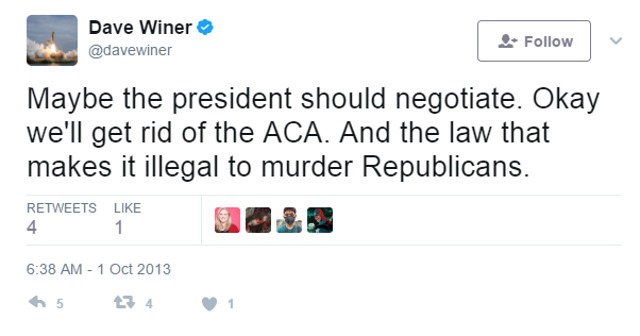
• There’s social media:

It turns out the shooter was a “Bernie Bro.”

The leaders of the Democrat Party need to speak out against this violent rhetoric. If they fail to do so, it speaks volumes about how radical and anti-American the party has become. (For more from the author of “A mass shooting isn’t surprising given the mainstreaming of political violence by Democrat extremists,” please click HERE)