How to Make Mexico Pay for the Fence

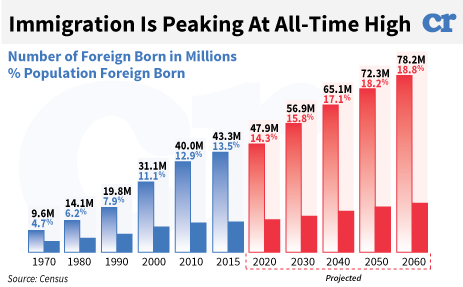
In the course of a day’s driving, I heard National Public Radio claim repeatedly that illegal immigration from Mexico is nearly zero nowadays. But the non-partisan Center for Immigration Studies (CIS) reported in June 2016 that illegal immigration averaged 550,000 per year, up from 350,000 per year when President Obama won his second term. That’s an explosion. And at some point, immigration morphs into invasion.

I have strong opinions on the president’s immigration policies, partly because I lived directly on the Mexican border and have even lived inside Mexico. They’re good people, for the most part. If we have to be invaded, I’d rather be invaded by family-oriented Christians, like most Mexican adults, than by jihadis or atheists.

But I don’t want to be invaded. That’s not because I’m a xenophobe. If it is, I must be one of the best-traveled xenophobes on Earth. And it’s not because I’m bigoted or fearful of Hispanics – I’m the only non-Hispanic in my household, and I have voluntarily inhabited multiple Hispanic neighborhoods.

I’m against illegal immigration for some of the same reasons Cesar Chavez opposed it: it depresses U.S. wages, cripples labor law enforcement, and suffocates blue-collar trade unions in the cradle. But there are other reasons.

Invasion deprives us of our right to be us. Our mutual loyalties and moral consensus steadily dissolve. Homeowners feel ambivalent about taxes and bond issues that invest in communities long ceded to hostile, insular strangers. Young invaders often develop a contempt for their hosts in the communities they occupy. They are prone to litter and vandalize, to mark our private and communal spaces as their own.

There has been some debate whether “illegal alien” is a pejorative term. The favored euphemism is “undocumented,” which I reject because they do have documents. They’re just not American documents. The problem is not that they lack pieces of paper. The problem is that they are occupying our country without our permission.

Likewise, I reject the phrase “path to citizenship.” Illegal aliens are already citizens. They are not stateless persons. They are citizens of foreign countries, and they routinely appeal to their own consulates in the U.S. to intervene when they feel mistreated or excluded.

Our government’s paralysis has not been reciprocated by the Mexican government. The Mexican consulate in Los Angeles gets involved in California street demonstrations. It has confronted and threatened American citizens who have rallied against illegal immigration.

One writer quipped that the illegals ought to be called “undocumented Democrats.” And indeed Democrats have doubled down on illegal immigration as the future salvation of their party. With dependable ethnic bloc voting fortified by promiscuous naturalization of wave after wave of illegal immigrants, Democratic strategists are confident that they’ll be able to impose their will on the remaining red-state holdouts in perpetuity, even without amending the Electoral College.

Thus they are eager to relabel amnesty as “comprehensive immigration reform.” It is not reform of any kind. It is capitulation to a foreign invasion, not only of our labor market and social safety net, but our voting booths.

I am troubled not only by illegal immigration, but by high levels of legal immigration, and by the nature of that immigration. My primary care physician is an immigrant. Various surgeons and cardiologists who kept me alive over the years are immigrants. I’m grateful for them, and I hope they never leave America, but they are not the norm.

The massive influx of immigrants into the U.S. in recent decades was neither random nor spontaneous. The Mexican government has encouraged immigration by its least skilled and least educated citizens to our country. Although there is upward mobility for Mexicans after they arrive here, middle-class Mexican immigration is extremely rare. This amounts to an unspoken conspiracy between U.S. and Mexican elites at the expense of middle-class and working-class Americans.

The overall low quality of immigrants since the 1960s is partly an unintended consequence of our policy preference for family unification. It has lead to “chain migration,” in which immigrants determine who the next immigrants will be. We tend not to get the cream of the crop under that system. High achievers tend to prosper in their own countries, and stay put. Troubled adolescents and struggling siblings tend to get petitioned into the U.S. in hopes of a turnaround.

U.S. law has changed to permit immigrants to become naturalized citizens of our country without renouncing allegiance to the country they came from. This is troubling to those of us who have no plan B. America is all we have; it had better work out for us.

Should these tentative, conditional Americans get one vote apiece, just like us, if they keep their options open to revert to their alternate nationalities? Are they really Americans if their loyalties are not exclusively American? Alternative nationality, like an “alternative fact,” bears a strong resemblance to a lie.

Anybody who attended the soccer match between the Mexican and U.S. national teams in Chicago a few years ago knows that the immigrants who massed in Soldier Field are suffering no identity crisis. They’re Mexicans and they know it. No matter what their passports say.

I respect that. You should know who you are, and to whom you owe loyalty. Shame on us if we don’t know who we are, and if we don’t act in resolute loyalty toward fellow Americans.

Which brings me to “the fence.” If we don’t get a fence, I would like a refund on my passport. Do we really have our own country if foreigners can come in whenever they please? Of course we need a fence. Even if there were no illegal immigration at all, we’d need a fence to hinder terrorist incursions, and protect our border-area communities and ranchers from marauding criminal cartels.

It’s been disorienting to hear Democrats, who don’t blink at a $20 trillion deficit, gasp at the thought of spending $15-21 billion on a border fence. Suddenly they are deficit hawks.

But I do think the Democrats’ criticism of the president’s funding mechanism for a border fence is valid. A tax on imports from Mexico will be paid by American consumers, not by Mexico. If that tariff is part of a broader tax overhaul engineered in part to shake some money loose for the fence’s construction, then the fence will be funded neither by consumers nor Mexico, but by U.S. taxpayers.

Why not tax foreign remittances (via Moneygram, Western Union, bank transfers, money orders, etc.) from the U.S. to Mexico? This tax would be paid primarily by the illegal aliens who have made the fence necessary. These are admittedly solid, hard-working family men (give or take a few cartel soldiers and human traffickers). But they are nevertheless foreigners who have come to extract wealth from our people and send it away to their own. There is no ripple effect, there is no job creation, there is no investment in our communities with American money that has been sent on a one-way trip to Mexico.

Some of the tax burden would fall on legal immigrants and naturalized U.S. citizens from Mexico, who also have helped make the wall necessary by harboring illegals and encouraging them to stay after they arrive. They, too, are extracting wealth from our economy and sending it into the Mexican economy. If not, the remittance tax won’t touch them.

Is it a perfect funding mechanism? No. For one thing, there are free riders – like Central American countries that also send illegal immigrants north across our Mexican border. I would therefore favor applying the tax to foreign remittances sent to Guatemala, Honduras, Nicaragua and El Salvador.

We ought to consider continuing this tax after the fence is paid for. There will be continued costs for ground surveillance, Border Patrol flights and ICE enforcement at the illegal aliens’ places of employment.

We require drunk drivers to bear much of the expense of the government response to their law-breaking, whether therapeutic or simple incarceration. Why should foreigners invade our sovereign territory and be fed, housed and provided medical care in detention at our expense after they’re caught?

Why should we bankrupt our communities’ hospitals to provide care to foreigners who have no intention of paying their bills? I hope we’ll tax illegal aliens in a fair and focused way to fund the costs of resisting their lawlessness, and to defray the costs of humanitarian medical care for them and their families.

What of the president’s plans to staff up the Border Patrol and ICE? Didn’t he order a federal hiring freeze?

I recommend that he consider creating a reserve component for Immigration & Customs Enforcement (ICE) and the Border Patrol, to routinely augment full-time officers and to provide surge capacity – the ability to mobilize large numbers of trained, qualified officers during an enforcement crisis.

Our military is not the only organization with a reserve component. When I was a Civil Defense program manager, I remember some very capable, experienced FEMA reservists responding to our catastrophic weather events. Counties in California and Indiana train and deploy reserve sheriff deputies. Volunteer fire departments provide much of the fire protection and emergency medical response in rural America. Why not ask American citizens to consider stepping forward to protect our nation’s sovereignty?

I believe there will be an abundance of civic-minded volunteers, including many bilingual Hispanics, whose neighborhoods are disproportionately impacted by the Mexican invasion. The reservists would comprise a large, qualified pool of candidates for full-time vacancies, already screened and trained, with the necessary security clearances and performance evaluations.

If “sanctuary city” politicians or cartel-compromised Mexican officials mobilize anti-enforcement mobs against ICE and Border Patrol operations, the rule of law is unlikely to prevail without a surge of enforcement muscle. I believe a well-trained, well-equipped, well-supervised reserve component can go a long way toward restoring compliance with American law at our borders and in our workplaces.

Follow Joe Miller on Twitter HERE and Facebook HERE.

American Airlines Rips Lena Dunham’s ‘Transphobic Talk’ Claim

American Airlines is disputing Lena Dunham’s claims that she overheard two female airline employees having a “transphobic talk” at the airport on Wednesday, saying the time stamps of her claims don’t add up.

A spokesperson for the airline told TheWrap that they are unable to substantiate the allegations made by the creator and star of HBO’s “Girls.” Dunham tweeted around 3 a.m. ET, said the airline spokesperson, when American’s last departure/arrival at JFK was around 1:45 a.m. ET.

Additionally, a video that Dunham posted around the same time showed that the actress was flying on Delta Air Lines, which according to the spokesperson, doesn’t operate out of Terminal 8, whereas American Airlines does. The two are not connected, argued the spokesperson. You can see a map of the terminals here. (Read more from “American Airlines Rips Lena Dunham’s ‘Transphobic’ Talk Claim” HERE)

Follow Joe Miller on Twitter HERE and Facebook HERE.

Secret Behind Murkowski’s Obamacare Flip-Flop

Sen. John McCain is getting most of the blame from the right and praise from the left for his vote to scuttle Senate legislation to repeal parts of Obamacare, but another GOP member is coming under fire for reneging on her vow to repeal the law and offering a weak explanation for her reversal.

Sen. Lisa Murkowski, R-Alaska, campaigned twice on ditching Obamacare and even voted for the straight repeal in 2015, when the bill was vetoed by President Obama . . .

After seven years of railing against Obamacare, why did Murkowski end up as a deciding vote to save it?

“Number one, she’s a big-government leftist. Anything that grows government, grows federal control, she’s for,” said Joe Miller, who ran against Murkowski in 2010 and 2016.

“Most Alaskans that have political contact remember what she did in 2010. She actually called me out and said I was a liar about her position on Obamacare because we had a YouTube clip of her waffling statements on Obamacare. We said, ‘Look, this gal isn’t really for full repeal,’” Miller explained.

(Read more from “Secret Behind Murkowski’s Obamacare Flip-Flop” HERE)

Follow Joe Miller on Twitter HERE and Facebook HERE.

Senate Blocks Trump From Making Recess Appointments Over Break

The Senate blocked President Trump from being able to make recess appointments on Thursday as lawmakers leave Washington for their summer break.

Sen. Lisa Murkowski (R-Alaska), doing wrap up for the entire Senate, locked in nine “pro-forma” sessions — brief meetings that normally last roughly a minute.

The move, which requires the agreement of every senator, means the Senate will be in session every three business days throughout the August recess.

The Senate left D.C. on Thursday evening with most lawmakers not expected to return to Washington until after Labor Day.

Senators were scheduled to be in town through next week, but staffers and senators predicted they would wrap up a few remaining agenda items and leave Washington early. (Read more from “Senate Blocks Trump From Making Recess Appointments Over Break” HERE)

Follow Joe Miller on Twitter HERE and Facebook HERE.

Handwritten Obama Note Found – Exposes MASSIVE Hillary Email Lie

A series of handwritten FBI notes that were recently released have confirmed that Barack Obama’s administration’s White House counsel was directly involved in deliberations over the release of Hillary Clinton emails as early as spring of 2015.

“Pat Kennedy (early May ’15) calls interagency MTG (meeting) re: scheduled release by JAN ’16, asking quick turnarounds – WH Counsel, CIA, etc…OSD, DNI, NSC and (redacted),” the notes read, according to Fox News.

These notes lay the case out from the perspective of the FBI agents investigating it. The reference to “Counsel,” seems to be the earliest confirmation of White House involvement.

This came after Obama’s White House tried to put as much distance between itself and the Clinton email scandal as possible. In a March 7, 2015 interview, Obama claimed that he had only learned that Clinton was using a private email server to conduct official government business from the media . . .

However, emails released by WikiLeaks written that same day from Clinton aide Cheryl Mills to Clinton Campaign Chairman John Podesta say otherwise.

“We need to clean this up. He has emails from her — they do not say state.gov,” she wrote. (Read more from “Handwritten Obama Note Found – Exposes MASSIVE Hillary Email Lie” HERE)

Follow Joe Miller on Twitter HERE and Facebook HERE.
Top Dem Wants to Know Why Trump’s Classified Conversations Were Leaked

Congress needs to investigate the “disgraceful” leaks of President Trump’s private conversations with world leaders, a top Democratic senator said on Thursday.

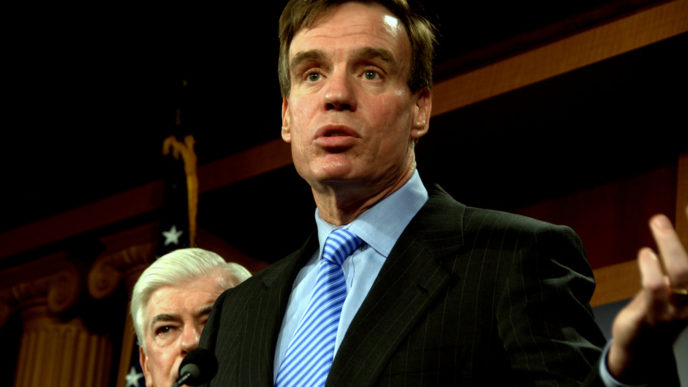
“A president of the United States, a governor would tell us they’ve got to be able to have confidential conversations,” Virginia Sen. Mark Warner told The Daily Beast. “And I think it was disgraceful that those [came out].”

Warner is the top ranking Democrat on the Senate Intelligence Committee.

“Whether that is Intel or Judicial [committees] looking into it, somebody ought to,” the senator told The Daily Beast.

The Washington Post published Thursday morning leaked classified transcripts of Trump’s private conversations with the leaders of Mexico and Australia. The phone calls took place shortly after Trump’s inauguration but were just now leaked to the Post. (Read more from “Top Dem Wants to Know Why Trump’s Classified Conversations Were Leaked” HERE)

Follow Joe Miller on Twitter HERE and Facebook HERE.

Jeff Sessions Warns Sanctuary Cities About Missing out on Help to Fight Crime

Attorney General Jeff Sessions cited a reported sexual assault by an illegal immigrant in Portland, Oregon, to explain why the Justice Department will continue cracking down on sanctuary cities that receive federal funds.

If a municipality wants access to its National Public Safety Partnership resources, the Justice Department announced Thursday, the local jurisdiction will have to demonstrate a commitment to cooperating with federal immigration agencies.

The program is aimed at providing federal training assistance to local law enforcement to combat violent crime. The program is designed to enable cities to consult with and receive coordinated training services and other resources from the Justice Department.

“By protecting criminals from immigration enforcement, cities and states with so-called ‘sanctuary’ policies make all of us less safe,” Sessions said. “We saw that just last week, when an illegal alien who had been deported 20 times and was wanted by immigration authorities allegedly sexually assaulted an elderly woman in Portland, a city that refuses to cooperate with immigration enforcement.”

Sessions was referring to reports that Sergio Jose Martinez, 31, was arrested and charged with sexually assaulting a 65-year-old woman in Portland. Martinez had been deported at least 20 times to Mexico.

The charges against Martinez reportedly include robbery, kidnapping, burglary, and sexual abuse.

Sessions said sanctuary policies are driven by politics, with disregard for the safety of a jurisdiction’s residents when officials don’t cooperate with federal immigration authorities. The attorney general added:

By forcing police to go into more dangerous situations to re-arrest the same criminals, these policies endanger law enforcement officers more than anyone. The Department of Justice is committed to supporting our law enforcement at every level, and that’s why we’re asking ‘sanctuary’ jurisdictions to stop making their jobs harder.

By taking simple, commonsense considerations into account, we are encouraging every jurisdiction in this country to cooperate with federal law enforcement. That’s what 80 percent of the American people want them to do, and that will ultimately make all of us safer—especially law enforcement on our streets.

he Public Safety Partnership program, announced in June, offers training and technical assistance to help local jurisdictions address violent crime.

The Justice Department initially selected 12 locations: Birmingham; Indianapolis; Memphis; Toledo; Baton Rouge; Buffalo; Cincinnati; Houston; Jackson, Tennessee; Kansas City, Missouri; Lansing, Michigan; and Springfield, Illinois. These are not sanctuary cities.

The Justice Department plans to consider other cities. In letters to officials in Albuquerque; Baltimore; San Bernardino, California; and Stockton, California, the agency asks these questions:

(1) Does your jurisdiction have a statute, rule, regulation, policy, or practice that is designed to ensure that U.S. Department of Homeland Security (DHS) personnel have access to any correctional or detention facility in order to meet with an alien (or an individual believed to be an alien) and inquire as to his or her right to be or to remain in the United States?

(2) Does your jurisdiction have a statute, rule, regulation, policy, or practice that is designed to ensure that your correctional and detention facilities provide at least 48 hours advance notice, where possible, to DHS regarding the scheduled release date and time of an alien in the jurisdiction’s custody when DHS requests such notice in order to take custody of the alien?

(3) Does your jurisdiction have a statute, rule, regulation, policy, or practice that is designed to ensure that your correctional and detention facilities will honor a written request from DHS to hold a foreign national for up to 48 hours beyond the scheduled release date, in order to permit DHS to take custody of the foreign national?

(For more from the author of “Jeff Sessions Warns Sanctuary Cities About Missing out on Help to Fight Crime” please click HERE)

Follow Joe Miller on Twitter HERE and Facebook HERE.

Government Has No Clue How Much Land It Bought With $815 Million

Interior Department officials have no idea how much land they bought for $815 million, nor if the properties are being used for their intended purpose, a government watchdog reported Wednesday.

The department’s officials couldn’t provide its inspector general with data about land purchase programs, the watchdog’s report said. The inspector general consequently surveyed 108 programs and found that 16 of them awarded 701 grants between 2014 and 2015 to purchase $815 million worth of land.

The Interior Department “does not centrally track information about grants awarded for the purpose of acquiring land,” the inspector general said, adding:

As such, [the Interior Department] is unable to identify how much grant money has been used to purchase land, how much land has been purchased and whether that land is being used for its intended purpose. Without an adequate process in place to monitor funds used to purchase land, [the department] is potentially exposed to significant risk of wasted funds.

Additionally, less than half of the 278 grant recipients reported their land inventories to the department programs that funded them, which violated federal regulations, according to the report. (Read more from “Government Has No Clue How Much Land It Bought With $815 Million” HERE)

Follow Joe Miller on Twitter HERE and Facebook HERE.

New York Times ‘Voter Suppression’ Video Game Is Pure Propaganda

An “Oregon Trail”-style “Op-Doc” video game released by The New York Times just days before the 2016 election asks readers to “find out if your vote can survive the great, flawed adventure of American democracy.”

The premise: The race of the character you choose determines whether your vote survives “the GOP’s tactics.”

This biased game presents race and geography as the determining factors in one’s ability to vote, while disregarding the alarmism and stereotypes it perpetuates.

The game offers three characters: a white programmer from California, a Latina nurse from Texas, and a black salesman from Wisconsin.

The first choice leads through a sunny street in California, where you “stroll” to your polling place in pleasant weather. The game tells you that your frustration is nonexistent, and there is no line.

You enter the voting booth, cast your vote, and immediately see an image of the White House and an American flag. The screen reads, thick with sarcasm, “Congratulations! You have cast your vote. It has been a tough journey.”

In contrast, the Texan Latina nurse must take a bus across town to her polling place, which has a long line. The screen reads, “GOP tactics that cut back on polling places and workers are causing huge lines!”

While waiting, you’re told that your son has dysentery—yes, dysentery—and you’re given the option to leave the line or continue. If you leave, your vote is declared dead. If you stay, the voting machines malfunction.

Then, your daughter needs to be picked up from day care, and another child calls you crying for help (all within an hour).

If you ignore all of these pleas, you see old, white men in red hats “inspecting the line,” and you must run away from expletives they fling at you. If you’re hit, a gravestone appears and reads, “Voter intimidation tactics worked.”

If you are lucky enough to outrun the evil line inspectors, you find that the polling place requires photo identification, and you don’t have it.

You have three options: give up, cast a provisional ballot that you are told will not be counted (a factually incorrect statement), or get your ID and return to vote, at which point the screen reads, “I hate voting but I love my country!”

It’s an equally grim scene for the black salesman from Wisconsin.

You once again take a bus across town, and learn that “the GOP’s voter fraud initiatives are causing major lines at the polls!”

You’re left to wait as your boss docks your pay and takes away your shifts, you get stuck in the freezing rain, and your co-worker gets (you guessed it) dysentery, and hates you for not being able to cover his shift.

Once you enter the polling place, you must also defeat the red-hatted men throwing “insults and angry rhetoric” at you, and if you make it past them, you, too, have forgotten your ID and face the same options as the Latina nurse.

After playing the game, one is left with a clear picture of what The New York Times thinks of America: a largely segregated land where everything, from Republicans to the weather itself, works to keep minorities from voting.

Think about the stereotypes that this game relies on, and worse, that it perpetuates.

African-Americans and Hispanics must ride the bus, the inference evidently being that “they are poor.” They are apparently also, in the eyes of The New York Times, incapable of dealing with simple tasks like obtaining an ID or remembering it on Election Day.

Apparently, the idea did not cross the game designers’ minds that nearly everyone has an ID, that they carry it with them as a matter of routine, and use it almost daily for things like buying alcohol or driving a car.

The Times’ staff and the game’s designers are hardly the only enlightened progressives to hold these ignorant views. One has to wonder where they get these distorted ideas.

Oh, yes, the Justice Department under President Barack Obama.

In a 2014 lawsuit challenging North Carolina’s voter ID requirement, the elimination of same-day registration, and the shortening of early voting, a Justice Department expert witness—professor Charles Stewart of the Massachusetts Institute of Technology—testified that North Carolina’s law was discriminatory.

Stewart said that early voting and same-day registration are “well situated for less sophisticated voters, and therefore, it’s less likely to imagine that these voters … can figure out or would avail themselves of other forms of registering and voting.”

Who are those less sophisticated voters? According to Stewart, they “tend to be African-Americans.”

Infantilizing minorities in the name of protecting them is the epitome of paternalistic prejudice, and it is exemplified in “The Voter Suppression Trail.”

This game is completely asinine. It is shallow identity politics, and little else.

The game’s designers utterly ignore contrary facts. Consider, for example, that minority voter turnout increased after North Carolina, Georgia, and Indiana adopted voter identification laws.

In fact, despite claiming in lawsuits last year that voting laws in North Carolina and Texas were crafted deliberately to suppress minority turnout, the Justice Department could not identify any disenfranchised voters.

As for those fictional, slur-spewing, voter-intimidation squads, let’s not forget the real-life incident in 2008, when two members of the New Black Panther Party were charged with voter intimidation for standing outside a Philadelphia polling location with wooden bats and wearing military-style uniforms, while shouting racial slurs at white voters.

The Justice Department dropped these charges shortly after Obama took office. Any form of voter intimidation, regardless of the race of the perpetrator or the victim, is illegal and should be punished.

This type of cheap rhetoric trivializes the real issues our country is facing with election fraud. Indeed, The Heritage Foundation has documented nearly 1,100 proven instances of fraud in 47 states.

When someone rigs an election, votes without being eligible, or casts multiple ballots, legitimate voters are essentially disenfranchised, to say nothing of the damage done to the integrity of the process and of the results.

Efforts to reform and enhance our electoral security have been met with the common allegation that they hide racist motives. Consider this Slate article,“The Dark Prince of Voter Fraud Alarmism is Joining the Trump Administration,“ which personally attacked Hans von Spakovsky, one of Heritage’s own legal scholars.

Von Spakovsky and fellow commissioner J. Christian Adams recently responded to these critics.

Anti-election integrity activists are free to resort to name-calling if they wish, but the fact is, this should be a nonpartisan issue.

Efforts to secure the ballot box against fraud are spurred by concern for the security and legitimacy of the voting process—perfectly valid goals given that issues like voter impersonation and intimidation are real problems that should be addressed.

Surely the majority of rational people would play this game and realize its ridiculousness. However, we need to look at the implications of such cheap rhetoric perpetuated by the left and the effect it has on civil discourse in the public sphere.

By shying away from honest debate and relying solely on attention-grabbing sophisms, we risk burying our heads in the sand, to our collective detriment. (For more from the author of “New York Times ‘Voter Suppression’ Video Game Is Pure Propaganda” please click HERE)

Follow Joe Miller on Twitter HERE and Facebook HERE.
Trump Backs TRUE Immigration Reform With RAISE Act

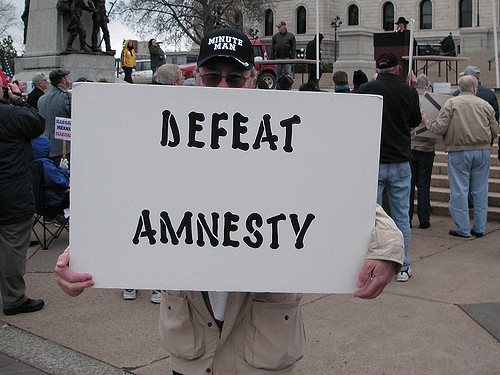
For far too long, much as with health care reform, the Washington Cartel has hijacked the meaning of immigration reform. Until now, it has meant mass amnesty for illegal immigration, endless expansion of the current failed legal immigration system, and ignoring the needs of the American citizen.

Sens. Tom Cotton, R-Ark., and David Perdue, R-Ga., with the re-introduction of the RAISE (Reforming American Immigration for a Strong Economy) Act, have flipped the paradigm on its head. Most importantly, the White House is actually taking an active role in promoting this legislation — an imperative in promoting any conservative idea.

There is broad consensus among the public that immigration should a) be limited to those who have unique skills; b) cultivate the assimilation of American values and the English language; and c) that it should be a net positive for all Americans, not just the corporate-D.C. cartel.

This is the message Trump ran on, and it is the message that Cotton and Purdue have restored with this legislation (after a several-month detour by the White House). If the president continues to use the bully pulpit to sell this plan, he could go a long way toward staving off a looming disaster in the midterms and actually making the party stand for something important again.

The problem: The 1965 immigration bill

As I chronicle in detail of Chapter 7 of my book, “Stolen Sovereignty,” the 1965 immigration bill killed our immigration system long before illegal immigration and the 1986 amnesty became the dominant issues.

The Immigration and Nationality Act of 1965 was sold by its proponents as the exact opposite of what it has actually done. It was sold as in line with our history and tradition of only bringing in those who will patriotically assimilate and not become a drain on the public purse.

Sen. Ted Kennedy, the lead sponsor of the bill, famously declared, “The bill will not flood our cities with immigrants. It will not upset the ethnic mix of our society. It will not relax the standards of admission. It will not cause American workers to lose their jobs.” He thundered at a Senate hearing how “the bill will not permit the entry of subversive persons, criminals, illiterates, or those with contagious disease or serious mental illness” or “to a person who is likely to become a public charge.”

Sensing what the public wanted from immigration, the LBJ administration echoed a similar sentiment. Attorney General Nicholas Katzenbach predicted that the ’65 bill would induce a net increase of only about 60,000 immigrants per year.

A complete lie. The Immigration and Nationality Act of 1965 wound up being the most extreme policy implemented during the latter part of the 20th century, as measured against the criteria laid down by the bill’s own supporters. Here are some points from my book:

Overwhelming numbers of immigrants: Whereas 18.2 million immigrants came during the Great Wave in 1890-1919, over 61 million immigrants have come since passage of the bill (not including illegal immigrants, who are largely influenced by the drive to reunite with relatives as a result of the record legal immigration.)

Living in poverty: According to Pew, in 1970, 18 percent of immigrants were living below the poverty line. At present, 28 percent of immigrants are living in poverty. The poverty rate among natives, on the other hand, has held steady between 13 and 15 percent. More than 50 percent of all immigrant households receive welfare benefits, compared to only 30 percent of native households in the United States that receive welfare benefits.

Dramatic shifts in countries of origin: What about the promise not to fundamentally change the orientation of the country? In 1910, 89 percent of immigrants were from Europe; today that number is just 10 percent. It’s not just a cultural transformation, it affects the economy as well. As of 2013, the median family income for immigrant families from Europe was $66,600, roughly twice the income of those from Mexico ($31,100), the Caribbean ($31,100), Africa ($34,800), and central/South America ($37,400). This, despite the fact that most of the recent job growth has gone to the immigrant population.

Dramatic imbalance: What about Ted Kennedy’s promise that his bill would not “inundate America with immigrants from any one country or area?” Fifty percent of all immigrants since 1965 have come from Latin America — 29 percent from Mexico alone. According to the Pew Research Center, as of 2010, Mexicans were the largest immigrant group in thirty-three states, with immigrants from other Latin American countries winning first place in six other states. At the height of the first great wave in 1910, on the other hand, Germans held the distinction of the most represented immigrant group in just seventeen states.

Criminal activity: What about criminals? There are 2.1 million illegal and legal immigrants convicted of crimes, but 1.2 million criminal aliens remain at large in the United States and have not been deported.

Language assimilation problems: A record 63.2 million, or one in five U.S. residents, speak a language other than English at home. In six states, that number exceeds 30 percent and is as high as 44 percent in the state of California. Thirty-four of the major metropolitan areas in the country have a third or more residents who speak foreign languages at home; sixty-seven metropolitan areas top 25 percent in foreign-language speakers.

California a canary in the coal mine: California demographics speak for themselves. Orange County was once the bread basket of GOP politics in the state and was a big part of the GOP’s dominance during the Nixon and Reagan eras. Thirty percent of the county’s population is now foreign-born and 45.5 percent of residents speak a foreign language at home.

As leading immigration historian Aristide Zolberg has observed, “Whether hailed or deplored, there is no gainsaying that this development was contrary to the tacit agreement to maintain immigration as a minor feature of American existence that underlay the 1965 reform.”

The new RAISE Act: What would it do?

The main problem of the 1965 bill, which was exacerbated by a 1990 immigration bill, is that it forced immigration officials to prioritize family ties over skills.

Thus, once the initial burst of immigrants was predominantly low-skilled and from third-world countries, it set off a phenomenon of “chain migration,” whereby the majority of future immigrants were from similar socio-economic backgrounds.

The result is that just 15 percent of our green cards (1.6 million of the 10.8 million legal permanent residents over the past decade) are allocated based on any skill, and most of those green cards are not awarded for broad-based skills and ability to assimilate — but rather in crony visa programs.

Which brings us back to the RAISE Act. This bill fulfills the blueprint I laid out in “Stolen Sovereignty” for cutting immigration by 40-50 percent by merely getting rid of the non-skilled, extended-family categories. By getting rid of the diversity visa lottery and extended-family visa preferences, this bill charts a path toward re-empowering Americans to determine who gets to join the civil society.

Deeply rooted in the preamble of the Declaration and in consent-based governance is that the citizenry must decide every important policy issue. And the most important decision is the future orientation of the society. Converting our system to a skills-based criterion rather than a family-based one will place the keys of our immigration system back in the hands of the citizenry rather than special interests and the immigrants themselves. It will end the stolen sovereignty.

On the employment side of the ledger, rather than submit the future of our society to individual corporations that lobby the most for visas, this bill would revamp the current visa system and replace it with 130,000 visas to be allocated based on a points system that prioritizes education, English-language proficiency, high-paying job offers, merit, and entrepreneurial initiative. Those with the most points will get first preference.

This system would completely cut out the cronyism and is the sort of holistic reform of immigration that many of us want for health care. When you appeal to broad common-sense principles and cut out the crony middlemen, the American people are empowered and much of the politics goes by the wayside.

On paper, even Jeb Bush, Marco Rubio, and an array of Democrats have said they want a system that is based on merit rather than family ties. Now is their time to back up their words. Do they really care about the immigration issue beyond the obsession with amnesty?

Thankfully, President Trump is leading on this issue and actually endorsing a good piece of legislation. He should deliver a special address before Congress laying out the vision and unite the party behind it. A united GOP (one could only dream!) behind this issue would open up an entirely new front in the 2018 midterms.

It’s time we stop ceding the ground of common-sense reform to those who seek to perpetuate the failed status quo. (For more from the author of “Trump Backs TRUE Immigration Reform With RAISE Act” please click HERE)

Follow Joe Miller on Twitter HERE and Facebook HERE.