DOD Reveals Stunning New Details Following Trump’s Attack on Iran

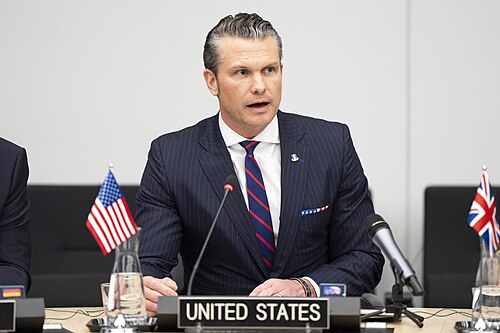
Defense Secretary Pete Hegseth and Chairman of the Joint Chiefs of Staff Gen. Dan Caine revealed stunning new details following President Donald Trump’s historic strikes against Iranian nuclear sites on Saturday.

Hegseth and Caine confirmed that deception was involved to execute “Operation Midnight Hammer,” commending the American military, who “performed flawlessly” during the mission. Part of the fleet of B-2 bombers flew west over the Pacific as a decoy, while the “main strike package” headed east before striking Iran at about “6:40 p.m. Eastern Standard Time.”

Hegseth also clarified that only the Iranian nuclear targets were “devastated” and that civilians were not targeted.

“Many presidents have dreamed of delivering the final blow to Iran’s nuclear program, and none could, until President Trump,” Hegseth told reporters during a press conference Sunday. “The operation President Trump planned was bold, and it was brilliant, showing the world that American deterrence is back. When this president speaks, the world should listen.”

“No other country on planet Earth could have conducted the operation that the chairman is going to outline this morning, not even close,” Hegseth added.

(Read more from “DOD Reveals Stunning New Details Following Trump’s Attack on Iran” HERE)

Supreme Court Hands Trump Admin Victory On Efforts To Deport ‘Worst’ Illegal Migrants

The Supreme Court allowed the Trump administration to more quickly deport illegal migrants to countries not specified in their removal orders.

A majority temporarily blocked a lower court order that required the Department of Homeland Security (DHS) to give migrants notice and allow them to raise concerns about potential threats of torture before deporting them to a “third country.”

Justices Sonia Sotomayor, Ketanji Brown Jackson and Elena Kagan dissented from the decision.

“Apparently, the Court finds the idea that thousands will suffer violence in farflung locales more palatable than the remote possibility that a District Court exceeded its remedial powers when it ordered the Government to provide notice and process to which the plaintiffs are constitutionally and statutorily entitled,” Sotomayor wrote. “That use of discretion is as incomprehensible as it is inexcusable.”

The Trump administration argued the order interfered with their ability to deport “some of the worst of the worst illegal aliens” in its emergency application. (Read more from “Supreme Court Hands Trump Admin Victory On Efforts To Deport ‘Worst’ Illegal Migrants” HERE)

Photo credit: Flickr

How Likely Is An Iranian Sleeper Cell Attack On US Soil?

The U.S. strike against Iran on Saturday night has ignited fears that Iran may choose to orchestrate attacks against Americans with undercover agents.

Iran threatened to activate sleeper cells in the U.S. days before President Donald Trump decided to strike Iran’s nuclear facilities Saturday night, two U.S. officials told NBC News. In the wake of the U.S. attacks against the Iranian nuclear program, the Department of Homeland Security (DHS) issued a memo Sunday warning of a “heightened threat environment” in light of the attacks, warning that Iranian government affiliates could launch terrorist attacks.

“The likelihood of violent extremists in the Homeland independently mobilizing to violence in response to the conflict would likely increase if Iranian leadership issued a religious ruling calling for retaliatory violence against targets in the Homeland,” the memo read. “Multiple recent Homeland terrorist attacks have been motivated by anti-Semitic or anti-Israel sentiment, and the ongoing Israel-Iran conflict could contribute to U.S.-based individuals plotting additional attacks.”

Trump announced a ceasefire agreement on Truth Social Monday evening between Iran and Israel, set to go into effect at approximately 12:00 a.m. EST, which would mark an end to the ongoing twelve day conflict assuming it holds. While Iran may have indicated it is no longer interested in continuing the war in the short-term with the agreement, the regime has a considerable history of pursuing violent plots on American soil.

In 2011, two men linked to the Iranian government were charged in a plot to assassinate the Saudi Arabian Ambassador on American soil. One co-conspirator, Gholam Shakuri, was involved in the Iranian Revolutionary Guard Corps (IRGC) Qods Force, a key cog of Tehran’s state-sponsored terror machine. (Read more from “How Likely Is An Iranian Sleeper Cell Attack On US Soil?” HERE)

Trump Hits Iran, Left Explodes — Even One Republican Says It’s ‘Unconstitutional’

Leading members of Congress and progressive activists erupted on social media following President Donald Trump’s announcement that the United States had launched airstrikes against Iran.

Rep. Rashida Tlaib (D-MI) stated, “Dear colleagues: Don’t make another mistake in dragging our country into another war,” Tlaib tweeted. “You can stop the President and the war mongers in Congress by signing on to our War Powers Resolution.”

“Trump struck Iran without any authorization of Congress,” Ro Khanna (D-CA) posted. “We need to immediately return to DC and vote on @RepThomasMassie and my War Powers Resolution to prevent America from being dragged into another endless Middle East war.”

Massie, a libertarian-leaning Republican, joined Democrats in blasting the strikes, writing, “This is not Constitutional,” in response to Trump’s post.

Former DNC Vice Chair David Hogg also weighed in,“What happened to no new wars?” Hogg asked. “Also how are we paying for this? If we can’t afford to spend trillions on healthcare we sure as hell can’t afford to spend trillions on another endless war.” (Read more from “Trump Hits Iran, Left Explodes — Even One Republican Says It’s ‘Unconstitutional’” HERE)

Did Trump Violate Constitution With Strike on Iran? Republicans in Congress at Odds

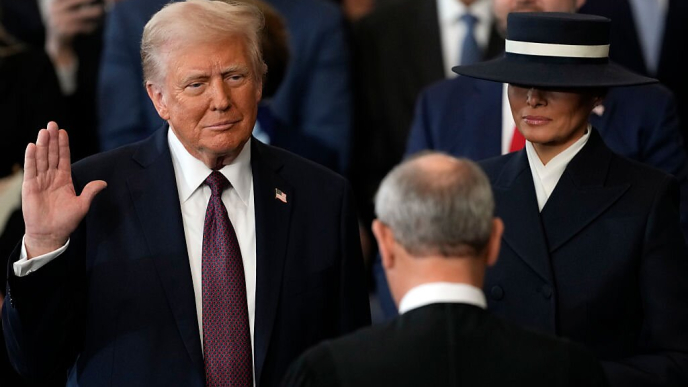
In the wake of President Donald Trump’s military strike on Iran’s nuclear facilities Saturday, Republicans in Congress are at odds over the constitutionality of the military action without congressional approval.

House Speaker Mike Johnson said: “The President made the right call, and did what he needed to do. . .

But a fellow Republican, U.S. Rep. Thomas Massie of Kentucky, said the dropping of 12 bunker buster bombs in a precision strike on three nuclear sites was “not constitutional.”

Massie responded directly to Johnson’s opinion, saying: “Why didn’t you call us back from vacation to vote on military action if there was a serious threat to our country?” . . .

Numerous presidents of both major political parties have taken military action against countries without congressional approval in recent years, including Democrat Barack Obama launching strikes in Afghanistan, Iraq, Syria, Libya, Yemen, Somalia and Pakistan.

(Read more from “Did Trump Violate Constitution With Strike on Iran? Republicans in Congress at Odds” HERE)

Photo credit: Gage Skidmore via Flickr

If Iran Blocks Strait of Hormuz, What Will Happen to U.S. Energy Costs?

Iran is reportedly weighing blocking a key commercial choke point known as the Strait of Hormuz, a move that could drive up energy costs in the U.S. and across the globe, according to energy sector experts who spoke with the Daily Caller News Foundation.

Israel began to bombard Iran to eliminate the Islamic Republic’s ability to build a nuclear weapon on June 13, and the U.S. carried out “Operation Midnight Hammer” on Saturday night, bombing three of Iran’s nuclear facilities. While Iran’s parliament has reportedly voted to close the Strait of Hormuz in a retaliatory move to choke the world’s oil supply in response to the American strikes, the U.S. is well-positioned to combat the inevitable energy cost spike that would follow if Iran succeeds, sector experts told the DCNF.

“The escalating conflict between Iran and Israel is already putting upward pressure on oil and natural gas prices—and that pressure will intensify if the Strait of Hormuz is blocked,” Trisha Curtis, an economist at the American Energy Institute, told the DCNF. “This kind of disruption would send global prices higher and tighten supply chains. Fortunately, the U.S. is well-positioned to respond — our domestic production strength and growing export infrastructure make American oil and natural gas increasingly indispensable to global markets.”

Iran does not have the legal authority to halt traffic through the strait, meaning it would need to usurp control through force or the threat of force, according to legal scholars and multiple reports. The Iranian parliament’s reported move to block the Strait on Sunday awaits final approval by Iran’s Supreme Council, according to Iran’s Press TV.

The Strait is only 35 to 60 miles wide and connects the Persian Gulf to the Indian Ocean, flowing past Iran, the United Arab Emirates and Oman. The thoroughfare is vital for global trade, as tankers carried one fifth of the world’s oil supply through the Strait of Hormuz in 2024 and the first quarter of 2025, according to data from the U.S. Energy Information Administration. (Read more from “If Iran Blocks Strait of Hormuz, What Will Happen to U.S. Energy Costs?” HERE)

Federal Land Sales, More Logging and More Oil Revenue: What’s in the Big Federal Bill for Alaska?

Members of the U.S. Senate last week proposed a major sale of federal land as part of the “Big, Beautiful Bill” proposed by Republicans to fund the U.S. government.

If adopted, the proposed sale could be significant for Alaska, where the federal government owns and manages 61% of all land in the state.

Under language proposed by the U.S. Senate’s Committee on Energy and Natural Resources, the Bureau of Land Management and the U.S. Forest Service would be required to sell between 2.2 million and 3.3 million acres of public land across 11 Western states, including Alaska.

National parks and monuments would be off limits to sale, but wide swaths of Forest Service and Bureau of Land Management land would still be available.

The proposed language states that the sold land “shall be used solely for the development of housing or to address associated community needs,” and that the Secretary of the Interior or the Secretary of Agriculture can determine whether the sold land is being used for an appropriate purpose. (Read more from “Federal Land Sales, More Logging and More Oil Revenue: What’s in the Big Federal Bill for Alaska?” HERE)

Photo credit: Flickr

Kremlin Warns That Other Nations Ready to Give Iran Nukes: ‘Dangerous Escalation Has Begun’

Moscow warned Sunday that several nations are prepared to supply Tehran with nuclear weapons, as Russia and China condemned America’s attack on Iran’s nuclear facilities.

Dmitry Medvedev, who serves as deputy head of Russian President Vladimir Putin’s Security Council, claimed Saturday’s US airstrike — the first to use 15-ton GBU-57 “bunker-buster” bombs in combat — only caused minimal damage to Tehran’s nuclear sites, including the fortified Fordow enrichment plant.

Medvedev, who did not specify which countries are ready to arm Tehran, reiterated that the attacks would not stop Russia’s ally in the Middle East from acquiring nuclear weapons.

The statement comes as Iranian Foreign Minister Abbas Araghchi said he will be traveling to Moscow to meet with Putin to discuss countermeasures.

“We enjoy a strategic partnership, and we always consult with each other and coordinate our positions,” Araghchi told Russian media.

Russia’s Foreign Ministry described the American airstrike in Iran as “a gross violation of international law, the UN Charter, and UN Security Council resolutions. (Read more from “Kremlin Warns That Other Nations Ready to Give Iran Nukes: ‘Dangerous Escalation Has Begun’” HERE)

Homeland Security Warns of Possible Terrorist Attacks in U.S. Following Strike on Iran

The Department of Homeland Security issued a terrorism alert on Sunday — warning of possible Iranian attacks against the US following the American airstrikes against Tehran’s nuclear program.

DHS warned officials to be on the lookout for Iranian-led attacks over the next three months by terror cells inspired to retaliate following Saturday night’s strike.

“The likelihood of violent extremists in the Homeland independently mobilizing to violence in response to the conflict would likely increase if Iranian leadership issued a religious ruling calling for retaliatory violence against targets in the Homeland,” DHS said in a statement. (Read more from “Homeland Security Warns of Possible Terrorist Attacks in U.S. Following Strike on Iran” HERE)

Neocons Use Accusations of ‘Appeasement’ to Morally Blackmail People Into Supporting Forever Wars

Bad World War II analogies appear to have become a dime a dozen in today’s political discourse. In just the past few months, I’ve excoriated Russell Moore for his ridiculous reference to the Molotov-Ribbentrop Pact in response to President Donald Trump’s push toward a peaceful resolution of the war in Ukraine and pilloried Max Boot’s baffling comparison of Ukraine’s recent attack on Russia’s bomber fleet to the Japanese attack on Pearl Harbor.

Now, Mark Levin, in his zealous crusade to push the United States into directly joining Israel’s strikes against Iran, has invoked the most tired and most misconstrued talking point related to the Second World War: appeasement.

Levin’s screed (it’s far too light on substance to be called an op-ed), titled “Isolationism is the same as appeasement — and it’s keeping Trump, Netanyahu from transforming the Middle East,” does little more than launch ad hominem attacks and provide a masterclass in projection. It’s amazing to read sentences like these: “They’re too self-righteous in their ignorance to realize how absurd they sound. … In fact, they’re so blind and self-important that they don’t see the new foreign policy taking place in real time, right in front of their eyes!” and not even detect even a hint of self-awareness from a man who is advocating for the United States to become stuck in yet another Middle East quagmire.

Remember how all those other times our attempts to “transform” the Muslim world worked out so well?

Afraid that his readers won’t be convinced by merely insulting the intelligence of so-called “isolationists,” Levin tries to morally blackmail any potential skeptics by blowing the appeasement dog whistle as loudly as he can. “There’s nothing new or good about isolationism, which, in a word, is appeasement. It’s old and promotes war, such as World War II,” he writes bluntly.

It seems like whenever very reasonable people object to yet another forever war, neocons crawl out of the woodwork to screech “appeasement!” to try to cow their foreign policy opponents into embarrassed silence. If you don’t agree with the neocons’ next regime-change project, you’re no better than British Prime Minister Neville Chamberlain, who meekly gave in to Adolf Hitler in 1938 and emboldened Nazi aggression — thereby unleashing all of the devastation that ravaged Europe. If you don’t believe in toppling tinpot dictator No. 12, installing an American puppet state, and sacrificing untold amounts of American blood and treasure, you, specifically, are setting the stage for another World War II, another Holocaust. At least, that’s the implication. (Read more from “Neocons Use Accusations of ‘Appeasement’ to Morally Blackmail People Into Supporting Forever Wars” HERE)

Photo credit: Gage Skidmore via Flickr