
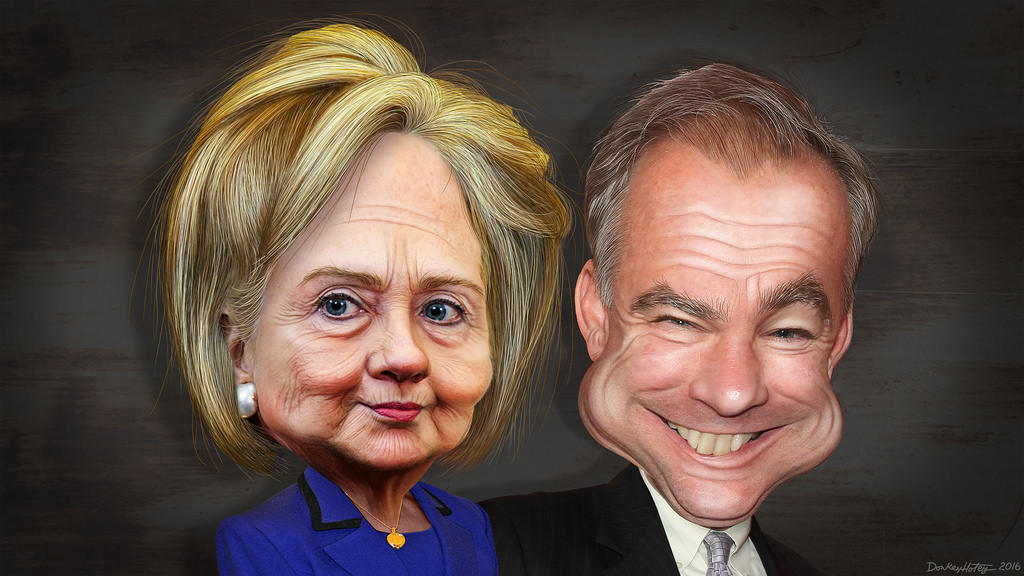
Yes, Vice Presidential Picks Do Matter
It is often said that the vice president matters chiefly because he is “a heartbeat away from the presidency.” It is, of course, true. Historically, the VP has replaced a sitting president nine times (eight because of the death of the president, and one because of the resignation of the president). So around 20% — one out of five — of our 44 presidents came to hold that office because of succession. Therefore, it is important that a presidential candidate choose his running mate wisely.
But there is another, overlooked aspect of the importance of the vice president. It must not be forgotten that, as Aaron Mannes — scholar of the vice presidency — writes on his blog, many VPs “do have political ambitions and that their actions can be shaped with an eye to their own future candidacies.” (Remember Al Gore?)
Reviewing the 2000 book “Wreath Layer or Policy Player?: The Vice President’s Role in Foreign Affairs”, the published dissertation of bestselling Reagan biographer and Conservative Review commentator Paul Kengor, Mannes recounts an example used by Kengor:
[I]n 1983 VP Bush traveled to Europe to push for the deployment of Pershing missiles, which was running into domestic opposition in the potential host countries. By all accounts – both in the general press and from administration figures – Bush did a fine job, bolstering deployment supporters and responding to critics. On the other hand in 1986, Bush went to Saudi Arabia to encourage the Saudis to keep oil prices low, which was devastating the Soviet economy. Instead Bush told them the US needed price stability, the opposite message the Saudis had been getting from Reagan and his senior cabinet officers. Kengor hypothesizes that low oil prices were hurting the oil industry and the states where it is based and that Bush wanted their support for his own upcoming Presidential run.
Kengor came to the conclusion, Mannes writes, that
VPs at the end of their career may be better able to serve the President objectively and not seek to protect their future political careers. Since the publication of Kengor’s book the United States has seen two VPs who saw that position as the apex of their career – Cheney and Biden. In some respects Kengor’s observation seems correct – Cheney and Biden’s service (for better or worse) appears to be entirely focused on serving their President.
There is an even more dramatic example. During the Second World War, President Franklin Delano Roosevelt was extremely ill. For most of the war, his VP was Henry Wallace — a diehard Soviet sympathizer. He thought Stalin was the champion and savior of the masses. At one point, in fact, he visited a Soviet work center and found it to be Heaven on earth (blissfully unaware that he was actually visiting one of Stalin’s Gulags). He would sneak all kinds of military secrets to Soviet intelligence. FDR removed him from his 1944 ticket and replaced him with Harry Truman — who would become President when FDR died in 1945. In 1948, Wallace would run for President as head of the Communist-controlled Progressive Party – specifically to derail Truman’s resistance to Soviet aggression.
Ann Coulter wrote about this in her 2003 book Treason:
Incredibly, if Roosevelt had died one year earlier, Stalin might have immediately gained control of the United States presidency, Treasury Department, and State Department. Soviet dupe Henry Wallace would have become president, and it is very possible that he would have made Soviet spy Harry Dexter White his Treasury secretary and Soviet spy Alger Hiss his secretary of state.
(Nowadays, of course, Ann doesn’t seem to mind Russian dupes and their Kremlin-stooge entourage — she even worked in the primaries to clear the field of conservatives who oppose the Evil Empire.)
Even without these counterfactuals, the death of FDR did change the way the vice presidency works. As Aaron Mannes writes in his review of Kengor’s “Wreath Layer or Policy Player?: The Vice President’s Role in Foreign Affairs”:
Kengor notes that one important factor in the increased foreign policy role of the vice president was the rocky succession by Truman after FDR died. Not only did Truman not know about the atom bomb project, he was also unfamiliar with FDR’s negotiations with Stalin about post-war Europe and had not even met the Secretary of State. Because of that instance, there have been many recommendations for expanding the vice president’s role in foreign policy.
Sometimes we are lucky to have great vice presidents. It is how the presidencies of Calvin Coolidge and Harry Truman came to be; men who would not have otherwise become president.
So yes, Americans should pay close attention to the VP debates. Despite the impression we often get, the VP does matter. (For more from the author of “Yes, Vice Presidential Picks Do Matter” please click HERE)
Follow Joe Miller on Twitter HERE and Facebook HERE.


