Plot to Replace Europeans With Refugees Exposed

Millions of migrants mostly from Africa and the Middle East have swarmed Europe in the last three years – the result of what has been explained by world leaders as a war-driven “refugee” crisis.

Yet, a United Nations document, prepared in the year 2000 and rediscovered by WND, reveals the U.N. was already promoting the notion of “replacement migration” in Europe with the support of open-borders non-governmental organizations and “progressive” politicians.

The document – “Replacement Migration: Is It a Solution to Declining and Aging Populations?” – details the plunging birthrates across Europe and identifies a solution: mass immigration.

The 17-year-old document contended mass immigration was necessary to replace the aging populations of developed countries. Without the migration of populations from the developing world, it reasons, economies will suffer because of labor shortages and falling tax revenues . . .

The report specifically targets the U.S., Germany, Britain, France, Italy, Japan, South Korea and Russia as prime candidates for replacement migration. It is not an obscure study, written and then ignored, but a founding piece of the pro-migration agenda pushed by the United Nations, the U.S. Chamber of Commerce and open-borders advocates. (Read more from “Plot to Replace Europeans With Refugees Exposed” HERE)

Follow Joe Miller on Twitter HERE and Facebook HERE.

German Media Failed to Report Refugee Crisis Honestly

An influential German institute has studied thousands of article published by daily newspapers during the refugee crisis. Their conclusion: journalists lost their objectivity and drove a wedge through society.

As hundreds of thousands of refugees arrived in Germany in 2015 and early 2016, daily newspapers took on the role of “public educators” rather than objective critics of public policy, a team of researchers at the Otto Brenner Institute conclude, according to a report in Die Zeit this week.

The researchers, led by former Die Zeit editor Michael Haller, studied thousands of articles published between February 2015 and March 2016 by leading daily newspapers, including Bild, Die Welt, the Süddeutsche Zeitung and the Frankfurter Allgemeine Zeitung.

The report, which will be published on Monday, criticizes “the so-called mainstream media” for lining up behind Chancellor Angela Merkel’s open-door refugee policies, and for uncritically taking on “the slogans of the political elite.” (Read more from “German Media Failed to Report Refugee Crisis Honestly” HERE)

Follow Joe Miller on Twitter HERE and Facebook HERE.

Freeeeedom! This All-Out WAR on Obamacare Will Make You Fist-Pump

The House Freedom Caucus has not abandoned the health care fight. In fact, it has declared all-out war on Obamacare.

On Wednesday, the conservative House members filed a motion to force a vote on the 2015 repeal bill the GOP-controlled Congress passed and sent to President Obama.

Congressman Tom Garrett, R-Va., a freshman representative, filed a special rule known as a “discharge petition” to begin the process of forcing a vote.

“Every member of this body elected prior to last year’s election who has an ‘R’ beside their name at some point voted on many of the dozens of occasions on which we passed a repeal,” Garrett told reporters, with many of his caucus colleagues accompanying his side. “Let me be clear on this: It’s not a full repeal and nothing. It’s a full repeal with two years … with a 24-month phase-out to find a replacement.”

“This is a message to House leadership that we support their best efforts and we want to work with them to continue to move the ball forward to do what we all said we wanted to do,” Garrett said.

“This is a message to the Senate that if they act as Leader McConnell has suggested that they act, we have their backs. We will be here. This is a message to the president of the United States that we haven’t abandoned the fight, nor have we relinquished our desire to fight for the promises we made.”

Rep. Garrett went on address the Left’s ad hominem attacks on Republicans.

“We hear about how Republicans ‘don’t care and they want to kill people.’ ‘They don’t care about people. ‘They want to knock people off their plans,” Garrett said.

“In this nation you can choose, in some places, to buy marijuana. You can choose to pay to go bungie jumping. You can choose to go scuba diving. You can buy explosives for the Fourth of July. But, by gosh, you can’t buy a health care plan that doesn’t have maternity or mental health care even if you want to,” Garrett said.

“So we’re about choice, we’re about freedom, and we’re about keeping our word. We’re about helping our leadership do what they say they wanted to do, and we’re about absolutely letting the people at home who are as frustrated as I am, and was, know that there are still some people here who are going to do what they said they would do.”

The repeal legislation Garrett and the other members of the Freedom Caucus want Congress to vote on would repeal most of Obamacare. To force a vote, the discharge petition will require signatures from 218 members of Congress.

Even if there aren’t enough to sign the petition, one benefit is that voters will be able to see which members of Congress support repeal, and which don’t.

“We should put on President Trump’s desk what we put on President Obama’s desk. We should demand no less,” said Freedom Caucus Chairman Mark Meadows R-N.C.

This is what it looks like to be a conservative in Congress and fight. (For more from the author of “Freeeeedom! This All-Out WAR on Obamacare Will Make You Fist-Pump” please click HERE)

Follow Joe Miller on Twitter HERE and Facebook HERE.

Murkowski 1 of the 3 Republican Senators Blocking Final Effort to Defund Planned Parenthood

It looks like Planned Parenthood won’t be defunded and Obamacare won’t be repealed thanks to three Republican senators.

Republicans failed to rally enough senators to vote for the Better Care Reconciliation Act, which would repeal and replace Obamacare. Then, Majority Leader Sen. Mitch McConnell, R-Kentucky, announced the Senate would instead only vote on repealing the pro-abortion healthcare law.

The bill repealing Obamacare would also defund Planned Parenthood for one year. Three Republican senators, Shelley Moore Capito of West Virginia, Lisa Murkowski of Alaska, and Susan Collins of Maine, have all said they’d vote against the bill. This means McConnell doesn’t have the 50 votes needed to debate and then pass the bill.

Capito has a mixed record on abortion, having voted for a few moderate pro-life bills but also to expand research on human embryonic stem cell lines and fund contraception. In 2015, she voted to repeal Obamacare, when it was obvious the then-president would veto the legislation. She said she doesn’t support repealing Obamacare without a replacement.

(Read more from “Murkowski 1 of the 3 Republican Senators Blocking Final Effort to Defund Planned Parenthood” HERE)

Follow Joe Miller on Twitter HERE and Facebook HERE.

Legal Experts Weigh in on Trump’s Right to Be Riled at Sessions, DOJ

Jeff Sessions will likely continue to lead the Department of Justice, despite the public clash between President Donald Trump and his choice for attorney general.

But Trump’s frustration with the direction of the Russian probe and the special prosecutor are understandable, said Tom Fitton, president of Judicial Watch, a government watchdog group.

“Sessions should un-recuse himself and get rid of [special counsel Robert] Mueller,” Fitton told The Daily Signal. “This is a political effort to jail the president and his family because people don’t like him.”

Trump told The New York Times that he regrets tapping Sessions for attorney general since Sessions recused himself from the investigation into Russian interference into the 2016 presidential campaign. Trump called Sessions’ decision to recuse himself from the case “unfair to the president.”

It was the recusal that eventually led to the Justice Department appointment of Mueller, who has reportedly expanded the investigation beyond Russia’s role in the 2016 presidential campaign and into Trump’s past business dealings. Furthermore, Mueller has staffed up with Democratic donors.

“To be fair to Sessions, I think he believed he was recusing himself from a very limited set of circumstances,” Fitton said. “He was a bit naïve because that is not the way to approach it. You can’t have an attorney general that is unable to manage the largest case known to the public that is going on in the Justice Department. Now they have moved beyond Russia and are investigating everything.”

Trump, in an interview with the Times, said:

Jeff Sessions takes the job, gets into the job, recuses himself, which frankly I think is very unfair to the president … How do you take a job and then recuse yourself? If he would have recused himself before the job, I would have said, ‘Thanks, Jeff, but I’m not going to take you.’ It’s extremely unfair—and that’s a mild word—to the president.

During a press conference Thursday where Sessions wanted to talk cybersecurity, the only questions were about Trump’s comment. The attorney general responded, “I plan to continue to do so as long as that is appropriate.”

White House deputy press secretary Sarah Huckabee Sanders told reporters Thursday the president doesn’t plan on pushing Sessions out.

“As the president said yesterday, he was disappointed in Attorney General Sessions’ decision to recuse himself. But clearly he has confidence in him or he would not be attorney general.”

Pressed further if Trump wants Sessions to resign, Sanders responded, “I think you know this president well enough to know that if he wanted somebody to take an action, he would make that quite clear.”

Sessions had little choice but to recuse himself in the matter, argued Matthew Whitaker, a former U.S. attorney for the Southern District of Iowa.

“My understanding of the DOJ policy is that he needed to recuse himself from the investigation because he was part of the campaign,” Whitaker told The Daily Signal.

Whitaker, president of the Foundation for Accountability and Civic Trust, a government watchdog group, said Trump’s comments shouldn’t interfere with the Russian investigation.

“This just confirms rumors we’ve been hearing for the last several months,” he said. “The president just had a forum and a venue to share his feelings. It’s unfortunate, but it won’t have any bearing on the important work of the DOJ. The remarks will pass.”

During his March announcement, Sessions said:

During the course of the last several weeks, I have met with the relevant senior career department officials to discuss whether I should recuse myself from any matters arising from the campaigns for president of the United States. Having concluded those meetings today, I have decided to recuse myself from any existing or future investigations of any matters related in any way to the campaigns for president of the United States.

However, in lieu of a finite charge, Sessions could have delayed recusal and would be on solid legal ground, contends Ken Boehm, chairman of the National Legal and Policy Center, a government watchdog group.

“Jeff Sessions could have said to Trump, ‘If asked, I would recuse myself,” Boehm told The Daily Signal. “I think the world of Jeff Sessions. I think he’s a good man. But, if you look at every other incident, people in positions at Justice in the past administration wouldn’t do it because they would fear a fishing expedition. Before Sessions recused himself, he should have called for an actual crime, a statute. He would have been on firm legal ground.” (For more from the author of “Legal Experts Weigh in on Trump’s Right to Be Riled at Sessions, DOJ” please click HERE)

Follow Joe Miller on Twitter HERE and Facebook HERE.

Republicans Just Made Tax Reform More Difficult

This week, the House Budget Committee released its long-awaited budget. It makes progress in some areas, and falls short in others.

One of the places it falls short is in facilitating tax reform.

By all accounts, tax reform will be difficult. True tax reform that simplifies the tax code while making important reforms to enable greater economic growth must also take on the difficult task of taking away special tax privileges that benefit well-organized special interests.

The proposed budget includes reconciliation instructions that allow Congress to fast-track reform in the Senate, limiting debate and lowering the necessary vote threshold to a simple majority, instead of requiring 60 votes.

However, the budget sets tax reform up to be revenue-neutral, which makes tax reform a Herculean task. The budget does provide room for repeal of the Obamacare taxes, but the revenue-neutral constraint on the remaining effort for tax reform is problematic for several reasons.

First, revenue is not the problem.

Over the next 10 years, the Congressional Budget Office’s projected baseline revenues are set to grow as a percentage of gross domestic product from the current 17.6 to 18.4. At the end of the 10-year budget window, revenues will be a full percentage point above historical averages.

I will say it again—revenue is not the problem. Spending is the problem. The budget proposal instructs the committees to find $203 billion in mandatory savings, but these reforms are only a small piece of the necessary cuts to truly reform our long-term fiscal problems.

Sustainable, long-term tax reform should be deficit-neutral in reconciliation, allowing Congress to adjust both spending and taxes to alleviate the pressure for future tax hikes from rising deficits. Congress must reform the programs that our tax dollars fund.

Second, the revenue-neutral constraint forces Congress to make a false choice between not doing tax reform at all, and tax reform that is tied to new revenue raisers.

The search for additional new sources of revenue has already led policymakers down several unfortunate paths. Carbon taxes, value added taxes, and international minimum taxes have all been proposed as revenue raisers tied to otherwise pro-growth tax reforms.

The most prominent example of a new and possibly destructive source of additional revenue is the proposed border adjustment tax.

Third, revenue-neutrality may be difficult to accomplish, even if harmful revenue raisers are included.

It is unclear if the current House tax reform blueprint, which includes about a trillion dollars from the border adjustment tax, will be scored as revenue-neutral.

Some dynamic analyses—analyses that take economic feedback into account—have shown the House plan to be revenue-neutral. However, others, whose modeling is probably more consistent with how congressional scorekeepers will likely look at the reforms, show the plan will lose around $3 trillion in revenues over 10 years.

The true economic impact will be more pronounced than the projections of congressional scorekeepers, but unless Congress is willing to take unprecedented actions to use outside revenue analysis—which is not prohibited—they will have to work within the constraints of the scores they are given by their internal referees.

Lastly, the proposed budget continues the tradition of using a current law rather than a current policy baseline.

Using a current policy baseline, which basically assumes the status quo will continue, would have made tax reform easier by assuming a revenue target of about $460 billion less.

Instead, the continued use of the current law baseline follows the letter of the law, which does not take into account the current policy of regularly extending many expiring provisions.

There are competing reasons to use one baseline over the other, but the use of current law as a benchmark certainly makes tax reform more difficult.

The proposed budget does provide about $1 trillion for the repeal of Obamacare taxes. This is an improvement over past budgets that have not included the repeal of these destructive taxes.

However, the repeal of the Obamacare taxes is only a small piece of tax reform. True reform will require additional room to work.

The rules of reconciliation require deficit neutrality outside the 10-year budget window—not revenue neutrality—and there are many options for pro-growth tax reform that include both spending restraint and economically desirable base broadeners that remove current tax preferences and raise additional revenue.

The budget could use a longer budget window to allow for more gradual spending reforms and additional tax savings. It is also not necessary to outline specific spending cuts this year.

Congress could impose an automatic mandatory sequester to limit the growth of government spending and meet reconciliation’s constraints, allowing more time to review spending reforms in a process separate from the tax reform debate.

On the revenue side, there are more than $3 trillion of base broadeners that are not included in the House tax reform blueprint that Congress should consider including in its reform.

Pro-growth tax reform that provides relief for American families and businesses must continue to be the centerpiece of Congress’ agenda going forward. The House Budget Committee’s proposed budget makes that task considerably more difficult. (For more from the author of “Republicans Just Made Tax Reform More Difficult” please click HERE)

Follow Joe Miller on Twitter HERE and Facebook HERE.

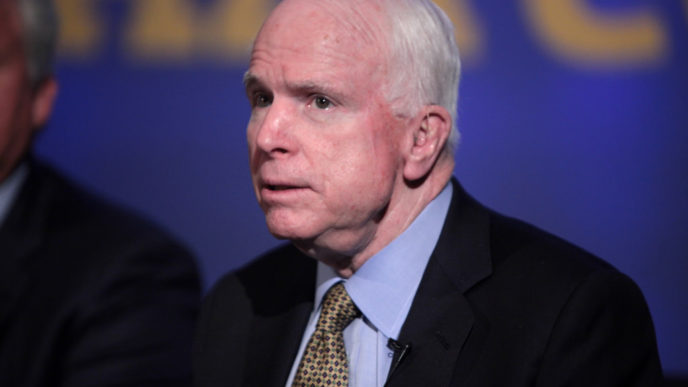
McCain Vows: ‘I’ll Be Back Soon’

Sen. John McCain used his signature snark on Thursday to warn colleagues that he will be returning soon to Washington — and chastised the Trump administration for ending assistance to moderate Syrian rebels battling the government of Bashar al-Assad.

The twin statements served as reminders of the outsized role the 80-year old senator plays on Capitol Hill. Republicans badly need him to return as they try to shore up a weeks-long debate on a health-care overhaul. And he has been more willing than most Republicans to buck his party and the president to demand more decisive action to bolster the nation’s security, particularly in areas involving the country’s cyber defenses and posture against Russia.

McCain announced late Wednesday that he has been diagnosed with a tumor called a glioblastoma after surgery to remove a blood clot above his left eye last week. The tumor is an aggressive type of brain cancer, and the prognosis is generally poor.

The news sparked bipartisan calls for his swift return and public statements of support from Trump and his predecessors. Former president George W. Bush said on Thursday that he phoned his 2000 GOP presidential campaign rival to “encourage him in his fight.” (Read more from “McCain Vows: ‘I’ll Be Back Soon'” HERE)

Follow Joe Miller on Twitter HERE and Facebook HERE.

The REAL Reason for GOP Hypocrisy

So, when it was impossible to repeal or replace or do anything about Obamacare because President Obama was in the Oval Office with his veto pen?

As the Daily Caller noted here: “Forty-eight current Republican senators supported the 2015 Obamacare repeal bill, including Sens. Lisa Murkowski of Alaska and Shelley Moore Capito of West Virginia.”

Then? Then the unexpected, as explained here by Republican Pennsylvania Senator Pat Toomey recently. The headline: “Sen. Pat Toomey on health care delay: I didn’t think Trump would win presidency.”

The story says, in part: “‘I didn’t expect Donald Trump to win. I think most of my colleagues didn’t. So we didn’t expect to be in this situation,’ Pat Toomey, R-Pa., said Wednesday […] The Pennsylvanian senator isn’t the only GOP lawmaker working on health care who also wasn’t expecting the Trump presidency. ‘I didn’t think President Trump had a chance at winning,’ Senate Majority Leader Mitch McConnell, R-Ky., said in an interview with a local Kentucky TV station in December 2016.”

And now? Now that there is in fact a President Trump sitting at Obama’s old desk, pen in hand and ready to sign a repeal of Obamacare? Again, the Daily Caller: “Two Republicans senators who voted to repeal Obamacare in 2015 now say they will not support a similar bill by Senate Majority Leader Mitch McConnell […] Now Murkowski and Moore Capito oppose the McConnell measure.”

The utter hypocrisy here is breathtaking. This is a flat-out betrayal of one of the biggest GOP promises since the days of opposition to slavery.

There is room for disagreement on how to go about the repeal. This amounts to a discussion of whether the glass is half full or half empty. Is the GOP bill cementing Obamacare in place — as per Senator Rand Paul? Or is it a move, however tepid, toward a free-market system?

When it says of the “Obamacare Republicans”: “The Obamacare Republicans ran on fiscal discipline but they rejected the best chance for entitlement reform in a generation. They campaigned against deficits—and some like Mr. Moran and Nevada’s Dean Heller have endorsed a balanced-budget amendment—yet they dismissed a $1.022 trillion spending cut. They denounced Obamacare’s $701 billion in tax increases but then panicked over repealing ‘tax cuts for the rich.’”

Particularly startling in all this mess was this comment, again per the WSJ, from Utah’s Senator Mike Lee: “Mr. Lee opposed the first draft of the bill in part because it ‘included hundreds of billions of dollars in tax cuts for the affluent.’ He opposed the new version for ‘not repealing all of the Obamacare taxes.’”

One can only be gobsmacked that any Republican United States Senator has picked up the class warfare thinking of the Obama Left by protesting against “hundreds of billions of dollars in tax cuts for the affluent.”

So, what do we have here when all is said and done? (And it must be noted, there are kudos for Texas Senator Ted Cruz and his ceaseless efforts to get something done that has some relation to principle.)

What we have is one very, very confused Republican Party.

The party of the free market is making it abundantly clear that it is really the party terrified of the liberal media and Democrats picturing them as so many Ebenezer Scrooges for wanting to take away a new entitlement … in spite of the fact that said entitlement is crashing and burning around them and is surely at the root of some future national financial calamity, as was witnessed with the infamous Community Reinvestment Act that eventually contributed to the financial collapse of 2008.

Note well that the CRA, passed in 1977 at the instigation of President Jimmy Carter, passed the House by a vote of 384-26, with 18 of those 26 nays coming from Republicans. Other than those 18 — conservatives of the day with names like California’s John Rousselot and Bob Dornan, Ohio’s John Ashbrook, and Illinois’ Phil Crane — the rest of the House Republicans sided with Jimmy Carter, Tip O’Neill, and liberals.

Decades later, of course, the financial house of cards they set in motion crashed. As Mark Levin notes in “Rediscovering Americanism”: “The progressives’ interference with the housing market through the Community Reinvestment Act resulted in the collapse of that market, a calamitous disaster for millions of homeowners who lost the equity in their homes or lost their homes outright.”

Exactly. But now, as in 1977, progressives have interfered with a giant chunk of the American economy, this time the American health care system. And as demonstrated in the GOP-controlled Senate, there are Republicans today, as in 1977, all too willing to side with the progressives as they buy in to the same reasoning for not repealing Obamacare that they bought in passing the CRA.

The idea was succinctly and fatuously expressed this time by West Virginia’s Shelley Moore Capito: “As I have said before, I did not come to Washington to hurt people.”

Except, of course, she is. Obamacare has ruined health insurance for many Americans, and, yes, as noted here, it has even proved fatal for some. (In that cited case of Long Islander Frank Alfisi, who was denied needed dialysis because of Obamacare rules, at his death, Mr. Alfisi’s daughter was told by her father’s doctor, “You can thank Mr. Obama for this.”)

There is a serious problem here — a problem that has nothing to do with health care. The problem? Far too many Republicans have been politically gulled into buying the progressive argument about the role of government, because they fear being painted as an elected version of Scrooge or, worse — because they genuinely buy in to leftist/progressive dogma about the role of government.

This is in complete opposition to the founding principles of the country, not to mention those of the GOP. And it produces disasters like refusing to repeal Obamacare or going along with disasters waiting to happen, like the Community Reinvestment Act. As Rush Limbaugh has asked in the wake of this disaster: “What’s the point of voting Republican?”

In sum, too many Republicans (most prominently, today, Senators Murkowski and Capito) are ignoring the wisdom of Ronald Reagan.

“The nine most terrifying words in the English language are, ‘I’m from the government and I’m here to help.’”

(For more from the author of “The REAL Reason for GOP Hypocrisy” please click HERE)

Follow Joe Miller on Twitter HERE and Facebook HERE.

US Postal Service Breaks Election Laws to Support Hillary, Media Silent

The big three networks ignored a report Wednesday uncovering violations of federal law committed by the U.S. Postal Service, which pressured managers to approve time off for employees to campaign for former Secretary of State Hillary Clinton and other Democrats.

“High-level postal officials had for years granted employees’ requests for unpaid leave, leading last year to an ‘institutional bias’ in favor of Clinton and other Democrats endorsed by the National Association of Letter Carriers, one of the largest postal unions” amounting to a violation of the Hatch Act, reports The Washington Post.

The Hatch Act is a law enacted in 1939 to prevent federal employees from supporting candidates. Investigators concluded that the postal service had been involved in the process since the 1990s.

“You kind of have to scratch your head when you have such systemic violations of the Hatch Act and nobody’s really held accountable,” Republican Sen. Ron Johnson of Wisconsin told WaPo. (Read more from “US Postal Service Breaks Election Laws to Support Hillary, Media Silent” HERE)

Follow Joe Miller on Twitter HERE and Facebook HERE.

Spokesman for Trump’s Legal Team Abruptly Resigns

Mark Corallo, the spokesman for President Trump’s independent legal team, resigned his position on Thursday, according to several reports.

Corallo’s resignation comes as Trump’s legal staff ramps up a campaign to discredit Special Counsel Robert Mueller, who has expanded the scope of his investigation of Trumpworld in recent weeks.

What began as an investigation into potential collusion between members of the Trump campaign and Russian government has broadened to include a look at Trump’s businesses and those of his family members and other associates, including former campaign chairman Paul Manafort.

According to reports from The New York Times and The Washington Post, Trump’s Russia-related legal staff, which is separate from White House counsel, has been looking for ways to discredit Mueller and his staff of lawyers and investigators. Many of the lawyers hired by Mueller have donated to Democratic politicians, including Hillary Clinton. (Read more from “Spokesman for Trump’s Legal Team Abruptly Resigns” HERE)

Follow Joe Miller on Twitter HERE and Facebook HERE.