Christian Pastor in Bible Belt Admits Personally Worshiping Allah

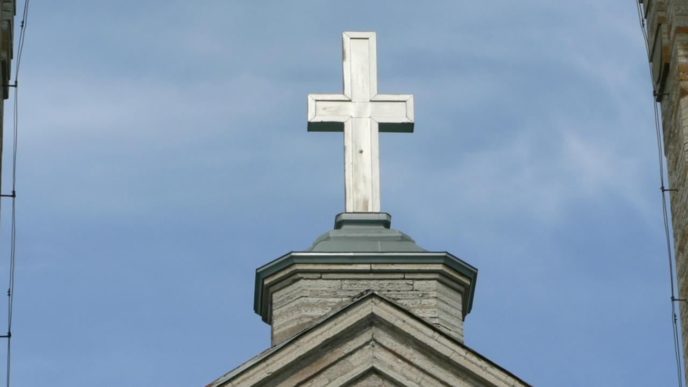
A former church has been taken over and converted to a mosque in a rural North Carolina county, and a group of Christian pastors took part in the conversion ceremony in an effort to “show mutual respect” for their Muslim neighbors.

Crosses have been removed from the former church’s facade and steeple, and mosque leader Ali Muhammad turned them over to the group of pastors.

“What they were attempting to do is honor our tradition and so they wanted to turn the crosses over to us,” said the Rev. Jim Melnyk, pastor of St. Paul’s Episcopal Church in Smithfield, a small town in Johnston County about 45 minutes south of Raleigh. “They were reaching out to us, and we were reaching out to them.”

Melnyk said he was joined by pastors from the United Methodist Church, United Church of Christ and three different Baptist congregations at Saturday’s ceremony, which marked the official conversion of a former Pentecostal church into a mosque. One lay person from the local Presbyterian Church was also present for the “celebration.”

Melnyk told WND the mosque had reached out to the local churches through an interfaith group in Raleigh and was hoping to strike a welcoming and respectful tone for the two faiths. (Read more from “Christian Pastor in Bible Belt Admits Personally Worshiping Allah” HERE)

Follow Joe Miller on Twitter HERE and Facebook HERE.

The People of the Bubbles

Imagine you are flying over an American suburb in Middle America, say in Ohio, Indiana, Iowa, or Pennsylvania.

You hover over a cul de sac, where kids ride tricycles and Moms share a glass of wine after work and chauffering their charges around to soccer practice.

In fact, you can see that most of the homes are inhabited by two-parent families. If you asked the parents’ primary motivation for living in suburbia, most would tell you they’ve moved for the K-12 education the local school district affords.

These families have also moved for a certain quality of life, mobility and access to grocery stores and malls. Life for many is relatively easy. Certainly there are worries: how to pay for college 10 years hence or how to fund the roofing contractor who says he can fix the worsening leak in the family room.

For good or bad, these families are living in a bubble of our society’s creation. Problems in this bubble are those of the First World.

Now imagine you are soaring over an inner city, the south side of Chicago, for example, or downtown Newark, or the east thirties in Indianapolis.

Life is harder in this bubble, where homicide is an everyday occurrence and gangs of both domestic and illegal alien lineage dominate black market commerce. Grocery stores are few and far between; liquor stores, payday loans, and bail bonds are the growth industries.

For the depressed neighborhood over which we are poised, single-parent families make up the majority of households. The single-parent route is an easy choice to make for many, incentivized as it is by government child care payments, food stamps, and WIC vouchers.

Inhabitants of the first bubble, those of suburbia, seldom cross over the perimeter of the second.

And the ability of those residing in the second bubble to permeate the membrane into the first is hampered by a lack of family support, a restricted ability to choose schools best suited for a particular student, and a societal fabric rooted in the life style of criminal gangs, drug abuse and violent crime.

With that said, residents of the second bubble can also be said to be extraordinarily wealthy compared to most.

Because if the second bubble can be thought of as an outer concentric ring to the first, it’s worth imagining that there is a third bubble outside the second.

The third circle consists of the vast majority of the world’s population. Water, basic sanitation, food and shelter are constant concerns. Disease and tribal violence have reduced the lifespan of the average third-bubble resident by a decade or two or three.

The third bubble consists of billions of people, and their plight is largely invisible to residents of the first and second circles.

Poorly educated in civics, first- and second-circle residents take for granted the magnificent compact and civil society that surrounds them with life’s every convenience. The most difficult decision some first- and second-circle residents will make on a daily basis is which of the 1800 television channels to watch at 8pm.

Our complex legal system, rooted in thousands of years of human experience, manifested itself in two magnificent legal documents that charted the course for the most successful republic in human history.

And yet there is little — and for many, no — appreciation by residents of the first and second bubbles for the masterful work of art that our nation’s highest law represents.

Demagogues of all political persuasions, men and women lacking in virtue, have placed the priorities of their party, their ethnic group, or their ahistorical social constructs, over country and principle.

Which brings me to the fourth bubble, a circle within the first. Call it the zeroth bubble.

In it are the self-proclaimed elites of government and media. The residents of the zeroth bubble reside in coastal enclaves and surrounded by elaborate systems that protect them from those who live in the first, second and third bubbles.

The residents of the zeroth bubble often secure permanent employment in the form of government sinecure or job-hopping between government, media, academia, lobbying, and public relations.

Their personal security is assured by heavily-armed forces that offer many of them around-the-clock protection.

There is little crossover from the zeroth bubble to the first. And certainly less still between the zeroth and the second.

It’s also safe to say that the device has yet to be invented that can measure the empathy that the elites feel for the residents of the third bubble.

Which helps explain why illegal immigration — from human- and drug-smuggling to MS-13 — is of no concern to the Chamber of Commerce, or your typical Senator, or Thomas Friedman of The New York Times.

The zeroth bubble people wouldn’t ever see the results of the open borders policies they espouse and support, nor can they even countenance them.

In fact, they’re sufficiently disconnected from the residents of the first bubble that they missed the entire Trump phenomenon.

The eponymous Z Man has popularized a simple dichotomy of two worlds in which the coast elites (“the cloud people”) rule over the largely invisible rabble (“the dirt people”) in flyover country.

But this view is insufficient, in my opinion.

One way to explain our country’s polarization, its angst, and its current squabbles is by imagining a set of four concentric circles, or bubbles.

Residents of each bubble lack a sufficient understanding that the other bubbles exist, and are thereby blinkered, unsympathetic, and — most of all — ungrateful.

The zeroth bubble — that of the elites — is apoplectic over its increasing and irreversible irrelevance, which explains the daily attacks on the President intertwined with its unflagging support for flatly illegal or extra-constitutional activities when the President is a Democrat.

As each bubble has become less porous and more opaque, empathy and apprecation for our society’s blessings are in very short supply.

Recognizing that the four bubbles exist is, perhaps, a step in the right direction. (For more from the author of “The People of the Bubbles” please click HERE)

Follow Joe Miller on Twitter HERE and Facebook HERE.

Ann Coulter Ready to Jump Ship on Trump Over Obama Amnesty, the Wall, Other Broken Promises

Conservative author Ann Coulter was one of the most vocal supporters of Donald Trump during the presidential campaign.

She wrote “In Trump We Trust” and proclaimed that she worships him like the “people of North Korea worship their Dear Leader – blind loyalty.”

Coulter described herself as a single-issue voter during the election and was drawn to Trump due to his “Mexican rapist speech” and him calling for a border wall to be built.

In an interview Sunday with The Daily Caller, Coulter let it be known she still has hope in the Trump presidency, but is ready to jump ship.

[Question:] So there’s no wall, and Obama’s amnesties look like they are here to stay. Do you still trust Trump?

[Answer:] Uhhhh. I’m not very happy with what has happened so far. I guess we have to try to push him to keep his promises. But this isn’t North Korea, and if he doesn’t keep his promises I’m out. This is why we voted for him. I think everyone who voted for him knew his personality was grotesque, it was the issues. (Read more from “Ann Coulter Ready to Jump Ship on Trump Over Obama Amnesty, the Wall, Other Broken Promises” HERE)

Follow Joe Miller on Twitter HERE and Facebook HERE.
McMaster on WaPo Claim Trump Gave Russians Highly Classified Info: ‘I Was in the Room, It Didn’t Happen’

The Washington Post ran a story late this afternoon claiming Donald Trump, in his meeting with Russian Foreign Minister and Ambassador, disclosed highly classified information, including information that could reveal sources and methods.

Despite the length of the story, the allegations of substance are all in this single paragraph:

Trump went on to discuss aspects of the threat that the United States learned only through the espionage capabilities of a key partner. He did not reveal the specific intelligence-gathering method, but he described how the Islamic State was pursuing elements of a specific plot and how much harm such an attack could cause under varying circumstances. Most alarmingly, officials said, Trump revealed the city in the Islamic State’s territory where the U.S. intelligence partner detected the threat.

From that, WaPo argues:

The identification of the location was seen as particularly problematic, officials said, because Russia could use that detail to help identify the U.S. ally or intelligence capability involved. Officials said the capability could be useful for other purposes, possibly providing intelligence on Russia’s presence in Syria. Moscow would be keenly interested in identifying that source and perhaps disrupting it.

Russia and the United States both regard the Islamic State as an enemy and share limited information about terrorist threats. But the two nations have competing agendas in Syria, where Moscow has deployed military assets and personnel to support President Bashar al-Assad.

(Read more from “McMaster on WaPo Claim Trump Gave Russians Highly Classified Info: ‘I Was in the Room, It Didn’t Happen'” HERE)

Follow Joe Miller on Twitter HERE and Facebook HERE.

Good Fences Make Good Neighbors: Build the Wall

It’s that time of year again. Financial reserves from our December fundraiser have been slowly depleted and VDARE.com is staring down a funding shortage as we creep into summer. In order for us to survive until the fall, we have to bring a total of $80,000 right now. We all need to pull together to make it happen.

Earlier this week, our intrepid editor, Peter Brimelow, noted that “This is the spring of our discontent” – in other words, although we’re all discontented with Trump’s lack of progress so far, the fact is, there are tremendous opportunities right now because the Trump administration exists at all. We must build the wall. We must restrict legal immigration. We must deport illegals, for the sake of America. These things will only happen if organizations like VDARE.com have your support.

Of course, no matter how generous the funding, if we didn’t have concrete plans for changing the tide, nothing would happen.

So what are our plans?

Here’s a sample of what we can do immediately with the right funding:

VDARE Book Club: The discussion over Steve Bannon’s edgy reading list has created a major stir in the Main Stream Media and opened the opportunity for a VDARE Book Club. We have an incredible lineup of books that examine the roots of our movement and look ahead to where we go from here. We just need an initial capital investment to roll it out.

VDARE Campus Speaking Tour: Peter Brimelow and John Derbyshire were doing campus talks before they were cool. For that matter, they were protested against and blacklisted before it was cool. Now, with anti-Free Speech activism taking over college campuses, we cannot back down. We have several invitations that we’re eager to accept and we’d like to add as many more as possible.

VDARE Conferences: It’s no secret that public meetings of American patriots can be tricky to pull off. We will not be cowed by the strong-arm tactics of Cultural Marxist enforcers. Conferences provide a space for the most significant thinkers in America today to come together and work out solutions to keep America American, plus our attendees have the opportunity to get to know fellow patriots. The show must—and will—go on!

VDARE Merchandise: A strong defense of culture cannot overlook the importance of social signaling, and the most effective way for us to harness that power is by getting VDARE.com’s brand and ideas in people’s daily lives. Clothing, bags, lapel pins, bumper stickers, Christmas ornaments—it’s time to develop witty, beautiful, powerful merchandise for our audience.

All of these projects will chip away at the Mainstream Media blackout on our issues (patriotic immigration reform and questions of American national identity). Together, they will strengthen the VDARE.com brand, reach new audiences and open possibilities for ever more effective execution of our mission.

The mission of the VDARE Foundation is education on two main issues: first, the unsustainability of current US immigration policy and second, the “National Question,” which is the viability of the US as a nation-state. We do this through the VDARE.com webzine and VDARE Books, public speaking, conferences, debates and Mainstream Media appearances.

In this capacity, VDARE.com has accomplished a great deal. Already, we have taken our place as the voice of patriotic immigration in America. Our country need that voice – now more than ever – to get louder and louder until it is impossible to ignore.

Our ultimate goal is to become a far-reaching patriotic media conglomeration. VDARE.com will always be our flagship operation and we want to expand into hard-hitting podcasts, professional videos and books that can reflect the paradigm shift America so desperately needs. VDARE.com can amplify the most interesting and disciplined voices of this movement we have created, and unite the community under the shared interest in keeping America American. But none of this is possible without your help. What do you have to give? (For more from the author of “Good Fences Make Good Neighbors: Build the Wall” please click HERE)

Follow Joe Miller on Twitter HERE and Facebook HERE.

Migrants in Sweden Suspected of Converting to Christianity to Get Asylum

The Swedish migration agency is handing out pop quizzes on the Bible to make sure migrants aren’t converting to Christianity to receive asylum.

Risk of persecution because of one’s religious faith can boost a person’s chances of gaining asylum. The Swedish migration agency is making unannounced visits to asylum seekers to quiz them on the Bible and make sure their conversions are genuine.

“How many books are in the New Testament?” and “What is the difference between Orthodox and Protestant churches?” are examples of questions converts have to answer.

Immigration lawyers have criticized the measure, but the agency defends the questions as knowledge true Christians should know.

“There are reasonable demands that the [asylum] applicant should have certain knowledge based on what they’ve told us and how they’ve gained knowledge of the Bible,” Carl Bexelius of the Swedish migration agency told state broadcaster SVT in an article published Saturday. “This knowledge should be there naturally, and it shouldn’t be something they need to read up on.” (Read more from “Migrants in Sweden Suspected of Converting to Christianity to Get Asylum” HERE)

Follow Joe Miller on Twitter HERE and Facebook HERE.

Trump Says It’s Possible He Could Pick FBI Head by Next Week

President Donald Trump said Saturday that “we can make a fast decision” on a new FBI director, possibly by late next week, before he leaves on his first foreign trip since taking office.

“Even that is possible,” he told reporters when asked whether he could announce his nominee by Friday, when he is scheduled to leave for the Mideast and Europe.

Four candidates to be the bureau’s director were in line Saturday for the first interviews with Attorney General Jeff Sessions and his deputy, Rod Rosenstein, at Justice Department headquarters. They are among nearly a dozen candidates Trump is considering, a group that includes several lawmakers, attorneys and law enforcement officials. (Read more from “Trump Says It’s Possible He Could Pick FBI Head by Next Week” HERE)

Follow Joe Miller on Twitter HERE and Facebook HERE.

The Worst Word in American Politics

For the past couple of years, the most important word in American politics has been the worst — “rigged.”

Emanating from slang back in the 17th century, developing into a description of financial fraud, and then branching out to apply to cheating in sports and elections, “rigged” had a breakthrough year in 2016, and it shows no sign of loosening its grip.

It is a word of grievance and conspiracy. It is a word of institutional distrust. It is a word of larger forces beyond our control taking advantage of us. It is a word that says, “We wuz robbed — and we will make them pay.”

In short, it is the perfect term for a fevered era in our national life.

“Rigged” began to get its currency as a charge thrown around by the anti-globalization movement and left-wing critics of income inequality. The anti-poverty group Oxfam issued a report in 2002 on globalization called “Rigged Rules and Double Standards.” The word popped up during the heyday of Occupy Wall Street. So it wasn’t unexpected that Bernie Sanders made the “rigged” economy a rallying cry. (Read more from “The Worst Word in American Politics” HERE)

Follow Joe Miller on Twitter HERE and Facebook HERE.

How Instability in the Taiwan Straits Strains the US Position in Asia

While the eyes of the world are focused on security developments on the Korean Peninsula, two recent events should resharpen attention on the Taiwan Straits.

The Chinese launched a new aircraft carrier, and President Donald Trump indicated that he would check with Chinese President Xi Jinping before he would take another phone call from the president of Taiwan.

The new ship, whose name is as yet unknown, marks China’s first domestically produced aircraft carrier. It joins the Liaoning, China’s first aircraft carrier. Remarkably, the Liaoning itself only joined China’s fleet in 2014; before that, China had no experience even operating an aircraft carrier.

In short, China has joined the ranks of carrier navies in less than five years. This reflects the broader overall growth of the People’s Liberation Army Navy, as China has added a range of new surface combatants (including air defense destroyers), many new submarines, and an array of logistics and support ships that will allow the PLA Navy to operate for sustained periods far from its shores.

Most recently, the PLA announced a fivefold expansion of the PLA Navy’s Naval Infantry force—its counterpart to the U.S. Marines.

This expanding set of naval capabilities, including an improved ability to conduct forced entry operations and expeditionary warfare, directly affects Taiwan. Beijing’s hostility towards the island has increased substantially with the election of President Tsai Ing-wen in 2016.

Tsai’s Democratic Progressive Party was founded on the concept of promoting Taiwanese independence. Tsai has been very careful not to push that aspect in her policies, but this has done little to mollify Beijing.

Instead, Beijing has repeatedly insisted that, to maintain cordial relations between Beijing and Taipei, Tsai must explicitly endorse the so-called “1992 Consensus.” Intended to allow the two sides to engage in dialogue while bypassing the political status of Taiwan, the very meaning of this phrase is now debated.

The People’s Republic of China claims this “consensus” essentially accepts the idea that there is only a single China, and the entities on both sides of the Taiwan Straits are part of that China.

Tsai’s reluctance to submit to Beijing’s demand to use the phrase should not be surprising since it fundamentally contradicts a foundational aspect of the Democratic Progressive Party. Also, the party won massive victories in the 2016 election cycle, not only taking the presidency of Taiwan, but also control of the Legislative Yuan, Taiwan’s Congress, or parliament. Tsai almost certainly could not politically survive the abandonment of a cornerstone Democratic Progressive Party position by acceding to Beijing’s demands.

Unfortunately, Taiwan’s overall political situation appears to have been weakened by Trump’s comments. In an interview with Reuters, when asked if he would speak with Tsai again, Trump responded by saying: “I think [Xi Jinping’s] doing an amazing job as a leader and I wouldn’t want to do anything that comes in the way of that. So I would certainly want to speak to him first.”

The statement has roiled U.S.-Taiwan relations, as it appears to suggest that the administration is willing to grant China an implicit veto on whether to have contact with Taipei. That no sitting American president has spoken directly with the government in Taipei since 1979 is irrelevant; the optics on the statement suggest that the U.S. is granting China the ability to determine American actions.

In reality, the United States can, and should, conduct an independent foreign policy with regards to Taiwan. This is the spirit of the Taiwan Relations Act, which is a key document governing U.S.-Taiwan relations. In fact, when it comes to arms sales, it is specifically stated that:

The president and the Congress shall determine the nature and quantity of such defense articles and services based solely upon their judgment of the needs of Taiwan, in accordance with procedures established by law.

This has long been taken to mean that the United States will not consult with China before determining what items to sell Taiwan. It should not be consulting with Beijing on other aspects of U.S.-Taiwan relations either. Undermining and diluting the understandings that link the U.S. and Taipei will prove as counterproductive for long-term regional stability as undermining the security and economic ties between the U.S. and key allies such as South Korea and Japan. (For more from the author of “How Instability in the Taiwan Straits Strains the US Position in Asia” please click HERE)

Follow Joe Miller on Twitter HERE and Facebook HERE.

North Korea’s Missile Launch a ‘Litmus Test’ for Trump and South Korean Leader

President Donald Trump will speak again to the newly elected South Korean president—who during his campaign advocated more direct engagement with North Korean leader Kim Jong Un. That was before North Korea’s ballistic missile test over the weekend.

Trump talked by phone to South Korean President Moon Jae-in on Wednesday, the same day the country’s liberal leader was sworn into office.

Asked if the administration will advise against South Korea’s engagement in light of the missile test, White House press secretary Sean Spicer declined to get ahead of Trump’s next conversation with the new leaders.

“The president looks forward to having a new conversation with the new president and discussing the way forward, but I’m not going to get ahead of him on that,” Spicer told The Daily Signal during the press briefing.

The test missile reportedly flew more than 430 miles and reached an altitude of 1,245 miles before landing in the sea between North Korea and Japan, demonstrating that it could be used to target U.S. military bases in the Pacific.

North Korea’s launch will be a “litmus test” for both Trump and Moon, Bruce Klingner, senior research fellow in Asian studies at The Heritage Foundation, told The Daily Signal in a phone interview.

On one front, Klingner wonders if Trump will get ahead of China in seeking more sanctions on North Korea.

“Trump has been effusive in his praise for China,” he said, but added, “China is doing less than meets the eye. So will Trump hold back on sanctions?”

He continued:

Moon wanted less sanctions and more engagement. North Korea, as with [U.S. President Barack] Obama in 2009, showed they will act no differently with a liberal progressive than they did with his conservative predecessor [President George W. Bush].

The missile test should prompt caution for South Korea’s peace ambitions, said Anthony Ruggiero, senior fellow at the Foundation for Defense of Democracies, a national security think tank.

“Governing is different than campaigning. North Korea also gets a vote. North Korea responded to Moon Jae-in’s outstretched hand with a ballasted missile test,” Ruggiero told The Daily Signal Monday.

Beyond sanctions, there are few diplomatic options to contain North Korea, and the United States will have to take the lead, Ruggiero said.

“China and Russia will not put the level of necessary pressure on North Korea, only the Trump administration [will],” he said. “This will not serve as a wake-up call for Russia.”

Over the weekend, Spicer issued a statement saying North Korea’s test missile hit close to Russia, and that “the president cannot imagine that Russia is pleased.” During the briefing, he again brought up the key United Nations Security Council member nations that haven’t been cooperative in pushing sanctions—China and Russia.

“There is no question that North Korea continues to threaten the United States, our allies, Japan, South Korea, and its neighbors, including both China and Russia,” Spicer said. “We are calling on all of those folks in the region, in particular, China and Russia, to do everything they can in terms of sanctions to help resolve the situation and bring stability to the peninsula.”

North Korea likely has the capacity for an electromagnetic pulse that could target the United States, said Clare Lopez, vice president for research and analysis the Center for Security Policy, a national security think tank. She said she doesn’t believe the U.S. civilian power grid could withstand such an attack if the regime is able to launch over the continental United States.

As for South Korean, Lopez said she believes the new government assuredly understands the threat.

“I can’t imagine the South Korean leadership is naïve about North Korea,” Lopez told The Daily Signal. “The new president might want to express a diplomatic ambition, but I can’t believe he is oblivious to the existential threat of the North.” (For more from the author of “North Korea’s Missile Launch a ‘Litmus Test’ for Trump and South Korean Leader” please click HERE)

Follow Joe Miller on Twitter HERE and Facebook HERE.