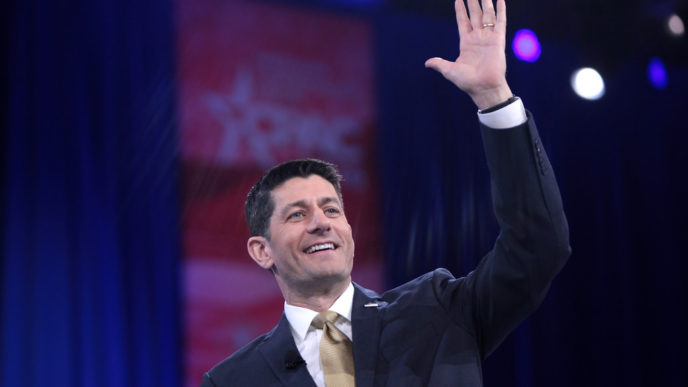
Just four days after House Speaker Paul Ryan declared Obamacare the “law of the land,” House Republicans say they’re moving forward with their plan to repeal and replace the health care law despite the divisions in their party on how to reform the health insurance market.
Ryan and members of his leadership team reaffirmed their support for unwinding the Affordable Care Act during a weekly press conference with reporters Tuesday, saying that their first failed attempt to replace Obamacare wouldn’t deter them from moving forward.
“We’re not going to retrench into our corners or put up dividing lines,” Ryan said after a meeting with Republican lawmakers. “There’s too much at stake to get bogged down in all of that.”
The renewed focus on repealing Obamacare came after Ryan decided to withdraw the House GOP’s health care bill Friday, a decision made after it became clear there wouldn’t be enough votes to pass it.
Republicans released their plan to repeal the health care law and implement parts of a replacement at the beginning of the month.
But the bill lacked a natural constituency.
Instead, both centrist Republicans and conservatives decried the plan—conservatives disliked it because they felt it wouldn’t lower the cost of premiums, and centrist Republicans felt it didn’t do enough to protect those newly enrolled in Medicaid.
After pulling the bill, Ryan told reporters “Obamacare is the law of the land” and stressed that Republicans would instead move on to other items on their agenda, like tax reform.
But by Tuesday morning, Republicans appeared to have regrouped, and Ryan stressed the GOP conference would continue to work toward gaining consensus on a replacement plan even as they tackle other legislative priorities.
“We’re going to get this right,” Ryan said, “and in the meantime, we’re going to do all the other work we came here to do.”
Any path forward on Obamacare’s replacement is going to require agreement between conservatives and centrist Republicans, factions of the party that opposed the House GOP’s health care bill for different reasons.
But the two groups appear willing to further engage in talks over health care reform.
According to The New York Times, the House Freedom Caucus and centrist Tuesday Group are engaging in talks with Stephen Bannon, President Donald Trump’s top strategist.
And even Ryan, who said Friday some Republicans in the House couldn’t get to “yes” on the bill, told reporters Tuesday that Republicans would “sit down and talk things out” until they compromise.
“We saw good overtures from those members from different parts of our conference to get there because we all share these goals, and we’re just going to have to figure out how to get it done,” the speaker said.
Ryan wouldn’t elaborate on any details of a new plan or on a timeline. But some conservatives are already plotting their own path.
Rep. Mo Brooks, R-Ala., filed a bill Friday that fully repeals Obamacare. Brooks, along with some conservatives, also may use a legislative tool that would force a floor vote on a bill dismantling the health care law.
The plan requires Brooks to collect 216 signatures on a discharge petition. Once that happens, and after the legislation has remained in committee for 30 days, the lower chamber would be forced to vote on the bill.
“We will find out who is truly for repeal of Obamacare and who is not,” Brooks told reporters. (For more from the author of “House Republicans Renew Plans to Repeal Obamacare After Failed First Attempt” please click HERE)
https://joemiller.us/wp-content/uploads/obamacare-3-1.jpg8001200Joe Millerhttps://joemiller.us/wp-content/uploads/logotext.pngJoe Miller2017-03-28 20:26:342017-03-28 20:26:34House Republicans Renew Plans to Repeal Obamacare After Failed First Attempt
Attorney General Jeff Sessions’ announcement on Monday that the Justice Department will bar all sanctuary cities from receiving any grants or other federal funds from the department should be welcome news to Americans—especially those whose families have been victimized by criminal illegal aliens released by sanctuary cities like San Francisco.
As Sessions pointed out, Kate Steinle, a resident of San Francisco, was shot and killed two years ago by an illegal alien as a direct result of San Francisco’s policy of refusing to honor federal detainer warrants.
The killer, Francisco Sanchez, had seven previous felony convictions and the city released him from custody despite the fact that Immigration and Customs Enforcement (ICE) had filed a detainer with San Francisco asking that he be kept in custody until immigration agents could pick him up.
Sanchez even admitted to a television reporter that the only reason he came to San Francisco was because of the city’s sanctuary policy.
Sessions also mentioned another such incident that happened just within the last two weeks.
According to the attorney general, Ever Valles, another illegal alien, was charged with the murder and robbery of a man at a light rail station.
The only reason he was on the street was because the city of Denver refused to honor a detainer that ICE had filed with the city and released him from the Denver jail in December.
Valles is just one of many such criminal aliens who are being loosed on the American public by the reckless policies of sanctuary cities.
ICE recently released the first of its weekly reports on cities that have refused to honor ICE detainer warrants, as mandated by President Donald Trump’s executive order, “Enhancing Public Safety in the Interior of the United States.”
The report details all of the local jurisdictions across the country from Florida to New York to Washington state that refused ICE detainers from Jan. 28 to Feb. 3 and released criminals from their jails rather than turn them over to the federal government for deportation.
The crimes committed by these illegal aliens, as outlined in a report covering just a single week, include: domestic violence, arson, aggravated assault, burglary, forgery, intimidation, possession of a dangerous weapon, intimidation, drug trafficking, sexual assault, homicide, and a host of other crimes. This is also no surprise.
As I have outlined before, prior reports by the Government Accountability Office that have reviewed the criminal histories of illegal aliens in federal, state, and local jails show a path of destruction and repeated criminal behavior by criminal aliens that is truly shocking.
There are literally millions of Americans like Steinle who have been victimized by crimes committed by illegal aliens that should not have happened and would not have happened if we actually enforced our immigration laws and if local jurisdictions cooperated with federal authorities instead of trying to obstruct them.
Sessions said that the American people “are justifiably angry” about these sanctuary policies that endanger them. They understand something that irresponsible local officials don’t seem to care about: “When cities and states refuse to help enforce immigration laws, our nation is less safe.”
The failure to deport criminal aliens like Valles puts “whole communities at risk—especially immigrant communities in the very sanctuary jurisdictions that seek to protect the perpetrators.”
The amount of federal grant money at stake is more than $4.1 billion, which the Justice Department distributes through its Office of Justice Programs.
Sessions said that all jurisdictions applying for such grants will have to certify that they are in full compliance with 8 U.S.C. Sec. 1373, which bans local and state jurisdictions from prohibiting their employees—including law enforcement—from exchanging information with the federal government over the citizenship status of any individual.
The American people certainly agree with what Trump and Sessions are doing. Sessions cited a poll in which 80 percent of Americans agreed that illegal aliens arrested by cities should be turned over to immigration authorities.
Sessions urged state and city officials to “consider carefully the harm they are doing to their citizens by refusing to enforce our immigration laws, and to rethink these policies.”
Hopefully, the added incentive of losing access to billions of federal dollars will help them “rethink” their rash sanctuary policies. (For more from the author of “The Left’s Sanctuary Cities Hurt Americans’ Safety” please click HERE)
President Donald Trump told the nation’s largest police union his administration will “always have your back,” a departure from what many police organizations say they felt about the previous administration.
The Fraternal Order of Police visited the White House Tuesday. Many police organizations criticized the Obama administration for being quick to criticize the officers after a police shooting before knowing all the facts.
Trump met with nine police union officials from across the country, and was joined by Vice President Mike Pence and Attorney General Jeff Sessions, where he asserted “there is nobody braver” than law enforcement, and thanked them for their endorsement in last year’s election.
“I made a crucial pledge,” Trump told the police officials. “We will always support the incredible men and women of law enforcement. I will always have your back 100 percent.”
Such words from a president mean a lot, noted Scott Erickson, president of Americans in Support of Law Enforcement.
Erickson wasn’t part of the meeting, but asserted this first formal meeting with Trump and the Fraternal Order of Police marks a change in tone.
“Public perception of police is slowly improving for two reasons,” Erickson, who was a police officer in San Jose, California, for 18 years, told The Daily Signal. “People got burnt out on the negativity, hearing the worst about cops. Two years ago, it hit a new low. Last year, approval for cops spiked. But what top government officials were saying filtered down to public discourse about cops. That is changing.”
During his presidency, Barack Obama verbally criticized several police departments, asserting in July 2009 that the Cambridge Police Department “acted stupidly,” when an officer stopped a Harvard professor outside his home. In December 2012, after winning re-election, Obama said some local police departments “are not trying to root out bias.”
In July 2016, after shootings in Minnesota and Louisiana, Obama said while in Warsaw, Poland, “These are not isolated incidents, they are symptomatic of a broader set of racial disparities that exist in our criminal justice system.”
That same month, during a memorial service for five slain police officers in Dallas, Obama talked about racial disparities in law enforcement, saying, “When all this takes place more than 50 years after the passage of the Civil Rights Act, we can’t just simply turn away and dismiss those in peaceful protest as troublemakers or paranoid.”
These were the types of comments that framed the description of police officers, Erickson said. That seems to have changed with a new president, according to Erickson.
“Police no longer feel they are going to have an administration casting a skeptical eye on them before all of the facts are in,” Erickson said.
On Feb. 9, Trump signed three executive orders to back law enforcement. The first stated the federal government is on the side of federal, state, tribal, and local law enforcement. The second established a task force for reducing crime, and the third created a separate task force to determine the best way to take on transnational criminal organizations and drug cartels.
During his meeting with police Tuesday, Trump said that police must be empowered to keep the public safe.
“Sadly, our police are often prevented from doing their jobs,” Trump said. “In too many of our communities, violent crime is on the rise. These are painful realities that many in Washington don’t want to talk about. We have seen it all over.”
Trump noted, “I always ask, ‘What’s going on in Chicago?’”
Dean Angelo, president of Chicago Fraternal Order of Police, was among those who met with the president. After the meeting, the Chicago Tribune reported Angelo said, “I just mentioned that the police officers want to work, and that [they] need people to support police officers to go back to work so they can work toward stemming the violence in our city.”
Trump referenced during the meeting that Sessions on Monday talked about withholding Justice Department grants from cities that don’t cooperate with federal law enforcement on immigration, commonly known as sanctuary cities.
Fraternal Order of Police National President Chuck Canterbury said the organization backed the president on cracking down on sanctuary cities.
“We believe in enforcing the laws of the country of the United States,” Canterbury told reporters after the meeting, according to the Tribune. “We believe that sanctuary city status is not a good thing for America. We support the president on his sanctuary city initiative.” (For more from the author of “Trump Signals Change in Tone for Police From Obama” please click HERE)
https://joemiller.us/wp-content/uploads/Donald_Trump_25218642186-3.jpg20293044Joe Millerhttps://joemiller.us/wp-content/uploads/logotext.pngJoe Miller2017-03-28 20:18:192017-03-28 20:18:19Trump Signals Change in Tone for Police From Obama
Some consider it the most powerful investigative committee in Congress: the House Oversight and Government Reform Committee. It has nearly unlimited purview to look into most any matter that has a tie to government.
In the past, that’s meant investigating everything from steroids in sports to the housing crisis. I recently spoke to the current Republican chairman of the committee, Rep. Jason Chaffetz: “The Oversight Man” who’s watchdogging government under Donald Trump’s presidency.
The following is the transcript of our interview:
Attkisson: There’s no better way to understand the business of the House Oversight Committee than to see it in action.
Rep. Chaffetz: Who at the Department of Homeland Security office is holding you back?
Huban Gowadia: So I have to work with the Office of General Counsel.
Rep. Chaffetz: Give me some names. I want to know who to call up here.
Attkisson: Republican Jason Chaffetz is in the chairman’s seat and can usually found taking names or at least trying. Today, he’s grilling a TSA official about why the agency is stonewalling investigations into retaliation against whistleblowers.
Rep. Chaffetz: Tell me the attorneys that are telling you not to provide this information to Congress, tell me the names of the attorneys that are telling you not to provide this to the OSC. I want names.
Huban Gowadia: I will follow up with you.
Rep. Chaffetz: No. I want you right now, you’ve had notice of this hearing. I need specific names. You got staff sitting there, how many staff with the TSA? One, two three, four, five, six, seven. One of these seven people has got to get on the phone, get your butt up out of this committee, and go get that information before this hearing’s done.
Rep. Chaffetz: I think one of the, the big things you have to do as the chairman every day, almost every hour, you have to make decisions about what to investigate, what not to investigate. We get about 15 whistleblowers a day. You have to vet those and figure out what’s real and what’s not real.
Attkisson: What are some of the most famous or infamous instances of investigations this committee’s done over many years?
Rep. Chaffetz: When we have the FBI director, Mr. Comey, come and talk about what was going on and not going on with Hillary Clinton, that was certainly a big, big moment, and nation was captured to it.
James Comey: If I don’t see the evidence in that case that she was acting with criminal intent in her engagement with her lawyers.
Rep. Chaffetz: And I guess like I read criminal intent as the idea that you allow somebody without a security clearance access to classified information. Everybody knows that director. Everybody knows that.
Attkisson: How do you describe for people who don’t pay that much attention to Congress what the job of the Oversight Committee is?
Rep. Chaffetz: Oversight was founded in 1814, its role and responsibility is to look over every government expenditure there is. Abraham Lincoln actually sat on this committee in the two years that he served in the United States Congress.
Committee video: He was concerned that the president wasn’t telling the truth, and so he set off on this quest to find the truth.
Attkisson: More recently, the Oversight Committee issued more than 1,000 subpoenas involving alleged misconduct by the Clinton administration. It dug into Iraq War contract fraud under President George W. Bush. It’s probed the housing crisis, steroids in sports, and the IRS targeting of conservatives. And in 2012, it held an attorney general, Eric Holder, in contempt for the first time in history for withholding subpoenaed documents in the Fast and Furious gunwalking case.
Rep. Chaffetz: There is no one person in this country that’s above the law.
Attkisson: Some people accuse the committee, whether it’s being run by a Democrat or Republican at the time, of being political in nature, of in essence, going after whoever’s in the other party, or if the administration is in the opposite party.
Rep. Chaffetz: Our job is not to be a cheerleader for the president, and I think that’s over the long term one of the things we’ll be judged by is, did you call balls and strikes that are coming over the plate, to use a baseball metaphor, did you call the same on Democrats as you did on Republicans?
Attkisson: Now with President Donald Trump in the White House, that philosophy is already being put to the test. What issues has the Trump administration, if any, already put before you?
Rep. Chaffetz: Well we have five different things that we’re looking at as it relates to mishandling classified information. General Flynn going to Russia, taking money for a speech. The president in Mar-a-Lago, I’m glad he likes it there, I want him to enjoy life and get out and away from the White House from time to time but you still have to deal with classified information in a moment’s notice, and you have questions about how he is handling that. Another thing that we have done is when Kellyanne Conway went on national television and touted Ivanka Trump’s brand.
Kellyanne Conway: It’s a wonderful line, I own some of it, a free commercial, go buy it today, everybody, you can find it online.
Rep. Chaffetz: As an executive branch employee you can’t do that. At any level of government. You can’t endorse or support or use the bully pulpit or the assets of certainly the White House or any department or agency.
Attkisson: Chaffetz and the committee’s lead Democrat, Elijah Cummings, signed a letter asking the Office of Government Ethics to recommend possible disciplinary action.
Rep. Chaffetz: You have to call it out and refer to it what it is, which is wrong, wrong, wrong. And she can’t do that again.
Attkisson: What about the hottest topic in the media, the question of Russia’s interference in the U.S. election?
Attkisson: What is your understanding of the evidence as you know it?
Rep. Chaffetz: Well we rely heavily on Devin Nunes as the chairman of the intel committee, as well as Adam Schiff, the ranking Democrat. You can’t just rely on The New York Times, but even The New York Times said there was no direct evidence that tied any of this together. So, let’s be vigilant, let’s understand that some of these bigger nation states; they’re not necessarily our friends, they’re not trying to do us a favor. The Russians, the Chinese, others are constantly trying to probe us, trying to affect our nation, they’re constantly spying on us. This is not breaking news. How you deal with it is interesting. So, to suggest that this was somehow Donald Trump’s fault or problem, it really does kind of mystify me.
Attkisson: How do you explain when you watch TV news and you see politicians talk about it, it seems like everything’s about Russia, almost disproportionately so?
Rep. Chaffetz: Where were they when Mitt Romney said that our biggest geopolitical threat was Russia and Barack Obama mocked him? Where were they at that point? And where were they when Barack Obama, as the president, stood up and said, even if you wanted to affect the election, you couldn’t.
President Obama: There is no serious person out there who would suggest somehow that you could even rig America’s elections. I’d invite Mr. Trump to stop whining and go try to make his case to get votes.
Attkisson: But Russia and the election is one topic the Oversight Committee doesn’t plan to tackle under Chaffetz. He says that’s being done by the House Intelligence Committee, which has the necessary clearance to look into classified matters. A recent hearing got heated when Democrat Stephen Lynch argued the Oversight Committee should be investigating, too.
Rep. Lynch: They hacked the American election. That is their …
Rep. Chaffetz: There’s no evidence of that and President Obama said that that wasn’t even possible.
Rep. Lynch: This is high confidence, this is our own FBI! High confidence that they hacked the election. They interfered with our elections and if we’re turning a blind eye to that that’s a shame. That’s a shame. That corner of our democracy and we’re just gonna say, ‘Oh, that’s somebody else’s work.’ That’s not anybody else’s work. That’s our work.
Attkisson: Chaffetz says the committee is also taking a pass at voter fraud allegations from President Trump.
President Trump: We also need to keep the ballot box safe from illegal voting.
Rep. Chaffetz: I don’t see any evidence of that, so I didn’t pursue that investigation even though the president of the United States was saying there’s evidence. I haven’t seen any.
Attkisson: Sometimes the leader of this committee in particular becomes a target of whoever’s in the other party, or whoever is feeling attacked. Has that happened to you, or do you expect that to happen?
Rep. Chaffetz: It happens on a daily basis.
Attkisson: How do you handle it?
Rep. Chaffetz: Just let it fly right past. No matter what issue, I can say that the sun is going to rise tomorrow and people on either side of the parties will disagree about that. You could say that that flower is beautiful, and you still get disagreements. That’s just the nature of it and you don’t take it personally. Remember that you’ve got a wife and kids that love you and that’s what’s really important). (For more from the author of “Meet ‘the Oversight Man’ in Congress” please click HERE)
https://joemiller.us/wp-content/uploads/2906819234_770f49ab0f_b-1.jpg6851024Joe Millerhttps://joemiller.us/wp-content/uploads/logotext.pngJoe Miller2017-03-28 20:13:242017-03-28 20:13:24Meet ‘the Oversight Man’ in Congress
If someone walks into a hospital and claims that they’re being tracked, and that they need to have a tracking device removed, there’s a pretty good chance that they’re going to be sent to a mental institution instead. However, according to a doctor who wished to remain anonymous to protect his patient, that very situation occurred last October and it didn’t end how you might expect.
The patient in question was a 28-year-old woman who claimed that she had a GPS tracking device planted in her body. Normally a patient like that would be regarded as crazy, but this woman appeared totally sane, and she had an incision mark on her side. So the doctor decided to check her out anyway. The medical staff at the hospital were stunned when they finally gave her an X-ray.
Embedded in the right side of her flank is a small metallic object only a little bit larger than a grain of rice. But it’s there. It’s unequivocally there. She has a tracker in her. And no one was speaking for like five seconds — and in a busy ER that’s saying something.
It turns out that it wasn’t a GPS device, but an RFID chip. “It’s used to tag cats and dogs. And someone had tagged her like an animal, like she was somebody’s pet that they owned.”
In a way, that makes it even creepier than a GPS device. RFID chips have a very short range. To be useful for tracking someone’s position, they would have to be kept confined in an area where the right equipment is in place to send or receive signals from the chip. The doctor would later discover that this woman was a victim of sex trafficking.
Science fiction has been warning about the potential of tracking devices for years, but usually in reference to how the government might use this technology. It just goes to show that the way humans use technology in the real world is often stranger (and creepier) than fiction. (For more from the author of “They Thought She Was Crazy: Doctor Extracts RFID Chip From Sex Trafficking Victim” please click HERE)
https://joemiller.us/wp-content/uploads/5611594783_8e9a533564_b-2.jpg6831024Joe Millerhttps://joemiller.us/wp-content/uploads/logotext.pngJoe Miller2017-03-27 22:31:562017-04-02 03:10:06They Thought She Was Crazy: Doctor Extracts RFID Chip From Sex Trafficking Victim
A total of 501 juveniles have been reported missing in D.C. since the beginning of the year. This startling number has forced the hands of several officials who’ve written a letter to call on special help from the Justice Department in investigating the matter.
The letter, obtained by the Associated Press, asked FBI Director James Comey and Attorney General Jeff Sessions to “devote the resources necessary to determine whether these developments are an anomaly or whether they are indicative of an underlying trend that must be addressed.” It was signed by Congressional Black Caucus Chairman Cedric Richmond (D-La) and Del. Eleanor Holmes Norton, who represents D.C. in Congress.
“Ten children of color went missing in our nation’s capital in a period of two weeks and at first garnered very little media attention. That’s deeply disturbing,” Richmond’s letter said.
As the AP reports, the District of Columbia logged 501 cases of missing juveniles, many of them black or Latino, in the first three months of this year, according to the Metropolitan Police Department, the city’s police force. Twenty-two were unsolved as of March 22, police said.
The Twitter profile for the DC police department is quite literally riddled with images of missing young black and latino girls. In spite of the officials’ concern and the posts on Twitter, police are assuring the public that there is nothing out of the ordinary. (Read more from “Hundreds of Washington, D.C. Children Missing Already in 2017, Officials Seek FBI Help, Fear Pedophile Network Growing” HERE)
A new refrain echoing through the Washington, D.C., swamp, is the need to find Democrats to play along with GOP leadership, simply because the House Freedom Caucus didn’t jump at its beckoning during last week’s RINOcare debacle.
To paraphrase Sterling Archer, do you want single-payer healthcare? Because this is how you get single-payer healthcare – in the long run, at least.
(In case anyone needs a recap of the last few weeks, here’s a succinct one.)
Now failed GOP presidential candidate John Kasich, Rep. Adam Kinzinger, R-Ill., Fox News’ Judge Jeanine Pirro have all joined the call to disregard conservatives and run to the left to score support from the other side of the aisle.
This new impulse raises three questions that will have to be answered first:
1. Which Democrats do they plan on working with?
Yes, there are some Democrat members in states where the president won whose positions are precarious, but the Blue Dog Coalition is now a storied legend of a bygone era at this point. And Jim Webb’s 2016 campaign (and statements following) have provided more than enough insight as to what happens to those on the Left who don’t keep to the party’s line in the sand.
2. What will Trump trade to get “bipartisan consensus”?
Even if Paul Ryan can find some folks to break away, a bill that would gain Ryan enough consensus on the Left would almost certainly lose him critical support on the Right, all the while dragging the Republican Party even further from its repeal promises. Any sort of reform would have to be a real sweetheart of a deal for enough votes to break away from Minority Leaders Nancy Pelosi and Chuck Schumer, especially since Dems have every political incentive to allow the system to collapse under Republican governance.
3. Is it worth it?
Even in a best-case scenario, such an effort would only wreck the market slightly less than the current scenario, which is an easy way to slap the old “bipartisan” sticker on a bill while putting the country closer to an elephant-brand collapse (for which the inevitable answer will be a single-payer system). How IS Venezuela doing, by the way? I haven’t checked in a while.
Such a proposal would obviously run outside of the pale for the House Freedom Caucus, but what about those in the Republican Study Committee who weren’t sold on the RINOcare beta version to begin with?
And we mustn’t forget that the president himself cannot introduce legislation, nor can he bring it to the floor. For all the flaws in the original health care design, one would only hope that the speaker’s conservative leanings would lead him to put his foot down at some point … lest he put his name on anything that would taint the GOP’s “Better Way” agenda with a health care law that would be, at best, a slight reform of Obama’s signature boondoggle.
Meanwhile, Freedom Caucus leadership has made it clear that obstruction is not its goal — a real repeal of the law is. HFC Chair Mark Meadows, R-N.C., and Vice Chair Jim Jordan, R-Ohio, have iterated and reiterated their willingness to work with House Leadership and the Oval Office to draft a bill that better repeals more of Obamacare.
Rather than perform an act of ideological and political contortion to create an even more lukewarm bill with Democrat consensus, it would appear that Republican leadership would simply have to try something it failed to do on the first attempt: adequately include free-market reformers in the process, rather than handing them a do-or-die ultimatum.
This is not a situation where the conservative approach has been tried and found wanting, but one where the Republican approach has been found difficult and left untried.
Indeed, the temptation to take one’s ball and go home can be quite tempting, especially when you’re down a few runs in the second inning. But, in this case, it makes far less sense than going back to the dugout, tweaking your game plan, and finding a winning strategy that plays to your whole bench. There’s still time to win this one. (For more from the author of “3 Questions Ryan Needs to Answer Before Running to the LEFT on RINOcare” please click HERE)
https://joemiller.us/wp-content/uploads/25208767379_e0a858c976_b.jpg6831024Joe Millerhttps://joemiller.us/wp-content/uploads/logotext.pngJoe Miller2017-03-27 21:56:002017-03-27 21:56:003 Questions Ryan Needs to Answer Before Running to the LEFT on RINOcare
Several unanswered questions remain In the Hillary Clinton State Department email scandal. For instance, there was never an official government report detailing if and how her illegal email practices damaged national security.
Now, Judicial Watch has filed a lawsuit to find an answer to that question.
“In the critical matter of Hillary Clinton’s illegal email practices, the Director of National Intelligence simply ignored a directive requiring a damage assessment and a report,” Judicial Watch said in a statement.
As such, they have filed a lawsuit in federal court to force the Office of the Director of National Intelligence (ODNI) and the Department of State to comply with the law.
The suit, filed in the U.S. District Court for the District of Columbia, cites the requirement in Intelligence Community Directive (“ICD”) 732, issued on June 27, 2014, that a damage assessment be conducted whenever there is “an actual or suspected unauthorized disclosure or compromise of classified national intelligence that may cause damage to U.S. national security” ICD 732(D)(2) (Judicial Watch v. Office of the Director of National Intelligence et al. (No. 1:17-cv-00508)).
Since the election is over, and because President Trump has declined to prosecute the case against Clinton’s mishandling of classified information, the story has fallen out of the news. It is important to remember that Clinton’s actions weren’t scandalous merely because she was a presidential candidate, but because her actions might have enabled America’s enemies to access classified State Department intelligence.
With all the suspicion over suspected Russian hacking, one would assume there would be bipartisan support for determining how Hillary Clinton may have compromised America’s security. If nothing else, there should be interest in preventing such gross negligence from happening again.
Judicial Watch says this new lawsuit presents the Trump administration with the opportunity to hold Clinton and others responsible for compromising national security to account. (For more from the author of “Will Trump Take Advantage of This New Lawsuit to Hold Hillary Clinton Accountable” please click HERE)
https://joemiller.us/wp-content/uploads/Msc2012_20120204_408_Clinton_Hillary_Frank_Plitt-5.jpg28323196Joe Millerhttps://joemiller.us/wp-content/uploads/logotext.pngJoe Miller2017-03-27 21:43:012017-04-02 03:23:15Will Trump Take Advantage of This New Lawsuit to Hold Hillary Clinton Accountable?
Seven years of campaign promises to repeal Obamacare were broken when the Republican Party rolled out the American Health Care Act. But somehow, the Freedom Caucus is now taking the brunt of the abuse for the bill’s failure to launch.
Everyone but House leadership seemed to recognize the bill was bad. The chief complaint of conservatives in the House Freedom Caucus was the bill’s failure to repeal mandated essential health benefits – those insurance regulations responsible for increasing premiums and high deductibles. Still, moderates thought the bill went too far and sought to protect Medicaid expansion in their states. Voters across the political spectrum were unhappy, with the AHCA polling at only 17 percent public approval.
When those concerns were brought to the president from the Freedom Caucus, he reportedly told them to “forget about the little shit.” What the president failed to understand was that the “little shit” would break this bill. House Conservatives were on the cusp of supporting the legislation if Speaker Paul Ryan and leadership agreed to repeal the fundamental insurance regulation problems. Moderates in the party balked at that proposition and the Speaker Ryan pulled the bill Friday.
Now the spin has begun. Rep. Austin Scott, R-Ga., declared it was Freedom Caucus Chairman Rep. Mark Meadows, R-N.C., who “betrayed” the American people.
Mark Meadows betrayed Trump and America and supported Pelosi and Dems to protect Obamacare. https://t.co/zjcfmMhs9P
The media has latched on to that narrative. The Wall Street Journal lambasted the Freedom Caucus as “the Obamacare Republicans.” Politico published a hit piece over the weekend detailing insider frustrations with the “far-right” members who sunk the bill, insisting that if fulfill seven years of campaign promises.
Rep. Adam Kinzinger, R-Ill., is running around insisting that the Freedom Caucus just saved Obamacare, and pledging to work with Democrats to overcome conservative opposition to future legislation.
The House Freedom Caucus just single-handedly saved #Obamacare.
On Friday, President Trump blamed the Democrats for Obamacare’s failures. In the same remarks, he said he would be “totally open” to working with Democrats after Obamacare “explodes.”
Really, the whole of the weekend’s news can be summed up in one succinct Ben Shapiro tweet.
As the Republican Party moves on to tax reform, conservatives should be prepared to be boxed out of negotiations, again. (For more from the author of “3 Questions Ryan Needs to Answer Before Running to the LEFT on RINOcare” please click HERE)
https://joemiller.us/wp-content/uploads/medical-563427_960_720-1-1.jpg640960Joe Millerhttps://joemiller.us/wp-content/uploads/logotext.pngJoe Miller2017-03-27 21:39:222017-03-27 21:39:22It’s Official: The Post-RINOcare War on Conservatives Has Begun
Did Jesus change your life and set you free from homosexual practice? If so, your testimony is not welcome on Vimeo. Not now. Not ever. And if you see homosexuality as another aspect of sexual brokenness, something Jesus died for and something you can be healed from, your opinion is not welcome on Vimeo. Case closed. Door shut. End of subject.
In the words of Dr. David Kyle Foster, director of Pure Passion TV and himself a former homosexual, “This is pure religious bigotry and censorship.”
Last December, Vimeo contacted Foster. They told him that some of Pure Passion’s videos had been marked by a moderator since “Vimeo does not allow videos that harass, incite hatred or depict excessive violence.” They instructed him to “remove any and all videos of this sort from” from his account. He had 850 videos on Vimeo at that point. They let him know that his account would be reviewed in 48 hours. If his ministry failed to remove the allegedly offensive videos, then, he was informed, “your videos and/or your account may be removed by a Vimeo moderator.”
Foster’s ministry is not the first to be unfairly censured. Last year, Vimeo closed the account of Restored Hope Network. This is an association of ministries that help people deal with unwanted same-sex attractions. Vimeo also closed the account of NARTH, the National Association for Research and Therapy of Homosexuality. NARTH is an association of psychologists, psychiatrists, counselors and therapists who have had the temerity to stand up to the PC establishment and who refuse to celebrate LGBT activism. For such a horrific thought crime, their Vimeo account is no more.
Vimeo’s message is clear: If you have same-sex attractions, whatever their cause, you must embrace them, if not celebrate them.
Foster was quite aware of Vimeo’s history. But he was not about to go down without a hearty protest. So he wrote back to Vimeo. “You must have the wrong account,” he wrote. “We are an award-winning Christian ministry that only posts content that helps people, not hurts them. We never defame anyone. We never incite hatred or depict violence of any kind. Our message has been one of love from start to finish.”
He explained, “Our videos help sexual abuse victims, people who have been sex trafficked, those who are addicted or in any other condition that causes them distress. We are constantly receiving professional awards and commendations from people who have been helped by the world-class experts who populate our videos.”
He even asked Vimeo to please cite “any video that does otherwise and we will have a second look. It would be a shame to remove the hundreds of videos that help people in very desperate circumstances — some of whom have even claimed to have been prevented from suicide by the messages of hope that we produce.”
The next day, Melissa B., a “Trust and Safety Coordinator,” responded. “It seems that a number of your videos,” she said, “go against the Vimeo Guidelines of: ‘We also forbid content that displays a demeaning attitude toward specific groups, including: Videos that promote Sexual Orientation Change Efforts (SOCE).’”
By this logic, Alcoholics Anonymous would not be welcome on Vimeo, since their videos demean alcoholism. Weight loss videos would not be welcome, because they shame the overweight. Testimonies of Christian converts from Islam would not be welcome, because they shame Muslims.
In reality, all these videos are welcome on Vimeo. Why? Because none of them cross the forbidden line. None say: “If you’re not happy being gay (or bisexual or transgender), God has a better way.”
Foster wrote back again, explaining why they were targeting the wrong account. “The testimonies of people who have been significantly helped by our videos is practically endless,” he explained. “Why would anyone want to censor such a voice for the broken and helpless?”
Surprisingly, Vimeo accepted his explanation. They told Foster he did not need to remove his videos “at this time,” but they asked him to keep their guidelines in mind “for any future uploads.”
Alas, on March 16, the cycle started again. Vimeo gave Foster one week to remove the supposedly offensive videos.
He wrote back, noting that the matter had previously been resolved. He then received an email from Sean M., who explained:
Your statement equating homosexuality to “sexual brokenness” betrays the underlying stance of your organization. To put it plainly, we don’t believe that homosexuality requires a cure and we don’t allow videos on our platform that espouse this point of view.
Please remove any and all videos that discuss homosexuality as a condition requiring healing. We also consider this basic viewpoint to display a demeaning attitude toward a specific group, which is something that we do not allow.
You can see why Foster described this as “pure religious bigotry and censorship.”
Vimeo is forbidding you from agreeing with the Bible when it comes to human sin and brokenness.
Vimeo is forbidding you from preaching the gospel of transformation when it comes to homosexuality.
Vimeo is engaging in blatant, unapologetic, aggressive anti-Christian censorship.
Foster wrote to me privately, pointing out that Vimeo allows “videos of terrorists and pornographers.” This made their stand against his ministry even more hypocritical.
He and Sean then engaged in a series of emails. But this was Vimeo’s bottom line: They recognized that Foster’s ministry was not “overtly vitriolic. However, “Referring to homosexuality as a ‘dysfunction of sexual brokenness’ or ‘sexual distortion’ is not OK, nor is reference to ‘the fact that God can transform the life of anyone caught in homosexual confusion’. … Vimeo disagrees wholeheartedly with the notion that homosexuality is a form of brokenness, or something that requires healing, or something that people need to seek freedom from.”
To repeat: This is forbidden on Vimeo!
To paraphrase: Dr. Foster, we know you’re not hateful. But don’t you dare testify about Jesus transforms lives. And don’t you dare imply that there is anything wrong with being gay. Not a word!
Then, on March 24, all 850 videos were removed and the Pure Passion account was closed.
This is an outrage, and it needs to be addressed. Here’s what you can do today:
Write to Vimeo and ask them to restore immediately the account of Dr. David Kyle Foster and Pure Passion. State politely that this is a form of religious censorship and bigotry. If you can say something positive about Foster’s ministry through your own experience, do that as well.
Subscribe to Pure Passion’s YouTube channel. At least for now, it has not been shut down. There you’ll find videos from speakers like Kay Arthur and John Bevere. They address issues of sexual addiction and pornography, expose the horrors of sex-traffickin. They also provide testimony of ex-gays.
Consider getting a copy of Foster’s powerful “Such Were Some of You” DVD.
Share this article with a friend.
Pray that the message of freedom and liberty in Jesus — from ALL brokenness and sin — would be proclaimed even more loudly and powerfully in the days ahead. May Vimeo’s efforts to silence a powerful ministry (along with other excellent ministries and organizations) amplify this ministry’s message.
(For more from the author of “Vimeo Declares War on Gospel Transformation” please click HERE)
https://joemiller.us/wp-content/uploads/vimeo-1183720_960_720.png720373Joe Millerhttps://joemiller.us/wp-content/uploads/logotext.pngJoe Miller2017-03-27 21:03:212017-03-27 21:03:21Vimeo Declares War on Gospel Transformation