Will the Democratic Party complete its descent into madness this weekend?
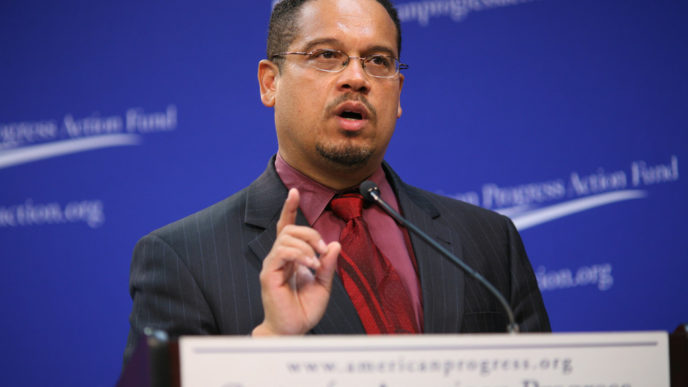
As the Democratic National Committee meets in Atlanta to select its next chairman, the frontrunner for the position — extremist Rep. Keith Ellison, D-Minn. (F, 26%) — represents the leftist radical fringe’s complete takeover of the party. In a survey of DNC members, Ellison leads his nearest rival with nearly twice the support.
Ellison, the first Muslim American elected to Congress, has built a coalition of support across the DNC spectrum. He is the favorite of the Bernie Sanders, I-Vt. (F, 17%) wing of the party while simultaneously garnering the endorsements of progressive icons such as Sen. Elizabeth Warren, D-Mass. (F, 18%) and leadership figures like Senate Minority Leader Chuck Schumer, D-N.Y. (F, 2%).
All this to say, it is clear most of the Democratic Party has abandoned any pretense of operating in the mainstream. Just how radical is Rep. Keith Ellison?
This is a man who:
once compared the 9/11 terror attacks to the Reichstag fire (though later he retracted those remarks) to attack President George W. Bush as a dictator;
previously and repeatedly advocated on behalf of the Muslim Brotherhood-affiliated CAIR;
compared school choice to Jim Crow laws; and, among of things,
holds every radical liberal position on abortion, on amnesty for illegal aliens, on gun control, on environmental statism.
As if his radical positions weren’t enough to disqualify from leadership in a rational party, Ellison’s disturbing ties to radical Islam ought to give his Democratic colleagues pause. But they don’t. Nor does Ellison’s past relationship with the radical Louis Farrakhan, who perpetually makes the most disturbing anti-Semitic comments possible.
“I want to disabuse the Jews today of the false claim that you are the chosen of God — that Israel or Palestine belongs to you,” Farrakhan recently said at a Nation of Islam conference in Detroit, to the applause of the crowd. He continued, saying:
I want to disabuse you of that. I want to make it so clear and I’m going to tell you about your future. You that think you have power to frighten and dominate the peoples of the world. I’m here to announce the end of your time.
Ellison also shares Farrakhan’s anti-Israel sentiments.
“The United States foreign policy in the Middle East is governed by what is good or bad through a country of 7 million people. A region of 350 million all turns on a country of 7 million. Does that make sense?” Ellison said of the state of Israel at private fundraiser in 2010.
Even the liberal Anti-Defamation League has referred to those comments as “disqualifying.” And we’re supposed to believe President Donald Trump is the anti-Semite? As CR’s Jordan Schachtel noted:
We live in a strange world where actual anti-Semites are lecturing non anti-Semites on anti-Semitismhttps://t.co/FhRDbO8KK0
And all that is just the beginning of Ellison’s radicalism, as Conservative Review Editor-in-Chief Mark Levin has explained previously:
That the Democratic Party is even permitting Keith Ellison run for leadership is a disgrace. That he is so close to winning that leadership position shows how far gone the Democrats are in kowtowing to the most radical elements of the Left. (For more from the author of “No Room for You, Moderate Dems. DNC on the Verge of Appointing Extremist Ellison as Chair” please click HERE)
https://joemiller.us/wp-content/uploads/4794107292_3081bc8c71_b.jpg6831024Joe Millerhttps://joemiller.us/wp-content/uploads/logotext.pngJoe Miller2017-02-22 22:07:142017-02-22 22:07:42No Room for You, Moderate Dems. DNC on the Verge of Appointing Extremist Ellison as Chair
President Donald Trump’s tortured relationship with the spoken word can lead to problems. Case in point, his remarks about Sweden at a rally in Melbourne, Florida on Saturday night. While Trump seemingly made a remark about a recent terrorist attack in Sweden, what he meant was the reported uptick in crime in migrant centers in the country. His remarks have ignited a firestorm online. I try to wade through it all to present to you what is exactly “going on in Sweden.”
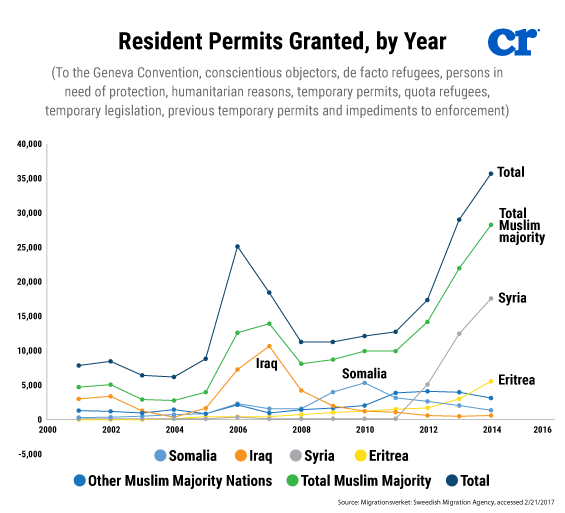
If President Trump is right and there is a growing Islamic migrant caused crime wave in Sweden, the first step is to define when the surge in refugees from predominately Muslim countries started to spike in the country. Migrationsverket, the Swedish Migration Agency, has published country of origin data from 1980 to 2014 (pdf). This data does not include 2015, which saw the highest level of asylum seekers in the recent history of the nation.
Migrationsverket breaks out nine Muslim majority countries in their data set. Those countries are Kosovo, Somalia, Afghanistan, Bangladesh, Iraq, Iran, Lebanon, and Syria. It is clear that the Syrian civil war and ISIS has created a significant uptick in refugees from Syria, beginning in 2012. Prior to that year, immigration from that country was negligible. The second largest number of migrants come from the Horn of Africa with Eritrea and Somalia combining for close to 6,900 persons. The agency has not yet compiled country of origin for the roughly 160,000 asylum seekers that entered in 2015, but there are reports that have placed the Syrian number at over 50,000.
The recent surge in refugees caused Sweden, in the middle of 2016, to toughen its rules. The New York Times reported that Sweden took steps to curb the open door policy it had in place. The country was on pace to admit 200,000 refugees in 2016, or two percent of its population, the majority of whom were from Muslim majority countries.
Does this dramatic uptick in migrants starting in 2012 have anything to do with crime in Sweden? That’s where it gets complicated. As Politfact noted, Swedish authorities do not break out crime data by immigration or refugee status. So it is impossible to determine if any crime increase can be definitively linked to migrants.
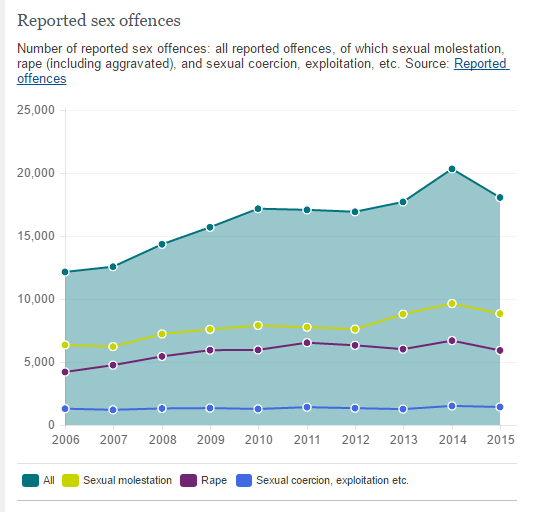
What is apparent however, despite the media cherry-picking two years 2014 and 2015, is the significant increase in the number of reported sexual assault and homicides that have coincided with the increased numbers of migrants. According to the Brå, which reports Swedish crime statistics, reported sexual assaults have increased from 17,077 cases in 2011 to 18,057 in 2015. They peaked in 2014 at 20,326, which was 19 percent higher than in 2011. Preliminary data from 2016 show a reported 20 percent increase in sexual “molestation” from 2015, according to Brå numbers. Rapes increased by 13 percent from 2015 to 2016 according to the same preliminary report.
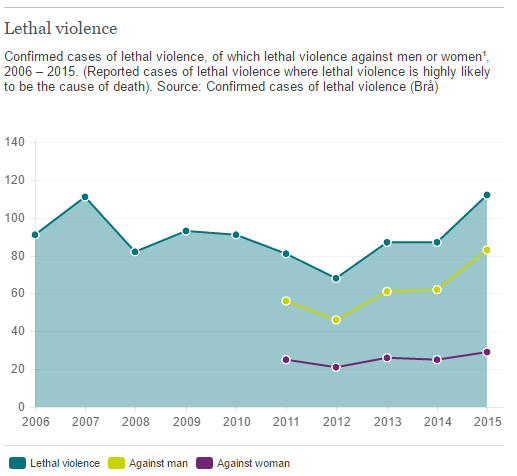
Similarly, according to Brå, lethal violence has shown an increase. Lethal violence is described as murder, manslaughter, or assault that results in death. In 2011 there were 81 instances of lethal violence reported; in 2015 there were 112 cases. This is an increase of 38 percent. From 2014 the increase was almost 29 percent. Lethal crimes data for 2016 will not be available until the end of March according to Brå.
The data does show an uptick in violent crime, particularly sexual assault and lethal crimes that coincides with the increased migrant wave. That fact is undeniable and buttressed by the data from Swedish authorities. The media, who have cherry-picked the drop in reported sexual assaults from 2014 to 2015, are misleading with their reporting. But there are also two critical pieces of data missing: 2016 assault numbers, and a breakdown of crime by immigration status. Without those data points, both sides of the argument have cases to be made.
There is certainly a significant amount of anecdotal evidence to buttress the claims of increased violence by migrants in Sweden. Most significantly is the documentary by Ami Horowitz which kicked off the current news cycle. Horowitz was interviewed by Tucker Carlson the day before President Trump made his statement.
Horowitz, with on-the-ground reporting, shows a very different picture than what the MSM or Swedish authorities want you to believe.
In Norway, a bordering Scandinavian country, the authorities recently produced a guide on how migrants should treat women. This was a direct result of a rise in rapes that accompanied a similar increase in migrants.
A spring 2016 Pew poll showed that a whopping 88 percent of Swedes disapprove of the way the European Union, of which Sweden is a member, is handling the refugee crisis. That is the second highest number after Greece, which has been a first port of entry for many migrants as they make their way through Europe. The next highest is 77 percent in Italy.
No matter where the debate here in America stands on the issue, it is clear the Swedish people are concerned about migration to their country. That is why, as previously mentioned, the government took extraordinary means to limit refugee settlement after a long history of virtually open borders. This action happened shortly after the Pew poll was conducted.
The data clearly show an uptick in sexual assaults, and lethal crimes since the massive increase in refugees to Sweden from majority Muslim countries. It is careful to remember that correlation does not always equal causation. Until Sweden publishes data which includes the immigration status and country of origin in their crime statistics, on-the-ground experience will continue to drive the narrative. Politifact and other “MSM fact checkers” owe it to their readers to paint a complete picture. (For more from the author of “What the Mainstream Media Won’t Tell You About Donald Trump and Crime in Sweden” please click HERE)
https://joemiller.us/wp-content/uploads/Swedish_police_vans_in_Stockholm.jpg19442592Joe Millerhttps://joemiller.us/wp-content/uploads/logotext.pngJoe Miller2017-02-22 21:58:312017-02-25 22:35:19What the Mainstream Media Won’t Tell You About Donald Trump and Crime in Sweden
What happens when courts create faux rights, such as the “right” for foreign nationals to immigrate, the “right” for states to demand more immigrants from the federal government, the “right” for illegal aliens to obtain driver’s licenses, or the “right” to 15 days of early voting?
Inevitably, the courts overlook the most foundational of rights that are written in plain English — the ones that serve as the foundation of our republic. Last week, it was a state court in Washington violating the property and conscience rights of those who don’t service homosexual ceremonies. Today, it is the courts infringing upon the one right that pre-dated the Bill of Rights and is written in the most unambiguous and absolute terms: “shall not be infringed.”
As is always the case, after conservatives secured a 2-1 victory at the Fourth Circuit last year against Maryland’s “assault weapons” ban, the full en banc panel upheld the law. In a 10-4 ruling – one which was full of vengeful rhetoric over Sandy Hook and ignorance of the distinction between a machine gun and a ‘scary looking’ semi-auto — the court ruled that Maryland could ban 45 commonly held weapons as well as magazines that hold more than 10 rounds. “We have no power to extend Second Amendment protection to the weapons of war that the Heller decision explicitly excluded from such coverage,” wrote a brazen Judge Robert B. King. Every Democrat appointee except for Judge William Traxler (who wrote the dissent) and one GOP appointee joined the majority opinion.
Following the Sandy Hook shooting, states like Maryland, New York and Connecticut banned a multitude of semi-automatic rifles containing cosmetic features that make them look scary. Some states also required forced registration of those firearms already owned by private citizens. Additionally, they banned magazines that hold more than 10 rounds. Yet, despite almost a decade since the Heller decision, the lower courts have been allowed to chip away at this foundational right. Thus far, the Second, Fourth, Seventh, and Ninth Circuits have all ruled that almost any common gun or magazine in use can be banned by a state if the pistol grips and picatinny rails on the rifles look scary. Additionally, the Second, Third, Fourth, Ninth, and Tenth Circuit Courts have each ruled there is no right to self-defense outside the home — in contravention of the plain language of the Heller decision.
As I’ve written before, the notion that any common weapon can be banned violates the inalienable right to self-defense, which predated the Second Amendment. It is a natural right. Yet, given that we live in a world where rights come from the Supreme Court, we should at least ensure that lower courts properly read the text of the Heller decision. Here is what Scalia wrote in the majority opinion:
We know of no other enumerated constitutional right whose core protection has been subjected to a freestanding “interest-balancing” approach. The very enumeration of the right takes out of the hands of government—even the Third Branch of Government—the power to decide on a case-by-case basis whether the right is really worth insisting upon. A constitutional guarantee subject to future judges’ assessments of its usefulness is no constitutional guarantee at all. Constitutional rights are enshrined with the scope they were understood to have when the people adopted them, whether or not future legislatures or (yes) even future judges think that scope too broad.
Thus, contrary to the Fourth Circuit’s opinion, this case has already been addressed by Heller. There is no government “interest balancing” for perceived benefits of public safety that can justify the infringement upon the right to self-defense for any commonly held weapon used for lawful purposes.
Judge William Traxler, in a rare display of intellectual honesty for a Democrat appointee, laid out the consequences of this case in plain English:
Today the majority holds that the Government can take semi automatic rifles away from law-abiding American citizens. In South Carolina, North Carolina, Virginia, West Virginia and Maryland, the Government can now tell you that you cannot hunt with these rifles. The Government can tell you that you cannot shoot at targets with them. And, most importantly, the Government can tell you that you cannot use them to defend yourself and your family in your home. In concluding that the Second Amendment does not even apply, the majority has gone to greater lengths than any other court to eviscerate the constitutionally guaranteed right to keep and bear arms.
Indeed, in the case of lower courts upholding sweeping gun bans, the silence of more than three justices willing to grant cert to petitioners (it takes four) is deafening. As Justice Thomas has noted in his dissent on the denial of cert on the two previous assault weapons bans, the other justices (presumably Roberts and Kennedy included) are clearly allowing the Second Amendment to become a second-class right. And Roberts was allowing this to happen even when Scalia was on the court. Thus, don’t expect this to change after Gorsuch takes his seat on the high court.
What this decision demonstrates, once again, is that not only does stare decisis (precedent) only hold true for liberal Supreme Court rulings, but it fails to bind even the lower courts to opinions it doesn’t like. This is the same rationale the Ninth Circuit used to trash 200 years of settled case law when they created a right to immigrate.
Protecting gun rights from heavy-handed laws in blue states is practically the only benefit left for conservatives to keep the practice of judicial review. Yet, the past five years of gun cases has demonstrated that the courts will never serve as a legitimate venue for us to protect real rights. As such, why empower them to create phony rights for protected classes and dangerous rights for foreign nationals? (For more from the author of “Bastards on the Bench: Fourth Circuit Limits Second Amendment Right to Possess Common Firearms” please click HERE)
https://joemiller.us/wp-content/uploads/gun-on-ground.jpg14401920Joe Millerhttps://joemiller.us/wp-content/uploads/logotext.pngJoe Miller2017-02-22 21:51:012017-02-25 22:13:24Bastards on the Bench: Fourth Circuit Limits Second Amendment Right to Possess Common Firearms
For years, establishment media outlets have ignored the uptick in violence against Jews nationwide. Now that Donald Trump is president, they use anti-Jewish hate in America as a tool to attack the White House’s legitimacy.
Jewish Community Centers throughout the country have been on the receiving end of bomb threats, forcing school closures and a tense environment in these local areas. In one recent high-profile incident, a Jewish graveyard was vandalized. Though the perpetrators of these crimes have yet to be identified, many media and left-wing institutions have decided that Trump is to blame for these incidents.
The Anne Frank Center for Mutual Respect, an obscure far-left institution based in New York City, has utilized the namesake of the Holocaust victim to bash the entire White House as an anti-Semitic administration. Their statement, which includes sentences like: “The anti-Semitism coming out of this Administration is the worst we have ever seen from any Administration,” has been picked up by countless media outlets, few of which point out the organization’s extreme left-wing platform.
President Trump is many things, but an anti-Semite he is not. For decades, he has been a very public figure, and the media is yet to find a single file that proves Trump has ever fanned the flames of anti-Semitism.
Trump’s children, Ivanka, Eric, and Donald Jr., are all married to Jews. His top advisors are Jews. His closest friends are Jews. His Mar-a-Lago club (in the city of Palm Beach, where Jewish entry to many of institutions is still blocked to this day) and his many other properties encourage Jewish membership. He has been incredibly supportive of the Jewish state of Israel. Simply put, there is *zero* evidence that Donald Trump has ever said or done anything explicitly anti-Semitic. He is, by all accounts, a close friend of the Jewish community.
In November 2016, the FBI released its annual hate crime data for the year 2015. Of the 1,402 victims of anti-religious hate crimes in 2015, over 52 percent were Jewish. From 2014 to 2015, hate crimes against Jews shot up nine percent. Year after year, the vast majority of anti-religious hate crimes have targeted Jews, although American Jews account for only two percent of the U.S. population.
But in reporting on anti-Jewish hate crimes that occurred under the auspices of President Obama, the mainstream media either completely ignored the facts or buried the most important information. Never did anyone in the media ever ask if Barack Obama was to blame for a supposed anti-Jewish climate growing in America.
When the FBI report came out while Obama was still in office, showcasing that more than half of all anti-religious hate crimes targeted Jews, the New York Times headline on the data read: “U.S. Hate Crimes Surge 6%, Fueled by Attacks on Muslims.” The Washington Post echoed the Times report, using the title: “Hate crimes against Muslims hit highest mark since 2011.” The Post story made no mention that Jews accounted for the vast majority of victims. Politico headlined its story: “FBI: Hate crimes against Muslims in U.S. jump 67 percent in 2015”. CBS News utilized an almost identical title. The Boston Globe, NBC News and several others followed suit with comparable titles.
Mainstream media outlets appeared very concerned with the rise of anti-Muslim violence (as they should be), but breezed completely over the most common victims of anti-religious hate crimes.
Until Donald Trump became president, much of the media didn’t seem to care that Jews were overwhelmingly the majority of victims of anti-religious hate crimes. Now, the media utilizes consistent widespread anti-Semitism as a tool to target Trump. (For more from the author of “The Media Ignores Anti-Semitism Unless It’s a Tool to Target President Trump” please click HERE)
https://joemiller.us/wp-content/uploads/Donald_Trump_2016.jpg14771498Joe Millerhttps://joemiller.us/wp-content/uploads/logotext.pngJoe Miller2017-02-22 21:37:192017-02-22 21:37:19The Media Ignores Anti-Semitism Unless It’s a Tool to Target President Trump
As if on cue, riots broke out in a heavily immigrant suburb of Stockholm as soon as the media mocked President Donald Trump for a vague warning about immigration-related problems in Sweden.
At a campaign rally over the weekend, Trump issued forth with a mystifyingly ominous statement. “You look,” he declared, “at what’s happening last night in Sweden.” What? Had the president invented a nonexistent terror attack? As it turned out, the reference was to a segment on Sweden he had watched on the Fox News show Tucker Carlson Tonight the previous night rather than to any specific event in the Nordic country . . .
By welcoming a historic number of asylum-seekers proportionate to its population, Sweden has indeed embarked on a vast social experiment that wasn’t well thought out and isn’t going very well. The unrest in the Stockholm suburb of Rinkeby after police made an arrest the other night underscored the problems inherent in Sweden’s immigration surge . . .
Sweden welcomed more than 160,000 asylum-seekers in 2015, and nearly 40,000 in October of that year alone. For a country of fewer than 10 million, this was almost equal to 2 percent of the population — in one year. The flow doubled the number of asylum-seekers at the height of the Balkans crisis in 1992 . . .
There is a stark gap in the labor-force-participation rate between the native born (82 percent) and the foreign born, (57 percent). As the Migration Policy Institute points out, Sweden is an advanced economy with relatively few low-skills jobs to begin with. On top of this, high minimum wages and stringent labor protections make it harder for marginal workers to find employment, while social assistance discourages the unemployed from getting work. (Read more from “What’s Happening in Sweden” HERE)
https://joemiller.us/wp-content/uploads/8696786470_a59af959a0_b.jpg7681024Joe Millerhttps://joemiller.us/wp-content/uploads/logotext.pngJoe Miller2017-02-22 20:29:202017-02-22 20:29:20What’s Happening in Sweden
Have you ever watched a movie where the good guy got framed for what the bad guy did and you felt morally indignant, desperate to see justice done and the horrible wrongs made right? That’s how I feel when I see social madness in our country, wondering to myself, “How can this go on in front of our eyes? What kind of craziness is this?”
Let me give you several cases in point.
Transgender Activism in a Texas High School
In Texas, a 17-year-old girl who identifies as a boy is taking testosterone supplements as she begins to “transition” to being male. (She currently identifies as a boy named “Mack” Beggs and is referred to as “he” in a relevant article about her.) She is in the news because she wrestles on the girls’ team and just won a tournament when her opponent in the finals forfeited because the other girl’s parents protested the match.
And they had every reason to protest.
Beggs is taking performance enhancing drugs, and in a physically-taxing sport like wrestling, the differences are all the more tangible. That’s why the lawsuit brought by the parents of another female wrestler urged the governing body to suspend Beggs “because of the use of the steroid. The suit claims that allowing the wrestler to compete while using testosterone exposes other athletes to ‘imminent threat of bodily harm.’”
This is not rocket science, and Beggs would not be allowed to compete in a college-level or Olympic or professional match while on steroids. (Is this why Beggs is undefeated this season?)
Steroids and other performance enhancing drugs are banned for logical, obvious reasons, yet logic seems to stop at the door when it comes to transgender activism.
Accordingly, Beggs’ grandmother (and guardian), rather than recognizing how unfair this all was to the other girls who worked so hard to be there, could only say, “Today was not about their students winning. Today was about bias, hatred and ignorance.”
This is absolute nonsense, and while my heart goes out to young “Mack” and I truly want to see her find wholeness without sex-change surgery and a lifetime of hormones, I reject the notion that her struggles should now be imposed on the other female athletes.
Shame on the school system for letting this happen.
Allegations of Gay Bullying in the WNBA
To give another example from the sports world, we are constantly reminded of the struggles experienced by gay athletes, to the point that Michael Sam, the first openly gay player drafted by the NFL, blamed the NFL’s alleged homophobia on his failure to make it at the highest level of the sport.
Of course, it makes perfect sense that other players would be uncomfortable around him once he announced he was homosexual. After all, they are strong young men in the prime of life who work out together and play together and shower and undress next to each other and who horse around in manly ways. Why should they be expected to feel perfectly at home with an openly gay player, even if they did their best to ignore this and behave as professionals?
Today, however, we’re hearing about something very different.
An article about former WNBA player Candice Wiggins states, “There is a ‘very, very harmful’ culture running throughout the WNBA, she says, which saw her get bullied during her eight-year career because she is heterosexual.”
She claims that, “Me being heterosexual and straight, and being vocal in my identity as a straight woman was huge. I would say 98 percent of the women in the WNBA are gay women. It was a conformist type of place. There was a whole different set of rules they [the other players] could apply.”
And, she alleges, “People were deliberately trying to hurt me all of the time. I had never been called the B-word so many times in my life than I was in my rookie season. I’d never been thrown to the ground so much. The message was: ‘We want you to know we don’t like you.’”
Could this be true?
If it is, even if her estimate about the percentage of lesbian players is too high, don’t expect her story to get much traction in the news. After all, straights are never the victims, only gays are the victims, and because Wiggins is straight and therefore part of the dominant culture, she can’t be the victim. Straights are the bullies, so suck it up, lady, and stop complaining.
As this story gets more responses, we’ll see if my theory holds true.
NFL, NBA Threaten Texas
How about one more from the sports world before I get to the most egregious example of all?
Back in Texas, the NFL and NBA have warned the state that if they pass a bill similar to North Carolina, which, among other things, forbids boys who believe they are girls from playing on girls’ sports teams or using the girls’ bathrooms, locker rooms, and showers, the state will be severely punished by the leagues.
Responding to the NFL, which was the first to threaten Texas, Gov. Greg Abbott said, “The last thing the NFL needs to do is to get into the business of telling states how to operate their own political operations.” Indeed.
And what will the NFL and NBA (and NCAA and others) do if state after state does the right thing and protects the privacy and rights of its citizens? Hopefully, we’ll find out in the years ahead as the pushback against radical LGBT activism continues.
USDA Officials Order Christian Business Owner to Hide His Beliefs on Marriage
Finally, in Michigan, a Christian business owner experienced an absolutely outrageous example of government overreach. As explained by Tony Perkins, “Donald Vander Boon has been operating a meatpacking center in Michigan for almost 15 years — but thanks to the federal government, it’s his freedom that’s getting butchered.”
What happened is truly shocking (and should send shock waves across the country).
When USDA officials were touring the plant for an inspection:
They noticed a handful of brochures on the break room table about natural marriage. As Don tells it, the article was mixed in with the stacks of newspapers celebrating the recent Supreme Court decision redefining marriage. Even so, the on-site officers took offense to the literature, walked into Don’s office, closed both doors, and told him they’d call off the inspection if the material wasn’t removed.
So, the Christian owner of a meatpacking center employing 45 workers was given an ultimatum by USDA officials — who were there to inspect the meat operation, not the beliefs, of Vander Boon — telling him that if he didn’t remove the material on marriage, there would be no inspection, as a result of which the center would be shut down.
Yes,
According to inspectors, Don’s article was “offensive” and had violated a new rule from the Obama administration that gave government officials (including these inspectors) the right to take “immediate and appropriate corrective action” when dealing with anything they considered “harassment.” Vander Boon’s position on marriage, he was told, qualified.
In his own words, “It’s made me realize how quickly we can lose our religious liberty. I never dreamed that I would have this experience, and that I would have USDA personnel telling me that I had to choose between putting an article on the break room table or my business.”
Today, more than 18 months after this event took place, despite ongoing legal efforts by the ADF, the Department of Agriculture has not changed its policy or responded to Vander Boon’s rightful concerns. Perhaps this is coming to your business next?
There’s a reason I and others have been sounding the alarm for years now, seeking to wake up a slumbering church and a complacent society.
If these latest examples don’t jolt readers into reality, I wonder what will.
Honestly, I hate to imagine.
So, let’s pray and act today lest tomorrow’s news makes today’s news look relatively mundane.
God have mercy on America. (For more from the author of “Latest Examples of Cultural and Governmental Bullying: Church, Wake Up” please click HERE)
https://joemiller.us/wp-content/uploads/13206083313_54d98bafda_b.jpg6831024Joe Millerhttps://joemiller.us/wp-content/uploads/logotext.pngJoe Miller2017-02-22 20:24:332017-02-22 20:24:33Latest Examples of Cultural and Governmental Bullying: Church, Wake Up
A suicide bomber who attacked a military base in Iraq this week was a former Guantanamo Bay detainee freed in 2004 after Britain lobbied for his release, raising questions about the ability of security services to track the whereabouts of potential terrorists.
The Islamic State group identified the bomber as Abu Zakariya al-Britani, and two British security officials also confirmed the man was a 50-year-old Briton formerly known as Ronald Fiddler and as Jamal al-Harith.
He was one of 16 men paid a total of 10 million pounds (now worth $12.4 million) in compensation in 2010, when the British government settled a lawsuit alleging its intelligence agencies were complicit in the torture of prisoners at Guantanamo Bay, according to the officials. (Read more from “Iraqi Suicide Bomber Was Ex-Gitmo Detainee” HERE)
Department of Homeland Security (DHS) officials tried to hack Indiana’s state electoral system with at least 14,800 “scans” or hits between Nov. 1, 2016, to Dec. 16, 2016, The Daily Caller News Foundation Investigative Group has learned.
The attacks are the second confirmed IT scanning assault by DHS officials against states that resisted then-President Barack Obama’s attempt to increase federal involvement in state and local election systems by designating them as “critical infrastructure” for national security.
Members of the National Association of Secretaries of State voted Saturday at their winter meeting to oppose the designation. They are asking President Donald Trump to overturn it.
Former Indiana Gov. Mike Pence was also Trump’s vice presidential-elect during much of the period covered by the DHS scans of the Indiana system.
Indiana Secretary of State Connie Lawson, the incoming president of the association, told The DCNF Tuesday that, “we know that between November 1 and December 16 we were scanned with about 14,800 scans, nearly 15,000 different times.” (Read more from “Obama’s Feds Tried to Hack Indiana’s Election System While Pence Was Governor” HERE)
https://joemiller.us/wp-content/uploads/16066418144_ac1a61d1c3_b-2.jpg6831024Joe Millerhttps://joemiller.us/wp-content/uploads/logotext.pngJoe Miller2017-02-22 20:17:132017-02-22 20:17:13Obama’s Feds Tried to Hack Indiana’s Election System While Pence Was Governor
At a time when President Donald Trump’s administration is reportedly considering cuts to public broadcasting, one Democrat governor already has proposed to eliminate taxpayers’ subsidies for his state’s TV and radio affiliates.
West Virginia Gov. Jim Justice’s budget proposal would cut state funding for the West Virginia Public Broadcasting, or WVPB, from $4.6 million all the way down to zero.
Justice’s fiscal year 2018 budget proposal is aimed at closing a $500 million revenue shortfall. It also includes about $450 million in new tax hikes.
“You’re faced with a $500 million hole in the bucket,” Justice told the state Legislature earlier this month. “And the next year is a $700 million hole in the bucket … We’ve got an 18 carat dog’s mess, don’t we? We do. I didn’t create the dog’s mess. I have inherited the dog’s mess. And I am telling you, you have to have real direction and real ideas and real cooperation together to be able to get out of this.”
Justice went on to broadly talk about making spending cuts and tax hikes painless, but didn’t specifically address public broadcasting during his State of the State address.
Justice’s spokesman Grant Herring didn’t return multiple phone calls and emails from The Daily Signal on Wednesday.
WVPB CEO Scott Finn referred The Daily Signal to Herring for all questions.
The state’s portion of the funding makes up almost half of the WVPB’s $10 million budget, according to Friends of West Virginia Public Broadcasting and the West Virginia Public Broadcasting Foundation, which advocate on behalf of and raise private money for the state’s public broadcasting.
A statement from the organizations’ chairs read, “such a drastic and immediate cut threatens the very existence of our state’s PBS and NPR stations.”
“This state cut would translate into layoffs of up to 75 percent of our staff, which would endanger our ability to operate,” read the statement from Friends of WVPB Chairwoman Susan C. Hogan and WVPB Foundation Chairman Ted Armbrecht.
About $4.2 million of the $4.6 million covers the salaries and benefits for WVPB’s 71 employees, according to the Charleston Gazette-Mail.
Hogan told The Daily Signal the organization has hired a lobbyist and a marketing director to galvanize public support.
“Alternative ways [for WVPB] to exist would be as a private nonprofit. The other is to become part of a university,” Hogan told The Daily Signal. “The former would take years to get to that point. The latter would take intense negotiation.”
The state Legislature is holding hearings and drafting its own budget proposal, said Jared Hunt, spokesman for West Virginia House Speaker Tim Armstead, a Republican. For now, the speaker doesn’t have a specific position on public broadcasting. But, it’s ultimately up to the governor, Hunt said.
“Even if we do restore the funding, the governor does have line-item veto power and if he wanted to, he could take that funding back out,” Hunt told The Daily Signal. “If he wanted to take that funding back out in the final version of the budget bill, that is his prerogative. A lot will depend on what the governor’s perspective is at the time.”
Taxpayers, whether at the state or federal level, shouldn’t have to fund what is heavily liberal-leaning programming, said Mike Gonzalez, a senior fellow at The Heritage Foundation.
“Whether it’s state or federal, all taxpayers shouldn’t be expected to fund such marked bias,” Gonzalez told The Daily Signal. “They have been criticized for this for years, and their only defense is ‘No, we’re not [biased].’”
Trump met Wednesday with his budget team at the White House, as the president plans to present a budget proposal in the near future. News reports say he intends to privatize the Corporation for Public Broadcasting, the agency that oversees the TV network, Public Broadcasting System, as well as National Public Radio.
U.S. taxpayers spend $445 million annually on the Corporation for Public Broadcasting.
In brief remarks from the White House, Trump didn’t address any specific detail other than cutting waste and getting spending under control. Office of Management and Budget Director Mick Mulvaney and Treasury Secretary Steven Mnuchin sat on each side of the president, while other top advisers were also in the Roosevelt Room with him.
“The finances of this country are a mess but we’re going to clean that up,” Trump said. “I will be holding everybody accountable for that.”
Gonzalez thinks PBS and NPR could do well as private nonprofits.
“It is unfair and unwise to fund any media organization that ignores the philosophy and arguments of one-half of the country,” Gonzalez added. “I think their membership model for raising money works. I think they would survive and thrive on their own.”
Hogan contends that public broadcasting is essential for the America.
“[The Corporation for Public Broadcasting] is the spirit and soul of America,” Hogan said. “You tell me a cable station that does what PBS does.” (For more from the author of “Democrat Governor Wants to Cut Taxpayer Funding for Public Broadcasting to Zero” please click HERE)
https://joemiller.us/wp-content/uploads/NPR_Headquarters_Building_Tour_33180_10714293993.jpg16883008Joe Millerhttps://joemiller.us/wp-content/uploads/logotext.pngJoe Miller2017-02-22 20:11:432017-02-22 20:11:43Democrat Governor Wants to Cut Taxpayer Funding for Public Broadcasting to Zero
The Trump administration acted Wednesday night to fix the Obama administration’s unlawful “gender identity” school policy and return authority to parents and teachers in the states.
Civil rights officers in the Department of Justice and the Department of Education issued a joint letter saying the administration was rescinding the policy, which had required schools to allow transgender students to use the restrooms, locker rooms and similar facilities of their choice—or face loss of federal funds.
In the letter, they said the Obama mandate did not show “due regard for the primary role of the states and local school districts” in making education policy.
The Trump administration is doing the right thing in correcting Obama’s unlawful overreach, which imposed a one-sided solution on all 50 states. Parents and teachers in local schools now can work to find win-win solutions that protect the dignity, privacy, and safety of all students.
For years, the Obama administration unilaterally had redefined bans on “sex” discrimination to include “gender identity.”
The problem came to a head May 13, when Obama’s Justice and Education departments sent a “Dear Colleague” letter to our nation’s schools, informing them that “both federal agencies treat a student’s gender identity as the student’s sex for purposes of enforcing Title IX,” a 1972 law prohibiting sex discrimination in federally funded schools.
With this decree, the Obama administration directed all schools to allow “students to participate in sex-segregated activities and access sex-segregated facilities consistent with their gender identity.”
Schools were told they had to allow students access to bathrooms, locker rooms, dorm rooms, and hotel rooms for overnight field trips based entirely on the self-declared gender identities of their students.
On Aug. 21, U.S. District Judge Reed O’Connor ruled the Obama administration’s attempt to redefine sex was unlawful, and blocked the decree from going into effect.
O’Connor held that it “cannot be disputed that the plain meaning of the term sex as used … following passage of Title IX meant the biological and anatomical differences between male and female,” and he placed a nationwide injunction on the administration’s guidance to schools.
The Justice Department, under Attorney General Loretta Lynch, appealed this ruling Oct. 20.
But on Feb. 10, with Jeff Sessions as the nation’s new attorney general, the Justice Department withdrew that motion for a stay and cancelled the scheduled oral arguments.
The Trump administration rescinded the Obama guidance saying officials would interpret the word “sex” in Title IX to mean “gender identity.” Instead, the administration will allow parents and teachers to work together in local schools to find nuanced solutions that address the needs of everyone.
Wednesday night’s moves signaled a change in position that could have a significant impact on the Justice Department’s controversial Title IX lawsuit against North Carolina’s Public Facilities Privacy & Security Act (known as HB2), which the Trump administration inherited.
The actions also could affect a Title IX gender identity case, currently set for oral argument at the Supreme Court next month, that depends in large part on the Department of Education’s position.
Dignity, Privacy, and Safety Concerns
Last week at The Heritage Foundation, a panel of women explained the many policy problems with “gender identity” laws.
As one of them said, “when gender identity wins, women always lose.”
The panelists—a rape survivor, a lesbian, a feminist activist, a stay-at-home mom, and a conservative—explained how people who identify as transgender should be free to live as they want, but that the law shouldn’t therefore eliminate women-only spaces or redefine what it is to be a woman.
While we must be sensitive to the dignity, privacy, and safety concerns of people who identify as transgender, that is not a reason to ignore the dignity, privacy, and safety concerns of everyone else.
Unfortunately, the Obama-era policies were entirely one-sided. They favored the concerns of people who identify as transgender while entirely discounting the concerns of others.
Safe Spaces for Women, a group that “provides survivors of sexual assault with care, support, understanding, and advice,” recently submitted an amicus brief to the Supreme Court explaining how gender identity policies can negatively impact sexual assault survivors:
Safe Spaces for Women has a strong interest in ensuring that the voices of women who have suffered sexual abuse are heeded when policies are made that may directly affect their physical, emotional, and psychological well-being. This includes policies that require educational institutions covered by Title IX to admit to female showers, locker rooms, and restrooms biological males who identify as female. While Safe Spaces for Women bears no animus toward the transgendered community, it is deeply concerned that … survivors of sexual assault are likely to suffer psychological trauma as a result of encountering biological males—even those with entirely innocent intentions—in the traditional safe spaces of women’s showers, locker rooms, and bathrooms.
The brief goes on to note that the guidance from the Obama administration was issued “without giving those affected a voice in the process. … improperly circumvent[ing] the notice and comment process when that process was needed most.”
Likewise, Kenneth V. Lanning, a 40-year veteran law enforcement officer who specialized in sex crimes for the FBI at Quantico for 20 years, explains the problem with “gender identity-based access policies” for sex-specific intimate facilities.
Lanning says “the problem with potential sex offenses is not crimes by transgendered persons,” but rather “offenses by males who are not really transgendered but who would exploit the entirely subjective provisions” of such policies “to facilitate their sexual behavior or offenses.” Lanning explains that:
Allowing a man, based only on his claim to be [a] transgendered woman, to have unlimited access to women’s rest rooms, locker rooms, changing rooms, showers, etc. will make it easier for the type of sex offense behavior previously described to happen to more women and children. Such access would create an additional risk for potential victims in a previously protected setting and a new defense for a wide variety of sexual victimization.
Indeed, as The Daily Signal previously noted, such sexual victimization already is occurring by men who have disguised themselves as women.
What to Do Now
Wednesday night’s actions by the Justice and Education departments will lead to good policy outcomes, which is why it should not be limited to Title IX.
The Trump administration should extend this decision to every area where federal agencies have imposed new “gender identity” rules on the American people without basis in law, without congressional authorization, without considering legitimate countervailing concerns, and without the support of the American people.
Congress should make such administrative actions permanent by reintroducing and passing H.R. 5812, the Civil Rights Uniformity Act, which clarifies that the term “sex” does not mean “gender identity” for the purpose of interpreting civil rights statutes. This would have the benefit of undoing the past and current abuses of Title IX, as well as preventing future abuses of other civil rights law.
Passing the Civil Rights Uniformity Act would ensure that unelected bureaucrats and judges would not get to unilaterally reshape policy affecting women and girls. It would allow schools to continue providing separate bathroom and locker room facilities and sports teams based on biological sex, not gender identity.
It also would address other unilateral Obama-era “gender identity” reinterpretations in health care, emergency shelters, housing, and employment. At the same time, such legislation would properly leave states and private entities entirely free to provide nuanced, sensitive, and reasonable accommodations of people who identify as transgender.
Up until last year’s prime-time interview of the celebrity then known as Bruce Jenner, few Americans ever had had a conversation about transgender issues. It’s a conversation we need to have.
But the Obama administration tried to shut down these discussions before they’ve even begun. The Obama administration attempted to force a one-size-fits-all policy on the entire nation rather than allow parents and teachers and local schools the time, space, and flexibility to find solutions that work best for everyone.
The Trump administration has taken the first steps to correct this.
While the Obama administration attempted to rewrite law to impose a federal “gender identity” policy on the entire nation, the Trump administration is respecting federalism, local decision-making, and parental authority in education.
For most Americans, concerns related to transgender students are a new reality. Rather than follow the Obama administration’s rush to impose a top-down solution on the entire country, the Trump administration is allowing the American people to have these conversations, consider all the relevant concerns, and make policies that will best serve all Americans.
Good for them. (For more from the author of “Trump Right to Fix Obama’s Unlawful Transgender School Policy” please click HERE)
https://joemiller.us/wp-content/uploads/5440603914_97c06d6eaa_b-1-1.jpg6831024Joe Millerhttps://joemiller.us/wp-content/uploads/logotext.pngJoe Miller2017-02-22 20:08:152017-02-22 20:08:15Trump Right to Fix Obama’s Unlawful Transgender School Policy