Tuesday night on his radio show, Conservative Review Editor-in-Chief Mark Levin defended President Donald Trump against the media’s baseless allegations that he is promulgating anti-Semitism in America.
Levin reminded the audience of the anti-Israel, anti-Jewish policies put in place by the Obama administration, such as the Iran nuclear deal and massive immigration from Jew-hating countries.
“We’re told Trump is not only tolerating anti-Semitism taking place in this country, but is encouraging it through his supporters,” Levin said. “Encouraging it through his supporters? No, that would be Barack Obama.”
Levin continued, reminding the mainstream media about the Obama policies they ignored that have resulted in anti-Semitic activity.
“That would be the new immigrants in this country from parts of the Arab and Muslim world” and those “who have taken over college campuses and shut down speech, particularly any speech that supports Israel” Levin added. “That would be some of the leftists in this country who are trying to lead an economic boycott of Israel.”
“The Left is filled with bigotry. The Left is filled with poison. It is the Left that’s filled with violence,” he said. (For more from the author of “Levin Reminds Trump’s Media Critics Who the Real Anti-Semitic President Was” please click HERE)
https://joemiller.us/wp-content/uploads/Mark_Levin_tips_hat-1.jpg17222199Joe Millerhttps://joemiller.us/wp-content/uploads/logotext.pngJoe Miller2017-02-21 22:25:152017-02-21 22:25:15Levin Reminds Trump’s Media Critics Who the Real Anti-Semitic President Was
The media pounced on President Trump after he declared Saturday that large-scale immigration in Sweden is not working out. Appearing at a campaign rally in Florida, the President defended his ban on immigrants from dangerous countries.
We’ve got to keep our country safe. You look at what’s happening in Germany. You look at what’s happening last night in Sweden. Sweden! Who would believe this? Sweden! They took in large numbers, they’re having problems like they never thought possible.
Swedish authorities immediately responded with denials, and much of the media media fixated on his reference to “last night.” Trump clarified later that he was referencing an episode of Tucker Carlson Tonight, which had aired the night before.
My statement as to what's happening in Sweden was in reference to a story that was broadcast on @FoxNews concerning immigrants & Sweden.
Rising Number of Rapes and Violence in Sweden, Largely by Muslim Immigrants
This was all an exercise in diversion from this glaring fact: Sweden’s increase in violence comes largely from the large influx of Muslim immigrants entering the country.
Rapes have increased by an alarming 250 percent since 2003, rising from 24.9 cases of reported rapes per 100,000 inhabitants to 66.5 last year. Reports of sexual molestation incidents increased by a “striking” 20 percent between 2015 and 2016, reaching 10,500 in 2016.
Örebro Police investigator Peter Springare says the crimes are mostly committed by Muslim immigrants. On February 3, he wrote on Facebook, “Mohammed, Mahmod, Ali, again and again.” Springare is now reportedly under criminal investigation for “incitement to racial hatred.“
In January, Malmö Police Chief Stefan Sinteus issued a desperate plea for help combating “the upward spiral of violence.” The city is composed of 32 percent immigrants. British UKIP leader Nigel Farage refers to Malmö as “the rape capital of Europe.”
Over the past 15 years, Sweden has taken in 650,000 immigrants seeking asylum. About 35,000 claimed to be “unaccompanied minors,” but could very well be young men disguising their age in order to improve their chances of not being deported.
Many are unemployed and jobless, straining the country’s welfare system. According to the Swedish Migration Agency, another 25,000 to 45,000 immigrants are expected this year.
Videos of the rioting and burning uploaded to YouTube reveal the extent of the violence, and contradict the media’s claims there has been no increase in violence. Rioters often outnumber the police, as they throw stones at the officers and beat them up.
What’s Really Happening
In the video below, a Swede in Rinkeby contradicts Swedish politicians and media reports. She says there isn’t a large police presence; they show up after the riots calm down. Law enforcement has set off 55 no-go zones, she reports. Law enforcement will not go into them unless in large patrols. The left-leaning media denies the existence of the no-go zones.
Videos show the radical Islamists plotting against law enforcement. They will plant a bomb in a trash can, then put it on fire. When the fire department comes to put out a fire, the bomb explodes on them. Similarly, they set traps for the police. They will report a rob and throw rocks at them.
The woman goes on to say that Trump’s remarks were accurate. In fact, the reason the violence doesn’t make the news is because it’s so prevalent. “There aren’t any headlines about this kind of stuff,” she explains, “since it’s so common.” Additionally, the Swedish politicians who deny it’s happening are “too proud … to admit they got it wrong. … They want to believe that they are so morally superior to everyone else that their multiculturalism can’t fail and that their feminism can’t fail.”
Rape as Jihad
Such violence by Muslim immigrants is not unique to Sweden. The problem is cropping in other European countries that have welcomed immigrants from Muslim countries. Writing in Algemeiner, Abigail R. Esman described the infamous New Year’s Eve attacks on women in Cologne, Germany, as “a different kind of terrorist attack.” Muslims in Europe have long exhibited misogyny, abuse and sexual exploitation of women, writes Esman, author of Radical State: How Jihad Is Winning Over Democracy in the West.
All of these trends have paved the way for sexual violence as a natural weapon for jihad in the age of ISIS. Indeed, we’ve seen it used not just in the mass gang rapes in Europe in recent years, but in the sexual enslavement of Yazidi girls in Syria and Iraq. We’ve seen it further in ISIS propaganda that even encourages its male members to rape women to bring them “closer to Allah.”
Thirty years ago, political and media elites might have been able to hide this. But they can’t prevent ordinary citizens from recording violent riots and arson with their smart phones and uploading the footage to YouTube and Facebook. The truth will get out. (For more from the author of “Fact Check: Trump Is Right. Violence Is Rising in Sweden” please click HERE)
https://joemiller.us/wp-content/uploads/burning-fire.jpg12801920Joe Millerhttps://joemiller.us/wp-content/uploads/logotext.pngJoe Miller2017-02-21 22:14:412017-02-21 22:14:41Fact Check: Trump Is Right. Violence Is Rising in Sweden
A federal judge ruled Tuesday that Texas can’t cut off Medicaid dollars to Planned Parenthood over secretly recorded videos taken by anti-abortion activists in 2015 that launched Republican efforts across the U.S. to defund the nation’s largest abortion provider.
An injunction issued by U.S. District Sam Sparks of Austin comes after he delayed making decision in January and essentially bought Planned Parenthood an extra month in the state’s Medicaid program.
Texas is now at least the sixth state where federal courts have kept Planned Parenthood eligible for Medicaid reimbursements for non-abortion services, although a bigger question remains over whether President Donald Trump will federally defund the organization. (Read more from “Judge Blocks Texas Cutting Medicaid to Planned Parenthood” HERE)
Donald Trump made his success in the building trade. One of the key reasons he speaks so plainly and bluntly to ordinary voters is the many years he spent jawboning with construction workers and foremen. So let’s hope he understands this metaphor: Just as you can’t put up a great building with shoddy materials and lazy workmanship, you can’t make America great again if the government you run is attacking that country’s building blocks. If the foremen and workers you’re paying are putting too much sand in the concrete, or using tin instead of structural steel, the building that you end up with is doomed to collapse.
If your appointees and agencies are hunting down and executing the “little platoons” that make ordered liberty possible, your country will fall apart. As founding father John Adams said, “Our Constitution was made only for a moral and religious people. It is wholly inadequate to the government of any other.”
America will not be rejuvenated but ruined if Trump doesn’t act to support the First Amendment Defense Act and protect the kind of people who made America great — people like Barronelle Stutzman, the Washington florist who faces destruction because she politely declined to take part in a same-sex wedding.
A small business owner, churchgoer, and faithful Christian, she pretty much defines the kind of citizen that keeps our country going. They give to charity at higher levels than other people. They are more likely to stay faithful to their spouses. Their kids join the military, police and fire department. They volunteer for civic-minded projects, and sign up for neighborhood watches. They believe in Christian mercy but also insist on justice — which is why so many of them voted for Donald Trump, in the hope that he would bring order to our country’s chaotic immigration process, and regain control of our borders. They love their country, their city, their neighborhood, their family, and God.
The ACLU Didn’t Build America. People of Faith Did.
These are the heirs of the Pilgrims, who sailed across an ocean and planted a colony in the howling wilderness, rather than live under a government where unaccountable bureaucrats could demand that they violate their conscience. They’re the heirs of the Abolitionists, who smuggled escaping slaves along the Underground Railroad, to flout an unjust law. They’re heirs of the suffragists, who didn’t expect five judges to pervert the Constitution, but who worked through the system and played by the rules to change the Constitution to offer women the vote.
They’re the kind of people who joined the Civil Rights movement and worked with fellow Christians from very different backgrounds, of another race, to demand that the Constitution keep its promise to every American. They’re the kind of people today who pray outside abortion clinics and run crisis pregnancy centers. Drive by some government-funded murder mill early on Saturday morning, and look at those people’s faces. Whom will you see? Dozens and dozens of people like Barronelle Stutzman.
Does President Trump really want to side with the narrow-eyed fanatics who defend partial-birth abortion, and open borders, and massive bureaucratic interference with every American’s life? Those are the kind of people who support the American Civil Liberties Union — the organization that stands to benefit from seizing Ms. Stutzman’s 401k, and auctioning off her home. They’re the people who put on those sickening hats and threw a national tantrum the day after Trump’s inauguration. They rioted in Berkeley, or cheered the rioters on as they skimmed the MSM headlines while sipping their pumpkin lattes. They regard Trump’s presidency as illegitimate, and will seize any excuse to claim that the election was hacked or stolen. They want to silence free speech on campus and impose their arrogant, secular agenda in every nook and cranny of American life.
Mr. President, You Must Pick a Side
And to do that, they must destroy all the Barronelle Stutzmans. They will use whatever power they can grab hold of, from perversions of federal law like the Obama administration’s gay hijack of the Civil Rights Act, to education bureaucrats’ perverted, transgendered reading of Title IX. They use corporate power to blackmail non-profit organizations like the Boy Scouts, and their dominance of the media to blacken the names of good, innocent people who happen to disagree with them — and get them fired.
These kind of arrogant cynics thought it would be clever to use Obamacare to bankrupt Catholic nuns, and close down Hobby Lobby. They tried to use Title IX in California to shutter Christian colleges. They will use force, fear, or fraud without compunction, because they believe that they serve the abstract demands of “justice” and “liberation,” and that the end justifies the means. It was lawyers like this who wrote the briefs that sank President Trump’s sensible executive order on immigration, and who serve on the Ninth Circuit Court that wrote that absurd decision. Reporters who think like this are spinning “fake news” about the president every single news cycle, distorting and mocking every word that comes out of his mouth.
Mr. President, you need to pick a side: The Barronelle Stutzmans of America, who voted for you and trusted you and just want to live in peace — or the arrogant, strutting elites who hate her and everyone like her, and who hate you even more. Will you stand up for your supporters, the people who made America great, and can make it great again? Or will you cave in to the bullies who oppress her, and reject you?
We are waiting for your answer. (For more from the author of “You Can’t Make America Great Again by Destroying Americans Like Barronelle Stutzman” please click HERE)
https://joemiller.us/wp-content/uploads/27150179783_fef4b857d2_b.jpg6831024Joe Millerhttps://joemiller.us/wp-content/uploads/logotext.pngJoe Miller2017-02-21 22:03:452017-02-21 22:03:45You Can’t Make America Great Again by Destroying Americans Like Barronelle Stutzman
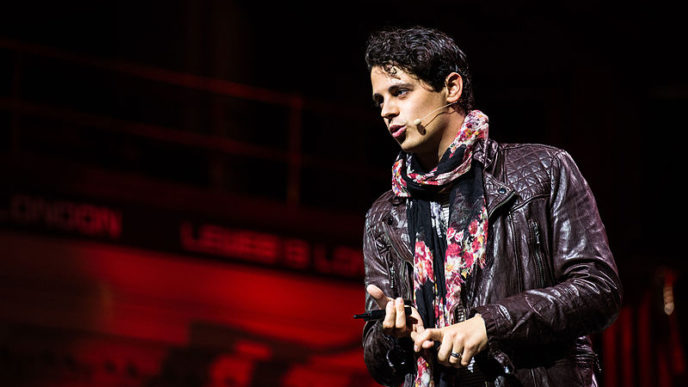
Polarizing writer Milo Yiannopoulos resigned as an editor at Breitbart News on Tuesday and apologized for comments he had made about sexual relationships between boys and men . . .
He said he was resigning from Breitbart, which helped make him a star, because it would be “wrong to allow my poor choice of words to detract from my colleagues’ important reporting.”
The apology followed days of criticism from fellow conservatives after the release of video clips in which Yiannopoulos appeared to defend sexual relationships between men and boys as young as 13. (Read more from “Milo Yiannopoulos Apologizes for Remarks, Quits Breitbart” HERE)
The Department of Homeland Security will make prioritization key in its beefed-up enforcement of the border and the interior of the country—removing criminals first, while more recent arrivals will also face expedited removal.
However, critics call it “mass deportation” that will face a legal challenge.
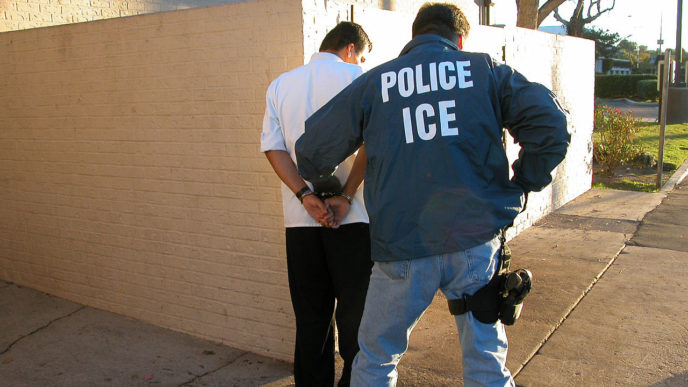
Homeland Security Secretary John Kelly released implementation memos to agencies to enforce President Donald Trump’s executive orders he signed in January. A key new policy is expanding the number of illegal immigrants subject to “expedited removal” procedures if an illegal immigrant can’t provide evidence they have been in the country for more than two years.
Among other matters, the memos call for moving forward on building a border wall, hiring more Customs and Border Protection agents to stop illegal border crossings, and adding more Immigration and Customs Enforcement agents to police the interior. Also, the Victims of Immigration Crime Engagement Office was established within ICE.
White House press secretary Sean Spicer said the actions Tuesday demonstrate the administration is serious about making the country safer.
“The message from this White House and from DHS is that those people who are in this country and pose a threat to our public safety and committed a crime will be the first to go and we will aggressively be making sure that occurs,” Spicer said during the White House press briefing.
The DHS actions are a welcome change from the Obama administration that interfered with immigration enforcement, said Ira Mehlman, spokesman for the Federation for American Immigration Reform, a pro-enforcement group. But, Mehlman added, the emphasis on prioritizing dangerous illegal immigrants is “a lot like the Obama administration.”
“The past administration put a priority on criminals and those that just entered the United States,” Mehlman told The Daily Signal. “The difference is that the Obama administration just focused on recent arrivals at the border, and sent them back. That’s important, but we also need serious interior enforcement.”
The policies won’t survive a court challenge, said Omar Jadwat, director of the Immigrants’ Rights Project at the American Civil Liberties Union.
“These memos confirm that the Trump administration is willing to trample on due process, human decency, the well-being of our communities, and even protections for vulnerable children, in pursuit of a hyperaggressive mass deportation policy,” Jadwat said in a public statement. “However, President Trump does not have the last word here—the courts and the public will not allow this un-American dream to become reality.”
More than likely, the implementation orders have solid legal ground, said Josh Blackman, an associate professor at South Texas College of Law Houston.
“There is probably not a strong challenge to the order Secretary Kelly signed, but a question of due process could come up regarding expedited removal,” Blackman told The Daily Signal. “If you’re picked up at the border and turned around there usually is no question. Expanding that to being picked up at the interior, that could arguably imply a stronger connection to the U.S. and require due process for removal.”
A legal challenge would have little merit, but doesn’t necessarily mean the administration will prevail, said Hans von Spakovsky, senior legal fellow at The Heritage Foundation.
“It is well within the administration’s authority, but anyone can file a lawsuit, and that won’t stop errant judges from acting,” von Spakovsky told The Daily Signal.
Spicer stressed that the administration is only enforcing immigration law as it would any other law.
Our job, especially here at the White House, isn’t to call balls and strikes and say this person only violated part of the law. If this was any other subject, if this was tax evasion and we said, ‘Well, they really only cheated on their taxes a little,’ you wouldn’t be saying should they be going to prison or should they be getting a fine. At some point laws are laws. If people have a problem with the law, whether it’s at the local, state, or federal, then we should petition our lawmakers and executives to change it. Our job should not be should this individual not have to abide by the law, should this individual get a pass?
(For more from the author of “Trump Targets Criminals, Late Arrivals in Immigration Enforcement” please click HERE)
Army Lt. Gen. H.R. McMaster is a perfect fit for the position of national security adviser, and it is no surprise that his selection by President Donald Trump has delighted many in the defense and national security community.
Trump announced Monday night that McMaster will replace Michael Flynn, the retired Army general who resigned a week ago after he admitted misleading the vice president about the content of a December phone call with the Russian ambassador.
McMaster is a scholar-warrior, much like two fellow flag officers serving in Trump’s Cabinet—retired Marine generals James Mattis and John Kelly.
McMaster is a brilliant strategist who has devoted his Army career to understanding military history and helping America’s armed forces learn from the mistakes of the past in order to fight more effectively in the future. One of us, Thomas Spoehr, can say this with confidence, having known him for many years.
Notably, McMaster wrote a 1997 book, “Dereliction of Duty,” which criticized top military leaders during the Vietnam War for failing to give their candid advice to the president and secretary of defense. As national security adviser, one of McMaster’s key roles will be to provide unvarnished advice to the president.
More recently, as commander of the 3rd Armored Cavalry Regiment during the Iraq War, McMaster led U.S. forces in beating back an insurgency that was running rampant in the western Iraqi city of Tal Afar, where al-Qaeda had taken control.
In an interview with National Geographic, he described the situation his troops, and the Iraqi people, faced in Tal Afar:
All the schools were closed because of violence, all the marketplaces were closed. There was no power. There was no water. The city was lifeless. People lived in abject fear.
What McMaster did next changed the course not only of one city, but the entire U.S. military strategy in Iraq. He invested in working directly with the Iraqi people and building trust in the U.S. military’s capability to eliminate terrorists threatening their livelihoods. He moved his troops off large bases and brought them in contact with local residents.
In so doing, McMaster contributed to laying the groundwork for a new counterinsurgency strategy implemented by Army Gen. David Petraeus that ultimately would lead to the neutralization of al-Qaeda in Iraq and increased stability throughout the nation.
This strategy was not popular at the time, yet McMaster recognized its potential and was unwavering in his drive to try a new approach. Remaining willing to re-examine strategies and plans is a key attribute for the national security adviser.
McMaster is also just as much a warrior as he is a scholar and brilliant intellectual. He served in the first Persian Gulf War, receiving a Silver Star for his leadership and bravery in the 1991 Battle of 73 Easting, the largest tank-on-tank battle since World War II.
In this 23-minute battle, McMaster’s company destroyed 28 Iraqi tanks, 16 personnel transports, and more than 30 trucks.
These accomplishments speak volumes about McMaster’s professionalism, leadership, and passion for defending America. He is an extraordinary choice to be national security adviser, and Trump was wise to select him.
Going forward, Americans can rest assured knowing that H.R. McMaster will be the man providing national security advice and options to the leader of the free world. (For more from the author of “Trump’s Stellar Pick for National Security Adviser” please click HERE)
It was Nobel laureate economist Milton Friedman who made famous the adage, “There’s no such thing as a free lunch.” Friedman could have added that there is a difference between something’s being free and something’s having a zero price.
For example, people say that there’s free public education and there are free libraries, but public education and libraries cost money.
Proof that they have costs is the fact that somebody has to have less of something by giving up tax money so that schools and libraries can be produced and operated. A much more accurate statement is that we have zero-price public education and libraries.
Costs can be concealed but not eliminated. If people ignore costs and look only to benefits, they will do darn near anything, because everything has a benefit. Politicians love the fact that costs can easily be concealed.
The call for import restrictions, in the name of saving jobs, is politically popular in some quarters. But few talk about the costs. We know there are costs because nothing is free.
Let’s start with a hypothetical example of tariff costs. Suppose a U.S. clothing manufacturer wants to sell a suit for $200. He is prevented from doing so because customers can purchase a nearly identical suit produced by a foreign manufacturer for $150.
But suppose the clothing manufacturer can get Congress to impose a $60 tariff on foreign suits in the name of leveling the playing field and fair trade.
What happens to his chances of being able to sell his suit for $200? If you answered that his chances increase, go to the head of the class.
Next question is: Who bears the burden of the tariff? If you answered that it’s customers who must pay $50 more for a suit, you’re right again.
In his 2012 State of the Union address, President Barack Obama boasted that “over 1,000 Americans are working today because we stopped a surge in Chinese tires.”
According to a study done by the Peterson Institute for International Economics, those trade restrictions forced Americans to pay $1.1 billion in higher prices for tires. So though 1,200 jobs were saved in the U.S. tire industry, the cost per job saved was at least $900,000 in that year. According to the Bureau of Labor Statistics, the average annual salary of tire builders in 2011 was $40,070.
Here’s a question for those of us who support trade restrictions in the name of saving jobs: In whose pockets did most of the $1.1 billion that Americans paid in higher prices go? It surely did not reach tire workers in the form of higher wages.
According to the Peterson Institute study, “most of the money extracted by protection from household budgets goes to corporate coffers, at home or abroad, not paychecks of American workers. In the case of tire protection, our estimates indicate that fewer than 5 percent of the consumer costs per job saved reached the pockets of American workers.”
There is another side to this. When households have to pay higher prices for tires, they have less money to spend on other items—such as food, clothing, and entertainment—thereby reducing employment in those industries.
Some people point out that other countries, such as Japan, impose heavy tariffs on American products. Indeed, Tokyo levies a 490 percent tariff on rice imports to allow Japanese rice growers to gain higher income by charging Japanese consumers four times the world price for rice.
Therefore, some suggest that Congress should even the playing field by imposing stiff tariffs on Japanese imports to the U.S. Such an argument differs little from one that says that because the Japanese government screws its citizens, the U.S. government should retaliate by screwing its own citizens.
Putting the issue in another context: If you and I are at sea in a rowboat and I commit the foolish act of shooting a hole in my end of the boat, would it be intelligent for you to retaliate by shooting a hole in your end of the boat? (For more from the author of “There’s Nothing Free” please click HERE)
One of the most inane arguments against constructing a border wall is that the estimated cost of $12-$15 billion is just too much to bear. As if liberals suddenly care about spending when it comes to defending our sovereignty, security, and society from the crushing human and fiscal costs of illegal immigration, terrorist infiltration, drug importation, and sex trafficking. It’s akin to refusing to pay for the water to preempt a fire from spreading to your neighborhood and burning down your house.
Now a new report from the inimitable Steve Camarota of the Center for Immigration Studies demonstrates how easily the wall will pay for itself by saving taxpayers the heavy costs of future illegal aliens successfully kept out of the country. Camarota finds that, at a lifetime cost of $74,722 per illegal alien, the border wall will pay for itself within the 10-year budget frame if it only succeeds in keeping out 9 to 12 percent of those expected to successfully cross in the next decade. And as I will demonstrate, border fences are almost fully effective in keeping out those who smuggle through non-legal points of entry. Plus, the lifetime cost of keeping out each alien is very likely much higher.
Border fences work spectacularly
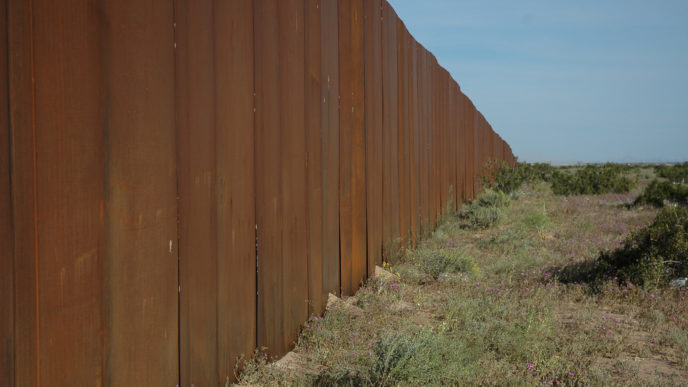
Once we establish the efficacy of a double-layered security barrier — similar to the one built in San Diego and Israel — it is simply indefensible to focus on the cost of the actual construction. Last month, we reposted my “Case for a Border Fence,” in which I prove conclusively that a double-layered security wall in the toughest areas serves as a force-multiplier.
The facts stand for themselves. A similar wall stopped almost 100% of the most committed Hamas terrorists in the West Bank and migrants on Israel’s southern border. The presence of such a security wall in the San Diego sector and a plain double (or triple) layered fence in the Yuma Sector reduced apprehensions by 95% and substantially reduced the flow of drugs. And most importantly, only a fraction of those two sectors — primarily in urban areas — have the double layered fence. Imagine if most of the sectors were sealed off?
We can see the effectiveness of fencing from a report published several months ago by the Senate Homeland Security Committee. Although there are only 35 miles of heavy duty double-layer fencing along the southern border, roughly one-third of the border has some form of fencing or vehicle barriers, with all but 100 or so miles being woefully inadequate. Nonetheless, the report found that while interdiction rates were over 50% across the border, they were as low as 5% in areas without any form of fencing. The history of the efficacy of fencing is “settled science,” as liberals like to say.
Thus, it’s quite evident that a fence would succeed in stopping a lot more than 9-12 percent of crossings. Camarota, however, just wanted to demonstrate how even a modest level of success would result in full savings. As Camarota noted, a full-proof wall, in his estimation keeping out 170,000 aliens per year, would actually save $64 billion over 10 years, which would mean taxpayers would recover the cost of the fence after just a few years’ worth of blocking illegal entry.
A wall stops hundreds of billions in unfunded liabilities and amnesty costs
But it gets better.
Camarota’s report uses data from the National Academies of Sciences, Engineering and Medicine to estimate the life-time fiscal impact (taxes paid minus services used) of immigrants by education level. He comes up with a sum of $74,722 per illegal-crosser. However, if the descendants of these illegal immigrants are factored in to the equation, the cost increases to $94,391 per illegal. And if different mythologies are used to calculate the life-time fiscal cost (not using net present value), the cost could be as high as $140,000-$150,000 per illegal, according to Camarota.
Moreover, there are more factors to consider when conducting a cost-benefit analysis of the wall. These numbers are merely comparing the cost of having a low-income migrant live here illegally vs. keeping that individual out. Liberals don’t merely oppose the border fence and allow illegals to come in only to remain here illegal. They want to give all these people amnesty, which will grant them access to welfare and entitlements. According to Robert Rector, “If amnesty is enacted, the average adult unlawful immigrant would receive $592,000 more in government benefits over the course of his remaining lifetime than he would pay in taxes.” That is eight times the cost of non-amnestied illegals residing in the country, per Camarota’s report.
Assuming a 95% success rate in deterring 170,000 immigrants, we could save roughly $100 billion a year relative to the cost of amnesty. Which means that just 6-8 weeks’ worth of deterring illegal entry would make building the fence more cost effective than amnesty.
A wall saves the cost of deportation, litigation, detention, and interior enforcement
The wall would likely save us from more than the estimated 170,000 illegals that evade the border patrol between points of entry. Until now we were only counting the fiscal cost of impoverished illegal immigrants who successfully infiltrate our borders and remain in the country undetected. In FY 2016, for example, 408,870 illegals were apprehended at or near the southern border. How many were not caught and successfully disappeared into the country? There is no way of telling for sure, but DHS estimated that in FY 2015 they apprehended 54% of those who infiltrated the country.
But even the 54% of illegals we supposedly apprehend every year are not free of charge. Not by a long shot. Many of them wind up successfully remaining in the country. According to recent data from the Syracuse University’s Transactional Records Access Clearinghouse (TRAC), nearly six in ten illegal aliens during the first ten months of FY 2016 were set free by immigration judges.
Even the ones we wind up deporting come at a big cost. They almost always surrender themselves to the border patrol, many of the children are let out of ICE custody, and even many families are now being released by the courts. The cost of the detention centers, the crushing burden on the courts, the education and health care for the Central American children, and the logistics of deportation all cost money. There is no better cost effective enforcement mechanism than a fixed impenetrable deterrent that prevents illegals from stepping foot on our soil in the first place. Not to mention the fact that it solves the political and legal arguments about deportation that invariably come into play the minute they enter our country.
Moreover, by focusing our investment in enforcement on a border wall, which is an up-front non-reoccurring cost for something that actually works, we will save billions in extra funding for the many other assets that have failed to secure the border. Just over the past decade, we have spent over $100 billion on different methods of security but to no avail — all to avoid the $12-$15 billion cost of building a double layer security barrier.
Thus, even if we say conservatively that roughly 700,000 illegals cross the border per year – including those apprehended and those who evade the border patrol – we can easily say that the life time cost of illegal immigration would be paid for within just a few weeks of a fence successfully deterring over 50,000 border crossings. And that is just the cost of illegal immigration.
Avoiding the cost of harmful drugs
According to the DOJ’s National Drug Intelligence Center, the economic cost of drugs in terms of crime, health care, and productivity is some $215 billion a year. And that was long before the recent opioid epidemic. The war on drugs has been a dismal failure in stopping drugs (although it has helped reduce crime across the board). However, there is one idea we never tried: keeping drugs out of America in the first place. The same wall that keeps out illegal immigrants and stopped Hamas terrorists will stop most drug smugglers.
The 800-pound gorilla in the room when it comes to analyzing the drug problem is the open southern border, and particularly the sectors with limited or no fencing. Almost every drop of marijuana seized by the feds in FY 2016 (99.8%) and 76% of cocaine came though the southern border. Of all the marijuana seized at the southern border, 82% was found in just two sectors: Tucson and Rio Grande (east Texas). Those are by far the two busiest corridors for illegal immigration and the sectors with the least meaningful fencing.
Remember the double-layered fence we mentioned earlier that was constructed in only part of the Yuma Sector? As a result, Tucson suffers from marijuana smuggling exponentially more than Yuma — by a factor of 22. Arizona has become the drug-smuggling capital of the country. From 2010 to 2015, heroin seizures in Arizona have increased by 207 percent, while methamphetamine seizures grew by 310 percent.
It’s hard to even calculate the tens of billions we would save every year as a result of plugging the hole and building a security wall in just those two sectors alone. In addition, according to the National Drug Threat Assessment, most of the heroin in this country, which is tearing our communities apart, is coming from Mexico. Obviously, we will never live in a utopia and a portion of the other drugs will come in through the maritime borders, with some drugs will be smuggled through cars passing legally over the border, but building the wall would go a long way in cutting the costs of the drug epidemic.
In addition to drug smuggling, the permanent presence of an impenetrable fence will deter the appalling sex trafficking cartel and terrorist smugglers. This has an enormous fiscal cost as well as a moral and national security cost. Also, to paraphrase DHS Secretary John Kelly at his confirmation hearing, “in America, some of us think of this drugs as leisure, but in Latin America they are killing their people.” And remember, every dollar of drug revenue that is lost to the Narco-terrorist gangs is a dollar less flowing into Islamic terror.
Anyone who wants to haggle over the price of the fence clearly has no understanding of the severe burden open borders has on our budget or doesn’t want to secure the border. (For more from the author of “New Report: A Border Wall Easily Pays for Itself With Its Own Effectiveness” please click HERE)
https://joemiller.us/wp-content/uploads/3370155351_cde8ae5644_b.jpg6811024Joe Millerhttps://joemiller.us/wp-content/uploads/logotext.pngJoe Miller2017-02-20 23:58:002017-02-25 22:36:36New Report: A Border Wall Easily Pays for Itself With Its Own Effectiveness
By Anika Smith. Yiannopoulos recently made headlines when social activists rioted at UC-Berkeley to prevent him from speaking.
He is back in the news today as conservatives register their outrage and disgust over recently surfaced comments he made defending pederasty and joking about molestation and sexual assault.
The Reagan Battalion posted a video yesterday bringing Milo’s comments to light.
Here is the uncut 5 minute video of Milo Yiannopoulos advocating for Pederasty involving "13 Year old" and "older men." HIS WORDS.@Mschlapppic.twitter.com/mAgmfpuyvu
Milo is a gay man noted for his outspoken support of Donald Trump, whom he calls “Daddy” for the sake of the reactions he gets. His schtick is posh-accented camp, and his reward is the outrage his comments trigger.
The right response should be easy enough: turn off, tune out, and don’t give Milo the attention he craves. Maybe spend that time reading about actual conservative intellectuals who are being punished for their beliefs. A good point from University of Washington president Ana Mari Cauce, who urged upset students not to ignore Milo but to “stay away” from his scheduled lecture there:
A. I never said “ignore,” I said “stay away.” There’s a difference. Look, this is a marathon, not a sprint. Folks need to think about how to use their energy and how to be strategic. What strategy do you want to use in what situation? The reason why I believed that he was not the most strategic thing to protest is that that’s what he feeds off, that’s what he makes money off.
Think about it for a second. If there had been no protest, what you’d see is a line of mostly white men, who might be described by some as “macho,” standing in line for hours to see a gay man in a boa in essence perform camp.
If CPAC wants to champion free speech on college campuses, they should have invited someone like Robert Oscar Lopez (also a Trump supporter, BTW), who has been hounded for his work advocating for children’s rights. As Lopez pointed out after the Berkeley riots, Milo’s campus lectures only serve to raise Milo’s profile, all while conservative professors are quietly expelled.
Instead of the positive reinforcement of a boycott or a protest of Milo, conservatives attending CPAC might choose to leave the hall quietly when he speaks, or taking to Twitter to champion those who fight against sexual assault in locker rooms, like the heroic Kaeley Triller Haver. Don’t forget what Milo said, and don’t forget that CPAC invited him to speak. But don’t give him the attention he wants. Don’t feed the trolls. (For more from the author of “SICK: Breitbart Writer Milo Yiannopoulos Celebrates Pedophilia, Disinvited From CPAC” please click HERE)
_______________________________________
Milo Yiannopoulos’s Pedophilia Comments Cost Him CPAC Role and Book Deal
By Jeremy W. Peters, Alexandra Alter and Michael M. Grynbaum. Milo Yiannopoulos, a polemical Breitbart editor and unapologetic defender of the alt-right, tested the limits of how far his provocations could go after the publication of a video in which he condones sexual relations with boys as young as 13 and laughs off the seriousness of pedophilia by Roman Catholic priests.
On Monday, the organizers of the Conservative Political Action Conference rescinded their invitation for him to speak this week. Simon & Schuster said it was canceling publication of “Dangerous” after standing by him through weeks of criticism of the deal. And Breitbart itself was reportedly reconsidering his role amid calls online for it to sever ties with him.
Mr. Yiannopoulos’s comments, which quickly created an uproar online over the weekend, put many conservatives in a deeply uncomfortable position. They have long defended Mr. Yiannopoulos’s attention-seeking stunts and racially charged antics on the grounds that the left had tried to hypocritically censor his right to free speech. (Read more from “Milo Yiannopoulos’s Pedophilia Comments Cost Him CPAC Role and Book Deal” HERE)