From Refugees to the Iran Deal: Will Congress Get Its Act Together Under President Trump?

For the latest evidence of the price the American people have paid for a feckless Republican Congress, look no further than the impunity with which the Obama administration is acting in a direct rebuke to the American people on one of the core national security concerns of our time.

Or was one of the central themes of the presidential election that Barack Obama’s party just lost not the need to assert American sovereignty and our national interest first by at least pausing immigration from jihadist hotspots?

Alas, it is only fitting that the swan song of this administration reads as follows: “Bring us your tired, your poor, your unvetted refugees.”

The news to which I am referring comes from a Fox report that the U.S. State Department has classified details on a deal the Obama administration cut with Australia resulting in the resettlement of approximately 2,500 refugees to the U.S. from countries such as Iran, Afghanistan and Iraq, among other Islamic supremacist-majority nations — refugees rejected by the Australians themselves.

There is the usual outrage around this deal, including the fact that the president has never articulated why it is in America’s national interest to import refugees from Islamic supremacist nations at a time when Islamic supremacists tell us they wish to infiltrate by embedding among such peoples. And what about the fact that our FBI director said we were incapable of vetting such refugees? Likewise, the Obama administration has remained mum rather than demanding that other Islamic nations take responsibility for absorbing such refugees given similarity in culture, the relative logistical ease with which such actions could be taken, financial wherewithal. Fundamentally, the Obama administration continues to show compassion for non-Americans over and above those who elected him.

A theme I raised in a recent piece in opposition to the choice of Senate Foreign Relations Cmte Chair Bob Corker, R-Tenn. (F, 45%) for secretary of state in President-elect Trump’s administration recurs in this story well, further reflecting the damage Sen. Corker has wrought and why he ought not to reach Foggy Bottom.

In a letter on the matter addressed to DHS Secretary Jeh Johnson and Secretary of State John Kerry, Sen. Chuck Grassley, R-Iowa. (D, 66%) and Rep. Bob Goodlatte, R-Va. (D, 64%) wrote “This situation is concerning for many reasons,” continuing “your departments negotiated an international agreement regarding refugees without consulting or notifying Congress.”

The very Senate treaty ratification power that readers will recall Sen. Corker turned on its head in the Iran Deal, essentially conceding the Senate’s check on the president’s seminal disastrous piece of foreign policy, is what the president relied on to negotiate this secret agreement. This follows the president’s neglect of the senate with respect to the Comprehensive Test Ban Treaty.

What fear should a president have when Congress fails to adequately use its oversight powers, powers of the purse, advice and consent and impeachment powers in the face of a rampantly lawless agenda?

A President Donald Trump is going to have to clean up President Obama’s numerous messes, and at every turn face a Democratic minority that unlike Republicans in the Obama years will have no fear of using every parliamentary and political trick and maneuver to thwart policy they do not like and corrupt that which they cannot stop.

But he is also going to have to deal with a Republican Congress that has shown itself to be lacking in spine for the last eight years.

The reassertion of Congressional power during the Trump years will certainly be a welcome thing.

Let us hope however that it is not so one-sided as to allow President Obama’s most disastrous actions to substantially survive. (For more from the author of “From Refugees to the Iran Deal: Will Congress Get Its Act Together Under President Trump?” please click HERE)

Follow Joe Miller on Twitter HERE and Facebook HERE.

Wrong Kind of Black? Twitter Libs Can’t Handle Ben Carson’s HUD Appointment

News broke Monday morning that President-elect Donald Trump will nominate former presidential rival Dr. Ben Carson to be his Secretary of Housing and Urban Development.

And the immediate reaction from many on social media was incredulous skepticism.

A few people cited statements made by Carson spokesman Armstrong Williams indicating that Dr. Carson felt he was unqualified to hold a cabinet-level position. Williams told the Hill that “Dr. Carson feels he has no government experience, he’s never run a federal agency. The last thing he would want to do was take a position that could cripple the presidency.”

Carson clarified his position in a November 15 Facebook post, indicating that his decision not to seek a cabinet position “has nothing to do with the complexity of the job as is being reported by some news outlets.”

It seems the president-elect convinced Dr. Carson to change his mind. And now Carson is being mercilessly ridiculed.

But here’s the thing:

Yeah, that’s definitely not happening.

The tolerance mob out in full force to nuke this appointment today. As for Dr. Carson, he’s just “honored” to serve.

(For more from the author of “Wrong Kind of Black? Twitter Libs Can’t Handle Ben Carson’s HUD Appointment” please click HERE)

Follow Joe Miller on Twitter HERE and Facebook HERE.
Japanese Prime Minister’s Pearl Harbor Visit Will Further Reconciliation

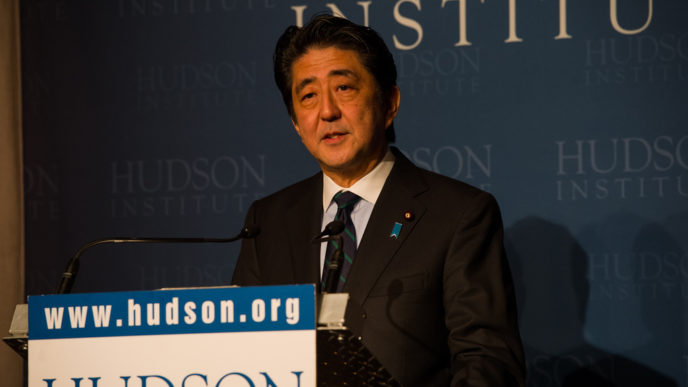
Japanese Prime Minister Shinzo Abe announced he would travel to Pearl Harbor later this month, the first Japanese leader to do so.

Abe commented he would accompany President Barack Obama to “pay tribute [and] comfort the souls” of those who died from both countries during World War II.

He emphasized his intent to “send messages about the importance of reconciliation” between the U.S. and Japan, former wartime enemies who became strong allies.

Abe’s visit, if not a quid pro quo for Obama’s visit to Hiroshima in May, makes a fitting counterpart to that trip, marking the alpha and omega of World War II in the Pacific.

In that sense, the two trips serve the same purpose as the USS Missouri, the location of the August 1945 signing of the treaty ending World War II, which is now moored next to the wreck of the USS Arizona, which was sunk during the December 1941 attack on Pearl Harbor.

Abe’s remarks at Pearl Harbor will be scrutinized for indications of Japanese remorse for its wartime hostilities. But Abe has already made several speeches striking a contrite tone.

During an April 2015 visit to Washington, he commented on his visit to the World War II Memorial, highlighting the battles of Pearl Harbor, Bataan, Corregidor, and the Coral Sea.

The prime minister expressed “eternal condolences” and “deep repentance” for the “lost dreams and lost futures of those young Americans.” Abe acknowledged “our actions brought suffering to the peoples of Asia, and vowed again to “uphold the views expressed by the previous prime ministers.”

In August 2015, Abe commemorated the 70th anniversary of the end of World War II by releasing a statement to make amends to Japan’s neighbors. Abe went further in acknowledging Japan’s wartime actions.

In December 2015, Abe and South Korean President Park Geun-hye were able to forge an agreement that provided a foundation for reconciliation of difficult historic issues arising from Japan’s 1910-1945 occupation of the Korean Peninsula.

America is often accused of having a short memory. But World War II remains a bedrock historic era and a lodestar for America’s sense of who we are as a country.

Pearl Harbor made clear that isolationism was not a viable way to avoid the dangers of the world. Withdrawing from the world and raising the drawbridge did not deter America’s enemies. The same is true today.

The United States arose phoenix-like from the devastation of Pearl Harbor and America’s “Greatest Generation” endured the crucible of war to bring peace and stability to the Pacific.

The U.S. and Japan overcame the animosity of conflict to become enduring partners and allies. That dichotomy is both a realization of Thomas Jefferson’s warning that “the price of freedom is eternal vigilance” and a symbol of what democracies can achieve together. (For more from the author of “Japanese Prime Minister’s Pearl Harbor Visit Will Further Reconciliation” please click HERE)

Follow Joe Miller on Twitter HERE and Facebook HERE.

Obama Administration Not Finished yet With Executive Actions, Regulations

On Monday, President Barack Obama issued his fifth executive order since the Nov. 8 election. In this case, it was to create a National Invasive Species Council to compile a report by 2020 on how to prevent such species from affecting climate change, food safety, and even military readiness.

Citing national security concerns, Obama issued another order on Friday blocking Chinese firm Fujian Grand Chip from buying Aixtron, a German company operating in California that produces crystalline layers used as semiconductors in U.S. weapons systems.

Executive orders aren’t the only means for Obama to act without Congress before he leaves office on Jan. 20.

A new policy on highly skilled immigrants, restrictions on for-profit colleges, and energy efficiency standards are among the matters that the administration wants that don’t require congressional authorization that the Obama administration is moving aggressively in the post-election to complete before Obama exits on Jan. 20.

Executive actions and administrative regulations were planned and considered before the election and not a result of Republican Donald Trump’s victory, White House press secretary Josh Earnest said at a White House press briefing, noting executive actions and regulations take “a lot of preparation.”

“I’m not going to rule out additional executive actions that the administration may take between now and January 20—after all, the president of the United States is the president of the United States until Jan. 20,” Earnest told The Daily Signal, adding:

But what I can rule out are any sort of hastily added executive actions that weren’t previously considered that would just be tacked on at the end. But are there some actions that have been in the pipeline for quite some time that could be announced between now and Jan. 20? That possibility certainly exists, but I don’t have anything to preview at this point.

Politico reported the list of Obama administration actions before leaving office includes:

A U.S. citizenship and immigration policy to make it easier for employers to sponsor highly skilled immigrants;

An Education Department policy to provide debt relief to students at for-profit colleges;

The Transportation Department is moving to ban cellphone calls on commercial flights;

The Occupational Safety and Health Administration could limit exposure to beryllium, a metal used in electronics and aerospace industries believed to pose lung cancer risks; and

The Department of Health and Human Services is seeking to change how doctors and hospitals get paid for administering drugs under Medicare Part B.

The fact that Trump could overturn much executive or administrative actions doesn’t appear to have caused pause, as the Federal Register has grown by 9,000 pages since Nov. 8, said Ryan Young, a fellow with the Competitive Enterprise Institute.

Gina McCarthy, the Environmental Protection Agency administrator, seemed eager for more action in a memo to staff sent to employees after the Nov. 8 election, which was obtained by the Washington Examiner.

“As I’ve mentioned to you before, we’re running—not walking—through the finish line of President Obama’s presidency,” McCarthy wrote. “Thank you for taking that run with me. I’m looking forward to all the progress that still lies ahead.”

Whether the regulations or executive actions are hasty shouldn’t really be the key question, said James Gattuso, a senior research fellow who studies regulatory issues for The Heritage Foundation.

“As far as I’m concerned, if it takes a long time to adopt rules or actions, or if they fly through the process, it doesn’t matter if it’s a bad rule,” Gattuso told The Daily Signal.

Regulations, he said, can be more tedious to overturn than executive orders or executive actions. However, the 1996 Congressional Review Act could be used to roll back many of those regulations, Gattuso said.

The law allows Congress, with the president’s signature, to scrap regulations it opposes, bypassing previous legal procedures in place, while forbidding bureaucrats from imposing rules that are substantially the same.

“No president is willing to sign a bill overturning their own regulation, but they are willing to overturn their predecessor’s regulations,” Gattuso said. “This is a once in a decade chance, really a once in several decades’’ opportunity, to roll back regulations.”

House Majority Leader Kevin McCarthy, R-Calif., and 21 House committee chairmen warned against a rush for regulations in a letter to agency heads, pledging to used the Congressional Review Act if need be. The Nov. 15 letter from House Republicans said:

As you are aware, such action often involves the exercise of substantial policymaking discretion and could have far-reaching impacts on the American people and the economy. Considering these potential consequences, we write to caution you against finalizing pending rules or regulations in the administration’s last days.

By refraining from acting with undue haste, you will ensure that agency staff may fully assess the costs and benefits of rules, making it less likely that unintended consequences will harm consumers and businesses.

Moreover, such forbearance is necessary to afford the recently elected administration and Congress the opportunity to review and give direction concerning pending rulemakings.

Should you ignore this counsel, please be aware that we will work with our colleagues to ensure that Congress scrutinizes your actions—and, if appropriate, overturns them—pursuant to the Congressional Review Act.

On Nov. 8, the Federal Register contained 78,300 pages, and as of Dec. 2, it had increased to 87,297 pages, Young said. Further, since Election Day, there were 144 new proposed regulations from federal agencies, and 243 regulations that were finalized.

“We could see a midnight rush the likes of which we haven’t seen before,” Young, of the Competitive Enterprise Institute, told The Daily Signal. (For more from the author of “Obama Administration Not Finished yet With Executive Actions, Regulations” please click HERE)

Follow Joe Miller on Twitter HERE and Facebook HERE.

The Next Brexit? Italy ‘No’ Vote Empowers Populist Revolt Against Establishment

Daniel Hannan, a British politician and a leading campaigner of Brexit, recognizes the forces that he says inspired Sunday’s referendum result in Italy, where the center-left prime minister resigned after voters rejected his proposed reforms.

“The obvious parallel with these elections is you carry a tremendous handicap if you are associated with the old regime in any sense,” Hannan told The Daily Signal. “Voters understandably feel patronized and lied to and ignored and disdained and they responded in this way.”

In a year when Britons voted to leave the European Union and Americans chose Donald Trump as president, the global populist movement claimed its latest victim Sunday when Prime Minister Matteo Renzi resigned after Italian voters rejected constitutional changes backed by his government.

Renzi had proposed to reduce the power of the Senate, the upper house of Parliament, to streamline the political system, create more stability, and accelerate growth in Europe’s fourth-largest economy. Italy has had 63 governments in 70 years.

But critics, empowered by an opposition campaign waged by the upstart, euroskeptic Five Star Movement party, said Renzi’s plan would put too much power in the prime minister’s hands.

The opposition capitalized on similar discontent that fueled the results in Britain and the U.S.

Italy is plagued by low growth, and its banking system has been in crisis for a decade. The country’s youth unemployment rate is around 35 percent, and young people soundly rejected Renzi’s reforms.

Italy is also contending with a tide of refugees and migrants from North Africa (more than 170,000 people have arrived in Italy so far in 2016).

While Renzi’s fall will not lead to the immediate takeover of Italy by a populist figure or party like the Five Star Movement, experts say the result of the election will reverberate across a European Union already shaken by anti-establishment anger.

“I certainly think there are common elements here,” said Robert Kahn, a senior fellow for international economics at the Council on Foreign Relations, in an interview with The Daily Signal, adding:

This populist wave we are seeing—by which I mean frustration, alienation, and rejection of mainstream politicians and institutions—was certainly part of the ‘no’ vote. While there are a constellation of factors, part of this is Italians using the referendum to lodge a protest vote against their government and policies. In that sense, it does rhyme with Brexit.

Change in Italy will be slow in coming since Renzi’s center-left Democratic Party remains in control of Parliament and national elections do not have to be called until 2018.

Though the Five Star Movement—which leans left, not right—advocates a referendum to determine whether Italy should give up its eurozone membership, observers say it would be difficult for the party to gain the power to make that happen. That’s because Italy’s mainstream political parties may aim to change voting laws to make it tougher to rule without a wide coalition.

The Five Star Movement and its leader, Beppe Grillo, a comedian-turned-politician, have said they won’t govern in a coalition government with traditional political parties.

Yet even without an immediate shake-up in Italy, 2017 promises to be an important year in determining the future of the European concept of integration.

European Union members Germany, France, and the Netherlands have elections next year with euroskeptic and populist candidates in the running.

Last week, President Francois Hollande of France, a socialist, said he won’t seek re-election in 2017, opening up the race to succeed him, which will include Marine Le Pen of the rising far-right populist National Front party.

German Chancellor Angela Merkel, who has presided over Europe’s strongest economy since 2005, will run for a fourth term in next year’s election. But she and her Christian Democratic Union party are under siege because of her decision to accept almost 1 million refugees and migrants from Syria, Afghanistan, Iraq, and other countries.

“In France and even in Germany, you have alternative parties that have extremely different visions of what Europe should be,” Kahn said. “It’s dramatic, it’s scary, and it’s threatening to the current union.”

Some say there are limits to the influence of anti-establishment anger.

They point to another election result on Sunday, where a center-left presidential candidate in Austria easily defeated his far-right challenger.

Andrea Montanino, director of the Global Business and Economics Program at the Atlantic Council and a former board member of the International Monetary Fund, says talk of Italy leaving the euro and the downfall of the union is premature.

“It’s important to differentiate this event from the rest,” Montanino told The Daily Signal in an interview. “This is part of the Italian normal legislative process. It will of course impose some instability for a while, but this is not a Brexit.”

On Monday, the day after the referendum in Italy, financial markets recovered from an initial scare that Renzi’s departure would lead to political stability, with stocks and the euro both rebounding in value.

Hannan, one of the architects of Brexit, said “there are too many uncertainties” to predict Italy will leave the euro.

But he said voters, like in Britain, sent a powerful message.

“The lesson is if you give people a choice between corporatist euro technocrats and angry populists, you aren’t going to like their verdict,” Hannan said. (For more from the author of “The Next Brexit? Italy ‘No’ Vote Empowers Populist Revolt Against Establishment” please click HERE)

Follow Joe Miller on Twitter HERE and Facebook HERE.
Can Donald Trump and Betsy DeVos Really End Common Core?

On the campaign trail, President-elect Donald Trump made big promises about getting rid of Common Core. “We’re going to end Common Core, we’re going to have education an absolute priority,” he said in a campaign video.

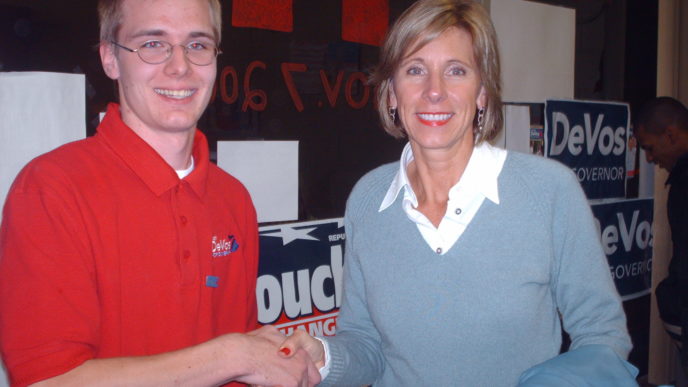
Upon being nominated secretary of the Department of Education, Betsy DeVos made clear her stance against the national education standards. “I am not a supporter—period,” she wrote.

But what can Trump and DeVos really do to dismantle the national education standards? The Daily Signal explains. (For more from the author of “Can Donald Trump and Betsy DeVos Really End Common Core?” please click HERE)

Follow Joe Miller on Twitter HERE and Facebook HERE.

Early Christmas! No Draft for Women and Philosopher Warfighter Nominated for SecDef

One could almost feel sorry for President Obama. Practically moments after confirmation that there wasn’t enough Senate support on either side of the aisle for drafting women, we see headlines that “White House announces support for adding women to military draft.”

Obama can do nothing to make this so. Only Congress can, and their decision is already made. The statement was little more than a head-pat to his base. America’s daughters will not be drafted for combat with ISIS, Syria, Iran, Afghanistan, or any other woman-stoning, gay-murdering enemies.

No Military Draft for Women

This is a victory for our military’s combat readiness and America’s young, able-bodied women, who should not be forced into being infantry replacements — the stated purpose of the draft during a large-scale war. Drafting them would require signing up equal numbers of women in all jobs — anything else wouldn’t be “equitable.” Only a tiny portion of the female population qualifies for the military as it is, and they, even having made the cut to join up, suffer an average of 2-10 times the injuries of their male counterparts.

It would be a bureaucratic nightmare for nearly no return to sift through millions of young women in order to find one or two who might be able to make men’s infantry unit standards but would still be at a stark disadvantage for survival in combat. Doing the same number of pull-ups also won’t mitigate the higher rates of injury, the fact that women are higher-value targets to our current enemies, or the other disproportionate risks women face.

Having equal rights under the law does not mean that men and women have the same obligations for the nation’s defense. Drafting women would mean more casualties, more coming home in body bags, and more missions lost. It would compromise our country’s security.

Now Congress can get back to hashing out other provisions in the military appropriations bill like the categorization of the sage grouse. In a world where this is in the spending bill for our national defense, it’s a wonder that common sense prevailed.

Secretary of Defense Mattis

Another early Christmas gift is the news that President-Elect Trump has chosen Marine Gen. James Mattis to serve as Secretary of Defense. Those who know the legendary general couldn’t be happier, and enemies of freedom the world over have every reason to fear. Mattis is a bold and plain-spoken warfighter, but also a well-read and philosophical student of history and warfare.

He is for American engagement around the world, but not endless military engagements with no clear plan for victory. He has a keen understanding of foreign policy and a deep affection for those who serve in America’s defense. He has not hesitated to name the enemy and believes in confronting even the most complicated military and foreign policy problems head on, rather than letting them fester for the next generation to handle.

Though some are concerned over his opposition to women in combat units, and his rejection of the idea that combat deployed troops are victims broken by their service, those who care about our military’s readiness to fight our merciless enemies and the welfare of those who do so know there is no better choice than James Mattis. He takes war extremely seriously and won’t be frivolous in recommending military operations.

He cares deeply for those who, as he puts it, close in on the last 600 yards of foreign policy, and their families that support them and endure their loss, injury and sacrifice. He believes in reason over impulse, in not repeating the mistakes of the past that have been learned in blood, and working with our friends and allies across the globe to ensure that savages like ISIS don’t prevail.

Making America great again includes restoring a credible military able to withstand any test — and we will be tested, probably sooner than later. For reversing the decline of the military and her material, and making her combat ready again, there’s no better man for the job. Indeed, we have much to be grateful for this holiday season. (For more from the author of “Early Christmas! No Draft for Women and Philosopher Warfighter Nominated for SecDef” please click HERE)

Follow Joe Miller on Twitter HERE and Facebook HERE.

Satanic Temple Slams New Texas Fetus Burial Rule Opposed by Pro-Choice Groups

Abortion rights activists may have found an unlikely ally in the Satanic Temple, which has vowed to oppose a new Texas state rule requiring fetal tissue be given a burial or cremation.

In two weeks, a new state rule on medical waste will take effect in Texas, meaning aborted fetal tissue must undergo “interment.”

From December 18, Texas hospitals and abortion clinics will no longer be permitted to place fetal tissue in sanitary landfills and instead will have to organize a burial of sorts. Although not an official law, the rule could be used to guide court procedures.

TEXAS RULE ON FETAL REMAINS THE SATANIC TEMPLE RELIGIOUS DEFENSE OF REPRODUCTIVE
RIGHTS
The Texas Department of Health and Human Services plans to enforce new rules that require that fetal tissue must be buried or cremated and can no longer be disposed of in sanitary landfills as they are in every other state. The Satanic Temple believes burial rites are a well-established component of religious practice. This is undisputed in the entirety of US legal history. In addition, members of The Satanic Temple believe in the inviolability of the body and, as such, these rules contradict our fundamental beliefs. The First Amendment protects our right to practice our beliefs,
and under the Religious Freedom Reform Act (RFRA), the State must present a compelling reason for why they want to enforce rules that inhibit adherence to our religious
practices. Clearly, the State of Texas has no compelling reason because these rules were
not enacted to promote health and safety, but rather to harass and burden women who terminate their pregnancies. For these reasons, members of The Satanic Temple are not required to comply with the Texas rule on fetal remains. Nevertheless, we will require legal support to protect the
rights of our members. Read more at thesatanictemple.com and religiousreproductiverights.com #thesatanictemple #religiousreproductiverights

A photo posted by The Satanic Temple (@thesatanictemple) on

The Satanic Temple, which uses Satan as a symbol to promote secularism, has now denounced the rule for enforcing a “well-established component of religious practice.”

The group has already targeted the inclusion of religious practices in education and local government by setting up an “After School Satan Club” in Oregon and hailing the Dark Lord in a prayer at an Alaskan council meeting. (Read more from “Satanic Temple Slams New Texas Fetus Burial Rule Opposed by Pro-Choice Groups” HERE)

Follow Joe Miller on Twitter HERE and Facebook HERE.

Could We Please Quit Pretending It’s About Marriage Equality?

Betsy DeVos, Donald Trump’s nominee for Secretary of Education is opposed to marriage equality. Representative Tom Price, Trump’s nominee for Secretary of HHS, is also opposed to marriage equality. Three other Trump Cabinet selections are against marriage equality, according to the strongly pro-gay Human Rights Campaign. Vice-President-elect Mike Pence has been working against it for years.

Brian Soucek, an acting professor of law at UC Davis, views all this with alarm. He wants to ward off “the threat to marriage equality in California” by repealing Proposition 8 — in case a future U.S. Supreme Court repeals its recent pro-gay marriage ruling.

I hate to tell him, but whether or not Proposition 8 is repealed, there’s going to be marriage inequality either way. There’s marriage inequality even now, under Obergefell v. Hodges. The case was always billed as a battle for marriage equality, but that was never what it was about.

It’s time we quit pretending. It isn’t just Donald Trump’s Cabinet that disbelieves in marriage equality. It isn’t just Jimmy Seibert, controversial pastor to HGTV’s Chip and Joanna Gaines. It’s Brian Soucek, too. It’s the Human Rights Campaign, along with virtually every other gay activist. It’s all of us.

No one believes in marriage equality.

No one, that is, except members of the hyper-radical fringe who want to do away with marriage altogether. They’re the only ones who really believe in marriage equality. Otherwise “marriage equality” has never been anything but a slogan.

Rhetoric in Action

It’s a good one, as slogans go; I’ll grant it that. Borrowed straight from America’s most magnificent noble ideals, it’s got the all right stuff to pack a a powerful rhetorical punch. Why shouldn’t marriage equality be self-evidently a human right, just as much as life, liberty and the pursuit of happiness! Who could possibly oppose such a positive vision?

But it gets better. The phrase also trades in the guilt we’ve felt over falling short of our country’s founding ideals. No sensitive human being would be caught dead being against it — not after all the ethical and social failures we’ve been guilty of for so long. We’re not making those mistakes again!

There’s a problem, though. For all its rhetorical usefulness, “marriage equality” can’t be a self-evident human right if it’s self-evidently self-contradictory and impossible — which is exactly what it is.

What “Marriage Equality” Would Mean, if Anyone Really Meant It

Consider what would happen if we took equality seriously as a primary principle for deciding what should count as marriage. It would mean calling an end to all of our exclusionary biases, like our prejudice against father-daughter marriages, multiple-partner marriages, sibling marriages, indeed, any relationship that anyone wants to label “marriage.” If you want marriage equality, that’s the only way you’ll really get it.

Of course LGBT activists are always quuick to tell us “No! That’s not what we meant!” They’re not at all interested in setting the stage for polygamy or incestuous marriages, they say; and I believe them. I just have trouble believing the part where they tell me at the same time they’re for marriage equality, because clearly they believe in marriage inequality, too, beyond their chosen line of marriage demarcation.

We All Draw Our Lines of Equality and Inequality

We all have lines of marriage demarcation. Marriage conservatives place our boundary in the space between opposite-sex relationships and same-sex relationships. Couples on one side of that line may be candidates for marriage; couples on the other side cannot. Couples on one side all deserve fully equal access to marriage (certain other reasonable conditions being in place, of course). In other words, we believe in marriage equality, but only up to a certain line; beyond that there is inequality, as we freely admit.

Marriage revisionists draw a line that looks almost exactly like our line, other than including same-sex couples. They, like we, are quick to exclude underage persons, incestuous relationships, polygamy and so on. As one pro-gay commentator wrote on the day the Supreme Court ruled in favor of gay marriage, “Justice Kennedy today wrote the opinion in Obergefell v. Hodges, finding state bans on same-sex marriage unconstitutional, and securing full marriage equality for gays and lesbians across America.” Marriage equality extends to gays and lesbians, now, but no further. In other words, LGBT activists believe in marriage equality, but only up to a certain line; beyond that there is inequality, as they freely admit.

Now I’m sure you’ve caught it already, but it bears repeating: we all believe in marriage equality up to a certain line, and inequality beyond that line. We all agree on marriage equality, and we all believe in marriage inequality. Our only disagreement is over the location of the line.

Some Lines are More Principled Than Others

So how do we all decide where to place our lines of marriage exclusion? Marriage conservatives can make a strong, principled case for the location of our line. It has to do with history, with family and community stability, with the social and physical health of individuals (especially women), and much more.

Those who stand for gay marriage can make no such principled case. Virtually all the arguments they make for gay marriage work just as well for any sort of couple, threesome, foursome, etc. that wants to call their relationship “marriage.” So why don’t these others get “marriage equality,” too? LGBT activists have been quick to say, “We don’t intend that for a moment! We’ve only asked to have marriage equality for gays and lesbians.” But why? From here it looks perfectly arbitrary.

Or maybe it’s not so arbitrary. Their line is in exactly the right place to gain the social approval they’ve needed for their cause. Activist leaders have long cautioned LGBT people against asking for too much too soon, knowing that they would surely suffer a backlash if they pushed too hard. This marriage-equality line of theirs looks suspiciously as if it’s landed where it is because it suits gay activists’ political purposes.

Enough Pretending Already

At any rate it should be clear enough: we all agree on marriage equality up to a certain line, and inequality beyond it. Our only disagreement is over the placement of the line. So let’s call this “marriage equality” slogan what it is: it’s a sham. Marriage equality isn’t real. The slogan exists only to arouse patriotism and guilt, and to make the conservative view on marriage appear morally inferior. Given that we all believe in marriage equality up to a certain boundary, however, it is no moral fault to prefer a principled boundary over an arbitrary one.

But LGBT activists will undoubtedly continue the sham. They don’t dare quit it. They can’t afford to give it up; it’s too much of a rhetorical powerhouse for them. They have to keep on pretending it’s about marriage equality. But we don’t have to keep letting them get away with the pretense. (For more from the author of “Could We Please Quit Pretending It’s About Marriage Equality?” please click HERE)

Follow Joe Miller on Twitter HERE and Facebook HERE.
What Donald Trump Could Really Do for America’s Working Class

Since as a winning candidate Donald Trump made a powerful symbol of the impending 1,000 lost jobs at Carrier Air Conditioning, it was inevitable that he would intervene in that business. It would have been politically foolish not to — and as the many savvy professionals whom he crushed in 2016 now should realize, Trump is nobody’s fool. So we learned this week that he has indeed used the many levers at an incoming president’s disposal to strong-arm/sweet-talk the company into saving those jobs for Americans, and denying them to Mexicans.

My first book was on the merits of the free market and free trade, but when I watched the footage of Carrier workers learning last year that their jobs were on the chopping block, I got teary-eyed myself and found my heart saying (despite my head) that Trump should indeed violate economic logic and engage in big government meddling, to “do something” for those workers — as Ronald Reagan once intervened against his principles to use a tariff to “save” Harley-Davidson from Japanese competitors.

Protectionism: Patriotic But Self-Defeating

There’s a strong rational case against protectionism — especially of the kind Trump engaged in here. The most benign form of protectionism, as free market economist Wilhelm Röpke explained, is a simple tariff. A small or medium tariff indeed distorts the market and imposes some inefficiency, but not necessarily more than any other form of tax. If imposed with advance notice and kept at predictable levels, businessmen and investors can simply figure it in to the cost of doing business — as they currently do the cost of environmental regulations.

What Trump did with Carrier is an order of magnitude worse: He singled out a particular company, and got the federal government down into the nuts and bolts of how it does business, threatening its corporate parent with lost federal contracts unless it made a specific decision — namely, avoid opening a factory in Mexico, and keep one open in the U.S. That is more than “leveling the playing field” against supposedly unfair foreign competition. It is picking winners and losers, like a umpire who has been bribed.

If the president gets in the business of directly trying to decide how every major manufacturing company in America makes such decisions, he is abandoning the free market altogether. Like Franklin Roosevelt, he is making himself effectively a board member of each of those companies. That starts a vicious cycle. Soon companies catch on that by threatening to move their factories abroad, they can provoke a presidential reaction — that pretty soon, the feds will move in and start offering tax breaks and other incentives, maybe extra federal contracts if they stay on American soil. Think of the squalid hog-slopping that happens when cities bid for the Olympics, or the bidding wars provoked by movie producers hungry for subsidies, and sports franchises who want new stadiums at taxpayer expense.

Making America Like the Post Office or Amtrak

All of this political meddling is profoundly wasteful, as the rotting hulks of Olympic complexes (and massive resulting deficits) testify all around the world. Such crony capitalism tends to benefit not productive and innovative companies, but those which are skilled at lobbying and greasing politicians’ palms. The more any business relies on federal help, the closer it becomes not to Southwest Airlines or Fedex, but to Amtrak and the Post Office. Is that really the way to make our companies profitable and high-paying? One of the most compelling reasons why the British voted for Brexit was to escape the micromanagement of the economy imposed by the wannabe federal government of the European Union.

Add up all those objections to protectionism, and then factor in how it raises the prices of ordinary goods for ordinary consumers, and you see why conservatives generally oppose it.

And yet, we need to look out for hard-pressed ordinary workers — the kind of people whose businesses don’t get bailed out by the U.S. federal government, as enormous Wall Street banks were after their reckless run of irresponsible investments in shaky mortgages, which crashed in 2008. Steve Bannon is right to observe that this bailout — conducted almost at gunpoint, under the threat of a “Great Depression” — was a corrupt transfer of wealth from the little guy to the “1 percenters,” which violated every tenet of free market economics and simple justice.

It is healthy that we feel some solidarity with blue collar workers simply because they’re fellow Americans — whose ancestors fought in our wars, and who still disproportionately enlist in our country’s armed services. (Long gone are the days when young men from elite schools routinely signed up for at least four years — though some Southerners still do.) The impulse to choose to “buy American” stems from the virtue of patriotism.

A Real Pro-Worker Agenda

We can be patriotic but smart. We can look out for U.S. workers without turning them into postal workers. (My dad was a mailman; as he told it, when two windows are open in a post office with a long line waiting, that means five workers sit idle, flipping through copies of Playboy they’ve stolen from the mail.) Here is a list of measures which a President Trump could take instead of Putin-style palm-greasing and browbeating to interfere with companies’ rational economic decisions. These steps would be populist in the positive sense, since they benefit the people.

Secure our country’s borders and workplaces by building a wall and making E-Verify mandatory for every business with more than five workers. Americans shouldn’t have to compete with unregulated, exploited laborers who can be threatened with deportation by their employers.

Drastically cut low-skill legal immigration, and the resettlement of refugees from distant countries. Some jobs are simply doomed to migrate overseas. But there’s no reason to fill the entry-level and low-skill jobs that can’t be outsourced with recent arrivals from other countries. Fixing immigration by itself would reduce most of the pressure on less-skilled American workers’ wages.

Cut our corporate tax rates, which are currently among the highest in the world. Stop granting tax breaks to individual companies (like Carrier) and grant them to … every company doing business in the U.S.

Greatly increase the per-child tax deduction for families, who are struggling under the regressive Social Security tax.

Promote school choice not by creating vouchers, which would give federal bureaucrats control over even private, Christian schools. Instead, create large and refundable tax credits which parents could use for tuition at any school — including home schools.

In one “grand bargain” piece of legislation, dismantle the labyrinth of regulations imposed after 2008 on banks to prevent them from failing, and use anti-trust laws to break up enormous banks that can threaten the whole economy with their reckless investments. Any bank that’s “too big to fail” is too big to exist — and the proliferation of such banks offers a perfect excuse for massive government meddling in that sector of the economy.

Reverse Richard Nixon’s massive blunder, and as George Gilder recommends, recouple U.S. currency to the price of gold. America’s post-war boom took place on a modified gold standard, and 1970s stagflation resulted when we abandoned it. Some link to an external commodity in limited supply in the real world would stop the Federal Reserve from massively inflating the money supply every time an incumbent president wanted to win an election — and sparking a mindless “boom” of wasteful investments in pointless dotcom startups and dodgy real estate boondoggles.

Each of these ideas is Constitutional, populist and economically sound. A Trump administration could stick up for blue-collar workers and middle-class families without descending intp cronyism and corporatism. It just takes imagination and political courage. (For more from the author of “What Donald Trump Could Really Do for America’s Working Class” please click HERE)

Follow Joe Miller on Twitter HERE and Facebook HERE.