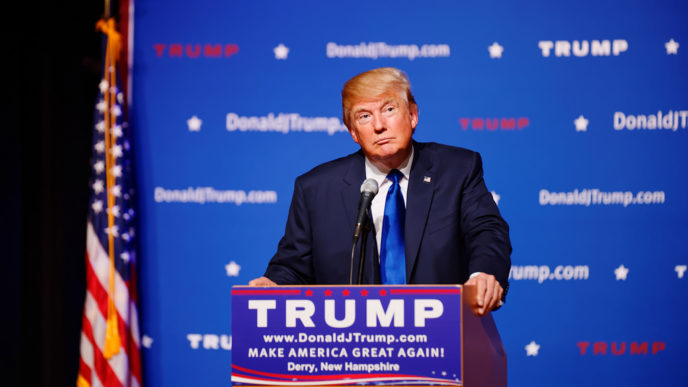
Why I Serve on the Catholic Advisory Committee of the Trump/Pence Campaign

In the first presidential debate, Hilary Clinton paraphrased words attributed to the great French writer Alexis de Tocqueville: “America is great because America is good. If America ever stops being good, it will stop being great.” Those words were probably not written by him. Nor were these words,

I sought for the greatness and genius of America in her commodious harbors and her ample rivers — and it was not there. … in her fertile fields and bound less forests — and it was not there … in her rich mines and her vast world commerce — and it was not there. … In her democratic Congress and her matchless Constitution — and it was not there. Not until I went into the churches of America and heard her pulpits flame with righteousness did I understand the secret of her genius and power.

I accepted the invitation to the Catholic Advisory group to Trump/Pence 2016 campaign because I believe these words are true, no matter who wrote them.

The American Founding

Our age is reeling under what Pope Benedict XVI called a “dictatorship of relativism.” Relativism says there are no objective truths. The American founders were not relativists. They declared independence with the bold words “We Hold These Truths.”

They affirmed that fundamental human rights were endowed by the Creator. The Catholic Church affirms these truths. But it just doesn’t affirm them in theory. It demands that we work to promote and defend them. The Catechism of the Catholic Church (numbers 2239, 2240) says very clearly that we citizens have the duty to work for “the good of society in a spirit of truth, justice, solidarity, and freedom” as an act of gratitude for what we have been given. Then it says:

Submission to legitimate authorities and service of the common good require citizens to fulfill their roles in the life of the political community. Submission to authority and co-responsibility for the common good make it morally obligatory to pay taxes, to exercise the right to vote, and to defend one’s country.

As a Catholic clergyman, I take this duty seriously. I am grateful to my country and love the United States, and very concerned for her future. This election matters. It also matters to the Republican Party that it hear the Catholic voice strongly.

The Right to Life and Religious Freedom

First among the truths our nation’s founders declared is the Right to Life. This is not a right our nation now fully recognizes. Abortion is legal in the United States. Innocent children in the womb are being killed by surgical instruments, chemical weapons or suction, at any time and for any reason. Every procured abortion is a violation of the Natural Law Right to Life.

We have no excuse. We know these children are our brothers and sisters. We offer surgery to them. We prosecute someone who takes their lives in the commission of another crime. We take 4D and 3D images of these children and send them to friends. We know what we are doing and are culpable as a Nation.

The next president could name four Justices to the United States Supreme Court. Those appointments will determine if this horrible practice continues. Even just two could shift the balance and change the law for generations. Donald Trump affirms the Right to Life and Hilary Clinton denies it.

The Constitution protects religious freedom. It requires the government to accommodate religious faith, but now we find it increasingly treated with hostility. I don’t need to go over the examples.

Just think of the baker who can’t bake a cake celebrating a same-sex “marriage” because of her deeply held religious conviction about marriage being persecuted and fined. Or the Little Sisters of the Poor. Or the growing effort to compel Christian institutions to deny sexual difference and conform to the radical gender identity agenda. There are many more examples, and the number is growing.

Our founding fathers understood that the nation they’d created couldn’t survive without a strong religious people. In 1798 John Adams proclaimed, “We have no government armed with power capable of contending with human passions unbridled by morality and religion. … Our Constitution was made only for a moral and religious people. It is wholly inadequate to the government of any other.”

Our founders understood that the free exercise of religion goes beyond the freedom to worship within church buildings. They knew it included bakers baking cakes and nuns caring for the poor. Donald Trump affirms religious freedom. He will correct the abuses unleashed by the Johnson Amendment which gags the speech of the Church and support the First Amendment Defense Act. Hilary Clinton opposes both and is hostile toward the Church and religious freedom.

Marriage and Family and School Choice

The rights of children and the common good are best secured by recognizing the uniqueness of faithful monogamous marriage above all other relationships. The family is the first society, first economy, first school, first civilizing and mediating institution and first government, and the first place for the formation of virtue and character in children. This is both common sense and my Church’s teaching.

In rejecting marriage, the United States Supreme Court in its Obergefell opinion erred. In the dissent of Chief Justice Roberts, he noted “the majority’s decision is an act of will, not legal judgment. The right it announces has no basis in the Constitution or this Court’s precedent.” He was correct.

Donald Trump will protect the rights of the Church to advocate for marriage and the family free from governmental coercion and persecution. Hilary Clinton will not.

The founders also understood the parents right and duty to direct their children’s education. So does the Catholic Church. The Catechism calls the right of parents to choose a school for their children “fundamental” and says that the government has “the duty of guaranteeing this parental right and of ensuring the concrete conditions for its exercise” (number #2229).

Donald Trump supports school choice. Hilary Clinton is opposed to it.

Good Government and Economic Freedom

Finally, two other areas guided my choice to join the Catholic Advisory Group. They are matters of prudential judgement, meaning that people who hold the same principles may have different ideas about how to act upon those principles. In many cases of prudential judgment, I find myself in agreement with the Trump/Pence campaign and opposed to the Clinton/Kaine campaign.

First, I affirm the principle of subsidiarity. Governing should first occur at the lowest level and any other governing entity should defer and assist the smallest governing unit, not usurp their role.

Donald Trump will devolve government back to the state and local levels. He will recognize the necessity of supporting mediating associations, those groups like the family and churches that stand between the individual and the state, that make up what we call “civil society.” Hillary Clinton advocates increased centralization of power at the federal level and letting government over-ride mediating institutions.

Second, I believe in a truly free economy. By that I mean one that should not be controlled by either a federal bureaucracy or a corporatist class. The free economy will expand participation while promoting enterprise and awarding initiative. After reviewing the economic policies of Donald Trump and Hilary Clinton, I determined Trump promotes economic freedom.

Conclusion

I accepted the invitation to the Catholic Advisory Group to the campaign of Donald J. Trump to offer the kind of policy analysis I have expressed in this essay to the campaign. (For more from the author of “Why I Serve on the Catholic Advisory Committee of the Trump/Pence Campaign” please click HERE)

Follow Joe Miller on Twitter HERE and Facebook HERE.

At Stake: The Constitution

This election is about a lot of things, but it is fundamentally about the U.S. Constitution and whether federal judges will adhere to their oath to “… faithfully and impartially discharge and perform all the duties incumbent upon me … under the Constitution and laws of the United States,” or dilute, attack and destroy our founding document.

That the Constitution is on the ballot in the persons of Hillary Clinton and Donald Trump, who hold differing views of it and have pledged to appoint radically different judges to federal benches, is revealed in a recent op-ed for Slate by Richard Posner, a judge for the U.S. Court of Appeals for the 7th Circuit and a senior lecturer at the University of Chicago Law School.

In his op-ed, as reported by The Washington Times, Judge Posner claims to see “absolutely no value” in studying the Constitution because “18th-century guys, however smart, could not foresee the culture, technology, etc., of the 21st century.” I suspect if they had seen modern culture with our fixation on Kim Kardashian, they might have retreated to England.

Even the Bill of Rights, says Posner, “do not speak to today.”

Wow. Freedom of speech, assembly, the press, religion, no warrantless searches and more are outmoded concepts? Who knew? (Read more from “At Stake: The Constitution” please click HERE)

Follow Joe Miller on Twitter HERE and Facebook HERE.

Immigration Insanity: This Federal Judge Just Turned Six States Into Sanctuary States

If you thought executive amnesty was bad, wait until you get a taste of judicial amnesty. A new order from a federal judge issued a week from last Friday will prevent ICE from placing detainers on many illegal aliens held in local jails in six states. This radical violation of American sovereignty — judicial tyranny on steroids — will have the effect of creating a judicial sanctuary for sanctuary cities and prevent the Obama administration from detaining even the few illegal aliens they are pursuing. You heard that correctly, a federal judge wants to grant de facto amnesty to those even the Obama administration wants to deport!

For the past decade, ICE has issued detainers on those suspected of being in the country illegally who have been arrested by local officials, but are about to be released. ICE asks local police to hold the individual for 48 hours if they have probable cause an individual is an illegal immigrant so they can apprehend any criminal alien without them being released into the population. Remember, in almost every case where an illegal is arrested, they were never apprehended for simply being an illegal alien. They have usually committed an additional crime. These are not your lovely housekeepers Democrats nostalgically speak of when stereotyping illegal immigrants.

On September 30, Judge John Lee of the Northern District of Illinois issued an order voiding out thousands of such detainers in Illinois, Indiana, Kentucky, Kansas, Missouri, and Wisconsin, the states where plaintiffs filed a class action suit. In a pattern of interpreting statutes in the most stringent manner for American sovereignty and in the most lenient manner for illegal aliens (in other cases they downright overturn statutes), Judge Lee asserted that ICE is required to obtain a warrant for every individual before issuing a post-release detainer unless they can verify that each individual suspected alien is a flight risk. This ruling will essentially take the policy of Cook County and the City of Chicago of “we will not enforce the law” and expand it to six states, ensuring that the Feds can’t enforce the law, even when local officials want to cooperate.

To begin with, the Obama administration has reduced the number of monthly detainers from nearly 30,000 in 2011 to under 10,000 since announcing the DAPA amnesty. That part of DAPA has not been halted by the courts, and this latest court ruling will likely void out most of the remaining detainers. Keep in mind, for the Obama administration to issue a detainer, that individual has to be a pretty nefarious character, given the fact that he has declined to deport even most criminal aliens.

As has been the case throughout the Obama administration, there is a bit of kabuki theater between the DOJ attorneys and the liberal judges. While the DOJ has to defend the laws and practices of the federal government, the Obama administration has not put up a rigorous defense for immigration enforcement, and that was evident in this case. As Judge Lee noted, the DOJ essentially agreed with the Soros-funded immigration groups that there is no ubiquitous flight risk among illegals. That is scandalous. By definition, illegal aliens with no documentation are the consummate flight risk, which is exactly why the relevant statute, 8 U.S.C. § 1357(a)(2), calls upon ICE to apprehend illegal aliens without a warrant when the suspected alien “is likely to escape before a warrant can be obtained for his arrest.”

For example, we know that 84 percent of family units from Central America that received a notice to appear before an immigration judge absconded and disappeared into the population before the final decision in 2014-2015, yet this judge feels that none of them can be detained. Among young illegal aliens who have crossed over in recent years, 90% failed to show up for their hearings, according to data from the House Judiciary Committee. The notion that illegals who have been arrested for crimes but never apprehended by the feds in the first place are not a flight risk is insane.

The consequences of this decision are devastating because it will codify sanctuary city policies into law everywhere, even where local law enforcement actually follows federal law. As CIS’s Jessica Vaughn reported, during a nine-month period in 2014 alone, local sanctuaries released 9,295 alien offenders ICE was seeking to deport. Of these illegals, 62% had significant prior criminal histories and 2,320 of them were subsequently rearrested for new crimes. There is no telling how many have committed crimes and were never caught. This is just a nine-month snapshot of the devastation from sanctuary policies. As of last year, 69% of them were still at large. So much for not being a flight risk.

While the lead plaintiff in this case was a U.S. citizen and obviously had standing to bring the suit against ICE, it is astounding that illegal aliens could piggyback on this lawsuit and secure a carte blanche order from a judge to suspend detainers in six states. In all cases of law enforcement actions, even pertaining to U.S. citizens, police operate based on probable cause. There are times that they make mistakes. In this case, the U.S. citizen, Jose Jimenez Moreno, can file a civil suit against the government if he wants to get revenge. But how do illegals get standing for relief when they are not even allowed to be in the country and how can a judge legislate immigration policy from the bench?

This is part of the disturbing trend of granting citizen rights to illegal aliens I warn about in Stolen Sovereignty. It has long been settled law that non-citizens have no right to stay in this country, nor are they entitled to a judge reviewing their case for remaining in the country. That understanding has been changed as we allowed liberal lawyers to violate that precedent in recent years. As Justice Robert Jackson, the famous Nuremberg prosecutor who was a champion of due process rights (he wrote the dissent in Korematsu v. United States, the Japanese internment case) and regarded as one of the greatest writers of his time wrote, “Due process does not invest any alien with a right to enter the United States, nor confer on those admitted the right to remain against the national will.”

While all human beings obviously have a right to due process before being punished or indefinitely detained, a country acting to protect its sovereignty can apprehend any alien with the purpose of deporting them. They are not entitled to judicial review beyond an appearance before some administrative official to ensure the individual is indeed not a U.S. citizen. “As to such persons, the decisions of executive or administrative officers, acting within powers expressly conferred by congress, are due process of law, ” wrote the court in 1892. That was a decision that Justice Felix Frankfurter regarded as “about as firmly embedded in the legislative and judicial tissues of our body politic as any aspect of our government.

Yet, over the past number of years, the courts have overturned this settled law and have now made their supremacy over sovereignty its own form of “settled law,” a premise adopted, at least in part, by much of the conservative legal profession. This will not change with a Republican president. It will only get worse with an administration that is serious about enforcing our sovereignty because the illegal alien legal profession has the ability to use the lower courts to litigate every last deportation to death, even in the few instances where we get narrow victories at the Supreme Court.

This is why Judge Roy Moore’s fight against the usurpation of the federal judiciary is about more than marriage. The federal judiciary is crushing states from exercising the powers they’ve held since our founding with regards to defining marriage, (gender?!), proscribing methods and procedures for elections, protecting civil and religious liberty, and enforcing immigration laws. Yet, at the same time, the courts are defending the blue states that thwart federal immigration law, the one area where the feds legitimately have plenary power in order to protect the sovereignty of the entire union.

That Congress can just sit idly and watch lower courts — which are a complete creation of the legislative branch — grant citizen rights to dangerous illegal immigrants reflects the ultimate breakdown of our system of governance and is a gross violation of the social contract. (For more from the author of “Immigration Insanity: This Federal Judge Just Turned Six States Into Sanctuary States” please click HERE)

Follow Joe Miller on Twitter HERE and Facebook HERE.

Can Someone Finally Put the ‘Clinton Surplus’ and ‘Gun Show Loophole’ Myths to Rest

There are some liberal myths that (like a bad case of athlete’s foot) just refuse to go away. Ironically, these myths are easily refuted with a simple internet search, but liberals rarely let facts get in the way of a good talking point. The latest reappearance of these liberal fairytales was in the recent second presidential debate. Hillary Clinton, who is smart enough to know that these myths are about authentic as tales of alien encounters at an LSD convention, insisted on using these myths in the last debate. To me, that means that she either lied or she isn’t as smart as her supporters claim.

Myth #1 “The Clinton Surplus”

I’ve debunked this myth before in my writings here at Conservative Review, but like that foot fungus, or Jason from the Friday the 13th movies, it keeps coming back. Now, again, for the umpteenth time THERE WAS NO BUDGET SURPLUS IN THE CLINTON YEARS. Can I be candid here? If you believe that President Bill Clinton’s presidency ran a surplus in any year where he occupied the White House then 1) you don’t know what you’re talking about 2) you do know what you’re talking about and you’re lying 3) you aren’t interested in anything other than protecting the Democrat “brand.”

Here’s a simple way to debunk the myth that President Clinton ran a surplus that even liberals who choose to blind themselves like Oedipus can understand (if they choose to understand). The national debt (the accumulated debt resulting from annual federal budget deficits) rose EVERY YEAR Bill Clinton was in office. Questioning me because I’m a conservative and you think I’m shilling for the GOP? Then please go to the Department of the Treasury’s own website by clicking here and plug in the Clinton years. Voila! The national debt increased every year which, by using uncomplicated logic, must mean that Bill Clinton added to the national debt every year by running budget deficits, not surpluses. If you are interested in additional details on the many scams the liberals and their media chums employ to keep this myth going then please read this excellent article by Craig Steiner which demolishes every single liberal “Clinton surplus” scam.

Myth #2 “The Gun Show Loophole”

This liberal myth most likely originated in a liberal focus group where the goal was to fabricate terminology to mislead voters regarding access to firearms. There is NO gun show loophole. It doesn’t exist. Yes, that’s right, it’s completely made up and people using this talking point must not know that they sound ridiculous when they bring it up, Hillary included.

People who use this debunked, nonsensical, talking point are similar to that really loud guy at a small, intimate house party that’s talking loud enough for everyone to hear, and telling stories about his high school football days that absolutely no one cares about. He looks ridiculous but he’s the only one who doesn’t know it. If you go to a gun show and ask a federally licensed firearms dealer to bypass the background check citing the “gun show loophole” you will likely be thrown out or, at a minimum, you will be sternly corrected. Again, don’t believe me, then check out this terrific video by Steven Crowder in which he humorously tries to use the “gun show loophole” to speed up the gun buying process. In short, some private sales and transfers or firearms, do not require a NICS check. But, this has nothing to do with a gun show and EVERY licensed federal firearms dealer at a gun show must, by law, conduct a background check. Saying otherwise makes you look silly, or it makes you a died-in-the-wool liberal, but I just said the same thing twice. (For more from the author of “Can Someone Finally Put the ‘Clinton Surplus’ and ‘Gun Show Loophole’ Myths to Rest” please click HERE)

Follow Joe Miller on Twitter HERE and Facebook HERE.

Win or Lose This November, Mike Pence Has a Bright Future Ahead of Him

Donald Trump is famous for his rhetorical aggression, his lack of harmony in speech, and his often controversial comments. Since he’s stepped into the arena of presidential politics, Trump has been the antithesis of political correctness — and proudly so.

Yet, every seemingly misspoken sentence has left Trump unscathed thus far. It was only days ago that Trump and Clinton were neck and neck in the polls in the battle for the White House. Unfortunately for Trump, it may not be his campaign rhetoric that tanks his bid for the Oval Office. Instead, the breaking point may be the newly released tape, more than a decade old, that records Trump using particularly vulgar language toward women.

Time will tell, or actually, the election for that matter, if Trump’s comments will be the nail in his presidential coffin. However, the man truly stuck in the middle is Governor Mike Pence, Trump’s running mate. Although, Pence unequivocally denounced Trump’s remarks, many in the conservative movement speculate that Trump’s character could curse Pence’s own future ambitions.

My assumption, however, is that those pundits are merely being dramatic or using it as a scare tactic to push Pence to quit the campaign. Whether you support Trump, never did, or have changed your decision after the latest bombshell, one thing remains certain: Mike Pence is no Donald Trump.

In fact, there is really no comparison. If anything, that’s what has made Pence a worthy vice presidential candidate. Trump has been a lifelong businessman, often times with varying political opinions. He occasionally appears readily religious and situationally conservative. I hope that Trump’s positions today are genuine. Still, as a non-politician without a voting record, we have only his word to go on.

Pence, on the other hand, has a long and documented political history, including a record in both Congress and as governor of Indiana. In Congress, he put his money where his mouth is: He rebuked his own party by voting against No Child Left Behind in 2001, he opposed a major entitlement expansion of Medicare in 2003, and he routinely voted against every notable government bailout, including Wall Street’s (TARP).

As a staff member for then-Congressman Pence in 2010, I know from personal experience that he was often guided in life and politics by his faith. Few members of Congress hewed so closely to their faith in God to guide day-to-day decisions.

Ironically, the second debate between Hillary Clinton and Donald Trump proved that Pence is much more than simply an extension of Trump. While they are known to disagree on a plethora of topics (trade and a ban on Muslims are just two examples), the distinction between the men was brought to the fore on Sunday night, when Trump nearly had to rebuke his own running mate on stage. Martha Raddatz questioned Trump’s interaction with Russia saying, “Pence at last week’s vice presidential debate said that ‘provocations by Russia need to be met with American strength.’” Trump quickly rebutted, “He and I haven’t spoken, and I disagree.” In this race, it is clear that Pence is his own man.

More so, Pence may be the best conservative option — with one of the best conservative résumés — in future elections. Aside from fighting in Congress for balanced budgets, tax cuts, and reducing the size of government, Pence has one of the most conservative records as governor.

As The Wall Street Journal highlights, his economic record in Indiana is impressive. In Indiana, economic growth matched or exceeded the national average. Job creation grew by 10 percent since 2012 in the state versus only 6.5 percent in the US. He alone expanded manufacturing jobs by more than 30,000.

Most impressively, Pence balanced the budget each and every year — while cutting taxes. He reduced income taxes, corporate taxes, personal property taxes and repealed the estate tax. And he did this all while keeping government spending below the rate of inflation.

Few can match Pence’s résumé.

That’s because Pence is his own man, and regardless of how this election turns out, any opportunity for a 2020 run will not be shattered by his decision to run with Trump. Pence is not running for power or prestige, but as a principled individual with conservative convictions. That passion was immediately apparent in his amazing performance during the first and only vice presidential debate. Even The Boston Globe agreed that Pence appeared presidential.

Like many before Pence, this vice presidential run will not be his legacy. Paul Ryan, R-Wis. (F, 51%), for example, is now Speaker of the House. Pence has a bright future ahead of him — whether he’s working in the White House come January or not. (For more from the author of “Win or Lose This November, Mike Pence Has a Bright Future Ahead of Him” please click HERE)

Follow Joe Miller on Twitter HERE and Facebook HERE.

Conservatives Not Impressed by What Paul Ryan Achieved in First Year as Speaker

“For insisting the GOP is still a party of ideas,” Paul Ryan made Politico magazine’s annual list of the 50 most influential lawmakers, intellectuals, and leaders in politics.

A year into his job as House speaker, though, the self-described policy wonk has helped generate lots of white papers but few legislative wins.

And while some fellow House conservatives applaud Ryan’s policy agenda, which stakes out Republican positions on everything from poverty to national security, they insist there’s a better way to get conservative reforms into law.

Shortly after picking up the speaker’s gavel, Ryan announced his top priority would be increasing the contrast between Republicans and Democrats.

“The No. 1 goal for the next year,” Ryan said during a Dec. 3 speech in the ornate Great Hall of the Library of Congress, “is for conservatives to put together a complete alternative to the left’s agenda.”

That effort generated six comprehensive policy proposals on poverty, national security, the economy, separation of constitutional powers, health care, and tax reform. Collectively dubbed “A Better Way,” the agenda provides a Republican policy blueprint but no actual bills.

And when asked by The Daily Signal to detail the speaker’s top conservative achievements, Ryan spokeswoman AshLee Strong listed three other House bills that remain mired in the Senate, a controversial fiscal relief package for Puerto Rico, and a vetoed Obamacare repeal bill.

With just 16 legislative days left in 2016, it’s not clear the three House-passed bills will get a vote in the Republican-controlled Senate. Strong would say only that the speaker would “continue to look for ways to move these.”

Back in February, a more verbose Ryan told Fox News Channel’s Megyn Kelly that conservative reforms can happen only with a Republican in the White House, noting that “the problem with divided government is you can’t always get everything you want.”

If Republicans would try sometime, House conservatives respond, they might get what they need, namely legislative wins.

Rep. Jim Jordan, chairman of the influential 40-member Freedom Caucus, acknowledged the challenges presented by an entrenched Democrat minority in the Senate and President Barack Obama in the White House.

But, Jordan told The Daily Signal, a list of policy proposals isn’t enough.

“The American people are calling for action, not just ideas,” he said.

“The American people already understand the difference between what the parties stand for,” Jordan said. “What they want to see from Republicans is a willingness to stand firm and get something done.”

Ryan, 46, promises that change is coming and that his “A Better Way” agenda could become law—just not this year.

“Much of this you can do through budget reconciliation,” Ryan said Sept. 30 while clutching a pamphlet for that agenda during his weekly press conference, “and I think the rest of it is something that the vast majority of the American people want to see get done.”

A parliamentary power play, budget reconciliation allows the Senate to pass legislation with a simple majority, rather than the standard 60 votes to avoid a filibuster, if the bill in question is budgetary in nature.

Ryan employed the measure in December while quarterbacking an effort to send a bill repealing Obamacare to the president’s desk for the first time. Obama vetoed the legislation shortly after.

To use budget reconciliation, though, Congress first needs a budget to fund the government, something Republicans failed to deliver this year.

“Ryan’s big thing was returning to regular order on the budget. He couldn’t even do that,” said David Bozell, president of ForAmerica, a conservative group that claims more than 7 million members online.

“Think on that,” Bozell told The Daily Signal. “[Ryan is] a former Budget Committee chairman who couldn’t even pass a budget despite enjoying the biggest majority Republicans have ever had.”

But the lack of a budget isn’t for a lack of trying. For months, Ryan tried to reach consensus on a budget inside the GOP conference.

Negotiations broke down over spending levels negotiated by Ryan’s predecessor, then-Speaker John Boehner, and Obama in October. GOP leadership made it clear that if conservatives wanted policy wins during the funding process they first had to accept higher spending.

Bickering over those spending levels finally derailed a potential budget and set the stage for a series of last-minute votes on government funding.

To the chagrin of conservatives, Ryan’s first year as speaker likely will come to a close when lawmakers pass a spending measure during the lame-duck session, that period after the November election but before the next Congress convenes.

A lack of accomplishments on conservative policy, plus increased spending, has earned Ryan criticism from outside conservative groups. But some conservatives still hold out hope for victories in the next Congress.

“Speaker Ryan has shown himself to be very skilled at cleaning out the barn,” Jason Pye, communications director for the conservative advocacy group FreedomWorks, told The Daily Signal. “But he has to start sowing the seeds of real conservative reform.” (For more from the author of “Conservatives Not Impressed by What Paul Ryan Achieved in First Year as Speaker” please click HERE)

Follow Joe Miller on Twitter HERE and Facebook HERE.

3 Ways to Use the Presidential Debate to Talk Taxes

With the leak of Donald Trump’s tax records by The New York Times, and following round two of the presidential debates in which both candidates spoke about their tax plans, taxes are in the news to stay.

But like its code, taxes are complicated. There’s the corporate tax rate, the sales tax, personal income tax, and loopholes to apply. The likelihood anyone does their own taxes without the help of an online program or accountant is low. Ain’t nobody got time for that, even if they could figure it out.

Starting today, and over the next few months, tax reform will be a hot topic to discuss with neighbors, family, friends, and co-workers. So where do you begin, and what angle provides the best argument for tax reform?

Here’s how to break it down.

Common Ground

It’s a pretty safe bet that most people agree: 1) we should all pay our fair share, but 2) the current tax system is difficult to understand. Too many loopholes exist that authorize some to legally circumvent a hefty payment or pay nothing at all. It’s not fair, but reform can make it fair; transparency works wonders.

Even though there is an argument to be made for private vs. public management, taxes fund services we use every day—think infrastructure, public transportation, etc. If we have to pay our fair share to ensure these services continue, we’d appreciate if our neighbor pays his fair share too. Removing the loopholes and simplifying the tax code achieves this end.

So, start with “we’re in this together.”

Examples

If we agree that all should pay their fair share, then the simplification of the tax code will better guarantee that happens. It will also reduce costs for families and small businesses.

The Daily Signal reported in August on how much money people have to pay just to file their taxes. The code is so complicated that a ridiculous amount of time and money is spent before the check is written to the state and/or federal governments. As the article notes: “Tax complexity is a charge on a charge.” What?

If that seems absurd, it’s because it is. Think of the possibilities if the time and money spent just to file taxes were eliminated with a simpler tax code—job creation! And other worthy endeavors. A bad tax system—unfair, complicated—decreases opportunity.

The Daily Signal also points out that the United States suffers from the highest corporate tax rate in the developed world. We’re ranked 154 of 178 in reference to “fiscal freedom.”

Let’s talk Burger King. Not many in the media were reporting on the corporate tax rate at the time—and even fewer Americans had been paying attention—but in 2014, Burger King made an announcement that it was planning to move its headquarters to Canada because the corporate tax rate was lower. I repeat, Burger King left the U.S. for Canada in order to pay lower taxes. (A little-known fact: The U.S. has the highest corporate tax rate in the developed world—higher than France!)

That caught the attention of the media and nearly every good, burger-loving American. All of a sudden, the corporate tax rate was in the news because everyone knows Burger King and nothing is more American than a burger!

Words

In addition to using words like “fair” and “simple” to describe the tax reform you want, be mindful of the phrases you choose to frame your argument.

For example, the “estate tax.” This is the technical name for the onerous federal tax levied against the property or business of someone who has just died, before the inheritance is passed on to the heirs. However, the term “estate tax” sounds regal and out of touch. If you want to illicit an emotional response (and better describe the tax), use “death tax.”

And if you ever get hit with the 99 percent argument? I often say: “The rich can afford to pay more, but you know who can’t? Everyone else. The more money the rich have to give to Uncle Sam, the more they have to downsize, which often leads to fewer jobs for you and me. It’s a losing situation.”

Taxes are tricky, both to pay and talk about. But hopefully the common ground, examples, and the right words/phrases outlined are a great starting point to make an argument for tax reform. Keep it simple, and we’ll cross our fingers that the tax code will soon follow suit. (For more from the author of “3 Ways to Use the Presidential Debate to Talk Taxes” please click HERE)

Follow Joe Miller on Twitter HERE and Facebook HERE.

Improper Recycling Could Land You in Jail: How Overcriminalization Threatens Everyone

Criminal laws and regulations in the United States have increased to absurd proportions in the past few decades, posing a growing threat to our constitutional liberties.

There are nearly 5,000 criminal laws and an estimated 300,000 or more criminal regulations at the federal level alone. In fact, there are so many possible criminal offenses that Harvey Silverglate, a civil liberties attorney, contends the average American probably commits at least three felonies a day, most without knowing it.

In April, the perils of overcriminalization were on full display when Brian Everidge traveled to Michigan with more than 10,000 bottles and cans, seeking to capitalize on Michigan’s generous 10 cents-per-bottle refund program. He stood to make $1,000.

Everidge was pulled over for speeding and found himself facing a $5,000 fine and up to five years in prison after the state trooper discovered his cargo. As it turned out, transporting more than 10,000 bottles into Michigan with the intent to collect a deposit is a felony.

Besides Michigan, nine other states have bottle deposit laws—California, Connecticut, Hawaii, Iowa, Massachusetts, Maine, New York, Oregon, and Vermont. Though each state law varies slightly from the others, each law operates on the same basic premise: Consumers pay a deposit on specified beverage containers and get reimbursed upon returning the emptied container.

Deposits vary from 5 cents to 15 cents by state and container size. When a person knowingly brings in containers sold outside the state, they are deceiving state officials by seeking the return of a deposit they never paid.

Surprisingly, interstate bottle fraud can be big business. In 2015, California officials uncovered a recycling ring that raked in $14 million from 2012 to 2014 on approximately 250 million containers brought from Arizona to California recycling centers.

The Michigan Treasury Department reported that interstate bottle fraud costs the state $10 to $13 million every year. Michigan state Rep. Kenneth Kurtz, a Republican, said of repeat “scammers who drive car and truck loads of cans from Indiana, Wisconsin, and Ohio,” that “If you are intending to defraud … then you should be held accountable for it.”

Six of the 10 bottle bill states—California, Maine, Massachusetts, Michigan, New York, and Vermont—have codified penalties specifically for cashing in on out-of-state bottles, or attempting to. Only Michigan and California, however, make it a crime.

Michigan’s penalties work on a sliding scale. Attempt to return up to 99 containers, you’ll get off with a civil fine; attempt to return 100 to 9,999 containers, you’re guilty of a misdemeanor; and if you attempt to return 10,000 or more, you’re now a felon and subject to up to five years in prison, a $5,000 fine or both.

Other types of fraud, such as dishonest practices in connection with official records on milk and butter production or failing to label imitation leather boots as such, are misdemeanors—no matter how much butter is produced or how expensive the boots are.

In California, trading in out-of-state recyclable containers is also a felony if the redemption value is more than $400. One truck driver faced criminal charges for smuggling 7,000 pounds of containers worth more than $7,100 in redemptions, with possible jail time of six months to three years.

The United States Supreme Court stated recently, in Bond v. U.S. (2014), that states “have broad authority to enact legislation for the public good—what we have often called a ‘police power.’” It also ruled in Minnesota v. Clover Leaf Creamery (1981) that a state can outright ban the sale of retail goods in a “plastic nonreturnable, nonrefillable container” if it so chooses, respecting the states’ broad discretion to implement environmental policies.

Heritage Foundation scholars have argued, however, that “the most successful environmental policies emanate from liberty.”

Criminal laws and penalties, writes John Malcolm, director of Heritage’s Meese Center for Legal and Judicial Studies, are “meant to enforce a commonly accepted moral code that is set forth in language the average person can readily understand and that clearly identifies the prohibited conduct.”

Administrative schemes like state bottle recycling programs, Malcolm writes, should “establish rules of the road (with penalties attached for violations of those rules) to curb excesses and address consequences in a complex, rapidly evolving, highly industrialized society.”

Maine’s bottle fraud rules exemplify a proper understanding of how law ought to work. Maine imposes civil fines whenever a person attempts to deposit more than 48 containers not sold in the state, with the penalty being the greater of a $100 fine for each container or $25,000 fine for each attempted transaction.

This creates a disincentive for cashing in on out-of-state containers and more than compensates the state for its losses without branding every person who violates the scheme as a criminal.

Moreover, Maine requires all recycling centers to post a sign that clearly defines “bottle fraud” and warns customers of its penalties, so anyone who unlawfully takes advantage of Maine’s incentive structure does so with a full understanding of the consequences.

Heritage scholars have identified ways to address the overcriminalization crisis. Lawmakers must reassess current laws and scrutinize any new laws that use criminal instead of civil penalties, incorporating safeguards to ensure that the criminal code is not a trap for the unwary. Everidge and the many others caught up in cases of overcriminalization deserve better from our justice system. (For more from the author of “Improper Recycling Could Land You in Jail: How Overcriminalization Threatens Everyone” please click HERE)

Follow Joe Miller on Twitter HERE and Facebook HERE.

Thick as Thieves: Murkowski, Alaska’s Political Establishment, and the PFD Grab

Ever wonder why our politicians never seem to represent us? Keep reading.

Alaska Dispatch News recently reported that telecommunications giant GCI funneled more than $2 million into the Alaska’s Future campaign in an attempt to strong-arm the legislature into a PFD grab that would direct half of the designated statutory payout to fund State deficit spending.

Over the past week, US Senate candidate Joe Miller has flooded the radio airwaves with an ad highlighting Senator Lisa Murkowski’s repeated attempts to tap the Permanent Fund for State spending while she was a State legislator, and reminding voters of the fact that Murkowski made statements earlier this year that appear to double-down on support for the PFD grab.

But is there really a connection between the corporate-sponsored Alaska’s Future campaign to take Permanent Fund earnings from Alaskans and Senator Lisa Murkowski?

Here’s what I found.

While Alaska’s Future campaign is a bipartisan group, run by Senator Dan Sullivan’s campaign manager Ben Sparks and former Senator Mark Begich’s spokeswoman Heather Handyside, it is in large part a campaign funded and directed by Murkowski donors. She is, in fact, the common denominator.

The Washington DC-based consulting firm, Black Rock Group, who is working Lisa Murkowski’s US Senate campaign is also consulting the Alaska’s Future campaign.

Alaska’s Future Co-Chair Ron Duncan of GCI has personally given the maximum $5,400 to Lisa Murkowski’s 2016 re-election campaign, and donated to numerous PACs who have funneled thousands more into the senior senator’s coffers.

At least three of Duncan’s Vice Presidents at GCI have donated a combined $9,900 more in personal contributions, and have also donated to PACs supporting Murkowski with thousands more.

Co-Chair Helvi Sandvik, President of NANA Development Corporation, has personally donated $3,500 to Murkowski, and steered an additional $7,000 to her from the NANA Development Corporation Inc. PAC.

Co-Chair Sophie Minich, President and CEO of the CIRI Corporation, is a past Murkowski donor.

No less than 17 of the 32 Alaskans named to the Alaska’s Future Leadership Council have either endorsed Mrukowski or donated to her, or to PACs that have donated no less than $34,875 to her campaign.

Further, corporate members have donated tens of thousands more through their PACS, and this before the latest disclosures have been posted to reflect donations since Murkowski picked up a legitimate challenger in the senate race.

Murkowski also has the backing of the AFL-CIO, whose leader in Alaska, Vince Beltrami, reportedly assisted GCI chief Ron Duncan with lobbying efforts in Juneau.

With just a handful of exceptions, the remainder of the Alaska’s Future Leadership Council are donors to either sitting Senator Dan Sullivan or former Democratic Senator Mark Begich.

    And to no one’s surprise, not one member of the group trying to grab your PFD has donated to any of Joe Miller’s three US Senate campaigns.

Alaska’s Future is a thinly veiled pay-to-play racket. They give money to the politicians, who take your money, and give a portion back to them. And the favor is returned come election time. This is what we call a quid pro quo. Everyone wins but the taxpayer.

And you wonder why Senator Murkowski offers consent to the politicians stealing your PFD? Wonder no more. Follow the money. The permanent political class is indeed thick as thieves, and they’re all in this thing together.

Thankfully, Joe Miller fought back, drafting the Save The PFD recall petition application in July.

And how can we fight back? Elect a man to the United States Senate who isn’t party to the theft.

In early September, when United States Senate Libertarian nominee Cean Stevens decided to step down, Joe Miller agreed to replace her on the ballot. He is the only viable candidate in the US Senate race capable of displacing this cabal and giving ordinary Alaskans a truly independent voice in Washington.

This One Tweet Shows Why You Can’t Trust Media ‘Fact Checkers’

In the wake of another debate, the self-appointed media fact checkers are at it again. Instead of fact checking, they often dispense opinions packaged as facts, and in some cases outright obfuscate on behalf of Democrats. NBC gave America a textbook case of the latter last night.

During the second presidential debate, Trump explained how, after a congressional subpoena, Clinton’s team had her server deleted of emails. During the exchange Trump made a metaphorical reference to Clinton wiping the server clean. NBC News, hilariously tried to fact check that.

The Claim

Trump says Clinton ‘acid washed’ her email server.

The Truth

Clinton’s team used an app called BleachBit; she did not use a corrosive chemical.

NBC rated the claim a “NOPE.”

This was not satire; they actually did this. What makes it more outrageous is Trump, in the same sentence, used the prhase “Bleach them.” Here’s the exchange as transcribed by the Washington Post.

When I speak, I go out and speak, the people of this country are furious. In my opinion, the people that have been long-term workers at the FBI are furious. There has never been anything like this, where e-mails — and you get a subpoena, you get a subpoena, and after getting the subpoena, you delete 33,000 e-mails, and then you acid wash them or bleach them, as you would say, very expensive process.

Two words after ‘acid wash’ Trump said ‘bleach them,’ which was an obvious reference to the computer program (not an app but that’s an aside) BleachBit.

It is noteworthy that NBC News did not try to fact check whether or not the underlying premise —that Hillary Clinton deleted emails after getting a subpoena — is true. Because it is. Morther Jones, not exactly a member of the Vast Right Wing Conspiracy, reported what the FBI report had to say about the emails (emphasis mine).

Pages 18-19: According to Mills, in December 2014, Clinton decided she no longer needed access to any of her e-mails older than 60 days. […] On March 2, 2015, The New York Times (NYT) published an article titled “Hillary Clinton Used Personal Email Account at State Dept., Possibly Breaking Rules.” […] In his interviews with the FBI, REDACTED [a PRN techie] indicated that sometime between March 25-31, 2015, he realized he did not make the e-mail retention policy changes to Clinton’s clintonemail.com e-mail account that Mills had requested in December 2014. […] He believed he had an “oh shit” moment and sometime between March 25-31, 2015 deleted the Clinton archive mailbox from the PRN server and used BleachBit to delete the exported .PST files he had created on the server system containing Clinton’s e-mails.

This explains why data was removed from the PRN server after the New York Times article and after the Benghazi committee had subpoenaed Hillary’s emails. It had nothing to do with anyone around Hillary Clinton. An IT guy at PRN realized one day that he’d forgotten about the retention order and went ahead and implemented it.

The report makes clear that Cheryl Mills sent an email, which the PRN techie received, telling PRN about the preservation request from the Benghazi committee. The techie said he knew it meant he shouldn’t disturb the Clinton server but apparently got confused and didn’t realize this meant he shouldn’t touch the old archives or the backups.

What is not being questioned is whether or Clinton’s team deleted the emails after the subpoena. It is established fact. By rating Trump as false — or in this case ‘NOPE’ – NBC News is intentionally misleading the public.

Remember when you read a “fact check” do some digging on your own, no matter who is providing the “facts.” (For more from the author of “This One Tweet Shows Why You Can’t Trust Media ‘Fact Checkers'” please click HERE)

Follow Joe Miller on Twitter HERE and Facebook HERE.