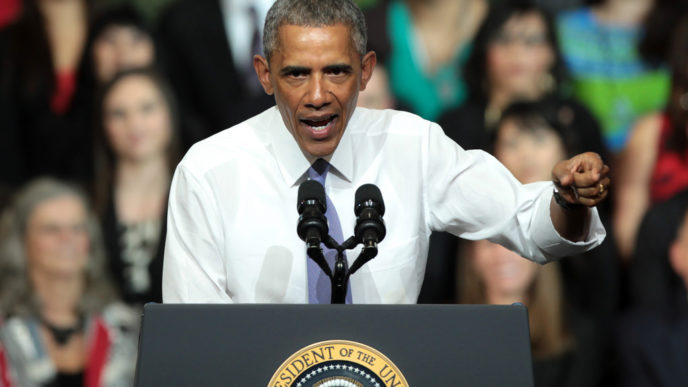
Muslim Expert Torches Obama’s ‘Countering Violent Extremism’ Agenda

The United States should ditch its current efforts at “countering violent extremism” and focus instead on “countering violent Islamism” (CVE), a prominent Muslim reformist told Congress on Thursday.

“Our current direction and lack of deeply flawed and profoundly dangerous for the security of our nation,” Dr. Zhudi Jasser, president of the American Islamic forum for Democracy, said at a House Homeland Security Subcommittee hearing Thursday. “As a devout Muslim who loves my faith, and loves my nation, the de-emphasis of “radical Islam” and the “Islamist” root cause of global Islamist terrorism is the greatest obstacle to both national harmony and national security.”

Jasser went on to say that until America can “name this, and once we can name it, treat it and then counter it,” its national security efforts will remain channeled through a “Whac-a-Mole program” that focuses on tactics, rather than ideology.

A report issued earlier this year from a DC-based counterterrorism consulting firm found the Obama administration’s CVE programs to be a “catastrophic failure” due to its inefficacy, poor management, and, most of all, because of the administration’s engagementwith organizations that have known extremist affiliations, like the Council on American Islamic Relations (CAIR) and the Islamic Society of North America.

Both organizations were unindicted co-conspirators in the 2007 Holy Land Foundation case; trusting such organizations to counter jihadism is akin to “treating arsonists like firefighters,” Jasser said.

While these groups may not be intrinsically extremist in their messaging, Dr. Jasser said, they “are distributing literature that glorifies political Islam, that glorifies sharia state ideology […] that ultimately ends up causing the harms that radicalize our community.”

Not only does government engagement with these organizations further empower the global jihad movement and “leaves us bare against the threat of radical Islamism,” Jasser added, it also “renders our greatest allies within the Muslim community — genuine reformers — entirely impotent and marginalized.”

Throughout the rest of his prepared testimony, Jasser also suggested that Congress reopen investigations into CAIR’s extremist ties, calling the group “one of the most obvious beneficiaries of this embrace of Islamist groups.” He also recommended that the administration stop all engagement with groups that have ties to the Muslim Brotherhood and “recognize their misogynist, anti-Semitic, homophobic, and anti-American ideological underpinnings.”

Also on the panel was Shireen Qudosi, a senior contributor at CounterJihad.com, who pointed out to members the difference between Islam and Islamism, and that the latter “is a political ideology that must be studied, understood, and defeated.”

Qudosi went on to attack the “Islamophobe” labelling of anyone who criticizes Muslims, saying that the accusation “moves Islam from a religion into a racial or biological context,” rather than approaching it as a belief system.

“Islam is a religion,” she added, one that should be challenged intellectually without fear of automatically being labeled an Islamophobe or racist for doing so. “It is an idea, a set of concepts and beliefs. As such, ideas, concepts, and beliefs do not have human rights; individuals do.”

“The best way to tackle ISIS, beyond Whac-a-Mole CVE systems, is to tackle their political ideology,” said Qudosi.

During an earlier panel in the hearing, George Selim, Department of Homeland Security Office of Community Partnerships director, told the subcommittee that the current CVE program under his direction isn’t even being guided by a complete, strategic plan, according to a report at the Washington Examiner. After being repeatedly hounded by committee members, Selim admitted that a strategic plan for a $10 million endeavor was “nearly ready,” and that he could only point to “anecdotal” evidence that the program had actually countered some violent extremism.

“I can’t sit here before you today and definitively say that person was going to commit an act of terrorism … but we’re developing that prevention framework in a range of cities across the country,” Selim confessed under oath. (For more from the author of “Muslim Expert Torches Obama’s ‘Countering Violent Extremism’ Agenda” please click HERE)

Follow Joe Miller on Twitter HERE and Facebook HERE.
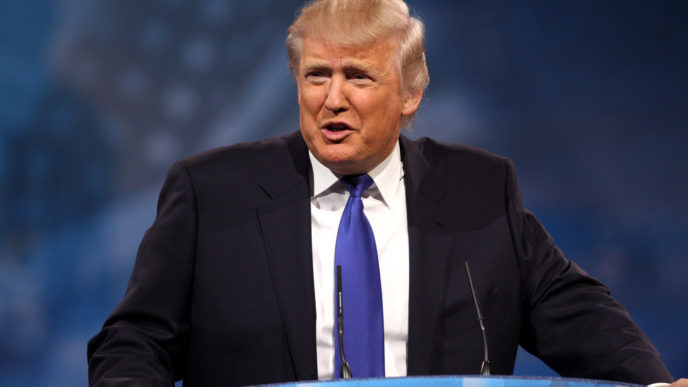
Trump Condemns Charlotte Riots, Says They Hurt Black Communities Most of All

Speaking in Pittsburgh Thursday, Republican presidential nominee Donald Trump delivered remarks focused on law and order amidst the violent riots that have swept Charlotte, N.C..

“Many Americans are watching the unrest in Charlotte unfolding right before their eyes,” Trump said at Shale Insight, a convention of natural gas industry officials. “Our country looks bad to the world, especially when we are supposed to be the world’s leader.”

Trump said that violence and rioting has no place in our communities:

“We honor and recognize the right of all Americans to peacefully assemble, protest, and demonstrate. But there is no right to engage in violent disruption or to threaten the public safety and peace of others.”

He pledged to bring such violence and crime to a “very rapid end” should he be elected president:

“The people who will suffer the most as a result of these riots are law abiding African-American residents who live in these communities where the crime is so rampant. It’s their jobs, housing market, schools, and economic conditions that will suffer. And the first duty of government is to protect their well-being and safety.”

“Crime and violence is an attack on the poor and will never be excepted in a Trump administration, never ever,” said Trump.

Ultimately, Donald Trump called for “more law enforcement, more community engagement, more effective policing,” citing former New York City mayor Rudy Giuliani’s controversial crime-fighting efforts as a good example. (For more from the author of “Trump Condemns Charlotte Riots, Says They Hurt Black Communities Most of All” please click HERE)

Follow Joe Miller on Twitter HERE and Facebook HERE.

The Silent but Growing Surge in Immigration Is Crushing American Taxpayers

The national security problems concerning the large number of refugees form the Middle East has been the top concern on the immigration front, but there are other growing concerns that have been overlooked by the media. A painstakingly detailed study from The National Academies of Sciences, Engineering, and Medicine (NASEM) finds that our unprecedented record high levels of immigration cost Americans as much as $296 billion a year. However, the data from that study is several years old and doesn’t account for the recent surge of Central Americans and Cubans crossing the border, some of the poorest immigrant groups crossing the board.

Surge in Central Americans

In 2014, there was a lot of media coverage concerning the surge of Central American migrants across our southern border. After ebbing a bit in 2015, the flow is now on par with the highest levels we saw two years ago. The number of unaccompanied minors has increased by 50% since last year, and overall, more family units have crossed over during the first 11 months of this fiscal year than in 2014. Meanwhile, only four percent of the unaccompanied minors have been deported (as opposed to Mexico, which deports 90 percent of the Central American migrants). Further, 80 percent of the UACs are housed with other illegal alien families.

It’s also important to note that Obama plans to abuse the refugee program and designate a few thousand of these individuals from Latin America as refugees, making them eligible for welfare immediately. For the current fiscal year, roughly 1,500 from Latin America have been accepted as refugees, but Obama just announced he is raising the sub-cap of refugees for FY 2017 to 5,000.

The cost of hundreds of thousands of some of the most impoverished Central Americans on our social services, hospitals, and schools is astronomical, and not even quantified in the cost analysis in the NASEM study using 2013 data.

The Cuban Migration Fleecing America

The other big story under the radar is the record number of Cubans crossing over our border — both by land in Texas and by sea in south Florida. During FY 2015, roughly 43,000 Cubans entered the U.S., double the level of the previous year. According to Pew, 46,635 Cubans have crossed over just in the first 10 months of this fiscal year alone. As we’ve noted before, due to the outdated Cuban Adjustment Act of 1966 (and a subsequent act in 1976), any Cuban who finds his way to our shores is essentially granted a green card immediately. And unlike other immigrants, they are eligible for welfare from day one.

This dynamic has created an entire scam industry whereby some Cubans are able to come here without consent, collect welfare, and return home while continuing to receive payments from U.S. taxpayers. It represents one of the most appalling violations of a nation’s sovereignty. And the trajectory is getting worse with tens of thousands of Cubans flooding South and Central America en route to our southern border. Raul Castro is orchestrating this migration as a leverage tool against Obama, who has shown no floor to the degree he will genuflect before the brutal dictator.

It’s gotten so bad that even Latin American countries are now asking that we stop our mindless policy of offering free shelter to anyone from Cuba who steps on our shore. Yet, instead of addressing the root of the problem, the Obama administration is fostering this invasion by pledging $1 million to Costa Rico in order for them to airlift the Cubans to our border!

This is a no-brainer winning issue for Republicans to fight in the upcoming budget bill (along with many other issues) but few members aside from Rep. Paul Gosar, R-Ariz. (B, 83%) are demanding action.

From the colonial times through the crafting of our modern immigration laws, the overarching and universal principle behind our immigration system was the notion that immigrants must never become a public charge. As late as 1993, Harry Reid introduced legislation excluding all legal immigrants from admission who “cannot demonstrably support themselves without public or private assistance.” In his speech introducing the bill and railing against illegal immigration, Reid expressed the following concern about our legal immigration system:

We now admit the equivalent of a major city each year, without having the vaguest idea of how we will educate all the new children, care for the sick, provide housing, jobs, build infrastructure, or attend to any of the human needs of the newcomers or those already here.

Our immigration levels have only increased since 1993. Quite dramatically, actually.

Is it so hard for Republicans to stand on the ground plowed by Harry Reid in the ‘90s concerning an issue that would garner a super-majority of support from American voters? Then again, if our grave security concerns are not reason enough for the political class to stand for sovereignty, why would they care about wasted taxpayer funds? (For more from the author of “The Silent but Growing Surge in Immigration Is Crushing American Taxpayers” please click HERE)

Follow Joe Miller on Twitter HERE and Facebook HERE.

Charges Filed Against Officer Involved in Deadly Tulsa Shooting

The police officer who shot and killed an unarmed black man Sept. 16 has been formally charged with first-degree manslaughter in connection with the shooting.

Officer Betty Shelby fired one shot at 40-year-old Terence Crutcher during a traffic stop in Tulsa, Okla. Dashcam footage from Shelby’s car and aerial footage from a police helicopter showed Crutcher walking away from Shelby with his arms in the air prior to the shooting, although the footage does not offer a clear image of when the shot was fired.

Scott Wood, Shelby’s attorney, said Crutcher did not follow more than two dozen commands and that the officer fired when the man began to reach into the window of his SUV.

Wood said Shelby suspected Crutcher was attempting to retrieve a weapon when he reached into the car. In her interview with homicide detectives, she reportedly said, “I was never so scared in my life as in that moment right then,” according to Wood.

Tulsa police say Crutcher did not have a gun on him, nor was a gun found in his vehicle.

Crutcher’s family maintains the windows to his SUV were closed, saying blood spatters on the glass are proof the windows were up at the time of the shooting.

The Department of Justice is also investigating the incident.

According to Tulsa Police Chief Chuck Jordan, dispatchers received a 911 call Friday evening about an abandoned SUV in the middle of the street, with the engine running and the driver’s door open.

Wood said that when Shelby arrived on the scene, the doors were closed and windows were open. At one point, Crutcher was walking toward her, and he began to put his left hand into his pocket.

Shelby told him to keep his hands out of his pockets. She tried to get Crutcher to talk to her about the vehicle, but she said Crutcher mumbled something unintelligible. He reached into his pocket again, and she again ordered him to keep his hands visible.

She pulled out her gun and another officer pulled out a Taser and ordered Crutcher to the ground. Instead, Shelby said, Crutcher ignored the command and walked toward the SUV with his hands up.

The orders can not be heard in the audio from the dashcam video, which is from another patrol car that arrives on the scene and begins with Crutcher walking toward his SUV.

Shelby said she thought Crutcher was acting like he might be under the influence of PCP, and police said they found the drug in his vehicle after he was shot.

Tulsa Mayor Dewey Bartlett said he was appreciative of the investigative work done so far on the case.

“Our Tulsa Police Department worked quickly to provide all the information to the District Attorney. I appreciate their efforts as well as the District Attorney’s usual thorough evaluation of the rules of law for which we are all accountable,” Bartlett said. “These are important steps to ensure that justice and accountability prevails.” (For more from the author of “Charges Filed Against Officer Involved in Deadly Tulsa Shooting” please click HERE)

Follow Joe Miller on Twitter HERE and Facebook HERE.

With DC District Court Oral Argument, a Chance to Push Back Against EPA’s Power Grab

On Sept. 27, the en banc panel of the United States District Court for the District of Columbia will preside over oral argument in State of West Virginia v. Environmental Protection Agency.

This will likely be one of the most momentous cases ever to be decided by any federal court.

At issue: Twenty-eight states and numerous private companies and trade associations are challenging an EPA regulation that seeks to cut carbon dioxide emissions in the energy industry by over 30 percent and nationalize the country’s electric power grid. The 1,500-page regulation, known as the Clean Power Plan, would give the federal government authority over how states use their natural resources.

The Clean Power Plan mandates carbon dioxide cuts to America’s power fleet, forcing states to make difficult, costly decisions such as switching from reliable conventional fuels to intermittent, expensive renewables, such as wind and solar.

The Environmental Protection Agency takes the position that man-made carbon dioxide is causing global climate change and therefore must be tightly controlled, at any cost. Carbon dioxide is essential to life on earth, and the global climate has been heating and cooling for millennia.

Regardless, the Clean Power Plan seeks to reverse what may be natural climate fluctuation at the cost of creating power blackouts, higher energy costs, job losses in the energy sector, and price spikes throughout the nation’s economy, including for necessities such as food and water.

Just as importantly, because carbon dioxide is everywhere and in everything, the Clean Power Plan arrogates enormous regulatory power to the EPA. Such a power grab by a federal regulatory agency is not only illegal, but is flat-out unconstitutional. It usurps states’ rights to regulate the use of their natural resources, in violation of the 10th Amendment.

Months ago, the Supreme Court recognized this troublesome constitutional issue and stayed the EPA’s enforcement of the Clean Power Plan pending resolution of the case in the lower court. In response, the D.C. Circuit decided to hear oral argument en banc before a panel of all judges serving on the court, rather than just the three-judge panel to which it was to have been assigned.

Beyond the constitutional issues, the case raises important issues regarding the rule of law and the extent to which the EPA must obey the law, just like the rest of us. In promulgating the Clean Power Plan under the federal Clean Air Act, the EPA violated the act in at least three ways.

First, carbon dioxide is emitted from “numerous and diverse” sources throughout the nation, not just from power plants. The act requires the EPA to regulate those types of ubiquitous emissions under the National Ambient Air Quality Standards program, which involves a multiyear process to determine the extent to which nationwide ambient air emissions of a particular substance are harmful to human health and welfare.

The next step requires the EPA to determine the extent to which man-made emissions of such a substance should be curtailed to lower national ambient air levels. The Clean Power Plan seeks to shortcut those legal requirements by regulating power plants under the source-specific standards of the Clean Air Act reserved for localized air pollution problems. Although it may be easier for the EPA to do so, the act does not give the EPA that kind of authority.

Second, because power plants as a category are already regulated under a different provision of the act dealing with toxic air pollutants, the EPA has no authority to regulate carbon dioxide emissions from power plants unless it finds that carbon dioxide is directly toxic to human health—a finding it would be impossible for the EPA to make for the obvious reason that carbon dioxide is essential to human life.

Third, the EPA even failed to comply with the source-specific requirements of the act because it neglected to make a finding that carbon dioxide emissions from power plants endanger human health and the environment. Without that endangerment finding, the regulation cannot stand.

These are only some of the issues that the D.C. Circuit will hear at 9:30 a.m. on Sept. 27. The court has devoted the entire day to oral argument, and many lawyers will present their cases. Even more lawyers, media representatives, policy analysts, politicians, and others will be present to observe and listen. We can only hope the court will uphold our constitutional freedoms, rather than kowtowing to the EPA’s power grab. (For more from the author of “With DC District Court Oral Argument, a Chance to Push Back Against EPA’s Power Grab” please click HERE)

Follow Joe Miller on Twitter HERE and Facebook HERE.

One Lawmaker’s Plan to Rein in Spending and Assert Conservative Principles

Before lawmakers in the House could read the Senate’s plan to fund the government after the end of the month, Rep. Steve King, R-Iowa, was dismissing the measure out of hand, calling it “unconstitutional.”

Congress is trying to hammer out a compromise to extend federal funding before the government’s annual spending authority expires Oct. 1. But King complained that GOP leadership, in the process, is furthering President Barack Obama’s executive actions to grant amnesty to millions of illegal immigrants.

The Iowa Republican has drafted an alternative spending package. And although he admits his plan isn’t likely to pass, he says it provides a conservative benchmark that contrasts with the short-term spending solution pushed by GOP leadership in both the House and Senate.

“They’re asking us to vote for an appropriations bill that funds clearly unconstitutional acts,” King told The Daily Signal, citing Obama’s move to exempt the children of illegal immigrants from deportation. House Speaker Paul Ryan, R-Wis., predicted Thursday morning that House passage of the Senate’s continuing resolution would “be low drama.”

Shortly afterward, King predicted that Senate Republicans’ package could not pass the House without Democrats’ support.

“A greater percentage of Democrats will vote for this [short-term spending measure] than the percentage of Republicans in the House,” King said. “I think that’s true, and to me that says there’s not a reason to hold back and put an alternative down.”

That alternative, which King said he would introduce Friday, is further to the right than anything proposed previously, even by the conservative House Freedom Caucus and the much larger Republican Study Committee.

His plan is meant to serve as a “benchmark,” King said, to show what’s possible if Republicans keep both chambers of Congress and retake the White House in the Nov. 8 elections.

It contrasts with the Senate measure, unveiled Thursday, which locks in spending at the current $1.07 trillion level until Dec. 9 and doesn’t include any of the policy riders conservatives have pushed. The Dec. 9 expiration date would mean that defeated or retiring lawmakers, who don’t leave until January, would vote on a new measure to continue to fund the government.

On the fiscal front, the King plan adopts a spending position that even conservatives abandoned as politically impractical this year. It would lock in a government spending level of $1.04 trillion, nearly a $30 billion reduction from the current level.

The plan, some of which reads like a carbon copy of the Republican Party’s 2016 platform, calls for repealing 14 of Obama’s marquee accomplishments.

King proposes to defund Obamacare, the Dodd-Frank regulation of the financial industry, and the Environmental Protection Agency’s Clean Power Plan. He calls for barring resettlement of refugees in the U.S., halting implementation of the nuclear deal with Iran, and stopping the transfer of internet regulation from a U.S. agency to a global body.

The King plan also would halt funds for executive enforcement of the Supreme Court decision legalizing same-sex marriage and the Department of Education’s transgender bathroom directive to schools that receive federal funds. It would block federal funding of Planned Parenthood and implementation of the EPA’s Waters of the United States regulation.

King also would stop new regulations from the Labor Department, defunding implementation of new overtime rules and fiduciary rules, which govern private retirement investment.

And it would take aim at the Obama administration’s executive orders relaxing immigration enforcement and implementation of the Paris accords on climate change.

King admits the “odds of succeeding aren’t good” for his grab bag of conservative priorities. But that’s not the goal, he told The Daily Signal:

It puts a marker down that says to the negotiators that there are a core of people here who actually believe in our platform and our conservative principles, and we’re just not willing to walk away without expressing them.

(For more from the author of “One Lawmaker’s Plan to Rein in Spending and Assert Conservative Principles” please click HERE)

Follow Joe Miller on Twitter HERE and Facebook HERE.
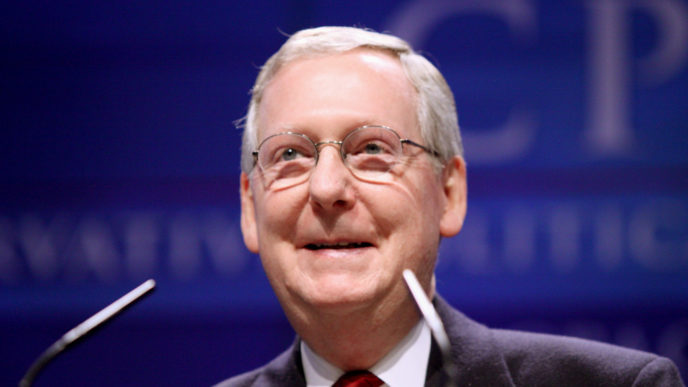
In New Spending Bill, McConnell Sides With Liberals, Ignores Conservative Priorities

After voting to proceed to a bill that didn’t exist earlier this week, the Senate has finally produced text of the continuing resolution, a short-term government spending bill.

The bill, written behind closed doors by Senate Majority Leader Mitch McConnell, was brought to the floor late Thursday afternoon, and for the majority of Senate Republicans, represented their first opportunity to see the text. According to McConnell, senators will have four days (two of them on a weekend) to review the bill before having to cast their votes next week.

As far as conservative priorities go, the bill is a failure. Among its many obvious flaws, it funds the government through Dec. 9—setting up a lame-duck session of Congress.

In the lame-duck session, which occurs after the election but before new lawmakers are sworn in, unaccountable legislators are likely to pass a bevy of backroom deals, to the detriment of representative democracy (and, we can assume, to the wallets of the taxpayer).

Even though it only funds the government for a scant 69 days, the McConnell continuing resolution manages to do it at the bloated Boehner-Obama spending levels that were jammed down the throats of conservatives in 2015.

In doing so, the continuing resolution sets up yet another spending cliff that will spawn a false panic in the lame-duck session, and lay the groundwork for more “must-pass” terrible deals. In other words, in December, lawmakers will once more have to pass yet another spending bill in order to ensure the government continues normal operations.

Worse still, this continuing resolution fundamentally grows government. The bill includes $500 million for the Federal Emergency Management Agency to address flooding in Louisiana—despite the $12 billion the agency already has.

Furthermore, it grants President Barack Obama vast new hiring authority, so he can bring in a bunch of bureaucrats to burrow into federal agencies right before he leaves office.

The most troubling elements of the McConnell continuing resolution, however, come down to policy. Conservative priorities are abandoned—or outright ignored—while liberal policies are given priority.

Conservatives in the House and Senate have long been focused on delaying the Internet Corporation for Assigned Names and Numbers (ICANN) transition—the deal that will pass governance of the internet from the United States to a “multi-stakeholder community” that includes authoritarian countries like Russia, China, and Iran.

Despite a multitude of congressional hearings and engagement from key Senate Republicans, McConnell chose not to address the ICANN transition—and in doing so, will allow it to proceed as scheduled on Oct. 1.

Perhaps the biggest slap in the face to conservatives, however, is the bill’s treatment of emergency funding to address the Zika virus. Whether or not Planned Parenthood—America’s largest abortion provider—would receive access to the Zika funding was a key sticking point in negotiations of the continuing resolution, with Democrats insisting that Planned Parenthood be able to access Zika funding, and conservatives in the House and Senate demanding that they be barred from doing so.

In his final bill, McConnell chose to side with the Democrats over conservatives. Not only does this bill lack a prohibition on funding for Planned Parenthood, it actually creates the opportunity for Planned Parenthood to get a raise.

Yes, you read that right. Under the funding bill written by the Senate majority leader, Planned Parenthood can get a raise.

How? According to analysis by The Heritage Foundation’s Roger Severino, Planned Parenthood already receives over $500 million in taxpayer money every year (legally, this money must be spent on family planning services other than abortion).

In the McConnell continuing resolution, Planned Parenthood gets its normal half a billion dollars in taxpayer funding. However, because the continuing resolution also gives it access to Zika funds, Planned Parenthood can receive even more money.

This state of play was confirmed earlier this week in press reports of Democrats publicly gloating over their win. With McConnell’s office silent on the state of negotiations, the Democrat leader in waiting, Sen. Chuck Schumer, D-N.Y., told Congressional Quarterly that the “Zika issue has been resolved” because GOP negotiators were “dropping all their riders.”

This short-term continuing resolution contains nothing for conservatives to be happy about. It hands Democrats victories while ignoring conservative priorities and growing government.

The fact that Senate leadership would put this type of bill forward now—before they have to face the voters in November—should raise serious concerns about what they intend to try and pass in the lame-duck session, when even fewer people will be watching. (For more from the author of “In New Spending Bill, McConnell Sides With Liberals, Ignores Conservative Priorities” HERE)

Follow Joe Miller on Twitter HERE and Facebook HERE.
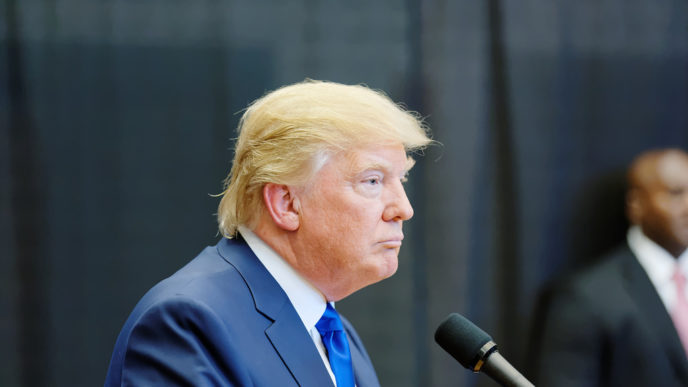
As Trump Offers Cleveland New Hope, Pastors Pray to Protect Him From ‘Satanic Attack’

Evangelical Christians of multiple races mixed their faith in God with their faith that Republican presidential candidate Donald Trump can heal the nation on Wednesday.

On Wednesday, Trump appeared at the Midwest Vision and Values Pastors Leadership Conference in Cleveland.

“I want to thank the African-American community because, I don’t know if you’ve been watching, but the poll numbers are going like a rocket ship,” Trump said. “I fully understand the African-American community has suffered from discrimination.”

Trump said America’s cities must be rebuilt.

“It breaks my heart to see any American left behind or to see a city like Cleveland that has had so many struggles, and that there are many wrongs that still must be made right,” the GOP nominee said.

After Trump spoke to the assembled crowd, Pastor Darrell Scott, a co-host of the event, spoke to Trump.

Scott said a “nationally known” pastor, whom he did not identify, had warned Trump “that if you choose to run for president, there’s going to be a concentrated Satanic attack against you.”

“He said there’s going to be a demon, principalities and powers, that are going to war against you on a level that you’ve never seen before, and I’m watching it every day,” Scott said, referring to the opposition Trump’s candidacy has spawned.

Scott’s wife, Belinda, then led the group in prayer as they gathered around Trump.

“Now God, I ask that you would touch this man, Donald J. Trump. Give him the anointing to lead this nation,” she prayed.

The meeting was open to clergy or all faiths and political ideologies.

“I think it’s good he’s open to hearing from clergy,” said Pastor Mike Wingerd of Emmanuel Assembly of God. “I’m very glad he’s concerned about religious freedom.”

Scott, who led the session, had spoken for Trump at the Republican National Convention.

“America is a melting pot, a country of diversity. We stand poised to make history, by standing together as Americans, as one. We are here as Americans regardless of race, creed or color. We are here as those who hold these truths to be self-evident, that all men are created equal, and that we are endowed by our creator with certain inalienable rights, and among these are life, liberty and the pursuit of happiness,” he said.

“The truth is the Democratic Party has failed us,” Scott said. “At home, our debt has grown, we are spiritually empty and we are more divided now than we have ever been before. Abroad, we are neither respected, we’re not feared by our adversaries, and our friends cannot count on us either. This is their legacy, and we need to make a sharp turn. We need to put into practice the great ideas and principles that our country was founded on, and which, after God, are the source of strength that has made this nation great.” (For more from the author of “As Trump Offers Cleveland New Hope, Pastors Pray to Protect Him From ‘Satanic Attack'” please click HERE)

Follow Joe Miller on Twitter HERE and Facebook HERE.

Every Immigrant Without High School Degree Will Cost Taxpayers $640,000

On Thursday, the National Academies of Sciences, Engineering, and Medicine will release its report on “The Economic and Fiscal Consequences of Immigration.” According to the report, first generation immigrants as a group increase the nation’s fiscal deficit. In other words, the government benefits they receive exceed the taxes paid.

The National Academies’ report provides 75-year fiscal projections for new immigrants and their descendants. The fiscal impact varies greatly according to the education level of the immigrant. Low-skill immigrants are shown to impose substantial fiscal costs that extend far into the future. The future government benefits they will receive greatly exceed the taxes they will pay.

On average, a nonelderly adult immigrant without a high school diploma entering the U.S. will create a net fiscal cost (benefits received will exceed taxes paid) in both the current generation and second generation. The average net present value of the fiscal cost of such an immigrant is estimated at $231,000, a cost that must be paid by U.S. taxpayers.

The concept of “net present value” is complex: it places a much lower value on future expenditures than on current expenditures.

One way to grasp net present value is that it represents the total amount of money that government would have to raise today and put in a bank account earning interest at 3 percent above the inflation rate in order to cover future costs.

Thus, as each adult immigrant without a high school diploma enters the country, the government would need to immediately put aside and invest $231,000 to cover the future net fiscal cost (total benefits minus total taxes) of that immigrant.

Converting a net present value figure into future outlays requires information on the exact distribution of costs over time. That data is not provided by the National Academies.

However, a rough estimate of the future net outlays to be paid by taxpayers (in constant 2012 dollars) for immigrants without a high school diploma appears to be around $640,000 per immigrant over 75 years. The average fiscal loss is around $7,551 per year (in constant 2012 dollars).

Slightly more than 4 million adult immigrants without a high school diploma have entered the U.S. since 2000 and continue to reside here. According to the estimates in the National Academies report, the net present value of the future fiscal costs of those immigrants is $920 billion.

This means government would have to immediately raise taxes by $920 billion and put that sum into a bank account earning 3 percent plus inflation per year to cover the future fiscal losses that will be generated by those immigrants.

To cover the future cost, each taxpaying U.S. household, on average, would have to pay an immediate lump sum of over $10,000. Costs would go up in the future as more than 200,000 additional adult immigrants without a high school diploma arrive in the country each year.

Again, converting a net present value figure into future outlays requires information on the exact timing of future costs that are not provided by the National Academies. However, a rough estimate of the future net outlays (benefits minus taxes) for the 4 million adult immigrants without a high school degree who have entered the U.S. since 2000 is perhaps $2.6 trillion.

One might argue that these estimates are exaggerated because many immigrants may return to their country of origin. But the report estimates already have a re-emigration rate of 31 percent built in.

A surge of low-skill immigrant workers may push down wages and thereby reduce consumer costs. But the National Academies report indicates such consumer gains would be modest, and if the wages of less-educated immigrants are driven down, the wages of less-educated U.S. workers will fall as well. Any consumer gains would come at the cost of wage losses for the most vulnerable American workers.

One might also argue that is it misleading to assign the costs of government “public goods” such as defense and interest of the national debt to recent immigrants. But the National Academies estimates exclude such public goods costs.

Advocates of ongoing, massive low-skill immigration have suggested that low-skill immigrants generate large-scale economic externalities that benefit U.S. workers. The National Academies report finds minimal evidence of such effects.

The continuing inflow of low-skill immigrants into the U.S. creates large fiscal burdens for U.S. taxpayers in both the present and the future. (For more from the author of “Every Immigrant Without High School Degree Will Cost Taxpayers $640,000” please click HERE)

Follow Joe Miller on Twitter HERE and Facebook HERE.
House, Senate Republicans Jockey to Advance Short-Term Spending Measure

The chairman of the largest conservative caucus in Congress is pushing House Republicans to pass a stopgap spending package before the Senate can finish work on its version.

The government’s authority to spend money expires at the end of the fiscal year, Oct. 1. And Majority Leader Mitch McConnell, R-Ky., is racing ahead on the upper chamber’s version of the spending package before that deadline.

But the House is stuck in neutral.

Pointing to that inactivity, Republican Study Committee Chairman Bill Flores, R-Texas, introduced a continuing resolution that would put federal spending on autopilot until Dec. 9, advance a Zika aid package, and fully fund veterans affairs and military infrastructure programs.

“What our CR does is try to advance a responsible spending program for the federal government that has a few key conservative riders and has no leftist riders on it,” Flores told The Daily Signal, referring to the short-term budget measure and “policy riders” that lawmakers often attach to spending bills.

Those policy provisions would require tougher vetting for refugees who are “from areas dominated by radical Islamic terrorists.”

It also would halt the White House plan to relinquish control of ICANN, the global nonprofit that functions as the phonebook of the internet by curating website domain names. Flores described the administration’s move as “Obama’s internet giveaway.”

The package is more compromise than conservative wish list, Flores admits. Since the beginning of the year, RSC has spearheaded the effort to reduce spending and avoid legislating during a lame-duck session of Congress—the period after the election but before the next Congress convenes.

Though the plan concedes both priorities, Flores said it’s the best possibility in the current political climate.

“Look, I don’t like [continuing resolutions].” Flores said. “I don’t think it’s a responsible way to fund the government. However, when you get put in a position where the government is going to be held hostage—particularly troop pay—then we’ve got to do this in a responsible manner.”

The Texas representative blames McConnell, the Senate majority leader, for caving to Democrats and creating the current debacle.

Before House Republicans could agree on a unified position on spending, McConnell announced he would negotiate the details of a continuing resolution with Senate Democrats and the White House.

Though by law spending bills must originate in the House, the Senate has repurposed a bill from the lower chamber as a “legislative shell.” But while that procedure gave the upper chamber a head start, it still hasn’t been able to agree on what will be in the final package.

Democrats insist they won’t vote for any bill that includes conservative policy riders that they call “poison pills.” And Flores said he is worried that Senate Republicans, eager to skip Washington for the campaign trail, are willing to oblige.

“The way Mitch McConnell has conducted these negotiations,” Flores said, “we were afraid that too many conservative priorities would be thrown into the ditch and liberal priorities would be attached.”

McConnell’s office did not respond to The Daily Signal’s request for comment.

The spending plan also excludes some Democrat priorities. Flores said it would prevent revival of the Export-Import Bank, stop renewable energy initiatives, and prevent Planned Parenthood from receiving any funds to fight the Zika virus.

The Zika issue has caused consternation among conservatives, who don’t want money appropriated to fight the virus to be used by Planned Parenthood. It’s not clear that the absence of an earmark alone is enough to stop money from flowing to the nation’s largest abortion provider, though.

The Flores proposal has attracted backing from the more conservative corners of Congress. Tuesday night, several members of the House Freedom Caucus expressed initial support for the Flores bill and frustration at the current situation.

“We want regular order. Speaker [Paul] Ryan talked about regular order. Well, by golly, let’s have regular order,” said Rep. Jeff Duncan, R-S.C., before launching into an explanation of how the House is supposed to pass spending bills before the Senate.

“But they don’t want to do regular order,” Duncan said. “They want to work out all the differences in the front end, then drop this big bill in front of us and say this is all you have a chance to vote on.”

Flores said he has pitched the idea to leadership. But when asked by The Daily Signal, a Ryan aide would say only: “House Republicans continue to work with our Senate colleagues on a continuing resolution.”

The plan didn’t come up during a Republican conference Wednesday morning, however, a source inside the closed-door meeting told The Daily Signal. (For more from the author of “House, Senate Republicans Jockey to Advance Short-Term Spending Measure” please click HERE)

Follow Joe Miller on Twitter HERE and Facebook HERE.