Trump Just Officially Took the Jeb Bush/Gang of 8 Position on Amnesty

In part two of Republican candidate for president Donald Trump’s town hall with Sean Hannity, scheduled to air tonight on Fox News, it seems Mr. Trump will finally clarify his position on amnesty. For the worse.

Speaking on what to do with non-violent illegal aliens, Trump said that under his plan they will “pay back-taxes” and that it would be a “very hard thing” to “throw them and their family out.”

Having illegal immigrants pay a fine and back taxes to stay in the country was the policy proposed in the Gang of Eight amnesty bill!

Further, that is the position on amnesty once held by former candidate for the Republican nomination for president Jeb Bush.

“I think for the eleven or twelve million people here illegally, they should come out from the shadows, they should pay a fine, they should pay taxes, they should work,” Bush said in an interview back in October of 2015.

He famously, or infamously, drew fire from conservative critics for referring to illegal immigrants crossing the southern border illegally as an “act of love.”

“A great country ought to know where those folks are and politely ask them to leave,” he said, adding later that properly targeting people who overstay visas “would restore people’s confidence” in the nation’s immigration system.

“There are means by which we can control our border better than we have. And there should be penalties for breaking the law,” he added. “But the way I look at this — and I’m going to say this, and it’ll be on tape and so be it. The way I look at this is someone who comes to our country because they couldn’t come legally, they come to our country because their families — the dad who loved their children — was worried that their children didn’t have food on the table. And they wanted to make sure their family was intact, and they crossed the border because they had no other means to work to be able to provide for their family. Yes, they broke the law, but it’s not a felony. It’s an act of love. It’s an act of commitment to your family. I honestly think that that is a different kind of crime that there should be a price paid, but it shouldn’t rile people up that people are actually coming to this country to provide for their families.”

One of those Bush’s fiercest critics was … Mr. Trump himself.

Remember this Instagram ad?

This is no "act of love" as Jeb Bush said…

A video posted by Donald J. Trump (@realdonaldtrump) on

Now that Trump himself has proposed non-violent illegal aliens be allowed to remain in the United States after paying fines in the form of “back taxes,” is Mr. Trump’s plan substantially different from Mr. Bush’s? Or the Gang of Eight bill’s?

(For more from the author of “Trump Just Officially Took the Jeb Bush/Gang of 8 Position on Amnesty” please click HERE)

Follow Joe Miller on Twitter HERE and Facebook HERE.

Pentagon Plays Hide and Seek With Trillions of Your Tax Dollars

After years of protesting that they were “too big to audit,” the Pentagon is finally under a congressionally-mandated review. Under a law passed in 2009, the Pentagon must provide their financials to Congressional overseers by September 30, 2017.

However, a new report published by the Pentagon’s Office of Inspector General (IG) highlights how problematic the Pentagon’s books truly are. The IG now believes there is “considerable risk” that the Pentagon will not be audit-ready by the date mandated by law.

And, really, it’s more than just a simple problem. To borrow a Trumpism, it’s a YUGE problem. In fact, according to the Pentagon, the U.S. Army has trillions of dollars in accounting errors in their books. Yes, trillions. These errors are based on missing receipts and invoices, or statements that literally just don’t add up.

Reuter’s Scot Paltrow found that the Pentagon didn’t simply misplace a few receipts, nor was it as simple as offering an Accounting 101-style refresher. Instead, Paltrow concludes, that the military was forced to “make trillions of dollars of improper accounting adjustments to create an illusion that it’s books are balanced.”

As the report highlights, we’re talking about insane bookkeeping flubs. In fact, the Pentagon fabricated nearly $2.8 trillion ledger entries in just the third quarter of 2015; overall, $6.5 trillion in fabricated entries for the year. The evidence is damning; such poor mishandling will put additional scrutiny on defense spending, the largest expenditure in the discretionary budget. As can be expected, it will be difficult for the military to justify needed resources when, in fact, the Pentagon admits:

[F]inancial statements were unreliable and lacked an adequate audit trail. In addition, DoD and Army could not rely on their accounting system data when making management and resource decisions.

How could this happen?

Part of the problem begins with the culture of military support in Washington. For years, military spending has been a sacrosanct topic. Politicians are often reluctant to question or challenge the ever greater need for military resources; it is a subject that can immediately make a politician look weak on national security.

Today, the military spends roughly as much as it did during the Cold War era, or at least, during the Reagan defense buildup. All told, including war funding, the military will cost the U.S. taxpayer roughly $586 billion this year.

To truly put the size of our defense budget into perspective, it is often helpful to compare it to, well, the resources of other nations – particularly those who may be foes. As you can see in the chart, we crush everyone in military might; or at least when it comes to buying military hardware.

The inability of the Department of Defense to manage their own budget is an affront to the American taxpayer, as well as to the troops the DoD oversees. Every few months a new story develops where the military has literally lost billions of dollars. For example, in April of 2015, the military was accused of losing $45 billion in Afghanistan.

That’s nearly as much as the federal government provides to build our nation’s roads, each year. Taking taxpayer funds for granted; squandering them, or losing them is a disservice to the American people. Yet, that is not even the most unfortunate aspect.

Most concerning is what this means for the fate of U.S. Military might in the future. The federal government is cash strapped, with $19.5 trillion in debt, and a social safety net that is consuming the federal budget. As a result, each dollar sent to the DoD will be under greater and greater scrutiny.

Even the Pentagon realizes that asking for additional funds to build up the military is unrealistic when they fail to account for the resources they currently have. In their Future Years Defense Program (FYDP) proposal, a five-year defense budget, the Pentagon has effectively asked for flat funding, or, on average, $534 billion per year through 2020.

In fact, instead of expanding the military, the Pentagon is already looking for new savings. Plans are in place to reduce the number of active duty troops, from 1.31 million to 1.27 million. The Pentagon also would like to reform military pay and initiate a new round of base realignments and closures.

The U.S. military is the best in the world. Men and women throughout our history have sacrificed their lives to protect the freedom we cherish, even as they seek to liberate other lands from tyranny and terror. However, the means to achieve these heights should not be abused. The sacred honor with which our troops commit themselves should not be disregarded and shamed by an organization that squanders the pledges of U.S. taxpayers. Each dollar committed to our national defense should be treated with respect, and with purpose. Anything less tarnishes the honor of our troops, and the costs which they have so bravely borne. (For more from the author of “Pentagon Plays Hide and Seek With Trillions of Your Tax Dollars” please click HERE)

Follow Joe Miller on Twitter HERE and Facebook HERE.

What a School Letting Students Opt out of Pledge of Allegiance Says About Our Patriotism

Can America thrive as a post-patriotic society?

A Florida elementary school recently caused a stir on social media when a man posted an image of his niece’s waiver from reciting the Pledge of Allegiance. The waiver form asked parents if they would like to opt their child out from “standing and placing his/her right hand over his/her heart” and reciting the pledge.

The infuriated uncle wrote on Facebook, “My niece brought this home from school today…What is happening to our country?!?”

Florida students have been able to opt out of the pledge since 2000.

The just over 30-word Pledge of Allegiance, written by Francis Bellamy in 1892, received an addendum of “under God” in the 1950s under President Dwight Eisenhower, but has remained a fairly constant and little-changed staple at schools and public gatherings for over half a century. While the specific merits of the pledge have elicited opposition on the left and right over the decades, the casual and increasingly dismissive treatment of even simple patriotic acts is a symptom of deeper trends in American society.

The decline of patriotism in American life will lead to profound crisis for the world’s youngest civilization—which has been fortunate enough to maintain one of the oldest, and certainly the greatest, of political systems.

A June Gallup poll indicated that only 53 percent of adults are “extremely proud” to be Americans, a 17 percent decline since 2003. The numbers were dragged down in particular by millennials; only 34 percent of adults under the age of 30 reported being “extremely proud” to be citizens of the United States. These steadily declining numbers, more than economic malaise or any other factor, demonstrate the current fragility unity of the world’s greatest superpower.

In spite of recessions, economic setbacks, and widespread government dependency, Americans remain a dynamic and entrepreneurial people at heart. But these factors alone aren’t alleviating the fact that most Americans believe the country is on the wrong track, fueling the current populist mood of the nation.

The great French observer of American life, Alexis de Tocqueville, warned that “ … epochs sometimes occur in the life of a nation when the old customs of a people are changed, public morality is destroyed, religious belief shaken, and the spell of tradition broken.”

Tocqueville ominously wrote that the country in such a state:

… assumes a dim and dubious shape in the eyes of the citizens; they no longer behold it in the soil which they inhabit, for that soil is to them an inanimate clod; nor in the usages of their forefathers, which they have learned to regard as a debasing yoke; nor in religion, for of that they doubt; nor in the laws, which do not originate in their own authority; nor in the legislator, whom they fear and despise. The country is lost to their senses; they can discover it neither under its own nor under borrowed features, and they retire into a narrow and unenlightened selfishness.

The decline in true or even symbolic patriotism is especially bad news for a country like the United States.

The blending of disparate races, ethnicities, and religions into a lasting national identity has been one of the greatest and historically rarest triumphs of this country. Americans have traditionally embraced displays of patriotism to a degree that astounds and occasionally disturbs citizens of other countries. But it has been necessary for a civilization that has brought together so many diverse peoples under one flag.

The long-term American cultural project of assimilation is fraying and its decline could open up the cleavages that exist under the country’s surface. For most of the world, “nationalism” has symbolized ethnic identity more than love of country—in the wake of quickly declining patriotism, this will likely become the norm in the U.S. as well.

When using the phrase “land of opportunity” is labeled a “micro-aggression” by universities, and most students fail a basic civic literacy test, it is no wonder young Americans have little attachment to their country. They may learn that their only true ties are to the subgroups their leftist professors imbue with such importance, rather than to all of their fellow Americans.

While the trendy notion of being a “citizen of the world” is popular in Western, cosmopolitan societies, in a globalized world in which communities have broken down, individuals fall back on tribe or look to radical mass movements to fulfill this sense of loss.

The flippant way in which patriotism is being cast aside in this country makes it vital that Americans attempt to restore patriotic sentiment and understanding of the nation’s traditions for current and future generations. Leaders capable of articulating what has made America unique are necessary, as is a public that has a keen understanding of what ideas are at the cornerstone of the republic.

South Carolina’s new law requiring students to study the founding documents is one of many ways civic and patriotic attachment to country can be restored—and similar laws could at least provide a baseline for responsible citizenship.

In an 1894 speech, Theodore Roosevelt spoke of the need for “true Americanism” for the U.S. to be a great country. He said:

We shall never be successful over the dangers that confront us; we shall never achieve true greatness, nor reach the lofty ideal which the founders and preservers of our mighty Federal Republic have set before us, unless we are Americans in heart and soul, in spirit and purpose, keenly alive to the responsibility implied in the very name of American, and proud beyond measure of the glorious privilege of bearing it.

If the trends continue and America proceeds down the path of being a post-patriotic society, no election or economic boom will put the country back on the right track or restore sagging confidence in the country’s political institutions.

Patriotism and pride in the U.S.’ unique institutions and founding principles has been the glue holding together a country diverse in ethnic backgrounds and creeds. Without allegiance to the American experiment, we may find that our citizens choose ethnic ties or “global citizenship” as more meaningful than their hollowed out and meaningless American identity. (For more from the author of “What a School Letting Students Opt out of Pledge of Allegiance Says About Our Patriotism” please click HERE)

Follow Joe Miller on Twitter HERE and Facebook HERE.

Under Obama’s New Enforcement Program, Fewer Illegal Aliens Being Captured for Deportation

Under a revamped Obama administration program intended to encourage greater cooperation from local law enforcement agencies in helping deport illegal immigrants who the government considers “a danger” to public safety, fewer people are being taken into custody for eventual removal from the country.

In November 2014, the administration introduced the Priority Enforcement Program (PEP), a less demanding version of a previous system that had been accused of violating immigrants’ civil rights, and did not differentiate between low-level and serious offenders.

The old program, called Secure Communities, influenced a number of local jurisdictions—known as “sanctuary cities”—to not work with the federal government.

While more local agencies are indeed working with federal immigration authorities since the new program began, a new study shows that those closer ties have not resulted in greater apprehensions of illegal immigrants who the government seeks to deport.

The federal Immigration and Customs Enforcement Agency (ICE) reports that only 2 percent of its requests to local law enforcement were declined in the first two months of fiscal year 2016.

However, during that same time period, ICE did not take custody of more than 60 percent of individuals it had requested information on.

“Obviously it takes an enormous time to turn around something as big as a Department of Homeland Security program, and this is clearly something that needs continuing monitoring,” said Susan Long of the Transactional Records Access Clearinghouse (TRAC) at Syracuse University, who acquired and compiled the data for her recent study. “But there is no indication at this point that the PEP directives have in fact been implemented successfully.”

New Program, Narrower Focus

In the old program, Secure Communities, ICE asked law enforcement agencies to hold somebody in custody for an extra 48 hours from when they would normally be released so that person could be picked up and deported. These requests were known as detainers.

With the new program, local authorities, in most cases, are asked to only notify Immigration and Customs Enforcement when they plan to release someone from jail whom the government seeks to deport.

ICE still can issue a detainer if it believes it has probable cause to deport an illegal immigrant who has been arrested, even if they haven’t been convicted.

In addition to switching from Secure Communities to the Priority Enforcement Program, the administration at the same time also announced it was narrowing the types of people it seeks to deport.

ICE officers are told to first target illegal immigrants considered to be threats to national security and public safety, who have likely been convicted of a felony. Other priorities for deportation include individuals who have been convicted of multiple misdemeanors, and recent arrivals who came here illegally after Jan. 1, 2014.

With about 11 million immigrants living in the country illegally, the administration argues that smart policy dictates focusing its deportation efforts more specifically, at people it considers to be dangerous.

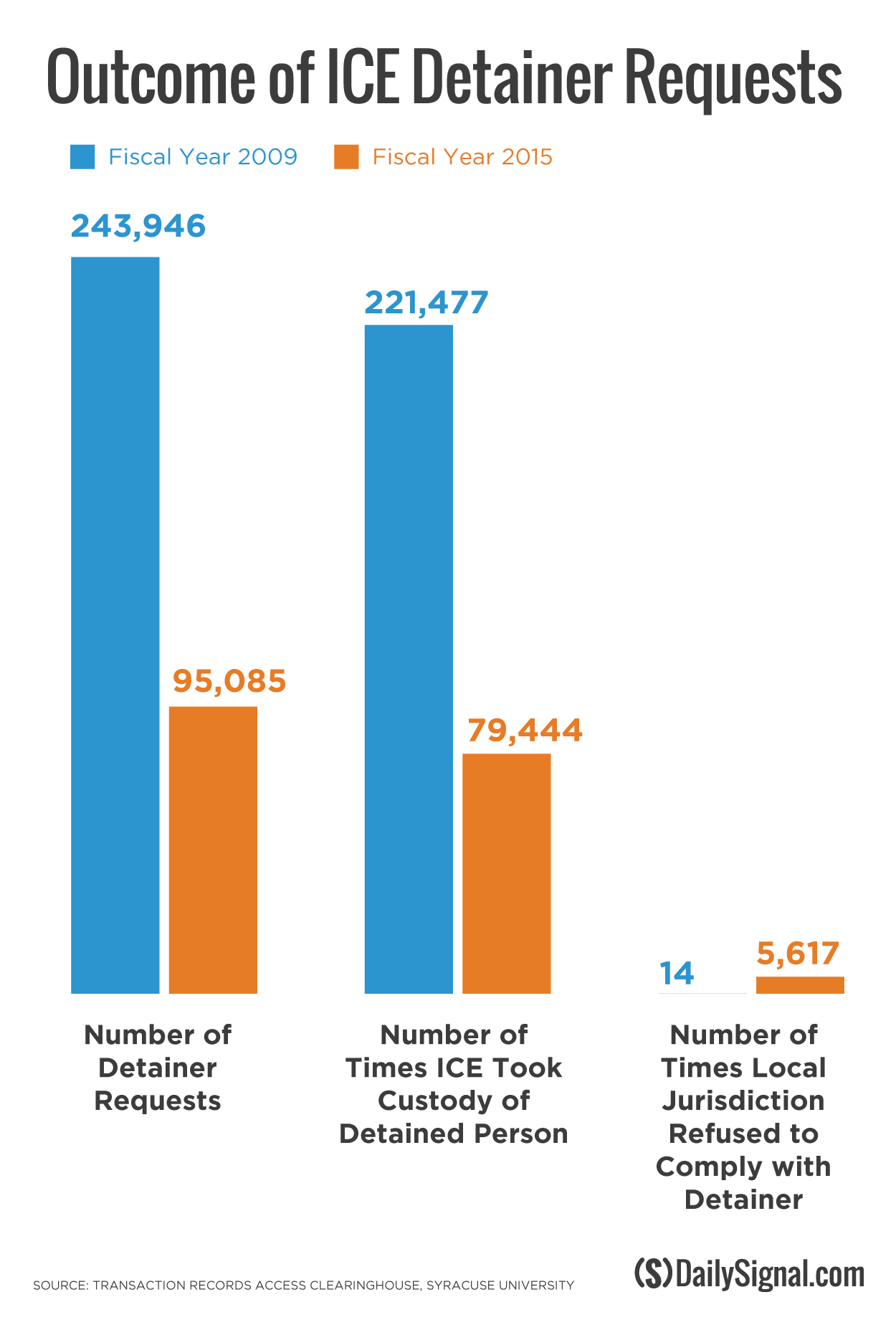
The natural result of this more narrow focus is that ICE is seeking to deport fewer people, according to the statistics acquired by TRAC.
160824_ICE-Detainer_v1

Under a revamped Obama administration program intended to encourage greater cooperation from local law enforcement agencies in helping deport illegal immigrants who the government considers “a danger” to public safety, fewer people are being taken into custody for eventual removal from the country.

In November 2014, the administration introduced the Priority Enforcement Program (PEP), a less demanding version of a previous system that had been accused of violating immigrants’ civil rights, and did not differentiate between low-level and serious offenders.

The old program, called Secure Communities, influenced a number of local jurisdictions—known as “sanctuary cities”—to not work with the federal government.

While more local agencies are indeed working with federal immigration authorities since the new program began, a new study shows that those closer ties have not resulted in greater apprehensions of illegal immigrants who the government seeks to deport.

The federal Immigration and Customs Enforcement Agency (ICE) reports that only 2 percent of its requests to local law enforcement were declined in the first two months of fiscal year 2016.

However, during that same time period, ICE did not take custody of more than 60 percent of individuals it had requested information on.

“Obviously it takes an enormous time to turn around something as big as a Department of Homeland Security program, and this is clearly something that needs continuing monitoring,” said Susan Long of the Transactional Records Access Clearinghouse (TRAC) at Syracuse University, who acquired and compiled the data for her recent study. “But there is no indication at this point that the PEP directives have in fact been implemented successfully.”

New Program, Narrower Focus

In the old program, Secure Communities, ICE asked law enforcement agencies to hold somebody in custody for an extra 48 hours from when they would normally be released so that person could be picked up and deported. These requests were known as detainers.

With the new program, local authorities, in most cases, are asked to only notify Immigration and Customs Enforcement when they plan to release someone from jail whom the government seeks to deport.

ICE still can issue a detainer if it believes it has probable cause to deport an illegal immigrant who has been arrested, even if they haven’t been convicted.

In addition to switching from Secure Communities to the Priority Enforcement Program, the administration at the same time also announced it was narrowing the types of people it seeks to deport.

ICE officers are told to first target illegal immigrants considered to be threats to national security and public safety, who have likely been convicted of a felony. Other priorities for deportation include individuals who have been convicted of multiple misdemeanors, and recent arrivals who came here illegally after Jan. 1, 2014.

With about 11 million immigrants living in the country illegally, the administration argues that smart policy dictates focusing its deportation efforts more specifically, at people it considers to be dangerous.

The natural result of this more narrow focus is that ICE is seeking to deport fewer people, according to the statistics acquired by TRAC.

For example, in October of 2008, the first month and year from TRAC’s data, ICE issued more than 19,000 detainer requests to local law enforcement. None of those requests were rejected by local law enforcement.

In November of 2015, the last month and year of TRAC’s data, ICE submitted a little more than 6,000 detainer and notification requests to local agencies. Almost 100 of the requests were rejected. Still, that refusal rate—about 1.6 percent—is much less than what it was at the height of the controversy over Secure Communities, when there were more sanctuary cities.

In June and July of 2014, for instance, 10.4 percent of ICE requests to local law enforcement were refused.

Serious Criminals ‘Getting Through’?

Immigration experts who reviewed the TRAC study noted that it has limitations. It only captures a short amount of time since PEP was implemented, and it does not show how many of those taken into custody by ICE were actually deported.

But some observers are concerned that even with increased cooperation from local law enforcement, ICE is apprehending fewer people it seeks custody of.

Randy Capps, the director of research for U.S. programs at the Migration Policy Institute, says that because ICE is more narrowly tailoring its deportation focus to those it considers to be serious criminals—and recent border crossers—it stands to reason that some of those who are not taken into custody are dangerous.

“It’s clear that the overall number of people getting detainers and into ICE custody are both going down so we have evidence that ICE is narrowing whom they seek to deport,” Capps told The Daily Signal. “And it is also clear a lot more major jurisdictions are sending people into ICE custody, while there are still some that are not.”

“So one has to ask, are people who would be considered a top priority and may commit a serious crime getting through and not getting deported?” Capps added. “We don’t know for sure because ICE has other ways to pick these people up. But one can assume a fair number with serious convictions are not getting into ICE custody.”

‘No Correlation’

An ICE official, who would not comment directly on the TRAC study, told The Daily Signal it’s not appropriate to conclude that just because the agency is receiving greater compliance from local jurisdictions, it should therefore be taking custody of more people who are referred to them for deportation.

That’s because, in instances where local agencies refuse to help facilitate the removal of illegal immigrants targeted by ICE, federal immigration officials often go off into communities on their own to find and take custody of those individuals.

These dispatched ICE officers, known as Fugitive Operations Teams, are usually tasked with finding and apprehending illegal immigrants who don’t show up for their deportation hearings, or those who have been ordered removed but escape before they’re deported.

But in other situations, the ICE official and Capps said, the Fugitive Operations Teams will be dispatched to find those who the government considers to be serious criminals—people who local agencies refuse to help deport.

“There is no direct correlation between a record showing an alien in ICE custody and a local jurisdiction honoring an ICE detainer,” the ICE official said. “In uncooperative jurisdictions, ICE officers often attempt to track down and arrest those individuals after they have been released from local custody. These are considered ‘at-large’ arrests because they take place outside the confines of a jail.”

These type of arrests that occur without the help of local law enforcement are not included in TRAC’s data.

“That wouldn’t show up in this [TRAC] data,” Capps said. “It does not count as someone taken into custody via a detainer. And as the number of issued detainers comes down, I think you will see fugitive operations picking up a higher share of people than in the past.”

Fugitive operations are also considered more expensive and time-intensive, Capps said.

“The limitation of fugitive operations is ICE has to go find people,” Capps said. “With that, there are all sorts of extra constraints, and it is much more expensive and difficult to do. When someone is in jail, they are captive, and you just go get them.”

Local Laws ‘Trumping’ ICE Policy

For ICE, the implementation of PEP was supposed to help avoid that extra effort, by promoting flexibility with how cities and counties devise their policies, and thus encouraging more cooperation.

That has happened in some cases.

ICE reports that of the 25 jurisdictions with the highest number of declined detainers, 17 of those jurisdictions are now PEP participants in some shape or form. These 17 jurisdictions represent 61 percent of previously declined detainers. So from ICE’s perspective, there is still progress left to be made.

Indeed, the TRAC data shows that since fiscal year 2014, a number of local jurisdictions in California have racked up the highest numbers of declined detainers and notification requests.

Before PEP was implemented, the Santa Clara County Main Jail had the highest refusal rate in the nation at 88.2 percent.

In the latest available data since PEP has been in place, from July through November 2015, ICE reports that Santa Clara County has only declined 4.8 percent of requests. Yet ICE has still been unable to take custody of the illegal immigrant in nearly every one of those cases.

“This raises the question: Did Santa Clara’s cooperation actually increase? Or did ICE simply stop recording refusals that occurred? Or is there some other explanation for these wildly dissimilar trends?” the TRAC report states.

To Capps, no matter what ICE considers to be cooperation, the data makes sense. In California, it’s harder to apprehend illegal immigrants through detainer requests because of a state law, known as the Trust Act, that strictly limits the situations in which local agencies will help ICE take custody of those it seeks to deport.

“The huge discrepancies in the refusal rate vs. not taking somebody into custody suggests to me that the refusal rate does not have that much meaning,” Capps said. “The share taken into custody has much more meaning in showing who is actually cooperating, and how well PEP is performing as it’s intended to. And some of that is outside ICE’s control if states and localities have laws that for the time being seem to be trumping ICE policies.” (For more from the author of “Under Obama’s New Enforcement Program, Fewer Illegal Aliens Being Captured for Deportation” please click HERE)

Follow Joe Miller on Twitter HERE and Facebook HERE.

RED ALERT: NYT Asks Google to Censor Search Results Related to Hillary’s Health Problems and They Do It

Some radical nutjob and New York Times reporter (but I repeat myself) recently called on Google to censor search results related to Hillary’s numerous health issues.

Farhad Manjoo is a reporter for the New York Times who writes about tech issues. His latest passion is a beef with free speech, though of course, as a leftist, he would never frame it that way.

More specifically, Manjoo is upset that a Google search about Hillary’s health turns up what he calls “conspiracy theories.” And because he’s decided that the negative information available on line about her health is unfounded, Google should “fix” the problem.

Based on my research, it would appear that Google is now obliging that request:

Curiously, Google’s super-smart auto-suggest feature appears incredibly ignorant when it comes to matter of Hillary Clinton’s well-documented health problems.

I did a few experiments, but judge for yourself:

Any results for Hillary health problems?

unnamed (1) (2)

Negatory, good buddy.

unnamed (2)

How about Hillary health condition or concerns?

unnamed (3)

No, apparently zillions of people are searching for “Hillary health centre” instead. That certainly seems plausible.

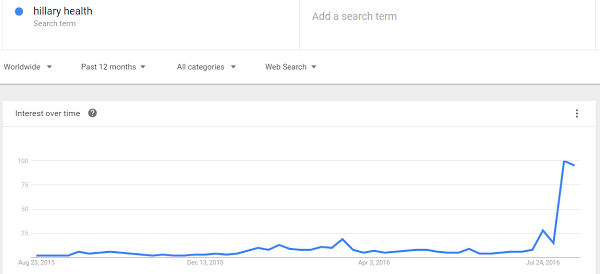
What does Google Trends have to say about the matter? This separate, and far less used service, allows users to determine search volumes for certain key phrases. I wonder what it has to say about search volume for Hillary health questions?

unnamed (4) (1)

Gee, that seems awfully curious. As tales of Hillary’s falls, concussions, confusion, reported seizures, sleepiness and a possible tongue biopsy slipped out of late, searches for Hillary health have skyrocketed.

Pity the guys at Google Type-Ahead Land never got the memo.

unnamed (5)

In fact, the number of folks searching for Hillary seizures and Hillary health problems are also noteworthy.

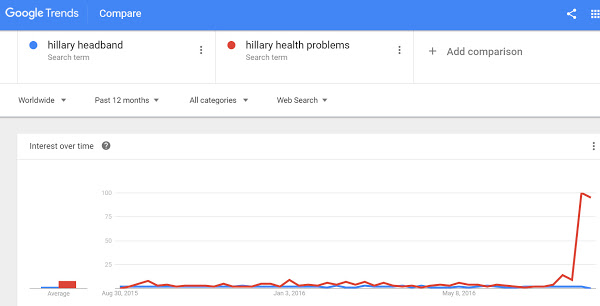
Need definitive proof Google is censoring the results? Check out the type-ahead results here and note Hillary headband.

unnamed (6)

Now compare the actual search volume for Hillary headbands versus Hillary health problems:

160823-hillary-headband

So Julian Assange is completely wrong, folks. Google isn’t deeply entwined with Hillary’s campaign. No, that’s just a conspiracy theory.

So, shut up: there are no concerns whatsoever with Hillary’s health. Why, just ask our new Overlords at Google, all you rubes in flyover country. (For more from the author of “RED ALERT: NYT Asks Google to Censor Search Results Related to Hillary’s Health Problems and They Do It” please click HERE)

Follow Joe Miller on Twitter HERE and Facebook HERE.

Fox News Hit With Lawsuit: Network ‘Sex-Fueled, Playboy Mansion-Like Cult’

Former anchor Andrea Tantaros has filed a lawsuit against Fox News Channel, asserting retaliation for lodging sexual harassment claims against former chairman Roger Ailes, The New York Times reported.

The Tantaros lawsuit, filed in Manhattan state Supreme Court Monday, also claims she was harassed by other executives at the network . . .

“Fox News masquerades as a defender of traditional family values, but behind the scenes, it operates like a sex-fueled, Playboy Mansion-like cult, steeped in intimidation, indecency, and misogyny,” the Times quoted Tantaros’ lawsuit . . .

According to published reports, some two dozen Fox News staff have since claimed harassment issues, including star host Megyn Kelly . . .

Tantaros says she complained that another Fox executive, Irena Briganti, had been attacking her. Tantaros lawsuit asserts that [Bill] Shine “told Tantaros that Briganti is like a rabid dog on a chain that we can’t control. Sometimes that dog gets off the chain.” (Read more from “Fox News Hit With Lawsuit: Network ‘Sex-Fueled, Playboy Mansion-Like Cult'” HERE)

Follow Joe Miller on Twitter HERE and Facebook HERE.

Diagnosing Hillary: Did Top Aide Seek ‘Treatment’ for Clinton?

Hillary Clinton has had a “serious concussion,” falls, double vision and other health episodes, causing great concern for her physical health – and now it’s been revealed that one of her top aides extensively researched a drug used to treat Parkinson’s and Alzheimer’s diseases.

While he worked for her at the State Department, Clinton Deputy Chief of Staff Jake Sullivan investigated the drug Provigil, according to an October 2011 emails sent to Clinton.

In one email, Sullivan tells Clinton the military administers Provigil, a drug that’s also used to treat narcolepsy and sleep-wake disorders.

“Provigil is used to treat excessive sleepiness caused by narcolepsy or shift work sleep disorder (sleepiness during scheduled waking hours among people who work at night or on rotating shifts),” Sullivan wrote in a prior email, according to the Daily Caller.

He said doctors often prescribe Provigil to treat “excessive sleepiness in patients with Parkinson’s, Alzheimer’s and multiple sclerosis.” (Read more from “Diagnosing Hillary: Did Top Aide Seek ‘Treatment’ for Clinton?” HERE)

Follow Joe Miller on Twitter HERE and Facebook HERE.

Obama’s Stealth War: Placing Special Ops in Syria and Libya … to What End?

Place our brave soldiers into an Islamic civil war first, ask questions about national security interests and strategy later. That has essentially been the modus operandi of our military adventures in the Middle East for this past generation.

In the waning months of the Obama presidency, few in the media have bothered to report that Obama is continuing to ratchet up the missions of our special operators, using them as his private mercenary force to save political face from quagmires in the Middle East until he leaves the White House and everything falls apart on the watch of the next president. As we observed in July, despite the much-vaunted debate over pulling out from Iraq and Afghanistan, Obama has actually increased troop levels in those regions in recent months. At the same time, he has placed draconian restrictions on their ability to fight the enemy and has failed to formulate any long-term strategic goals.

Meanwhile, the Taliban reportedly operate in more territory than they did before the 2001 U.S.-led invasion. The military just dispatched another 100 soldiers to Helmand province, which is overrun by the Taliban. Earlier today, at least one U.S. soldier was killed there in a roadside bombing and another one was seriously injured. What exactly are these 100 soldiers to do? How many more good men have to die for an aimless mission to prop up a Sharia government?

Obama wants to use our special ops as his private band aid as a panacea for the deep wounds he has sown throughout the region. Misusing special operators for impetuous crisis management with no broader strategy allows Obama to keep troop levels artificially low and avoid scrutiny from Congress or the media. Now he has added two more theaters to the war to nowhere: Libya and Syria.

Libya

Although the dubious mission behind Benghazi might seem like a thing of the past, our lack of strategy in the country has continued to fester since 2012. Obama has kept special operators on the ground for years, and now, according to the Washington Post, the Pentagon is finally admitting that they are involved in ground and air campaigns against the Islamic State in Sirte. While any war against the Islamic State sounds worthy, Obama is getting us sucked into the same Middle East sink hole that has plagued us for over a decade. Who exactly are we fighting for? Who will hold this ground?

While our troops on the ground are busy fighting an aimless war, the elected government in Tobruk just voted against joining the US-backed (and UN) Government of National Accord (GNA) in Tripoli. Obama is trying to successfully block reformers from fighting the Muslim Brotherhood, much like he tried to do in Egypt against the government of el-Sisi.

In 2014, the only democratically held elections resulted in the creation of a government in Tobruk (northeastern Libya) committed to rooting out the radical Islamists. The duly-elected Libyan House of Representatives appointed Khalifa Haftar commander of the Libyan army. Haftar successfully took back much of eastern Libya from the radical Islamists and fought the various terrorist factions, including those associated with the Muslim Brotherhood. Haftar was so feared by the Islamists that Ansar al Sharia, the group behind the Benghazi attack, accused Haftar of launching “a war against the religion and Islam backed by the West and their Arab allies.” Naturally, Obama and the international community didn’t appreciate the war on their Muslim Brotherhood friends so they installed a government in Tripoli, which includes a number of Islamist factions and is not very popular. Now, the Tobruk government has rejected the U.S. backed government – all the while our troops are on the ground fighting for …?

Syria

It’s not just the Islamic State that is in Syria. A multitude of Islamic factions, along with the Assad Administration, are fighting each other. Yet, our special operators are on the ground there to help “the rebels.” Not only is it unclear what ground they are holding and for whom, our soldiers are not even allowed to engage in combat while being placed in combat. As Eli Lake reported last week, their job is to not get shot at! This is similar to the dynamic in Afghanistan where special operators are being tasked with keeping the entire country together with a small force but they must call a lawyer before even calling in close air support. What happens when our soldiers are placed in an untenable situation? Last week, they were almost bombed by Syrian aircraft because nobody is coordinating a broader mission there that serves our strategic interests.

Syria is full of multiple enemy factions. Al Nusra recently decided to get in on the “Syrian rebel” racket that western countries have been offering. They decided to cut ties with Al Qaeda and rename themselves Jabhat Fath al-Sham (JFS), seizing the opportunity to unite the rebel factions. They now have an English-speaking Aussie spokesman with a Twitter account to boot. So will Obama’s myopic focus in Syria now lead him to back these Islamists as well simply because they are rebels? It’s no coincidence that Obama’s UN envoy vetoed an effort to designate Ahar-al-Sham, a close ally of Nusra, as a terror group. After all, these Islamist rebels have been more “effective” against the Islamic State than the Pentagon-backed rebels, who themselves have been pitted against CIA-backed rebels.

As Andy McCarthy puts it, by doubling down on the Syrian engagement “we’d simply be empowering one set of anti-American Islamists against another.” The entire effort against Assad and the Islamic State is dominated by groups with ties to Al Qaeda and the Taliban, as Thomas Joscelyn chronicles so clearly at The Long War Journal. What do we stand to benefit from getting involved in a viper pit full of enemy factions?

Why are we placing our troops into this untenable circus without first formulating a long-term plan? When there is no big picture of what we are fighting for, or worse, if we are downright fighting for the Muslim Brotherhood, the last thing we should be doing is placing our troops on the battlefield.

When Congress returns from summer recess, they have the opportunity to address Obama’s backwards strategy in the Middle East in both the defense authorization bill and the continuing resolution funding bill for fiscal year 2017. They can easily bar any funding, training, and equipping of rebel groups in Syria and deny any logistical support for the inept GNA in Libya. Given the track record of this Republican Congress, it’s unlikely they will even raise any concerns over Obama’s “strategy,” much less take any action. (For more from the author of “Obama’s Stealth War: Placing Special Ops in Syria and Libya … to What End?” please click HERE)

Follow Joe Miller on Twitter HERE and Facebook HERE.

Mass Casualties Reported After Car Bomb Goes off in Popular Resort Area

A car bomb blast ripped through a hotel in Thailand on Tuesday, killing one person and injuring 29.

“The explosion happened near a hotel in the province of Pattani, an area popular with Western tourists in the country’s south,” the Daily Mail reported.

“Pictures have emerged showing the remains of a building and a fire raging inside. The nationality of those caught up in the blast is not yet known,” the outlet added.

According to RT.com, the Thai government is reporting the attacks were carried out by a group of at least 20, though denying the perpetrators are Malay-Muslim insurgents.

The attack comes days after eight simultaneous explosions rocked the seaside resort of Hua Hin last month, killing two and wounding 21.

The State Department has listed no recent travel warnings regarding Thailand.

The West Bank and Gaza Strip of Israel, Iran, North Korea, Congo, Turkey and Honduras are among locations the State Department has issued recent warnings.

The British Foreign and Commonwealth Office has said there is a “high threat from terrorism” in Thailand.

It has also advised against “all but essential travel to the provinces of Pattani, Yala, Narathiwat and Songkhla on the Thai-Malaysia border.”

The Bangkok Post offered a list of recent bombings. In February of this year, a car bomb detonated outside a police station in the southern Thailand, injuring seven.

The deadliest attack in recent years happened in October 2010, when a blast at a Bangkok apartment complex killed four people. The government blamed the incident on the anti-government Red Shirt movement, which denied any involvement, according to the Post. (For more from the author of “Mass Casualties Reported After Car Bomb Goes off in Popular Resort Area” please click HERE)

Follow Joe Miller on Twitter HERE and Facebook HERE.

Global Warming Alarmists Plead: Save the Children by Not Having Them

Global warming will, of course, doom us all. That is, if the models created by scientists are any guide. Which they aren’t, since these models have for decades predicted temperatures far greater than what we actually see.

Too, our greatest natural disasters occurred long ago before global warming loomed, (as this site documents). In 1931, a flood killed perhaps two million Chinese. Forest fires in the USA are far, far below their destructive peak in the late 1920s. An awful flood happened in 1936, the same year a heat-wave killed some 12,000 Americans, which again was the same year of the highest maximum temperature.

Still, even though tornadoes, floods, fires and hurricanes are way down, the consensus is that global warming will kill us all. A hundredth of a degree increase in temperature is nothing to sneeze at, you know.

Who will fare worst in our coming climate apocalypse? That’s right! The children! The promised destruction of our littlest ones is why NPR and a group of academic philosophers say we should “protect our kids by not having them.”

Protect our kids by not having them? That’s like saying the way to protect your house from fire is by not building it, or that the way to protect against crop failure is to cease farming.

Barren wombs as cure for our climate “catastrophe” makes sense to philosophers Colin Hickey, Travis N. Rieder and Jake Earl, who defend the idea in “Population Engineering and the Fight against Climate Change,” which will appear in the journal Social Theory and Practice (PDF). They say that “threats posed by climate change justify population engineering, the intentional manipulation of the size and structure of human populations” (emphasis in original).

Now all philosophical arguments start with premises, the assumptions which must be accepted to get the argument going. Here are theirs:

Two uncontroversial ideas set the stage for this article. First, climate change is among the most significant moral problems contemporary societies face, in terms of its urgency, global expanse and the magnitude of its attending harms. Second, population plays an important role in determining just how bad climate change will be.

Balderdash: both ideas are controversial and, as shown above, both are far from the truth. This is not a good beginning to their argument. As Aristotle noted, “The least degree of deviation from the truth is multiplied later a thousandfold.” Let’s see if that prophecy holds here.

From their premises, the authors derive this:

In procreating one makes a whole new person who will emit [greenhouse gases]. But in fact, it is more than that. By creating a new person, one makes it possible that he or she will go on to create more people, who are then able to go and create even more people.

Who knew?

This radical deduction led to this conclusion: “The question, it seems, is not whether we should implement some sort of fertility-reducing population engineering program, but rather which interventions such a program should include.”

From there it was a short hop to the heading “Population Engineering Policies: Coercion and Choice Enhancement.”

Did somebody say coercion?

Somebody did. “This includes policies that involve straightforward violations of citizens’ autonomy or bodily integrity.” Not to worry. “Straightforwardly coercive interventions to reduce human population growth are almost always wrong.”

Almost always.

The other end of the scale of “total coercion” is pestering the population with putrid propaganda: e.g., “Poster campaigns featuring images of small, happy families and national slogans have been used widely” in other countries. While finding it distasteful, they don’t outright reject “outright misinformation, deception or manipulation,” and assure us they “would not endorse just any token preference-adjusting intervention to reduce fertility.” Grand of them.

They also put forward “women’s education and improved access to reproductive health care.” Now these are philosophers and you’d think they’d know better than to employ cheap euphemism. Reproductive health care means abortion and contraception, where there is no reproduction and where the health of any child “accidentally” conceived is permanently removed, and the would-be mothers endangered into the bargain.

Stripped of euphemism, the authors recommend active killing to reduce the population.

And if you’re “rich,” look out:

Our outline for a global population engineering program suggests that the greater a would-be procreator’s wealth, the more appropriate it will be to target that person with interventions to the right on the coercion spectrum. This is justifiable not only pragmatically, but also morally: since wealth is a fairly reliable proxy for individuals’ GHG emissions, and so for their carbon legacy, it is morally justifiable to exert greater pressure on wealthy people’s procreative behaviors.

Some people would still be allowed to have babies. Who decides who should procreate future GHG generators? Well, folks like author Travis Rieder, who is bravely passing on his genes (he has a daughter).

There isn’t a scintilla of a hint of a whisper of a ghost of a figment of an idea from these men that they might be wrong. But Aristotle was right. Start with silliness, end in lunacy. (For more from the author of “Global Warming Alarmists Plead: Save the Children by Not Having Them” please click HERE)

Follow Joe Miller on Twitter HERE and Facebook HERE.