Liberals, stop being so defensive. That’s the message of Harvard law professor Mark Tushnet in a new post at Balkinization, titled “Abandoning Defensive Crouch Liberal Constitutionalism.” The problem, according to Tushnet, is that liberals have been too defensive when it comes to advancing their agenda in the courts.
Now that President Barack Obama has reshaped the federal judiciary, liberal causes can win easily in court. And now that Justice Antonin Scalia has died, “judges no longer have to be worried about reversal by the Supreme Court if they take aggressively liberal positions.”
Tushnet blames what he calls the “culture wars” on conservatives, and he says liberals should now make conservatives pay. “The culture wars are over; they lost, we won,” he writes in italics. Tushnet claims that conservatives “had opportunities to reach a cease fire, but rejected them in favor of a scorched earth policy.”
Since when have liberals been defensive? The scorched earth policy has been theirs. They’ve been the aggressors—they’ve been offensive. Conservatives have been defensive.
It seems hard to envision how conservatives could have declared a unilateral cease fire when they weren’t the ones firing in the first place. Liberals aggressively sought in the courts an unlimited abortion license, a redefinition of marriage, and now for transgender bathroom policies throughout the nation. Liberals haven’t been bashful to use the courts to reshape social policy when they couldn’t win at the polls. (Read more from “Harvard Law Professor Says Treat Conservative Christians Like Nazis” HERE)
https://joemiller.us/wp-content/uploads/6566308_70169157ef_o.jpg600800Joe Millerhttps://joemiller.us/wp-content/uploads/logotext.pngJoe Miller2016-05-11 02:06:452016-05-11 02:06:45Harvard Law Professor Says Treat Conservative Christians Like Nazis
Ahmed Abu Khatalla, the accused ringleader of the of the Benghazi terrorist attacks that killed four Americans including a U.S. ambassador, will not face the death penalty if found guilty, Justice Department officials announced Tuesday.
The decision was revealed in a filing to D.C.’s federal trial court and marks a victory for Khatalla’s attorneys who had pressed the government to nix the death penalty as a punishment should the Libyan militant be convicted at trial, the Associated Press reported . . .
U.S. investigators have labeled Khatalla as the central figure behind the Sept. 11, 2012, assaults on a State Department diplomatic compound that killed U.S. Ambassador Chris Stevens, State Department information management officer Sean Patrick Smith, and two other Americans.
“The department is committed to ensuring that the defendant is held accountable for his alleged role in the terrorist attack on the U.S. Special Mission and annex in Benghazi that killed four Americans and seriously injured two others, and if convicted, he faces a sentence of up to life in prison,” Justice Department spokeswoman Emily Pierce said in a statement Tuesday, according to the Washington Post. (Read more from “State Department Will Not Pursue Death Penalty Against Accused Benghazi Leader” HERE)
https://joemiller.us/wp-content/uploads/1024px-Obama_and_Clinton_at_Transfer_of_Remains_Ceremony_for_Benghazi_attack_victims_Sep_14_2012.jpg6821024Joe Millerhttps://joemiller.us/wp-content/uploads/logotext.pngJoe Miller2016-05-11 01:59:082016-05-11 01:59:08State Department Will Not Pursue Death Penalty Against Accused Benghazi Leader
The Islamization of Britain made an immense advance this week, as a Muslim with extensive ties to jihadis and Islamic supremacists, Sadiq Khan, was elected mayor of London, just as London buses are set to carry ads proclaiming the “glory of Allah.”
It’s a sign of the times – and a sign of things to come. Is anyone really surprised? That a man such as Sadiq Khan, who has shared a platform with open Jew-haters, could still be elected mayor of London, is an indication of how far gone Britain already is. In Sadiq Khan’s campaign, his opponents brought up his close ties to jihadis, Islamic supremacists and Islamic Jew-haters as a blot on his record. Soon enough in Britain, however, that sort of thing will be a selling point for candidates appealing to an increasingly Muslim electorate.
The UK banned me from the country. It is already acting like a de facto Islamic state. Did anyone really think that the notoriously anti-Semitic UK would vote for Khan’s opponent, Zac Goldsmith — a Jew? London has already been overrun – voter fraud in Muslim precincts is rampant. Not that they will really needed it soon. London’s Muslim population is 1.3 million and growing.
The Muslims who voted for Sadiq Khan did not reject his extremist ties and supremacist rhetoric, dispelling the notion that most Muslims are moderates and do not adhere to the Sharia, or support extremism. Apparently, they are not “Uncle Toms,” as Sadiq likes to call moderate Muslims.
At the same time, many Jews were prohibited from voting. Even the Chief Rabbi of London was turned away – leading to the Chief Executive of one London borough having to resign. Innumerable voters throughout the London Borough of Barnet – where much of the British Jewish community lives today – were prevented from voting by a suspicious and never-explained “error” at the area’s polling stations. (Read more from “Pamela Geller: Immediately After Muslim Mayor Elected, London’s Iconic Buses Proclaim “Glory to Allah”” HERE)
https://joemiller.us/wp-content/uploads/islam.jpg515900Joe Millerhttps://joemiller.us/wp-content/uploads/logotext.pngJoe Miller2016-05-11 01:20:432016-05-11 01:20:43Pamela Geller: Immediately After Muslim Mayor Elected, London’s Iconic Buses Proclaim “Glory to Allah”
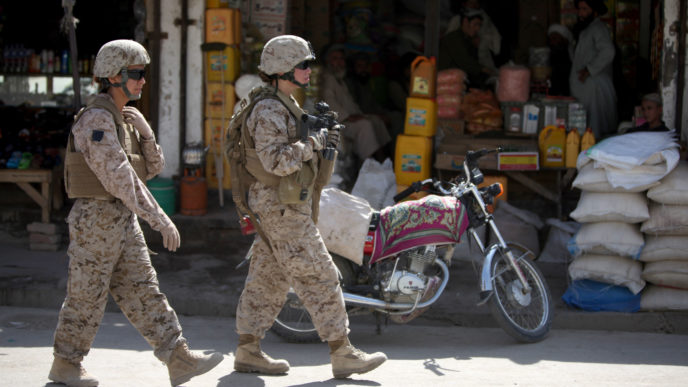
Not long ago, the Obama administration determined that women can enter all military combat occupations. Now the debate has quickly shifted to whether women can be forced into combat.
Suddenly, the exceptional qualifications and ambition of a few women seeking ground combat roles could have significant consequences for all women.
A proposal to “Draft America’s Daughters,” part of the National Defense Authorization Act, is headed for the House floor the week of May 16. The policy would require women between the ages of 18 and 26 to register for Selective Service, making them eligible to be called up—right along with young men—if Congress were to reinstate the draft.
Congress should act now to prohibit forcing women into combat, including through requiring them to register for Selective Service. Congress should also revisit the Obama administration’s decision to open all combat roles to women without exception, which increases pressure to include women in the draft. The rush to advance these policies ignores the military’s own research on the issue and leaves a number of critical questions unresolved.
Exceptions Denied
In 2013, then-Secretary of Defense Leon Panetta directed the military services to conduct reviews with the goal of integrating women into all combat occupations by January 2016. Service chiefs had until September 2015 to request exceptions.
The most extensive review was the Marine Corps’ Gender Integration Task Force, which evaluated mixed gender units in combat training activities over nine months. On 134 ground combat tasks, all-male units outperformed mixed units in 69 percent of the tasks. Mixed units outperformed male units in just two tasks. The findings showed significant differentials in performance between females and males. Top-performing females overlapped with low-performing males. Female training course completion rates lagged well behind men, and women’s injury rate was much higher.
Women’s increased risk of injury in combat-related tasks (especially load-bearing tasks that depend considerably on physiology) makes them more vulnerable when engaging the enemy. “Combat is not an equal opportunity for women because they don’t have an equal opportunity to survive,” says Jude Eden, who served in the Marine Corps but opposes opening combat roles to women. Women on the front lines would be especially at risk if captured by the enemy (consider the Islamic State’s brutalization of female prisoners in recent months).
The moral framework guiding Western policy for the use of force requires strategic choices to minimize casualties in combat. It is one thing for women to be drawn into combat incidentally or to be attached to a combat unit for a discrete functional mission. But it’s quite another to plan to send women into frontline ground combat knowing, as Eden says, “they don’t have an equal opportunity to survive.”
Combat Effectiveness or Social Goals?
The Marines’ evaluation of the combat effectiveness of mixed units led the commandant of the Marine Corps to recommend in September 2015 that some ground combat roles continue to be limited to men. That request was rebuffed, however, and Secretary of Defense Ash Carter declared in December that all military occupations, without exception, would be open to women as of Jan. 1, 2016.
Brushing past such military concerns was in step with a comment made by Joint Chiefs Chairman Gen. Martin Dempsey at the outset of the review period. As he told military commanders back in 2013, if a woman could not meet their units’ standards, they would have to justify why the standards need to be that high. Meanwhile, in May 2015, Navy Secretary Ray Mabus directed that one in four enlisted recruits in the Navy and Marine Corps should be women.
These instances raise questions about whether social goals have taken precedence over military objectives in the march to put women in combat. Moreover, the momentum to open all options for the few extraordinary women seeking to serve in ground combat is now propelling us toward a requirement that could affect all women.
Congress should prohibit forcing women into combat and should take a longer look at the blanket policy of women in all combat roles, prioritizing military effectiveness as it does so. Equality does not mean disregarding differences that are relevant to accomplishing the mission—especially when that mission is life or death.
Women in the armed forces have courageously served our nation with distinction, including during wartime. It does not do justice to the valor and sacrifice they have made in many different roles to suggest that women’s equality cannot be achieved without sending women into ground combat.
Women in Combat: May or Must?
While other arguments against including women in a draft can be made, some members of Congress and two federal court challenges already are seeking to exploit the opening of all combat roles to women to get a different result.
The combat exclusion was a significant factor in a 1981 Supreme Court case on registering women for Selective Service.
In Rostker v. Goldberg, the Supreme Court deferred to Congress, citing the combat distinction. “Since women are excluded from combat, Congress concluded that they would not be needed in the event of a draft, and therefore decided not to register them,” Justice William Rehnquist wrote for the majority. “Congress was certainly entitled, in the exercise of its constitutional powers to raise and regulate armies and navies, to focus on the question of military need rather than ‘equity.’”
If the draft were reinstated in a future conflict and women were included, what would the consequences be for combat effectiveness, for individual women sent into frontline ground combat, for the men alongside them, or for families and society at large?
With such looming questions unanswered, Congress should prohibit forcing women into combat, including through Selective Service registration. And, since many voices are already citing the fact that women can serve in all combat posts to argue that women must register for the draft, Congress should also revisit the blanket policy of women in combat. (For more from the author of “Don’t Force America’s Daughters Into Combat” please click HERE)
https://joemiller.us/wp-content/uploads/Defense.gov_News_Photo_100806-M-0301S-111_-_U.S._Marine_Cpl._Mary_E._Walls_right_an_ammunition_technician_and_linguist_Sahar_bot.jpg37445616Joe Millerhttps://joemiller.us/wp-content/uploads/logotext.pngJoe Miller2016-05-10 23:58:542016-05-10 23:58:54Don’t Force America’s Daughters Into Combat
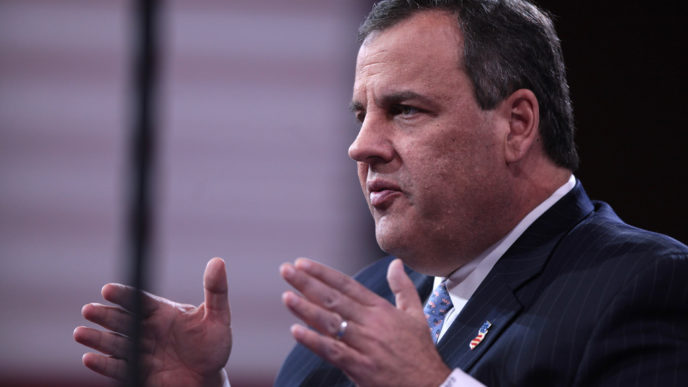
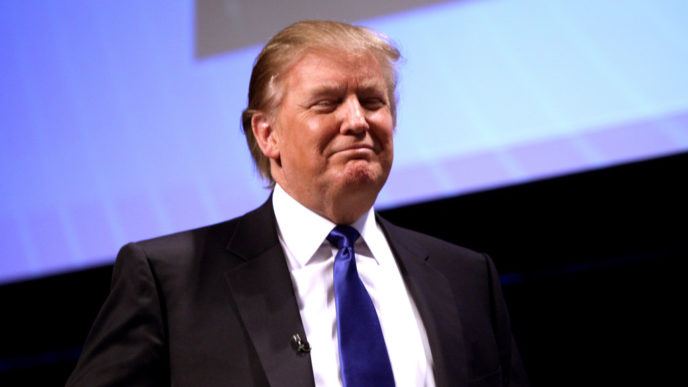
Presumed Republican presidential nominee Donald Trump announced this earlier in the week. that New Jersey Gov. Chris Christie will lay the foundation for a potential Trump administration by leading Trump’s transition team.
The team’s goal is to ensure that when the Obama administration leaves office in January, his successor’s administration is fully operational.
” … it is really important that Trump has publicly named a transition chairman,” said Max Stier, who is chairman of the Partnership for Public Service. “Trump is demonstrating his understanding that he needs to prepare for the possibility that he will be governing at the same time as he is trying to win the campaign.”
Trump said in a statement, “Governor Christie is an extremely knowledgeable and loyal person with the tools and resources to put together an unparalleled transition team, one that will be prepared to take over the White House when we win in November.”
“I am grateful to Governor Christie for his contributions to this movement,” he said.
According to the statement, Christie would be “overseeing an extensive team of professionals preparing to take over the White House, and all that entails.”
“I am honored by the confidence being placed in me by Mr. Trump and look forward to putting together a first-rate team to assemble an administration to help best serve the president-elect and the nation,” Christie said.
Stier suggested that Christie would not be able to serve as Trump’s running mate or take on an active, full-time campaign role because of the time needed to devote to the transition team.
Christie, who had originally sought the GOP nomination, endorsed Trump after his campaign faltered.
The Washington Post noted Christie has been “a key adviser … behind the scenes.” It also noted that his selection as the transition team leader give Christie “influence in the selection of White House and administration staff and in the development of a president-elect’s first steps.” (For more from the author of “Trump Gives Christie Major Role in Planning for a Trump Administration” please click HERE)
https://joemiller.us/wp-content/uploads/16481356400_a0b5479826_b.jpg6831024Joe Millerhttps://joemiller.us/wp-content/uploads/logotext.pngJoe Miller2016-05-10 23:44:532016-05-10 23:44:53Trump Gives Christie Major Role in Planning for a Trump Administration
With the once-crowded Republican field winnowed down to presumptive nominee Donald Trump and likely Democratic candidate Hillary Clinton nearly 300 pledged delegates ahead of rival Bernie Sanders, the scene was set Tuesday for a West Virginia primary that would change little in the electoral landscape.
Though a default win for Trump was projected by the Associated Press with zero percent of the vote counted, the Democratic race took longer to tally after polls closed at 7:30 p.m. ET.
Early reports indicated a strong showing by Sanders as Clinton spent much of the last week attempting to walk back comments that hurt her among many voters in the state. NBC News projected Sanders the winner of the contest shortly after 8 p.m.
West Virginia has been in the news over the past several days following comments Clinton made regarding the coal industry. When the former first lady promised to “put a lot of coal miners and coal companies out of business,” many West Virginians — including elected officials and those who make their living in the industry — were incensed.
Logan Mayor Serafino Noletti went so far as to write a letter to Sen. Joe Manchin, D-W.V., asserting neither Bill nor Hillary Clinton were welcome in the small mining town. When the former president arrived for a rally anyway, he was met by vocal protests from upset locals.
According to ABC News’ preliminary exit polling, roughly 30 percent of Democratic voters told pollsters that their family included at least one coal worker.
While the results of Tuesday’s vote might have no direct impact on November’s general-election matchup, exit polling did provide a barometer of the state’s current mood. A clear majority — about 60 percent — of Democrats expressed concern about the nation’s economic future. That number is 50 percent higher than the party’s national average this election cycle. (For more from the author of “Projected Winners Announced in West Virginia Primaries” please click HERE)
https://joemiller.us/wp-content/uploads/24564574914_062c7d99fe_o-1.jpg10801920Joe Millerhttps://joemiller.us/wp-content/uploads/logotext.pngJoe Miller2016-05-10 23:39:022016-05-10 23:39:02Projected Winners Announced in West Virginia Primaries
Former Louisiana Governor Bobby Jindal loves his country. He does not feel the same way toward Republican presidential nominee Donald Trump. However, in an election where he — as with all Americans — must choose, he has done so, writing his endorsement for Trump in a Wall Street Journal op-ed headlined, “I’m voting for Trump, warts and all.”
“I think electing Donald Trump would be the second-worst thing we could do this November, better only than electing Hillary Clinton to serve as the third term for the Obama administration’s radical policies,” Jindal wrote. “I am not pretending that Mr. Trump has suddenly become a conservative champion or even a reliable Republican: He is completely unpredictable. The problem is that Hillary is predictably liberal.”
Clinton looms large in Jindal’s column.
“I have no idea what Mr. Trump might do,” Jindal wrote, “while Mrs. Clinton is predictable. Both are scary, the former less so.”
Jindal argued that an election is a choice.
“I do not pretend Donald Trump is the Reaganesque leader we so desperately need, but he is certainly the better of two bad choices,” he continued. “Hardly an inspiring slogan, I know. It would be better to vote for a candidate rather than simply against one.”
Last week, as Indiana voters were going to the polls to give Trump the victory that unraveled his opposition, Jindal indicated he could support Trump against Clinton and noted a Trump victory would require soul-searching on the part of conservatives.
“We conservatives have to go back and do a better job of explaining our beliefs and principles to the voters,” Jindal told Politico. “I think Donald Trump is tapped into the middle class anxieties when conservatives say they’re for limited government, entitlement reform, free trade.
“Donald Trump is not for those things and doing well in part because voters are responding to what he’s saying. He’s saying, look he’ll fight for them,” he said.
Jindal has said Trump is not a genuine conservative — that is, against big government.
“I don’t think he’s opposed to big government; I just think he wants to be the one running big government. I do think he’ll be better than Hillary Clinton,” he said.
Jindal characterized Trump in harsher terms in a piece written for CNN last fall.
“Donald Trump is a shallow, unserious, substance-free, narcissistic egomaniac,” he wrote then.
“Like all narcissists, Trump is insecure, weak and afraid of being exposed,” Jindal added.
“We face a choice,” he continued. “We can decide to win, or we can be the biggest fools in history and put our faith not in our principles, but in an egomaniac who has no principles.” (For more from the author of “Donald Trump Receives Endorsement From Former Opponent” please click HERE)
The State Department can find no emails to or from a former Hillary Clinton aide who worked for the agency and also managed Clinton’s private computer server while she served as secretary of state, the government told a Republican party group in a court filing made public Monday. The agency insisted later that some messages to and from the ex-aide were recovered and turned over in other inquiries.
The government’s revelation in U.S. District Court in Washington came in answer to a lawsuit by the Republican National Committee. The committee had sued over its public records request for all work-related emails sent to or received by Clinton’s former aide, Bryan Pagliano, between 2009 and 2013, the years of Clinton’s tenure. The lawsuit also pressed for other State Department records from the Clinton era.
The RNC’s filing said lawyers for the agency had informed them in discussions that “the State Department has represented that no responsive records exist” for any Pagliano emails. Pagliano was hired at the agency after reportedly setting up Clinton’s server in 2009, but the lack of any official State Department emails raises the question whether he limited his email traffic using a private account, much like Clinton did during her four years as secretary, or whether his government emails were deleted. (Read more from “Emails From Clinton’s Former IT Director at State Department Appear to Be Missing” HERE)
https://joemiller.us/wp-content/uploads/maxresdefault-11.jpg7201200Joe Millerhttps://joemiller.us/wp-content/uploads/logotext.pngJoe Miller2016-05-10 01:10:302016-05-10 01:10:30Emails From Clinton’s Former IT Director at State Department Appear to Be Missing
A former North Korean military chief who Seoul had said was executed is actually alive and in possession of several new senior-level posts, the North’s state media said Tuesday.
The news on Ri Yong Gil marks yet another blunder for South Korean intelligence officials, who have often gotten information wrong in tracking developments with their rival. It also points to the difficulties that even professional spies have in figuring out what’s going on in one of the world’s most closed governments.
Ri, who was considered one of North Korean leader Kim Jong Un’s most trusted aides, missed two key national meetings in February. Seoul intelligence officials later said that Kim had him executed for corruption and other charges. (Read more from “Back From the Dead: Former North Korean General Believed Executed Turns up Alive” HERE)
https://joemiller.us/wp-content/uploads/maxresdefault-38.jpg7201280Joe Millerhttps://joemiller.us/wp-content/uploads/logotext.pngJoe Miller2016-05-10 00:33:172016-05-10 03:34:53Back From the Dead: Former North Korean General Believed Executed Turns up Alive
The Trump media surrogates have a quandary. They’re not sure whether to compare their man Donald Trump to Ronald Reagan, distinguish him from Reagan, or dismiss Reagan. It depends on the day and the subject. So they spin, and spin, and spin.
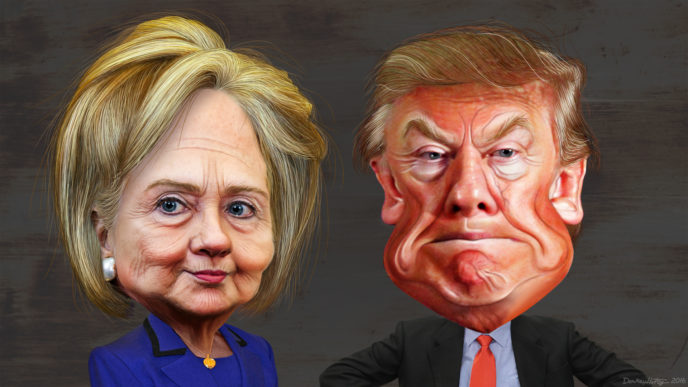
One area in which Trump can be nailed down is his overall view of trade. As I explained at Conservative Review, when it comes to Trump’s own financial dealings, he is an unrepentant globalist, from which he has made a fortune. But these days, as he runs for president, the billionaire is a radical protectionist who has repeatedly declared his intention to impose massive tariffs aimed at the economies of other countries, such as Japan and Mexico, and a forty-five percent tariff on products from China. Such broad tariffs would most certainly result in retaliation by the targeted countries. This is a sure job-killer that would also drive up costs of everyday products to low- and middle-class Americans. The net result: economic misery, not just for those hard-working, tax-paying Americans who work in industries that rely on international commerce and trade, but mostly everyone.
This is not Reaganism but Herbert Hooverism. And besides the economic impact, this would lead to empowering further centralized government — politicians, courts, and bureaucrats — and weakening further the private sector and individual liberty. This is precisely what occurred during the Great Depression. The federal government always gets more powerful under these conditions, which is among the reasons constitutional conservatives resist it.
Trump has also threatened Ford Motor Company, should it move forward with building a plant in Mexico. He has warned Apple Inc. against continuing to manufacture iPhones in China. Should he become president, Trump does not have the constitutional authority to manage and control private companies as if they are his own. But the Hugo Chavez-like rhetoric alone should concern freedom-loving Americans.
None of this seems to matter to professional Trump media surrogates, including Julia Hahn at Breitbart. Not only does she ignore these stunning Trump proclamations, she insists, for now anyway, that there really is no light between what Trump is saying and proposing and what Reagan said and did. Her premise is so thoroughly preposterous and her “arguments” so thin, I thought it worth a brief examination. Indeed, the opposite is true. Trump’s position on trade is more akin to socialist Bernie Sanders. As Trump explained to ABC’s George Stephanopoulos on Sunday, “I’m going to get Bernie [Sanders] people to vote, because they like me on trade.”
First, let’s look at the bogeyman, the trilateral agreement with the United States, Canada, and Mexico known as the North American Free Trade Agreement (NAFTA). Trump has said, “We will either renegotiate it or we will break it.” He has called it “a disaster.” Not only was Reagan a powerful advocate for such a trade arrangement, he is credited with giving it birth when he announced his candidacy for president in 1979. Reagan called for a “North American accord.” Indeed, in 1984, as a result of Reagan’s efforts, Congress passed the Trade and Tariff Act, giving the president “fast-track” authority to negotiate free trade agreements. And in 1988, the Canada-U.S. Free Trade Agreement, the predecessor to NAFTA, was signed. (It has since been overtaken by NAFTA, which includes Mexico.)
Reagan was so passionate about free trade generally, and NAFTA in particular, on September 13, 1993, he penned an op-ed for The Wall Street Journal, titled “Tear Down The Trade Wall,” urging the passage of NAFTA. Below is an excerpt, but I would encourage you to read it in full here. I raise this op-ed because of the extensive propaganda campaign underway to justify Trump’s protectionism by comparing him to Reagan:
For decades America has led freedom-seeking people around the world in their struggles to destroy and dismantle the oppressive barriers that divide countries and restrict liberty. Today, many of those battles have been fought and won — the barricades that once stood between countries no longer exist and their citizens are able to live together in freedom and prosperity. With this in mind, we, as Americans — as North Americans — are faced with a new challenge. The Cold War is over, and now we must break down the tariff walls that restrict the free flow of trade on our continent. The North American Free Trade Agreement can bring us that victory.
The reason for a free trade agreement is simple: Throughout history, whenever and wherever trade barriers have been lowered, the participating economies have flourished. Through Nafta, we will most certainly see a boost to the economic vitality of the U.S., Canada and Mexico. It will help mature and expand the North American economy, keeping us globally competitive.
Presidents of both political parties have embraced the North American Free Trade Agreement in order to forge a powerful bloc to compete in today’s global economy. Its history goes back even further. When I announced my candidacy for president in 1979, I believed in the potential for the world’s largest free trade zone and called for the creation of such a North American Accord.
We took a major step forward in 1988, when we were able to forge a historic trade agreement between the U.S. and Canada. This agreement cut tariffs and eliminated other trade barriers and, as a result, the world’s longest undefended border got a lot busier. Back then objections were raised, but the critics were proven wrong and our trade grew to a world record $175 billion — and our two-way investment also reached record levels.
Moreover, on August 6, 1983, in a radio address to the nation, Reagan spoke about the benefits of trade and the dangers of protectionism. He said, in part:
I’d like to talk to you today about trade — a powerful force for progress and peace, as you well know. The winds and waters of commerce carry opportunities that help nations grow and bring citizens of the world closer together. Put simply, increased trade spells more jobs, higher earnings, better products, less inflation, and cooperation over confrontation. The freer the flow of world trade, the stronger the tides for economic progress and peace among nations.
I’ve seen in my lifetime what happens when leaders forget these timeless principles. They seek to protect industries and jobs, but they end up doing the opposite. One economic lesson of the 1930’s is protectionism increases international tensions. We bought less from our trading partners, but then they bought less from us. Economic growth dried up. World trade contracted by over 60 percent, and we had the Great Depression. Young Americans soon followed the American flag into World War II.
No one wants to relive that nightmare, and we don’t have to. The 1980’s can be a time when our economies grow together, and more jobs will be created for all. This was the spirit of the Williamsburg summit in May. The leaders of the industrialized countries pledged to continue working for a more open trading system. But sometimes that’s easier said than done.
In 1986, under the General Agreements on Tariffs and Trade (GATT), Reagan started the Uruguay Round of multilateral trade negotiations. It culminated in lowering tariffs throughout the world and eventually the World Trade Organization. Over one hundred countries were signatories.
The Reagan record of promoting trade, through words and actions, abounds. Yet, not a single word of any of this was relayed to Hahn’s readers in her Breitbart piece comparing Trump to Reagan. In fact, she doesn’t quote Trump’s famous words either, when he told The New York Times, in part, “I would tax China on products coming in. I would do a tariff, yes — and they do it to us.” He said he’s “a free trader,” but that “it’s got to be reasonably fair.” “I would do a tax. And the tax, let me tell you what the tax should be … the tax should be 45 percent.” Forty-five percent on what? Not a single product or some products. But on all products coming from China and other unspecified tariffs aimed at Japan and Mexico.
Instead, Hahn cherry picks the occasions when Reagan did impose tariffs, which were rare and specific. For example, Hahn writes:
Reagan did not hesitate to impose duties, tariffs, and other trade fairness measures to enforce trade rules — the same measures which they now criticize Trump for supporting. Indeed, Reagan was harshly rebuked by so-called ‘free traders’ for taking ‘protectionist’ actions such as a 45% tariff on Japanese motorcycles to save the Harley-Davidson Motor Company of Milwaukee, Wisconsin. Reagan’s action seems similar to Trump’s call for a 45% tariff on Chinese imports.
Obviously, I’m familiar with these actions. I’ve even mentioned on my radio program that Reagan imposed certain tariffs. In fact, I’ve gone further. I have pointed out several times that the federal government imposes over 12,000 tariffs on products and the Federal Reserve manipulates our currency as well through a variety of techniques, most especially quantitative easing. I don’t believe much of this has been beneficial to our nation’s economy or hard-working low- and middle-income Americans. For all the attacks on free trade by the protectionists and Big Labor, the problem is the lack of it. More trade and commerce, along with cuts in regulations and individual and corporate income taxes, would contribute mightily to the nation’s economic expansion and job creation.
But a trade war is triggered when one country directs broad-based tariffs at another country, resulting in retaliation. And that’s what Trump is promoting. Again, as Reagan put it, referring to the 1930s,”No one wants to relive that nightmare, and we don’t have to.” Even when Reagan lifted the special tariff imposed on Japanese motorcycles, on May 16, 1987 he addressed the nation and emphasized the importance of trade and commerce, condemning protectionist legislation and warning of its consequences.
In 1985, and at other times, Reagan warned that he would veto protectionist legislation bouncing around Congress. He stated, “[S]o-called protectionism is almost always self-destructive, doing more harm than good even to those it’s supposed to be helping. … Protectionism almost always ends up making the protected industry weaker and less able to compete against foreign imports. … From now on, if the ghost of Smoot-Hawley rears its ugly head in Congress, if Congress creates a depression-making bill, I’ll fight it.” Indeed, Reagan was true to his word. In 1985, he vetoed legislation imposing tariffs on textiles, shoes, and copper.
In 1986, when the Democrat House passed another protectionist bill, the New York Daily News reported:
Employing some of his strongest language to date against the House-passed trade bill, President Reagan Thursday called the measure ‘kamikaze legislation’ and warned that it could send the economy ‘into the steepest nosedive since the Great Depression.’ Speaking to the National Association of Manufacturers, Reagan renewed his threat to veto the bill if it emerges from Congress in the same form that passed the House last week on a vote of 295-115. The measure would impose import restraints on countries such as Japan that maintain large trade surpluses with the United States.
It was killed in the Senate.
In 1987, as Congress was readying more protectionist legislation, Reagan warned against it. In 1988, as promised, Reagan vetoed another textile protectionist bill over Democrat Party objections.
Reagan said, in part, “It would impose needless costs on American consumers, threaten jobs in our export industries, jeopardize our overseas farm sales and undermine our efforts to obtain a more open trading system for U.S. exports. This bill represents protectionism at its worst.”
Now, let’s return to the premise of Hahn’s Breitbart piece. She launched her essay with this:
The members of the #NeverTrump movement cite, in part, Donald Trump’s position on trade as a reason why they cannot support their party’s presumptive nominee, chosen by Republican voters. They argue that Trump’s position on trade represents a betrayal of the Ronald Reagan legacy that defines virtually all thinking and rhetoric among the professional conservative class in Washington, D.C. However, there is one significant problem with this line of attack: namely, Reagan’s record on trade far more closely resembles Trump’s position than it resembles the view of those in the #NeverTrump movement. In fact, by their own definition, Reagan would have been a radical “protectionist”—meaning professional conservatives who are #NeverTrump would also have been for #NeverReagan.
The absurdity of Hahn’s piece is now clear, as is her rhetoric. Reagan’s approach to trade and commerce has very little in common with Trump’s positions. It is another weak effort to tie Trump to Reagan, the latter being an enormously popular and successful president. Her leader is no Reagan. He’s actually more Sanders, as he reaches out to the latter’s supporters. Perhaps Hahn will turn her attention to that? Don’t count on it.
Finally, some clean up. Hahn cites a CATO Institute piece condemning the Reagan trade record. Well, here’s a link to a CATO Institute piece praising it. So what? Then Hahn takes offense at my interview of Marco Rubio, throwing some red-meat out there for obfuscation purposes. What does that have to do with anything? Nothing. Chalk that up to immaturity. And among all the real experts and scholars she can cite for authority about the Great Depression, who’ve written at great length about the subject, she chooses Pat Buchanan as her source. At least she didn’t use Pat to defend Trump’s position on Israel, whatever it is.
As Trump apparently feels the Bern, moving left on the minimum wage, taxes, and trade, I would encourage liberty-loving Americans to insist that he demonstrate to us his worthiness to be president. He can count on his media surrogates no matter what, that’s quite obvious. But he has to persuade millions of others. Meanwhile, we will keep the pressure on him to support more freedom and less government. (For more from the author of “TRUMP ON TRADE: More Sanders Than Reagan” please click HERE)
https://joemiller.us/wp-content/uploads/25697590636_ea28f0ca4e_b.jpg6831024Joe Millerhttps://joemiller.us/wp-content/uploads/logotext.pngJoe Miller2016-05-10 00:25:452016-05-10 00:25:45TRUMP ON TRADE: More Sanders Than Reagan