Add This to the List of Reasons Conservatives Think ESPN Is Biased

There is a whole host of reasons conservatives have come to believe that ESPN has a left-leaning bias.

First, there was the network’s decision in 2015 to give the Arthur Ashe Courage Award to former Olympian-turned-reality TV star Bruce—now Caitlyn—Jenner.

Apparently, Jenner’s decision to publicly share his transgender journey, many years after his sports career was over, was more courageous than that of 19-year-old college basketball player Lauren Hill, who publicly lived out her battle against brain cancer on the court from 2013 to 2015, raising awareness and over $1.5 million for research before succumbing to the disease in April of that year.

Then there was the decision by the network to pull a golf tournament from one of then-candidate Donald Trump’s golf courses because it didn’t like some of his comments, but apparently had no problem allowing its ESPNW network to give voice and coverage to the Women’s March on Washington where one speaker, Madonna, said she wanted to blow up the White House. And naturally, the same network was nowhere to be found covering the March for Life.

And more double standards were on display when no action was taken by the network against ESPN sportscaster Tony Kornheiser when he compared the tea party to ISIS.

Yet the network did take action when former major leaguer-turned-ESPN analyst Curt Schilling posted comments on Facebook objecting to the push to open up bathrooms to the opposite sex. Schilling was promptly fired.

Like I said, there are plenty of examples showing ESPN’s lurch to the political and cultural left.

And now, in a public relations attempt to prove it doesn’t have a liberal bias—or at least that its viewers don’t think it has a liberal bias—it again shows just how real its liberal bias is.

In a survey of viewers (only select parts were released) conducted for the network in early May, of respondents who said they detect bias in ESPN’s coverage, 63 percent said it was a liberal bias.

But that isn’t how the network spun it.

It left that number out of its official statement and instead only referenced the 30 percent who said they thought the network expressed a conservative viewpoint.

When asked by the Washington Examiner why they didn’t include the 63 percent figure, a spokesman for ESPN said it was “implied.” When Sporting News asked the same question, the reply was that they were trying to keep the press release “short.”

Yeah, OK.

When it comes to bias, it’s not always what a media outlet says—it’s what it doesn’t say. It’s not always what facts it includes, it’s the ones it leaves out.

Earlier this year, ESPN’s public editor, Jim Brody, stated in a column about the controversy of ESPN wading into the cultural and political arena, “ESPN has made it clear: It’s not sticking to sports.”

But if another study of ESPN’s audiences—this one not conducted by the network itself—is accurate, voters of a certain political persuasion are making it clear they aren’t sticking with ESPN.

The study of 43 television markets nationally showed that ESPN’s audience, across its multiple channels (ESPN, ESPN2, ESPNU, etc.), is becoming more liberal and that fewer Republicans are watching.

Considering the “Worldwide Leader in Sports” has lost more than 10 million subscribers in recent years, ESPN might want to change its motto—and revisit its game plan. (For more from the author of “Add This to the List of Reasons Conservatives Think ESPN Is Biased” please click HERE)

Follow Joe Miller on Twitter HERE and Facebook HERE.

Alleged NSA Leaker Vowed to Stand With Iranian Terror Regime

A government contractor who was charged Monday with leaking top secret U.S. intelligence to the media appears to be a climate change activist and vociferous anti-Trump leftist who is sympathetic to the terrorist regime in Iran, according to her social media profiles.

Reality Leigh Winner, 25, was arrested by the FBI this weekend in Georgia and appeared in court Monday to face charges. Winner admitted that in early May, according to the Department of Justice affidavit, she “printed and improperly removed classified intelligence reporting” and sent that information to the media.

Also on Monday, The Intercept published a top-secret National Security Agency document related to Russian hacking efforts concerning the 2016 election. According to NBC News, Winner was the source of information for The Intercept, a far-left publication that supports American traitor Edward Snowden.

Why Winner had access to a top-secret document on Russian hacking initiatives remains a complete mystery. The DOJ affidavit did not specify how she accessed the information.

Winner’s photo was published by The Guardian’s Jon Swaine, who reported she is a former U.S. Air Force linguist who speaks Pashto, Farsi, and Dari, languages predominantly spoken in Afghanistan and Iran.

Winner’s Facebook profile showcases anti-Trump leanings and an apparent passion for climate-change activism.

In late January, shortly after Donald Trump became president, Winner changed her Facebook cover photo to an image of a tweet by “Rogue NASA” that stated: “Advocating for climate science and environmental protection is the most pro-life you can be. The future of the planet depends on it. #resist”

In February, Winner posted a photo of her visit to the local Georgia office of Republican Sen. David Perdue. In a comment on the visit, Winner claimed she had a “private 30 minute meeting” with Perdue in which she pleaded that “our senators not be afraid to directly state when our president or his cabinet tell outright lies.”

In another February post, she referred to President Trump as a “piece of shit.”

A Twitter account reportedly belonging to Winner announced that she would stand with the terrorist Iranian regime against the United States.

In March, she wrote a long letter to a Ms. Zoller in Georgia alleging a wild conspiracy about the “permanent war economy.” She assailed energy companies for creating the Middle East refugee crisis that she believes is further worsened by climate change .

Some of the political pages Winner “Liked” on Facebook include those of democratic socialist Senator Bernie Sanders, Koch Brothers Exposed, Media Matters for America, and the Natural Resources Defense Council.

She posted her last Facebook status on June 2, one day before she was arrested. “You are what you love, not who loves you,” she wrote.

Winner faces up to 10 years in jail for leaking classified information. (For more from the author of “Alleged NSA Leaker Vowed to Stand With Iranian Terror Regime” please click HERE)

Follow Joe Miller on Twitter HERE and Facebook HERE.

Reporter Searches for REAL Motive in Orlando Jihadi Attack

A year later, there are still some in the mainstream media trying to figure out why jihadi Omar Mateen shot up the Pulse nightclub. Paul Brinkmann of the Orlando Sentinel searches for a motive in a lengthy report titled, “Pulse gunman’s motive: Plenty of theories, but few answers.” Wait, what?

The article provides a little clarity on what Brinkmann was trying to report, but not much. His focus seems to be on the question of why the Pulse nightclub, and not another venue. But that isn’t really motive; that’s location. Focusing on location obscures the real motive, which is the destruction of the West in the name of Allah.

Brinkmann grasps to understand a full motive, instead of the one staring him right in the face.

Then came the Pulse massacre on June 12, putting Florida on the map with 49 red dots. Not everyone killed at Pulse was gay, but ISIS, which claimed responsibility for the attack, noted the victims were all in “a nightclub for homosexuals.”

But there’s still no evidence that the Pulse killer intended to target gay people. A year after the massacre, the only confirmed motive is the shooter’s statements to 911 operators and hostage negotiators. He told them he pledged allegiance to ISIS and wanted people to know the pain that Syrians and Iraqis felt.

“At the end of the day, there are things we can learn from this, but we may not get a definitive answer that explains why the killer chose this target,” said Mary Ellen O’Toole, a former senior profiler with the FBI and an expert on mass shootings.

Occam’s razor is a principle in philosophy that posits the simplest answer is often the correct one. That is the case here. Despite what numerous “experts” cited in Brinkmann’s piece say, this wasn’t about Mateen finding ISIS as a justification for some other motive. Radical Islamic jihad was the motive.

Until policymakers and the media understand that there are a group of people that want to destroy the
West and instill a worldwide caliphate, we can’t confront the problem. Looking for other motives to describe why jihadis attack — beyond jihad itself — is frankly dangerous.

CR’s Nate Madden, after the Manchester jihad attack, outlined, “Why terrorists attack children.” The statement could switch out “children” and replace it with any other group of people. The answer fundamentally remains the same. Here’s what Madden wrote:

These phases, as explained by Trump advisor Dr. Sebastian Gorka in 2015, are:

1. Vexation.
2. Spread savagery.
3. Administer savagery.

A talk Gorka gave at the Heritage Foundation in 2015 further illuminates how this strategy works. Here’s a synopsis of the lecture from the Institute of World Politics:

Phase 1, “vexation,” is comprised of operations to distract and exhaust the infidel enemy and his allies. It puts emphasis on smaller dramatic operations (as opposed to dramatic transnational attacks) and is used to prepare fighting units for phase 2. Phase 2, as Dr. Gorka explained, is the “spread savagery” stage, which ISIS has already begun. In this phase, leaders of the insurgency coordinate unconventional warfare to “dislodge” nations from local control. Phase 3, “administer savagery/consolidate/expand,” is designed to out-govern the government. In this phase, the leaders stabilize held areas, unite the population as a fighting community, and implement sharia law and government as a means to establish a base-state. This base-state is a new type of hybrid caliphate used to attack and expand into neighboring countries.

This is the big picture that it is so important to keep in mind when it comes to these sorts of terror attacks. It’s vexing enough for people in the West to worry whether a small explosion will make their trip to the market a fatal one. It’s more vexing when those same kinds of attacks become a monthly occurrence. And it’s even more vexing when those attacks are focused on a society’s children.

A jihadi picks his target to “distract.” Brinkmann’s focus on some other, hidden, non-jihad motive behind Mateen’s attack feeds directly into the jihadi playbook.

Stop trying to rationalize what the jihadis do; take them at their word. Then work to stop them from having the means to attack again. (For more from the author of “Reporter Searches for REAL Motive in Orlando Jihadi Attack” please click HERE)

Follow Joe Miller on Twitter HERE and Facebook HERE.

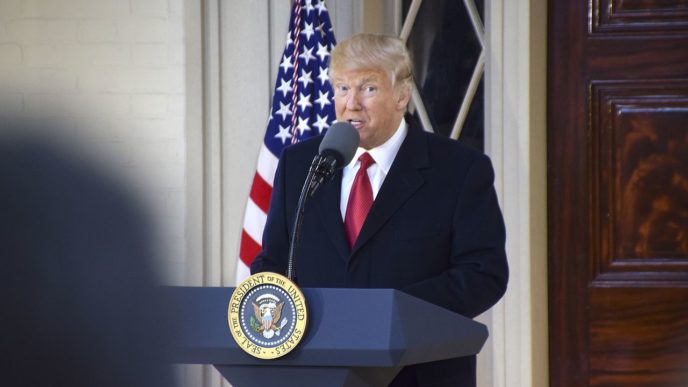
Trump Calls for American Resolve Against ‘Vile Enemy’

President Donald Trump says he will do whatever is necessary to protect the United States from a “vile enemy” that he says has waged war on innocents for too long, vowing: “This bloodshed must end, this bloodshed will end.”

Trump commented on the vehicle and knife attack that killed at least seven people in London at the conclusion of a Sunday night fundraiser for Ford’s Theater, scene of one of the most famous acts of bloodshed in American history: the assassination of President Abraham Lincoln.

“America sends our thoughts and prayers and our deepest sympathies to the victims of this evil slaughter and we renew our resolve, stronger than ever before, to protect the United States and its allies from a vile enemy that has waged war on innocent life, and it’s gone on too long,” Trump said in his first comments in public on the attack late Saturday in a busy section of London. He previously had commented via a series of Twitter posts. (Read more from “Trump Calls for American Resolve Against ‘Vile Enemy'” HERE)

Follow Joe Miller on Twitter HERE and Facebook HERE.

Hysteria Over Paris Pullout

For sheer hilarity and hyperbole it’s hard to beat a recent headline on a Washington Post editorial opposing President Trump’s decision to remove the U.S. from the nonbinding and unenforceable Paris climate agreement.

“Trump turns his back on the world,” it screamed.

A close second goes to the headline on a New York Times piece by columnist David Brooks: “Donald Trump Poisons the World.”

Dishonorable mention goes to former presidential adviser David Gergen, who said on CNN that Trump had committed “one of the most shameful acts in U.S. history.”

The secular progressives have again revealed their diminished capacity, which ought to disqualify them from leading anything, especially the country. (Read more from “Hysteria Over Paris Pullout” HERE)

Follow Joe Miller on Twitter HERE and Facebook HERE.

Key Steps to Restoring Accountability to the Federal Bureaucracy

Over the last century, we have seen an exponential growth of the federal bureaucracy.

As a practical matter, federal agencies—not Congress—have assumed the primary role in making the policies that affect our lives. Governing by regulation reached unprecedented levels under the Obama administration.

In his first 100 days, President Donald Trump has taken great strides to return our government to the people by reducing how much actual governing occurs by regulation.

For instance, within days of taking office, Trump issued an ambitious executive order that requires federal agencies to identify two old regulations to eliminate for every new regulation proposed and to ensure that the net costs of new regulations are offset by the elimination of old ones.

Trump has also nominated a number of exceptionally qualified agency heads who share a vision of less government by regulation, including, most recently, the inspired choice of Neomi Rao as his “regulatory czar” at the Office of Information and Regulatory Affairs.

I will be pleased this week to introduce Rao before the Homeland Security and Governmental Affairs Committee for her confirmation hearing. She is a distinguished scholar, with extensive experience in administrative policy.

Her confirmation will assure that federal regulation is carefully scrutinized and improved before imposing additional costs on American job creators and consumers.

But Congress, too, must act.

Governing by regulation is costly. By some estimates, federal regulations now impose a burden of well over $1 trillion annually on our economy—an amount that would equal more than $15,000 per household per year.

But the costs to core democratic values are greater still. A bureaucratic vision of governance threatens the separation of powers enshrined in our Constitution.

As James Madison explained in Federalist 47, “The accumulation of all powers, legislative, executive, and judiciary, in the same hands … may justly be pronounced the very definition of tyranny.”

Lawmaking by regulation consolidates governmental powers in the hands of unelected bureaucrats. It’s time to rein in the federal bureaucracy and make it more accountable.

That’s why last month I joined Sens. Rob Portman, R-Ohio; Heidi Heitkamp, D-N.D.; and Joe Manchin, D-W.Va., in taking an important step forward by introducing the Regulatory Accountability Act of 2017.

This bipartisan legislation, if enacted, would constitute the most significant reform to the federal bureaucracy in over seven decades. It would modernize the regulatory process to make it smarter, more cost-effective, and more democratically accountable.

And it would do so without undermining the ability of agencies to fully protect public health, safety, and the environment.

For instance, the Regulatory Accountability Act would codify the requirements developed and embraced by our last five presidents that federal agencies must analyze the costs and benefits of new regulations—using the best data and science—and generally adopt the most cost-effective approach.

Similarly, it would require agencies to review old regulations to determine whether they still serve their intended purpose, and it would allow the public to petition for old regulations to be withdrawn or otherwise modified.

To address the democratic deficits in the regulatory process, the Regulatory Accountability Act would also ensure greater transparency and public participation in the rulemaking process. It would require agencies to disclose the empirical data on which they base their proposed regulations for public comment, as well as provide greater notice before rulemaking.

It would likewise limit an agency’s ability to bypass the public comment period—a dangerous practice federal agencies have increasingly embraced in recent years.

For the most economically significant regulations, the bill would require agencies to invite public comment before proposing the rule and, in some circumstances, would allow interested parties to request a public hearing on the proposed rule.

While agencies would have to engage in additional analysis on the front end for some rules, the extra work will yield better results on the back end. That means smarter and more effective regulation for the public good.

Importantly, the Regulatory Accountability Act would give federal courts greater authority to review final regulations and, in particular, to ensure that the federal agency officials followed these procedures.

It would also help restore the proper separation of powers between the branches of government by eliminating so-called “Auer” deference, whereby courts largely defer to agencies’ interpretations of their own regulations.

As I have argued, this doctrine displaces the judiciary’s constitutional role and encourages federal agencies to use less democratically accountable processes.

Some might wonder why Republicans in this Congress would push for regulatory reform. After all, the American people have elected a Republican president who has articulated a bold vision for cutting back on the most costly aspects of the regulatory state. This legislation would apply to all regulatory activity—both further regulation and deregulation.

We continue to push for regulatory reform because this isn’t about politics. The Constitution requires a proper separation of powers between the three branches of the federal government. It requires lawmaking that is accountable to the people.

The bipartisan Regulatory Accountability Act is critical to restoring those constitutional values and, in the process, encouraging smarter and more effective federal regulations. (For more from the author of “Key Steps to Restoring Accountability to the Federal Bureaucracy” please click HERE)

Follow Joe Miller on Twitter HERE and Facebook HERE.

Trump Doesn’t Like So Many Anonymous Sources, and Neither Do These Journalism Experts

Last week, when pressed to answer questions about reports that Jared Kushner set up back-channel communications with the Russian government, White House press secretary Sean Spicer frequently responded by considering the source—or lack thereof.

“I’m not going to dignify partisan accusations of anonymous sources and alleged—unsubstantiated attacks,” Spicer told reporters Tuesday during exchanges that became testy at times when answering questions about President Donald Trump’s son-in-law and senior adviser.

The use of anonymous sources in stories critical of the president have been under the Trump White House’s skin for some time, though Rick Edmonds, a media business analyst at the Poynter Institute, which studies journalism and the media, wasn’t sure there are more stories based on anonymous sources under Trump than past presidents.

“Anonymous sources are bad in theory, because generally, journalists should try to get people on the record,” Edmonds told The Daily Signal. “But sometimes that is the only way to get ledes and background. If a reporter stands on principle and says, ‘I will not do that,’ they will miss out on information.”

Edmonds said there is typically a different set of rules in Washington than at news outlets in other places.

Most of the anonymously sourced stories have been about alleged ties to Trump and Russia. Other frequent topics are about infighting in the White House.

During his speech in late February, at the Conservative Political Action Conference in Maryland, Trump went so far as to accuse the media of making up anonymous sources.

“I’m against people that make up stories and make up sources,” Trump said. “They shouldn’t be allowed to use sources unless they use the name. ‘A source says Donald Trump is a horrible human being.’ Let them say it to my face. There are some great reporters, honest, talented as the day is long. But also dishonest people doing a disservice to the country.”

The Society of Professional Journalists tightened the organization’s code of ethics in 2014 to dissuade the use of anonymous sources. It calls for journalists to “identify sources whenever feasible. The public is entitled to as much information as possible on sources’ reliability,” and to “always question sources’ motives before promising anonymity. Clarify conditions attached to any promise made in exchange for information. Keep promises.”

The Associated Press Stylebook lays out the parameters for using anonymous sources. The stylebook says:

Under AP’s rules, material from anonymous sources may be used only if:

The material is information and not opinion or speculation, and is vital to the news report.

The information is not available except under the conditions of anonymity imposed by the source.

The source is reliable, and in a position to have accurate information.

Reporters who intend to use material from anonymous sources must get approval from their news managers.

Explain in the story why the source requested anonymity. And, when it’s relevant, describe the source’s motive for disclosing the information.

The story also must provide attribution that establishes the source’s credibility; simply quoting a source is not allowed. Be as descriptive as possible about the source of information.

“If you have to attribute facts to an anonymous source to nail down the story, that is one matter,” Edmonds said. “What I dislike is opinion, simply pushing negative opinions and using anonymity as cover.”

A major problem with nameless, faceless sources is that the motives of the leakers for the anti-Trump stories “might be pure, or could be poisonous,” wrote Brent Bozell and Tim Graham, of the Media Research Center, a conservative media watchdog group. Regarding recent stories in The Washington Post, they wrote:

Earth to the Post: your new motto is ‘Democracy dies in darkness,’ but anonymous sourcing is darkness. Every source who hides behind a wall as he tries to ruin other people’s careers is a self-serving coward with a personal or political ax to grind. Without knowing an identity, the public has no way of telling … anything. It’s idiotic for the press to demand transparency in government at the exact same time it rewards government officials who refuse to be transparent themselves.

Journalists pat themselves on the back that they would never be ‘stenographers to power,’ but they’re worse than that now. In their zeal to destroy Trump, they’ve become stenographers to anonymous power.

The use of anonymous sources prompted controversy on the left and the right. In 2003, New York Times reporter Jayson Blair was fired for fabricating stories based in part on anonymous sources. Also, New York Times reporter Judith Miller came under heavy scrutiny for reporting—based largely on anonymous government sources—about Iraq’s weapons of mass destruction in the lead-up to the Iraq War.

Paul Steiger, a former managing editor of The Wall Street Journal and founder of ProPublica, noted that leaks are absolutely needed to get to the truth.

“It is not the publishing of these secrets that threatens national security. Publishing these secrets threatens the secret-keepers,” Steiger said. “It protects the public interest by letting us know what powerful people are doing when they think no one is looking … We need more journalists revealing more secrets, not fewer.”

Margaret Sullivan, a media columnist for The Washington Post and a former public editor for The New York Times, noted famous instances of anonymous source usage such as Edward Snowden and surveillance of Americans during the Obama administration, going back to the Pentagon Papers and Watergate during the Nixon years. Sullivan wrote:

In a government increasingly obsessed with secrecy, and guilty of rampant overclassification, leaks are necessary and, largely, a very good thing.

And although there are legitimate national security concerns in some cases, I’d far rather live in a leaky America than one sealed up tight—with whistleblowers and journalists behind bars.

Identifying sources is particularly important today when so many people are throwing around the phrase “fake news,” said Andrew Seaman, the Society of Professional Journalists ethics chairman.

“The public has the right to know as much as possible about a story, including the messenger, who should be identified,” said Seaman, a journalist with Reuters.

He noted that Washington journalists were resistant to the change in 2014, and insisted anonymous sourcing is “the way Washington works.” The Society of Professional Journalists doesn’t have to approve of how Washington works, he added.

“Anonymous sources can be important, but journalists also need to be more aggressive and push a source to go on the record,” he said. “First ask, where else does this exist? It’s very rare that only one person knows about something in government.”

An example of using someone off the record to steer in the right direction would be the most famous anonymous source of all, Deep Throat of Watergate, who turned out to be the former No. 2 at the FBI, Mark Felt. He was never quoted in Washington Post stories by Bob Woodward and Carl Bernstein, but rather guided them on where to look. That said, the Watergate stories still included many other anonymous sources.

Ultimately, government officials at the highest levels have an obligation to be transparent, he said.

“An uptick in anonymous sources often happens as access becomes more scarce with shorter and fewer press briefings,” Seaman said. “If the administration wants to cut back on anonymous sources, they will be more transparent and open.” (For more from the author of “Trump Doesn’t Like So Many Anonymous Sources, and Neither Do These Journalism Experts” please click HERE)

Follow Joe Miller on Twitter HERE and Facebook HERE.

How to Fully Realize the Potential of Medicare Advantage

The House Ways and Means subcommittee on health will host a hearing this week on promoting integrated and coordinated care for Medicare beneficiaries. The committee will review how Medicare Advantage, the program of competing private health plans, is providing services for senior and disabled citizens.

This wide-ranging program includes, among other things, Special Needs Plans (SNPs) and other models for improving care delivery for our most vulnerable seniors and people living with disabilities.

The Congress is right to focus on seniors with special needs. In Medicare Advantage, this population is helped by three different types of SNPs: dual-eligible, or D-SNPs (qualify for both Medicare and Medicaid), chronic condition, and institutional.

Access to these plans remains high. Enrollment in these plans grew by 7 percent in 2016 alone and has grown from 0.9 million in May 2007 to 2.2 million in April 2016. The current SNP authority is set to expire at the end of 2018.

A key benefit of many Medicare Advantage plans is the provision of care coordination.

The care coordination helps patients access what they need and, for those senior and disabled citizens who are financed by both Medicare and Medicaid (dual-eligibles), the coordination between Medicare and Medicaid can provide more efficient care delivery at lower costs.

One care model out of Arizona concluded that it kept enrollees out of the hospital and produced fewer readmissions than traditional Medicare coverage.

If more widely adopted, this sort of care coordination could be especially helpful for patients facing multiple chronic conditions. This is significant because chronic illness is the biggest single driver of medical costs.

The Centers for Disease Control and Prevention reported that about half of people in the United States had one or more chronic health conditions as of 2012, and that if these conditions were properly managed, the superior care delivery could reduce health care costs for Medicare and Medicaid by up to $125.5 billion.

Not surprisingly, the Senate Finance Committee recently reported out the CHRONIC Care Act, a bipartisan bill that will help Medicare beneficiaries facing chronic illness.

The intensifying congressional scrutiny on the potential of Medicare Advantage is especially well-timed. Medicare Advantage is the senior’s alternative to traditional Medicare, and it has been rapidly growing.

Today, Medicare Advantage accounts for almost one-third of the entire Medicare population. The reason: Medicare Advantage gives seniors better options than traditional Medicare.

Consider the most important. Unlike traditional Medicare, which is a defined-benefit program, Medicare Advantage is a far more flexible defined-contribution program, meaning that the government makes a per capita contribution to the plans that seniors choose.

These competing health plans offer a broader and richer range of medical services than traditional Medicare, including various preventive services, as well as care coordination and case management for persons with chronic illness.

Medicare Advantage, as documented by The Heritage Foundation, has other attractive features as well. It provides a broad range of personal choice. In 2015, for example, 99 percent of all Medicare beneficiaries had access to Medicare Advantage plans, and could typically choose from among 18 health plans.

Unlike traditional Medicare, all Medicare Advantage plans provide protection from the financial devastation of catastrophic illness. Not surprisingly, beneficiary satisfaction is higher than that of enrollees in traditional Medicare.

For beneficiaries and taxpayers alike, Medicare Advantage is economically efficient. According to Heritage analysis reports, Medicare Advantage plans deliver care at costs routinely lower than traditional Medicare costs.

In this context, it is also worth noting that Medicare beneficiaries often pay no more than the regular monthly Medicare Part B premium. In 2017, this will range from $109 to $134.

In fact, according to the Medicare Payment Advisory Commission, the panel that advises Congress on Medicare reimbursement, a stunning 81 percent of Medicare beneficiaries had access in 2016 to at least one Medicare Advantage plan that included catastrophic coverage, as well as prescription drug coverage, with no additional premium over and above the standard monthly Medicare Part B premium.

By contrast, enrollees in traditional Medicare may have to pay an additional monthly premium for a Medicare prescription drug plan. Nationwide in 2017, the average prescription drug plan monthly premium is $42.17.

Because traditional Medicare has no catastrophic protection, and other gaps in coverage, beneficiaries must buy supplemental private coverage, such as Medigap coverage, and pay another additional premium.

Nationwide in 2017, the average Medigap monthly premium is $183.

Medicare Advantage has demonstrated the capacity of private plans to create innovative products for senior and disabled citizens, including those with chronic and complex medical conditions.

Congress should build upon this progress, expand Medicare Advantage’s platform for new payment and delivery models, and encourage the participation of health plans that hold promise of improving medical outcomes while reducing costs.

The program’s success can be a strong foundation for further reform of the giant Medicare program, especially through the adoption of a premium support model—a model based on Medicare Advantage’s system of defined-contribution financing and market-based competition. (For more from the author of “How to Fully Realize the Potential of Medicare Advantage” please click HERE)

Follow Joe Miller on Twitter HERE and Facebook HERE.

Meet the People Who Are Grateful for Trump’s ‘America First’ Climate Policy

On Saturday morning, a diverse collection of people gathered in front of the White House to support President Donald Trump’s decision to pull out of the Paris climate agreement.

While Washington, D.C., has been frequented by numerous anti-Trump protests since the 2016 presidential election, this event was overwhelmingly positive toward the administration.

Several of those interviewed said they were pro-Trump immigrants who were happy with the president’s “America first” policies.

One woman, Carmen Padilla, who was carrying a “Make America Great Again” sign, told The Daily Signal she was “so grateful that [Trump] had the courage to get out of these bad deals for America.”

While the rally-goers were positive toward Trump, most expressed similar opinions that the media has been unfair to the president and treated him differently than former President Barack Obama.

(For more from the author of “Meet the People Who Are Grateful for Trump’s ‘America First’ Climate Policy” please click HERE)

Follow Joe Miller on Twitter HERE and Facebook HERE.

‘The President Made It Sound Like…’ Leaked Documents Blow a Hole in Obama’s Russia Narrative

Leaked NSA documents revealing that Russia engaged in election-related hacking efforts just days before the election directly contradict what former President Barack Obama told the American public.

Speaking at a year-end news conference in December, Obama told the public that Russian interference in the election ceased after he told Russian President Vladimir Putin to “cut it out” in early September. Russia’s cyberattacks stopped after warnings of “serious consequences” if they continued, Obama said.

“What I was concerned about in particular was making sure [the DNC hack] wasn’t compounded by potential hacking that could hamper vote counting, affect the actual election process itself,” Obama said. “So in early September when I saw President Putin in China, I felt that the most effective way to ensure that that didn’t happen was to talk to him directly and tell him to cut it out and there were going to be serious consequences if he didn’t. And in fact we did not see further tampering of the election process.”

“But the leaks through WikiLeaks had already occurred,” Obama said, indicating that any further election interference was the result of emails released by WikiLeaks in the days and weeks leading up to the election.

“The president made it sound like that worked,” The New York Times reported at the time, noting Obama’s claim that “we did not see further tampering of the election process.” (Read more from “‘The President Made It Sound Like…’ Leaked Documents Blow a Hole in Obama’s Russia Narrative” HERE)

Follow Joe Miller on Twitter HERE and Facebook HERE.