Afghanistan Has Been America’s Longest War. Here’s What Success Will Look Like.

Wednesday’s terror attack in Kabul is a stark reminder of how brutal the war in Afghanistan still is.

A suicide truck bomber drove near the German Embassy in Wazir Akbar Khan, the diplomatic heart of Kabul, and then detonated his bomb amid the morning rush-hour traffic. The blast killed at least 90 civilians and wounded another 400.

This wasn’t the first such attack in Afghanistan, and it won’t be the last. After almost 16 years of war in Afghanistan, it is only natural to wonder: How do we know if we are winning?

Winston Churchill, while serving as a young officer fighting the Pashtuns in the 19th century, explained the difficulty of winning the type of war he faced then and that the United States faces now in Afghanistan:

There are no general actions on a great scale, no brilliant successes, no important surrenders, no chance for a coup de theatre. It is just a rough hard job, which must be carried through. The war is one of small incidents. The victory must be looked for in the results.

Some things never change. What was true in 1897 is as true in 2017.

When NATO ended its combat operations in Afghanistan and transitioned into a train, advise, and assist role in 2015, the usual fanfare associated with victory in war was notably absent. There were no triumphal parades, no formal surrender ceremony, and no heroic march into an enemy’s capital.

This is not the Afghan way of war.

As Churchill wrote in 1897, “The victory must be looked for in the results.”

In late 2001, just after the 9/11 attacks, there were two main goals in Afghanistan.

First, to deny al-Qaeda a safe haven from which to plan, train, and launch terrorist attacks on a global scale.

Secondly, to remove the Taliban regime from power as punishment for not cooperating with the international community and for harboring terrorism—a sort of 21st-century version of a 19th-century punitive raid on the frontier.

Both were accomplished with relative speed—it can even be argued that this was achieved by the summer of 2002.

As the years went by, the explanation for what U.S. forces were doing in Afghanistan shifted from America’s raw national security needs to vague notions of nation building and “bringing democracy.”

Consequently, the inability to produce what public opinion considers tangible and achievable results 16 years on has disappointed many.

Since our military intervention in 2001, we have focused on the quixotic goals of creating “a strong central government” and a “pluralistic society” in Afghanistan. We have tried accomplishing these goals by “holding free and fair” elections, “tackling corruption,” and building the “institutions of democracy.”

If we fail to achieve these goals, we are presented with doomsday scenarios of “ungoverned spaces,” the Taliban “back in power,” and the establishment of new terrorist “safe havens.”

But this black-and-white view of the situation doesn’t work in a place like Afghanistan. It is a place with many shades of gray.

Frustrated Expectations

There is a complex middle ground in Afghanistan, and this is where we are today—and where we will likely be for the foreseeable future.

Few in the United States believe that we have been defeated in Afghanistan. They just think we haven’t met the objectives they expected to be achieved—and that what we have achieved has taken too long and cost too much.

This is not an unreasonable view. We have been fighting in Afghanistan for almost 16 years and will likely have some form of military involvement there for at least 16 more.

An 18-year-old soldier serving in Afghanistan today was only 2 years old at the time of the 9/11 attacks. Thousands of U.S. troops have been killed and wounded and just shy of $1 trillion has been spent.

For years, especially in the earlier days of the war, successive U.S. commanders thought that if one more road could be paved, one more school built, or one more hospital constructed, America could leave Afghanistan just that much better.

Over the years, this focus on nation building—however well intended it might have been—resulted in expectations set so high in Afghanistan that even obvious successes on the security front were not considered good enough.

This created an impossible situation for the U.S. military. With the lofty goals of nation building defining our success in the early days, the only thing most people see today in Afghanistan is failure.

However, a closer look at the situation shows that much has actually been achieved.

Successes Thus Far

After the successful targeting of Taliban leaders, combined with a robust counterinsurgency campaign over the years, the group as a national movement has degenerated into several smaller, weaker, and localized insurgencies—each with a different set of grievances and goals.

Even with today’s horrific attack in Kabul, the level of violence in Afghanistan is nowhere close to its peak in 2011–2012. Al-Qaeda, which once used Afghan territory with impunity, no longer enjoys a safe haven in Afghanistan from which to plan and launch terror attacks on a global scale.

The threat posed to Afghanistan by the Islamic State isn’t even close to being in the same league as the Taliban, and pales in comparison to the terror group’s other affiliates in Syria, Libya, and Yemen.

No major terrorist attack originating from Afghanistan has been successful in the United States since 2001.

The Taliban that rolled into Kandahar in 1994 with tanks and planes is a shadow of its former self today.

In 2001, outside of a small rump of territory run by the Northern Alliance in northeast Afghanistan, the Taliban controlled the entire country.

Today, according to the special inspector general for Afghanistan reconstruction’s most recent quarterly report to Congress, the Taliban has “control or influence” in only 11 out of 407 districts across Afghanistan, equaling only 9 percent of the country’s population.

By contrast, 66 percent of Afghanistan’s population live under the “control or influence” of the Afghan government. The remaining 25 percent of the population lives in “contested” areas.

After 16 years of warfare, maybe we should come to terms with the fact that until there is a genuine political settlement between all warring parties and Pakistan stops providing succor to the Taliban, this might be as good as it’s going to get.

So what does success look like in Afghanistan?

Success in Afghanistan is not when 100 percent of its districts are under the complete control of the Afghan government or when there are no more suicide bombings. Nor is success in Afghanistan achieved when every road is paved, every girl goes to school, or everyone gets the right to vote.

These things are very important in themselves, and we should aspire to them, but they are neither the reasons why we went to Afghanistan nor the reasons why we should remain there.

Success is achieved when there is a stable enough Afghanistan—when it is able to manage its own internal and external security to a degree that stops interference from outside powers, allowing the country to resist the establishment of terror bases that were there before.

Nothing more and nothing less.

Realities on the Ground

The American public has every reason to be proud of what the U.S. military has accomplished under very challenging circumstances in Afghanistan. It is time that we have a dose of realism of what to expect in Afghanistan and lower our expectations on what is achievable for the future.

Afghanistan won’t be perfect or suddenly become some Switzerland in the Hindu Kush. Unless you are some idealistic dreamer who has never stepped foot in the country, this was never the goal.

For the rest of my life, there will be an insurgency in some form in the Pashtun heartland of the country. This doesn’t mean that the United States has failed. It is simply a reflection of the reality on the ground and in the region.

India, arguably the world’s largest democracy, fights two major insurgencies inside its borders today—as we were reminded last month when Maoist insurgents killed 25 Indian troops in Chhattisgarh.

Through local deals brokered by various tribes, it is inevitable that the black flag of the Taliban will be seen flying in places where U.S. troops were previously fighting and dying just years before.

Deals will be done between local factions that most reasonable people back in the United States would find incomprehensible, if not appalling. Allegiances between local Afghan tribes will change according to the direction in which the tide of success is seen to be flowing at the time.

This is not defeat. This is reality. This is the peculiar Afghan way of warfare in what is a deeply tribal society.

The Afghan military is far from being perfect, but that was never the goal. The goal is to get the forces to a capability where they can manage the insurgency themselves, without tens of thousands of Western troops on the ground.

Paraphrasing Lawrence of Arabia on the Arabs in his famous 27 Articles of 1917, it is better that the Afghans do it tolerably than we do it perfectly.

A Steady Support

If the West continues to mentor, train, and fund the Afghan military, then the Afghans will be able to take on the insurgency themselves. Eventually this will establish the security conditions inside which a genuine political process can take place between Afghans, the Afghan way.

This is why President Donald Trump’s upcoming decision to at least maintain, or even increase, the number of U.S. advisers and mentors is so important. One only has to look at what happened in Iraq when President Barack Obama withdrew all U.S. forces to understand why.

With each successful Taliban attack, the inevitable headlines immediately appear about America’s failures in Afghanistan.

But we cannot start seeing every tactical victory of the Taliban as America’s strategic defeat. There will be many more successful attacks like the one seen Wednesday in Kabul.

This is a unique kind of war, one in which the enemy has no problem killing himself to kill others and, for spiritual reasons, actually looks forward to the opportunity.

We need to start measuring success by achievements on the ground and not by unrealistic expectations. We also have to realize that patience is required. Success in Afghanistan will be measured in years and decades, not 24-hour news cycles and 140-character-long tweets.

It won’t be pretty, and there will be setbacks—after all, as Churchill reminds us: “It is a rough, hard job.” (For more from the author of “Afghanistan Has Been America’s Longest War. Here’s What Success Will Look Like.” please click HERE)

Follow Joe Miller on Twitter HERE and Facebook HERE.
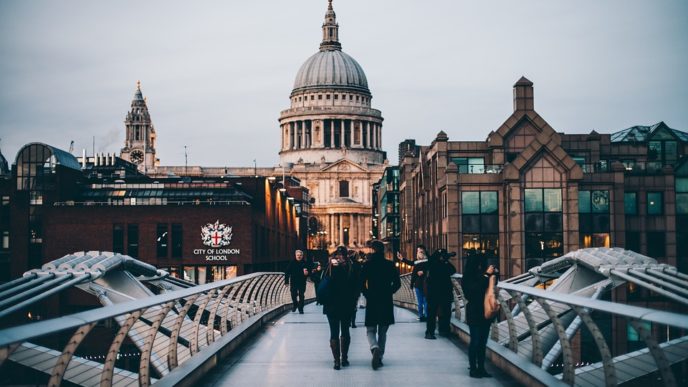
Terror Has Hit London Again. Why US Courts Should Let Government Do Its Job.

A new terror strike in London has renewed the world’s focus on transnational Islamist terrorism, rekindling the old debate over how best to fight it.

The debate is understandable, but it comes far too late. It has been nearly 16 years since the 9/11 attacks, and ongoing terrorist activity has fit a predictable pattern—as has the U.S. response.

The time for retrospection has long passed. Now is the time for action.

With the Islamic State, or ISIS, now losing territory in Iraq and Syria, the terrorist group is looking to shore up its image by looking outward and striking targets abroad.

ISIS is desperate to show it is still relevant. Recently, it claimed responsibility for an attack on a resort in the Philippines even though local officials say the incident was a botched robbery.

Security officials around the world expect ISIS and al-Qaeda to try any means possible to execute or inspire attacks anywhere they can. London is the latest target to be hit, not two weeks since the May 22 suicide bombing in Manchester.

[Editor’s note: British authorities said three suspects were shot to death after driving a van into a crowd on London Bridge, then getting out and stabbing people with long knives, killing seven and wounding or injuring more than 45.]

After decades of battling this threat, what we know is that the best way to stop terrorist attacks is to find the terrorists and stop them before they attack.

That’s not always possible. While such efforts are constantly underway, it’s common sense to take reasonable precautions where possible to put additional hurdles in the terrorists’ path.

That’s what President Donald Trump’s travel order was about. It was a lawful measure issued to help mitigate an emerging threat—the outflow of foreign fighters out of conflict zones in the Middle East.

But the lower federal courts blocked it.

It’s only understandable that Trump, after these latest attacks, would tweet his frustration over the judicial interference into this national security matter.

There is an argument to be made that opposition to these measures tells us more about the state of partisan politics in America than about the executive order’s legal and policy merits.

Regardless, in dangerous times when lawful tools are available to the government—and government is meant to protect us—the courts ought to let government do its job. (For more from the author of “Terror Has Hit London Again. Why US Courts Should Let Government Do Its Job.” please click HERE)

Follow Joe Miller on Twitter HERE and Facebook HERE.

Trump’s Paris Agreement Decision Shows He’s Not Afraid of Defying Global Elites

All the heroes carrying the fate of the world on their shoulders phoned in to NPR Friday morning. Former Secretary of State John Kerry, Canadian Minister of Environment and Climate Change Catherine McKenna, and business magnate Richard Branson, all nearly snarling, attempted to cultivate hatred and mistrust toward President Donald Trump following his decision to withdraw from the Paris Agreement.

Phony high-mindedness is also being deployed against Trump. French President Emmanuel Macron, for instance, went around America’s head of state and chief representative to flatter the American public, reassuring the American public that France and the world still “believes in you.”

That global elites feel sufficient self-confidence to attempt to publicly shame the president of the United States is partly because other U.S. presidents have typically succumbed to similar pressures long before they became public.

Yet few arguments against Trump reveal as much as a recent Washington Post headline: “Trump made up his mind on Paris. Now the rest of the world will do the same on him.” In other words, the U.S. president’s deliberations should be derived from fear of elite ire, speaking on behalf of a world majority.

Leveraging the alleged authority of the majority—not a national majority, but that of the world itself—Trump’s critics cite the fact that America, Nicaragua, and Syria are the only nations not subject to the Paris accord. The dogma that majorities are wise—half-believed, half-used as manipulation by advocates—is striking partly because of the elevation of nations like Iran and North Korea, suddenly viewed as committed environmentalists.

Using similar arguments, the Obama administration worked hard to obligate the American public, despite itself, to agreements that appeared to be treaties, but that have none of the legal or moral authority. The Iran agreement, for instance, proceeded in this way. From its example, one learned not only that such agreements are unenforceable, but that they contain a host of cash transfers, which would never stand the light of investigative inquiry if they were real treaties.

More importantly, obligating the entire nation for generations to come requires Senate ratification, for no small reason. That is because the public should consent to being obligated to going to war, like in case of violation of the Iran deal, or of transferring billions of dollars to other nations, while stifling domestic interests, like in the case of the Paris Agreement.

This Obama-era approach in practice means rule not by the U.S. Senate, but rule by elite international opinion, hiding behind a seeming majoritarian consensus. These opinion makers, feeling neither moral obligations to the well-being of any particular nation, nor under any check to carry out their promises, aim to replace the deliberative function of the Senate.

Trump is right to not cave to this breed of influence. If the agreement is suitable for the U.S., the Senate must debate the matter and gain the public’s consent. Without this, public trust and republican honor are undermined, and our constitutional institutions are replaced with rule by international pressure. (For more from the author of “Trump’s Paris Agreement Decision Shows He’s Not Afraid of Defying Global Elites” please click HERE)

Follow Joe Miller on Twitter HERE and Facebook HERE.
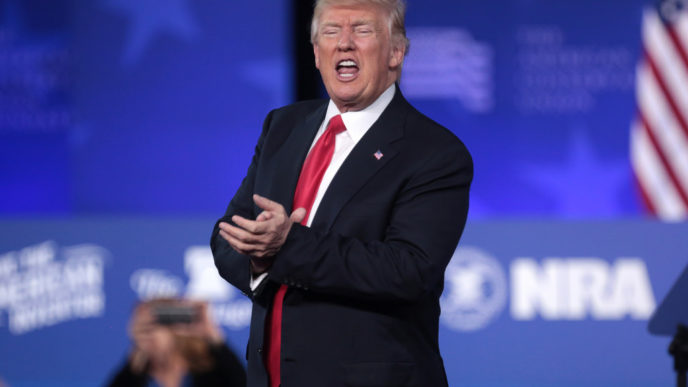
Trump’s Small Opening Shot on Global Warming

On June 1 President Donald Trump (a) took a giant bite out of the fairy tale of man-made global warming and (b) put a big check mark in his list of campaign promises kept. Other nations will slowly also defect from the Paris Accords, although we will endure hysteria for one or several years first.

Trump gave a lot of solid, irrefutable reasons for the United States to withdraw from the “Paris Accord” on climate change. President Barack Obama evaded the U.S. Senate’s power to ratify treaties. Any responsible President really had no choice. It was called a treaty by most other nations who signed it. lthough it is a treaty, the Senate never ratified it. It undermined the Constitution.

However, Republicans desperately avoid the central issue. Man-made global warming is the biggest hoax since P.T. Barnum. Neither Trump nor other Republican officials will confront the fact that it is a scam. By playing the “I don’t know” game, Republicans are encouraging massive lawsuits from other countries that will drain U.S. companies of hundreds of billions of dollars.

In fact, liberal lawyers will now try to over-rule the President’s decision. Remember that the U.S. Supreme Court already ruled in favor of the climate change fantasy in Massachusetts v. EPA, 549 U.S. 497 (2007). The Supreme Court forced the Environmental Protection Agency to regulate carbon dioxide because Massachusetts’ frozen beaches might warm up and become more tourist-friendly. The Supremes already fell for the sob story once that the planet is in danger.

So, we must stop tip-toeing around with weak arguments. Let’s get serious:

First, we know that the Earth’s orbit changes over time, in overlapping Milankovicth cycles, which affect the Earth’s climate. Cyclical changes in the shape and size of Earth’s orbit cause ice ages. We are now still in a long-term warming trend coming out of the last ice age, having nothing to do with humans. The gravitational pull of the other planets tugs Earth into more oval or circular orbits (and back again) over thousands of years.

Second, consider how absurd the hoax is: What was the temperature of planet Earth just yesterday? Does anyone know? Yes, I mean one single temperature reading for the entire planet. We’d have to average the temperature measurements from all over the planet. But we don’t measure the whole planet, only isolated airports, cities, and selected sites. (Sampling is only predictive if it is truly random.) Temperature changes are overwhelmingly a result of air masses moving around, including to or from places where we don’t have measurements. We don’t know what Earth’s temperature was yesterday. How can we say what it was millions of years ago or will be a hundred years from now?

Third, temperature scales were only invented in the mid-1850s. So there was no way to keep meaningful temperature records before about the 1880s. Scientific instruments have to be calibrated for consistency among different manufacturers and different units. Otherwise, different thermometers will not measure temperatures consistently. And then only a few cities had thermometers. People didn’t start keeping meticulous records right away even in the few locations measured. It wasn’t until airplanes needed to know the weather at airports in World War I and II that humans began to keep serious temperature records. Although the ancient Greeks understood the concept of a thermometer, nobody maintained historical records.

Fourth, climate alarmists have been caught falsifying temperature data. Meteorologist Anthony Watts with others discovered that from one year to the next climate alarmists keep reducing the temperatures of past years to make it look like current temperatures are rising. They published temperature data and then changed that in later versions to falsely create the appearance of a rising trend.

Fifth, as the “Surface Station Project” proved, temperature measurements are faulty. An audit by a huge team of volunteer meteorologists led by Anthony Watts conducted site visits and audits of the temperature measurement stations (which are mostly automated). They found that at least 80% of the stations that are measuring temperature do not comply with siting standards and are flawed. Some weather stations sit next to the hot exhaust of industrial office building air conditioners or in the path of the jet exhaust from jet airplanes at airports. Garbage in / garbage out.

Sixth, the geologic record shows that for millions of years atmospheric carbon dioxide has increased an average of 800 years after a rise in global temperature. CO2 does not cause a warming Earth. A warming Earth causes higher quantities of CO2, probably released from solution in the oceans.

Seventh, when the Earth was showing some slight warming, Mars, Pluto, and the moon Triton were also warming according to NASA and the Jet Propulsion Laboratory, and Jupiter and Saturn showed increase storm activity consistent with warming. Any cause of a warming Earth in the short term affected the entire solar system, not merely our planet alone. (Cycles in the “swinging sun” discovered by Dr. Theodor Landscheidt affect the heat of the sun.)

Eighth, there has never been any experimental analysis or investigation into the idea that increased carbon dioxide in the atmosphere causes the Earth to warm.

Global warming—like most modern faux science—rests on a metaphor. Unable to actually conduct real experiments, fiction writers calling themselves scientists create metaphors and then get lost in their metaphors.

The idea is that CO2 absorbs heat. Well, everything absorbs heat. Hold your hand over a candle and feel how your hand absorbs heat. (Some substances hold heat better than others.)

The crucial error of climate alarmism is that CO2 does not stay at the Earth’s surface. Hot air rises—up towards the thin upper atmosphere. From there, gases often radiate their heat into outer space. Could CO2 function as a conveyor belt transporting heat from the Earth’s surface out to space? We don’t know. There are no experiments that have ever tested what happens.

The metaphor is that CO2 in the atmosphere functions “like a blanket.” But blankets don’t float around the room. There have never been any experiments as to how CO2 behaves in the open atmosphere, in the complex global climate system. The fact that CO2 absorbs heat in the laboratory does not tell us what happens in the planetary climate.

Liberals are now hysterical that we are going to lose “green jobs” as if they are fooling anyone. I might be about the only climate realist in America who has actually installed solar electric panels (photo-voltaic cells). I helped my father design and build, with a worker, the wooden frame in his yard, and I wired most of the panels while my Dad set up the inverter boxes. I have been shocked several times by 600 volts D.C. as the wires fell loose and touched my head or shoulders. However, even with 60 solar panels—all imported from China—in the Southern sun (the newer, more powerful kind at 280 watts), the solar panels don’t generate enough electricity to fully power the house for an entire 24 hours. The sun only generates electricity for about 6 to 7 hours a day, from 10:00 AM to 4:30 PM.

The prospect of green jobs and a green economy—kick-started by government meddling in the market-place—is as big a fairy tale as man-made global warming itself.

Contact for Adm. Lyons: Lilian (703) 519-5600

Contact for Conservative Commandos Radio

Jonathon Moseley (703) 656-1230

Follow Joe Miller on Twitter HERE and Facebook HERE.

No, a KS GOP Rep. Did Not Threaten Colleague With Firearms

This may be the dumbest story you read about today, but it’s gaining traction with the Left, so here we go …

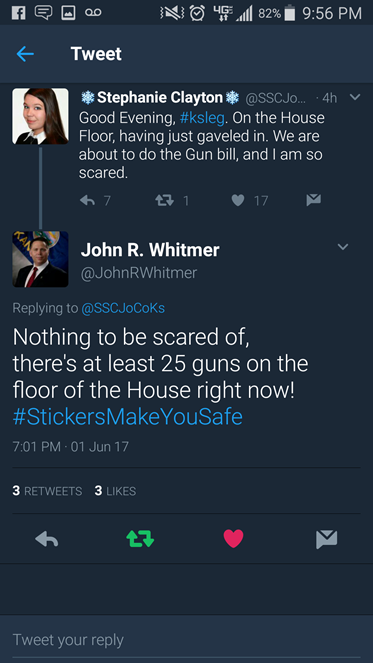
A conservative state lawmaker in Kansas, Rep. John Whitmer, R, is under fire for tweeting a joke that – in context – is completely anodyne.

Kansas lawmakers voted Thursday on a bill that would exempt state mental hospitals, community mental health centers, and the University of Kansas Health System from a concealed carry law passed in 2013, establishing these places as gun-free zones.

Before voting on the bill, for reasons that are unclear, Republican lawmaker Rep. Stephanie Clayton tweeted that she was “so scared” about the upcoming vote.

Clayton, a liberal Republican, voted in favor of creating the gun-free zones. Conservative lawmakers in Kansas had ridiculed the legislation with the slogan “a sticker doesn’t make you safe,” a reference to the inability of a gun-free zone sticker to make a place safe from criminals with firearms.

Rep. Clayton does not care for that argument.

So Rep. Whitmer decided to have some fun with Clayton and tweeted a joke.

See, it’s funny because real conservatives understand that Americans’ constitutional right to bear arms makes us safer. So, if Clayton feels unsafe, there’s no need to worry since 25 state lawmakers are packing on the floor of the House, making the area safe from harm.

And the liberal media is running with the “Republican lawmaker threatens colleague with guns before vote” story, and Whitmer was pressured into deleting his tweet.

Per The Daily Kos, emphasis mine:

The tweet, aimed at a fellow legislator was in response to an ongoing debate regarding notifications on the doors abut gun free zones. The message was also a lot more profound: a man physically larger than a female legislator reminding her he and others are carrying a gun, and she’s on what they view as the wrong side of a piece of legislation. Talk about intimidation.

Raw Story picked up the Daily Kos’ version of events.

A Republican state representative in Kansas raised some eyebrows on Thursday when he reminded one of his Republican colleagues that he was carrying a gun on him just before she was set to vote on a bill that would have allowed state psychiatric hospitals to bar people from carrying guns inside hospital grounds.

And now fellow lawmakers are calling for Whitmer to be sanctioned for a joke. Not a threat. A joke.

The Daily Kos and Raw Story won’t be the last liberal outlets to run with the “gun-toting conservative threatens fellow lawmaker before vote” lie. But now you know the context of this story and can expose this fake news. (For more from the author of “No, a KS GOP Rep. Did Not Threaten Colleague With Firearms” please click HERE)

Follow Joe Miller on Twitter HERE and Facebook HERE.

Trump Supporter: Portland Mayor Spread Lie, I Got Death Threats

After Portland Mayor Ted Wheeler referred to two upcoming conservative political rallies as “alt-right demonstrations” peddling “hatred and bigotry,” the event organizers are pushing back.

“I am calling on the federal government to immediately revoke the permit(s) they have issued for the June 4th event and to not issue a permit for June 10th,” Wheeler wrote on Twitter. He cited the deadly knife attack by Jeremy Christian, a homeless man with a violent criminal history, as reason for the proposed free-speech bans.

The ACLU of Oregon also weighed in on the controversy, pointing out that Wheeler’s call for censorship is unconstitutional.

Joey Gibson, a libertarian activist and founder of Patriot Prayer, organized the June 4 pro-Trump free speech rally. Gibson vehemently rejects Wheeler’s characterizations and called him irresponsible.

“If they spread this lie and people believe it, people are going to try and hurt someone,” Gibson said. “It’s irresponsible, especially coming from the mayor — a guy who is supposed to be the leader of his city.”

Gibson said he has received death threats from people who believe he is connected or allied with Jeremy Christian based on local reports. “I’m used to threats, but this time it’s different because people literally want to kill me,” he said. “I know nothing of Jeremy. He showed up to one of our marches with a bat and was extremely hateful. We eventually were able to kick him out.”

In late April, Gibson organized a free speech rally in east Portland after the 82nd Avenue of Roses Parade was canceled following violent threats towards the Multnomah County Republicans.

Christian attended the rally but was kicked out by organizers after doing Nazi Roman salutes and going on a racist tirade. Gibson added that he never saw Christian before or after that incident on April 29.

Gibson directed particular frustration at Willamette Week, an alternative Portland newspaper, for its recent profiling of him and his group in its report on white supremacists and the Alt-Right. Gibson claims that Wheeler told him that Willamette Week’s reporting “set the narrative for him” in a meeting that included the Portland Police chief on May 30.

One of the speakers scheduled for Gibson’s June 4 event includes controversial figure Kyle Chapman, aka Based Stickman. Chapman gained infamy when he was recorded fighting Antifa protesters at a free speech rally in Berkeley earlier this year.

Scott Pressler, an activist with ACT for America, the national security nonprofit founded by Brigitte Gabriel, was involved in organizing the June 10 “March Against Sharia, March for Human Rights” event. The rally is part of a nationwide march in two-dozen cities against Islamic fundamentalism, according to the event page.

In a statement, Pressler announced that the Portland event was canceled following what he said was a gross misrepresentation of the group by the mayor which endangered its members.

“Our organization is not an alt-right group,” Pressler wrote. “In fact, as a gay man who works for a Lebanese-American survivor of terrorism, I am offended that the mayor would use his position as political leverage over an organization trying to stop female genital mutilation.”

The statement continues: “By his inflaming emotions and labeling us as antagonists, Mayor Wheeler has endangered the safety of everyone scheduled to participate. For this reason, and to protect our members from the radical left, we are cancelling the Portland march.”

Ahead of the June 4 free speech rally, a flier left at the impromptu memorial at the Hollywood transit center included the Rose City Antifa logo and advertised a “group self-defense” training workshop. A prominently displayed graphic image shows a chainsaw cutting into President Donald Trump’s head. “Love trumps hate, chainsaw trumps love,” the flier reads.

A Facebook post by a group called Demand Utopia noted that the training had been canceled on Friday due to security concerns. “Someone in the community not affiliated with our group made a poor decision in creating a flyer that erroneously depicted this event as hosted by “antifa” and a training for June 4 along with violent images.”

Following the TriMet train attack on May 26, Portlanders have been divided on how to move forward. At the memorial, many chalk messages blamed the Portland Police, even though they apprehended Christian after he escaped on foot.

Other messages blamed Trump since the suspect allegedly hurled xenophobic verbal abuse at two teenagers before he knifed three men, killing two.

Christian’s social media record shows contradictory political views that make labeling him in simplistic terms difficult. He expressed support for Bernie Sanders, Jill Stein, and Black Lives Matter and made references to white nationalism and neo-Nazi paganism.

At Christian’s first court hearing on May 30, he yelled incoherently about free speech and patriotism, undoubtedly bringing additional scrutiny to Gibson’s free speech event on Sunday. However, Gibson said he has no plans to cancel the rally. (For more from the author of “Trump Supporter: Portland Mayor Spread Lie, I Got Death Threats” please click HERE)

Follow Joe Miller on Twitter HERE and Facebook HERE.
Trump Officially Announces Paris Agreement Withdrawal in Rose Garden

“We’re getting out.”

President Donald Trump announced Thursday afternoon the United States is withdrawing from the U.N.’s Paris Climate Agreement. During remarks in the Rose Garden, Trump repeatedly stressed his “America first” philosophy in making the decision.

“Withdrawing is in America’s economic interest and won’t matter much to the climate,” he said. Trump argued the agreement would have distributed America’s wealth to other nations. The “bad deal” would have hurt American workers, he insisted.

The announcement is the fulfillment of a campaign promise Trump made a year ago. During his first campaign speech detailing his energy policies, then-candidate Trump pledged to cancel the agreement if elected. The agreement was adopted in December of 2015 by 190 countries. President Barack Obama officially joined in September 2016. One hundred and ninety-five nations ultimately signed on.

The agreement requires all joining members to curb their greenhouse gas emissions by 2020. It also pursues “efforts to limit the [global] temperature increase to 1.5 °C above pre-industrial levels.”

“Someday we may see this as the moment that we finally decided to save our planet,” Obama said when he joined the agreement.

But conservatives have been critical from the beginning. The treaty was not ratified by the Senate, a violation of the Constitution’s Treaty Clause. Others claimed it is unsubstantial while extremely costly. Trump voters and conservatives pushed for him to keep his promise as he joined other world leaders at last week’s G-7 summit.

Trump came under pressure from leaders, even Pope Francis, to uphold the treaty. But efforts to change his mind, including from Ivanka Trump and Secretary of State Rex Tillerson, proved fruitless. Trump said he listened to “a lot of people both ways.” But Thursday government officials confirmed his withdrawal was “official.”

Dr. Calvin Beisner wrote for The Stream that full implementation of the Paris Agreement would lower the global temperature only 0.3ºF by 2100. Trump’s administration emphasized this point.

During his Rose Garden remarks, Trump declared he was willing to team with Democrats to either rework the agreement or forge a new, better climate deal.

Democrats are not responding in kind. Former Vice President Joe Biden quickly tweeted:

Former Vice President Al Gore whose global warming efforts have earned him an Oscar and hundreds of millions of dollars issued a statement:

However, President Trump made clear he wasn’t concerned about America’s “standing” in the world.

“I was elected to represent the citizens of Pittsburgh, not Paris,” Trump said.

(For more from the author of “Trump Officially Announces Paris Agreement Withdrawal in Rose Garden” please click HERE)

Follow Joe Miller on Twitter HERE and Facebook HERE.
Obama Administration Illegally Spied on Americans for Years

Once top-secret documents reveal that the Obama administratipn routinely violated Americans’ privacy while conducting “overseas” surveillance over the past five years. John Solomon and Sara Carter at Circa obtained a ruling issued by the Foreign Intelligence Surveillance Court on April 26 denouncing the practice. The FISA court is the secret judicial body that oversees surveillance.

The court learned that the NSA was conducting large numbers of prohibited searches of databases. The administration did not disclose the surveillance until then. It had to do that to meet a court deadline for renewing surveillance authorities. The requirement is part of the Foreign Intelligence Surveillance Act.

The Circa expose found that more than 5 percent of the upstream searches violated data privacy safeguards. The Obama administration had said it would follow those safeguards in 2011. Instead, surveillance increased by 300 percent.

Defying a Court Ruling

This increase defied a 2011 FISA court ruling. The court said the NSA had to find ways to limit what it collects and how long the data is kept. The FISA court realized at the time the collection was a problem. Searches were being done for the names of U.S. citizens in the databases.

The FISA court also revised the rules that year to prohibit these types of searches without a warrant. Nor longer could intelligence agencies search on an American’s email address or phone number. But the practice continued to occur after 2011. Not just a few times, but routinely and extensively. Some of those searches took place from the White House. Two years later, Edward Snowden disclosed the surveillance.

The FISA court accused the NSA of “an institutional lack of candor.” The ruling called the searches a “very serious Fourth Amendment issue.” The monitoring required no warrant, reasonable suspicion or probable cause. Without those checks, the agency pursued an unconstitutional search and seizure. Part of the opinion, which would have revealed the full extent of the surveillance, was blacked out.

In a responsive notice filed January 3, 2017, the NSA claimed the thousands of improper searches were due to “human error” and “system design issues.”

In April, the director of National Intelligence issued a report on the intelligence community’s use of data gathering techniques and compliance with the FISA process. In 2016, there were 5,288 occasions where the NSA searched for an American in its database. This was a slight increase over the number of those searches in 2015.

Upstream and Downstream Data Collection

However, searches for the metadata of known Americans more than tripled between 2013 and 2016. Searches increased from 9,500 in 2013 to 30,355 in 2016. That was the year the Obama administration may have spied on the Trump campaign,

Section 702 of FISA authorizes both “upstream” and “downstream” collection of data. Upstream refers to data moving through massive data highways within the U.S. Downstream collection snags data as it’s leaving the country. About 9 percent of the data NSA collects comes from upstream searches. In the process of collecting emails, the NSA sweeps up large numbers of emails. They are then stored in vast databases.

The surveillance is for monitoring foreign agents outside of the U.S. (The FBI is responsible for monitoring foreign agents within the U.S.) The FISA court requires “minimization” procedures. This means “masking” the identify of any American incidentally monitored.

The masked version is what is shared with other intelligence agencies. Intelligence official may unmask the name if he thinks he needs to do so to understand the data better.

Unmasking increased at the end of the Obama administration. Obama’s National Security Advisor Susan Rice was caught lying about her involvement in unmasking Trump campaign officials. She refuses to testify to Congress about it.

Congress passed The USA Freedom Act in 2016 to curtail bulk surveillance. But in 2016, the NSA collected 151 million phone records.

The FISA court also had harsh words for the FBI. This is due to the agency disclosing raw surveillance data to sectors of its bureaucracy “largely staffed by private contractors.” It went “went well beyond what was necessary to respond to the FBI’s requests.” The bureau discontinued the practice on April 18, 2016.

Where to Go From Here

The NSA decided on March 20 that it will no longer monitor communications of people who merely mention a foreign intelligence target. Instead, the agency will limit collection to communications between someone and a target. The agency asserts it will delete “the vast majority” of the information it collected through the previous method. The change was announced publicly on April 28, two days after the FISA court’s ruling.

Civil liberties hawkSen. Rand Paul (R-Ky.) said if this information is accurate, this story “will dwarf all other stories.” It constitutes “an enormous abuse of power.”

The watch dog organization Judicial Watch filed a Freedom of Information Act lawsuit against the DOJ and the NSA requesting records relating to the unmasking of Trump campaign officials, including former National Security Advisor Susan Rice’s involvement. (For more from the author of “Obama Administration Illegally Spied on Americans for Years” please click HERE)

Follow Joe Miller on Twitter HERE and Facebook HERE.
Report: Effort to Allow Transgenders in the Military Faces ‘Indefinite Delay’

An Obama administration effort to allow transgender citizens to serve in the U.S. military is undergoing an intense review by the Pentagon, Military Times reports.

Former President Barack Obama’s directive was issued in June 2016 and gave the services exactly one year to craft policy implementation. The Army and Marine Corps are reportedly the most resistant to the policy’s implementation, and the policy is reportedly now in a period of indefinite delay. The objections however appear to stem from logistical rather than idealogical concerns.

The logistical concerns include a lack of funding for upgraded group showers and changes to service-member’s living quarters. Military officials indicated to Military Times that a host of other procedural issues stood in the way of the policy’s implementation. “It’s not that we’re unsupportive or unwilling to implement it; just that there were administrative matters to be addressed,” the official clarified.

The delay was on full display after two cadets at U.S. service academies were not allowed to commission in their gender identity because no official policy guidance has been issued. One of the cadets from the Air Force Academy is being recommended for appointment to the Air Force civil service, where they can serve as a civilian employee of the Department of Defense. (Read more from “Report: Effort to Allow Transgenders in the Military Faces ‘Indefinite Delay'” HERE)

Follow Joe Miller on Twitter HERE and Facebook HERE.

Democrats Plot ‘Revolution’ to Circumvent Trump’s Paris Decision

Democratic officials have vowed to implement the goals of the Paris climate agreement, despite President Donald Trump’s decision to withdraw from the accord Thursday.

New York City Mayor Bill de Blasio vowed to issue an executive order soon to honor the goals of the Paris accord, including to keep future global warming below 2 degrees Celsius.

“On behalf of the people of New York City, and alongside mayors across the country, I am committing to honor the goals of the Paris Agreement with an Executive Order in the coming days, so our city can remain a home for generations to come,” DeBlasio said in a statement Thursday.

Pittsburgh Mayor Bill Peduto also vowed to follow the “guidelines” of the Paris Agreement, although he gave no specifics.

Democratic governors of California, New York, and Washington also announced the creation of the United States Climate Alliance. Govs. Jerry Brown, Andrew Cuomo, and Jay Inslee all vowed to meet the Paris Agreement goals.

“We will not ignore the science and reality of climate change, which is why I am also signing an Executive Order confirming New York’s leadership role in protecting our citizens, our environment, and our planet,” Cuomo said.

“If the president is going to be AWOL in this profoundly important human endeavor, then California and other states will step up,” Brown said.

It’s part of what former Vice President Al Gore is calling the “clean energy revolution” that would be crippled by pulling out of the Paris climate agreement. Gore said “no single person” can stop the “revolution”—that apparently needs a lot of political will to further.

San Francisco billionaire Tom Steyer circulated an email petition Thursday, calling on supporters to “urge your governor to fulfill the commitment your state has already made to meet our Paris targets: Go to 100 percent renewable energy.”

“It’s now up to states, cities, and local communities to pick up the mantle of leadership and take the actions necessary to protect our children and leave them a better world,” Steyer wrote in the email blast. (For more from the author of “Democrats Plot ‘Revolution’ to Circumvent Trump’s Paris Decision” please click HERE)

Follow Joe Miller on Twitter HERE and Facebook HERE.