Target Slashes CEO Pay Package After Bleak Year

Target Corp’s (TGT.N) Chief Executive Brian Cornell took a sharp cut in compensation after the company failed to meet financial goals in a year marred by declines in sales and share price.

Cornell’s cash-and-stock compensation fell by nearly a third to $11.3 million, according to a document filed with regulators two months after the company reported results that sent its stock tumbling to 2-1/2-year lows.

As per Target’s short-term incentive plan, Cornell’s compensation was based on the performance of two financial metrics: incentive EBIT, which makes up 75 percent of Cornell’s stock component, and the rest on adjusted sales.

Target said it missed its 2016 incentive EBIT goal of $5.74 billion by $623 million and fell short of its adjusted sales target of $71.62 billion by $2.13 billion.

“This looks pretty normal in terms of executive compensation and, I think, it is actually good executive compensation in a turnaround situation,” said Paul McConnell, managing director at Board Advisory LLC, an executive compensation, performance and succession advisory group. (Read more from “Target Slashes CEO Pay Package After Bleak Year” HERE)

Follow Joe Miller on Twitter HERE and Facebook HERE.

Fourth Man Accuses Seattle Mayor of Paying Him for Sex

A fourth man has accused Seattle Mayor Ed Murray of paying him for sex after being introduced to Murray as a teenager.

A Murray spokesman denied the latest allegations, made in a court filing late Tuesday, calling them a “sensational media stunt.” The mayor’s lawyers Wednesday morning redoubled their effort to get a judge to sanction the attorney who submitted the new court filing and is representing another man who filed a lawsuit last month.

The new accuser, 44-year-old Maurice Jones, said in a sworn court declaration he was introduced to Murray by Delvonn Heckard, the Kent man who filed last month’s lawsuit claiming Murray sexually abused him as a teenager in the 1980s.

Jones’ declaration, filed in King County Superior Court, was brief, saying he had been to Murray’s Capitol Hill apartment at an unspecified time and that Murray “gave me money for sex.” (Read more from “Fourth Man Accuses Seattle Mayor Ed Murray of Paying Him for Sex” HERE)

Follow Joe Miller on Twitter HERE and Facebook HERE.

Trump Expected to Unveil Massive New Protections for Religious Freedom Thursday

A leaked copy of a draft executive order titled “Establishing a Government-Wide Initiative to Respect Religious Freedom,” obtained by The Investigative Fund and The Nation, reveals sweeping plans by the Trump administration . . .

The four-page draft order, a copy of which is currently circulating among federal staff and advocacy organizations, construes religious organizations so broadly that it covers “any organization, including closely held for-profit corporations,” and protects “religious freedom” in every walk of life: “when providing social services, education, or healthcare; earning a living, seeking a job, or employing others; receiving government grants or contracts; or otherwise participating in the marketplace, the public square, or interfacing with Federal, State or local governments.”

The draft order seeks to create wholesale exemptions for people and organizations who claim religious or moral objections to same-sex marriage, premarital sex, abortion, and trans identity, and it seeks to curtail women’s access to contraception and abortion through the Affordable Care Act. The White House did not respond to requests for comment, but when asked Monday about whether a religious freedom executive order was in the works, White House spokesman Sean Spicer told reporters, “I’m not getting ahead of the executive orders that we may or may not issue. There is a lot of executive orders, a lot of things that the president has talked about and will continue to fulfill, but we have nothing on that front now.”

Language in the draft document specifically protects the tax-exempt status of any organization that “believes, speaks, or acts (or declines to act) in accordance with the belief that marriage is or should be recognized as the union of one man and one woman, sexual relations are properly reserved for such a marriage, male and female and their equivalents refer to an individual’s immutable biological sex as objectively determined by anatomy, physiology, or genetics at or before birth, and that human life begins at conception and merits protection at all stages of life.”

[Legal experts described the] breadth of the draft order . . . as “sweeping” and “staggering” . . . (Read more from “Trump Expected to Unveil Massive New Protections for Religious Freedom Thursday” HERE)

Follow Joe Miller on Twitter HERE and Facebook HERE.

Pence: WH Still Weighing Jerusalem Embassy Move

Vice President Mike Pence said Tuesday the White House continues to give “serious consideration” to moving the U.S. Embassy in Israel from Tel Aviv to Jerusalem.

And President Donald Trump is “personally committed to resolving the Israeli and Palestinian conflict” and is “making valuable progress” toward that goal, Pence said at an Israeli Independence Day commemoration.

Like most countries, the United States maintains its embassy in Tel Aviv because Israelis and Palestinians have competing claims to Jerusalem. Israel considers Jerusalem its undivided capital but Palestinians seek east Jerusalem for the capital of a future state. (Read more from “Pence: WH Still Weighing Jerusalem Embassy Move” HERE)

Follow Joe Miller on Twitter HERE and Facebook HERE.

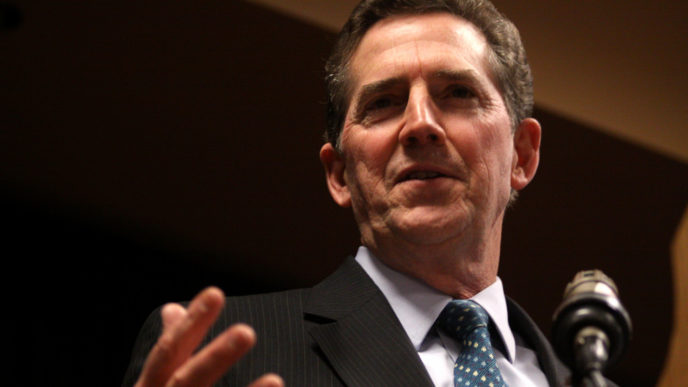
Jim DeMint Remains Defiant After Heritage Foundation Ouster

Ousted Heritage Foundation President Jim DeMint was defiant Tuesday, saying that his work at the conservative think tank helped shape many of President Donald Trump’s core ideas.

“When I came to Heritage in 2013, I told our staff and millions of members around the country that over the next four years, we had the opportunity to lead a resurgence of conservative policies and communications to win the hearts and minds of the American people,” DeMint, 65, a former South Carolina Republican senator, told Politico in an interview.

“I’m grateful to have worked with some of the greatest minds and talents in America and believe we’ve accomplished together what we set out to do.”

Heritage’s 22-member board voted to remove DeMint Tuesday, capping speculation since last week about his future with the organization.

He later released, through a spokesman, his own assessment of his helm at the foundation, Politico reports. (Read more from “Jim DeMint Remains Defiant After Heritage Foundation Ouster” HERE)

Follow Joe Miller on Twitter HERE and Facebook HERE.

Omnibus Violates Trump Promises With Bad Immigration Provisions

If the November election was analogous to conservatives recovering possession of the ball, this pending budget bill is the moment the president throws an interception. Unless, of course, he does the right thing and vetoes it.

Not only does this bill fund liberal priorities, including refugee resettlement, Obama’s amnesty, and sanctuary cities, it contains a number of odious provisions that weaken current law on immigration. We have already observed how this bill essentially weakens Trump’s leverage to even commence construction on a border wall while funding border security in other countries. However, there are a number of additional provisions that violate the president’s core campaign promises as well.

MORE IMMIGRATION FROM AFGHANISTAN

While fully funding the refugee program and failing to codify Trump’s executive order against judicial tyranny, this bill actually increases immigration from the Middle East. Sec. 7083 (p. 1447) increases the number of Special Immigrant Visas (SIV) for Afghanis by 2,500 – from 8,500 to 11,000. As we’ve written before, this has been a priority of liberal Republicans and Democrat in the Senate, even though we’ve had vetting problems with the families of interpreters and contractors. Remember, the Bowling Green bomb-plotters were Iraqi SIVs who were caught trying to blow up the soldiers they worked for.

Congress already added an additional 3,000 visas for these individuals plus an unlimited number for family members in the FY 2016 NDAA. Most of those visas have not even been issued yet. So why would Congress open the floodgates for even more visas at a cost of several hundred million dollars? Remember, SIV recipients are treated like refugees and are immediately eligible for all social entitlement and resettlement programs. They are also permitted to bring in an unlimited number of spouses and children. In recent years, the program has been expanded for other support members beyond interpreters or those helping our soldiers on the front lines – and this program is in addition to a separate visa program specifically for interpreters. Moreover, after 15 years of failure in Afghanistan, we are fighting for a corrupt Sharia government. Now we have nothing to show for it but more immigrants who, by and large, are strict adherents to Sharia.

Moreover, with the endless flow of immigration from the Middle East, why wouldn’t they at least cut other areas of immigration, such as the Syrian refugees who are arriving in the hundreds every month? Since Trump is apparently refusing to use the budget to codify his order for a moratorium from the Middle East, is it too much to ask that he not increase immigration?

GUTS 287G COOPERATION WITH LOCAL LAW ENFORCEMENT

One of the cornerstones of interior enforcement is the 287g program, which allows federal immigration officials to work with local law enforcement to apprehend illegal aliens. Obama terminated the program as part of his illegal amnesty, but Trump reinstated it by executive order. Sec. 210 (p. 684) of the omnibus prohibits these agreements if the DHS Inspector General determines that the terms of the agreement governing the delegation of authority have been “materially violated.” This provision was clearly inserted by Democrats who feel there might be an avenue through which they can get the IG to throw cold water on this vital program.

CREATES STATE DEPARTMENT SLUSH FUND FOR LIBERAL BUREAUCRATS TO BRING IN MORE REFUGEES

Section 7081 (p. 1443) of the omnibus essentially creates a slush fund for the Bureau of Consular Affairs within the State Department to use the fees it collects from visas as a permanent funding source from year to year.

While a number of agencies are somewhat “self-funded” by their own administration of fees, those funds are either deposited directly into the general treasury or are credited against the amount of appropriations they receive. For example, if an agency receives $50 million in appropriations but collects $20 million in fees, it can only draw $30 million from the Treasury. Moreover, it can’t use the funds from year to year. This is necessary so that agencies are fully controlled by Congress for every fiscal year rather than becoming rogue entities that self-fund outside Article I powers.

This bill, on the other hand, gives the State Department a full slush fund, in addition to appropriations, from which the funds can be transferred for other purposes.

In a normal administration, one would assume that the White House would control the direction of the agencies. But we have already seen that the White House is either unwilling or unable to stop the State Department from bringing in 900 refugees a week (which is not even required by the lawless courts). Clearly, the same personnel from Obama’s administration remain in place. Thanks to this provision in the omnibus, there will be a new revenue incentive for the agency to bring in as many visas as possible and use the extra funds to push the limits on refugee resettlement and other visa categories.

Thus, at the same time Congress is rescinding funds for the border wall, it is offering an extra slush fund with more flexibility to bring in even more refugees. This bill contains several other provisions that direct policy, even though it’s a spending bill — but not any conservative priorities.

THE SOFT BIGOTRY OF LOW EXPECTATIONS

Amazingly, OMB director Mick Mulvaney praised the budget and excused the problems by asking rhetorically, “Can you imagine how different this bill is from what the bill that President Obama would have signed back in September?”

This is part of a disturbing trend I’m noticing among some conservatives, in which they have such low expectations for success that they excuse away every act of political adultery by Trump and congressional Republicans by comparing it to what we would have gotten with Obama or Hillary. There is no sense of context, proportionality, and expectations in these excuses. (See my full podcast on realistic expectations vs. absurd excuses). Taking this reasoning to its logical conclusion, one could excuse away a Republican issuing amnesty by suggesting the Democrat would have amnestied more illegals. Or “at least the Republican president only appointed five Kerry people to foreign policy positions as opposed to 10.”

The reality is there is no need or excuse for any of this. We are not asking the president to balance the budget or reform entitlements in 100 days. We are asking him merely not to pursue some of the most egregious and downright illegal policies of the Obama administration. The Iran deal, defending the contraception mandate in court, issuing Obama’s amnesty, and bailing out insurers are all illegal policies that can be terminated … simply by doing nothing. To actively continue and even champion those policies is an act of political adultery that shouting “Gorsuch!” or “Keystone pipeline!” fails to ameliorate. To sign a budget bill codifying these priorities while he fails to demand that Congress address his priorities that have been illegally assailed by the courts casts doubt on his campaign promises.

Amazingly, as it relates to the budget, there is not much room even to use “but Obama would have been worse” as an excuse. It’s hard to see how the bill would have been significantly worse had Democrats won the election.

actually, not really. and i don’t mean that snarkily. maybe modestly different. but not THAT different. https://t.co/2KY2hKoS4P

(For more from the author of “Omnibus Violates Trump Promises With Bad Immigration Provisions” please click HERE)

Follow Joe Miller on Twitter HERE and Facebook HERE.
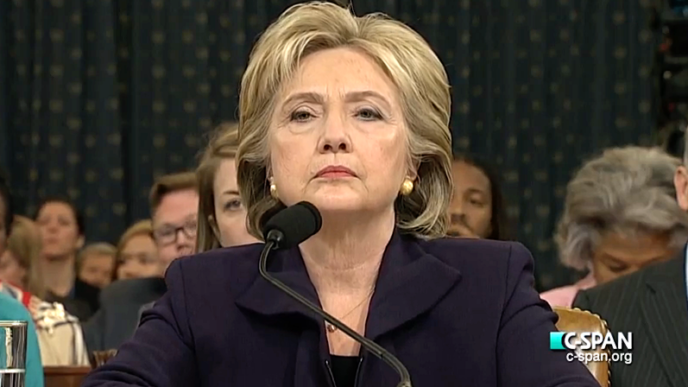
Hill-Arity: Area Grandma Extremely Confused by 2016 Election

Hillary Clinton is still insisting that the FBI and Russia sunk her presidential campaign.

On Tuesday, the former secretary of state pointed to the letter FBI Director James Comey sent to Congress and the Wikileaks email dumps for sufficiently damaging her campaign to lose to Republican Donald Trump.

“But I was on the way to winning until the combination of Jim Comey’s letter on October 28 and Russian Wikileaks raised doubts in the minds of people who were inclined to vote for me, but got scared off,” Clinton told CNN’s Christiane Amanpour at a Women for Women International event in New York.

“And the evidence for that intervening event is I think compelling, persuasive. And so we overcame a lot, we overcame an enormous barrage of negativity, of false equivalency, and so much else.”

What planet is Hillary Clinton living on? An entire book was written detailing her failed leadership during the campaign. Hillary Clinton lost the election because she is Hillary Clinton, and there were no external circumstances that could’ve changed the outcome, as many were quick to point out:

“If the election had been on October 27, I would be your president,” Clinton said.

Whatever helps you sleep at night, madame secretary. (For more from the author of “Hill-Arity: Area Grandma Extremely Confused by 2016 Election” please click HERE)

Follow Joe Miller on Twitter HERE and Facebook HERE.

What You Need to Know About the Obamacare Subsidies at the Center of the Health Care Debate

While Republicans and Democrats negotiated a government spending bill this week, another form of financial assistance that aims to help low-income Americans under Obamacare has been at the center of a debate involving insurance companies, consumers, and President Donald Trump.

These subsidies aren’t the tax credits implemented under the health care law, which lower the cost of premiums for eligible consumers, but are called cost-sharing reductions.

They’ve been the subject of much scrutiny lately, and a source of concern for insurance companies, congressional Democrats, doctors, hospitals, and the U.S. Chamber of Commerce.

So what are the cost-sharing reductions, how do they work, and why have they been thrust to the center of debate?

What Are the Cost-Sharing Reductions?

The cost-sharing reductions are subsidies designed to reduce out-of-pocket costs for low-income patients who purchase silver-level plans through Obamacare’s exchanges. The subsidies are only available to marketplace customers with an income between 100 percent and 250 percent of the federal poverty line ($12,000 to $30,000 for an individual).

In 2017, 7 million people—58 percent of marketplace enrollees—qualified for cost-sharing reductions, according to the Department of Health and Human Services.

How Do the Cost-Sharing Reductions Work?

While Obamacare’s tax credits and cost-sharing reductions are both intended to help lower the cost of coverage for low-income Americans, both serve different functions.

The tax credits are paid directly to consumers and lower the cost of premiums. But the government pays cost-sharing reductions directly to insurers.

Insurance companies then offer plans with reduced deductibles, copayments, and out-of-pocket limits to eligible patients.

In 2016, the government reimbursed insurers roughly $7 billion for cost-sharing reductions.

Why Are They in the News?

The cost-sharing reductions were the subject of much scrutiny in 2014, and now they’re back in the news again.

In 2014, the Republican-led House of Representatives filed a lawsuit against the Department of Health and Human Services, then led by Secretary Sylvia Mathews Burwell, over the subsidies.

Republican lawmakers argued that the Obama administration made payments to insurers without an appropriation from Congress, which they said was unconstitutional. But the Obama administration said it intended for lawmakers to fund the cost-sharing reductions alongside Obamacare’s tax credits.

In 2016, a federal district court judge in the District of Columbia sided with House Republicans and ruled that because Congress never appropriated money for the cost-sharing reductions, the Obama administration violated the Constitution.

President Barack Obama’s Department of Justice quickly appealed, and the judge’s order has been halted since then.

Now, the Trump administration has to decide whether it will continue the Obama administration’s fight, and the next court date is scheduled for May 22.

What Does the Trump Administration Want to Do?

At this stage, no one is entirely sure what Trump and his officials plan to do about the cost-sharing reductions.

Both the White House and the Department of Health and Human Services, now led by Secretary Tom Price, have sent mixed signals on whether they intend to continue funding the subsidies.

In a statement to The New York Times last month, the Department of Health and Human Services said the agency would continue to make payments to insurance companies.

But Trump floated the idea of using the cost-sharing reductions as leverage to bring Democrats to the negotiating table over a bill replacing Obamacare.

“Obamacare is dead next month if it doesn’t get that money,” Trump said of the subsidies in an interview with The Wall Street Journal last month. “I haven’t made my viewpoint clear yet. I don’t want people to get hurt … What I think should happen and will is the Democrats will start calling me and negotiating.”

Even more recently, though, White House budget director Mick Mulvaney told reporters Tuesday the administration hadn’t yet decided whether it will make cost-sharing reduction payments for May.

What Options Does Trump Have?

The Trump administration could drop the Obama administration’s lawsuit, and the Department of Health and Human Services would stop making payments to insurers.

But if the White House decided to continue funding the subsidies, it could move forward with the lawsuit that originated with the Obama administration.

Trump could also urge Congress to appropriate the money in future appropriations bills.

Democrats pushed the president and congressional Republicans to allocate money for cost-sharing reductions in a stopgap government spending bill that passed Congress this week. But money for the subsidies was ultimately left out of the legislation.

That spending bill keeps the government running until September.

While it remains unclear how the Trump administration wants to proceed—and whether Congress will appropriate money for cost-sharing reductions—the subsidies could be eliminated entirely.

The House GOP’s health care bill, called the American Health Care Act, gets rid of cost-sharing reductions.

What Happens If the Cost-Sharing Reductions Stop?

If the Trump administration decided to halt subsidies, insurance companies would lose the money they’re reimbursed for offering reduced deductibles, copays, and out-of-pocket limits to consumers.

To compensate for the lost money, insurers could raise premiums for all of their customers. The Kaiser Family Foundation estimates that if that were to happen, health insurance premiums would increase an average of 19 percent.

Insurance companies could also decide to leave the marketplace by canceling contracts with state and federal regulators, and end coverage for consumers mid-year, according to the Commonwealth Fund.

However, the Commonwealth Fund said leaving the marketplace would be complicated.

Where Do Republicans and Democrats Stand?

For Democrats, the answer to the question on what to do with the cost-sharing reductions is easy: They want Congress to appropriate the money to fund the subsidies.

They’re joined by a coalition of insurance companies, physicians, hospitals, and the U.S. Chamber of Commerce, which collectively sent a letter to congressional leaders last month urging them to fund the cost-sharing reductions.

Though the Republican-led Congress didn’t appropriate money for the subsidies in this week’s spending bill, top GOP lawmakers are also in favor of continuing the cost-sharing reductions.

Rep. Tom Cole, R-Okla., told The New York Times he believes Congress should provide the money to fund the subsidies.

He was joined by House Energy and Commerce Chairman Greg Walden, R-Ore., who said lawmakers had an obligation to insurers and consumers to make sure the government’s payments to insurance companies were made.

“We cannot leave them high and dry,” he told The New York Times. (For more from the author of “What You Need to Know About the Obamacare Subsidies at the Center of the Health Care Debate” please click HERE)

Follow Joe Miller on Twitter HERE and Facebook HERE.
FDA May Make Too Many Pizza Toppings a Crime

Jenny Craig can’t arrest you if you miscount your calories, but the federal government could if a new calorie-counting rule takes effect.

The U.S. Food and Drug Administration’s “Nutrition Labeling of Standard Menu Items in Restaurants and Similar Retail Food Establishments” (79 FR 71155) rule is scheduled to take effect on May 5. The 105-page rule implements Obama-era amendments to the Federal Food, Drug, and Cosmetic Act (FD&C Act), which sets national standards for the marketing and labeling of food products.

The rule will require, among other mandates, that all restaurants and other retail food outlets, such as movie theaters, operating as one brand with at least 20 stores display a calorie count in addition to other nutritional information for all standard menu items on the establishment’s “menus and menu boards.”

To demonstrate the potential scope of that provision, Lynn Liddle, a former executive vice president at Domino’s Pizza, said, “‘Menu’ can refer to any writing that [is] ‘used by a customer to make an order selection at the time the customer is viewing the writing’”—possibly including flyers and other advertisements.

“We no longer know what a menu is,” Liddle said, to point out how confusing the rule is.

When an executive of a major national corporation can no longer ascertain the meaning of the word “menu,” a rule has problems.

During the rule’s notice-and-comment period, some food purveyors raised concerns “that restaurants that ‘unwittingly misbrand their menu offerings’ will be held liable for their food that is misbranded under this rule and related provisions of the FD&C Act.”

The FD&C Act makes misbranding a criminal offense punishable by imprisonment up to one year and a fine of up to $1,000, with more severe sanctions for repeat offenses (21 U.S.C. § 333).

Industry representatives also pointed out that restaurant owners and supervisors can be held criminally liable for FD&C Act violations under the so-called “responsible corporate officer doctrine.” That stems from a U.S. Supreme Court case, United States v. Park (1975), in which the court upheld a retail food chain president’s criminal conviction for food safety violations that occurred on his watch.

An FDA spokesperson said that the agency will spend the rule’s first year on education, not enforcement, but that offers little comfort to market participants.

Chris Reisch, a Domino’s franchise owner in Kentucky who started out as a delivery man, explained, according to The Washington Free Beacon, “To face one year in prison for putting too many pepperonis on a pizza? Everybody laughs and smiles, but that’s the reality of the way it’s written now.”

As if extra pepperonis wouldn’t be a welcome surprise!

The FDA would require pizza providers to display calorie counts on a per serving (slice) basis, which poses a particular problem for proprietors who offer customers significant choice on their regular menu.

Domino’s, for instance, offers customers a selection of 27 regular toppings and nine sauces on five types of crust. All told, there are 34 million potential pizza combinations one could order from Domino’s. Whether a customer adds double pepperoni or mushrooms to their customizable pie can make a significant difference in the calorie range of each pizza.

According to the American Pizza Community—a lobbyist group that advocates on behalf of 20,000 pizza restaurants nationwide—no two slices are alike. This creates significant variance in calorie estimates across pizzas.

Tim McIntyre, an executive vice president at Domino’s Pizza, said that if workers “are heavy handed with cheese or pepperoni, and a pizza doesn’t meet standards and is outside of the range of the nutritional labeling, then that could be a store manager liable for a criminal penalty. And that’s absolutely ridiculous.”

Certain chains—including McDonald’s, Starbucks Coffee, and Panera Bread—already commenced compliance with the pending rule by posting calorie counts on their menu boards, but those restaurants maintain a menu with less potential for customization.

A bipartisan coalition led by Sen. Roy Blunt, R-Mo., recently introduced a compromise bill to meet the FDA’s objective that consumers know how many calories are in each menu item without placing an unnecessary burden on businesses.

The Common Sense Nutrition Disclosure Act of 2017 sets forth a modified rule that includes flexibility for “establishments with standard menu items that come in different flavors, varieties, or combinations.” Under the alternative act, restaurants where the majority of customers place their orders off-premises (online or over the phone) are allowed to disclose nutritional information online.

This compromise bill saves pizza shop owners from making up to $5,000 in menu board alterations per store and provides consumers with nutritional information in a much more accessible format. Domino’s, which takes 90 percent of its orders off-premises, already has a “Cal-O-Meter” available online that can quickly calculate the expected calorie count for any of its 34 million menu offerings.

Leave it to big government to impose an arbitrary regulation where industry has already developed a more efficient solution.

The calorie rule does not only affect pizza shops.

According to the Free Beacon:

Associations representing grocery stores and gas stations say the FDA does not even know what the regulation requires, including whether a store could face criminal penalties for serving different sizes of fried chicken.

In 1892, the Supreme Court issued its opinion in United States v. Eaton, which involved a challenge to a criminal indictment under the Oleomargarine Act, which imposed record keeping and tax burdens on oleomargarine dealers. There, the court reasoned that “a sufficient statutory authority should exist for declaring any act or omission a criminal offense.”

The court recognized that federal regulations may have the force of law, but if federal bureaucrats want to throw people in jail for things like faulty butter records or too many anchovies on a pizza slice, Congress must have expressed a clear intention to criminalize such a trivial act or omission.

As Heritage Foundation scholars have written elsewhere, many arcane regulations carry criminal penalties. It is also clear, as the Supreme Court held in United States v. Grimaud (1911), “that Congress may establish criminal penalties ‘for violations of regulations’ made by administrative agencies.”

But, applying the wisdom of the Eaton decision today, if Congress wants to make it a crime to fail to post calorie information on a menu board, it should say so. Such a significant determination should not be left to the FDA.

The Trump administration’s FDA is reportedly seeking to delay the May 5 effective date (again), but has yet to propose any substantive changes to the rule. If the FDA does not curtail the scope of the rule, Congress must act before it threatens pizza shop owners and similarly situated restaurant chains with criminal penalties for the failure to count calories according to the agency’s preferred standards.

The FDA may want people to eat healthier at restaurants, but it is not its role to send restaurateurs to the brig for unwitting recipe mishaps, nor is a regulatory requirement the proper means to intervene in Americans’ dietary choices. (For more from the author of “FDA May Make Too Many Pizza Toppings a Crime” please click HERE)

Follow Joe Miller on Twitter HERE and Facebook HERE.

Home Caregivers Identify Evidence of Voter Fraud in Bid to Oust Union

An in-home caregiver named Edison is supposed to live in a unit on the seventh floor of the Cedars of Edina apartment complex, according to a list supplied by the state government.

But when The Daily Signal tags along on a visit to the Gallagher Drive location by activists seeking to decertify the union that represents such caregivers, no one by Edison’s full name can be found in the directory of residents.

“As you can see, we scrolled through the electronic directory where the names are listed alphabetically,” canvasser Matt Patterson tells this reporter. “There is no one listed here named Edison.”

Which is odd, Patterson adds, because Edison’s name is a new one that Minnesota had just provided on a list of Medicaid-eligible home caregivers represented by the union, SEIU Healthcare Minnesota.

“We’ll want to make sure this person has actually moved and is not residing here,” he notes.

Patterson, executive director of the Washington-based Center for Worker Freedom, is working with a local lawyer to expose what they suspect is voter fraud, unauthorized collection of dues from Medicaid payments, and other illegal or improper actions connected with unionization of in-home caregivers in Minnesota.

Lawmakers on a joint subcommittee of the state House and Senate are scheduled to look into such allegations and evidence beginning next Monday, The Daily Signal has learned.

Volunteers canvassing neighborhoods in and around the Twin Cities also have found what they describe as nonexistent addresses, abandoned homes, and vacant lots, among other irregularities that raise questions about a 2014 election to unionize nearly 30,000 home caregivers.

That vote, conducted by mail-in ballot, was administered by the state’s Bureau of Mediation Services and resulted in victory for SEIU Healthcare Minnesota, an affiliate of the Service Employees International Union.

Copies of affidavits signed by the volunteers and obtained by The Daily Signal detail discrepancies between names and addresses listed in public records and actual locations they visited. The Minnesota residents who gave the affidavits are part of the campaign to decertify SEIU Healthcare Minnesota.

Several in-home caregivers, widely known in Minnesota as personal care assistants, or PCAs, have told The Daily Signal that they never received a ballot to vote in the election held in August 2014.

Other PCAs presented evidence in the affidavits suggesting that someone forged their signatures on union documents they say they never signed. Others say they believe someone copied their signatures onto union membership forms and election authorization forms they never would have knowingly signed.

‘My Fears Were Justified’

Janine Yates, a resident of Hopkins, Minnesota, works as a personal care assistant for a family friend.

In an affidavit, Yates says she is convinced an SEIU operative forged her signature on an election authorization form and then used it without permission so that dues would be deducted from her Medicaid benefit check.

In her affidavit, Yates recalls that an SEIU representative visited her at home in May 2014, roughly three months before the unionization election.

Although she was not “willing to endorse, support, or join” the union, Yates says in the affidavit, the SEIU representative was “very persistent.” She had to repeat herself and say “no” several times before he would leave her doorstep:

As the SEIU solicitor walked away, I saw him writing on the document he had presented me for signature. I was worried, at the time, that he was signing this card with my name. My fears were justified …

Exhibit A in Yates’ affidavit is a membership form that she says was presented to the union as though she had signed it when she had not.

Three weeks later, Yates says, another SEIU representative came to her door to ask her to join the union. When she declined, he gave her a document that he said was authorizing the union to send her updates by text message.

“Many months later, I realized that SEIU dues were being deducted from the PCA benefit I received for caring for my friend, which I never wanted and did not sign,” Yates says in the affidavit.

What the Law Did for SEIU

Douglas Seaton, a partner in a Minneapolis-based firm, is spearheading volunteers’ efforts to collect enough signatures to trigger a new election they hope will result in decertification of SEIU Healthcare Minnesota as the PCAs’ union. Patterson, of the Center for Worker Freedom, a nonprofit affiliated with Americans for Tax Reform, is working with him.

Under a Minnesota state program called PCA Choice, about 27,000 personal care assistants receive a Medicaid subsidy to cover the costs of services they provide to disabled individuals, who typically are family members such as a son or daughter. The PCAs provide these services in their own home or the home of the disabled individual.

Kris Greene, a personal care assistant who lives in Lakeville, is the lead plaintiff in litigation against the administration of Gov. Mark Dayton, a Democrat.

For the past six years, Greene, 53, has provided care at home for her 24-year-old daughter Meredie, who has a disorder called Rubinstein-Taybi syndrome.

“My daughter is very childlike and very vulnerable,” Greene says in an interview with The Daily Signal in St. Paul on the sidelines of the March 4 press conference.

“She was in a day program where she had to rely on a lot of people, but didn’t like it and she would not thrive there. She’s nonverbal and can’t speak well.”

In 2013, Dayton signed into law a bill that classified personal care assistants as public employees, but only for the purposes of collective bargaining. SEIU Healthcare Minnesota organized the election, using mail-in ballots, to unionize the PCAs.

Out of the 27,000 personal care assistants eligible to vote, however, only 5,849 voted. A total of 3,543 voted yes to name SEIU Healthcare Minnesota as their exclusive representative, and 2,306 voted no. This means that 13 percent of the state’s PCAs were permitted to unionize all 27,000.

The current contract between the state and SEIU allows the union to deduct 3 percent, or up to $948 a year, from Medicaid payments to personal care assistants who are part of the union.

Seaton estimates, based on public records, that SEIU could pull in as much as $5 million a year in dues from PCAs in Minnesota.

Going into the election, SEIU had every advantage since state law says unions need only a majority of those who vote and not a majority of the entire bargaining unit.

‘Reprehensible’

The U.S. Supreme Court, in the 2014 case Harris v. Quinn, ruled 5-4 that unions such as SEIU, which represent public employees, may collect dues only from those who voluntarily join.

Pamela Harris, an Illinois resident who cares for her disabled son at home, brought the case. Citing the First Amendment, Harris and others argued it was unconstitutional for state laws to compel in-home caregivers to pay union dues and accept a union as their exclusive representative to the government.

Harris says she is familiar with union tactics in Minnesota and sees union operatives as making a concerted effort to undermine the Supreme Court ruling.

“I still recall the two young SEIU representatives at my door early on a Sunday asking me to sign the card just so they could show their supervisor they had talked with me,” Harris says in an email to The Daily Signal, adding:

Little did I know that my decision to not sign their card likely kept me from supporting the SEIU. The duplicity and aggressiveness of the campaign was unsettling. The unions are rich, powerful, and adept at suppressing anyone who chooses to rebuke their compulsory fees.

The work that the good people in Minnesota are doing to uncover and shine light on this scheme is so important. The public needs to know how the SEIU and these politicians have twisted our laws to legally siphon these precious Medicaid dollars from our sons and daughters into their own pockets. …

Taking public dollars intended to provide care for the disabled and elderly, and giving it to the unions, is reprehensible. And it must be stopped.

Minnesota’s Bureau of Mediation Services, which monitors and administers union elections, requires that signatures from 30 percent of the 27,000 PCAs, or roughly 9,000, must be collected and filed with the agency before an election can be called.

So far, the volunteers organized by Seaton and Patterson have collected about 6,500 signatures, more than the number of voters in the 2014 unionization election and almost twice the number of votes in favor of the union.

Seaton also is pursuing litigation against the Dayton administration on behalf of seven personal care assistants. Those PCAs and other volunteers are part of the coalition Minnesota Personal Care Assistants, or MNPCA, which seeks to decertify SEIU Healthcare Minnesota.

Where’s Edison?

It is Sunday, March 5, and The Daily Signal is observing the canvassing efforts of Seaton and Patterson in the suburbs of Edina, located southwest of Minneapolis in Hennepin County. Edina, with a population of about 50,000, is named after Edinburgh, Scotland.

This afternoon, the canvassers visit a dozen addresses listed by the Bureau of Mediation Services as residences of PCAs in hopes of collecting signatures for a new election. Only three residents turn out to be home.

And then there is Edison, who is supposed to live at the Cedars of Edina complex.

Edison’s address appears on one of the agency’s lists of PCAs but his name isn’t in the apartment directory. Seaton and Patterson have yet to track him down. (The Daily Signal has the full name provided by the state, but is not publishing it.)

The volunteers are using lists of PCAs that a county judge ordered the Dayton administration to release. The day before, during a press conference in St. Paul, Seaton says the official lists are inaccurate, incomplete, and contradictory, making it difficult to collect signatures from those eligible to vote in a union election.

One of the 11 affidavits obtained by The Daily Signal is from Adam Sharp, a resident of Coon Rapids. Sharp isn’t a PCA, but volunteered to collect signatures and spent 12 days canvassing.

“I have discovered that a large number of the addresses on the list are nonexistent or are residences which are abandoned or for sale, or residences at which no one was ever a PCA, is no longer a PCA, or the PCA has moved away,” Sharp says in the affidavit.

One listed address turned out to a vacant lot, he says.

‘Condemned, Abandoned, Torn Down’

Benjamin Wetmore, another volunteer from Coon Rapids, says in his affidavit that he had similar experiences with the state-supplied lists of PCAs’ addresses during 20 days of canvassing:

I have discovered that a very large number of the addresses on the list are nonexistent or are residences which are condemned, abandoned, torn down, or for sale, or residences at which no one was ever a PCA, is no longer a PCA, or the PCA has moved away.

Sharp and Wetmore both say they encountered problems with 30 percent or more of some listings.

The Daily Signal accompanies Seaton and Patterson in a visit to an Edina neighborhood near Pamela Park, where they speak with a resident whose daughter is listed by the state as a PCA but is no longer one.

“My daughter is now off to college where she is a political science major,” the woman says. “She hasn’t worked as a PCA for three months.”

When her daughter lived at home, the woman explains, she attended to the needs of an older sister who is disabled.

The Bureau of Mediation Services dismissed MNPCA’s petition for a new election to decertify SEIU on Feb. 10, saying the group had not collected enough signatures.

Seaton submitted a formal request for reconsideration Feb. 20, but the agency has yet to respond. If the agency doesn’t reverse the dismissal, the lawyer says, he will appeal to the Minnesota Court of Appeals.

The Ramsey County District Court judge who ordered the Dayton administration to release the lists of PCAs has the authority to order the Bureau of Mediation Services to proceed with a decertification election.

The suit also names the Minnesota Department of Human Services, Minnesota Management and Budget, and relevant department heads as defendants.

Fearing for Program’s Future

In addition to Meredie, Greene has another daughter, Mari, 26, who like her mother is a personal care assistant.

“There’s a great bond between the sisters,” Greene says. “The PCA Choice program makes this possible. Meredie needs a lot of care and a lot of direction throughout the day. She enjoys and thrives being at home with her family.”

As the lead plaintiff in the PCAs’ case, Greene tells reporters she is concerned that SEIU Healthcare Minnesota could permanently alter the state program. She describes it as working for Medicaid beneficiaries, PCAs, family members, and taxpayers.

The alternative to home-based care services, Greene says, would be taxpayer-funded agencies.

For eight weeks, The Daily Signal has sought comment without success from SEIU Healthcare Minnesota and the union’s national organization.

Dayton’s office and the Bureau of Mediation Services also have not responded to multiple requests for comment on this and previous reports.

What’s Next

State Rep. Marion O’Neill, chairman of the House and Senate’s joint Subcommittee on Employee Relations, has scheduled a meeting for next Monday on related questions.

O’Neill, R-Buffalo, has told The Daily Signal that she wants to hold a hearing before the legislative session ends May 22 so that lawmakers can begin to probe allegations of fraud that arose before and after the 2014 unionization election, O’Neill says.

O’Neill and state Sen. Michelle Benson, R-Ham Lake, wrote March 14 to Bureau of Mediation Services Commissioner Josh Tilsen, citing the “troubling” allegations and asking him to appear before the 10-member subcommittee. Tilsen, a veteran labor mediator before he joined Dayton’s Cabinet, died unexpectedly April 18 from complications arising from a Staphylococcus infection.

The Dayton administration tapped Deputy Commissioner Todd Doncavage to lead the agency as acting commissioner.

Union officials have done nothing for her family other than to “cause concern for the future of the PCA program,” Greene says, adding:

They have also taken away my voice and are speaking for me at the State Capitol and to [the Department of Human Services]. How can they possibly know what’s best for us? I do not want the SEIU to come between me and my daughter, and intrude on our lives.

(For more from the author of “Home Caregivers Identify Evidence of Voter Fraud in Bid to Oust Union” please click HERE)

Follow Joe Miller on Twitter HERE and Facebook HERE.