In Shift From Obama, Trump Leans on Military in Fight Against Terrorism

In a break from his predecessor, President Donald Trump is giving more power to the military in carrying out the campaign against the Islamic State, and counterterrorism more broadly.

Military and national security experts say Trump seems to be largely following President Barack Obama’s strategy to defeat the Islamic State, also known as ISIS or ISIL, and other terrorist groups—relying on American special operations to assist local forces who do the bulk of the fighting in countries like Iraq, Syria, and Afghanistan.

But critics of Obama’s approach to fighting ISIS say he and his political aides were too involved with operational and tactical issues, and that Trump’s decision to delegate decisions to the military could allow for faster defeat of the terrorist group.

“I have seen a dramatic shift in a very positive way—away from the political micromanaging of the Obama years to freeing up generals and troops to destroy ISIL and help our partners,” Sen. Lindsey Graham, R-S.C., said in an interview with The Daily Signal.

“The strategy shift to allow more authority to commanders in the battlefield is welcome news to me and bad news for ISIL,” Graham said.

‘Can’t Delegate Risk’

While military leaders, and local forces doing the fighting against ISIS, welcome the opportunity to be more responsive to changes on the battlefield, some experts say Trump is assuming more risk by being hands-off.

Trump has been criticized for what looked to be a quick approval process for the military to conduct a January raid against terrorists from al-Qaeda’s branch in Yemen that resulted in the death of an American commando and several civilians.

Airwars, a nonprofit group that monitors civilian deaths from coalition airstrikes in Syria and Iraq, reports that in the month of March the number of reported civilian fatalities has increased to more than 1,000, from 465 in December, the last full month of the Obama administration.

Most recently, the senior U.S. commander in Iraq, Lt. Gen. Stephen J. Townsend, on Tuesday said that an American airstrike “probably had a role” in leading to the collapse of a building in Mosul that killed potentially hundreds of civilians.

“The Iraqis during the Obama years were constantly complaining we were not being aggressive enough in airstrikes, and I was one who argued the administration was a little too micromanaging,” said Andrew Exum, who was the U.S. deputy assistant secretary of defense for Middle East policy in the Obama administration, in an interview with The Daily Signal.

“The Mosul strike shows that as soon as you take more aggressive action and civilians are killed, it’s not like our Iraqi partners shoulder the blame—the blame falls on the U.S.,” Exum added. “You can delegate authority, but you can’t delegate risk. The risk associated with these types of strikes doesn’t stay at the tactical and operational role. It rapidly comes up to the strategic, political level.”

Pentagon officials have stressed this week that the rules of engagement that govern the military’s decisions around risk to civilians have not changed in the Trump administration.

Townsend did acknowledge the military has moved to speed up the process of providing airstrikes to help Iraqi troops and American special operations advisers in Mosul, with the goal to “decentralize” decision-making. Commanders in the field are able to request airstrikes without waiting for approval from more senior officers.

“This is part of a trend where it appears President Trump will empower Cabinet secretaries more than Obama did,” said Thomas Spoehr, the director of The Heritage Foundation’s Center for National Defense. “If you are in the Pentagon and you are more actively involved in making decisions, it causes you to be reflective because you own that decision. They know you can create more terrorists than you can kill if you cause a bunch of civilian casualties.”

‘There to Help’

Defenders of this approach note that reports of greater civilian casualties come at a time of more intense military operations in Mosul and by forces fighting ISIS in Syria.

Iraqi forces, with the help of the U.S. coalition, have mostly secured the east side of Mosul, Iraq’s second-largest city, but the fight for the west side of the city has entered a different phase, and it’s happening in tight, urban quarters where ISIS fighters purposely locate themselves near civilians.

“You can expect more risk of civilian casualties as the fight develops into confined spaces,” said Graham, who noted he has made 42 trips to Iraq and Afghanistan as a senator. “Mosul is house to house, street to street, and airpower in an urban environment is always tough to deploy. ISIS is an enemy that consciously puts civilians in harm’s way. The people of Mosul know we are there to help.”

Exum said in the Obama administration, the approval process for “dynamic airstrikes”—or those that are made and decided upon as action calls for, and not deliberately pre-planned—“never touched Washington, D.C.”

“The micromanaging criticism really wasn’t about airstrikes,” Exum said. “It was about movement of men, weapons, and material around the battlefield. The Obama administration gave wide, wide latitude to the commander [Gen. Joseph Votel] of U.S. Central Command (CENTCOM) in terms of collateral damage.”

Experts emphasize that Obama also earned pushback for controversial use of airpower, most notably when the U.S. in 2015 struck a hospital run by Doctors Without Borders in Kunduz, Afghanistan, killing staff members and patients.

“In the the Obama years, there were a lot of airstrikes done, a lot of them controversial and close calls,” said Michael O’Hanlon, a national defense and foreign policy expert at the Brookings Institution, in an interview with The Daily Signal.

“Part of what you saw later on in the administration was the White House trying to throw sand in the gears in a way that did not really change the strategy, but reduced the odds of a mistake. Some of us felt this was almost the Obama team trying to be a little too precious. You are trying to persuade yourself there’s this big constraint on our action but in the end you are still pulling the trigger.”

Escalating Military Efforts

Though Trump is not straying too far from Obama’s counterterrorism strategy, experts say they see other signs of the new administration more heavily relying on military power.

Earlier this month, the U.S. sent an additional 400 troops to Syria to assist in the looming fight to take back Raqqa, ISIS’ self-declared capital—a near-doubling of the number of American troops already there.

The amount of U.S. advisers in Iraq supporting the Mosul offensive has also risen in recent months.

The strategy in both these missions hasn’t changed from the Obama administration, where local forces do most of the fighting, and the Americans assist with advising and logistical support.

“The Trump administration seems to be not as hung up on troop numbers, which I think can be healthy as long as there is good transparency between the president and his military leadership,” Exum said.

In addition, the Trump administration has loosened the rules for American special operations raids and airstrikes in Yemen, targeting the al-Qaeda affiliate there. The New York Times reported the U.S. has launched more airstrikes in Yemen this month than during all of last year.

The Times said Thursday that the U.S. has removed similar constraints in Somalia, declaring parts of the country an “area of active hostilities” to intensify fighting against the al-Shabab, a terrorist group linked to al-Qaeda.

The Washington Post reported this week the Trump administration is weighing a proposal by Defense Secretary James Mattis to escalate U.S. involvement in an ongoing war in Yemen between Iranian-backed Houthi rebels and a coalition of Persian Gulf states led by Saudi Arabia.

The Post said Mattis is advocating “limited” U.S. military support to an offensive by the United Arab Emirates to retake a Red Sea port from the Houthis, in a move to more aggressively confront Iran.

“This would be a complete change in attitude and a reversal in policy, and it’s about time someone stood up to the Iranians,” Graham said.

Preparing for ‘Day After’

Brian Katulis, a senior fellow for national security at the Center for American Progress, said Obama’s limited support to the Saudi coalition did little to stem a two-year-old war that has resulted in significant civilian casualties.

But he recommends more broadly that the Trump administration needs to support its increasing military efforts with a “day after” strategy to help resolve underlying political and sectarian disputes that drive violence in places like Iraq, Syria, and Yemen.

Katulis wonders how much Trump will value diplomacy given his budget request that increases military spending and cuts State Department funding.

“The U.S. under successive administrations has not used its leverage to achieve their goals in places like Yemen,” Katulis told The Daily Signal in an interview. “The Trump administration would be making a big mistake of simply escalating some military operations in the absence of linking it to a long-term plan to stabilize the country. We could unwittingly be enmeshed in a campaign that contributes to Yemen’s collapse and humanitarian disaster.”

Graham agrees that Trump must accompany military actions with a diplomatic and political plan.

“You never win a war by bombing and leaving,” he said.

As an example of the approach Graham says the U.S. should take to counterterrorism, the South Carolina senator is calling for the Trump administration—if the American-backed coalition is successful in dislodging ISIS—to leave behind a residual force in Iraq to help the country rebuild.

“The U.S. should be part of an international effort to help the Iraqis hold and reconstruct their territory,” Graham said. “I think President Trump is open-minded to the idea.” (For more from the author of “In Shift From Obama, Trump Leans on Military in Fight Against Terrorism” please click HERE)

Follow Joe Miller on Twitter HERE and Facebook HERE.

Alabama Congressman Files One-Sentence Bill to Repeal ObamaCare

By Fox News. An Alabama congressman introduced a one-sentence bill in the House Friday to repeal ObamaCare.

Republican Rep. Mo Brooks introduced the bill as the Obamacare Repeal Act, AL.com reported.

“Effective as of Dec. 31, 2017, the Patient Protection and Affordable Care Act is repealed, and the provisions of law amended or repealed by such Act are restored or revived as if such Act had not been enacted,” the bill states. (Read more from “Alabama Congressman Files One-Sentence Bill to Repeal ObamaCare” HERE)

___________________________________

After Repeal Failure, GOP Senators Propose ObamaCare Subsidy Patch

By Jessie Hellman. As House Republicans struggle to find a way to repeal ObamaCare, the two GOP senators from Tennessee are looking to temporarily fix an issue that may strike the health insurance exchanges next year.

A bill introduced by Sens. Lamar Alexander and Bob Corker would allow people to use their ObamaCare subsidies to purchase any state-approved plan on the private market if there are no insurers selling policies on the federal exchange in their county.

Big insurers such as UnitedHealth and Aetna have mostly left the individual market over the years, citing financial reasons. Thirty-two percent of counties across the country only have one insurer offering ObamaCare plans.

Meanwhile, 34,000 people living in metro-area Knoxville, Tenn., will have no options on the exchanges after Humana announced it would not participate in 2018.
More insurers may decide to drop out of the market next year given the uncertainty of the GOP’s repeal effort.

“We need to act. We’re talking about giving people peace of mind, particularly if you’re a low-income person and you have a fear that in 2018 you won’t have any health insurance,” Alexander told reporters Thursday. (Read more from “After Repeal Failure, GOP Senators Propose ObamaCare Subsidy Patch” HERE)

Follow Joe Miller on Twitter HERE and Facebook HERE.
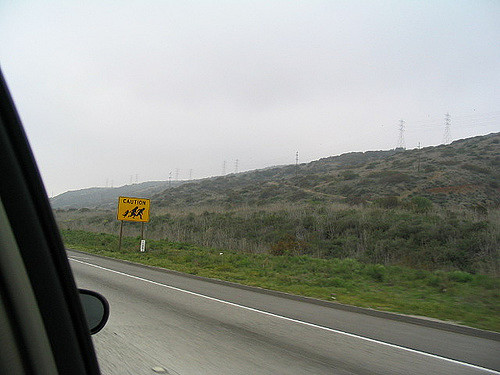
Massachusetts Sheriff Demands That Elected Leaders of Sanctuary Cities Be Arrested

A Massachusetts law enforcement official testifying before Congress on Tuesday called for leaders of sanctuary cities to be arrested.

Bristol County Sheriff Thomas Hodgson told the House Subcommittee on Illegal Immigration that sanctuary cities “have become magnets for illegal aliens, some of which have violent criminal records.”

“If these sanctuary cities are going to harbor and conceal criminal illegal aliens from ICE, which is in direct violation of Title 8 of the U.S. Code, federal arrest warrants should be issued for their elected officials,” Hodgson said. “Our citizens would be safer if we never stopped enforcing immigration law and if we never formed or turned a blind eye toward sanctuary cities.”

He also took aim at a Massachusetts legislator who passed along rumors of a planned ICE raid in Brockton on Tuesday and Wednesday . . .

“This is the most outrageous, outrageous example of what is going on across the United States that is undermining my job and every other law enforcement officer in the United States,” he said. (Read more from “Massachusetts Sheriff Demands That Elected Leaders of Sanctuary Cities Be Arrested” HERE)

Follow Joe Miller on Twitter HERE and Facebook HERE.

The Cumulative Effective Tax Rate

Early Americans would roll over in their graves if they heard about modern-day America’s topsy-turvy departure from many of the hard-won freedoms and liberties of the American Revolution. They would be unable to make sense of all the different taxes we pay today, and especially the government’s legal entitlement to a portion of an American’s labor via an income tax. There was no such tax on labor for the earliest Americans; it was unconscionable to tax someone’s personal property, which one’s labor was then considered. The concept of paying one’s “fair share” did not exist until after mid-20th century.

In general, operating expenses of private corporations and the federal, state and corporate-county municipal governments are passed on to the end users (public) in the form of taxation.

A partial list of the transparent as well as all the unseen hidden taxes include: federal and state income tax, county taxes, federal and state sales tax, accounts receivable tax, alcohol tax, alternative minimum tax, building permit tax, cigarette tax, corporate tax, dog license tax, education tax, estate tax, excise tax on imports, food license tax, fuel permit tax, gift tax, hotel tax, inheritance tax, inventory tax, car rental tax, IRS interest charges, IRS penalties and levies, license tax, labor tax (withholding), marriage license tax, Medicare tax, municipal state tax on insurance premiums, worker’s compensation and unemployment tax, property tax, recreational vehicle tax, sales tax, self-employment tax, road usage tax for truckers, school tax, Social Security tax, Supplemental Security Income (SSI), telecommunications tax, travel tax, utility tax, vehicle licensing registration tax, vehicle sales tax, watercraft registration tax, well permit tax, hospitality tax and last but not least, the hidden tax of inflation of a debt-based central banking system and all finance charges.

I’m sure I must have missed something!

While on a TV talk show in 1981, President Reagan mentioned that 46 different taxes contributed to the price of one loaf of bread. Imagine how many more taxes have been added since then. How many taxes and fees are hidden in an airline ticket? Seldom considered is how the cost of doing business has the effect of decreasing one’s purchasing power as more and different kinds taxes make up the retail price you end up paying.

The retail price accounts as the total of the multiple costs of doing business. Throughout a company’s chain of events from production to sales and marketing, labor costs take a huge bite; they are the wages, taxes and fees imposed on the labor of every employee from the factory-floor worker to CEO. Materials, essential resources, and the interest amounts on a company’s business loans are all rolled into the price you pay.

Americans take a beating from taxes that appear to now exponentially erode earnings (personal property). “Bracket creep,” as it is called, over time automatically moves a taxpayer into new, higher tax brackets. For example, in 1970, private pensions and Social Security retirement were not considered taxable income, though today, they are. These sort of official changes often move people into a higher income bracket with subsequent increased amounts due to state and federal governments.

What if mainstream media routinely reported on the cumulative total of what everyday American pays annually in taxes? Would you connect the dots to the direct impact this has on your personal finances, e.g., actual disposable income and increasing dependence on credit? The addition of all taxes, transparent and not so transparent, (hidden taxes mentioned above, upfront fees and regulation costs of federal and state regulatory compliance, federal fines (like what British Petroleum passed on to consumers after the Gulf oil spill) lead this writer to the educated guess that the average American pays somewhere in the range of a cumulative 30 to 60 percent of their annual gross earnings in taxes, depending on their tax bracket.

Are you powerless when it comes to this topic? I don’t think so. Knowledge is power, and power can lead to informed action. (For more from the author of “The Cumulative Effective Tax Rate” please click HERE)

Follow Joe Miller on Twitter HERE and Facebook HERE.

After Trump Threatens to ‘Fight’ Freedom Caucus, Conservatives Vow to ‘Keep Promises’

After Republicans pulled a bill to repeal and replace Obamacare last week, conservative members of the House Freedom Caucus are shrugging off criticism leveled at them by Republican colleagues — including from President Donald Trump himself.

In a Thursday morning tweet, Trump said the Freedom Caucus “will hurt the entire Republican agenda if they don’t get on the team,” and vowed to “fight” conservative members in 2018 midterm elections.

“When people say the Freedom Caucus is jeopardizing the president’s agenda, guess what jeopardizes the president’s agenda?” said Rep. Andy Biggs, R-Ariz., a freshman Freedom Caucus member. “Losing the House and Senate jeopardizes the president’s agenda. You have to keep your promises and our promises are to repeal Obamacare.”

“The Freedom Caucus is trying to keep our promises,” Biggs said in an interview with The Daily Signal. “I don’t think going to Democrats, especially when they are trying to impeach the president, seems rational or realistic.”

About half of the more than 30 members of the Freedom Caucus joined at least 17 centrist Republicans in refusing to back the GOP leadership’s health care bill.

Centrists worried the bill imperiled too much of Obamacare, and conservatives said it did not go far enough.

Despite the bill’s failure, and signals that the White House wants to move on to other issues, Freedom Caucus members insist they want to work with Trump to craft a bill Republicans can unite around.

“The Freedom Caucus’ job is simple: to do what we promised the American people we’d do,” Rep. Mark Meadows, R-N.C., told The Daily Signal in a statement. “Our group has worked tirelessly to try to improve the AHCA to ensure it will actually bring down costs for everyday Americans. We believe this is our job and our duty and not something we can let fall by the wayside and move on to the next policy battle. We’re open to working with any and everyone that is willing to work toward a solution.”

Freedom Caucus members say it would be a mistake for Trump to rely on Democrats and centrist Republicans to advance other parts of his agenda, including tax reform, and passing a short-term spending bill before April 28.

“There are competing factions in the White House and whoever got Trump’s ear on this one is just not serving him well,” said Rep. Dave Brat, R-Va., a Freedom Caucus member, in an interview with The Daily Signal. “The Democrats aren’t letting any of Trump’s appointments through, and there is no evidence the Democrats will show any taste for repealing Obamacare in any way, shape, or form.”

“The Freedom Caucus is basically the base of the Trump vote,” Brat added. “So whoever is advising him to go back to the old formula that has failed for year after year, that’s just terrible counsel.”

Rep. Raul Labrador, R-Idaho, a founding Freedom Caucus member, seconded that view, warning Trump via Twitter to “remember who your real friends are.”

Biggs insists he still believes Trump shares his conservative principles, and he is hopeful the president decides to follow them.

“The Freedom Caucus more than any group of Republicans in Congress are the ones who supported Trump to be president,” Biggs said. “Some in our group really went out on a limb and took it on the chin and supported Trump because he said he stood for the principle of repealing Obamacare, he stood for building a wall, he talked about a balanced budget, reforming taxes, everything we stand for.”

“Each person has their own level of capacity to accept or reject stress,” Biggs added. “I didn’t run for reelection in 2018. I ran for election in 2016 because I believed certain things, I made the case I would do things, and I have been out here busting my tail trying to do those things. If I can do those things, reelection will take care of itself.”

Some Freedom Caucus lawmakers, however, believe the group demanded too much in the Obamacare debate, and is limiting its relevance moving forward unless it becomes more accommodating.

Rep. Ted Poe, R-Texas, left the caucus over the weekend, and Rep. Trent Franks, R-Ariz., in an interview with Politico, wondered if caucus members overplayed their hand.

“If we see the thing fail completely — nothing but shards around us — then we probably saw the Freedom Caucus overplay their hand… and I say that as a grateful member of the Freedom Caucus,” Franks told Politico.

More cautious members fear that Trump wields a powerful megaphone, and his base of supporters are mostly the Freedom Caucus’ own constituents, meaning conservative lawmakers could be blamed if Republicans fail to repeal and replace Obamacare.

They acknowledge the sensitivity of negotiations, because moving the legislation too far to the right could discourage centrist Republicans, especially those in the Senate who represent states that expanded Medicaid.

Trump again targeted the Freedom Caucus in a Thursday night tweet, this time singling out the group’s leaders.

Yet other Freedom Caucus members embrace the targets on their backs, a hunted position they are used to occupying.

“Trump’s tweets reaffirm that the Freedom Caucus is having a major impact on public policy in Congress — that the Freedom Caucus is not a force to be ignored,” said Rep. Mo Brooks, R-Ala., in an interview with The Daily Signal. “This Twitterverse is the new Washington. I have zero worries about it. If you want me to vote for a piece of legislation, either persuade me it is good for America or change it so that it is good for America.”

Despite apparent cracks in the relationship, Brat maintains that Trump and the Freedom Caucus should form a natural alliance.

“The two themes Trump ran on is the forgotten man and draining the swamp,” Brat said. “The Freedom Caucus is all of that and that’s what we are moving forward on.” (For more from the author of “After Trump Threatens to ‘Fight’ Freedom Caucus, Conservatives Vow to ‘Keep Promises'” please click HERE)

Follow Joe Miller on Twitter HERE and Facebook HERE.

Fire Collapses Portion of Interstate Highway in Atlanta

A bridge on Interstate 85 in Atlanta collapsed on Thursday as a fire raged beneath it, authorities said, sending black smoke into the air and briefly causing a fireball before the structure fell in on itself.

There were no immediate reports of casualties in the incident, which snarled traffic for miles (km).

“We are trying to assess the damage and determine how quick we can repair it,” Republican Georgia Governor Nathan Deal told a news conference.

Black smoke billowed so thickly from the bridge in the heart of Atlanta that area residents told local media they thought a storm was coming or that the sun had set early when the fire started at around 6 p.m. local time.

Then flames rose several stories high from under the bridge before a section collapsed around 7:30 p.m., even as dozens of firefighters fought it, causing a brief fireball. (Read more from “Fire Collapses Portion of Interstate Highway in Atlanta” HERE)

Follow Joe Miller on Twitter HERE and Facebook HERE.

GOP Senators Ask Trump Administration to End ‘Too Big to Fail’ Policies

A group of Republican senators is leading an effort to end government-backed “too big to fail” bailout policies.

In an effort to end the practice of taxpayer bailouts of private companies, 10 Republican senators from the Senate Banking Committee penned a letter to the Trump administration requesting to terminate these policies for nonbanks, claiming they have resulted in significant expenses.

“Too big to fail” is a policy implemented by the Obama administration under the Dodd–Frank Wall Street Reform and Consumer Protection Act that allowed the Financial Stability Oversight Council—a federal board—to offer nonbanks taxpayer support for bailouts.

The letter said, “You have our strong support for using all the tools available as Secretary of Treasury to end ‘too big to fail’ and ensure that hard-working Americans are not responsible for any new bailouts.”

The senators specifically targeted the Financial Stability Oversight Council, as they claimed the council carries out “inconsistent practices,” which result in “unnecessary regulatory costs” that can hurt U.S. businesses.

The letter demanding the end of “too big to fail” policies was signed by Republican Sens. Tom Cotton from Arkansas, Pat Toomey from Pennsylvania, Richard Shelby from Alabama, Mike Crapo from Idaho, Mike Rounds from South Dakota, John Kennedy from Louisiana, Ben Sasse from Nebraska, David Perdue from Georgia, Thom Tillis from North Carolina, and Tim Scott from South Carolina.

The lawmakers also added that Secretary of Treasury Steve Mnuchin should evaluate the Financial Stability Oversight Council’s practices to rethink other financial rules and regulations.

In February, President Donald Trump signed an executive order that allowed the Department of the Treasury to review fiscal regulations, which include policies put in place by the Dodd-Frank Act that allowed for the creation of Financial Stability Oversight Council and “too big to fail.”

“Get rid of the designation process altogether. If you want to end ‘too big to fail,’ the last thing you want is to have the federal government identifying the firms that are too big to fail,” said Norbert Michel, a finance expert at The Heritage Foundation.

On the other side of the aisle, Democrats have defended these policies, claiming they play a vital role in preventing financial institutions from causing another economic catastrophe.

Jack Lew, the treasury secretary under the Obama administration, defended the Financial Stability Oversight Council last year.

“[Financial Stability Oversight Council’s] authority to designate nonbank financial companies is a critical tool to address potential threats to financial stability, and it has made our financial system safer and more resilient,” Lew said. “We intend to continue defending vigorously the process and the integrity of FSOC’s work, and I am confident that we will prevail.” (For more from the author of “GOP Senators Ask Trump Administration to End ‘Too Big to Fail’ Policies” please click HERE)

Follow Joe Miller on Twitter HERE and Facebook HERE.
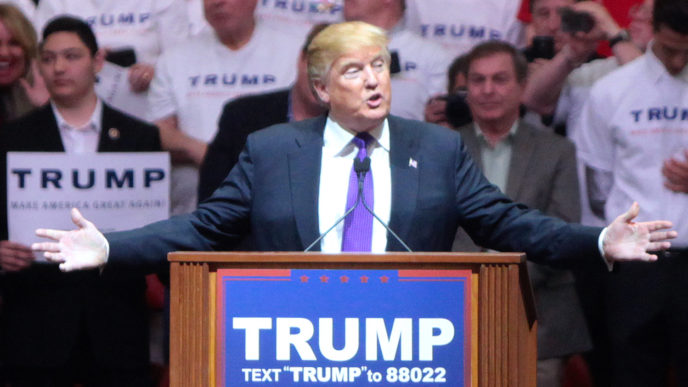
Trump’s Budget Cuts Face Resistance From Republican Lawmakers

Republican leaders are voicing disapproval of budget cuts proposed by President Donald Trump.

“I doubt there’d be a lot of appetite for dramatic cuts this year,” Senate Majority Whip John Cornyn, R-Texas, told Roll Call. “I just look at it as a conversation. They’ve got their views, we’ve got our views, and we need to sit down and work that out.”

According to CQ Roll Call’s Budget Tracker newsletter, Republican leaders such as Cornyn are openly disproving of Trump’s requested $18 billion in spending cuts for the current fiscal year budget, Politico reports.

Funding for the federal government will run out during the last week of April. In order to avoid a government shutdown, Congress must pass a spending bill by April 28.

Trump has suggested several ways to trim government spending, and some of the reductions include cutting “$1.3 billion from Pell Grant funding for college students; $1.2 billion from the National Institutes of Health; and $1.5 billion from the Community Development Block Grant program,” according to Budget Tracker.

Some of these cuts are alarming Republicans lawmakers such as Sen. Lamar Alexander. The Tennessee Republican chairs the Senate energy-water appropriations subcommittee. He’s hinting that Trump’s requested budget cuts may go ignored.

“[Trump] suggested some things and of course we’ll look at them, but we’ll write the budget,” Alexander told CQ.

Rep. Tom Cole, R-Okla., who serves as chairman of the House subcommittee on labor, health and human services, education, and related agencies, also suggested that Trump’s requested budget cuts might not be implemented.

“You know that’s fine, but it’s a little late in the process,” Cole told CQ. “We’ve closed out our bills.”

In his “skinny” budget proposal for the next fiscal year, Trump proposed to end taxpayer funding for the Corporation for Public Broadcasting, which supports public TV and radio broadcasters like NPR and PBS.

“This is an agency we all admire,” Cole said, according to Budget Tracker.

The Corporation for Public Broadcasting received $445 million in federal funding in 2016.

According to Budget Tracker, Republican lawmakers appeared skeptical about ending funding for the Corporation for Public Broadcasting. One GOP lawmaker, Rep. Andy Harris of Maryland, questioned if funding the corporation is necessary.

Romina Boccia, deputy director of the Thomas A. Roe Institute for Economic Policy Studies at The Heritage Foundation, told The Daily Signal in an email that the apparent refusal of Republican lawmakers to support Trump’s budget cuts are disappointing.

“For years now, Republicans have told the American people that if only they controlled both chambers of Congress and the executive, they could actually get stuff done,” Boccia said. “Now, we are seeing that those too were apparently empty promises.” (For more from the author of “Trump’s Budget Cuts Face Resistance From Republican Lawmakers” please click HERE)

Follow Joe Miller on Twitter HERE and Facebook HERE.
Why These GOP Senators Aren’t Concerned About Democrats’ Threat to Filibuster Gorsuch

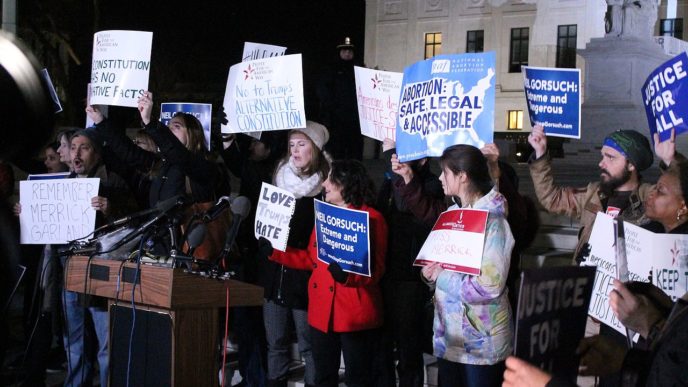
Despite the looming threat of a Democratic filibuster, a group of key Republican lawmakers from the Senate Judiciary Committee displayed confidence that Supreme Court nominee Neil Gorsuch will be confirmed during a press conference in the District of Columbia.

“The Democrats will not succeed in filibustering [Gorsuch],” Sen. Ted Cruz, R-Texas, said. “Judge Gorsuch should be confirmed to the Supreme Court and he will be confirmed.”

The other senators who gathered on the steps of the Supreme Court included Judiciary Committee Chairman Chuck Grassley of Iowa and Judiciary Committee members Lindsey Graham of South Carolina and Mike Lee of Utah.

Several former Gorsuch law clerks were also present at the event.

Graham said he was confident that Gorsuch would eventually be confirmed by the Senate.

“I’m here to tell you [Gorsuch] is going to be on the Supreme Court … it’s not a matter of when, but how,” Graham said.

Graham, who said there is “no better qualified person” than Gorsuch to sit on the Supreme Court, concluded by saying to his Democratic colleagues: “If you’d filibuster a judge like this, then it’s obvious that you’d filibuster anyone.”

Grassley was shocked by the Democrats’ filibuster threat, saying, “It leaves me very stunned why there’s this talk about a filibuster, because if he’s not qualified, then nobody is … it’s quite purely politics.”

Since a whip count has not been conducted yet, Grassley added that is he unsure if Republicans have enough votes to “go nuclear” and stop the Democrats’ filibuster.

“If Democrats make the choice to filibuster Judge Gorsuch, it will be a foolish choice … it will be a choice driven only by the political fear of incumbent Democrats that their angry political base would primary them,” said Cruz, as he talked over a group of shouting anti-Gorsuch protesters with People for the American Way.

A group of pro-Gorsuch demonstrators also gathered at the Supreme Court and, while dressed in judge attire, sang a number of songs in support of the nominee.

“Gorsuch is uniquely well qualified for the Supreme Court … he’s read every brief, every opinion, every case involving whatever dispute is in front of him,” Lee said.

In response to the claim from Sen. Dianne Feinstein that the judge has ruled on the side of large entities and not “the little guy,” Lee said a judge should ideally side with the law in the courtroom, not “emotionally compelling arguments.”

Leah Bressack, one of the SCOTUS nominee’s former law clerks, was also present at the press conference to advocate for Gorsuch. Bressack also spoke at his committee hearing.

“There’s no question about the judge’s independence and impartiality,” Bressack said. “The hearings have shown that he will not prejudge any cases that come before him. We know that he is a justice of who all Americans will be proud.”

Gorsuch has completed his Supreme Court hearings and awaits an April 7 confirmation vote. If all Republicans in the Senate vote for Gorsuch he will need eight additional votes from Democrats to avoid a filibuster. (For more from the author of “Why These GOP Senators Aren’t Concerned About Democrats’ Threat to Filibuster Gorsuch” please click HERE)

Follow Joe Miller on Twitter HERE and Facebook HERE.

Two Activists Who Filmed Undercover Videos of Planned Parenthood Charged With 15 Felonies

The two antiabortion activists who mounted a hidden-camera investigation against Planned Parenthood officials have been charged with 15 felony counts of violating the privacy of health-care providers by recording confidential information without their consent.

In announcing the charges against David Robert Daleiden and Sandra Merritt on Tuesday, California Attorney General Xavier Becerra said the duo used manufactured identities and a fictitious bioresearch company to meet medical officials and covertly record the private discussions they initiated.

“The right to privacy is a cornerstone of California’s Constitution, and a right that is foundational in a free democratic society,” Becerra said. “We will not tolerate the criminal recording of confidential conversations.”

The criminal complaint alleges that on 14 occasions, between October 2013 and July 2015, Daleiden and Merritt filmed people without permission in Los Angeles, San Francisco and El Dorado counties. The activists face a felony count for each person covertly recorded, and an additional felony charge for criminal conspiracy to invade privacy. (Read more from “Two Activists Who Filmed Undercover Videos of Planned Parenthood Charged With 15 Felonies” HERE)

Follow Joe Miller on Twitter HERE and Facebook HERE.