Government Watchdog Questions Sessions’ Need for Recusal From Russian Probe

Attorney General Jeff Sessions announced Thursday he would recuse himself from any Justice Department investigation that relates to the 2016 presidential campaign.

“My staff recommended recusal. They said since I had involvement in this campaign, I should not be involved in any campaign investigation,” Sessions said at a press conference Thursday.

“I have studied the rules and considered the comments and evaluations,” Sessions said. “I believe those recommendations are right and just. Therefore, I have recused myself in the matters that deal with the [Donald] Trump campaign.”

Sessions said he did not meet with Russian operatives about the election.

Some government ethics experts contend the recusal wasn’t necessary—at least not from a probe of alleged Russian interference in the 2016 presidential election.

He should only recuse himself from an illegal leak investigation that he was a victim of, said Tom Fitton, president of Judicial Watch, a conservative government watchdog group.

“He should only recuse himself from the investigation of illegal leaks because it relates to him, he was a victim,” Fitton told The Daily Signal.

Fitton said a member of the Senate Armed Forces Committee meeting with a Russian ambassador seems rather routine. He said this is why he thinks it’s puzzling that even some Republican lawmakers are calling for Sessions to recuse himself in regard to investigating the alleged Russian hacking of the Democratic National Committee communications.

“The real Russian scandal is that President Barack Obama’s team used the pretext of Russian interference in the election to justify wiretaps and illegal leaks of the Trump team, including a U.S. senator, now attorney general,” Fitton added. “The Russians’ interference in the elections is chasing unicorns, with these smoky allegations of collusion between the campaign and the Russian operatives, without evidence.”

Federal investigators reportedly examined communications between Sessions and Russian Ambassador to the United States Sergey Kislyak from last year.

The conversations between the then-Alabama senator and the Russian ambassador cast doubt about Sessions’ testimony during the Senate Judiciary confirmation hearings, when he said he didn’t talk to Russians as a Trump campaign surrogate. The FBI, CIA, National Security Agency, and the Treasury Department are reportedly involved in the investigation.

Sessions said he would send a written explanation of his testimony to the Senate Judiciary Committee.

During the press conference, Sessions said he was “taken aback” by the question at the Senate hearing about campaign surrogate discussions with Russians.

“In retrospect, I should have slowed down and said I did meet with one Russian official a couple of times,” Sessions said.

Sessions said the conversation with the official became testy, and that he turned down a lunch invitation. Sessions noted they disagreed on the issue of Ukraine.

Senate Minority Leader Charles Schumer, D-N.Y., House Minority Leader Nancy Pelosi, D-Calif., and other Democrats have called for Sessions to resign from office for what he told the committee.

Republican lawmakers such as Rep. Jason Chaffetz, R-Utah, the chairman of the House Committee on Oversight and Government Reform, as well as GOP Sens. Susan Collins of Maine and Rob Portman of Ohio called for Sessions to recuse himself from the Russian investigation.

Fitton, of Judicial Watch, said Sessions would clearly have to recuse himself in a potential perjury investigation, but based on the questions and answers in the Judiciary hearing, it’s unlikely he could face a credible allegation.

Concurring with Fitton, it seems likely that Obama holdovers might be pushing these leaks to undermine the current administration, said Hans von Spakovsky, a former Justice Department attorney in the George W. Bush administration, now a senior legal fellow at The Heritage Foundation.

“As president, Obama was 100 percent political during his administration and hasn’t stopped,” von Spakovsky told The Daily Signal. “The Sessions meetings are much ado about nothing if you look at the questions and answer from the hearing.”

During the confirmation hearing, Sen. Al Franken, D-Minn., asked Sessions: “If there is any evidence that anyone affiliated with the Trump campaign communicated with the Russian government in the course of this campaign, what will you do?”

Sessions responded, “I’m not aware of any of those activities. I have been called a surrogate at a time or two in that campaign and I didn’t have—did not have communications with the Russians, and I’m unable to comment on it.”

Separately, Sen. Patrick Leahy, D-Vt., asked Sessions in a questionnaire: “Several of the president-elect’s nominees or senior advisers have Russian ties. Have you been in contact with anyone connected to any part of the Russian government about the 2016 election, either before or after Election Day?”

Sessions responded: “No.”

Sessions talked to Kislyak once in his office, in a meeting that Sessions spokesman Sarah Flores told The Wall Street Journal was about diplomatic matters. Sessions also spoke to Kislyak at a Heritage Foundation event held in Cleveland during the Republican National Convention, where Sessions was the keynote speaker at luncheon that was part of the forum.

A statement from The Heritage Foundation explained that in coordination with the State Department and other groups, it held a forum titled “Global Partners in Diplomacy” in Cleveland in July 2016, which was an educational program for ambassadors invited by the State Department to observe the Republican National Convention.

Topics at the conference included various regional issues, national security and trade, among numerous others, with State Department officials present at all program events. About 100 individuals attended the luncheon event where Sessions spoke, according to The Heritage Foundation.

The State Department handled coordination for ambassadors and did not provide The Heritage Foundation with a list of ambassadors that attended.

Flores told The Wall Street Journal that Sessions, as a member of the Senate Armed Forces Committee, had more than 25 conversations with ambassadors last year, including those from Britain, South Korea, Japan, Poland, India, China, Canada, Australia, and Russia.

During his tour of the U.S.S. Gerald R. Ford aircraft carrier on Thursday, reporters asked President Donald Trump if he still had confidence in Sessions, he answered, “Total.”

When asked if Sessions should recuse himself, Trump responded, “I don’t think so.”

Trump also said that he wasn’t aware of Sessions speaking with a Russian ambassador, and when asked if Sessions testified truthfully to the Senate, Sessions said, “I think he probably did.” (For more from the author of “Government Watchdog Questions Sessions’ Need for Recusal From Russian Probe” please click HERE)

Follow Joe Miller on Twitter HERE and Facebook HERE.

Bakers Accused of Homosexual Hate Get Emotional Day in Court

The ongoing battle between gay rights and religious liberty escalated Thursday as husband-and-wife bakers in Oregon appealed their case after being ordered to pay $135,000 in damages for declining to make a cake for a same-sex wedding.

“Everything up to this point has been administrative hearings,” Aaron Klein, co-owner with his wife Melissa of the since-closed bakery, told The Daily Signal afterward.

“Every time we tried to make a constitutional argument it was stomped on, because it was administrative law,” he said. “But now we’re finally in a courtroom where the Constitution and due process can be argued on a level we haven’t seen before. I’m looking forward to seeing the outcome.”

In court, an attorney for the Kleins again argued that designing and baking a cake to celebrate a same-sex marriage would violate the bakers’ Christian faith.

Both the Kleins and the same-sex couple who filed the original complaint against them were present inside the courtroom.

Afterward, while speaking to reporters, Melissa Klein had an emotional response.

“We lost everything,” she said. “I loved my shop, and losing it has been so hard for me and my family.”

In an exclusive telephone interview with The Daily Signal later, she added:

“That was a part of our life, and it was something that we thought was going to be passed down to our kids. It’s something that I miss every day still. I don’t think I’ll ever be able to get over it because it was our second home.”

A three-judge panel of the Oregon Court of Appeals heard oral arguments from both sides, with questions focused on issues such as:

Does Oregon have a “compelling reason” to grant the Kleins a religious exemption from the state’s antidiscrimination law?

Does a cake count as artistic expression protected by the First Amendment, and how do you differentiate between what constitutes art and what doesn’t?

What was the particular message involved in designing and making a cake for a same-sex wedding, and how is it understood by an observer?

To what extent may an artist be compelled to do something?

How is sexual orientation different from race as a personal characteristic?

The Kleins used to run Sweet Cakes by Melissa, a family bakery they owned and operated in Gresham, Oregon. But after the Kleins declined in 2013 to make a cake for a same-sex couple’s wedding, citing their religious beliefs, they faced protests that eventually led them to shut down their bakery.

In July 2015, an administrative judge for the Oregon Bureau of Labor and Industries ruled that the Kleins had discriminated against a lesbian couple, Rachel and Laurel Bowman-Cryer, on the basis of their sexual orientation. The judge ordered the Kleins to pay the $135,000 for physical, emotional, and mental damages.

Under Oregon law, it is illegal for businesses to refuse service based on a customer’s sexual orientation, as well as race, gender, and other characteristics.

The Kleins maintained that they did not discriminate, but only declined to make the cake because of their religious beliefs about marriage. Designing and baking a custom cake for a same-sex wedding, they said, would violate their Christian faith.

The Kleins appealed to the Oregon Court of Appeals on the basis of their constitutional rights to religious freedom, free speech, and due process.

The three appeals judges also pursued these lines of questioning:

Was the award of damages—the $135,000 the Kleins were ordered to pay—out of line with other cases before the Oregon Bureau of Labor and Industries?

Was it reasonable for that state agency to extend the damages through more than two years after the alleged discrimination actually occurred?

Did Bureau of Labor and Industries Commissioner Brad Avakian prejudge the case and in doing so strip the Kleins of their right to due process?

How is sexual orientation different from race as a personal characteristic?

Each side had equal time to make their case and the Kleins, as plaintiffs, got an additional five minutes for a rebuttal. The oral arguments were live-streamed, and may be watched in full here.

“The government should never force someone to violate their conscience or their beliefs,” Kelly Shackelford, president and CEO of First Liberty Institute, a religious freedom group that represents the Kleins, said in a press statement, adding:

“In a diverse and pluralistic society, people of good will should be able to peacefully coexist with different beliefs. We hope the court will uphold the Kleins’ rights to free speech and religious liberty.”

But Charlie Burr, a spokesman for the Oregon Bureau of Labor and Industries, whose lawyers represent the Bowman-Cryers, said:

“The facts of this case clearly demonstrate that the Kleins unlawfully discriminated against a same-sex couple when they refused service based on sexual orientation.”

Since the case began in 2013, the Kleins have argued the cards were stacked against them.

Lawyers for the Bureau of Labor and Industries pursued the charges against the Kleins on behalf of the lesbian couple, who went on to marry.

Avakian, the agency official, made multiple public comments criticizing them before any rulings, the Kleins said.

The administrative judge who issued the final ruling also is employed by the state agency.

Besides ordering the Kleins to pay $135,000, Avakian ordered the former bakery owners to “cease and desist” from speaking publicly about not wanting to bake cakes for same-sex weddings based on their Christian beliefs.

Both parties have said the case has taken a heavy toll on their families. Aaron and Melissa Klein, who have five children, say they continue to face hurtful attacks from liberal activists.

According to an article the Bowman-Cryers wrote for The Advocate, a publication focused on LGBT issues, they are foster parents for two “high-needs” girls.

“Part of the reason we decided to get married in the first place was to provide stability for our daughters,” they wrote, adding:

Before we became engaged, we became foster parents for two very high-needs girls after their mother, a close friend of ours, died suddenly. Lizzy, now 9, has cerebral palsy, autism, and a chromosomal disorder that causes developmental delays. Anastasia, now 7, has Asperger’s and stopped speaking when her mother died.

While the case wound its way through the courts, we won full adoptive custody of Lizzy and Anastasia, and they are the light of our lives.

The appeals judges are not expected to rule for several months. If they rule against the Kleins, the couple’s next step would be appealing to the Oregon Supreme Court. (For more from the author of “Bakers Accused of Homosexual Hate Get Emotional Day in Court” please click HERE)

Follow Joe Miller on Twitter HERE and Facebook HERE.

Assisted Suicide Dehumanizes Suffering, Opponents Argue

Allowing physicians to help people kill themselves is a misguided “game-changer” in how society responds to suffering, a doctor who specializes in children’s medicine said during a Heritage Foundation event on assisted suicide.

“Physician-assisted suicide redefines the concept of a medical good as never before,” Dr. G. Kevin Donovan, professor and director of pediatrics at Georgetown University, told the audience for the panel discussion.

“For the first time, we will plan to end suffering by ending the life of the sufferer,” Donovan said.

The event Monday, which featured Sen. James Lankford, R-Okla., a sponsor of legislation on the topic, focused on the societal dangers of physician-assisted suicide.

Ryan T. Anderson, a senior research fellow at Heritage, called the widespread legalization of the practice “a grave mistake.”

So far, five states plus the District of Columbia have legalized physician-assisted suicide. But, Anderson noted, 16 other states have introduced bills to allow it.

“Physician-assisted suicide comes with serious costs,” he said. “Too many people view it as purely a private matter between an autonomous adult who desires to die and another autonomous adult who can provide medical assistance to die.”

Anderson was host of the event along with Kathryn Jean Lopez, a senior fellow at National Review Institute.

Lankford said the issue is personal for him because someone in his own family could be targeted by proponents of assisted suicide. Their standard for proceeding, he noted, is a diagnosis that someone has six months or less to live.

“I have a very dear family member … given a diagnosis of six months to live in 1981, and she is still kicking and is still a pretty amazing lady,” Lankford said.

So the standard is presumptuous, the Oklahoma Republican said:

This belief that somehow medicine can look over the shoulders of someone and tell someone exactly how long they [will] live begs the reality of just everyday care for individuals and … quite frankly, for those of us who are followers of God, just the belief in what God can choose to do in the life of an individual and the dignity of that person.

Before the District’s physician-assisted suicide law went into effect Feb. 18, Lankford introduced a resolution attempting to halt its implementation.

Donovan also said it is impossible for his fellow doctors to be completely accurate in judging the lifespans of patients because it is not something they have been trained to do.

“There are at least a couple of things that doctors do not do well,” Donovan said. “And the first one is prognosticate the end of someone’s life because actually, we do not have much training in that and we do not have much data. Every patient is an individual.”

Also on the panel was Melissa Ortiz, the founder of Able Americans, an organization that seeks to give a voice to those with chronic illness and physical and mental disabilities. Ortiz said her husband’s own neurological disability helped convince her that society must reframe the discussion:

We have got to change the conversation from talking about ‘the elderly’ and ‘the disabled’ to talking about people who are elderly and people with disabilities. When you take away that little ‘the’ … they become individuals with stories. Putting the ‘the’ in front of it makes them objects and objectifies them; dare I say, it makes them subhuman.

Ortiz said she has experienced the reality of the “disabled” label.

“I cannot tell you the number of times that people have addressed [my husband] to ask what I would like,” she said. “And before that they would ask my mother or my friends, because I couldn’t possibly answer for myself because I am in a wheelchair.”

Ortiz said her family also was faced with a situation with a loved one where caring action made all the difference.

Her father-in-law battled prostate cancer, which spread to the bone, and did not have “great doctors,” she said:

I fired all the doctors and got him much better care … and he was with us for … 12 years after that. He would have missed knowing his only grandchild, and his only grandchild would have missed knowing him.

Suffering and illness, Ortiz said, can be a way to “walk in victory”:

Suffering, internal illness is not always about us as individuals, the person doing the suffering. It is about the people around us and learning to walk out that suffering, not looking for a way to get out, but looking for a way to walk in victory.

Kathleen Buckley Domingo, also on the panel and associate director for the Archdiocese of Los Angeles Life Ministry, said she is alarmed at how physician-assisted suicide has been handled in her state.

Physician-assisted suicide became legal in California on June 9, 2016.

“We do not know how many people have taken advantage of assisted suicide because we are not allowed to know how many people have taken advantage,” Domingo said. “There is no tracking system that is open to any kind of public scrutiny at all.”

Physician-assisted also includes a significant amount of unknowns, Domingo said.

“What happens if you change your mind? What happens if you change your mind and then become incompetent and someone else in the house still thinks it is a good idea? These are very real situations that real families in California are right now facing,” she said.

Supporters of physician-assisted suicide, including Compassion & Choices, an organization advocating its legalization across the nation, argue that terminally ill individuals should have the choice to “end their suffering if it becomes intolerable.”

Donovan said choosing death by opting for assisted suicide may be the least expensive path to take, but is dangerous for patients and physicians.

“In medicine we know that what is permissible becomes habitual, and what is habitual becomes standard care, and what is [the] standard of care becomes obligatory,” Donovan said. “We will be changing the standards of care for all physicians and all patients by changing this law for society and the profession.” (For more from the author of “Assisted Suicide Dehumanizes Suffering, Opponents Argue” please click HERE)

Follow Joe Miller on Twitter HERE and Facebook HERE.

Former Congresswoman: If Trump Investigates High-Level Pedophiles, It Will Go “All the Way to the Top,” Will Take Down Dems and Republicans

If there is one thing that’s consistent about Donald Trump, it’s that he is horribly inconsistent. Whether it be flip-flopping on states’ rights for cannabis laws or praising NATO after promising to leave it, where Trump stands on the issues is a crap shoot. That being said, however, there is one issue on which Trump has remained steadfast, it is bipartisan, and everyone should agree on it — it’s time to stop human trafficking. And a former Democrat congresswoman from Georgia agrees.

It is important to note that human trafficking is not the same as working in the sex industry. Those who work in the sex trade, voluntarily, are not victims of human trafficking. However, they often find themselves victims of the government and the black market created by that government who pushes their line of work into dark alleys and shady places.

As corporate media writes off talk of ‘pizzagate’ as if it’s some tinfoil conspiracy theory that couldn’t possibly happen, recent busts of pedophilia rings are shattering their claims. In fact, after a massive bust in California, Los Angeles County Sheriff Jim McDonnell says the arrests represent a “very sad commentary on the condition we’re dealing with.”

“Pretending this issue doesn’t exist only makes us more complicit in it,” newly elected San Diego City Attorney Mara Elliott said last month.

However, it appears that Donald Trump has decided that he won’t be party to those who deny the horrid reality that is the child sex trade.

Trump held a press conference last week in which he detailed his plans to go after the victims of the “human trafficking epidemic,” as he explained.

In most of these recent busts, however, many of those arrested were simply willing adults seeking a mutually beneficial arrangement for sex with another willing adult.

These facts do not belittle the necessity to go after child traffickers. However, it does show how much money is squandered enforcing the government’s version of morality on society. The funds allocated to go after the voluntary sex trade could help to expose the real monsters behind human trafficking.

Let there be no doubt, those who engage in the child sex trade are society’s most vile — and many times, the most elite.

Former Congresswoman Cynthia McKinney also agrees with Trump. However, she takes it a step further, noting that going after child predators will lead to the downfall of both Republicans and Democrats — as this problem goes all the way to the top.

For those who don’t remember McKinney, she is the Congresswoman who bravely questioned the elite — on the house floor — about their role in the child trafficking industry.

As the Free Thought Project has pointed out, pedophilia among the elite is rampant. The problem has gotten so bad in England that officials issued an order last month to stop naming streets and landmarks after local heroes and politicians because they could later be exposed as pedophiles.

In February, the Free Thought Project reported on the fact that the police chief recently came forward and confirmed that the former Prime Minister of England, Sir Edward Heath, had raped dozens of children. The department also noted how those within the government helped cover up these crimes.

In December, we reported on the massive child sex ring that was blown apart in Norway. That investigation quickly led to arrests of, “51 people, all men, (who) are so far involved in the case. 24 of them come from Hordaland and Sogn og Fjordane. 26 come from other areas of Norway, from Southeast to Finnmark in the north. Among the accused offenders, there is also one Swedish national. Two politicians, one Labor politician from Oslo and a former national Progress Party (FrP) politician from Eastern Norway are involved in the case.” One is also a kindergarten teacher, and four of the 51 arrested were perpetrators in the video evidence collected.

Domestically, these higher level arrests are few and far between as anytime ‘the elite’ are mentioned alongside the term ‘pedophile’, the Praetorian guard, aka the corporate media, shout down all those who dare pose any questions.

However, even though the media won’t report on it, these disgusting child predators are so vile they are hard to ignore.

In January, admitted child rapist and former speaker of the house who is currently in jail, Dennis Hastert came across our radar after he demanded one of the children he raped pay back the hush money given to him by Hastert — because he broke his silence about the rape.

When the victim, known only as ‘Individial A’, broke his silence, Hastert’s child rapes were exposed — resulting in the subsequent prosecution.

“To the extent any contract existed between plaintiff [Individual A] and defendant [Hastert], plaintiff breached that contract,” Hastert’s lawyers wrote.

“Plaintiff’s breach of conduct resulted in damages to defendant and plaintiff is accordingly required to return $1.7 million to defendant.”

Individual A did not go public with this information — he merely spoke to the FBI after the transactions were uncovered by investigators. However, this sicko couldn’t care less about airing this repugnant grievance in the public forum as it was almost entirely ignored by the media.

There was also another massive pedophilia scandal in the United States in what became known as the Franklin child sex ring coverup. Once the FBI took over the investigation from state authorities, however, it turned into a witch hunt to persecute the child victims – going so far as to charge them with perjury in a successful attempt to scare the other 70+ victims to recant their testimony regarding the child sex ring.

It appears, at least for the time being, that Donald Trump is aware of this problem and intends to take it head on. However, we will have to wait to see. (For more from the author of “Former Congresswoman: If Trump Goes After High-Level Pedophiles, It Will Take Down Dems and Republicans” please click HERE)

Follow Joe Miller on Twitter HERE and Facebook HERE.

Illegal Alien Speaks out at Press Conference About Being Illegal, Then Is Promptly Detained by ICE

An illegal alien decided to speak publicly at a news conference about her immigration status Wednesday. She was later detained by Immigration and Customs Enforcement officers.

Daniela Vargas, 22, was detained in Jackson, Miss. shortly after speaking at the press conference, The Clarion-Ledger reports. Vargas, an Argentine national who arrived in the U.S. at age 7, was previously protected under President Obama’s Deferred Action for Childhood Arrivals (DACA) program. Her DACA status, however, recently expired.

Vargas’ attorney Abby Peterson told The Clarion-Ledger that Vargas’ car was pulled over by ICE agents moments after the news conference, and they told her, “You know who we are, you know what we’re here for.”

The press conference was hosted by local churches, immigration attorneys and the Mississippi Immigrants Rights Alliance to speak about recently deported families. “A path for citizenship is necessary for DACA recipients but also for the other 11 million undocumented people with dreams,” Vargas said at the press event.

Vargas can be seen in this photo of the press conference wearing a blue shirt with short hair and standing in the back.

(Read more from “Illegal Alien Speaks out at Press Conference About Being Illegal, Then Is Promptly Detained by ICE” HERE)

Follow Joe Miller on Twitter HERE and Facebook HERE.
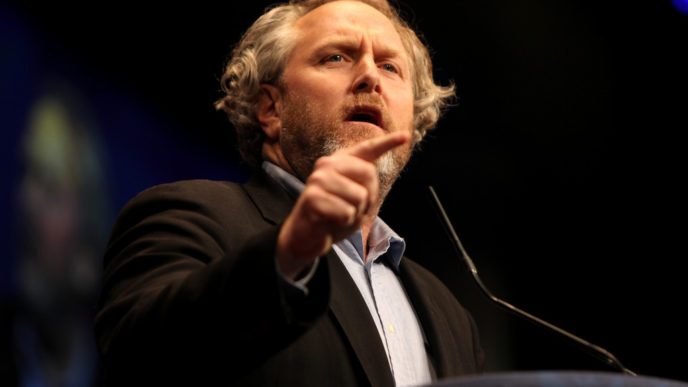
A Warrior for Conservatism: Levin Remembers Andrew Breitbart on Anniversary of His Death

During his Wednesday night radio show, Mark Levin remembered his late friend and colleague Andrew Breitbart on the five-year anniversary of his sudden and untimely 2012 death.

“We had a fun time together,” Levin recalled of the website founder and namesake. “Such an easygoing guy, but he was committed to conservatism.”

“I just want people to know there was a flesh and blood human being before there was a website,” the Conservative Review editor-in-chief explained.

Andrew Breitbart was “that a hard act to follow,” Levin chuckled, recalling the last time he saw the newsmaker and journalist alive.

“He had a wonderful sense of humor, but you would never question his intelligence,” said Levin. “He was a remarkable young man.”

“He was a warrior for conservatism. Absolutely. 100 percent,” Levin concluded. “He’s greatly missed.” (For more from the author of “A Warrior for Conservatism: Levin Remembers Andrew Breitbart on Anniversary of His Death” please click HERE)

Follow Joe Miller on Twitter HERE and Facebook HERE.

Rogue California Judge Releases Orlando ISIS Terrorist’s Wife on Bail

A California judge has ignored the government’s pleas to keep Noor Salman — the wife of the Orlando jihadi terrorist who killed 49 people at Pulse nightclub last year — in prison, ordering her release pending bail Wednesday afternoon.

Judge Donna Ryu held the opinion that Salman is not connected to the Islamic State terror group — though her husband killed and injured dozens after swearing allegiance to the group before his onslaught — and did not have radical views, according to the Orlando Sentinel. Ryu also claims that Salman is not a flight risk nor does she threaten public safety.

“I find at this time the weight of the evidence is debatable,” the judge commented.

Prosecutors strongly cautioned against releasing Salman on bail. The government now has two days to appeal the ruling before Salman can be released on a $500,000 bond. If she goes free, Salman will be obligated to wear an electronic ankle monitor.

On June 12, 2016, Omar Mateen — Salman’s deceased husband — committed the worst terrorist attack on American soil since 9/11. The Department of Justice claims that Salman helped her husband commit that massacre. She has been charged with aiding and abetting and provision of material support to a foreign terrorist organization.

Salman was involved in several suspicious activities in the run-up to the terrorist attack. For one, she was with her husband when he cased the scene in Orlando. Just days prior to the nightclub assault, Salman helped her husband stock up on ammunition, received access to his bank account, and was added to his life insurance policy.

Additionally, prosecutors claim Salman “knowingly misled” the FBI in their investigation of the attack, which is a federal offense.

Even more evidence has come to light in recent days regarding Salman’s activities prior to the attack. She and her husband racked up tens-of-thousands of dollars in credit card purchases days before the shooting, the Associated Press reported.

Orlando Chief of Police John Mina expressed his extreme disappointment with the unilateral actions taken by the rogue justice in California.

(For more from the author of “Rogue California Judge Releases Orlando ISIS Terrorist’s Wife on Bail” please click HERE)

Follow Joe Miller on Twitter HERE and Facebook HERE.

ICE Chief Refuses Senator’s Request for Criminal Illegal’s Case File

Immigration and Customs Enforcement (ICE) officials refuse to share the case file of a convicted criminal and illegal alien suspected of murdering five men, including one of Sen. Claire McCaskill’s constituents, the Missouri Democrat said Wednesday.

An exasperated McCaskill said to the Senate Committee On Homeland Security and Governmental Affairs (HSGAC) hearing on border security that the file that may provide answers to how ICE failures allowed convicted felon Pablo Antonio Serrano-Vitorino to escape. He skirted multiple encounters with police, re-entered the country illegally after deportation, and allegedly murdered four men in Kansas and 49-year-old Randy Nordman in Missouri in March 2016.

“If we want to stop future tragedies, we have to see that file,” said McCaskill, who is the panel’s ranking minority member, as she faced Nordman’s widow, Julie, who testified Wednesday. “We have to understand the mistakes that were made. And we have to have our questions answered.”

ICE officials cited privacy concerns for refusing to disclose the file, a claim that “flies in the face” of President Donald Trump’s recent executive order declaring non-citizens have no privacy rights, McCaskill said.

McCaskill said ICE Director Thomas Homan also refused to appear at Wednesday’s hearing, or send a representative. President Donald Trump named Homan acting director of the agency in January. (Read more from “ICE Chief Refuses Senator’s Request for Criminal Illegal’s Case File” HERE)

Follow Joe Miller on Twitter HERE and Facebook HERE.

How Trump Proposes to Help Victims of Crimes by Illegal Aliens

With family members of three Americans killed by illegal immigrants looking on, President Donald Trump on Tuesday night used his address to Congress to bring attention to his plan for an office to help victims of crimes committed by those not authorized to be in the country.

“I have ordered the Department of Homeland Security to create an office to serve American victims,” Trump said in his speech. “The office is called VOICE—Victims of Immigration Crime Engagement. We are providing a voice to those who have been ignored by our media, and silenced by special interests.”

The mention brought audible groans and murmurs from some, apparently Democrats, in the House chamber.

Trump mandated creation of the office as part of an executive order he signed Jan. 25.

But by using part of his prime-time address to highlight this little-known part of the executive order, Trump sent a message as his administration implements a series of tough immigration enforcement measures.

“The idea is to have an office that will assist and advocate for people who have been victims or family members victimized by criminal immigrants,” Jessica Vaughan, director of policy studies at the Center for Immigration Studies, said in an interview with The Daily Signal.

“There is a legitimate need for this kind of office, and they will be busy. I don’t see it as a symbolic or political move at all.”

The Trump administration has provided little information on what exactly the office will do, its budget, or staffing level. On Wednesday, Immigrations and Customs Enforcement (ICE), the agency in the Department of Homeland Security tasked with creating the office, gave few additional details.

“The men and women comprising the VOICE office will be guided by a singular, straightforward mission—to support victims of crime committed by immigration violators through access to information and other resources, as needed,” ICE spokeswoman Jennifer Elzea said in a statement to reporters.

Information, Answers

In memos last week detailing implementation of Trump’s immigration policies, John Kelly, secretary of the Department of Homeland Security, wrote that victims of crime committed by illegal immigrants “are often not provided adequate information about the offender, the offender’s immigration status, or any enforcement action taken by ICE against the offender.”

Kelly said ICE will appoint a liaison to “facilitate engagement with the victims and their families to ensure they are provided information about the offender and that their questions and concerns regarding immigration enforcement are addressed.”

Little published data exists on crime committed by illegal immigrants, and critics of the new office worry the president is exaggerating the risks to make his immigration enforcement initiatives more attractive.

A 2015 study by the nonpartisan Migration Policy Institute found that 820,000 illegal immigrants had criminal convictions, including about 300,000 with felony records.

“What they are trying to do is criminalize immigrants,” David Leopold, an Ohio-based immigration attorney, told The Daily Signal. “It seems this administration will stop at nothing to dehumanize and criminalize immigrants.”

Administration officials and their defenders point out that the program is aimed at illegal immigrants, not immigrants in general.

‘Providing Evidence’

In the memos, Kelly writes that the process to gather and publish information about crime committed by illegal immigrants is hampered by a previous DHS policy that protected all those on whom the agency has records through the Privacy Act of 1974, regardless of their immigration status.

The Privacy Act of 1974 governs the collection, use, and dissemination of personal information about individuals maintained in federal government records.

Kelly said DHS no longer will afford privacy rights to those who are not U.S. citizens or legal permanent residents. He also ordered ICE to provide monthly reports to the public detailing the arrest and release of illegal immigrants.

“The biggest thing this new office ought to be doing, and what it sounds like it is going to be doing, is gathering information on and regularly reporting the quality and quantity of crimes committed by illegal immigrants,” said Hans von Spakovsky, a senior legal fellow at The Heritage Foundation. He added:

I don’t know of any government agency that is on a regular and consistent basis collecting this information and reporting it to the public and Congress. That is a very important way of providing evidence of the effects of not enforcing our immigration laws.

Objections of Immigration Lawyers

Immigration lawyers have expressed concerns about language in Kelly’s memo on reallocating DHS resources currently used to “advocate on behalf of” illegal immigrants to the new VOICE office.

It’s not clear what funds Kelly means, and ICE did not answer questions from The Daily Signal on that subject.

Greg Chen, director of advocacy at the American Immigration Lawyers Association, told The Daily Signal that no government resources explicitly benefit immigrants who live in the country illegally.

Chen and his colleague, William Stock, president of the group, speculated that Kelly may be referencing funds ICE currently uses for “community engagement officers.”

According to ICE, community engagement officers strengthen “partnerships with state and local law enforcement agencies, community organizations, local governments, civic leaders, and the public” by fostering communication regarding the government’s immigration enforcement efforts.

These ICE officers sometimes sought community assistance to identify people they were looking to apprehend, Stock told The Daily Signal.

“Because the [officers] have also dealt with issues like communication problems family members have if a loved one is detained, there has been some press labeling them and the overall Community Relations Office at ICE [as] ‘advocates for illegal immigrants’ and calling for them to be defunded,” Stock said.

‘Shooting Himself in the Foot’

If the Trump administration were to deemphasize these efforts, and illegal immigrants lost privacy protections, Chen said, he worries this will harm law enforcement investigations that depend on tips from residents.

“If Trump’s real goal is to improve national security and public safety, he is shooting himself in the foot,” Chen said. “Immigrant communities will be less likely to use local law enforcement services to report crimes, and that is what law enforcement needs.”

Regardless of this program’s fate, Vaughan, of the Center for Immigration Studies, contends that victims of crimes committed by illegal immigrants deserve more support. She said:

Every law enforcement agency in the country at the state and local level has a victim advocacy office. It seems only fair you should have something dedicated to those harmed in a crime that is committed by someone here illegally that would not have occurred if that person wasn’t in the country to begin with.

(For more from the author of “How Trump Proposes to Help Victims of Crimes by Illegal Aliens” please click HERE)

Follow Joe Miller on Twitter HERE and Facebook HERE.

Trump’s 5 Health Care Principles, Explained

President Donald Trump didn’t shy away from asking Congress to unwind Obamacare during Tuesday night’s joint address, and he presented lawmakers with a list of five policies to consider as Republicans craft their replacement for the health care law.

During his speech, Trump called on lawmakers to repeal and replace Obamacare, and reform the health care system to “expand choice, increase access, lower costs, and at the same time, provide better health care.”

“Mandating every American to buy government-approved health insurance was never the right solution for our country,” Trump said. “The way to make health insurance available to everyone is to lower the cost of health insurance, and that’s what we are going to do.”

The president offered few specifics on what reforms he would like to see Congress pursue as they work toward a replacement for Obamacare.

But Trump did outline five policies he supports in a proposal that will dismantle the health care law.

Many of the policies are in line with those backed by House Speaker Paul Ryan and Health and Human Services Secretary Tom Price. But some have been met with resistance from the House and Senate’s most conservative members.

The GOP conference hasn’t yet united around a plan to repeal and replace the law, and Trump’s comments seemed to tip the scales in favor of leadership’s suggested reforms.

But, conservatives have said they’ll oppose any legislation that doesn’t fully repeal Obamacare, and their hard line sent Republican leaders back to the drawing board.

Here are the policies Trump said he would like to see in an Obamacare replacement plan, and where they stand in the context of the current debate.

1. “We should ensure that Americans with pre-existing conditions have access to coverage, and that we have a stable transition for Americans currently enrolled in the health care exchanges.”

Obamacare’s pre-existing conditions provision has become one of the health care law’s more popular measures. Under the Affordable Care Act, insurance companies were prohibited from discriminating against consumers with pre-existing conditions.

Trump, Price, and congressional Republicans have repeatedly said they want to make sure Americans with pre-existing conditions have access to health insurance.

Most replacement plans include a provision barring insurers from discriminating against customers with pre-existing conditions if the person maintained coverage continuously, and a draft proposal—viewed as the leading plan—leaked to the press last week penalized individuals who let their coverage lapse by raising their premiums 30 percent for a year.

2. “We should help Americans purchase their own coverage through the use of tax credits and expanded health savings accounts—but it must be the plan they want, not the plan forced on them by our government.”

Republicans across the board agree on expanding health savings accounts, or medical savings accounts.

In fact, GOP leaders want to see the expansion of health savings accounts included in the bill that will repeal Obamacare.

But where Republican leadership and conservative lawmakers are at odds is in the financial assistance available to customers buying individual market coverage.

Tax credits were a staple of Obamacare replacement plans rolled out by Price and Ryan, and the leaked repeal document created refundable tax credits based on age—ranging from $2,000 for consumers under 30 to $4,000 for consumers over 60.

But conservatives object to the idea of refundable tax credits and say they’re a form of “Obamacare lite.”

They’re not ruling out all forms of financial assistance for consumers, though. Last month, the House Freedom Caucus, a group of approximately 40 conservatives, backed an Obamacare replacement plan from Sen. Rand Paul, R-Ky., and Rep. Mark Sanford, R-S.C., that created a $5,000 tax credit for those who contribute to their HSAs.

By referencing tax credits explicitly, Trump seemed to side with Ryan and Republican leadership.

However, conservatives after the speech suggested that Trump didn’t explicitly endorse “refundable tax credits,” which leadership’s plan calls for, and which they object to.

3. “We should give our great state governors the resources and flexibility they need with Medicaid to make sure no one is left out.”

Trump hasn’t offered specifics on which changes to Medicaid he would prefer. However, he seemed swayed by Ohio Gov. John Kasich, a Republican, after a meeting at the White House on Friday—Trump suggested Kasich meet further with Price and chief of staff Reince Priebus to discuss Obamacare’s future more.

Kasich is opposed to repealing the Medicaid expansion, but favors making changes to the Affordable Care Act.

Governors who decided to expand the program, as well as Republican senators representing those states, have opposed a rollback of the Medicaid expansion, which expanded eligibility.

Still, Republican governors are working with congressional leaders to discuss potential changes and come up with a plan for the future of the Medicaid program.

Trump’s call for giving governors “resources and flexibility” with Medicaid seems to go along with Republican plans to block grant the program.

Some Obamacare replacement plans call for Medicaid to be turned into a block grant, or a lump sum of money allocated to the states. Others, though, favor a per-capita allotment.

Like the tax credits, the future of the Medicaid expansion is a point of contention for conservative lawmakers.

House and Senate conservatives are urging Republican leaders to bring a bill from 2015 rolling back key provisions of Obamacare, including Medicaid expansion, before members vote again.

Any proposal that falls short of that legislation won’t earn their support, and Medicaid expansion, specifically, is a sticking point for the conservatives.

4. “We should implement legal reforms that protect patients and doctors from unnecessary costs that drive up the price of insurance, and work to bring down the artificially high price of drugs, and bring them down immediately.”

Trump’s fourth policy calls for medical malpractice reform.

The issue hasn’t been prominent in debates over Obamacare’s future, though, Price and Ryan did say in the past they wanted to make tort reform part of their replacement plan.

On drug pricing, though, Trump has criticized the “artificially high price of drugs” before. During the campaign, the president said he was in favor of letting Medicare negotiate prescription drug prices.

Last month, White House press secretary Sean Spicer confirmed Trump hadn’t changed his stance. But the high cost of prescription drugs has largely been left out of discussions surrounding Obamacare’s replacement.

5. “The time has come to give Americans the freedom to purchase health insurance across state lines—which will create a truly competitive national marketplace that will bring costs way down and provide far better care.”

The ability to purchase health insurance across state lines has been the one health care reform Trump has consistently advocated.

And on this policy, in particular, Republicans are in agreement.

Some Obamacare replacement plans floated by GOP lawmakers over the years would allow consumers to buy coverage across state lines, including Ryan’s “Better Way” plan, Price’s proposal, and the Paul-Sanford replacement bill.

Trump and his fellow Republicans believe allowing insurers to sell across state lines will increase consumers’ access to coverage.

This proposal is beneficial for insurers based in states with strict regulations that can drive up the cost of plans, since they would be able to sell coverage in others with less stringent mandates.

However, it’s not the only thing that needs to be done to lower costs and boost competition, according to Sabrina Corlette, a research professor at Georgetown University. (For more from the author of “Trump’s 5 Health Care Principles, Explained” please click HERE)

Follow Joe Miller on Twitter HERE and Facebook HERE.