Trump’s OMB Pick Shares Vision on Social Security, Regulation

Rep. Mick Mulvaney, R-S.C., appeared before the United States Senate Committee on the Budget Tuesday to share how he will reform entitlement programs and regulations, should he be confirmed by the Senate as the next director of the Office of Management and Budget.

In his opening statement, Mulvaney said that the Office of Management and Budget has likely been falling short on its duties to oversee entitlements and regulations.

“I think the law currently requires OMB to do a retrospective analysis of regulations, and it’s probably been falling short on that,” Mulvaney said.

During the hearing, Mulvaney stressed the importance of reforming entitlement programs in order to save them for future generations.

Sen. Lindsey Graham, R-S.C., asked Mulvaney about his intentions to “save” the Social Security program.

“Would you agree with me that for younger workers, they may have to work longer when they enter the program to save the program?” Graham asked.

Mulvaney said that he has told his children to “prepare for exactly that.”

Graham also questioned Mulvaney about his vision for other entitlement programs such as Medicare and Medicaid.

Mulvaney said that failing to take action on these programs is not an option.

“If we do nothing, then by the time I retire, there will be an across-the-board 22 percent cut to Social Security benefits,” Mulvaney said.

Mulvaney said that he would not be advocating cuts to Social Security benefits for the elderly.

“I don’t think that any proposal that … that I would take to the president, should I be confirmed, would suggest that we touch folks anywhere who are already—I’m not making my parents go back to work, they’re 74 years old,” Mulvaney said.

If the Social Security program is not reformed, Mulvaney said that individuals will not receive the full benefits of the program.

“Without changing the current Social Security program, a 40-year-old today will receive roughly 77 percent of what they have been promised for their adult life,” Mulvaney said.

Sen. Pat Toomey, R-Pa., questioned Mulvaney about the future of Social Security and its implications on being available to young people.

“To continue to suggest that we do not have to do anything here is just being dishonest to the young people … Is that fair?” Toomey asked.

Mulvaney said that Toomey’s estimation was “correct” and stressed that in order to fix the program, people will have to work more hours in order to close the budget gap in Social Security.

“It would require, I think, one of the proposals would require a need to work an extra couple of months before I retire … ” Mulvaney said.

Mulvaney also stressed the importance of reforming government regulations.

He said that Trump is committed to significantly reign in regulatory programs.

“My very distinct impression, from working with the transition team, is that regulatory reform is going to be an absolute priority for this president,” Mulvaney said. “In fact, I think you saw him mention yesterday that he wants to cut 75 percent of the regulations. He is absolutely dead serious about this.”

Mulvaney expressed confidence in the dedication to reforming regulation, stating that he believes Trump to be “the first person to campaign for president on regulatory reform since Ronald Reagan.”

“I have some plans or ideas of how we could help to [reform regulation], but I absolutely believe that you will see this be a priority for President Trump,” Mulvaney said.

In mid-December, Trump, then-President-elect, announced Mulvaney as his choice to lead the Office of Management and Budget.

Republican leaders have expressed confidence in Mulvaney to lead the Office of Management and Budget.
Sen. James Lankford, R-Okla., said that Mulvaney would do a “great” job in the leadership role.

Sen. Mike Enzi, R-Wyo., chairman of the United States Senate Committee on the Budget, said in a statement released Tuesday that he is “pleased that President Trump has nominated a fiscal conservative for this key post” and expressed faith in Mulvaney’s ability to “reform the broken budget process.” (For more from the author of “Trump’s OMB Pick Shares Vision on Social Security, Regulation” please click HERE)

Follow Joe Miller on Twitter HERE and Facebook HERE.
Trump Signs ‘Mexico City Policy’ Banning Foreign Aid-Supported Abortions

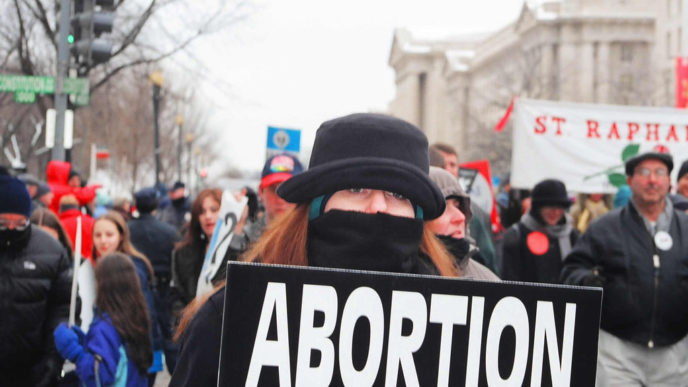
President Donald Trump on “Day One” of his presidency signed an executive order restoring the so-called “Mexico City Policy,” which requires all foreign non-governmental organizations that receive federal funding to refrain from performing or promoting abortion services.

Ronald Reagan first established the broader policy 33 years ago, which built on a 50-year-old law banning USAID from providing funds to any nongovernmental organization providing a number of services — including abortion.

Called the “global gag rule” by critics, the policy has been lifted or reinstated by presidents since Reagan, depending on whether the president was a Republican or a Democrat. Bill Clinton lifted the policy in 1993, George W. Bush reinstated in 2001 and Barack Obama pulled it during his first term as president.

Under the policy, International Planned Parenthood Federation (IPPF) will lose federal funding. Alison Marshall, the director of advocacy for IPPF, estimates that the abortion organization will lose approximately $100 million over a period of two to three years.

Sen. Jeanne Shaheen (D-N.H.), the only woman remaining on the Senate Foreign Relations Committee, said she has a legislative plan in place now that President Trump moved forward with restoring the policy. Shaheen is also worried that President Trump will gut gender equality programs, among other “liberal social policies.” Calling the move to reinstate the Mexico City policy “short-sighted,” Shaheen said that “Abolishing those programs is antithetical here in our democracy.”

Sen. Lindsey Graham (R-S.C.) said that it was “time to take a hard look at women’s aid programs,” reported Foreign Policy. “The State Department is trying to basically get countries who receive foreign assistance to sign up for a liberal agenda,” said Graham. He added that under the Obama administration, “It’s been out of control.”

In addition to his action on the Mexico City Policy, President Trump signed executive orders withdrawing the U.S. from the Trans Pacific Partnership (TPP) and freezing federal workforce hiring. President Trump exempted the military from the hiring freeze. (For more from the author of “Trump Signs ‘Mexico City Policy’ Banning Foreign Aid-Supported Abortions” please click HERE)

Follow Joe Miller on Twitter HERE and Facebook HERE.

GOP Squishes Dig Their Heels in against President Trump’s Budget Cuts

President Trump’s team is seeking “dramatic” cuts to government spending. If you voted for the president and for Republicans in Congress with the belief that they would support an agenda to reduce the size of government, you are likely thrilled with this news.

The plan being considered by the newly inaugurated president would reduce federal spending by an estimated $10.5 trillion over the next 10 years.

But it could run into a wall of opposition in the GOP-controlled Congress.

Several Republican senators are voicing opposition to provisions in Trump’s plan that would cut their favorite pet-spending projects.

For example, Sen. Orrin Hatch, R-Utah (F, 33%) told The Hill that eliminating the Legal Services Corporation – a move that would save $400 million – would not get through the Senate.

“I think that would be hard thing to do. Even if you wanted to do that, you couldn’t get it through the Senate,” he said.

President Trump’s plan closely resembles proposals from the Heritage Foundation and from the Republican Study Committee. According to The Hill, Senator Lisa Murkowski, R-Alaska (F, 20%) will “pull out all the stops” to oppose any cut to the essential air service program, a subsidy for rural airports in areas with low populations that the Heritage Foundation and RSC propose to end.

Senator Lamar Alexander, R-Tenn. (F, 15%) unapologetically dismissed cuts to discretionary spending as a means of tackling the debt. “Any effort to balance the budget by cutting discretionary spending is not a straightforward approach,” he said. “The part of the budget that is creating the debt is the entitlement part of the budget.”

While it is true that entitlement programs are the largest drivers of the near-$20 trillion debt, President Trump has previously indicated that he has no interest in touching entitlement spending.

“I’m not going to cut Social Security like every other Republican and I’m not going to cut Medicare or Medicaid,” Trump told The Daily Signal in 2015. “Every other Republican is going to cut, and even if they wouldn’t, they don’t know what to do because they don’t know where the money is. I do.”

Meanwhile, Sen. Roger Wicker, R-Miss. (F, 28%) has pledged to fight the elimination of a catfish inspection program the Heritage Foundation argues is redundant and ripe with government waste. The Mississippi Republican, whose home state is the nation’s leading producer of catfish, said ending the program “would be a problem and wouldn’t save any money.”

The long story short is that given the president of the United States opposes reigning in entitlement programs, any cuts to come from this administration must come from discretionary spending. And while Republicans can talk a great game on government spending on the campaign trail, once they’re in office, no one wants to end their personal favorite pork projects.

If President Trump is serious about cutting government spending, he’s going to have to fight for every penny. (For more from the author of “GOP Squishes Dig Their Heels in against President Trump’s Budget Cuts” please click HERE)

Follow Joe Miller on Twitter HERE and Facebook HERE.

‘America First’ Donald Trump Acts to Save Nonwhite, Foreign Babies

It might seem counterintuitive: One of President Donald Trump’s first actions in office, on the Monday morning after he was inaugurated, was to act in defense of foreigners — most of them yellow, black, or brown. As LifeSiteNews reports, President Trump

signed an executive order today reinstating the “Mexico City Policy” banning government funding of foreign pro-abortion groups like the International Planned Parenthood Federation.

A cultural political football, the policy was first enacted by President Ronald Reagan in 1984 and was maintained by President George H.W. Bush until it was rescinded first by Democratic President Bill Clinton in 1993. Eight years later, President George W. Bush reinstated Mexico City and it was in effect until Barack Obama reversed it upon entering office in 2009.

The Mexico City Policy bans funding to organizations that perform abortions overseas or lobby for legalizing them in foreign nations.

“But wait,” some liberal might say, as he peels off his vaginal protest hat. “I thought that Trump was for America First. If he thinks that fetuses are human, wouldn’t he first act to protect some American ones?”

The Civil Rights Movement for Unborn Americans

The obvious answer is that Trump doesn’t have the executive power to protect unborn children in the United States. That will take a complex series of courageous political actions, from choosing the right judges to appoint to the U.S. Supreme Court to doing whatever it takes — including trashing the Senate filibuster — to get each of them confirmed. We will need to throw all our political support behind each of those necessary actions.

After that, we will have to battle in each of the 50 states to pass the most protective laws that we can. A federal law protecting unborn children seems unlikely to pass, and would be difficult to enforce in places where the Culture of Death is deeply embedded. (Just check the map of counties that voted for Hillary Clinton.)

As the Civil Rights movement worked incrementally, pro-lifers want to pass the most protective enforceable laws that are politically possible at any given moment, while constantly pushing the envelope to protect even more Americans. The example of Prohibition reminds us of the drawbacks of imposing on a large and diverse country the norms of a narrow majority. It doesn’t last.

First, Kill No Foreigners

But there’s something deeper going on here. Yes, it’s true that this America-First president who has been smeared as a white racialist wants to protect non-white foreign children from U.S.-taxpayer subsidized violence. If that’s really surprising to anyone, it’s because that person has guzzled fake news and hysterical slander for so long that he thinks it’s a pumpkin latte.

A proper nationalism — for which the best word is patriotism — begins by accepting limits.

There are limits to U.S. borders: We don’t want to conquer the world.

There are limits to the vigor of Anglo-American culture: We cannot assimilate limitless numbers of immigrants all at once.

There are limits to our influence: We can’t remake the political cultures and defang the hostile religions of every nation across the earth.

The foreign policy that comes with healthy patriotism is traditionally called “Realism.” It accepts the fact that in a fallen world with tragic limits, we Americans are also fallen and limited. We must tend the flame of Liberty here at home, and cheer on others who wish to light it on their shores. But we won’t descend with fire and sword to set the world ablaze, as a past Republican president once recklessly promised the planet. As surviving Iraqi Christians would tell us, we might well do more harm than good.

Realism starts with the Hippocratic principle: First, do no harm. So it is only right and just that a Trump administration begin by cutting off U.S.-funded aggression against unborn children around the world.

Who Wants to Abort More Africans and Bolivians?

There are a few groups that are deeply unhappy with Trump’s decision:

White racists (like those at Radix magazine) who want to see non-white kids aborted, both here and in America.

Population cranks (like Paul Ehrlich) who want to see as many kids of any color aborted everywhere as soon as possible.

Radical feminists who believe that unborn children are the moral equivalent of fibroid tumors, who want the U.S. government to impose that superstition on foreign countries (from Ireland to the Philippines) where the majority disagrees.

Leftists at the Sierra Club, who are worried about population growth in the U.S. They think it’s immoral to stop foreigners from crossing U.S. borders, but moral to stop them from having children back at home.

Elitists in every country who crave control over the child-rearing choices of the poor, who for decades have threatened the weakest people on earth with cutting off food and medical aid, if they didn’t stop having children. From forced sterilization in India to forced abortion in China, the track record of global “population” activists makes the worst of European colonialism seem positively benevolent.

Dark warnings from elitists at the Rockefeller Foundation and similar groups that population growth (here and abroad) threatened America largely lay behind Roe v. Wade, as Justice Blackmun’s citations in that decision freely admitted. As current abortion enthusiast Justice Ginsburg told the New York Times: “[A]t the time Roe was decided, there was concern about population growth and particularly growth in populations that we don’t want to have too many of.”

Are We Images of God or Pets at a Kill Shelter?

And there’s the rub. Supporters of national sovereignty and a market economy see poor people (both here and abroad) as our equals under God, who stand in need of enforceable property rights, economic freedom, and sane political order. Given those crucial but fragile human goods, they can equal us or outpace us, as many recently destitute Asian nations are doing.

Scornful leftists like Hillary Clinton who find millions of Americans “irredeemable” and “deplorable” see poor people differently. The Clintons, Blackmuns, and Ginsburgs of this world look at less fortunate countries like vast shelters full of adorable, starving pets. We’ll adopt as many as we can (via immigration), then neuter or euthanize the rest.

And that’s the bottomless chasm of world view that now divides America. (For more from the author of “‘America First’ Donald Trump Acts to Save Nonwhite, Foreign Babies” please click HERE)

Follow Joe Miller on Twitter HERE and Facebook HERE.
Newt Gingrich Condemns ‘Propaganda Media’ for Biased Coverage of Trump

Just days into his presidency, Donald Trump is already experiencing an unprecedented level of one-sided media coverage, former House Speaker Newt Gingrich said. And don’t expect it to get any better, he warned.

Speaking Monday at The Heritage Foundation—the fourth of a six-part series on understanding Trump and Trumpism—Gingrich addressed the media’s negative coverage of Trump’s inaugural address.

According to Gingrich, the left’s dishonesty and hostility is something Trump should expect to deal with “every day for eight years.”

“It will never go away, it will never end, and it’s not an accident, it’s not confusion, it’s not misinformation,” he said. “These people are their mortal enemies.”

Gingrich cited a clear and purposeful misrepresentation of the president when Time journalist Zeke Miller mistakenly tweeted that a bust of Martin Luther King Jr. had been removed from the Oval Office on Saturday.

“It is so enraging to have the propaganda media put out something like the Martin Luther King Jr. story because it’s designed to sustain a specific attack, designed to create a brand that says you cannot be for Trump if you’re nonwhite because he is a racist,” Gingrich said.

While Trump’s inaugural address was categorized by several in the media as dark and militant, Gingrich suggested it was the most vivid statement of anti-discrimination of any other president in American history.

“These are pretty strong statements against discrimination, which had it been uttered by a liberal Republican or a liberal Democrat, it would have led to rhapsodic response from people like Chris Matthews, flowing with joy at the commitment to a colorblind America,” Gingrich added.

“Instead of covering this extraordinary commitment to anti-discrimination on the part of President Trump in his new inaugural,” Gingrich said, “you have a brief flurry over whether or not he has kicked out Martin Luther King Jr.”

Outraged by the media’s coverage of Trump’s first days in the White House, Gingrich addressed what the world looks like from middle America, not the coastal elites.

“Trump, at one point, talked about America and the pain we’re living through and people thought he’s using much too strong of language,” he said. “We had 4,000 people shot in Chicago last year. What words would our left-wing friends like to use to describe a city in which 4,000 Americans are shot in one year?”

“Trump, to his credit, is threatening both the left and the establishment simultaneously,” Gingrich said. “That is so different than anything we’ve seen in our lifetime.”

Trump’s success is a result of “the hostility of the left-wing fascists” funded by George Soros and the “propaganda media” to create a country that is unacceptable to the majority of Americans, Gingrich argued.

“Soros would like to impose Soros’ vision of a hard-left world,” Gingrich said. “The fact that the day after the inaugural, you go and look at their speeches, you go and look at what they said, there’s no middle ground here. Either Trump surrenders or Trump wins. There’s not going to be any zone of compromise.”

Gingrich will continue part five of his six-part series on Trumpism at Heritage on Wednesday. The speech will take place at 11 a.m. EST. (For more from the author of “Newt Gingrich Condemns ‘Propaganda Media’ for Biased Coverage of Trump” please click HERE)

Follow Joe Miller on Twitter HERE and Facebook HERE.
A Look at 4 of the GOP’s Obamacare Replacement Plans

As Republicans debate their strategy for repealing and replacing Obamacare, GOP lawmakers have been accused of failing to put forth a replacement plan for the health care law.

But since President Barack Obama signed the Affordable Care Act into law in 2010, Republicans in both the House and Senate have unveiled a number of proposals mapping out how the health care law would be replaced, should it be dismantled.

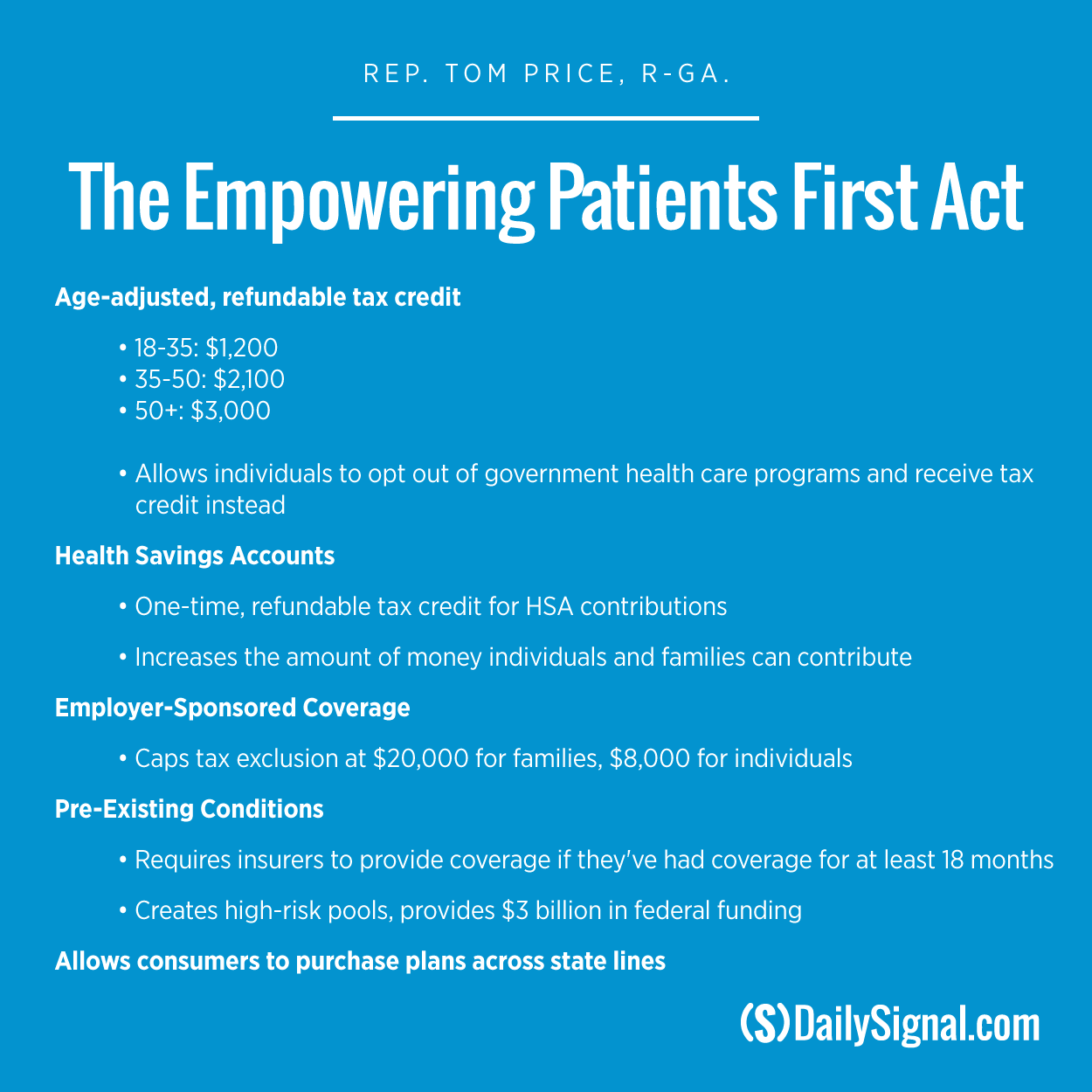
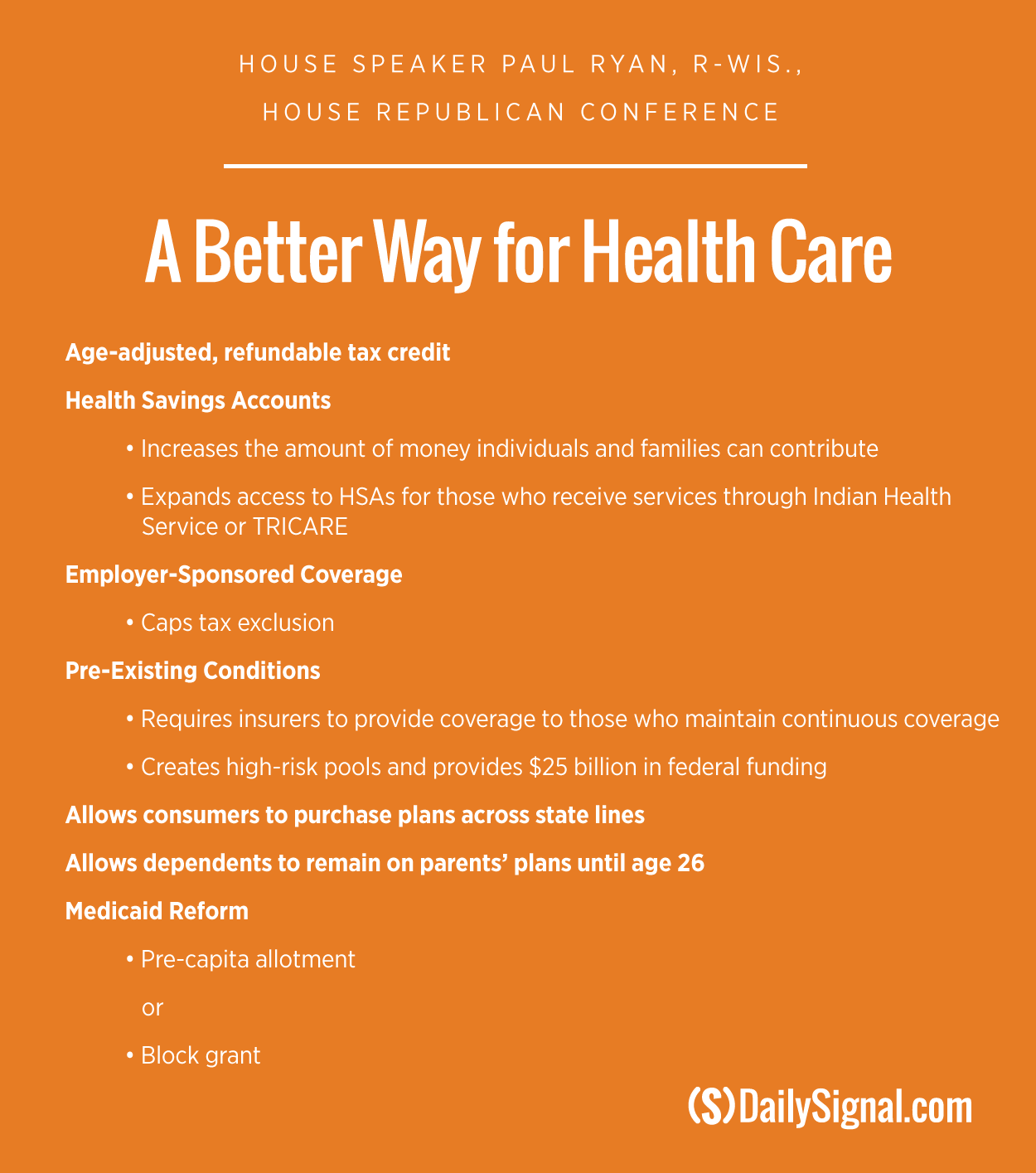
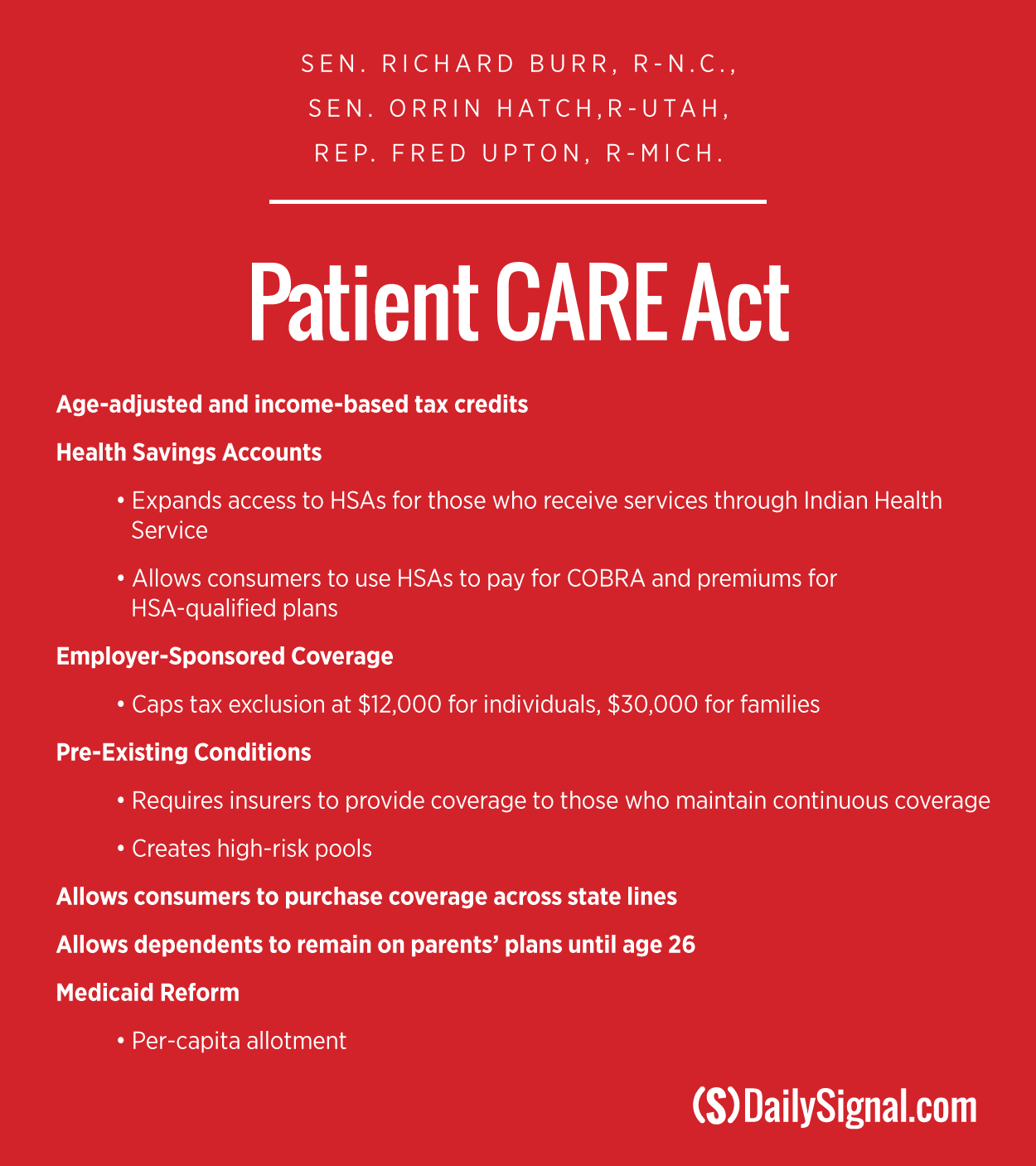
Most of the major plans share some key provisions: they offer tax credits to consumers; expand the use of health savings accounts, or medical savings accounts; and reform Medicaid.

But differences emerge in the nitty gritty details of each proposal, including whether tax credits are based on age or income, where to cap the tax exclusion on employer-sponsored coverage, and whether to turn Medicaid into a block grant program or per capita allotment.

House and Senate Republicans, along with President Donald Trump, are meeting in Philadelphia, Pennsylvania, on Thursday and Friday for their annual retreat, where House Speaker Paul Ryan, R-Wis., said earlier this month lawmakers will have a “full, exhausting” conversation on their plan for repealing and replacing Obamacare.

Already, there are at least four plans crafted to replace the law. On Monday, Republican Sens. Bill Cassidy of Louisiana and Susan Collins of Maine introduced another proposal ahead of this week’s GOP gathering.

While the other major Republican proposals repeal all of Obamacare, the Cassidy-Collins plan repeals only the health care law’s mandates, like the individual and employer mandates; maintains its subsidies and taxes; and allows states that like Obamacare to keep Obamacare.

In addition to the Cassidy-Collins plan, The Daily Signal examined proposals offered by Ryan and the Republican conference; Rep. Tom Price, R-Ga., who Trump nominated for secretary of health and human services; the Republican Study Committee; and Sen. Richard Burr of North Carolina, Sen. Orrin Hatch of Utah, and Rep. Fred Upton of Michigan.

See how these Obamacare replacement plans stack up.

170118_obamacare-replace_Price-plan_V3

170118_obamacare-replace_Ryan-plan_V4

170118_obamacare-replace_RSC-plan_V2

170118_obamacare-replace_Burr-plan_V3

(For more from the author of “A Look at 4 of the GOP’s Obamacare Replacement Plans” please click HERE)

Follow Joe Miller on Twitter HERE and Facebook HERE.
4 Questions Trump MUST Ask His Potential SCOTUS Nominees

Since the election, the country has been waiting with bated breath at who President-elect Donald Trump will nominate to fill Justice Antonin Scalia’s vacant Supreme Court seat.

Recent Marist polling found that 80 percent of Americans believe that appointing originalists to the highest bench in the land was either an “immediate” or “important” priority. Now, short lists are circulating and the Trump transition team is reportedly holding meetings with potential nominees.

While during the election it seemed that the only requirements to fill the seat was a two-box checklist (“Pro-life” and politically conservative), when an entire branch of government has gotten so far away from its original purpose, it requires a bit more than that.

Here’s what Trump’s team (and eventually the Senate) ought to be asking candidates:

1. What are rights, and what does the Constitution have to do with them?

One of the most visible consequences of the judicial oligarchy is a never-ending regime of ever-changing rights. Rather than being fundamental, transcendent, and bound up with our human dignity, “rights” are now construed to mean whatever the state wants them to mean.

Of course, one of the most egregious historic examples of this is Justice Anthony Kennedy’s infamous line that everyone has the “right to define the universe” as they see fit in Planned Parenthood v. Casey in 1992. But this sort of thinking has promulgated across the spectrum, from immigration to voting laws.

A solid justice would be quick to respond that rights cannot be created by Congress or willed into existence by an activist judge, but preexist any form of government and are best protected by the federal system envisioned in the Constitution.

2. What does the 14th Amendment really do?

The 14th Amendment was originally written with the intent of undoing the legal atrocities of chattel slavery. Since then, its provisions have been used as a blanket justification to codify a never-ending list of positive rights into the body of constitutional case law. This modern understanding of the amendment has not only been used to create “rights” to abortion and same-sex marriage, but has also been used by leftist judges to arbitrarily manufacture “rights” to early voting, transgender bathrooms, and a host of other issues.

This has, in turn, created a legal regime where the imaginary rights begin to devour the fundamental negative ones that are actually referenced in the Constitution – as has been the case of conscience rights under the Obama administration.

So where does it stop? Does the 14th Amendment give the judiciary license to create a never-ending catalogue of imaginary rights? Or is its scope far more limited?

3. Does the Supreme Court create “settled law”? Is it the final arbiter?

What the founders envisioned as the weakest branch of government has now become a place where political discourse goes to die. Antonin Scalia pointed out as much in the Obergefell decision months before his death. Is Obergefell v. Hodges truly “settled law”?

Is any watershed ruling? Or was the concept of judicial supremacy something contrived in the 20th century and since been used to pull issues out of public debate and put them squarely at the control of the legal profession?

A solid Supreme Court candidate would articulate that the founders never granted the court with anything close to the current power that it enjoys, and never intended for it to have the power to “settle” issues of public debate.

Candidates might also add that the founders explicitly rejected a judiciary council of review to do this. And as Daniel Horowitz has pointed out at CR, even the oft-cited Marbury v. Madison decision never granted the Supreme Court the final say on political questions. The court, along with Congress, the president, and the states each had their own responsibilities of interpretation.

4. What is the Supreme Court’s role?

This is an area ripe for review. If the court isn’t meant to act as a super legislature – as it has been doing for the past few decades – then what is it meant to do? The best answer for this would be to rule on issues of statute – along with its areas of original jurisdiction – while sharing the role of constitutional interpretation along with the other branches and the states.

However, the pithiest answer might be, “Whatever the Constitution and the Congress allow it to rule on, and nothing more.”

As pundits, politicians, and journalists over the next few weeks take to deriding and extolling various portions of judicial records for Trump’s short list, these questions will fall by the wayside in favor of media postmortems on how they’ll affect political questions from the bench.

As we have explained repeatedly here at Conservative Review, the problems facing our court system can’t be fixed by simply putting political conservatives (read: “good” judges) on the bench and hoping the problem rules itself away. Decades of Republican appointees have proven this. The kind of constitutional bona fides necessary to fill Scalia’s seat are going to have to be proven by the answers to the above questions.

These questions don’t nearly encompass the breadth of what should be asked of a worthy potential jurist the American people want to see Justice Scalia succeeded by someone who understands our constituting document as written, they ought to be first on the list. (For more from the author of “4 Questions Trump MUST Ask His Potential SCOTUS Nominees” please click HERE)

Follow Joe Miller on Twitter HERE and Facebook HERE.
Inside the Radical Islamic Law Firm Representing the Orlando Terrorist’s Widow

Noor Salman will utilize a fringe Islamic law firm in her attempt to prove innocence against charges she assisted her deceased husband, Omar Mateen, in conducting the deadliest terrorist attack on U.S. soil since 9/11.

In June, Mateen — who pledged allegiance to the Islamic State terror group — killed 49 innocents at the Pulse nightclub, wounding an additional 53.

Salman faces charges of aiding and abetting and providing material support to ISIS. She has also been accused of obstructing the investigation and deliberately misleading local and federal law enforcement officials. She claims to be innocent of any wrongdoing, but there is a stack of evidence showing Salman was fully aware of her husband’s plans and radicalization.

She will be represented by the Texas-based Constitutional Law Center for Muslims in America, which is part of the Muslim Legal Fund of America (MLFA).

The MLFA has been involved in several high-profile Islamic terror cases. They represented clients in the Holy Land Foundation Trial, which was the largest terror-financing trial in U.S. history. Five officers of the Holy Land Foundation were charged with providing material support to the Palestinian terrorist group Hamas.

MLFA has also represented Sami Al-Arian, a fundraiser for the Palestinian Islamic Jihad terror group, who was deported to Turkey in 2015.

In 2003, the legal fund held a fundraiser for five brothers accused of setting up a financial front for Hamas.

Along with their controversial work defending terrorists, the MLFA board of directors is stacked with individuals who are closely connected with the international Muslim Brotherhood.

One board member, Mouffa Nahhas, is the past president of the Council on American Islamic Relations (CAIR) — Dallas Fort-Worth chapter. CAIR was an unindicted co-conspirator in the Holy Land Foundation trial. The FBI has showcased in federal court how CAIR was created to support Hamas.

Another board member, Hatem Bazian, is a lecturer at the University of California, Berkeley, and the president of American Muslims for Palestine. Bazian has called for an intifada (armed Islamic uprising) in America. He also co-founded the Students for Justice in Palestine, an anti-Israel hate group that has ties to the Muslim Brotherhood.

Prosecutors insist Noor Salman was intimately involved in the planning stages of her husband’s jihadi massacre. Her counsel claims Salman was actually a victim in the entire situation, suffering abuse at the hands of Mateen. Nonetheless, her reported choice of the MLFA-affiliated Constitutional Law Center for Muslims in America as her counsel is sure to raise some eyebrows. (For more from the author of “Inside the Radical Islamic Law Firm Representing the Orlando Terrorist’s Widow” please click HERE)

Follow Joe Miller on Twitter HERE and Facebook HERE.

Trump Should End Government Funding of NPR’s Biased News

Is National Public Radio’s description of an Obama urban directive as something that merely “links [government] funding to desegregation” fake news?

Well, it’s so slanted that if you had no prior knowledge of the program, and heard NPR’s depiction of it, you would just say to yourself, “Sounds good to me.”

But to many conservatives, including the man that President Donald Trump has nominated to be the new secretary of housing and urban development, Ben Carson, the Orwellian “Affirmatively Furthering Fair Housing” is a tortured interpretation of the Fair Housing Act.

To them, coercing suburbs to build high-density, low-income housing in order to reflect the national racial makeup—even when there isn’t a hint of discrimination—is an outrageous attempt to pursue the liberal dream of closing down the suburbs by changing their nature.

To Stanley Kurtz, writing in National Review, “the regulation amounts to back-door annexation, a way of turning America’s suburbs into tributaries of nearby cities.”

Carson, writing in The Washington Times, said the Affirmatively Furthering Fair Housing directive reminded him of the “failed socialist experiments of the 1980s.” That view was not reflected in NPR reporter Pam Fessler’s unflattering piece on Carson following his nomination. The piece referred positively to the housing program as “stepped up enforcement of the 1968 Fair Housing Act, which is intended to reduce segregation.”

Like other examples of NPR’s treatment of Cabinet appointments and other domestic and international news, Fessler’s report echoed almost exclusively the worldview of the left.

This is a characteristic that is shared to some degree by the Public Broadcasting System, NPR’s television equivalent.

And this attribute will become a problem for the taxpayer-funded Corporation for Public Broadcasting, which oversees both NPR and PBS, as the incoming Trump administration looks to make cuts in the budget—as it should.

To be sure, NPR and PBS will have the odd National Review editorial writer or conservative scholar on as a guest commentator once in a while. But that is not the issue.

The issue is that a conservative philosophy and outlook doesn’t inform the way the news is written and presented the way, say, Mother Jones seems to do.

We saw what happens when a journalist “gets” both sides. Fox News’ Chris Wallace received bipartisan praise for the way he moderated the last presidential debate in October.

As The Wall Street Journal put it at the time, there was a reason he was more effective than his preceding moderators:

He asked questions that would never have even occurred to the other moderators. Mr. Wallace’s personal politics are a mystery to us, but his position as an anchor at Fox News … means he is exposed to political points of view that are alien at most other media outlets.

NPR has done nothing to counter its persistent liberal bias, despite years of complaints from conservatives—including us—that its patent lack of diversity of thought was unfair and misguided for a tax-funded entity.

Several changes at the top during the past few years have had no apparent impact.

The partially taxpayer-funded public broadcaster appeared to be trying to turn a new leaf in 2011 when it brought in Gary Knell as CEO “to calm the waters,” following the ouster of Vivian Schiller. Charges of liberal bias under Schiller had revived conservative calls to defund NPR.

Knell lasted only 20 months, however, and several changes later, NPR in 2014 doubled down on its worldview. It named as its CEO Jarl Mohn, a former senior official with the American Civil Liberties Union who has given at least $217,000 mostly to “Democratic candidates and political committees” by NPR’s own admission.

NPR’s only response to conservative complaints about its liberal viewpoint is to deny that this is the case. It’s the “Who you gonna believe, us or your lying ears?” defense.

So, no wonder the reporting on the nominees was off. Carson wasn’t the exception. Here are several others:

The piece on Oklahoma Attorney General Scott Pruitt’s nomination as head of the Environmental Protection Agency, for example, lacked any kind of perspective on the harm that the agency’s aggressive regulatory zeal has caused to companies large and small. Also missing was how the EPA shakes down companies and forces them either to make contributions to environmental groups or face huge fines.

Such details may have put into context the scathing, melodramatic attack on Pruitt by the Sierra Club, one of the groups that may now lose both influence and funds, which reporter Nell Greenfieldboyce included in her piece. The “conservative balance” lacked any of these details, but actually offered another negative: George Will’s observation that Pruitt had been “one of the Obama administration’s most tenacious tormentors.”

Jessica Taylor’s report on the choice of fast-food restaurant CEO Andrew Puzder as secretary of labor made note of his opposition to raising the minimum wage. The piece was remarkably neutral in that it did not reflect any assumption as to whether this policy is good or bad for employees making minimum wage.

Not so for the analysis that Jeremy Hobson (host of NPR’s “Hear and Now”) conducted with Business Insider’s Kate Taylor. There, the worries of “labor groups” about Puzder’s “commitments to labor rights” were prominent.

“Anybody pushing for passage of laws that protect labor rights are going to have a bit of an uphill struggle,” Taylor concluded. There was no conservative counterweight.

Nor is NPR’s liberal slant limited to only Trump’s Cabinet appointments.

Scott Simon’s commentary on Cuban dictator Fidel Castro upon his death was actually titled, “Easy to See Why Some Loved Fidel Castro’s Cuba, Many More Fled.”

Right up front there was a trope about how “American mobsters used to run this place.” But actually, Cuba was a thriving economy when Castro took over in 1958, one that compared favorably with Mediterranean Europe or Southern U.S. states. But you didn’t hear that from Simon.

It shouldn’t surprise that the views held by the left form the background of many stories, as NPR either directly quotes liberal outlets as reference points or uses language that is undistinguishable.

On the very controversial public debate over whether men should be able to use women’s bathrooms if they identify as women, NPR’s Ethics Handbook uses as a reference point the National Lesbian & Gay Journalists Association’s guidelines in recommending that the debate be cast as “whether transgender people should be allowed to use public bathrooms ‘based on their gender identities or, instead, what’s stated on their birth certificates.’”

Many Americans—and not just conservatives—however, take issue with the notion that “a man can be trapped in a woman’s body” or vice-versa. Sex to them is a matter of objective biology, not a subjective social construct.

As the Washington Examiner put it before the end of the year, “Not everyone heeds the command to pretend that Caitlyn Jenner is a woman.”

These are views held by millions of taxpayers. By choosing only one side, NPR’s reporting can be as skewed as anything found on MSNBC—or conservative talk radio for that matter.

But because it is delivered in mellifluous and serene tones, a pitch which NPR staffers refer to with self-congratulation as “Minnesota Nice,” and because it has the stamp of the government’s endorsement, the reporting is considered objective and reflective.

The consumer, therefore, is likely not adding an extra layer of caution—the caveat emptor factor that one adds with Rachel Maddow or Sean Hannity.

To the question asked at the start of this piece: No, NPR’s description of “Affirmatively Furthering Fair Housing” wasn’t fake news. But it wasn’t the whole news, either.

And listeners have a right to know they must use a prism, just as taxpayers have a right not to fund a one-sided news outlet.

The 2017 federal appropriations for the Center for Public Broadcasting were $445 million. PBS gets about $300 million of that.

Defenders say that in the age of a $19 trillion debt, this is a “rounding error.” Well, if it’s so small, then maybe cutting won’t hurt as much, and the money can be used elsewhere, or returned to taxpayers.

NPR will survive without government funding. It has a good membership model. It also offers a good product, as does PBS.

But the new conservative administration and congressional majority coming in have a responsibility to the conservative base not to continue to fund a “public broadcaster” that leaves half the nation feeling ignored.

If it doesn’t, the new governing majority had better get used to seeing its policies traduced on a regular basis by NPR, the way the new Cabinet’s positions clearly have been. (For more from the author of “Trump Should End Government Funding of NPR’s Biased News” please click HERE)

Follow Joe Miller on Twitter HERE and Facebook HERE.
Relief Is on the Way: What Trump’s Obamacare Executive Order Will Do

A newly inaugurated President Donald Trump rang the opening bell for what will be a multistep process to repeal and replace the Affordable Care Act, or Obamacare, as he signed an executive order on Friday directing his subordinates to:

exercise all authority and discretion available to them to waive, defer, grant exemptions from, or delay the implementation of any provision or requirement of the Act that would impose a fiscal burden on any State or a cost, fee, tax, penalty, or regulatory burden on individuals, families, healthcare providers, health insurers, patients, recipients of healthcare services, purchasers of health insurance, or makers of medical devices, products, or medications.

While it is true that Congress will need to enact legislation to address Obamacare’s major components, the Trump administration can immediately begin to pare back and rework the law’s numerous and detailed regulations.

In large part, that is because the law itself granted the executive branch considerable discretionary authority to fill in the details through regulation. Those details can now be changed by a new administration, and this executive order makes doing exactly that the official policy of the Trump administration.

As to the substance, the new president’s clear directive is for his appointees to focus on minimizing the damaging effects of the law. That constitutes a sharp change in direction from the one taken by the Obama administration.

The implementation approach taken by the Obama administration was essentially to try to increase subsidized enrollment heedless of any resulting costs or disruptions to either the public or private sectors. This executive order signals that the Trump administration’s first order of business for Obamacare will instead be to minimize those costs and disruptions.

That will be particularly welcome news for those who faced loss of their coverage and doctors and escalating premiums and deductibles, but received no offsetting Obamacare subsidies.

Their lived experience of Obamacare as “all pain, no gain” was a major factor explaining not only the law’s persistent unpopularity but also why voters in sequential elections handed Republicans control of first the House, then the Senate, and finally the White House.

As for the mechanics, the new administration’s actions to implement this executive order in the coming weeks will reflect considerations of both effect and timing.

The Trump administration is likely to prioritize those changes that will have the biggest and most immediate effects—such as ones that can help stabilize the unsubsidized individual and small employer health insurance markets and head off any repeat in 2018 of the massive increases in premiums announced last fall for 2017.

What is little appreciated, even by Washington policymakers, is that while subsidized Obamacare enrollment has been slowing, the damage the law is doing to unsubsidized markets has been accelerating.

For instance, while insurers exiting Obamacare’s subsidized exchanges was widely reported last fall, less attention was paid to the more disturbing news that a number of insurers were also exiting the unsubsidized individual and small employer health insurance markets as a result of Obamacare.

The administrative actions called for in this executive order can help to shore up those nonexchange markets.

Furthermore, the Trump administration acting (wherever possible) to quickly roll back Obamacare’s voluminous and detailed regulations will support and encourage congressional efforts to advance repeal and replace legislation; signal a new direction for health reform to insurers, providers, employers, and other stakeholders; and offer consumers tangible evidence that relief is on the way. (For more from the author of “Relief Is on the Way: What Trump’s Obamacare Executive Order Will Do” please click HERE)

Follow Joe Miller on Twitter HERE and Facebook HERE.