Trump’s Nominees Face ‘Unprecedented’ Democrat Obstructionism

President Donald Trump starts his first full week in the White House with just two Cabinet secretaries confirmed by the U.S. Senate. That’s the lowest number in decades and a sharp contrast from former President Barack Obama.

Trump’s picks have fared worse than past Cabinet nominees. Even though Trump enjoys a Republican-led Senate, Democrats have kept their promise to delay confirmation of his nominees, even if they lack the votes to ultimately defeat them.

The Daily Signal reviewed Senate confirmation data for newly elected presidents, beginning with Jimmy Carter in 1977 through Obama in 2009. The chart above shows when the Senate confirmed each president’s Cabinet secretaries.

Those six presidents had an average of 10 Cabinet secretaries confirmed in their first week in office. President Bill Clinton had the most with 13. President George H.W. Bush had two nominees confirmed in week one, although three others remained in office from the Reagan administration.

The Senate confirmed two Trump nominees on Inauguration Day: James Mattis to be secretary of defense (98-1) and John Kelly to be secretary of homeland security (88-11). Senators were also supposed to vote Friday on a non-Cabinet nominee—Rep. Mike Pompeo, R-Kan., to be CIA director—but Democrats objected and delayed the vote until Monday.

Most of Trump’s nominees haven’t yet advanced out of Senate committees. Some of those votes will take place this week. The Senate Commerce Committee, for instance, announced it would vote on the nominations of Elaine Chao for transportation secretary and Wilbur Ross for commerce secretary on Tuesday.

While it’s possible the full Senate could act on those nominees this week, there’s nothing officially on the calendar.

Senate Majority Leader Mitch McConnell, R-Ky., didn’t hold back in his criticism of Democrats for their delaying tactics.

“I urge colleagues to remember that we worked with the administration of former President Obama after he was first inaugurated,” McConnell said in a Senate floor speech Friday. “We confirmed seven members of his Cabinet the day he took office, and nearly the entire Cabinet was filled within two weeks.”

In 2009, Obama had 10 Cabinet secretaries confirmed after his first week in office. Nine of those nominees won Senate confirmation by voice vote, where an official tally isn’t recorded. The Obama nominee who faced the greatest GOP opposition—Timothy Geithner for treasury secretary—was approved 60-34 on Jan. 26, 2009, less than a week after Obama took office.

Like Trump, Obama enjoyed a Senate controlled by his own party. Democrats had 57 senators on Jan. 20, 2009, when Obama took office. Today, Republicans have 52 senators.

None of Trump’s nominees currently face the likelihood of defeat, yet that hasn’t stopped Senate Minority Leader Chuck Schumer, D-N.Y., from delaying the confirmation process.

Schumer said Sunday on NBC’s “Meet the Press” that he would continue to play the role of obstructionist.

“There are so many of these nominees that have different views than what the president-elect, now the president, campaigned on that of course there should be scrutiny,” Schumer said. “Now will we win some of these fights? Possibly. That’s why we have a debate.”

Friday’s debate over Pompeo illustrated the divisiveness in the Senate.

A new president’s national security team is usually the first to be confirmed. In the case of the CIA, both Director John Brennan and Deputy Director David Cohen resigned Friday, leaving the agency without a permanent director.

“It makes no sense to leave this post open,” McConnell said Friday. “Not for another week, not for another day, not for another hour. America’s enemies will not pause in plotting, planning, and training simply because the Democrats refuse to vote.”

Schumer countered that Trump’s nominees are “poorly prepared.” He said Democrats were slowing down the process to conduct a more thorough examination.

“If I were the Republicans, of course I’d want to ram a Cabinet like this through. I’m embarrassed by it,” Schumer said on “Meet the Press.”

Earlier this month, The Washington Post called the Democrats’ tactics “an unprecedented break with Senate tradition.”

“Republicans treated a newly inaugurated President Obama’s nominees fairly, and Democrats should do so now,” McConnell said. “Our country is counting on it.” (For more from the author of “Trump’s Nominees Face ‘Unprecedented’ Democrat Obstructionism” please click HERE)

Follow Joe Miller on Twitter HERE and Facebook HERE.
5 Remarkable Quotes from President Trump’s Inaugural Address

It is official. Donald John Trump has taken the oath of office and is now the 45th President of the United States of America.

In his Inaugural address, President Trump talked about the people who put him into office, the “forgotten” men and women of America who have been left behind by the liberal, Big-Government policies of the previous administration.

His speech was not a conservative speech. He did not talk about limited government. Rather, President Trump pledged that the powers of government will now turn and be subservient to the American people.

“At the center of this movement is a crucial conviction that a nation exists to serve its citizens,” Trump said. “Americans want great schools for their children, safe neighborhoods for their families, and good jobs for themselves. These are just and reasonable demands of righteous people and a righteous public.”

President Trump’s government will put “America first,” he promised. It will put the American people, all American people first, he said.

Here are some of the highlights from his speech:

1. America first:

“We assembled here today are issuing a new decree to be heard in every city, in every foreign capital, and in every hall of power. From this day forward, a new vision will govern our land. From this day forward, it’s going to be only America first, America first.”

2. On domestic policy:

“We will build new roads and highways and bridges and airports and tunnels and railways all across our wonderful nation. We will get our people off of welfare and back to work, rebuilding our country with American hands and American labor.”

3. On foreign policy:

“We will seek friendship and goodwill with the nations of the world, but we do so with the understanding that it is the right of all nations to put their own interests first. We do not seek to impose our way of life on anyone, but rather to let it shine as an example. We will shine for everyone to follow.”

4. On unity:

“The bible tells us how good and pleasant it is when God’s people live together in unity. We must speak our minds openly, debate our disagreements honestly, but always pursue solidarity. When America is united, America is totally unstoppable.”

5. On the common brotherhood of all Americans:

“It’s time to remember that old wisdom our soldiers will never forget, that whether we are black or brown or white, we all bleed the same red blood of patriots.”

It is well and good that President Trump believes in a government for, and by, the people of the United States of America. But to make America truly great again, the new president must heed the wisdom of America’s founding fathers. His government must respect the constitutional limits imposed upon it by our founding documents. His administration must pursue an agenda that does not ask what government can do for the people, but rather what individuals, with the inestimable blessings of liberty, can do for themselves and their neighbors.

If President Trump’s administration adheres to the United States Constitution, if it secures the natural rights of the people and protects American liberties, he will be great. (For more from the author of “5 Remarkable Quotes from President Trump’s Inaugural Address” please click HERE)

Follow Joe Miller on Twitter HERE and Facebook HERE.
So Much for Tolerance: Photos of the Violent Protests of Trump’s Inauguration

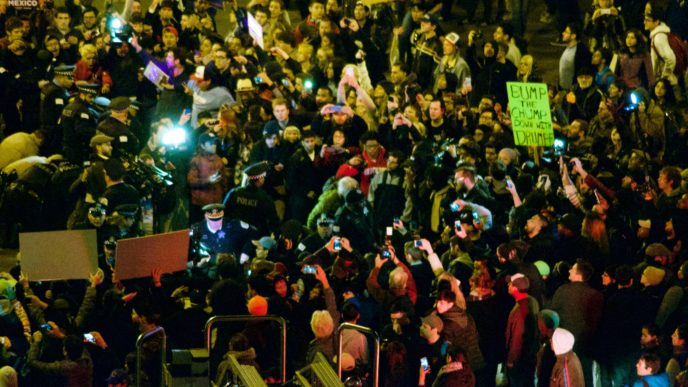
In some parts of the nation’s capital today, it looks like a war zone.

And it’s because of protesters who are presumably taking out their anger over the election—and the voters’ decision—by acting violently and destructively on the streets of Washington.

Here are some of the most compelling photos and tweets documenting the destruction:

(For more from the author of “So Much for Tolerance: Photos of the Violent Protests of Trump’s Inauguration” please click HERE)

Follow Joe Miller on Twitter HERE and Facebook HERE.

Obama’s Legacy: 5 Failures the Media Won’t Tell You About

Even though Obama’s presidency comes to an end Friday, The Great Revision has long been underway. Obama and the mainstream media have been spreading falsehoods and fantasies about his record. Last year, I co-wrote and published a comprehensive takedown of Obama’s presidency so that America wouldn’t be so easily fooled. Here are five failures that stand in stark contrast to the fictions Obama has been spreading about his legacy:

1. Job growth was actually bad

Obama fancies himself a great president for the economy, citing “record job growth” and a low unemployment rate as proof. What he won’t tell you is that while roughly 15 million jobs were created since 2010, the working-age population grew by nearly 18 million. In fact, the jobs gap got wider during the “recovery”, and most of those jobs were actually part-time. Not only has job growth not kept up with population growth, and the labor force participation rate is at a 38-year low, but wage growth has also been stagnant. Hardly a record to be proud of.

2. Obamacare didn’t cover 20 million people

Obamacare certainly didn’t provide coverage “for all Americans” and I suppose Obama deserves a tiny bit of credit for not claiming that it did. But he is claiming that 20 million gained coverage because of Obamacare — which is pure hogwash. About 14 million people actually gained coverage, with 11.8 million of them actually getting coverage through Medicaid. And more than two-thirds of those people were eligible for Medicaid before Obamacare even existed. And then there’s the skyrocketing premiums — the same premiums Obama promised to lower by $2,500 per family — and higher deductibles and out-of-pocket maximums. Despite Obamacare, the number of Americans delaying seeking health care over costs has not gone down since Obamacare was implemented. And, by the way, last year saw healthcare costs increase by the largest rate in over thirty-two years. Bravo, Obama! Bravo!

3. Obama crippled the Democratic Party

There is perhaps no better indictment of Obama’s presidency than how it crippled the Democratic Party nationwide over the course of his two terms. Between state legislatures, governorships, and the U.S. Congress, Democrats lost over 1,000 seats. Twenty-five states now have a total Republican-controlled government, compared to just five with total Democrat-controlled government. Thanks to the outgoing president, the Republican Party is the strongest it has been since the 1920s. But that’s a colossal failure I can live with. Thanks, Obama!

4. Race relations are worse … much worse

While Obama credits himself for improved race relations in the United States, recent polling says that a majority of Americans disagree. He had the chance to be a force for good in the struggle to heal the wounds of racial division, but he chose, among other things, to embrace Black Lives Matter. Thanks to bitter rhetoric and acts of violence within the BLM movement, there was a sharp increase in shooting deaths of police officers last year and a staggering 93% of police officers have become more concerned for their safety as a result. This was a huge failure of the first black president in history.

5. The most scandalous modern presidency

And then there are the oft-repeated claims by Obama (and his allies) of having a scandal-free administration. In a recent interview with 60 Minutes, Obama declared he was proud his administration was the first “in modern history that hasn’t had a major scandal in the White House.” Sure, except for Solyndra, Fast and Furious, the Benghazi attack and cover-up, the IRS scandal, the AP phone records scandal, the Sestak Job offer scandal, the GSA scandal, the NSA scandal, the Iran nuclear deal and ransom, the VA scandal, the Pigford scandal, the Bergdahl swap, various EPA scandals … just to name a few. But, who’s counting, right? Of course, the media scoffs at these scandals, giving Obama pass after pass, when any one of them would have likely sunk anyone else’s presidency. The truth, however, is that the Obama and his administration were so tainted by controversy and scandal that Richard Nixon looks like George Washington by comparison.

From every conceivable angle, from failed policies to absent leadership to outright corruption, Obama’s presidency has set a new low bar. The media, however, seems to be working overtime to ensure that the truth of Obama’s legacy is covered up, so that history will judge him a successful president. The only way to prevent this from happening is to know all the facts. That is why I wrote The Worst President in History: The Legacy of Barack Obama. We can do a lot better than settling for failure and calling it success. (For more from the author of “Obama’s Legacy: 5 Failures the Media Won’t Tell You About” please click HERE)

Follow Joe Miller on Twitter HERE and Facebook HERE.

Trump’s Inauguration Speech: Two Feet Firmly Planted on Our Fallen Earth

Donald Trump has provoked more outright panic among people with advanced degrees than any politician in recent history. It would be easy for the unwary to draw the darkest conclusions. The desperate urgency of his enemies, from panicked globalists penning incendiary columns to social justice warriors literally torching limos, suggests that his rise represents some new force of extremism, or dark, regressive forces that threaten our very Republic.

Surely (onlookers could reason) Trump holds to some radical, dangerous creed, or else why are all these smart people engaged in such a nationwide public meltdown? If you’re sitting in a crowded theater, and not just one person but dozens are shouting, “Fire!”, you are likely to head for the exit.

But sometimes where there’s smoke, there really isn’t any fire, but instead a smoke machine planted in Lady Liberty’s skirt. Today we saw the peaceful transfer of power in our Republic, and the American experiment in ordered liberty is as safe as it ever was. In fact, in key ways it is safer.

Donald Trump: Inclusive Patriot

To those listening honestly with even a modicum of charity, Trump’s speech should have helped to disarm most of the genuine causes for worry that his critics have raised over many months. Trump firmly rebuked the small, vociferous cult of online Caucasoid tribalists whom some have tried to smear him as championing. Trump used these ringing words, which clearly came from the heart:

A new national pride will stir our souls, lift our sights and heal our divisions.

It is time to remember that old wisdom our soldiers will never forget: That whether we are black or brown or white, we all bleed the same red blood of patriots, we all enjoy the same glorious freedoms, and we all salute the same great American Flag.

President Trump made it starkly clear that his vision of national solidarity, of “loyalty to each other” has everything to do with citizenship, and nothing to do with race. His is the healthy, Jacksonian nationalism of a Truman or a Reagan — and not the narrow, crabbed and envy-ridden sentiment of racial separatists or supremacists of any color.

A Foreign Policy for a Fallen World

Trump’s foreign policy principles are clearly drawn from that same Jacksonian heritage, which does not use lofty promises of global transformation that are sometimes hard to distinguish from Jacobin or Leninist rhetoric. Instead, Trump speaks plainly of defending our national interest in a fallen and perilous world. How often over the past 16 years have our decisions on crucial questions, from Iraq to the “Arab Spring,” been distorted and rendered delusional by universalist abstractions, which ignore the stubborn facts on the ground in Fallujah or Benghazi.

Too many “forgotten Americans” from coal mining country or struggling farms have bled out and died on alien sand, as our nation’s debts piled still higher, in pursuit of fantastical projects that seemed uplifting to some speechwriting civilian over on M Street.

Making Citizenship Great Again

Those who are tempted to panic over Trump’s pledges to enforce our duly enacted immigration laws should know that his promises, just like those laws, grow out of a deep respect for citizenship as a concept with texture and meaning, carrying both rights and duties — not some blank PDF which anyone on earth may download and print out at Kinkos.

While we recognize the equal humanity, under God, of foreign nationals, for Trump it is unpatriotic to treat them as indistinguishable from our fellow Americans — whose ancestors worked, fought, may even have slaved for the weal of this nation in particular, not for humanity as a category.

In fact, Trump’s vision of citizenship goes a good deal further than many libertarians and classical liberals think fitting: He sees the United States as one vast extended family, to the point that we should be willing to sacrifice economic efficiency for the sake of looking out for the least among us. Sound economists have warned us of the Rube Goldberg absurdities that come along with protectionism, and it’s not at all clear that less fortunate Americans would benefit from a trade war that we provoked.

Helping the Forgotten American

So when it comes time to implement Trump’s agenda in nitty-gritty policies, we must insist that measures meant to help Americans whose livelihoods are challenged by foreign competition be as small-scale and short-term as possible. Just as Trump rightly sees that the U.S. government cannot create democracy where the seeds for it always shrivel, he must realize that the same government cannot save entire industries whose economic foundations in reality are crumbling.

Americans have traditionally been a flexible, adaptable, “can-do” people, who picked up and moved from New England to flee its stony soil for the vast fields of the West, and left unprofitable farms to staff the vast factories of Chicago and Detroit. What Trump sees, as most other Republicans didn’t, is that the transitions which economic reality has imposed on many less-connected Americans have been bumpy, painful, and sometimes destructive.

Wall Street gamblers were able to threaten an economic meltdown in 2008, to gain a golden parachute from the government. The election of Donald Trump is a fitting rebuke to elites in both parties who allowed that injustice to happen.

Trump tapped into the populist current that now runs through most Western countries, a wholesome rebellion against the cozy backroom deals and policy tweaks customized to serve the self-styled “cognitive elite,” the people who sail from elite colleges to corner offices, who use the rhetoric of “justice” and “inclusion” to rise to unaccountable power in U.S. federal agencies and European Union commissions. He spoke in brash and divisive terms of an open split between the interests of these elites and the people they claim to represent. It was bracing to hear him state matters so bluntly.

Restoring the Balance in American Politics

No, Donald Trump will not create a Peronist regime, which wrecks the U.S. economy in pursuit of some ill-conceived “social justice.” He will not embark us on wars of naked aggression and foreign conquest. He will not seed our cities with racial hatred, nor blacklist Hollywood actors.

What he will do is repair the grave imbalances in our politics that has emerged in recent decades. For too long we have allowed those who can master phrases and administer people to thrive, while those who work with their hands are shunted aside — and often replaced by compliant foreigners. Too many policy debates are dominated by a battle of empty abstractions, as taxes rise, budgets burst and real-world communities wither.

In an age when European governments react to the crime waves inflicted by a massive influx of Muslims with Third World skill sets and a 7th century worldview by censoring the news so citizens won’t rebel, it is more than simply refreshing to have a president like Trump, who is impervious to happy talk and in touch with ordinary people. It might even prove redemptive. (For more from the author of “Trump’s Inauguration Speech: Two Feet Firmly Planted on Our Fallen Earth” please click HERE)

Follow Joe Miller on Twitter HERE and Facebook HERE.
Trump Signs Executive Order Curbing Obamacare

Hours after taking the oath of office, President Donald Trump followed up on his campaign pledge to try to start chipping away at Obamacare, and curb federal regulations.

Trump signed an executive order on Friday evening from the Oval Office “to ease the burden of Obamacare as we transition to repeal and replace,” White House press secretary Sean Spicer told reporters Friday.

The new president’s goal is to repeal the Affordable Care Act, better known as Obamacare, which will require congressional actions.

“Potentially the biggest effect of this order could be widespread waivers from the individual mandate,” Larry Levitt, a senior vice president at the Kaiser Family Foundation, told The Washington Post. Currently, individuals who do not have health insurance and do not qualify for an exemption must pay a $695 annual fee or up to 2.5 percent of annual household income.

“They’re very aware of the fact that the first job is to prevent the Affordable Care Act from doing more damage than it’s already done,” says Ed Haislmaier, a senior research fellow in health care policy at The Heritage Foundation. “As we saw with the premium increases in the fall, people who are buying individual or small employer coverage without a subsidy are getting hammered.”

Haislmaier cautioned, however, that the executive order is “the beginning of the process.” The order states that it’s the goal of the administration to repeal the law, but:

In the meantime, pending such repeal, it is imperative for the executive branch to ensure that the law is being efficiently implemented, take all actions consistent with law to minimize the unwarranted economic and regulatory burdens of the act, and prepare to afford the States more flexibility and control to create a more free and open healthcare market.

The order mentions several times, “To the maximum extent permitted by law,” and continues:

[T]he heads of all other executive departments and agencies … with authorities and responsibilities under the act shall exercise all authority and discretion available to them to waive, defer, grant exemptions from, or delay the implementation of any provision or requirement of the act that would impose a fiscal burden on any state or a cost, fee, tax, penalty, or regulatory burden on individuals, families, healthcare providers, health insurers, patients, recipients of healthcare services, purchasers of health insurance, or makers of medical devices, products, or medications.

Democrats have argued that gutting the law that mandates individuals buy health insurance and employers provide it would leave millions uninsured. Republicans say the mandate has been overly burdensome.

Obamacare has seen an increase of about 14 million insured, based largely on Medicaid expansion. The law requires individuals to buy insurance and employers to provide it.

However, the Obama administration admitted that health care premiums increased by an average of 25 percent across 39 states in October. Further, 33 states have fewer insurers offering coverage on Obamacare in 2017 than in 2016. Only one state, Virginia, gained insurers. Five states have one insurer, while 13 have just two. One-third of all U.S. counties will have just one insurer.

White House chief of staff Reince Priebus sent a memo titled “Regulatory Freeze Pending Review” to block all pending regulations under review but not yet in the Federal Register. (For more from the author of “Trump Signs Executive Order Curbing Obamacare” please click HERE)

Follow Joe Miller on Twitter HERE and Facebook HERE.

Veterans Explain Why They Came to Trump’s Inauguration

Thousands of people gathered in the District of Columbia to watch the inauguration of President Donald Trump and Vice President Mike Pence.

Trump was sworn into office Friday at noon, where he marked the event as a time of change for the American people.

“Today we are not merely transferring power from one administration to another or from one party to another,” the president said, “but we are transferring power from Washington, D.C., and giving it back to you, the American people.”

And for those who served—traveling from near and far to watch the peaceful transition of power—it was exactly what they wanted to hear.

“Trump’s the man to bring the country back together again through a united front,” David Barrow, a U.S. Army veteran, told The Daily Signal.

“We support Donald Trump,” he continued. “We believe that he is the man to make America great again. I think he has the fortitude, the willpower, the determination, and the people surrounding him to make good decisions.”

Barrow, who served in the 3rd U.S. Infantry Regiment, or the Old Guard, traveled to the District from Goose Creek, South Carolina, with his wife and daughter to watch Trump take the oath of office.

The 70-year-old said he supported Trump because he expressed a sense of urgency for the economy and has a “desire to re-establish the United States as a world power, both militarily and economically.”

“We believe God has a purpose in placing Trump where he is,” Barrow said.

Wearing a Clemson University cap and a jacket bearing the logo of the Old Guard Association, Barrow said he is looking for Trump to re-establish ties with allies of the United States and “make the military strong again.”

Like Barrow, Mike Costello, 54, of Melbourne, Florida, is looking to Trump to rebuild the military during his time in office.

Costello, his wife, and daughter made the decision to travel to the District for the inauguration just two days before Trump took the oath of office—a decision Costello attributed to his “relentless” wife.

An Army veteran, Costello and his family run a communications business, and he said the last eight years have been especially difficult for his small business.

“It’s been tough,” he told The Daily Signal. “It’s hell.”

The 54-year-old said he’s seen his taxes and the cost of health insurance—Costello provides coverage to his employees—increase over the span of President Barack Obama’s presidency.

Costello supported Trump from Day One, and said the president separated himself from the pack of more than a dozen other Republicans vying for the GOP’s nomination early on.

“He’s not a politician,” he said. “He spoke his mind. You didn’t have to worry about what he was thinking or if he was lying to you.”

Unlike Costello, Scott Mason didn’t support Trump early on.

Mason, of Hilton Head, South Carolina, initially backed Florida Sen. Marco Rubio in the primaries and “Texas candidates,” like Sen. Ted Cruz, he said.

But after the Republican primaries ended, Mason, 50, decided to support Trump.

“It’s the direction that he wanted to take the party and wanted to bring it back to the American public, or at least his intention was to give it back to America,” Mason told The Daily Signal. “We’ve heard that from other candidates before, but it’s never been a believable thing, and obviously he came to a position where he had everybody and they believed what he said.”

Mason served in the U.S. Navy but now works for fire rescue in South Carolina.

During a campaign stop in the Palmetto State, Mason—who was working at the event—said Trump stopped him and his colleagues for a “grip and grin,” and to thank them for their work.

Over the last eight years, Mason said he feels like America has “taken the blame for a lot of things that have gone on globally.”

He specifically pointed to the Iran nuclear deal and the Obama administration’s handling of the January 2016 detention of 10 Navy sailors by Iran.

“There’s a lot of things that left a bad taste, and hopefully we’ll go in a new direction, a better direction, one that directs the general public’s agenda,” Mason said.

The Navy veteran traveled to the District with his son and wife. The trip to the nation’s capital was a Christmas gift to his 14-year-old son, who was gifted a Trump/Pence poster along with the weather forecast for Jan. 20—Inauguration Day.

Over the course of Trump’s presidency, Mason said he hopes to see Trump enact “American-centric type of policies.” But he also wants the country to unite around the new president.

“When it’s all said and done after the election, America needs to come together and do what’s best for America and go forward,” Mason said. “I don’t believe that if you go back to this day four years ago, eight years ago, that there were protests against President Obama, so that just goes to show you how slanted the two parties are and their reactions to results.”

Already, Trump has the support of at least one man who opposed him during the election.

George Davis, a 66-year-old from Muskogee, Oklahoma, came to the inauguration not to see the new president, but to raise money to fix up a Vietnam War memorial in his town.

Standing on the route inauguration attendees walked to the Make America Great Again welcome concert, Davis sold Trump banners to “raise as much money as I can.”

An Army veteran who served in Vietnam and Panama—and received two Purple Hearts during his time in the military, he said—Davis said it was Trump’s campaign promises that he disagreed with, particularly his commitment to build a wall along the country’s southern border with Mexico, and his economic policies.

“He was in areas like Pittsburgh and places like that that I’ve visited, and there’s no way he can refit the factories to open them back up again without spending billions of taxpayer money,” Davis said, “and I just don’t agree with that.”

He also said he disagreed with his rhetoric toward the country’s allies, including German Chancellor Angela Merkel, and referenced the petition members of the British Parliament debated in June calling for Trump to be banned from entering the country.

“They’re some of our strongest allies, and he weakens us by talking that trash and getting them mad at us,” Davis said.

Still, the 66-year-old said he hopes Trump fixes the issues at the Department of Veterans Affairs and strengthens the military, which Davis said has been weakened over the last eight years.

And now that Trump is sworn in, Davis said he stands behind the new president.

“He’s our new commander in chief,” he said, “so yes, I do support him.” (For more from the author of “Veterans Explain Why They Came to Trump’s Inauguration” please click HERE)

Follow Joe Miller on Twitter HERE and Facebook HERE.

Trump Keeping 50 Obama Administration Officials

President-elect Donald Trump has asked roughly 50 senior Obama administration officials to remain in their roles in order to “ensure the continuity of government,” spokesman Sean Spicer said Thursday.

The decision comes as Trump is reportedly struggling to fill important posts in his new administration.

Among the Obama holdovers are key national security officials, including Brett McGurk, special envoy to the global coalition fighting the Islamic State in Iraq and Syria.

The move is somewhat surprising, given Trump’s repeated criticism of Obama’s effort to combat the terrorist group. He called the president “the founder of ISIS” during a campaign event last April.

McGurk, however, does have bipartisan credentials. He served as an adviser on Iraq and Afghanistan under President George W. Bush. (Read more from “Trump Keeping 50 Obama Administration Officials” HERE)

Follow Joe Miller on Twitter HERE and Facebook HERE.

Climate Squish? Rick Perry Vows to Follow ‘Sound Science’ on Climate Change

Despite previous statements questioning human activity’s role in climate change, former Texas Governor Rick Perry assured Senate Democrats in his confirmation hearing to be Secretary of Energy that he believes the “climate is changing.”

“I believe some of it is naturally occurring, but some of it is caused by manmade activity,” Perry told the Senate Committee on Energy and Natural Resources Thursday, reassuring skeptics that he will follow “sound science” as energy secretary.

Perry also strongly repudiated a controversial climate change questionnaire from the Trump transition team that circulated the Energy Department, which the transition team later disavowed. “I didn’t approve it. I don’t approve of it. I don’t need that information. I don’t want that information,” Perry told the committee, in no uncertain terms. (For more from the author of “Climate Squish? Rick Perry Vows to Follow ‘Sound Science’ on Climate Change” please click HERE)

Follow Joe Miller on Twitter HERE and Facebook HERE.

Why Trump Poses a Bigger Threat to the Left Than Reagan, According to Newt Gingrich

President-elect Donald Trump poses a greater threat to the left than any other political leader in the last 100 years, Newt Gingrich proclaimed on the eve of Inauguration Day.

Speaking at The Heritage Foundation on Thursday, Gingrich predicted that the Trump administration will dismantle the Washington establishment, unlike anything America has ever seen.

“Trump is a direct moral threat to both the value system of the left—because he’s so politically incorrect—and to the power structure of the left,” the former House speaker said.

Trump will put an end to the liberal agenda pushed by the establishment since Franklin Roosevelt, Gingrich predicted.

“I believe it’s an opportunity to end the 84-year dominance of the left starting with Roosevelt in 1932,” Gingrich said. “[Ronald] Reagan didn’t end it, I didn’t end it. It has continued to be the dominant underlying force in American culture and government. We have a chance now to really do that.”

As the media becomes increasingly terrified and the left’s anticipation has risen, Gingrich said, it has become clear to me that there is no historical parallel to Trumpism.

Not even Reagan can serve as a model for a chief executive whose primary goal is to completely alter the current power structure, Gingrich noted.

“Reagan’s goal was to defeat the Soviet empire and, within the context of the traditional system, to accelerate economic growth and rebuild a belief in America and American history,” he said. “He didn’t spend a lot of time trying to take on the core value system of the left.”

Trump’s tackling of the left’s ideology is comparable to Margaret Thatcher’s annihilation of socialism in Great Britain during her years as prime minister.

Thatcher assailed socialism, “which is exactly what Trump should do,” Gingrich said. “Thatcher was a direct threat to both the value system and the power structure of the left in Great Britain.”

Gingrich suggested that while Trump may not be an ideological, traditional conservative, he has the ability to not only create jobs and stimulate the economy, but also to overpower the left’s agenda.

“He is not an ideological, traditional conservative, but he may be the most anti-left political leader of the last 100 years,” Gingrich said. “If they come together as a team and if they really focus on large-scale change, this will in fact be a historic opportunity.

Gingrich urged Trump voters to be both “noisily supported” of the administration and heavily critical of the elite news media.

“Every time the news media does something wrong, scream at them,” he said. “Just pound on them. Don’t pretend that we should pay attention to them in a positive way.”

Gingrich will pick up with part four of his six-part series on understanding Trump and Trumpism at Heritage on Monday, Jan. 23. The speech will take place at 11 a.m. EST. (For more from the author of “Why Trump Poses a Bigger Threat to the Left Than Reagan, According to Newt Gingrich” please click HERE)

Follow Joe Miller on Twitter HERE and Facebook HERE.