Who’s Who in Trump’s Cabinet and Leadership Possibilities

As expected, many of the people being considered for top positions in the Trump administration are Republicans who supported him in the presidential campaign. The list excludes many of the big-name Republicans who shunned him, while it includes some of the smaller players — particularly Christian conservatives — who stuck with Trump. (For a description of the transition team helping Trump make the appointments, see the end of the article.)

Trump has already made some controversial choices, though they’re controversial to different groups. He selected Republican National Committee chair Reince Priebus, part of the transition team, as his White House chief of staff. He also chose Steve Bannon, former editor of Breitbart who became Trump’s campaign CEO, as his chief strategist and senior adviser.

As RNC chairman, Priebus is part of the Republican establishment many Trump supporters want kept away from influence. However, he avoided any behind the scenes maneuvers at the Republican National Convention in order to keep Trump from winning. Bannon has been accused of being “alt right” and particularly of being racist and anti-Semitic, but one prominent Jewish writer has laid out the case that he isn’t. Neither position requires Senate confirmation.

Secretary of State

Former NYC Mayor Rudy Giuliani is considered the top choice for this position. Another strong contender is former Speaker of the House Newt Gingrich. The hawkish John Bolton, former U.S. ambassador to the United Nations, is also in the running. Senator Rand Paul (R-Ky.), a member of the Senate foreign relations committee which would vote first on the nominee, said he will do everything he can to block Bolton from getting the position, and also strongly opposed Guiliani.

Trump is also considering two Republican Clinton supporters: Richard Armitage, a former Republican State Department official and Henry Paulson, former Treasury Secretary under George W. Bush. Sen. Bob Corker (R-Tenn.), who has a lifetime score of 80 from the American Conservative Union, is one more possibility.

Secretary of Defense

Stephen Hadley, who served as a former national security adviser under both Bush administrations, is considered a leading contender for this position. Unlike several of his former defense colleagues from those administrations, he did not cross parties and endorse Hillary Clinton for president.

Lt. Gen. Michael Flynn, former head of the Defense Intelligence Agency, is also in the running for this and the National Security Advisor position. Famous for saying Hillary Clinton should be put in prison, Flynn would need a waiver from Congress to serve, since due to his military service he is ineligible to serve in such an office for five more years. Former Rep. Mike Rogers (R-Mich.), who was chairman of the House Intelligence Committee and has an ACU lifetime rating of 78, is said to be considered for the position, as well as for CIA chief. He was removed from his position as national security senior adviser to the transition team.

Sen. Jeff Sessions (R-Ala.), a senior member of the Senate Armed Services Committee, is also considered a front-runner, though he’s also being considered for National Security Advisor. He has a 95 percent rating from the ACU, in contrast to Rogers’ 78. Rep. Kelly Ayotte (R-NH), who lost her re-election bid this year, is also on the short list. She has a lifetime rating from the ACU of 68. Former Arizona Senator Jon Kyl, whose lifetime ACU rating is 96, is another possibility, as is Rep. Duncan Hunter Jr. (R-Calif.), a Marine combat veteran with an ACU lifetime score of 92.

National Security Adviser

Both Sen. Sessions and retired Lt. Gen. Flynn are top contenders for this post.

Attorney General

Senator Ted Cruz (R-Texas) — one of 3 senators with a lifetime ACU rating of 100 — is reportedly being considered for Attorney General. Florida Attorney General Pam Bondi is a good friend of Trump’s and may be offered the position, as is Sen. Sessions. Kansas Secretary of State Kris Kobach, who is serving as an immigration adviser to Trump’s transition team, is another possibility. He has a strong conservative record, particularly on immigration, and once served as a Baptist missionary to Uganda.

White House Press Secretary

It is rumored that Kellyanne Conway is being considered for this position, since she performed so well representing the campaign. Another top contender is conservative radio talk show host Laura Ingraham, who vocally supported Trump.

Homeland Security Secretary

Two conservative sheriffs are being looked at for this post, Milwaukee County Sheriff David Clarke and Maricopa County Sheriff Joe Arpaio, who just lost re-election. Rep. Sessions is being considered for this position, due to his tough position on illegal immigration. New Jersey Governor Chris Christie and Former Sen. Jim Talent (R-Mo.), whose lifetime ACU rating is 92, are also possibilities. House Homeland Security Committee Chairman Rep. Mike McCaul, R-Texas, who has an 89 rating from the ACU, is another contender.

Treasury Secretary

Steven Mnuchin of Goldman Sachs is considered the top choice, recommended by the transition team. He served as the campaign’s national finance chairman. The transition team is also reportedly considering investor Wilbur Ross Jr., Rep. Jeb Hensarling of Texas, and JPMorgan Chase & Co. Chief Executive Officer Jamie Dimon. Hensarling, whose ACU lifetime score is 97, proposed a bill to overhaul the Dodd-Frank financial reform law.

Health and Human Services Secretary

Rep. Tom Price (R-Ga.) is considered a top pick for Secretary of Health and Human Services. He has an excellent record in Congress, with a lifetime score of 96 from the ACU. Former Speaker of the House Newt Gingrich and former Louisiana Gov. Bobby Jindal are also under consideration. Florida Gov. Rick Scott is another possibility.

Former presidential contender Ben Carson, who had strongly supported Trump after he dropped out of the race, turned down an offer to serve in the administration as Secretary of Health and Human Services or other agency head, saying he did not have the background qualifications.

Housing and Urban Development Secretary

Pamela Patenaude’s name is being circulated for this position. She was an assistant HUD secretary under George W. Bush.

Army Secretary

Van D. Hipp, Jr., a former deputy assistant Army secretary for the elder Bush, is considered a strong contender for Army Secretary.

Education Secretary

Eva Moskowitz, known for championing charter schools, is under consideration, as well as former Washington D.C. public schools chancellor Michelle Rhee, who advocates school vouchers and charter schools. Betsy DeVos, a billionaire GOP donor who actively promotes school choice has also been named. She originally supported Common Core but changed her mind once it was federalized. William Evers, who worked at the younger Bush’s Education Department, is also in the running.

Labor Secretary

Victoria Lipnic, who worked at the Labor Department under George W. Bush, is being vetted for this position.

Secretary of the Interior

Two former governors are under consideration for Secretary of the Interior, Sarah Palin of Alaska and Jan Brewer of Arizona. Governor Mary Fallin of Oklahoma is as well. Cynthia Lummis, who is ending her term as Wyoming representative with a 94 lifetime rating from the ACU, is on the short list. Robert Grady, who served the elder Bush, is also being considered.

Environmental Protection Agency Secretary

Carol Comer, the commissioner of Indiana’s Department of Environmental Management and appointed by Pence, is under consideration for this position. She is an attorney who defended clients against EPA enforcement actions. Leslie Rutledge, the attorney general of Arkansas, is also being looked at. As AG, she took on the EPA’s Clean Power Plan and rules on emissions.

Commerce Secretary

Trump’s first choice for Commerce Secretary is 78-year-old billionaire investor Wilbur Ross. Linda McMahon, a former World Wresting Entertainment executive and friend of the Trump family, is high on the list for this position.

U.S. Ambassador to the United Nations

Richard Grenell previously served as U.S. spokesman at the U.N. under President George W. Bush. He would be the first openly gay person to fill a Cabinet-level foreign policy post.

Other Positions

Several other names are being considered for less controversial foreign policy, defense and nuclear related positions. There will also be people appointed to head Energy and the Office of Management and Budget.

RNC Chair

While not technically a position in the administration, Trump has significant say over who becomes the next RNC chair. Michigan GOP chairwoman Ronna Romney McDaniel, niece of Mitt Romney, is considered the front-runner.

The Transition Team

The transition team helping Trump make the appointments is headed by vice-president-elect Mike Pence. It includes what the Wall Street Journal calls “a mix of GOP traditionalists and outsiders … members of Trump’s family (all on the executive committee), Republican politicians, conservative thinkers and activists, and major Republican donors.” His campaign manager Kellyanne Conway, who served as his campaign manager, is a senior adviser. It originally included several lobbyists, though there are now reports that Mike Pence has removed them.

Among the politicians, Rep. Marsha Blackburn (R-Tenn.) has a lifetime score of 96 from the American Conservative Union, but the other members of Congress on the team have moderate records. The donors include Paypal co-founder and venture capitalist Peter Thiel, who spoke at the party’s convention; GOP mega-donor Rebekah Mercer, a large donor to Ted Cruz’s primary campaign; and Dune Capital Management CEO Steven Mnuchin, who had been the campaign’s national finance chairman. Among the thinkers are many from the conservative Heritage Foundation, including its founder, Ed Feulner, and former Reagan attorney general Edwin Meese.

Many of the GOP “bicoastal elite” — including financial elites and social liberals — who might have dominated the transition either bowed out ahead of time or have been removed. One, New Jersey governor Chris Christie, was demoted from chairman to vice chairman.

Part of the transition team is an Agency Action Team assisting with the process of filling positions in the administration. Ken Blackwell is in charge of Domestic Issues. He is a leading Christian conservative, and Stream contributor, who has served in multiple elected positions in Ohio.

Others from the Heritage Foundation besides Feulner and Meese are Paul Winfree, who is overseeing issues related to the Office of Management and Budget. Kay Coles James, a Heritage trustee, is overseeing management and budget issues along with Meese, who served as president of the conservative Council for National Policy. William L. Walton, a Heritage trustee affiliated with CNP, has been tasked with overseeing Economic Issues. James Carafano, vice president for foreign and defense policy studies at the Heritage Foundation, is heading up oversight of the State Department. (For more from the author of “Who’s Who in Trump’s Cabinet and Leadership Possibilities” please click HERE)

Follow Joe Miller on Twitter HERE and Facebook HERE.
Levin: ‘Why Isn’t This National News?!’

Democratic Party leadership has announced their overwhelming support for Rep Keith Ellison, D-Minn. (F, 28%) to become the new DNC chair. The left-wing congressman has past ties to the Nation of Islam, the Muslim Brotherhood, and holds very dangerous policy positions.

Yet, the mainstream media are pretending as if none of that is the least bit controversial.

“Why isn’t this national news?!” shouted Mark Levin Wednesday night on his radio program, before explaining who Ellison really is.

Listen to the full clip below:

“That’s the future of the Democrat Party,” Levin went on to say. “Backed by Schumer … who’s getting ready to sabotage [the Trump] administration even before they are sworn in.”

It’s becoming readily apparent that when the Democrats are backed into a corner they get radical — fast. (For more from the author of “Levin: ‘Why Isn’t This National News?!'” please click HERE)

Follow Joe Miller on Twitter HERE and Facebook HERE.
McConnell to Lead Senate GOP, Schumer New Democratic Leader

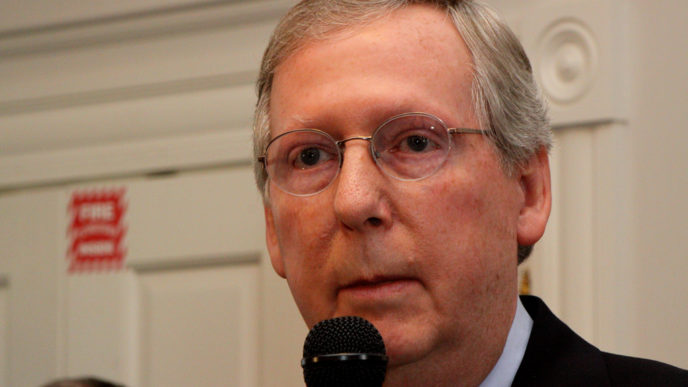
Senate Republicans re-elected Mitch McConnell on Wednesday to be majority leader next year while Democrats picked Chuck Schumer to lead them, setting the chief actors as the chamber prepares for an agenda that will be dominated by Donald Trump and the GOP.

McConnell, 74, is a discreet but deadly master of the Senate’s legislative chess game. His role will be to steer GOP bills to the desk of a president whose name he barely spoke during a tumultuous campaign in which many Republicans viewed Trump and his incendiary comments on Muslims, veterans and others as political poison.

“It’s time to accept the results of the election, to lower the tone and to see what we can do together to make progress for the country,” McConnell, from Kentucky, told reporters Wednesday.

As Senate minority leader, Schumer will assume his weakened party’s most powerful remaining post as it struggles to define its role in a Republican-dominated government. (Read more from “McConnell to Lead Senate GOP, Schumer New Democratic Leader” HERE)

Follow Joe Miller on Twitter HERE and Facebook HERE.

FUNNY: LA Times Produces List Of “Fake New Sites” That Includes a Bunch O’ Sites More Accurate Than It Is

Kemberlee Kaye at Legal Insurrection points us to another example of hysterical media at its finest.

Having blamed James Comey, Russia, John Podesta, Julian Assange, warmal colding, and screwed up computer algorithms for the failure of a screeching, unhealthy, and unpopular harridan to achieve the presidency, the latest culprit appears to be “fake news”.

You rednecks — of all races, religions and ethnic backgrounds who voted for Donald J. Trump — are too stupid to distinguish fact from fiction, got it?

To help you out, the Melissa Zimdars, Assistant Professor of Communication at Merrimack College in Massachusetts, created a list of, “false, misleading, clickbait-y and satirical ‘news’ sources.” The LA Times published the list.

You read that right.

The Los Angeles Times, one of the most biased news sources in the U.S. — which is still withholding the controversial videotape of Barack Obama toasting PLO terrorist Rashid Khalidi — claims to be the arbiter of fake news.

Among the sites that are more accurate and legitimate than the Times itself, which the nutty professor listed as “fake” include:

Bizpacreview.com
Breitbart.com
DailyWire.com
IJR.com
LibertyUnyielding.com
ProjectVeritas.com
RedState.com
TheBlaze.com
Twitchy.com
WorldNetDaily.com
ZeroHedge.com

Curiously, Zimdars failed to list CBS (home of Dan Rather), NBC (home of Brian Williams), and the innumerable other mainstream “news” sources have been outed as straight-up purveyors of Democrat propaganda. (For more from the author of “FUNNY: LA Times Produces List Of “Fake New Sites” That Includes a Bunch O’ Sites More Accurate Than It Is” please click HERE)

Follow Joe Miller on Twitter HERE and Facebook HERE.

Enemies of the Republic: Liberals Want to Abolish the Electoral College Because They Lost

Rather than earnestly address the reasons Hillary Clinton lost the game she was playing, some in the Democratic Party are now simply trying to change the rules.

Following a series of creeds trying to tie the Electoral College to slavery in the wake of Donald Trump’s victory, multiple news outlets began reporting Tuesday that Clinton’s lead in the national popular vote has since passed the 1 million mark, adding to the furor of those who wish to see the republican institution of the Electoral College abolished in favor of a direct democratic vote.

On Tuesday, Sen. Barbara Boxer, D-Calif. (F, 4%) introduced a bill to abolish the Electoral College, calling it “an outdated, undemocratic system that does not reflect our modern society.”

“In my lifetime, I have seen two elections where the winner of the general election did not win the popular vote,” reads a statement from Sen. Boxer. “One person, one vote!”

Outgoing Senate Minority Leader Harry Reid, D-Nev., (F, 2%) concurred with Boxer on the Senate floor, saying that he’s “not seen anything like [what] we’re seeing today in America. A man who lost the popular vote by 2 million votes is now president-elect.”

This won’t happen. This shouldn’t happen. Ever.

Those upset by last week’s results can continue to clamor that Hillary Clinton won the popular vote all they like but this is nothing more than political pandering to, and by, disaffected voters.

Switching to a popular vote would require a constitutional amendment. In order to amend the Constitution, in its current form, the proposed bill would need the support of two-thirds of both chambers of Congress, and then be ratified by three-fourths of the state legislatures.

Good luck with that.

Even in the event of a filibuster-proof Democrat majority in the Senate and a 292 majority in the House, 75 percent of the states of this Union would never go for something that would disenfranchise their citizens to such a degree. (Alternatively, there is the yet-realized national convention for constitutional amendments, as well.)

Were the Electoral College be abolished, the only relevant states, nay, counties, whose voices would be heard at all would be those with dense populations. The concerns of our fellow citizens would be an afterthought behind the demands of the Acela corridor, California coast, Chicago, Seattle, and a handful of other urban locales. States without those population hubs need not apply, the concerns of their citizens need not be considered.

It makes complete sense that a California senator introduced the measure. Should it pass, her constituents would have a ridiculously lopsided voice in the way the rest of the 49 states are governed.

Put simply, the Electoral College is no less relevant in the 21st century than is the freedom of the press in the age of the 24-hour news cycle. This recent effort to change presidential elections is nothing short of a desperate messaging bill that would never pass, precisely for the reasons it exists.

Benjamin Franklin once famously told his fellow citizens in Philadelphia that America had “a Republic … if you can keep it.” The Electoral College is one of the means by which we do so. Senator Barbara Boxer calls the practice a “disaster for democracy,” and there is some merit to what she says. But we do not have a democracy.

Our system of government is a republic, one where the concerns of Manhattan, Chicago, and L.A. County do not get to railroad those of Kansas, Wisconsin, Wyoming, or Indiana. The Electoral College ensures that our commander in chief is responsive to the needs of the whole, not a privileged few population hubs. One where the votes of the rancher in Montana and the factory worker in Michigan are not railroaded by the cabals of college-educated elites on our coasts.

Ours is representative government, not mob rule.

Those upset by 2016’s results certainly have a very sympathetic base going forward. But again: Now is the time for Democrats to take a serious look in the mirror about why they lost (the Washington Examiner has some sound thoughts on the subject, as does CR’s Rob Eno) — not move the goal posts. (For more from the author of “Enemies of the Republic: Liberals Want to Abolish the Electoral College Because They Lost” please click HERE)

Follow Joe Miller on Twitter HERE and Facebook HERE.
Republicans Begin to Unite Around Obamacare Repeal Plan

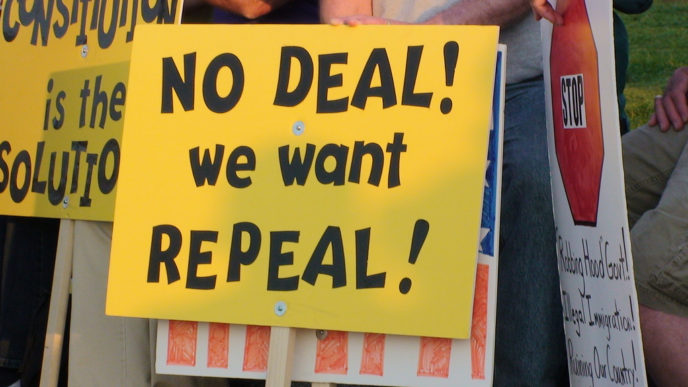
House and Senate budget leaders, along with conservative lawmakers, are beginning to unite around a proposal that would avoid a filibuster from Senate Democrats and put a bill repealing key provisions of Obamacare on President-elect Donald Trump’s desk not long after his inauguration—a bill that is likely to earn his signature.

Republicans’ talks of repealing the Affordable Care Act became a possibility following Trump’s victory over Democratic presidential nominee Hillary Clinton last week.

In the days following the election, scholars and lawmakers began floating plans to unravel the health care law.

But now, House and Senate budget leaders have endorsed a proposal that involves Congress passing two budget resolutions—one for 2017 and one for 2018—early next year, the first of which would instruct lawmakers to use a budget tool called “reconciliation” to dismantle the health care law.

Under reconciliation, legislation under consideration by the Senate needs just a simple majority, 51 votes, to pass, blocking a filibuster by Senate Democrats.

Because Congress failed to pass a budget resolution for 2017—a proposal stalled in the House—budget experts say Republicans could pass a revamped fiscal roadmap for next year, one that includes reconciliation instructions for Obamacare’s repeal.

To ease the transition for consumers, that reconciliation bill would likely have a delayed enactment date to give congressional Republicans time to craft and pass a replacement plan.

After passing a budget resolution for 2017, GOP lawmakers could then craft a second budget resolution for 2018, which could also include reconciliation instructions to tackle another legislative priority, such as an overhaul of the tax system.

Using this two-budget approach to repeal Obamacare would give Republicans the chance to put a bill dismantling the health care law on Trump’s desk soon after his Jan. 20 inauguration, lawmakers said.

“I think having the opportunity to have two reconciliation bills as opposed to one, two reconciliation processes as opposed to one, is wise,” House Budget Committee Chairman Tom Price, R-Ga., told CQ.

Senate Budget Committee Chairman Mike Enzi, R-Wyo., also endorsed the plan, according to Politico.

Enzi told Politico that this double reconciliation strategy would allow Republicans to address their top legislative initiatives without having to worry about filibusters from Senate Democrats.

Price and Enzi are at the helm of the committees that draft the budget resolutions that would include reconciliation instructions.

Not only have Congress’s budget leaders endorsed the use of reconciliation to dismantle the health care law, but the strategy also earned the support of House conservatives, who have long said they have an obligation to voters to repeal the Affordable Care Act.

“Health care will be better and more affordable when Obamacare is repealed, plain and simple,” Rep. Jim Jordan, R-Ohio, told reporters Wednesday. “Everyone understood that as a huge issue in the election.”

“We have to use the reconciliation process, so let’s do it the right way, but let’s do it as quickly as we possibly can,” he continued. “It was part of the mandate that the American people sent to this town last week.”

Congressional Republicans have voted more than 60 times to repeal Obamacare and were only successful in getting a repeal bill, passed using reconciliation, to President Barack Obama’s desk earlier this year.

Because the GOP will lack the 60 votes needed to overcome a filibuster from Senate Democrats—Republicans will hold 52 seats in the next Congress—Rep. Matt Salmon, R-Ariz., said reconciliation is the only way to ensure such a bill gets to Trump.

“The only guarantee is to go through reconciliation. The Senate will never get a repeal of Obamacare off the floor. They’ve never been able to get an appropriations bill off the floor,” Salmon told reporters Wednesday. “So when it comes to heavy lifting for something as major as this, it’s probably going to have to be like we did it through the reconciliation process again.”

To successfully repeal Obamacare using reconciliation in 2017, congressional Republicans could follow a blueprint they mapped out in 2015.

That year, GOP lawmakers drafted a budget resolution for 2016 that included instructions for budget committees in both chambers to draft a reconciliation bill repealing the Affordable Care Act.

Their legislation ultimately repealed the law’s individual and employer mandates, Medicaid expansion, tax credits, and the medical device and Cadillac taxes. The reconciliation bill also stripped the government of its authority to run Obamacare’s state and federal exchanges, and lessened the fines for failing to comply with the mandates to $0.

Both chambers of Congress ultimately passed the bill, but Obama vetoed the legislation.

House Republicans then attempted to override the president’s veto, but lacked the two-thirds majority needed to do so.

Now that Republicans will control both the executive and legislative branches in 2017, GOP lawmakers have said they plan to follow through on their promises to repeal Obamacare.

Just one day after Trump won the presidency, Republican leaders were laying out their agenda for the 115th Congress, with the health care law topping the list.

“I would be shocked if we didn’t move forward and keep our commitment to the American people,” Senate Majority Leader Mitch McConnell said last week.

Republicans have discussed a replacement for the Affordable Care Act, though an official bill doesn’t yet exist.

Several GOP lawmakers have drafted their own individual proposals over the last few years, and Speaker Paul Ryan rolled out a replacement plan in June under the Wisconsin Republican’s “A Better Way” agenda.

According to CQ, it’s unclear if the GOP’s plan would be included in a reconciliation bill repealing the health care law or when a proposal would be rolled out. (For more from the author of “Republicans Begin to Unite Around Obamacare Repeal Plan” please click HERE)

Follow Joe Miller on Twitter HERE and Facebook HERE.

Obama’s Contribution to Our Identity Politics Climate

While in Greece this week, President Barack Obama called the anxieties about national, cultural, and ethnic identities that impacted this election a “volatile mix.” He attributed this angst, though, to impersonal forces such as globalization, deindustrialization, and social media.

It wasn’t him. For eight years, the president said, he’s been working hard against approaches “that pit people against each other.”

The president is being uncharacteristically modest here. While he didn’t himself start the multicultural, identity politics process—we have a long list to blame for that—he’s done more than his share to contribute to the present climate.

As New York University professor Jonathan Haidt told Vox in an interview on Wednesday on the problems roiling the West, “the economic issues are much less than half the story … diversity, immigration, and multiculturalism are right at the heart of the problem in Western democracies.”

“Identity politics is like throwing sand in the gears … a world in which factions are based on race and ethnicity, rather than economic interests, that’s the worst possible world.”

And time and again, Obama stoked the two forces that militate against the nation state today: subnational groups and supranational threats. When speaking to ethnic groups, he hawked the victimhood that is the bonding agent of multiculturalism; when Congress stood in his way, he circumvented it by going to the United Nations.

First let’s look at what Obama said. Standing next to Prime Minister Alexis Tsipras, one of the leftist firebrands who have emerged in an anti-globalization wave in Europe, the president was asked whether he had underestimated anger and fear in America. As is his wont, Obama wasn’t brief.

“I think there are a whole range of factors involved,” the president averred. “I do think there is a common theme that we have seen in a lot of advanced economies and that we’ve seen around the world, although they manifest themselves in a number of ways.” He continued:

Globalization combined with technology, combined with social media and constant information, have disrupted people’s lives, sometimes in very concrete ways. A manufacturing plant closes and suddenly an entire town no longer has what was the primary source of employment. But also psychologically. People are less certain of their national identity, or their place in the world. It starts looking different and disorienting.

And there is no doubt that that has produced a populist moment on the left and right in many countries in Europe. When you see a Donald Trump and a Bernie Sanders, both two very unconventional candidates have considerable success, then obviously there’s something there that’s being tapped into, a suspicion of globalization. A desire to reign in its excesses, a suspicion of elites and governing institutions that people think may not be responsive to their immediate needs. That sometimes gets wrapped up in ethnic identity or religious identity or cultural identity. That can be a volatile mix. It’s important to recognize that those trends have always been there and it’s the job of leaders to address people’s real legitimate concerns and channel them in the most constructive ways possible. …

The more aggressively and effectively that we deal with those issues, the less that those fears may channel themselves into counterproductive approaches that pit people against each other. Frankly, that’s been my agenda for the last eight years.

We don’t all remember it this way. If a phrase sticks in our minds it is when during the 2010 elections Obama brazenly called on Hispanics to say, “we’re gonna punish our enemies and were gonna reward our friends who stand with us on issues that are important to us.”

There was also the time when he addressed the Congressional Hispanic Caucus and, after telling a 75-year-old story of how an L.A. cop had humiliated a Mexican-American (this while the country was reeling with anti-police agitation), he called on Hispanics to rally to the Democrats.

Obama has carried this self-serving message of “you’re a victim, vote for us” whether he was meeting with Americans of Asian background, African background, or of the Muslim faith.

Nobody denies that there are people who harbor racist or bigoted views in America—or any country. But you shouldn’t be allowed to pursue a divide and conquer, hyper-partisan strategy for eight years and then say, “Who, me?”

This has been his record with subnational groups. As for transnational threats to American sovereignty, the president has done an end-run around the elected U.S. Congress—a supposedly co-equal branch of government—by running to the United Nations on the Iran deal, nuclear testing, and a global climate deal.

Just three weeks ago, and acting entirely out of spite, he ordered our U.N. ambassador to abstain from a U.N. vote against the Cuban embargo. This is a law that was passed by the Congress, which is elected by the American people, while the U.N. includes the world’s worst dictatorships.

Americans are indeed less certain of their national identity and their place in the world, as the president said, but chalking it up to the internet and cheap jeans from China is a bit disingenuous.

Obama is rightly getting kudos everywhere for being such a class act during this transition period. But it would behoove him—and liberals in general, especially—to do some self-analysis of how exactly they have stoked popular disquiet about what’s happening to America. (For more from the author of “Obama’s Contribution to Our Identity Politics Climate” please click HERE)

Follow Joe Miller on Twitter HERE and Facebook HERE.
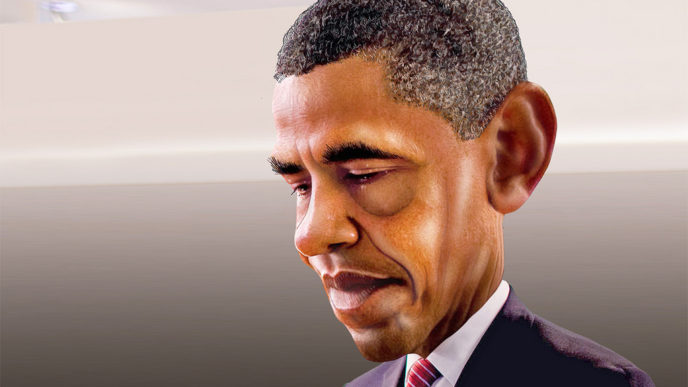
Illegals Demand Obama Issue Mass Pardons Amid Trump Deportation Fears

Illegal immigrants are preparing to ask President Obama to pardon some 750,000 Dreamers, saying such a move is their last, best hope to stave off what they fear will be a wave of deportations once Donald Trump takes the Oval Office.

Community leaders have planned a rally in New York on Wednesday to make the request.

“Millions of law abiding undocumented immigrants are fearful of what will happen when the new Administration takes control in January,” the group of New York state lawmakers and immigration advocates said in a statement announcing the rally. “However, President Obama has the power of pardons that he can use to protect all DACA enrollees.”

As of September, more than 740,000 illegal immigrants had been approved for Mr. Obama’s Deferred Action for Childhood Arrivals program, a minor amnesty that grants young adult illegal immigrants a two-year stay of deportation and issues them work permits, entitling them to driver’s licenses and some taxpayer benefits.

Mr. Trump has signaled that he would cancel that order, leaving Dreamers out of status when their work permits expire. That puts Mr. Obama in a bind because he has expressed an interest in helping illegal immigrants but also has acknowledged limits on power. (Read more from the author of “Illegals Demand Obama Issue Mass Pardons Amid Trump Deportation Fears” HERE)

Follow Joe Miller on Twitter HERE and Facebook HERE.
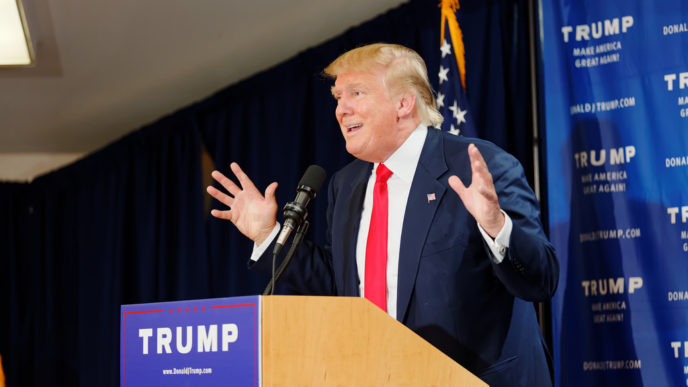
Sanctuary Cities Defy Trump’s Pledge to Defund Them. How He Can Fight Back.

Leaders of sanctuary cities that protect illegal immigrants from deportation are responding defiantly to threats by President-elect Donald Trump to withhold federal funding from them.

Local governments from cities including the District of Columbia, Los Angeles, New York City, Chicago, and Boston over the past few days have said that despite the financial cost they could face in a Trump administration, they will not change policies that limit their cooperation with immigration-related requests from the federal government.

“To all those who are, after Tuesday’s election, very nervous and filled with anxiety as we’ve spoken to, you are safe in Chicago, you are secure in Chicago, and you are supported in Chicago,” Chicago Mayor Rahm Emanuel, a Democrat, said Monday. “Chicago will always be a sanctuary city.”

Though Trump has not specified how he would fulfill his promise to combat sanctuary cities since winning the presidency, allies of his say he has broad tools to encourage localities to play a more proactive role in immigration enforcement.

“These mayors, what they aren’t saying, is they receive tons of dollars in federal grants and president-elect Trump has made clear that sanctuary cities may see some of that money dry up if they are continuing to defy federal law,” said Kris Kobach, Trump’s immigration adviser and the Kansas secretary of state, in an interview Tuesday on “Fox & Friends.”

Blocking Funding

Previous efforts in Congress to withhold federal funding from sanctuary cities have failed recently, including legislation sponsored by Sen. David Vitter, R-La., last year that focused on law enforcement grant programs and Community Development Block Grants for affordable housing, anti-poverty programs, and infrastructure development.

With 48 Democrats in the new Senate class, the minority party still has the power to filibuster legislation it doesn’t like.

But proponents of stronger immigration enforcement said legislation specific to one form of grants—funding from the Department of Justice—could be easier to implement.

That’s because the Department of Justice is currently undertaking a review on whether to withhold federal law enforcement money from 10 sanctuary cities, including New York, Chicago, and Philadelphia.

The Obama administration began this project last year, and it has sent letters to those jurisdictions asking them to certify that they’re complying with a federal law that requires local governments to share certain information about illegal immigrants with federal officials.

“If these sanctuaries want to cling to their policies, the federal government ought to sue them for obstruction,” said Jessica Vaughan, director of policy studies for the Center for Immigration Studies, in an interview with The Daily Signal.

Expanding Enforcement

Vaughan, and other immigration experts, say they also expect Trump to bring back a controversial local enforcement program, called Secure Communities.

Under Secure Communities, federal immigration agents asked law enforcement agencies to hold in custody illegal immigrants who they came into contact with for an extra 48 hours from when they would normally be released so they could be picked up and deported. These requests were known as detainers.

Critics of the program said it violated immigrants’ civil rights, and did not differentiate between low-level and serious offenses. Many local jurisdictions stopped complying with the program, fearing they would be sued by immigrant rights groups.

In November 2014, the Obama administration got rid of the program and replaced it with a less demanding version, the Priority Enforcement Program (PEP).

With the new program, local authorities, in most cases, are asked to only notify federal immigration officials when they plan to release someone from jail whom the government seeks to deport.

“I think he [Trump] will bring back Secure Communities,” said Alex Nowrasteh, an immigration policy analyst at the Cato Institute. “That is super easy to do and the legislative and regulatory machinery is already there. If he did that, there would be much more uniform detection of illegal immigrants in local and state jails and they would be much more likely to be released into ICE [Immigration and Customs Enforcement] custody.”

In his first post-election interview, Trump said he will focus on deporting illegal immigrants with criminal records and not everyone living in the United States illegally. He put the number he would target at 2 million or 3 million people.

The Obama administration already prioritizes deporting convicted criminals. It has expelled 530,000 convicted criminals from the U.S. since 2013.

But its definition of criminal is narrower than the approach that Trump may take.

Currently, federal immigration officers are told to first target illegal immigrants considered to be threats to national security and public safety, who have likely been convicted of a felony. Other priorities for deportation include individuals who have been convicted of multiple misdemeanors, and recent arrivals who came here illegally after Jan. 1, 2014

Nowrasteh and Vaughan say reverting back to Secure Communities could allow Trump to widen that net so it includes illegal immigrants who have been charged but not convicted, and people charged with immigration violations like illegal re-entry and overstaying visas.

“I could see him widening [immigration enforcement] dramatically to what was going on under Secure Communities where he would target any unlawful immigrant who was arrested for any reason,” Nowrasteh said.

State and City Pushback

If Trump were to do that, Nowrasteh said, he will get pushback from states and localities.

Some states and cities already have in place laws that limit their cooperation with federal immigration authorities.

For example, in California, it’s harder to apprehend illegal immigrants because of a state law, known as the Trust Act, that strictly limits the situations in which local agencies will help ICE take custody of those it seeks to deport.

The mayor of Somerville, Massachusetts, meanwhile, has issued an executive order, also called the Trust Act, which shields immigrants with minor or no criminal records from possible deportation.

“I could see a case where a state like California will take the federal government to court saying it’s unconstitutional for the feds to force them to participate in this type of program,” Nowrasteh said. “I have no doubt there are many administrative ways these cities and police departments can obstruct [federal] immigration enforcement.”

Indeed, a 2014 federal appeals court ruling declared that complying with detainer requests is optional, and local jurisdictions are legally free to enact their own policies.

Also, a 1997 Supreme Court ruling in the case Printz v. the United States confirmed that Congress cannot force states to enact or enforce a federal regulatory program, such as ICE’s detainer requests.

If localities continue to oppose helping the federal government, Vaughan said she expects Trump to make it hard for them to resist.

According to the Los Angeles Times, Trump’s advisors are drafting plans to resume workplace raids and to ramp up pressure on local police and jails to identify illegal immigrants.

“The foundation for more robust enforcement is already there,” Vaughan said. “The idea is not, and has not ever been, to go door to door and round up every illegal immigrant who can be found. It’s to have a credible enforcement system that works on a routine basis, that focuses the most on threats, but does not necessarily exempt people caught in worksite operations or other ways that can come to the attention of ICE.” (For more from the author of “Sanctuary Cities Defy Trump’s Pledge to Defund Them. How He Can Fight Back.” please click HERE)

Follow Joe Miller on Twitter HERE and Facebook HERE.
Democrats Looking for Answers After Devastating Election

Hours after the arrest of 17 progressive protesters at a sit-in at New York Sen. Charles “Chuck” Schumer’s office, President Barack Obama said Democrats will be doing some healthy reflection after the pounding the party took in last week’s national election.

The progressive wing of the Democratic party, which backed Vermont Sen. Bernie Sanders’ presidential primary challenge to eventual nominee Hillary Clinton, wants to double down on its agenda. It blames Clinton’s supposed centrist stance and close ties to Wall Street for the loss to Republican Donald Trump on Nov. 8.

Some of this will play out in the coming months in the competition to be the next Democratic National Committee chairman.

The President and Protesters

“When your team loses, everybody gets deflated and it’s hard and it’s challenging and so I think it’s a healthy thing for the Democratic Party to go through some reflection,” Obama, who as president is the outgoing titular leader of his party, said in a press conference Monday. “I think it’s important for me not to be big-footing that conversation. I think we want to see new voices and new ideas emerge.”

Obama said the Democratic Party can’t waiver from its core beliefs.

“I believe that we have better ideas, but I also believe that good ideas don’t matter if people don’t hear them and one of the issues that Democrats have to be clear on is that, given population distribution across the country, we have to compete everywhere,” Obama said.

Protesters outside likely Senate Democratic leader Schumer’s office had a different view than Obama.

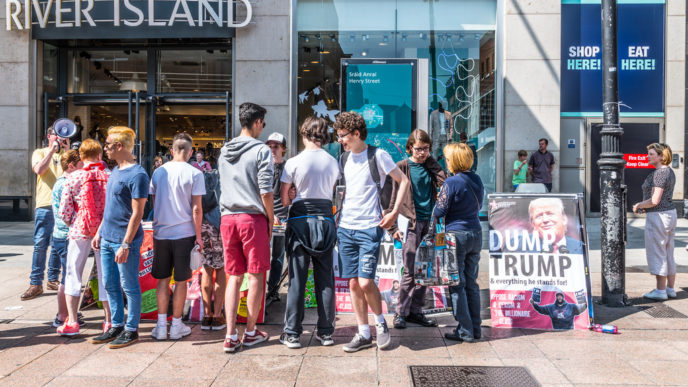
The 45 millennial activists, calling themselves “All of Us 2016,” made two demands: that Democrats vow to never negotiate with President-elect Trump and that Schumer step aside from his designated role and endorse Sanders to be the party’s Senate leader.

“The Democrats cannot negotiate with a racist, fascist President Trump, they must filibuster all day and all night to stop his racist, fascist agenda,” All of Us co-founder Waleed Shahid, 25, of Brooklyn, told The Daily Signal. “It was negotiation that led to calling African-Americans three-fifths of a citizen.”

The protesters sang, “We stand for our future and together we stand strong.” They also chanted, “Our future is on the line, Chuck Schumer, grow a spine.”

“Democrats lost because they couldn’t tell the truth. Schumer is entirely funded by Wall Street,” Shahid said, adding it would have turned out different if Sanders had been the Democratic nominee. “Sanders inspired the American people.”

Various protesters were arrested in groups of one and two, and taken away. This is revealing about Schumer, said Anna Bonomo, 26, of Hermitage, Pennsylvania.

“Charles Schumer decided to have almost 20 millennials arrested instead of meeting with us and talking with us,” Bonomo told The Daily Signal. “I think that just goes to prove that Wall Street Democrats like him are not here for the people they claim to represent.”

Schumer’s office did not respond to inquiries from The Daily Signal.

The Democratic National Committee did not respond to The Daily Signal’s questions about the state of the party. The DNC chair’s leadership role will be elevated with Republicans holding the White House and Congress.

Electing the Next Chairman

Interim DNC Chairwoman Donna Brazile was shouted down last week by a DNC staffer, who blamed the party’s establishment for Trump’s victory and warned of pending doom from climate change, The Huffington Post reported. The DNC staffer told Brazile:

Why should we trust you as chair to lead us through this? You backed a flawed candidate, and your friend [former DNC Chair Debbie Wasserman Schultz] plotted through this to support your own gain and yourself. You are part of the problem. You and your friends will die of old age and I’m going to die from climate change. You and your friends let this happen, which is going to cut 40 years off my life expectancy.

DNC members will choose a successor to Brazile in February.

Both Schumer and Sanders have endorsed Rep. Keith Ellison of Minnesota, co-chairman of the Congressional Progressive Caucus, to be the next chairman of the Democratic National Committee, as has outgoing Senate Democratic leader Harry Reid of Nevada.

But securing the nomination won’t be easy for Ellison, the first Muslim in Congress.

Competition for Leadership

Former Vermont Gov. Howard Dean, who chaired the DNC from 2005 through 2009 when the party retook Congress and the White House, plans to run for the job again. Former Maryland Gov. Martin O’Malley, who ran unsuccessfully for president, has said he’s interested in the job.

Others possibilities are reportedly Labor Secretary Thomas Perez and New Hampshire Democratic Party Chairman Raymond Buckley.

In addition to Trump’s surprising win over Clinton, the Nov. 8 election also saw the GOP hold the House and Senate and make gains among governorships and state legislatures. Trump even won traditionally blue states of Pennsylvania, Wisconsin, and Michigan.

Sanders scolded the Democratic Party in a tweet Monday morning, though he didn’t address the protest group advocating his elevation to Senate Democratic leader.

“I come from the white working class, and I am deeply humiliated that the Democratic Party cannot talk to the people where I came from,” Sanders tweeted.

He later tweeted: “The Democratic Party can no longer be led by the liberal elite. We have to stand up to Wall Street and the greed of corporate America.”

Politico reported that big Democratic donors met with billionaire financier George Soros at the District of Columbia’s elite Mandarin Oriental hotel for a closed-door conference sponsored by the Democracy Alliance, a progressive activist organization. Soros spent millions trying to get Clinton elected. Ellison attended the meeting spanning Sunday through Monday.

Others attending the conference were House Minority Leader Nancy Pelosi of California and Massachusetts Sen. Elizabeth Warren. Soros’ Democracy Alliance has contributed more than $500 million to get Democrats elected and on liberal groups since 2005. (For more from the author of “Democrats Looking for Answers After Devastating Election” please click HERE)

Follow Joe Miller on Twitter HERE and Facebook HERE.