CLASSIC: Fundamentally Transforming America

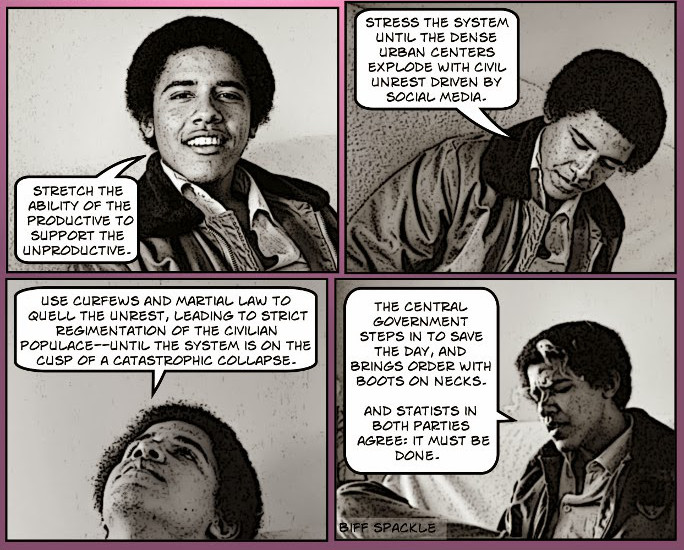
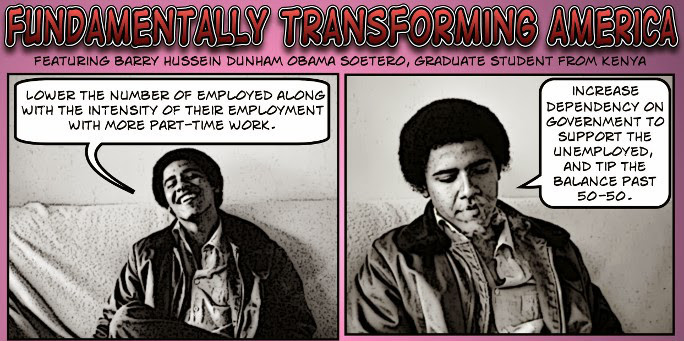
Dialogue via Lee Cary, artwork via the unparalleled Biff Spackle:

160917-barry-010
160917-barry-020

Got Cloward-Piven? (For more from the author of “CLASSIC: Fundamentally Transforming America” please click HERE)

Follow Joe Miller on Twitter HERE and Facebook HERE.

Past Is Prologue: America Is More Like Soviet Russia Than You Might Expect

Could America have its own version of a Russian Revolution? With Vladimir Putin’s modern-day authoritarian intelligence state inserting itself into the 2016 American presidential election, the question is more timely than you might think. More unsettling — putting aside Russia’s meddling in American affairs — is the argument that such an ideological revolution is already well underway.

A recent essay in The New Criterion by Gary Saul Morson illuminates this chilling thesis. As a professor of (among other weighty subjects) Russian literature and the history of ideas at Northwestern University, Morson is uniquely qualified to comment on the parallels between the two nations that previously represented opposing poles of political philosophy. In his piece titled “The house is on fire!” Morson explains how the Soviet Union’s bloody communist past has great bearing on America’s present and future.

Morson, that perhaps rare, intellectually honest professor at a major American university, surveys communism’s past and reasonably suggests — with its millions of victims from the Soviet Union, China, and Ethiopia — that communism ought to be considered on par with Nazism in terms of its barbarism and our revulsion to it.

Yet curiously, Prof. Morson writes, likely alluding to his peers in the academy,

In intellectual circles … such comparisons taint not Communists, but the person who makes them.

This in spite of the ghoulish revelations from the Soviet archives – from Mitrokhin to Stalin – hiding in plain sight. Morson gives an example:

Our knowledge of Bolshevik horrors expanded dramatically when, after the fall of the Soviet Union, its archives were opened. Jonathan Brent and Yale University Press brought out volume after volume of chilling documents, but public opinion did not noticeably change. How many readers of The New York Times know about its role in covering up the worst of Stalin’s crimes and earning a Pulitzer Prize (still unreturned) for doing so?

I understand being so carried away by Communist ideals that one denies or justifies millions of deaths. What amazes me is that people and publications who have done so still feel entitled to criticize others from a position of moral superiority.

More on that Pulitzer story here and here.

The refusal to acknowledge communism’s history of genocide — and for the “lucky” ones starvation, misery, and the constant need to look over one’s shoulder — in particular among the nation’s progressive elite, has real consequences. As does the inability of said progressives to acknowledge a link between collectivist ideology and its dire consequences. To many such people, it is the intent of the ideas — using the state to “help others” and thus create a utopia — that matters, even if the ends prove cataclysmic.

Look no further than the viability of a Bernie Sanders presidency in the same country that several decades ago had supposedly vanquished communism for the corrosive effect of such an ethos. No, Bernie is not a communist in the sense of being a Bolshevik or Menshevik. But his ideas are based on the same socialist principles underlying those movements, and they are geared toward similarly disastrous ends. His ideological and political differences with the communists of yesteryear are a matter of degree, not kind.

The idea that wealth redistribution is moral, and that the provision of goods and services by the state is a legitimate function have tremendous sway in America.

And the pervasiveness of political correctness powerfully attests to the idea that the roots of communist ideology have insinuated themselves in the American mind, manifesting themselves in every aspect of our culture.

If there is an underlying subtext to Prof. Morson’s piece, that is the harrowing reality.

Consider several of the communist bigwigs that Prof. Morson quotes, and the relevance of their positions to our nation at present:

Delivering a toast on the twentieth anniversary of the Bolshevik seizure of power, Stalin declared: “We will destroy each and every enemy, even if he was an old Bolshevik; we will destroy all his kin, his family. We will mercilessly destroy anyone who, by his deeds or his thoughts — yes, his thoughts! — threatens the unity of the socialist state. To the complete destruction of all enemies, themselves and their kin!” … Georgy Arbatov, adviser to five general secretaries of the Soviet Communist Party, observed that “the main code of behavior” was “to be afraid of your own thoughts.”

In America we do not destroy political enemies by sending them to the gulag or grave by way of mysterious “accidents,” but we do so in more subtle, nuanced ways: Think of the IRS Scandal, selective enforcement of laws, harassment at the hands of federal agencies, etc.

But thought control — a.k.a., political correctness — is a much more powerful tool. It calls to mind a certain former secretary of state’s comment in front of the Organization of Islamic Conference on “combatting religious intolerance.” Then-Secretary Clinton spoke to a group of Sharia supremacists about the need for Western nations to use “some old-fashioned techniques of peer pressure and shaming” to counter language offensive to Muslims.

A direct government threat may be happily distant for most Americans, but fear of social ostracism for holding beliefs conflicting with the prevailing progressive orthodoxy is ever-present. Who needs a formal, state-controlled cultural police force when people will self-censor lest they draw the ire of friends and colleagues?

Prof. Morson quotes Felix Dzerzhinsky, founder of the Cheka, a secret police force and precursor to the KGB used to purge (read: assassinate thousands of people) Russia of “enemies of the state” during the so-called Red Terror.

Dzerzhinsky wrote in a journal aptly titled, “Red Terror”:

We are not waging war against individual persons. We are exterminating the bourgeoisie as a class. During the investigation, do not look for evidence that the accused acted in deed or word against Soviet power. The first questions that you ought to put are: To what class does he belong? What is his origin? What is his education or profession? And it is these questions that ought to determine the fate of the accused.

True, the scale of violence in American class warfare is incomparable to that of the Soviet Union and China — rooted though it may be in the same Marxian philosophy and ethics and geared toward consolidating all manner of power in the hands of the state. Different cultures are different. But Dzerzhinsky’s questions are telling.

From railing against “millionaires and billionaires” of America’s most prominent political figures to the pervasive social justice warrior rhetoric on white privilege and the patriarchy, Dzerzhinsky’s premises are more apparent in American society than anyone might care to admit. And perhaps most stunning of all, we as a nation cannot see it and do not know it. This blindness, ignorance, or combination of both speaks to the effectiveness of a communism that we may have “vanquished” in a conventional sense – the Soviet Union fell, albeit without its murderous leaders ever being put on trial and punished for their crimes – but the ideas of which are powerful as ever.

Prof. Morson quotes Lenin, who said “Morality is entirely subordinated to the class struggle of the proletariat.” The means are what matters. Ends are irrelevant. The struggle is inherently moral. Get on the “right side of history.” This is how you get the Affordable Care Act the effects of which are diametrically opposed to its name.

Prof. Morson quotes Trotsky on the Communist Party:

Comrades, none of us wishes or is able to be right against his Party. The Party in the last analysis is always right, because the Party is the sole historical instrument given the proletariat for the solution of its basic problems … I know that one cannot be right against the party. It is only possible to be right with the Party and through the Party for history has not created other ways for the realization of what is right.

The progressivism that pervades our government, our media, and our schools — as well as the consequence of not adhering to such an ideology — testify to the power of The Party.

Prof. Morson continues:

Is it any wonder that those who reject human rights, treat people in terms of friendly or enemy groups, place no moral limit on action, and are certain that whatever they do is right should wind up committing colossal evil?

Although the Left in America would take issue with the idea that the violation of individual liberty represents a rejection of human rights, does any statement better describe the party of class warfare, Clintonian notions of right and wrong, and all manner of disasters from Obamacare to open borders and suicidal “Countering Violent Extremism”?

Prof. Morson concludes his piece on a sobering but well-taken note:

Perhaps my training as a Russian specialist distorts my judgment, but as I contemplate the ideas spreading from the academy through society, I fear, a century after the Russian Revolution, a tyranny greater than Stalin’s. Comrades, the house is on fire.

Bad ideas have bad consequences. (For more from the author of “Past Is Prologue: America Is More Like Soviet Russia Than You Might Expect” please click HERE)

Follow Joe Miller on Twitter HERE and Facebook HERE.

Tim Kaine Is Running for the Job of Messiah

Democratic vice-presidential nominee Tim Kaine belongs to the strange subculture of people fixated on the Catholic Church and eager to change nearly everything about it. Kaine’s latest attempt to play pope unrolled last week, when he addressed the gay activist Human Rights Campaign, assuring them that the Church would drop its 2,000-year-old teaching on marriage.

Kaine thinks that the Church should base one of its seven sacraments not on Genesis, Leviticus and St. Paul, but on Obergefell v. Hodges. Forget the decrees of apostles, popes and bishops: Let’s reshape our faith to suit a secular court’s 5-4 majority, he seemed to say. Thomas More was willing to see his head hacked off rather than let the state tear up God’s rules about marriage, but Tim Kaine is more of a Henry VIII-style Catholic — that is, he makes up the rules as he goes along.

That would explain how Kaine could go from running for office in Virginia as a pro-life candidate to hobnobbing with baby-parts magnate Cecile Richards of Planned Parenthood, and running on the Democratic Party’s rabidly pro-abortion platform — which opposes even the slightest protection for viable unborn children, protections that exist across even socially liberal Western Europe.

Now, I respect people who have lost their faith in one church’s creed and search out another — admitting what they’re doing like honest adults. According to Pew Research, some 40 percent of American Catholics leave the Church and don’t return. There are also those who feel unsure about one piece or another of the Church’s complex teachings, so they quietly ponder and pray.

But Kaine isn’t either such person. Instead, he’s one of those tribal Catholics who grew up believing that they somehow own the Church, so they have the God-given right to knock down its walls and install jacuzzis. Too many Catholics in positions of power and influence seem to agree. As I wrote in the Politically Incorrect Guide to Catholicism:

When a large group of highly educated people who have dedicated themselves to an organization with firm doctrines, strict rules, and stern demands — such as the Catholic Church— reject those doctrines, rules, and demands, what do they do with themselves instead? Shrug and join the United Methodist Church? … When families (like the Kennedys or the Bidens — and millions of less famous Irish and Italian American clans) have strong ethnic and historical connections to the Church, what do they do when they reject its teaching authority? The history of the Catholic Left after Vatican II gives us the answer: Such people focus on the parts of the original mission that still appeal to them — and jettison the rest.

Apparently the “parts” of the Catholic mission that Kaine is willing to cling to are those that can be soldered onto a left-wing political juggernaut. The New York Times reports that back in the 1980s, Kaine went with a band of radicalized Jesuits to Honduras. Once he was there, “Mr. Kaine embraced an interpretation of the gospel … known as liberation theology.” Columnist Ken Blackwell correctly notes that liberation theology (condemned by three popes, including Pope Francis) is “an avowed Marxist ideology inimical to the institutional Catholic Church and to the United States.” Blackwell also observes that

around the time Kaine was there, Jesuits were arrested for gunrunning, and, the next year, the Honduran government banned any more American Jesuits from coming to that country because of their left-wing activism.

They also expelled one American-born Jesuit, who also had to leave that religious community because he was too radical even for them. That priest was Father Jim Carney, and he was the one The New York Times tells us Kaine sought out across the border in Soviet-supported Nicaragua….

I spent my years in Catholic high school contending with Tim Kaine’s ilk: Disgruntled feminist nuns who admitted they hated Pope John Paul II, scraggly ex-seminarians who denied that Jesus’ body had risen from the dead, wizened oddballs who hated our faith but couldn’t find other jobs. They showed us Sandinista propaganda films in religion class. They lied to parents about what they were teaching, and bullied students who disagreed. I’ll never forget what one of those Tim Kaine clones said when I disputed his latest revision of basic Christian doctrine, and I cited the words of Jesus in the Gospel.

The teacher smiled thinly and said, “Jesus didn’t have an M.A. in theology from Catholic University. I do.” (For more from the author of “Tim Kaine Is Running for the Job of Messiah” please click HERE)

Follow Joe Miller on Twitter HERE and Facebook HERE.

Obama’s Absurd Double Standard on Defense Spending

This week we learned that the Obama administration has requested $2.6 billion in emergency funding for Louisiana flood relief. While the specifics of the Louisiana flood relief request should be thoughtfully considered, the very nature of this request highlights the Obama administration’s absurd double standard on budget issues.

Back in July, President Barack Obama announced that he had decided to keep more troops in Afghanistan at the end of 2016 than he had previously planned, and more than he had proposed funding in his fiscal year 2017 Overseas Contingency Operations budget request. While the decision to keep more troops in Afghanistan was a step in the right direction, it immediately raised the question of how to pay for these forces.

The day after Obama’s announcement, Secretary of Defense Ash Carter suggested that the Department of Defense might need to submit a supplemental funding request to cover the costs of the increased Afghanistan mission. This supplemental request would be categorized as “emergency spending,” just like the Louisiana flooding request.

And here’s where politics enters the picture. While Obama has now submitted an emergency funding request for Louisiana by itself, he has so far, two months after announcing his policy change, refused to submit an emergency funding request for the mission in Afghanistan without pairing it with unrelated domestic spending requests.

A White House Office of Management and Budget spokeswoman publicly admitted that any funding request for Afghanistan would not be considered by itself because “any increase in funding must be shared equally between defense and nondefense.”

Some in Congress were understandably upset by this. Sen. John McCain, R-Ariz., chairman of the Senate Armed Services Committee, called it “extortion,” saying:

If the president believes that sending thousands more young Americans into war is in the national security interest of the United States, he should support the additional funding required to support those warfighters. Full stop. No caveats, no qualifications, and no strings attached.

It would seem this “extortion” only goes one way. According to the Obama administration, if the military needs increased funding to succeed in a mission, that funding increase has to be paired with unrelated domestic funding. But if additional domestic spending is needed, it apparently does not need to be paired with increased defense spending, as we witnessed with the recent Louisiana funding request.

As commander in chief, the president should take a more strategic view of the nation’s needs.

Ever since the Budget Control Act of 2011, the Obama administration has successfully fought to preserve a dollar-for-dollar link between defense and nondefense discretionary spending levels. According to Obama and his Democratic allies in Congress, every dollar added to the defense budget must be matched with a dollar added to the domestic budget.

This is an absurd, nonsensical way of budgeting that only survives in Washington. Threats to U.S. vital interests are rising and the U.S. military has been dramatically weakened under major budget cuts over the last five years, but any increase in the defense budget has to be matched with nondefense budget increases? This makes no sense.

Think about it in the context of a family budget. If one spouse wants to invest in a better, more expensive home security system due to increased crime in the neighborhood, will the other spouse refuse to agree to this funding increase without a dollar-for-dollar increase in funding toward a new car or an upgraded cable TV package? Of course not.

If threats are rising, and your security system needs to be improved, you will tighten your belt in other areas to pay for this increase. Only in Washington can a politician get away with holding a security funding increase hostage for completely unrelated domestic spending increases.

While the details of the Louisiana flooding relief request can be debated, the request shows that the Obama administration is only committed to the “dollar-for-dollar” principle when it results in growing domestic spending. When security spending is on the table, it is happy to use it as political leverage for its own priorities. Defense and nondefense should not be linked. What some call the “firewall” between defense and nondefense should be broken, and every dollar spent should be considered on its own merits.

This crazy suicide pact on spending needs to end. Afghanistan funding and other security needs should be considered on their own merits, and the defense budget overall should be increased in response to growing threats and a shrinking, weaker U.S. military. The American people deserve a reasonable budget process, not one that involves hostage-taking and extortion, or using the military as leverage for domestic agendas. (For more from the author of “Obama’s Absurd Double Standard on Defense Spending” please click HERE)

Follow Joe Miller on Twitter HERE and Facebook HERE.

No, the Constitution Isn’t Outdated

Time tests quality, and the fact that our Founders’ creation has outlasted so many other regimes signifies their skill and prescience.

But for others, such as Supreme Court Justice Ruth Bader Ginsburg, the Constitution’s age is a mark against it. Asked in a 2012 interview whether Egypt’s new government should look to other constitutions for guidance, Ginsburg replied, “I would not look to the U.S. Constitution, if I were drafting a constitution in the year 2012. I might look at the Constitution of South Africa.”

She added that Canada’s Charter of Rights and Freedoms might also be a good place to start, as it is “much more recent than the U.S. Constitution. … It dates from 1982.”

More recently, this summer, 7th Circuit Judge Richard Posner wrote in an op-ed for Slate that he “[sees] absolutely no value to … studying the Constitution.” His reasoning: “Eighteenth-century guys, however smart, could not foresee the culture, technology, etc., of the 21st century.”

Time tests quality, and the fact that our Founders’ creation has outlasted so many other regimes signifies their skill and prescience.

The left frequently claims that political science, like the natural sciences, is continuously advancing. Accordingly, a competently crafted constitution written in the early 1980s must almost certainly be better than a constitution written in the late 1780s. After all, the framers of Canada’s charter had the benefit of nearly two centuries of societal developments that our Founders could not have foreseen.

As Richard Stengel, former president and CEO of the National Constitution Center, wrote in a splashy 2011 article in Time magazine:

Here are a few things the Framers did not know about: World War II. DNA. Sexting. Airplanes. The atom. Television. Medicare. Collateralized debt obligations. The germ theory of disease. Miniskirts. The internal combustion engine. Computers. Antibiotics. Lady Gaga.

Stengel’s list is instructive as it gives the reader a sense of the changes liberals think our Constitution does not adequately account for. Take for instance: “airplanes, the atom, the internal combustion engine, and antibiotics.” These all represent technological or scientific innovations unknown to the Founders that, purportedly, have some relevance to structuring a government.

Some scientific and technological changes do require that we think carefully about the Founders’ intent when they were writing the Constitution. For instance, new technologies allow police to peer into homes without physically entering them, intercept an email or a text message, or track your car from their computer back at the precinct. Whether these things constitute a search or seizure of citizens’ “houses, papers, and effects” under the Fourth Amendment is an important question the Founders do not answer for us directly.

But by no means are we merely left to guess how the Constitution speaks to these modern conditions. Through the Founders’ own writings contained in the Federalist Papers, notes on the proceedings of the Constitutional Convention and correspondence, thoughtful judges and legal scholars get a clear sense of the spirit behind the words on the page.

Given the Founders’ concern that government would use warrantless searches to harass and condemn political dissidents, it is hard to imagine James Madison or Alexander Hamilton would approve of warrantless wiretaps, drone flyovers, and email dragnets conducted by federal agencies.

Other items on Stengel’s list—sexting, miniskirts, and Lady Gaga—belong to another category of societal development liberals often refer to when questioning our Constitution’s continued relevance: shifting social norms.

What they typically forget is our Constitution was never meant to address every new cultural development nor freeze American society in place as it existed at the turn of the 18th century. The Founders knew that the societal concerns and policy questions particular to their time would eventually be resolved and new issues would arise to take their place.

While the Constitution was not meant to steer the development of American culture in every sense, the Founders did think a free society demanded certain qualities of character among the citizenry: habits of self-governance, respect for the rights of others, and reverence for the law. But within those brackets is allowed some latitude for culture to develop organically and locally without the heavy hand of government at the helm.

While the Founders took special care to ensure the Constitution’s foundation could survive new developments in technology and society, the durability of the document owes as much to what the Founders knew about human nature and worked into our foundational text as it does what they recognized they could not foresee and left to future generations.

Our Founders believed government must be strictly restrained because those attracted to political power rarely restrain themselves. The Founders knew even the power of the majority should not be total, since infringements of individual liberty authorized by 150 million voters are often no more just than those authorized by a single ruler.

As Madison writes in Federalist 51, “If men were angels, no government would be necessary. If angels were to govern men, neither external nor internal controls on government would be necessary.”

When men and women sprout wings and halos, or seraphim and cherubim descend from the heavens to run our government, then it might be time to question the continued utility of our Constitution. But as long as human nature remains subject to the same failings the Founders wisely identified, we should be skeptical of liberal doctrines that allow the powerful to interpret the extent of their own power and protect only those individual liberties a bare majority approves of.

As yet, the heavens have not parted, and human nature is still as fallible as it was 229 years ago. Thankfully, our nation was blessed with a generation of men who had insight to perceive the essential character of man vis-à-vis government and the wisdom to craft institutions rooted in those unchanging realities. (For more from the author of “No, the Constitution Isn’t Outdated” please click HERE)

Follow Joe Miller on Twitter HERE and Facebook HERE.

5 Reasons to Expect an Absolute Nightmare This December

By all appearances, Republicans will suffer some serious losses in the upcoming election. The House may remain in GOP hands, but the Republican majority is expected to shrink. The Senate, on the other hand, is tilting towards Democratic control.

If the Republicans Party loses its majorities, the GOP’s ability to lead conservatives in Congress will have lasted a measly two years. During that time, they have accomplished little. However, the time for Republicans to adopt something — hell, anything — remotely conservative, is now. There are only a few opportunities available, but perhaps none is as important as the upcoming spending bill, known as the Continuing Resolution (CR).

In a matter of days, 2016 spending authorization will expire, and it will soon become evident whether Republicans are prepared to fight for conservative principles — or relent to Obama. Unfortunately, in the Senate, Majority Leader Mitch McConnell, R-Ky. (F, 42%) has already expressed interest in caving to Democrat demands by passing a short-term CR into December. House conservatives, on the other hand, want to lock in conservative spending priorities for a longer term, or at least for the next nine months.

McConnell knows that this December represents a lame-duck session of Congress. Lame-duck sessions are dangerous times for Congress. As my former colleague, Andy Koenig, noted in the Wall Street Journal,

Dozens of lawmakers on Capitol Hill will retire after November’s election, some voluntarily, some not. But many of them, on both sides of the aisle, are demanding a last chance to pass their preferred policies – in a lame-duck session, this time without interference from pesky voters.

Yes, those pesky voters mean YOU. While we should be clinging to one last chance to sway conservative policy in the CR, we must simultaneously fear the speed at which McConnell is so ready to allow liberals the last word. Here’s what has us concerned.

More Spending

Lame-duck spending bills are synonymous with more spending.

During the 2012 lame duck, Congress passed the “fiscal cliff” budget deal, which increased spending by $47 billion. The same scenario played out the following December, in 2013. Republicans again relented to Democrat demands for additional spending, agreeing to reverse austerity measures passed in the Budget Control Act (a 2011 conservative bill that was designed to reduce spending by $1.2 trillion over a decade). The 2013 lame-duck spending bill, however, increased spending for two years; a $45 billion increase for 2014 and an $18 billion increase for 2015.

There was more of the same this past December. Congressional Republicans agreed to increase spending by $80 billion; $50 billion of which was tacked on to this year; the other was designed for next year.

If Congress is consistent at all, it’s in their desire to increase spending during December; particularly during a lame duck. Senator McConnell’s interest in jamming through a spending bill during the lame duck indicates that we should expect more of the same.

Union Bailout

Last week, thousands of unionized coal miners from the United Mine Workers of America (UMWA) protested around the U.S. Capitol. Their demonstrations were meant to pressure Congress into providing a bailout for their broken pension and healthcare system. Those miners, in particular, expect Congress to write a check for nearly $490 million — per year.

That amount will cover just a fraction of the short-fall each year. In total, the miners’ pension fund is short nearly six billion in promised benefits. And pleas from the unions are starting to find sympathy among politicians. In July, The USA today reported bipartisan support for Congressional action, especially from Ohio’s Senators, Democrat Sherrod Brown, D-Ohio (F, 11%) and Republican, Rob Portman, R-Ohio (F, 49%).

The dangerous precedent Congress will set by bailing out this one constituency could lead to one of the world’s largest bailouts. As I wrote last week, unions in total (not just miners) across America have underfunded pension funds totaling more than $600 billion. Furthermore, there are other private, non-unionized plans that need $760 billion in order to fulfill pension promises — or more than $1.3 trillion.

Will Congress offer bailouts for some Americans and not others? Unlikely. Therefore, December could be the start of a multi-trillion dollar pension bailouts.

Obamacare Bailout

Last Friday, the Obama Administration released a discreet memo to every health insurer effectively offering an additional Obamacare bailout. The bailout is related to Obamacare’s risk corridors, created to help insurance companies initially transition into the exchanges. Companies with large profits were asked to deposit part of those gains with the government in order to help other insurance companies that were operating at a loss.

As you can imagine, this plan only works if the insurance companies are actually making money. As Chris Jacobs writes at National Review, “As with most things Obamacare, risk corridors haven’t turned out quite like the administration promised. In 2014, insurers paid in a total of $362 million into the risk-corridor program – but requested $2.87 billion in disbursements.”

Without the necessary funds to bailout all the insurance companies, the Obama administration attempted instead to use taxpayer dollars — a move that turned out to be illegal. It was actually Congress, shockingly enough, that stepped in to prevent Obama from using any funds for this purpose.

Yet, sure enough, Obama found a loophole. The administration has since been sending public notices that insurers are permitted to sue the United States government. Yes, you read that right — “Please sue me.” That letter, sent out in November 2015, signified that all unpaid risk corridor charges were “an obligation of the United States Government for which full payment is required.”

Therefore, instead of complying with the Congressional prohibition on bailouts, the Obama administration has instead encouraged insurance companies to litigate their case before a court; a procedure that would allow the Obama administration to pay the insurance companies from another taxpayer fund, the Judgement Fund of the Treasury; a fund that is used to pay out claims against the U.S.

Absent any action from Congress, Republicans could end up bailing out Obamacare. By doing nothing, Obama will continue to pay-off the insurance companies through the Judgement Fund, blatantly ignoring the intention of Congress.

Previous spending bills have been used to stop Obamacare bailouts; in this instance, Congress can once again prohibit insurance companies receiving payment from the Judgement Fund.

In the end, Congress may proactively bailout out the insurance companies — or do nothing, and accomplish the same end. But just remember, the health care lobby is massive, not to mention wealthy — and there will be many members leaving Congress who would like new employment.

Unneeded Emergency Funding

Flooding and severe storms wreaked havoc on Louisiana last month. In total, 20 parishes were declared a major disaster; at least 60,000 homes were damaged. The governor of the state is expecting damages could exceed $8.4 billion. Of course, that is a preliminary estimate — and everyone is hoping the federal government will pick up the tab.

At first glance, there appears to be enough money in existing federal coffers to help Louisiana. According to Roll Call, FEMA’s emergency fund has $5.3 billion available in its Disaster Relief Fund, not to mention another $7.4 billion that was appropriated this year. In total, the federal government has more than $12 billion available, more than enough to assist Louisiana.

Yet, that isn’t stopping Republican members of Congress from asking for more! In fact, Republican Senators David Vitter, R-La. (D, 69%) and Bill Cassidy, R-La. (F, 50%) along with House Republican Whip, Steve Scalise, R-La. (D, 64%) and the rest of the Louisiana delegation, sent President Obama a letter requesting more emergency funding, “With Congress considering appropriation bills to fund the federal government, it is crucial that a Louisiana supplemental disaster funding component be included as part of the funding bill.”

Congress has long been known to use emergency funding as an excuse to increase spending, even when it’s not particularly needed. Might we see more of this in the lame duck?

Zika Funding

Controversy has surrounded Zika since early summer when the first confirmed cases showed up in Florida. In late June, Congress departed for a summer break without consensus on Zika funding. Despite the government having access to $590 million, left over from Ebola fuding, both parties want at least an additional $1 billion. Republicans requested $1.1 billion, while Democrats demanded $1.9 billion. However, Democrats want more than simply an extra $800 million – they wanted that additional cash to get funneled to Planned Parenthood. That request left the two parties in stalemate.

Until today, that is. According to press reports, it appears Mitch McConnell is willing to relent in order to get a deal done on Zika. That means that in addition to the $550 million the federal government already sends to Planned Parenthood, they may now qualify for more federal money — this, let me remind you, is under a Republican Congress.

To clarify, this agreement may get done before the new fiscal year. But if Republicans and Democrats can’t settle the Zika debate in its entirety — or if the virus gets any worse, we should all prepare to see this issue addressed further in the lame duck.

Conclusion

Republicans spent years working to regain the House, and fought even longer to recapture the Senate. The opportunities that Republican gained by taking control of Congress were endless. Yet few, if any, truly conservative goals were accomplished. Instead, this Republican moment will be remembered for higher spending, larger debts, and bigger deficits. They have one more chance to make a name for themselves — this time by avoiding a complete sell out during this year’s lame duck. (For more from the author of “5 Reasons to Expect an Absolute Nightmare This December” please click HERE)

Follow Joe Miller on Twitter HERE and Facebook HERE.

Will the Third Party Candidates Matter for Once? They Could This Year

For the first time in a while, not one but two third-party candidates are getting traction in the U.S. presidential race. Libertarian Party candidate Gary Johnson is polling from 7 to 12 points in general election polls, and Green Party candidate Jill Stein from 2 to 5 points — that’s at least one-tenth of the voters between them, and as much as one-sixth.

Although minor candidates tend to see their support shrink as the election nears, in a tight race each could take enough votes from one of the major candidates to give the election to the other.

The RealClearPolitics average gives Clinton a 2 point edge over Trump, with Johnson taking 9 points and Stein 3. If the election were held today, and Johnson’s voters went to Trump while Stein’s went to Clinton, Trump would win 49.9 to 44.8. But there are a lot of ifs.

What’s Happened Before?

In 1948, a divided Democratic party chose the unpopular Harry S. Truman, who had become president when Franklin Roosevelt died 82 days into his fourth term. One faction, upset with Truman’s support for civil rights, formed the States Rights Democratic party (the “Dixiecrats”) and nominated South Carolina senator Strom Thurmond. The other faction, upset with his Cold War policies, shifted to the recently formed Progressive party and its candidate, former vice president Henry Wallace.

Democrats worried that the two together would take enough votes from Truman to shift the electoral college to give Republican Thomas Dewey the presidency. They wouldn’t need to get many votes to tip some states to Dewey.

Thurmond drew only a little over one million votes (Truman got over 24 million and Dewey almost 22 million) and carried only four southern states and 39 electoral votes. Wallace got almost the same number of votes, but his support was spread across the country and he carried no state. Truman won with just under 50 percent of the vote and 303 electoral votes. Neither third-party candidate mattered at the end.

Most minor candidates have rarely cracked one percent of the vote, but at least a couple have tipped elections before. In 1968,the former governor of Alabama, George Wallace, who had been a lifelong Democrat, ran as the American Independent Party candidate and received 13.53 percent of the vote. It is believed he took enough votes away from Democratic candidate Hubert Humphrey to allow Republican presidential candidate Richard Nixon to win — by about 1 point.

In 1984, independent John Anderson took 6.6 percent and Libertarian Ed Clark 1.06 percent of the vote, not enough to stop Republican Ronald Reagan from winning the presidency.

Reform Party candidate Ross Perot fared the best of minor candidates in recent years, achieving 18.9 percent of the vote in 1992. He was widely perceived as having taken enough votes away from George H.W. Bush to tip the election to Bill Clinton. Perot ran again in 1996, but only received only 8.4 percent of the vote, not thought to have had an effect on the outcome.

What Will Happen This Year?

The question this year is whether come election day enough voters will be so turned off by Clinton and Trump that they’ll vote for a third-party candidate in high enough numbers to turn the election. The two major candidates have record high combined negatives.

Johnson is a somewhat conservative Libertarian, so if he were not in the race, it is possible most of his votes would go to Trump. However, he’s socially liberal on some issues, so Johnson voters are far from the GOP’s for the taking if Johnson’s support tanks in the runup to election day. Stein is a progressive, so if she were not in the race, most of her votes would probably go to Clinton. It’s also possible that if Johnson and Stein were out of the picture, many of their voters would either vote for another minor candidate or not vote at all.

The polls give different answers — and the answers are confusing. A recent Quinnipiac poll of voters in the battleground state of Florida found that including Johnson and Stein in the list of candidates did not affect the results. Without them, each of the two leading candidates got 47 percent of the vote, with only 2 percent saying they’d vote for someone else. With the two third-party candidates included in the poll, Trump and Hillary each got 43 percent.

But here’s part of what’s confusing: While only 2 percent had said they’d vote for someone else when only Trump and Clinton were included, 10% said they’d vote for someone other than Trump or Hillary when Johnson (8 percent) and Stein (2 percent) were included in the poll question. They’ll both be on the Florida ballot, but will voters consider them or focus on the two major candidates?

The same is true in two other battleground states, North Carolina and Ohio, according to the same poll. In both states Clinton wins by 4 points whether or not the other two candidates are included. In Ohio, however, the inclusion of Johnson and Stein increases Trump’s lead from one point to four — even though Johnson takes 14 percent of the vote and Stein six.

In at least one state, the two candidates may tip the balance, according to the latest polls. In normally Republican-voting Arizona, a Washington Post-SurveyMonkey poll found that Clinton edges out Trump by 46 percent to 45 percent in a two-way race. But with Johnson and Stein in the race, Trump takes the lead by two points, while Johnson comes in at 13 percent and Stein at four percent.

But The Electoral College

But the most important reality, as Cliston Brown notes in The Observer, a New York City weekly published by Trump’s nephew, is that Johnson and Stein probably won’t affect the electoral college numbers, and those are the numbers that elect presidents. Speaking of the fourteen states thought to be in play, the candidate who leads in the head-to-head vote is also leading when the two third-party candidates are included. Brown estimates that “On average, across the 14 competitive states, the third-party effect is benefitting Trump by about 0.25 percent.”

Yet that could change. A significant stumble by either major candidate could send some of their supporters to Johnson or Stein, enough to shift the vote in one of the close battleground states. Their presence allows disaffected Clinton or Trump supporters to participate in the election while feeling they’re voting on their principles, rather than just voting for the major candidate because they have to.

The third-party candidates could affect the race in another way: by changing the debate and forcing the major candidates to deal with their issues. If either minor candidate can reach 15 percent support in polling, he or she will be eligible to participate in the presidential debates. If Johnson is invited to the debates, he could become as significant a third-party candidate as Ross Perot was in 1992, due to the heightened publicity. (For more from the author of “Will the Third Party Candidates Matter for Once? They Could This Year” please click HERE)

Follow Joe Miller on Twitter HERE and Facebook HERE.

How Hispanics, Blacks Have Fared in Obama Economy

President Barack Obama will be speaking this week for the last time during his presidency to annual dinners for black and Hispanic members of Congress, even as his record for the two largest minority groups in the country is at best questionable, based on government numbers.

A Census Bureau report this week found wages have climbed back to pre-recession levels in 2015, including for blacks and Hispanics. However, throughout Obama’s two terms, the highest unemployment rates continue to be among African-Americans and Hispanics, according to the Bureau of Labor Statistics.

The president’s policies haven’t helped either group, said Horace Cooper, co-chairman of Project 21, a black conservative group.

“The black community has suffered tremendously under the president’s policies,” Cooper told The Daily Signal in a phone interview.

“The president seems to be so proud that wages are back, but that just means the misery has endured until his last year in office,” Cooper added. “He has turned the Great Recession that should have been two to three years into five to seven years. We haven’t had full job growth for almost eight years.”

The president, not surprisingly, had a different perspective, touting the Census numbers in a White House video Tuesday. Obama said:

Incomes actually went up 5.2 percent. This is actually the biggest jump year over year since 1968. The good news is, it went up for everybody, all income groups, except those at the very, very top, all races, genders … It paints a picture of an economy that is improving, that is reducing poverty and increasing incomes. This is all a consequence of some of the smart economic policies we’ve been putting in place over the last several years.

The White House noted that Hispanics saw the largest gain in median income at 6.1 percent, while seeing a 2.2 percent drop in poverty. Further, blacks had a 2.1 percent drop in poverty.

However, the recovery has been too weak to celebrate, said James Sherk, a research fellow for labor economics at The Heritage Foundation.

“This has been the slowest recovery of the post-war era,” Sherk told The Daily Signal. “All racial groups suffered losses in the downturn that are only now being recovered.”

On Thursday, Obama is speaking to the 39th Annual Congressional Hispanic Caucus Institute Public Policy Conference and Annual Awards Gala. Then, on Saturday, he will speak at the Congressional Black Caucus Foundation’s 46th Annual Legislative Conference Phoenix Awards Dinner. Both events are in Washington.

Based on the new Census report, the estimated median income for blacks in 2015 was $37,211. That’s up from the previous year, when it was $35,694. But it’s only nominally higher than when Obama came into office at $36,179. The year before Obama ran, the estimated median income for blacks was $37,809. Pre-recession, 2007, the median income for black Americans was $38,970.

However, the wages picture is better for Hispanics, whose estimated median income for 2015 was $45,148, up about $2,600 from the previous year. It marks the only significant increase for Hispanics during Obama’s tenure. In 2009, the median income was $42,022, then leveled to $40,000 or $41,000 until a slight increase in 2014. In 2007, before the recession, the median income was $44,215.

However, a year-to-year comparison could lack precision based on a redesigned survey from the Census Bureau in 2014, which is intended to capture more income than the old survey.

The employment situation for the two demographics is more cloudy, according to Bureau of Labor Statistics reports. African-Americans are hit hard on both fronts. Hispanics have one of the highest labor force participation rates of any demographic, but also lag in employment. Labor force participation has actually declined slightly for both groups, going from 63 percent in 2008 to 61 percent for blacks during most of Obama’s time in office. Hispanics had a 68 percent workforce participation rate in 2008, but after 2010 fell to 66 percent and remained there.

Pre-recession, the unemployment rates were 8.3 percent for blacks and 5.6 percent for Hispanics in 2007. This climbed in 2008 during when the recession hit. During Obama’s first year in office, according to the statistics bureau, blacks had an unemployment rate of 14.8 percent. Hispanics had a 12.1 percent unemployment rate. They remained mostly steady the next two years.

By 2012, the unemployment rate dropped for both groups, but was still much higher than the national average. It dropped slightly during the first year of Obama’s second term. However, in 2014, overall unemployment had decreased to 6.2 percent, but actually increased to 11.3 percent for blacks. Hispanics, that year, were on a par with the national average.

Obama and progressives in general would prefer to identify various voting blocs instead of boosting economic advancement, said Michael Gonzalez, a senior fellow in foreign policy for The Heritage Foundation and author of “Race for the Future: How Conservatives Can Break the Liberal Monopoly on Hispanic Americans.”

“My main beef with progressives is blocs rather than individuals,” Gonzalez told The Daily Signal. “They want to drive a narrative that you have no power to change things and must depend on the government for help. We shouldn’t look at Hispanics as a group, that’s their mistake.”

Cooper, of Project 21, said that African-Americans did fare better during the Ronald Reagan years, and even during the 1990s with Bill Clinton, along with every other demographic, before Obamacare, the stimulus spending, and other regulation crowded out the private sector.

“There was an increase in black Americans owning homes, in high school graduations, and attending college,” Cooper said. “Today, it’s harder for entrepreneurs. If not for the digital economy, all opportunities might be eliminated. Barriers for entry into the economy are artificially higher because of the federal government.” (For more from the author of “How Hispanics, Blacks Have Fared in Obama Economy” please click HERE)

Follow Joe Miller on Twitter HERE and Facebook HERE.

The Clinton Diagnosis — Chronic Secrecy and Dishonesty

With the Clintons, mistrust always pays.

A couple of weeks ago, Hillary was yukking it up with Jimmy Kimmel over the absurdity of rumors that she was hiding something about her health. Look, she can open a pickle jar! That feels so long ago now that her campaign has admitted that she was indeed hiding something about her health — a pneumonia diagnosis late last week.

Some of the diagnoses from afar of Hillary’s purported illnesses have been elaborate fantasies, and she might have really been fit as a fiddle when she opened the famous pickle jar. But through her secretive handling of her pneumonia, she has, once again, shown how it never pays to trust a Clinton.

Bill and Hillary have a way of treating the credibility of their allies as a disposable commodity, in this case including the credibility of a protective media.

The press had worked itself into a lather in recent weeks about the illegitimacy of inquiries into Hillary’s health. They were repaid by Clinton leaving reporters behind without notice at the Sept. 11 memorial; nearly collapsing when she was out of their view (the incident was captured on video by a bystander); giving them a wave and a misleading “feeling great” outside of Chelsea Clinton’s apartment, where she had gone to recover; and leaving them behind yet again to go to her home in Chappaqua and see a doctor. (Read more from “The Clinton Diagnosis — Chronic Secrecy and Dishonesty” HERE)

Follow Joe Miller on Twitter HERE and Facebook HERE.
Memo to the Washington Post: The Bible Does Reject ‘Transgender’ Behavior

With the op-ed “Where in the Bible does it say you can’t be transgender? Nowhere” (Aug. 26), the Washington Post apparently feels no embarrassment from publishing such a poorly executed attempt at exegesis of the biblical text (this from 3 weeks ago; it’s hard to keep up with nonsense). I had already responded on Aug. 15 to a badly done New York Times op-ed that claimed that the Bible depicts God as transgendered and affirms gender fluidity. The WashPost op-ed arrives at a similar ideological objective (i.e., claiming that the Bible is not opposed to transgenderism) but from a different angle. Rather than make the case that the Bible endorses transgenderism it attempts to argue that “there is not a single verse in scripture that discusses transgender identities.”

The author is a certain Eliel Cruz who is identified as “a bisexual Christian writer” and “executive director of Faith in America” (a organization which, according to his bio, is “dedicated to ending religious based bigotry towards LGBT people”). I see no evidence that he has any academic expertise in the field of biblical studies (just the kind of person the Post is eager to get?). His three arguments are as follows.

Cross-Dressing or Transgenderism: What’s the Difference?

Cruz claims that the reference in Deuteronomy 22:5 women who wear men’s clothes and men who wear women’s clothes as “an abomination (abhorrent, detestable) to Yahweh your God” is about cross-dressing and not transgenderism.

In the ancient Near East, this is a distinction without much of a difference. Almost certainly at least some of these figures (probably most of the men) were connected with the indictment of the so-called qedeshim: literally, “cult figures” or self-named “sacred ones,” connected with idolatrous cult shrines (Deut 23:17-18). These men thought themselves possessed by an androgynous deity. As self-perceived women in male bodies they attempted to erase their masculine identity with feminine dress, manners, occupations, and sometimes even castration.

Comparable Mesopotamian figures were known as the assinu, kurgarru, and kulu’u. A later manifestation were the Greco-Roman figures known as the galli, connected with the Great Mother Cybele. In Deuteronomy and the Deuteronomistic History (Judges thru 2 Kings) they were condemned for having committed an “abomination” (1 Kings 14:24; 15:12 22:46; 2 Kings 23:7). The biblical writers rejected any presumption that these birth-males were females.

Centuries later the apostle Paul referred to the malakoi (“soft men”; a Greek term, the Latin equivalent of which was molles), men who deliberately feminized themselves, sometimes to attract male sex partners, through dress, mannerisms, hairstyle, and at times even castration. This is a more generic term and necessitates no cultic connection (though in some cases there was such a connection). Paul listed such figures among those who, without repentance, would not inherit the kingdom of God.

Binary Significance

Cruz then claims that Genesis 1:27, “male and female he created them,” carries no binary implications. He cites the use of “and” in the phrase “the heavens and the earth” (Gen 1:1) and in the reference to God as “the alpha and the omega” (Rev 1:8) as including “everything in between.”

Yet the understanding of the phrase “male and female” as implying a sexual binary is all too obvious. In the few times that this exact phrase is used elsewhere in the Hebrew Bible it always indicates a sexual pair: Gen 5:2 (genealogy fulfilling command to “be fruitful and multiply,” similar to 1:27) and 6:19; 7:3, 9, 16 (animals going into the ark “two by two”).

According to Mark 10:5-9 (parallel in Matt 19:4-6), Jesus cited “male and female he created them” in Gen 1:27 alongside Gen 2:24 (“For this reason a man shall … be joined to his woman and the two shall become one flesh”) in order to establish a principle about duality of number in sexual relations. In short, Jesus predicated a limitation of two persons to a sexual union on the foundation of a divinely designed complementary sexual pair.

A century before Jesus the Jewish sectarian group known as the Essenes likewise applied the same principle from Gen 1:27, this time in connection with the duality of number in the Noah’s ark narrative (“two by two … male and female”), to reject polygamy among their adherents, calling the male-female requirement for sexual relations “the foundation of creation.” Jesus went further in applying the principle to a rejection of divorce/remarriage for any cause.

So Jesus clearly saw binary significance to the phrase “male and female.” His citation of Gen 2:24 confirms this, when he includes a reference to “the two” (man and woman) becoming “one flesh.” Mention of “the two” is missing from the Hebrew text of Gen 2:24 but all the other versions (Greek Septuagint translation, Aramaic Targums, Latin Vulgate, Samaritan Pentateuch) pick it up as obviously implied in the original.

Birth Sex, Gender and Intersex

Cruz also appeals to a distinction between birth sex and self-constructed “gender.” Yet he ignores the fact that biblical authors reject the idea that a self-constructed “gender” that differs from birth sex is in any sense true.

Cruz appeals to the “intersex” also, even though this is a separate issue from so-called “transgenderism.” The appeal to “intersex individuals” is akin to an appeal to conjoined twins as a basis for rejecting a standard of monogamy. It makes as a basis for imploding the entire standard an extraordinarily rare exception, where something goes developmentally wrong in nature’s processes (e.g., an inhibition of testosterone production or sensitivity, or an XXY in an essentially male child). The overwhelming percentage of the tiny subset of the population often categorized as “intersex” do not in fact straddle equally between two sexes but are marked predominantly as one sex or the other in terms of the possession (or lack) of a mostly functioning X chromosome.

When Jesus discusses briefly “eunuchs (eunouchoi) who were born so from the womb of their mother” (Matt 19:12) he rejects neither the binary male-female foundation for marriage nor the principle of duality of number secondarily derived from the foundation that he had just established (19:3-9). On the contrary, he presumes that if “born eunuchs” cannot enter the covenant of marriage as “men” they must remain celibate.

It is lamentable that the Washington Post is more interested in propaganda for the “transgender” cause than in credible scholarship. If they don’t like what the Judeo-Christian Scriptures have to say, then they should just say so rather than attempt to distort the witness of these texts in order to service their tainted ideological objectives. When the ends justify the means, all trust is lost in the integrity of the alleged journalism. (For more from the author of “Memo to the Washington Post: The Bible Does Reject ‘Transgender’ Behavior” please click HERE)

Follow Joe Miller on Twitter HERE and Facebook HERE.