McConnell Thinks Were Stupid? Here’s the Lesson He Still Hasn’t Learned

Senate Majority Leader Mitch McConnell, R-Ky. (F, 42%) is gloating. He and his team believe they have achieved a noble and worthy feat.

“GOP establishment trounces tea party in congressional elections,” a headline in Politico blared yesterday. The Washington Post published an explainer titled “Why Mitch McConnell’s Strategy to Quash the Tea Party is Working.”

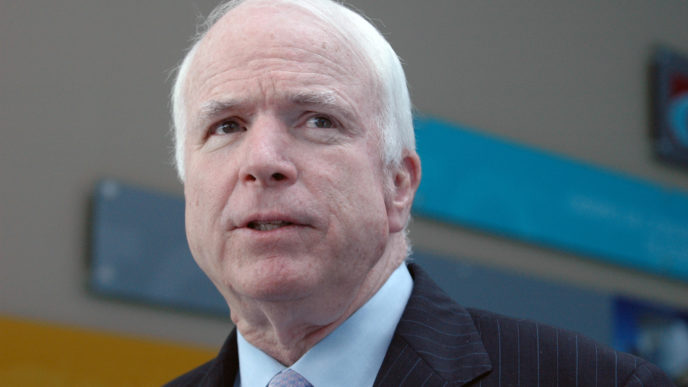
Both stories focus on the fact that incumbent Senate Republicans, such as Sen. Marco Rubio, R-Fla. (C, 77%) and Sen. John McCain, R-Ariz. (F, 34%) staved off primary challenges this cycle. But that’s not notable. What’s notable is that the Senate Majority Leader views success as killing the grassroots—which is exactly the attitude that fueled the fury and fracture within the GOP that ultimately installed Donald Trump as its presidential nominee.

The stories do not talk about how the McConnell and his allied political operatives guided candidates to address voters’ concerns and message a principled, winning agenda. The pieces seek to snuff out reliably conservative fundraising operations such as the Senate Conservatives Fund and the Club for Growth—groups that are a “shell of their former selves,” if you believe the Washington Post.

The gruel they’re serving up, however, is pretty thin.

For example, the Washington Post piece detailed how McCain was able to fend off his primary challenger by labeling her “Chemtrail Kelli Ward,” tying her to a conspiracy theory about airplane exhaust.

“It wasn’t pretty, but McCain won and Republicans have their best chance at keeping the seat in the red column in November,” the Washington Post story read. “It is a different story at the top of the ticket, and many establishment Republicans look at these Senate races as the petri dish for how to get a more palatable candidate in the next presidential primary.”

(Never mind that McConnell, along with McCain and the rest of the GOP establishment, are openly backing a non-palatable, conspiracy-theory espousing candidate for president. Or that the Club for Growth, which they ridicule, was one of the first conservative organizations to run ads opposing Trump’s candidacy.)

McConnell and his crew want people to believe they’re some kind of grand master strategists because they helped the GOP’s 2008 presidential nominee McCain—who possesses an incredible donor network, name ID, and history in his state—beat a weak, loony challenger who wasn’t even supported by SCF and the like.

In other words, they think we’re stupid.

McConnell hasn’t learned his lesson and likely never will. He believes he will ultimately be able to use Trump to tar all future conservative threats. One problem: that involves losing the White House for the third straight presidential election.

McConnell titled his recently-released memoir “The Long Game.” That must be because there’s still no victory in sight.

Republicans have been boxed out of the White House for two terms. While the GOP has been in the wilderness, the only constant leadership figure in Washington has been McConnell, who offers nothing but false victories, embarrassing displays of political expediency, and disdain for the base.

McConnell is arguably the person in Washington most responsible for making Trump the GOP nominee, who is poised to lose to the most disliked and distrusted Democratic presidential candidate in history — potentially dragging down scores of GOP candidates down with him.

Had the party produced any meaningful leadership in Washington, any respected figure that instilled unity within the ranks, or delivered results for conservatives, Trump probably would not have had an opening to launch his candidacy.

Remember, it was McConnell openly loathed the Tea Party’s influence over GOP’s historic 2010 and 2014 midterm wins and infamously told the New York Times he would “crush them everywhere” in the future. And, that’s what he did, save Nebraska where Sen. Ben Sasse, R-Neb. (A, 94%) prevailed against establishment forces to win his seat in 2015. It should be no surprise to anyone that Sen. Sasse is proudly #NeverTrump.

In short, if McConnell wants credit for crushing the Tea Party, he should get credit for the way Trump is crushing the GOP, as well. One is directly related to the other.

McConnell’s reign in Washington has been defined by three things: no leadership, no unity, and no results. Those three things that created the perfect storm for Trump to rise.

That’s certainly not anything to brag about. (For more from the author of “McConnell Thinks Were Stupid? Here’s the Lesson He Still Hasn’t Learned” please click HERE)

Follow Joe Miller on Twitter HERE and Facebook HERE.

Labor Day — Burgers, Brats and … Socialism?

How’s about some ketchup on that burger? It’s extra red. What about a pinch of socialist sauerkraut on that bubbling bratwurst Didn’t you know? That’s what your Labor Day barbecue was originally meant to commemorate: socialism. Delicious, juicy, smoky socialism with a side of potato salad (German, of course) and a game of Cornhole (everyone’s a winner!).

But hey, isn’t Labor Day really just all about celebrating the value of hard work? Actually, no. At least not originally. And no, I’m not being paranoid. The history of Labor Day is fascinating. And it really is rooted in socialism.

Don’t take this capitalist’s word for it. Marxist.com, a popular pro-socialism website, proudly exclaims, “The September holiday was conceived of and celebrated by socialists and militants within the labor movement, and we should remember and reclaim this history.”

Labor Day: A Brief History

The history stretches back at least to 1882 when a couple of socialists named Matthew Maguire and Peter McGuire, both members of the Socialist Labor Party, proposed an official workers’ holiday in New York to be called Labor Day. While historians differ over which man was principally responsible, the socialist pair had success, and on Sept. 5 of that year the United States saw its first official socialist Labor Day celebrated in New York City.

As the popularity of New York’s Labor Day gained momentum in urban centers across the U.S., Labor Day was declared a national holiday in June of 1894, to be held, like New York’s own, the first Monday of every September.

Whereas the rest of the socialist world celebrates Labor Day on May 1 (May Day), America has always marched to the beat of a different drummer. And so we — a nation made both the greatest and wealthiest in all of history through free-market principles, heretofore reasonably regulated, but, alas, regulated almost to death under our current administration — give our little nod to socialism on the last day of summer (appropriate, I think, as wherever there is socialism, the fall is not far behind).

And so, as we enjoy friends, family, food and fun this extended Labor Day weekend, let’s heed the advice of Marxist.com and remember that this holiday — this “workers’ paradise” for a day — was “conceived of and celebrated by socialists and militants within the labor movement.”

Socialists Started Labor Day, But They Don’t Get It

Socialists may have started Labor Day, but it’s Christianity and capitalism that best understand, dignify and magnify human labor.

It was the influence of Christianity, remember, that led the Christian West to gradually raise its view of common labor. As tough as the serfs of the middle ages had it, they were vastly better off, and with far more rights, than the slaves under pagan Rome. (See Rodney Stark’s The Victory of Reason for a good discussion of this.) Christianity elevated the status of common laborers partly by recognizing them as a fellow creatures made in the image of God, and by insisting that the Christian peasant was a brother in Christ.

Christianity also elevated common, manual labor by insisting that the material creation was rational and good (even if wounded by the fall), not something irrational and dark to be despised and avoided, as many pagans had believed. God after all, became flesh and dwelt among us. The incarnation dignifies the material world.

Finally, Christianity, by rejecting atheistic materialism, recognizes that the labor of the office clerk, the banker and the entrepreneur is also real labor, even if you don’t see them shaping physical things with their hands. Christianity gets this right because, unshackled from the shortsightedness of materialism, it understands that the immaterial labors of the mind are as real as the creations of the brick layer or steel worker.

These insights, taken together, helped birth capitalism in the West, which has lifted literally billions out of extreme poverty, even as the false vision of socialism has impoverished, and stranded in poverty, tens and hundreds of millions.

So, yes, the socialists started Labor Day, and if they have their way, they’ll ruin labor. If we intend to stop them, we have our work cut out for us. (For more from the author of “Labor Day — Burgers, Brats and … Socialism?” please click HERE)

Follow Joe Miller on Twitter HERE and Facebook HERE.

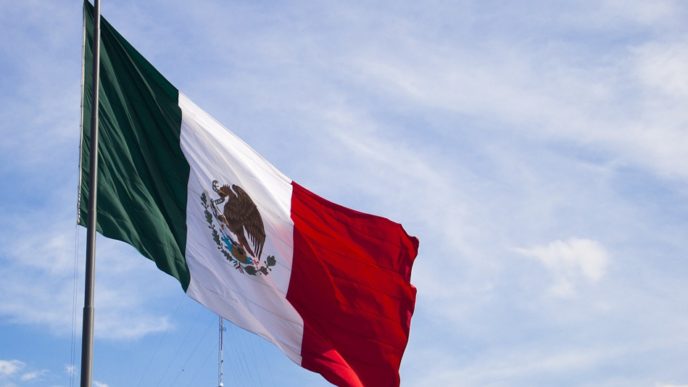
What Trump Could Learn From Studying Mexico’s History

Donald Trump’s visit to Mexico has captured the headlines, and seems like a smart piece of political strategy. It suggests that he understands the need for dialogue, and the fact that our southern neighbor is far too important to America’s national interest for a president to treat it as a handy campaign pinãta. Just imagine if Mexico became not merely uncooperative but actually hostile, and cozied up to Russia or China: We’d face a replay of the Cuban Missile Crisis.

Trump’s speech on immigration was stirring, detailed and smart. It focused rightly on America’s national interest and the needs of the least among us: crime victims, less skilled workers and hard-pressed honest taxpayers, all of whom suffer from our uncontrolled national borders.

His having met with that country’s leader, let us hope that Mr. Trump embarks on a deeper study of Mexico’s people and history, from which he could draw a long list of valuable lessons in politics and governance. Sadly, most of those lessons would be on what to avoid.

What Happened to Monterrey, Mexico?

Mexico is a vast, complex, and beautiful country full of hard-working people of enormous creativity and faith, which has for most of its history been crassly misgoverned — wasting its great potential, and driving millions to flee their homes for America, in defiance of our just and democratically enacted immigration laws.

I’ve only visited Mexico once, in 2000. I stayed with Catholic activists in the city of Monterrey, which was then one of Mexico’s most prosperous cities. People called it “Mexico’s Dallas.” Apart from the gorgeous architecture and delicious food, the thing that stayed with me most was our drive through the city’s slums. The houses were small and fragile-looking, crowded too close together. But most were carefully maintained, freshly painted, and festively decorated. These people, however poor, insisted on their dignity.

Since then, Monterrey has been devastated by drug cartels, whose heavily armed and utterly ruthless soldiers think nothing of gunning down police captains, mayors, and thousands of civilians. I wonder what those humble homes I saw in 2000 look like today, and how their inhabitants are faring. I wonder how many were willing to break America’s laws to come here.

Mexico Inherited Bad Political Philosophy From Spain

That one city is a microcosm of Mexico as a whole. The stark contrast between American and Mexican history can be traced all the way back to the culture and politics of the nations that colonized them. The English who settled in North America came from a kingdom where the Magna Carta had prevailed for more than 300 years, guaranteeing due process and property rights. Its monarch’s rule was dependent on the consent of the English Parliament. Local government was strong, and much of the power decentralized. The English Reformation, for all the cruelty that was practiced on both sides, had underlined the need for restraints on royal power, as non-conforming Protestants cited medieval, Catholic precedents in Common Law to protect their political and religious freedom.

By contrast, the Kingdom of Spain had made itself religiously homogeneous in 1492 when it expelled the last Jews and Muslims. In 1520-21 the Spanish Crown crushed the revolts of localists. Its kings repealed the fueros (Spanish Magna Cartas) that had once guaranteed the rights of citizens and small communities. Spain’s kings rejected as inefficient and antiquated medieval restraints on monarchs, and governed according to the new and “modern” theory of absolute monarchy. Order was not seen as something that grew organically from the ground, but as a magnetic force that proceeded from a single all powerful center, in Madrid.

This contrast in political philosophies set the tone for the histories of two nations. While English colonies developed vibrant town councils and state legislatures, mostly rejecting attempts to impose royal governors from England, the provinces of New Spain were run by appointees arriving from Spain. The initiative for laws came not from the citizens of Mexico City or Monterrey, but from faraway Madrid.

Nor did the Spanish legal system provide the same robust protections for property rights as English citizens — and colonists — could rely on. Read the Peruvian economist Hernando de Soto (cited here at The Stream) on how crucial property rights are to raising people from poverty and supporting the rule of law.

Town Meetings in New England, But Not in New Spain

When England tried to impose protectionism for its own benefit on the residents of its colonies, their local governments resisted, and winked at citizens smuggling to avoid such crippling tariffs. By contrast, New Spain’s governors were perfectly willing to govern that province in Spain’s (not New Spain’s) interests, suppressing whole industries if Spain found the competition obnoxious. The path to wealth in New Spain lay through royal patronage and vast land grants, not industry or commerce.

When the United States and Mexico cast off their colonial masters, each followed for the most part in the tracks which their past had lain down. While the American founders built into their Constitution elaborate checks and balances, and preserved most taxing and governing power for states and even towns, the elites who seized power in newly founded Mexico continued to act like Spanish grandees, seeing those whom they governed not so much as citizens but as subjects — especially the large majority of Indian and mixed-race residents, who had little voice in governance. (Of course, in America we persecuted our Indians and imported African slaves — our hands are by no means clean.)

It was only the Catholic Church that preserved some land for Indians, land that ambitious descendants of the Conquistadors would gradually steal, in the name of “freeing” Mexico from the dominance of the Church. The periodic revolutions and coups d’etat that marked the transitions of power in Mexico were not philosophically driven movements like the American Revolution, but mostly the acts of strongmen like General Santa Anna who sought unaccountable power. Sometimes they used that power, as in the 1920s, to persecute clergy and churchgoers — trying to break the back of the only institution that could resist the centralized state. The faithful priests and peasants who took up arms in resistance (the Cristeros) nearly toppled that evil government.

Nationalism, Populism, Protectionism: 3 Imports America Doesn’t Need

Through all these historical traumas, the hard-working and long-suffering people of Mexico have forged a powerful sense of their own nationhood, which ideologues sometimes have fanned into intolerant nationalism. The socialist Party of Institutionalized Revolution rode such sentiments to power. In 1938 it seized the property of the (foreign-built) oil industry and turned it into a crony capitalist monopoly; then it harshly restricted the influx of foreign capital. Such economic populism, whether practiced in Mexico or Argentina, has a predictable effect: It starves local industries of much-needed investment, and helps make a few fat cats rich, while impoverishing the majority.

It’s ironic, then, that Donald Trump has made so much political hay from criticizing Mexico. In many ways the political impulses he has tapped into throughout his campaign are examples of what went wrong in Mexico. Economic populism; protectionism; angry reactive nationalism; impatience with the separation of powers and the rule of law; and the willingness to override property rights (see eminent domain): these are the hallmarks of Mexican political history, which produced a struggling country whose citizens are fleeing its cities to move to ours.

Nevertheless, as Trump said eloquently and accurately in his policy speech on immigration, the U.S. is the aggrieved party in the immigration crisis. While our neighbors in Mexico deserve our goodwill, respect and prayers, their country is in fact rife with social problems that we should not be importing in the form of millions of low-skill migrants whose political and social expectations have been formed by crony socialism. (For more from the author of “What Trump Could Learn From Studying Mexico’s History” please click HERE)

Watch a recent interview with the author below:

Follow Joe Miller on Twitter HERE and Facebook HERE.
Corrupt Media Wouldn’t Care If Hillary Handed out Suitcase Nukes as Party Favors at Clinton Foundation Events

Where does media bias come from?

Anyone who really wanted to know had that question answered when much of the media took a break from attacking Trump to attack the Associated Press. What does the AP have in common with Trump? Both were hurting Hillary Clinton’s chances to score payoffs from dictators, arms dealers and tycoons with terrorist ties for the next four to eight years.

The Associated Press got in trouble with the rest of the media for digging up dirt on the Clinton Foundation. Instead of just repeating the usual Clinton denials, it actually ran the numbers and noted that more than half the “ordinary folks” who got meetings with her had donated to her Foundation.

Instead of reporting on the AP story, the media went to war on its own. It wasn’t just the usual suspects like Vox and Slate who have a reputation for attacking any actual reporters who stray off the reservation and actually do their jobs. This time all the big boys were on the job.

CNN called in AP’s Kathleen Carroll to barrage her with classic ‘Have you stopped beating your wife’ loaded questions like, “Did you feel the pressure to publish something even though so many critics have said it didn’t amount to much?” A better question might be why CNN didn’t inform viewers that its parent company was a Clinton Foundation donor. But that would be practicing journalism.

Instead CNN offers gems like, “AP’s ‘Big Story’ on Clinton Foundation is big failure”. A high school paper could have come up with a cleverer putdown, but in this brave new world in which media companies donate to front groups for presidential campaigns and then denounce stories exposing their corruption there are no more new ideas, just organized spin sessions.
If you didn’t like the AP headline, try Vox’s “The AP’s big exposé on Hillary meeting with Clinton Foundation donors is a mess.”

Yes, they are all reading from the same script.

The New York Times initially blacklisted the story. Then it came out with a call for Hillary Clinton to cut ties with the Clinton Foundation. That’s like asking Al Capone to cut ties with the mob.

But the Times might have started out by cutting its own ties to the Clinton Foundation.

Carlos Slim, the Mexican-Lebanese billionaire who keeps the lights burning at the New York Times HQ, gave the Clinton Foundation anywhere from 2 to 10 million dollars. Then there’s the six figure sum that Hillary picked up for delivering one of her comatose speeches about something or other in a robotic monotone.

It wouldn’t do for his Manhattan investment property to undermine his Washington D.C. investment property.

The Times tremulously urged Hillary to cut ties with the organization she had used to fuel her political ambitions, worrying that, “If Mrs. Clinton wins, it could prove a target for her political adversaries.”

Could prove? If the New York Times occasionally bothered to report the news, it would have noticed that it already had. But the Times isn’t worried about ethics, legality or national security. Instead it, incredibly, asks Hillary to act to protect her agenda and reputation from her own crimes.

That’s like asking an embezzler to quickly burn his second set of books before the cops catch him.

The New York Times doesn’t give a damn if foreign interests buy the White House. Its only concern is to protect Hillary from Republican attacks. And this overt bias is actually downright moderate.

It’s almost noble compared to the Washington Post, another Clinton Foundation donor, which fired off one attack after another. There was this cheerfully breezy masterpiece which read like North Korean propaganda written by a Portland hipster, “AP chief on patently false Clinton tweet: No regrets!” (For more from the author of “Corrupt Media Wouldn’t Care If Hillary Handed out Suitcase Nukes as Party Favors at Clinton Foundation Events” please click HERE)

Follow Joe Miller on Twitter HERE and Facebook HERE.
Separating the Value of Black Lives From the Black Lives Matter Movement

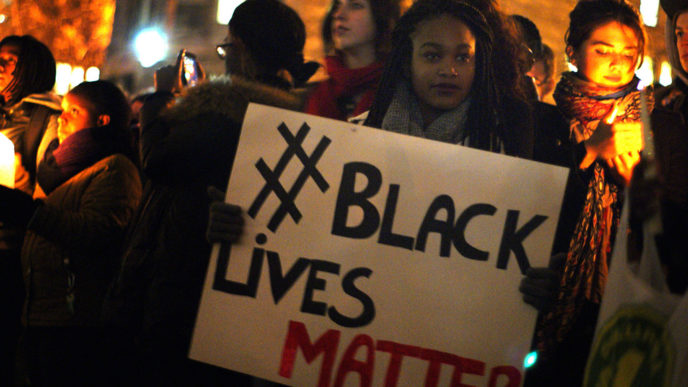
Did you know that if you support the Black Lives Matter movement — as in the official, BlackLivesMatter.com website — you are not only standing with black Americans but also standing with a radical social agenda including queer and transgender activism along with the disrupting of the nuclear family?

Before I demonstrate this to you, allow me to explain the purpose of this article. I write with the goal of standing with my African-American brothers and sisters for true and full equality in America while encouraging them to distance themselves from leaders and movements who do as much harm (if not much more harm) than good.

NFL quarterback Colin Kaepernick, whom I recently addressed over this very issue, would do well to heed this warning.

But first, a moment of personal background for those who do not listen to my daily talk radio show, the Line of Fire.

For several years now, God-fearing, law-abiding African-Americans have called the broadcast and, with great respect and humility, told me that I have no idea what it’s like to be a black American, that I have no idea how much racial prejudice still exists in our country, and that I have no idea how many obstacles black Americans still face.

I for one don’t doubt what they’re saying, which is why I spoke of the “very real challenges faced by African-Americans” in my open letter to Kaepernick, also mentioning the “very real problems that do exist in America, including issues of racial discrimination and injustice.”

The perspective of my callers was echoed by Dr. Brian Williams, one of the doctors who tried to save the lives of the Dallas policemen who were assassinated by an African-American shooter in July. Speaking as both a doctor and a black American, Dr. Williams said, “This is much more complicated for me personally.”

As he explained, “There’s this dichotomy where I’m standing with law enforcement, but I also personally feel that angst that comes when you cross the path of an officer in uniform and you’re fearing for your safety. I’ve been there, and I understand that.”

And yet there he was in anguish, trying to save the lives of these officers, men whom, in a different setting, he would have unduly feared.

As a white American, I cannot relate to this personally, although I grew up in the most open-minded household you could imagine, with my first organ teacher being openly gay (he and his partner would often stay for dinner with the family) and my second organ teacher being a black man who was married to a white woman, which cost both of them dearly in the 1960s.

The fact is that I have never been racially profiled and I have not faced some of the challenges that many of my black brothers and sisters have faced, all of which brings me to say this: I am glad that we are revisiting the question of racial injustice in America but I believe that movements like Black Lives Matter are hurting the cause more than helping it.

In similar fashion, as stated in my open letter, I have no issue with Kaepernick wanting to take a stand for his beliefs. I simply believe he’s using the wrong setting and putting an emphasis on the wrong issue.

Has he himself been negatively influenced by Black Lives Matter?

According to FoxNews.com, “NFL quarterback Colin Kaepernick’s conversion to social activism coincided with his romancing of a hip hop DJ of Egyptian descent [Nessa Diab] who has frequently spoken about perceived racial injustices and ‘Islamaphobia’ in the U.S.” (There are also reports that he has converted to Islam, but these have been disputed.)

Diab is popular on MTV and is associated with Islamic activism and with the Black Lives Matter movement, which would help to explain the change in Kaepernick’s Instagram account in the four months it has been in existence.

Initially, most of his posts centered on him playing football. “But 31 of his last 42 posts have strong social justice connotations, often featuring quotes from radical Nation of Islam leader Malcolm X, Black Panthers founder Huey Newton and cop killer Assata Shakur. During a Sunday news conference about the flag flap, Kaepernick dressed in a black hat with a large, white ‘X’ and a T-shirt that featured photos of Cuban despot Fidel Castro and Malcolm X.”

What about the Black Lives Matter movement itself? Not only is it allegedly supported by extreme leftists like George Soros, and not only have some of its foundational myths been exposed, but it forthrightly proclaims its radical social agenda on its website for everyone to see. How many have taken notice?

Under its guiding principles page, along with subjects like Loving Engagement (which does not overtly call for non-violent resistance but does make a positive statement), there are also headings like this: Black Villages: “We are committed to disrupting the Western-prescribed nuclear family structure requirement by supporting each other as extended families and ‘villages’ that collectively care for one another, and especially ‘our’ children to the degree that mothers, parents and children are comfortable.”

So, this movement opposes the very structure which is most under attack in black America today — namely, the nuclear family — also failing to mention “fathers” by name (note the references to mothers, parents, and children, but not fathers). What kind of social madness is this?

Other guiding principles include being Queer Affirming, under which heading it is affirmed that, “… When we gather, we do so with the intention of freeing ourselves from the tight grip of heteronormative thinking …” There is also the call to be Transgender Affirming, where it is explained that, “… We are committed to being self-reflexive and doing the work required to dismantle cisgender privilege and uplift Black trans folk ….”

Is this really a movement that can represent African-Americans nationwide? I think not.

That’s why it’s essential for those who really want to address questions of social injustice — be it the effects of the Democrat-led welfare system or apparent disparities in prison sentences or other apparent injustices — to distance themselves from the Black Lives Matter movement and take a reasoned stand for righteousness.

As you do, I’m standing with you, shoulder to shoulder, as best as I can. (For more from the author of “Separating the Value of Black Lives From the Black Lives Matter Movement” please click HERE)

Watch a recent interview with the author below:

Follow Joe Miller on Twitter HERE and Facebook HERE.
Use These 3 Strategies to Talk to a Liberal About Income Inequality

The phrase “income inequality” has a lot going for it. It’s catchy and memorable, and “inequality” breeds an immediate emotional response—contempt for the existence of an unfair policy and outrage that people might support it.

Those who cry out in favor of ending it have successfully packaged their indignation as a pep rally for the masses; those who cry out against the existence of “income inequality” are seen as selfish and uncaring.

That’s quite a narrative to change, but it’s not impossible. They might have a good phrase, but you have a great argument.

Building on the strategies we’ve outlined in previous weeks, here’s how you can have a conversation with a liberal about “income inequality”:

1. Common Ground

It may be easy to dismiss someone who is preaching from an economic handbook that’s a few shades closer to socialism than you’ll ever be. But don’t throw the baby out with the bathwater when talking with someone about “income inequality.”

More than likely, the common ground here is that you, on both sides of the argument, want everyone to have an equal chance at living the American dream. That’s a good, solid piece of common ground if your aim is to see that no one is unfairly disadvantaged.

2. Examples

Most important is to expose the myth that the pie is only so large and the rich get rich at the expense of the poor. The best way to do so is by using examples with a focus on the issue of income mobility—or, in other words, are we making it easier for all people to climb the economic ladder?

Those beating the drum of income inequality to the tune of the rich paying their “fair share” often neglect the fact that the “rich” includes small business owners (by the way, usually not millionaires or even close). The more money small business owners have to pay in taxes to the government, the less money they can pay their employees, which leads to layoffs and/or the closing of businesses. And fewer jobs help no one, least of all those struggling to make ends meet. If you know of a business in your community that’s closed its doors because of too-high taxes, talk about it. It will resonate with those who want to stand up for local businesses.

Another good example points to the real reason the poor remain poor—burdensome regulations that make it difficult to start businesses. The Daily Signal highlighted this issue a couple of weeks ago. All Lata Jagtiani wanted to do was make an honest living using her skill of eyebrow threading, but due to unnecessary regulations in her state requiring hours of training for something she already knew how to do, she was ultimately prevented from serving her clients. In the name of “safety,” Jagtiani wasn’t able to make a living and a valuable service was withheld.

3. Words

While the words “income inequality” aren’t threatening on a piece of paper, we know the phrase means something entirely different in political conversation since being hijacked by the big government side. Using this short phrase in a void isn’t a bad thing—but we all know we aren’t in Kansas anymore, Toto.

If you’re trying to fight the bad policy that stands behind the phrase “income inequality,” a good place to start is to use different language—language that speaks to the heart of what you’re trying to say.

Use phrases like “equal opportunity,” “hard work,” or “achieve the American dream” to better illustrate your point—it’s more effective to give someone the opportunity to succeed instead of handing out freebies. Also, talk about making it easier for all people to climb the economic ladder (ahem—income mobility) as a way to help your audience better visualize what you are talking about.

So, don’t shy away from a topic that can be tricky to navigate. Embrace the common ground of the American dream, use examples that show government interference is causing the poor to stay poor, and use the right words to unify instead of polarize. (For more from the author of “Use These 3 Strategies to Talk to a Liberal About Income Inequality” please click HERE)

Follow Joe Miller on Twitter HERE and Facebook HERE.

John McCain Is in the Fight of His Political Life in the Age of Donald Trump

After 30 years in the Senate, during which he transformed himself from war hero into political icon, John McCain now finds himself in more jeopardy than at any time during his political career. And for much of that, he can blame Donald Trump.

This reelection campaign, his fifth, is forcing the Arizona Republican to do battle on multiple fronts, testing his political dexterity in ways unlike any of his previous races, including two unsuccessful bids for the presidency.

First he must clear his primary Tuesday, a day after he turns 80, against an arch-conservative whose campaign received a late six-figure boost from a Trump donor. Then, assuming he wins the nomination, he must move into a general election just two months away against a well-funded Democrat, U.S. Rep. Ann Kirkpatrick, whose campaign is wrapping McCain’s support for Trump around the veteran Republican’s neck in a bid to drive up Latino turnout.

McCain insists that he will not alter his high-wire campaign strategy, which basically involves steadfast support for Trump while also reserving the right to regularly criticize the GOP nominee when he does or says something objectionable. (Read more from “John McCain Is in the Fight of His Political Life in the Age of Donald Trump” HERE)

Follow Joe Miller on Twitter HERE and Facebook HERE.
3 Ways Obama’s New Overtime Rule Will Hurt Employees

In an alleged attempt to increase the income of certain salaried employees, the Obama administration issued a new overtime rule, set to take effect Dec. 1., that will almost certainly do more harm than good for the employees it seeks to help.

Currently, employers only have to pay the overtime time-and-a-half rate to salaried employees who make less than $23,660 per year (as well as some who make more but don’t have sufficiently advanced job duties). The new rule more than doubles the pay level subject to overtime to $47,476.

This effectively means that many salaried employees can’t be paid to get a job done, but must instead be paid based on their hours.

Beginning in December, employees who make less than $47,767 a year must keep track of their hours and their employer must pay them time-and-a-half for any work over 40 hours per week.

Seems like it could benefit employees through higher pay, right? That’s what the Obama administration thinks. It claimed the rule will increase pay by an average of $1.2 billion per year across roughly 4.2 million workers (an extra $285 per worker).

But that assumption defies the economic literature. It effectively assumes employers have an extra $1.2 billion in spare change that they can dole out to employees without consequence.

Even left-leaning economists Jared Bernstein and Ross Eisenbrey acknowledge that’s not the case. They write that additional overtime costs “would ultimately be borne by workers as employers set base wages taking expected overtime pay into account.”

Another option for keeping total costs constant is to shift employees to hourly rates.

In the end, employees are likely to lose desired job flexibility and income dependability, and will likely have no additional income (maybe even less) to show for it:

1. Lost Flexibility. In today’s more service-oriented economy, the previous eight-hour work day has become less common as employees shift hours between days and weeks, and often perform work—such as responding to emails—outside the office and outside normal business hours. This flexibility gives employees greater autonomy and a better work-family balance. If employers must keep track of their employees’ hours and pay them time-and-a-half for any work over 40 hours in a given week, employers will limit employees’ flexibility. No more staying late a few nights one week in exchange for leaving early the following week, no more working from home where hours are more difficult to track, no more logging extra hours to cover for a co-worker (who would do the same in exchange), and potentially no more—or fewer—paid vacation days.

2. Less Stable Incomes. Salaries are beneficial for employees and employers alike. Salaries provide certainty of cost for employers and certainty of income for employees, allowing both to properly budget their resources. Salaries also allow employees to be paid to get a job done as opposed to having to log a certain number of hours. Many workers log fewer than 40 hours during less busy weeks or seasons and more than 40 hours in busy periods. Because most employers can’t afford—at least not without consequence—to pay employees with variable hours their existing base salaries as well as time-and-a-half when they work more than 40 hours, they will likely shift those employees to an hourly rate that results in roughly the same income for the year. But most employees prefer a regular paycheck over variable ones. After all, their mortgage or rent and most other expenses don’t vary from month-to-month.

3. Excessive Compliance Costs Likely to Reduce Wages. The Obama administration estimated employers will spend $295 million per year complying with the new regulation. The rule is unlikely to raise average wages as employers will reduce base pay or shift employees to hourly pay. But even if the rule raises wages by the administration’s unlikely estimate of $1.2 billion per year, $295 million in compliance costs amounts to an outrageously high 25 percent administrative fee. Those compliance costs will almost certainly be passed onto employees through lower wages.

Rather than intervene in mutually advantageous salary arrangements between employers and employees, the government should let employees agree to be paid to get a job done. The Obama administration’s paternalistic approach will ultimately hurt the employees it aims to help by limiting job flexibility, reducing income certainty, and potentially reducing incomes through excessive compliance costs. (For more from the author of “3 Ways Obama’s New Overtime Rule Will Hurt Employees” please click HERE)

Follow Joe Miller on Twitter HERE and Facebook HERE.

The Trump-Russia Link: Notable. The Hillary-Russia Web: Huge.

Obama’s Justice Department is investigating both the Hillary Clinton campaign and the Donald Trump campaign for possible ties to corrupt funding traceable back to Russian Vladimir Putin’s regime. While Trump’s alleged involvement through his campaign manager has been extensively covered by the media, forcing that campaign manager to resign, far less ink has been spilled over Clinton’s extensive connections.

Skolkovo, a research facility known as Russia’s version of Silicon Valley and partially funded by the Russian government, contributed tens of millions of dollars to the Clinton Foundation while Hillary Clinton was secretary of state. The Obama administration’s plan was to help Russia create its own version of Silicon Valley. Obama claimed he wanted to “reset” U.S. relations with Russia. Clinton Cash author Peter Schweizer revealed that Clinton was behind it, asserting that “no cabinet official in the Obama Administration was more intimately and directly involved in the Russian reset than Hillary Clinton.”

Schweizer published a report in June with the details, entitled From Russia With Money. He found that 17 of the 28 American, European and Russian companies that participated in the Skolkovo initiative were Clinton Foundation donors such as Google and Intel, or sponsored speeches for former President Bill Clinton. Some on the Russian side of the Skolkovo initiative also contributed to the Clinton Foundation.

ClintonTrump-Russian-Funding-Chart-1-900

Clinton’s Campaign Manager, John Podesta, Also Did Quite Well With Russian Money

The FBI warned technology companies to avoid the Skolkovo initiative due to concerns that Russian companies backed by Putin’s government wanted to gain access to “classified, sensitive, and emerging technology” from U.S. tech companies. But undeterred by the warning, Clinton’s campaign manager, John Podesta, went ahead and served on the Skolkovo board representing Joule Energy, a solar company based in the Netherlands.

Two months after Podesta joined the foreign firm (which included senior Russian officials), a $35 million transfer came in from Rusnano, an investment firm founded by Putin. One of the investors in Joule was Hans-Jorg Wyss, a major Clinton Foundation donor. Podesta consulted for a foundation run by him.

Podesta, who formerly served as chief of staff to Bill Clinton, failed to disclose his position on the board of this offshore company in federal financial reports, as appears to be clearly required by law, prompting the FBI investigation. Additionally, while serving in that position he headed the left-wing think tank Center for American Progress, which wrote favorably about the Russian government, apparently in exchange for money secretly funneled to the organization by Russians, according to Schweizer. The organizations in the trail of money have ties to Russian oil and gas companies, which opposed U.S. efforts to explore fracking and natural gas.

ClintonTrump-Russian-Funding-Chart-2-900

How Many Pay-to-Play Schemes are Connected to the Clinton Foundation and the Putin Government?

Schweizer’s report alludes to numerous apparent quid pro quos like this one. “The other senior State Department official involved in the Skolkovo process was Lorraine Hariton,” he writes, “the State Department’s Special Representative for Commercial and Business Affairs. (Hariton served on Hillary Clinton’s National Finance Committee during the 2008 campaign.)”

I have previously covered other similar pay-to-play operations involving Clinton’s revolving door between the state department and the Clinton Foundation. Congressional members are now demanding an investigation into a large transfer of money to the Clinton Foundation made by the Russian owner of Uranium One, which was timed when Clinton gave authorization as secretary of state for him to buy the company.

Trump’s Campaign Manager was Demoted and Resigned After His Russian Ties Were Exposed

Trump has also been criticized for hiring a presidential campaign manager, Paul Manafort, who has ties to funding from the Russian government, specifically, by way of his connection to a former pro-Russian Ukrainian regime. However, Manafort was only in that position for four months, and resigned Friday from the campaign due to the controversy.

In 2012, Manafort and one of his associates helped the Ukrainian organization European Centre for a Modern Ukraine, which included members of then-president Viktor Yanukovych’s ruling party, direct money to Washington firms to lobby Congress for the benefit of Yanukovych. (Yanukovych was eventually forced out due to corruption and fled to Russia.) Like Podesta, Manafort was criticized for failing to notify the Department of Justice as a lobbyist about ties to foreign parties and leaders. Regardless, the FBI has said Manafort is not the target of their investigation.

ClintonTrump-Russian-Funding-Chart-3-900

Podesta Blames the Client

The Podesta Group also represented Centre for a Modern Ukraine. The lobbying firm is now threatening to turn on its own client, issuing this statement,

The firm has retained Caplin & Drysdale as independent, outside legal counsel to determine if we were misled by the Centre for a Modern Ukraine or any other individuals with regard to the Centre’s potential ties to foreign governments or political parties. When the Centre became a client, it certified in writing that “none of the activities of the Centre are directly or indirectly supervised, directed, controlled, financed or subsidized in whole or in part by a government of a foreign country or a foreign political party.” We relied on that certification and advice from counsel in registering and reporting under the Lobbying Disclosure Act rather than the Foreign Agents Registration Act. We will take whatever measures are necessary to address this situation based on Caplin & Drysdale’s review, including possible legal action against the Centre.

It remains to be seen whether Podesta will resign as Clinton’s campaign chair. Unlike Trump, Clinton doesn’t seem to have a problem with her campaign manager’s deals, perhaps because she was heavily involved with the same type of activity herself. Tellingly, Trump replaced Manafort with Breitbart News chief Steve Bannon, who made Schweizer’s Clinton Cash into a documentary. It sends a strong message as to how Trump will treat covert funding from Putin’s government. (For more from the author of “The Trump-Russia Link: Notable. The Hillary-Russia Web: Huge.” please click HERE)

Watch a recent interview with the author below:

Follow Joe Miller on Twitter HERE and Facebook HERE.
HEY, DEMOCRATS: Capitalism Works, If Government Lets It

A seemingly accelerating trend with many Americans is to look with skepticism and a jaundiced perspective at business, capitalism, and the profit motive. In spite of efforts by some to rewrite history, those of us who are students of history recognize that capitalism made America the economic superpower that it is. And the more we allow government to interfere in our economy, the more we move toward a fascistic system where government controls the means of production.

Business and the profit motive have turned us from an agrarian to a high-tech producing and consuming nation. All of us are dependent upon business and the profit motive for everything we do every day. From the manufacturer of the bed we arise from and the alarm clock we wake up to, to the toothpaste, shampoo, and comb we use in the morning. The beverage we imbibe to give us a kick-start in the morning and the vehicle we drive to work are products of once small businesses that have grown sometimes to global proportions. If any of those products or services we depend on get too expensive, we start shopping for cheaper alternatives. That’s capitalism in a nutshell.

Most of us even work for a small business driven by the profit motive. Those firms, created and managed by entrepreneurs, market and sell products, provide advice and services, and fill the needs of people from all walks of life. They pay us to fill a specific function within the company to help them service their customers more efficiently and cost-effectively. And most of them pay another 30% of our salaries or wages in the form of benefits to help retain quality employees. And according to Arthur Brooks of Syracuse University an amazing 89 percent of us are very satisfied or somewhat satisfied with our jobs.As a matter of fact, according to the Small Business Administration, small businesses represent 99% of all employer firms, employ half of all private sector employees, pay 45% of total U.S. private payroll, generate 80% of new jobs annually, create more than 50% of nonfarm private GDP, comprise 97% of all identified exporters, and produce 26% of the known export value to our GDP.

Yet every time new governmental regulation is imposed on businesses, the costs increase. Whenever the government increases taxes on companies, the costs increase again. In order to stay in business, they must pass those costs on to their customers, or find other ways to reduce costs like eliminating jobs. That’s why it makes no sense to tax companies since we all end up individually paying their taxes via increased prices for their products and services.

And it’s not just small business that makes our quality of life what it is, but the brother of small business; BIG business. It’s not an evil concept, to sell things that people want and need at prices that most people can afford, so they can sell as much or as many as possible, applying the economies of scale. And they do so with a profit motive in order to share their success with those who ponied-up the capital, (investors, silent partners, share-holders) facilitating their business ventures. Remember, if they over-price their widgets, they price themselves out of the market. If they underprice their widgets, they’re not going to remain viable, and will have to lay off employees and won’t be able to pay all those taxes the government is requiring of them. Then their employees will have to hope they can find another widget company to replace the job they lost.

The media, Hollywood, and even some of our fellow citizens bash “big pharma,” big oil, or big retailers like Wal-Mart. But in reality what do those “big” evil companies do? They provide needed products and services at reasonable prices, and jobs, enabling our national economic engine, and our quality of life, to keep chugging along. They have limited control over much of their expenses, but to be able to continue doing what they do, they achieve a modest profit to ensure their viability in future years, and allow us to have a job.

When politicians promise “free stuff” at the expense of taxpayers, they’re doing nothing more than attempting bribery – they promise free stuff for our votes. And it’s not their free stuff. It’s stuff they promise to use governmental coercion to forcibly take from others, in order to redistribute to those they’re bribing.

It’s no wonder that Bernie Sanders, who nearly captured the Democrat nomination, (and would have if the DNC had not colluded with the Clinton campaign) garnered the support he did as the self-avowed socialist peddled collectivist promises for populist electoral support.

And Hillary Clinton is no less ideologically aligned with socialistic solutions. A disciple of Saul Alinsky, and the first architect of a socialized healthcare system for the U.S., she has made some brash statements over the years that reveal her ideological convictions. Among her many anti-capitalist statements are these nuggets. “We’re going to take things away from you on behalf of the common good,” (6/29/04). “It’s time for a new beginning, for an end to government of the few, by the few, and for the few and to replace it with shared responsibility for shared prosperity,” (5/29/07). “(We) … can’t just let business as usual go on, and that means something has to be taken away from some people,” (6/4/07). “I certainly think the free-market has failed,” (6/4/07).

The brilliant economist, Thomas Sowell, has philosophically put the failed socialist ideology into proper perspective. “I have never understood why it is ‘greed’ to want to keep the money you’ve earned, but not greed to want to take somebody else’s money.” “Much of the social history of the Western world, over the past three decades, has been a history of replacing what worked with what sounded good.” And for academics who are smitten with the failed ideology, “Socialism in general has a record of failure so blatant than only an intellectual could ignore or evade it.”

Too many of us rely on fallacious populist typecasts of what business and the profit motive do, rather than relying on our empirical observations of their contributions to our quality of life and economic viability. We allow the media, Hollywood, or anti-business kvetching to taint our perceptions with a failed, yet idyllically appealing narrative of “equality” or “social justice.”

PragerU has produced an insightful clip that explains this perfectly. It can be seen here.

The profit motive, capitalism, and free enterprise, are the backbone to our economic system, and as such, are the key to future growth and prosperity, individually and collectively. Government encroachment and increased regulation stymie future potential growth, our quality of life, and our job security. It’s time for Americans to quit buying (with their votes), what self-serving politicians promise for them. Less regulation, less taxation, less government spending, and less government control is the solution for future economic growth and security. (For more from the author of “HEY, DEMOCRATS: Capitalism Works, If Government Lets It” please click HERE)

Follow Joe Miller on Twitter HERE and Facebook HERE.