WATCH: Trump’s Compelling Super Bowl Ad Ignores Two Key Economic Realities

Super Bowl viewers hoping for a break from partisan bickering and politics are in for a disappointment. Democratic presidential candidate Michael Bloomberg bought a commercial for the widely-watched event and decided to use his chance to reach millions of Americans to push misinformation and fearmonger in favor of his anti-gun agenda. Meanwhile, President Trump tapped into his war chest to run an ad of his own, making the case for his reelection.

Trump spent $11 million on the commercial, which emphasizes his strong economic record. It highlights the record-low unemployment rate we’ve seen during this administration, as well as burgeoning wage growth and strong economic prospects for African Americans and Hispanics. The president makes the case that voters should back him because “the best is yet to come.”

As my Washington Examiner colleague Tiana Lowe noted, it’s a strong ad with the right focus. Trump is wise politically to focus on the economy, rather than repeat his 2018 midterm mistake and make 2020 about anti-immigration sentiment. And the president absolutely does deserve credit for the successful economic results we’ve seen in part due to his tax cuts, deregulatory agenda, and pro-business policies. But, as most political ads do, Trump’s commercial leaves out a few key economic realities that voters ought to be aware of.

For one, Trump has completely, utterly failed to reign in the national debt and the annual budget deficit.

On the campaign trail in 2016, he promised to eliminate the debt entirely within eight years. (A very, very unrealistic promise.) Instead, we’re back up to $1 trillion annual deficits, bloated budget deals, and woeful future fiscal projects from the Congressional Budget Office. This isn’t entirely Trump’s fault, as both parties’ leaderships in Congress deserve serious demerits for such reckless spending as well, yet, it’s a blight on his tenure nonetheless, especially in light of the unrealistic promises he made. (Read more from “Trump’s Compelling Super Bowl AD Ignores Two Key Economic Realities” HERE)

Follow Joe Miller on Twitter HERE and Facebook HERE

John Roberts Is Finally Doing Something Constitutional

If you had to ask almost every modern judge how they would describe their jobs on the federal bench, they’d most likely offer the answer articulated by Chief Justice John Roberts during his confirmation hearings. “I will remember that it’s my job to call balls and strikes and not to pitch or bat,” said Roberts in his famous baseball analogy during his opening statement before the Senate Judiciary Committee in 2005.

But this is actually a dangerous expansion of judicial power, because the Constitution accords him no such power to serve as the final arbiter of broad political questions. The one place the Constitution does grant him that authority as an umpire? During impeachment.

Conservatives were outraged yesterday when Roberts, presiding over the impeachment trial as chief justice, “struck down” one of Rand Paul’s questions to the parties at the trial. Roberts declined to read the question because it publicized the name of Eric Ciaramella, who is believed to be the whistleblower behind this impeachment inquiry.

After being rebuffed by the chief, Rand Paul revealed on Twitter the exact question he sought to ask: “My exact question was: Are you aware that House intelligence committee staffer [Sean] Misko had a close relationship with Eric Ciaramella while at the National Security Council together,” Paul stated, “and are you aware and how do you respond to reports that Ciaramella and Misko may have worked together to plot impeaching the President before there were formal house impeachment proceedings?”

It’s a pretty good question that cuts to the core of the legitimacy of the House impeachment. And I understand why conservatives are outraged that an unelected judge could have such power to overrule the submission of this question. But here’s the irony: Roberts indeed does have such authority vested in him by the Constitution. The reason why Roberts has legitimate authority to strike down procedures and questions from senators regarding impeachment is precisely the reason why he lacks the authority to “strike down” laws and policies of the other two branches with finality on every other issue.

Thus, the only reason why it’s so outrageous that he appears to wield this power is because it’s built on top of the absurdity that he and his unelected colleagues have the final say over abortion, marriage, immigration policy, election law, affirmative action, and everything that matters to the country, thereby gutting the need for or utility of state governments or the other two branches of the federal government.

When the Constitution states [Art. I, §3, cl. 6] that “the Chief Justice shall preside” over the Senate impeachment trial, it wasn’t just meant as a figurehead position to engage in archaic parliamentarian rituals. While he doesn’t get a vote on removal of the president, he was given authority to play umpire – literally calling balls and strikes on the trial. As the great Joseph Story explained in his Commentaries on the Constitution, the reason why the chief justice was chosen to preside over the trial “was to preclude the vice president, who might be supposed to have a natural desire to succeed to the office, from being instrumental in procuring the conviction of the chief magistrate.”

Clearly, the Founders meant for the presiding officer to be “instrumental” in the process. But why did they choose the chief justice? According to Story, “Who could be deemed more suitable to preside, than the highest judicial magistrate of the Union. His impartiality and independence could be as little suspected, as those of any person in the country. And the dignity of his station might well be deemed an adequate pledge for the possession of the highest accomplishments.”

Now think about this in the context of today’s conception of the Supreme Court. We are told that the SCOTUS justices are the sole and final arbiter of every single political question, including the definition of marriage, the building block of all civilization. Indeed, as Roberts hears oral arguments in judicial cases with broad political implications during his tenure as presiding officer over impeachment, court-watchers are engaged in speculation about his challenge of remaining impartial and how this will influence his decisions in court cases.

This is the exact opposite of what the Founders envisioned, precisely because judges were supposed to merely adjudicate boring cases and controversies and be above politics, not be given the authority to create finality in the most important political issues.

One could get a glimpse of the original design of the court by reading a letter John Jay wrote to President Adams rejecting the president’s request to name Jay chief justice of the Supreme Court. Jay, who had been a member of the very first Supreme Court, lamented how boring and inconsequential the court was in molding the direction of the country. He complained about the judiciary not being on equal footing with the other branches of government. And being the political statesman type, Jay had no interest in languishing in a stuffy room adjudicating criminal cases or bankruptcy law in the waning health of his elder years.

As Edward Bates, President Lincoln’s attorney general, stated in his letter on the power of the courts, “It is the especial function of the judiciary to hear and determine cases, not to ‘establish principles’ nor ‘settle questions,’ so as to conclude any person, but the parties and privies to the cases adjudged.”

With that conception of the judiciary in mind, it’s easy to understand why the chief justice was chosen as presiding officer over an impeachment trial. But if he is the top gun in the branch of government that, we are told, “settles” every question – from what is a citizen to what is a marriage or what is human sexuality – then he is the absolute worst person for the job of impeachment, someone whose “impartiality and independence,” in the words of Story, could be greatly “suspected.”

In fact, when Hamilton in Federalist 65 entertains the idea of having the Supreme Court as a full body actually take part in the process of convicting the president, either alone or along with the Senate, he rejected the idea because it would cause “pretext for clamour against the Judiciary, which so considerable an augmentation of its authority would have afforded.”

Imagine if Hamilton were to know that this body gets to be judge, jury, and executioner over every issue of society. Where is the clamour?

Conservatives who are outraged at Roberts’ authority over the trial, just remember, your real outrage should be directed at his authority over the future of our entire society, economy, borders, and life itself. (For more from the author of “John Roberts Is Finally Doing Something Constitutional” please click HERE)

Follow Joe Miller on Twitter HERE and Facebook HERE

Trump Can Use This Supreme Court Victory to Neutralize ‘Resistance’ Judges

In June 2018, following endless litigation against Trump’s “travel ban,” the Supreme Court stated the obvious: The president has full authority to regulate and deny entry to foreign nationals at will. Yet the lower courts continue to come back for more and are even demanding that the Trump administration hand over more information to these same litigants who should not have standing to sue, per the Supreme Court decision. Will Trump’s victory yesterday at the Supreme Court for his enforcement of public charge laws have any greater success than the travel ban has had in the courts? It’s up to the president and Congress to check these rogue judges.

By a vote of 5-4, the Supreme Court agreed to stay the injunction placed on Trump’s public charge law by a New York district judge. It’s not a surprise that five justices understand the absurdity of a lower court enjoining a modest enforcement of a long-standing law against prospective immigrants accessing welfare and then receiving a green card.

What is more important, however, is the concurrence written by Justice Gorsuch, joined by Justice Thomas, because it gets to the heart of the judicial insanity grinding our sovereignty to a halt and hampering any effort by President Trump to enforce unambiguous statutes on the books.

No matter how many times these lower courts get slapped down by the Supreme Court, they feel they can still come back for another round, even on the same issue, and halt an entire policy, beyond legitimate litigants with standing before the court. Gorsuch wrote, “It would be delusional to think that one stay today suffices to remedy the problem.” Clearly observing this illegitimate trend of nationwide injunctions issued by forum-shopped judges in numerous other cases, Gorsuch called on his colleagues to “at some point, confront these important objections to this increasingly widespread practice.”

Much as in Justice Thomas’ concurrence in Trump v. Hawaii, Gorsuch observed that universal injunctions, used as ad hoc judicial vetoes on broad presidential authorities or statutes, clearly violates the limited scope of judicial power. “When a court goes further than that, ordering the government to take (or not take) some action with respect to those who are strangers to the suit, it is hard to see how the court could still be acting in the judicial role of resolving cases and controversies,” wrote Gorsuch in his concurrence.

Gorsuch went even further to illustrate some of the political chaos, absurdities, and undemocratic outcomes that are resulting from this unconstitutional practice. “As the brief and furious history of the regulation before us illustrates, the routine issuance of universal injunctions is patently unworkable, sowing chaos for litigants, the government, courts, and all those affected by these conflicting decisions.”

Finally, Gorsuch took it to the next step and explained, as I’ve been warning for two years, that once you legitimize this game of forum-shopping and judicial vetoes, there’s nothing stopping the Democrats from coming back for endless rounds of this:

There are currently more than 1,000 active and senior district court judges, sitting across 94 judicial districts, and subject to review in 12 regional courts of appeal. Because plaintiffs generally are not bound by adverse decisions in cases to which they were not a party, there is a nearly boundless opportunity to shop for a friendly forum to secure a win nationwide. The risk of winning conflicting nationwide injunctions is real too.

And the stakes are asymmetric. If a single successful challenge is enough to stay the challenged rule across the country, the government’s hope of implementing any new policy could face the long odds of a straight sweep, parlaying a 94-to-0 win in the district courts into a 12-to-0 victory in the courts of appeal. A single loss and the policy goes on ice—possibly for good, or just as possibly for some indeterminate period of time until another court jumps in to grant a stay. And all that can repeat, ad infinitum, until either one side gives up or this Court grants certiorari. What in this gamesmanship and chaos can we be proud of?

This is certainly refreshing. But too many supporters of the president will take this as a win and go home, simply hoping that three other justices join Gorsuch and Thomas in “overturning” the concept of universal injunctions. However, not only is that unlikely to happen, we shouldn’t have to wait for the Supreme Court to “allow” us to function as a constitutional republic. The other branches of government need to put these judges in their place and refuse to give effect to their civil disobedience.

Throughout the day yesterday, there were numerous headlines exclaiming how the Supreme Court “allowed” the public charge rule to go forward. Such language should give any constitutionalist heartburn. Courts do not stand above the other branches of government, and they do not veto or ratify policies. If that were the case, we would cease to have three co-equal, independent branches of government.

A spokesperson for the Department of Justice hailed the victory in a statement yesterday and expressed “hope” that “the Supreme Court is able to address the matter of nationwide injunctions once and for all at the appropriate juncture.” Well, the best way to ensure that this illegal practice doesn’t continue is for the other branches to refuse to give it effect.

Congress has plenary power over the Supreme Court’s subject-matter jurisdiction and judicial procedures and has full power over the entire existence of lower courts. It’s a disgrace that Republicans in Congress have failed to address this with a relentless legislative push.

As for the president and the attorney general, they must heed the principle of President Lincoln and the words of his attorney general, Edward Bates: “That is the sum of its [judicial] powers, ample and efficient for all the purposes of distributive justice among individual parties, but powerless to impose rules of action and of judgment upon the other departments.” (For more from the author of “Trump Can Use This Supreme Court Victory to Neutralize ‘Resistance’ Judges” please click HERE)

Follow Joe Miller on Twitter HERE and Facebook HERE

Will Trump Consider Suspending Travel to China Amid the Coronavirus Outbreak?

An epidemic that begins in another country can only spread to America if we admit people at our ports of entry traveling from the source country. Yet whenever a public health crisis breaks out, such as the Ebola crisis in West Africa in 2014 and in Congo last year, a temporary travel ban seems to be the last thing on the minds of the federal agencies responsible for protecting public health, rather than the first option. Immigration and travel are regarded as too sacred to restrict. Will the coronavirus outbreak in China be different?

The death toll from the 2019-nCoV epidemic, simply referred to as the coronavirus, has now exceeded 80, as more than 2,700 cases have been confirmed in China. The potentially deadly respiratory illness originated in Wuhan, China, and has spread throughout Hubei province and even to Hong Kong. Travel likely should have been shut down two weeks ago, but the virus has now spread to the United States. There are now five confirmed cases – two in California, one in Seattle, one in Chicago, and one in Maricopa County, Arizona. All five patients had traveled recently to Wuhan.

Nancy Messonnier, the director of the National Center for Immunization and Respiratory Diseases at the CDC, announced over the weekend, “We expect to find more cases of novel coronavirus in the United States.”

It’s particularly alarming given that the symptoms and source of this virus are like those of severe acute respiratory syndrome (SARS), which also originated in south China in 2002. During the SARS epidemic, which lasted into 2003, 774 died out of a total of 8,098 known cases worldwide.

One would expect that the first course of action of the government would be to prevent Chinese from traveling here or Americans from traveling to China and returning, or at least to impose a travel ban on parts of China. That is the first step to ensuring that the disease doesn’t spread like wildfire in our country. Yet, as with epidemics of the past, there doesn’t seem to be any imminent warning of suspending travel.

This is particularly jarring in the case of China. On average, we issue 1.4 million tourist visas to Chinese nationals every year, more than to nationals of any other country in the world. That’s a pace of nearly 4,000 per day traveling here, not including the Americans who travel to China and return. That is one massive pipeline through which an epidemic can spread.

Given that the epidemic is already reportedly this bad and China has a history of covering up the extent of natural disasters and viral epidemics in its homeland, shouldn’t there at least be a discussion about the parameters of a travel ban? As of now, the CDC has only issued an advisory notice not to travel to Wuhan City and urged people to take precautions while traveling to the rest of China. But where is the DHS on issuing a mandatory ban?

This lack of discussion over a travel suspension and the details of its parameters appears to be concerning Senator Josh Hawley, R-Mo. He penned a letter to four cabinet members asking about the “when and how” of a potential suspension of travel and whether it is even under consideration. Hawley alluded to Chinese disingenuousness and failing to “be fully forthcoming with respect to the details of the spread of this virus.”

In the letter addressed to the secretaries of Homeland Security, Health and Human Services, State, and Transportation, Hawley asked for a response on four pointed questions. But perhaps the most revealing is the final question: “In the event that federal officials make a preliminary determination to rule out restrictions on air travel, will you committ to inform the public that such a determination has been made in the interests of transparency and appropriate public scrutiny?”

It’s interesting how, reading between the lines, Hawley seems to suspect some departments might already have ruled out a suspension of travel. Clearly, history has shown that the concern about suspending either immigration or travel is deemed too great by our government, even when the circumstances require it. Hawley appears to be asking these departments to offer some confidence that public safety will be prioritized over the political or even economic concerns of a travel ban.

While the CDC has deployed officials to major airports to work with customs officers on screenings, the question is whether the volume of travel from China is simply too much. Statute (8 U.S.C. 1222(a)) requires the government to detain those seeking admission at ports of entry “for a sufficient time to enable the immigration officers and medical officers to subject such aliens to observation and an examination sufficient to determine whether or not they belong to inadmissible classes” carrying contagious diseases. Given the sheer numbers, it’s very hard to feel confident the effort is sufficient without a temporary suspension. (For more from the author of “Will Trump Consider Suspending Travel to China Amid the Coronavirus Outbreak?” please click HERE)

Follow Joe Miller on Twitter HERE and Facebook HERE

The Big Trump Administration Mistake That Led to Impeachment

There were literally thousands of qualified Trump-supporters eager to join his administration, yet those responsible for personnel decisions decided to retain Obama employees or hire NeverTrumps, who, collectively, either resisted or actively undermined Trump and his America First agenda.

The consequences of that neglect are now playing out in the Senate impeachment trial.

In his shocking article “Whistleblower Was Overheard in ’17 Discussing With Ally How to Remove Trump,” Paul Sperry describes a plot hatched by Obama holdovers and Democrat partisans in the White House National Security Council (NSC) to remove President Trump from office.

According to Sperry, after a staff-wide meeting called by then–national security adviser Lt. Gen. Michael Flynn, NSC co-workers Eric Ciaramella and Sean Misko, both Obama holdovers, were overheard talking about toppling Flynn and Trump.

Ciaramella said, “We need to take him out,” and Misko replied, “Yeah, we need to do everything we can to take out the president.”

That incident wasn’t the only time the pair exhibited open hostility toward the president. During the following months, both were accused of leaking negative information about Trump to the media.

Ciaramella has been unofficially identified as the “whistleblower” of the leaked Trump July 25, 2019 conversation with Ukraine’s president that provided the pretext for impeachment.

Sperry states that former NSC co-workers and congressional sources identified Lt. Col. Alexander Vindman, who held Ciaramella’s old position at the NSC, as the Democrat partisan who leaked the information to Ciaramella on July 26.

The same day, House Intelligence Committee chairman Adam Schiff hired Misko to head up the investigation of Trump.

Sperry also identifies another Schiff recruit believed to be part of the clandestine political operation against Trump. It is Abby Grace, who also worked closely with Ciaramella at the NSC, both before and after Trump was elected. During the Obama administration, Grace was an assistant to Obama national security aide Ben Rhodes.

It is disturbing to say the least that such opponents of the administration remained in high positions well into Trump’s tenure.

What is far more disturbing is that no action was taken against Ciaramella and Misko when their comments at the Flynn meeting were reported, or the fact that many possessing questionable loyalty remain in the Trump administration.

For example, why is James H. Baker, an Obama appointee, still director of the Office of Net Assessment at the Pentagon?

The October 24, 2019 court filing by the defense attorneys for General Flynn alleges that Baker leaked to the press copies of the transcripts from Flynn’s December 2016 telephone calls to then–Russian ambassador Sergey Kislyak. Baker had regularly scheduled lunches with The Washington Post’s David Ignatius, who published an article about the calls in January 2017.

Over four years, the Office of Net Assessment paid alleged FBI informant Stefan Halper, linked both to the Flynn case and the Trump-Russia collusion hoax, over $1 million for research papers of dubious value.

Trump-supporters have every right to be angry, both those who applied to serve in his administration but were ignored and those who see the agenda for which they voted sabotaged by partisan moles. (For more from the author of “The Big Trump Administration Mistake That Led to Impeachment” please click HERE)

_______________________________________________

Lawrence Sellin, Ph.D. is a retired U.S. Army Reserve colonel; trained in Arabic and Kurdish; an I.T. command and control and cyber-security subject matter expert; and a veteran of Afghanistan, Iraq, and Africa. He receives email at [email protected] and can be followed on Twitter at @LawrenceSellin.

Follow Joe Miller on Twitter HERE and Facebook HERE
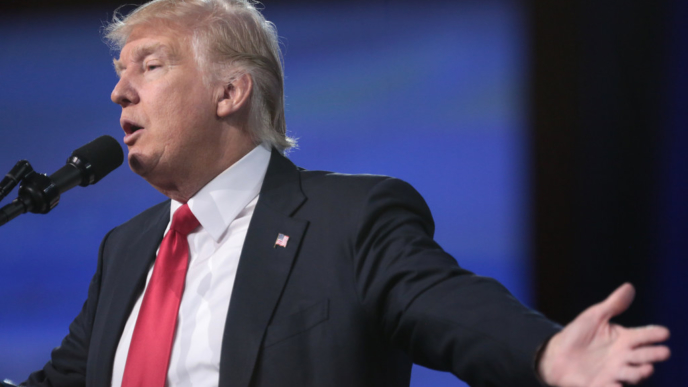
The War for the Democratic Party Will Destroy Lives and Change Our Country

. . .Its young congressional leaders, Reps. Alexandria Ocasio-Cortez, Rashida Tlaib, and Ilhan Omar, the fresh-faced consciences of the swamp, are all-three the targets of finance investigations. Two are tangled in credible accusations of anti-Semitism, and one is mired in a hard-to-believe incestual infidelity scandal with a married man on her payroll. . .

No doubt, Ocasio-Cortez’s immediate goal is her ally Sanders winning the primary. Toward that objective, the lies, back-stabbing, and attacks they have and will continue to face from former fellow travelers will be as vicious as they are relentless. Both he and she know, however, the ultimate goal is the transformation of the Democratic Party.

If they defeat the frantically-forming Biden wing of the party to win the primary, that prize will at once become more attainable and more imperiled than its been in 75 years, when President Franklin Delano Roosevelt’s socialist vice president was removed from the ticket — and thereby ascendancy to the presidency — for FDR’s final re-election campaign.

A Sanders loss to Trump, which in 2020 is far more likely than it would have been in 2016, would result in party retribution against all involved. Primaries and political exiles would be sure to follow. Then, a similar fate was assured conservatives after Sen. Barry Goldwater’s general election loss and, 12 years later, Gov. Ronald Reagan’s unsuccessful primary against sitting Republican President Gerald Ford. A political movement far stronger than Washington party politics saw to scuttling those planned executions.

This battle may be Sanders’s last stand, but the war for control of the Democratic Party has just begun. (Read more from “The War for the Democratic Party Will Destroy Lives and Change Our Country” HERE)

Follow Joe Miller on Twitter HERE and Facebook HERE

Trump’s Win Over Iran Leads U.S. Toward Peace Through Strength. Now on to Domestic Security

Peace through strength. The actions the president has taken toward Iran over the past week exemplify Reagan’s foreign policy motto more than anything we’ve seen since Reagan’s victory over the Soviet Union.

Trump knows he holds all the cards and all the power, and over the past week, he has unambiguously conveyed the message to Iran that he will use it. As a result, he is on the cusp of winning the greatest victory over Iran since 1979. Now Trump can pocket this foreign policy triumph and move on to domestic security issues, using the same tactics against his domestic political adversaries.

On our side, Trump has crippled Iran with sanctions, shredded Obama’s terrible nuclear “deal,” prevented Iran from causing an oil crisis thanks to our energy prowess, and killed its most treasured terrorist general. On the other side, Iran launched a dozen low-grade missiles at Iraqi sites, demonstrating that it is terrified to do anything more significant. The missiles launched at two joint Iraqi-U.S. bases in western and northern Iraq caused no American casualties. Also, according to the U.S. government, four of them malfunctioned, which is another embarrassment for the Islamic Republic.

It’s truly remarkable how an operation Iran dubbed “Martyr Soleimani” resulted in no casualties and limited damage. One might have expected Iran to “go nuclear” in response to the killing of its most revered general. But the entire world knows exactly why the regime didn’t respond more aggressively. Trump holds all the power through the U.S. military to utterly destroy Iran. The mullahs always knew we were stronger than they, but they never saw a president willing to actually show it.

Gone are the days of Iran capturing American sailors and the president rewarding aggression with sanctions relief. The killing of Soleimani demonstrated that Trump will take action, which for now, ensures that he won’t have to. Peace through strength embodied.

The path ahead for Trump is clear. He should pocket the victory, double down on the use of soft power through crushing sanctions, and continue allowing the military to prepare for the worst while communicating to Iran that the trigger will be pulled if the regime prods him. He should distance himself from the pro-Iran government in Baghdad and begin pulling our troops out of Baghdad so that Iran will never even have the ability to harm our assets, even if it is willing to risk Trump’s retaliation. It’s time to pull the plug on Iraq.

Trump actually signaled this when the State Department put out a joint statement with Kurdish Prime Minister Barzani following Iran’s pathetic retaliation without any mention of Iraq’s prime minister. Good riddance. As Lee Smith so brilliantly observed in today’s New York Post, “Soleimani’s killing lets us get out of the Iraqi quagmire on a high note.”

This will free up Trump to focus on completing the circuit of national security through domestic policy: the border, the visa system, sanctuary cities, and domestic crime.

The same principle undergirding Trump’s success against Iran applies to his domestic political adversaries on the Left. The only reason Democrats have won every budget battle of his presidency is because they knew Trump would not use his veto pen to leverage action on issues like border security and sanctuary cities. Much as with Iran, Trump holds all the cards. Between his veto pen, inherent executive authorities, and his bully pulpit to expose the radicalism on the Left on issues like illegal immigration and crime, Trump can smash Democrats to pieces. They just need to know he will actually take action. That he will actually use the veto pen, implement lawful executive actions, push back against the lawless courts, and direct the RNC to run endless ads against Democrats on the thousands of criminal aliens and domestic criminals who have been released through the twin policies of sanctuary cities and jailbreak.

While Iranian aggression remains a looming threat, the average American’s safety is still imperiled exponentially more by weak-on-crime laws and open-borders policies. Trump should spend the remainder of the year leveraging his veto pen, executive actions, and the bully pulpit to promote the following:

Cut off visas from most Middle Eastern countries. Ultimately, the only meaningful way Middle Eastern terrorists and terrorist regimes can attack us is through our immigration system. But the “travel ban” has been so limited as to make it almost meaningless. The Trump administration is increasingly granting visas even to Iranians. Trump has the full authority to end this tomorrow.

Deploy our military to our own border. As Trump moves from nation-building in the Middle East to the peace through strength model, it’s time to redeploy our troops to our own border. The Border Patrol is simply not equipped to deal with the cartels and criminal aliens coming in strategically; it’s time to treat our border as the security perimeter that it should be. Moreover, use of the military will further leverage Congress on funding for more border wall construction.

It’s time for Trump to sideline wayward lower court judges and begin cutting off various grant funds to sanctuary cities. He can use his bully pulpit to demonstrate the devastating effects of sanctuaries releasing thousands upon thousands of the worst foreign criminals, including child rapists and gang members. The issue is so one-sided in the polling, Democrats could never survive a protracted national discussion over harboring the world’s worst criminals. He must be willing to have a budget funding fight later this year over codifying this action. It’s a fight he can win.

Trump needs to reverse course on so-called criminal justice reform and actually push Reagan’s reforms on behalf of victims of crime, which was Trump’s natural position before Jared Kushner changed his mind. The entire nation is appalled at what New York has done on crime, but this is happening in almost every state to some degree. Trump should use his bully pulpit to run against it, while also pushing federal legislation on gun felons and getting rid of many pro-criminal loopholes created by the federal courts.

A sustained and unflinching battle for public safety for our communities is a fight Democrats cannot win – the same way Iran could not win a conflict with our military, once they knew Trump would actually go kinetic with that potential power. Well, the time has come for him to use the extent of his political tools and the power of the issues and gain the same victories on behalf of the law-abiding sovereign American citizen. (For more from the author of “Trump’s Win Over Iran Leads U.S. Toward Peace Through Strength. Now on to Domestic Security” please click HERE)

Follow Joe Miller on Twitter HERE and Facebook HERE

Our Global Missions: Soldiers Serving as… Dental Hygiene Teachers in Niger

Why do we have a military?

This is the question nobody in Congress asks as they pass annual defense authorization and appropriations bills codifying our aimless deployments in well over 100 countries without an understanding of what each mission is accomplishing. Well, now that congressional Democrats are demanding answers from Trump on our posture toward Iran, they might want to also ask what in the world we are doing in places like Niger.

Last week, United States Africa Command (AFRICOM) put out a press release lauding the “first-ever dental hygiene course in Nigerien village.”

The U.S. Army 443rd Civil Affairs Battalion Civil Affairs Team 219, deployed to Nigerien Air Base 201, hosted the first-ever dental hygiene course for school children in the village of Tsakatalam, Niger, Dec. 14, 2019.

The team partnered with local Agadez city dentist, Dr. Mahaman Aicha, who taught the Tsakatalam Primary School children for the first time how to properly brush and floss their teeth and the importance of good oral health.

The release goes on to say how two airmen deployed to the 724th Expeditionary Air Base Squadron collected donations to purchase hygiene supplies as well.

These might sound like heartwarming PR efforts on behalf of the military, but the real question here is what we are doing in Niger to begin with? Why is there never any question about the interests of the United States, the prudence, or the legal authority to use our military as global civil engineers, doctors, and teachers?

However, what is worse than using our military for social work is using it for social work in a combat zone. Niger is not a safe place. It is full of Sunni terrorists who subscribe to the ideology of the Islamic State. We lost four soldiers there in October 2017 fighting with a dubious Nigerian force to combat the Islamic State. But nobody is asking how African terror groups affect us or have the ability to strike us or to shut down shipping lanes as Iran does. Nobody is asking which ground we are holding, on behalf of whom, and in what sort of sustainable way. And it’s not just Niger; we are doing this all across Africa. There are an estimated 6,000 troops on the African continent, largely highly trained special forces.

On October 4, 2017, 11 soldiers of the 3rd Special Forces Group were ambushed in Tongo, Niger, while stopping a convoy to meet with local villagers, resulting in four fatalities. A Pentagon report found that the soldiers were ill-prepared for the mission. Yet here we are over two years later, and we still have troops there engaging in social work. Why is there no desire in Congress to find out more about this mission? Why are there only legal and policy concerns about countering Iran, the one country that unambiguously attacked us multiple times recently?

Just this Sunday, with all the focus on Iraq and Iran, al-Shabab terrorists attacked a U.S. airstrip on the Kenyan coast, killing one American soldier and two American contractors. The adjacent base, Camp Simba, is used by our special forces to train Kenyan forces in the fight against Shabab. While Shabab, an offshoot of al Qaeda, is certainly a terrible collection of terrorists, what is it we hope to accomplish in Somalia and Kenya? Our operations there are all the more absurd when you consider that we’ve brought into our own country 130,000 Somali immigrants, and many of them have been caught with ties to terrorism. Some are suspected of funding those wars from our soil through welfare fraud! If it’s in our interests to go there, then by a factor of a million, isn’t it in our interests to ensure we cut off all immigration from these countries so they can’t come here, as well as fund the operations there?

It’s not that there is never a strategic purpose for us to have a base in a far-flung country as a logistical support for indispensable national security interests. And as part of that, there are times when it’s appropriate for the military to engage in community relations to build needed alliances. But we need an operational audit of where we have troops, why they are there, what is the threat assessment, and what is the scope of their mission. Once we know what it is we are doing there, then we can do a cost-benefit analysis to determine whether it’s prudent and worth the cost to continue. The fact that none of these questions are ever asked of our missions in Africa, Syria, Iraq, or Afghanistan, except for when it comes to Iran, demonstrates that the inquiry by Congress into the Soleimani drone strike is all about politics and not about concern for our troops and our national security.

As I wrote, Congress nearly unanimously signed off on $71.5 billion in “overseas contingency operations” in the defense appropriations bill and the entire status quo of military deployments in the defense authorization bill just a few weeks ago. No questions were asked. Now that there is concern by some about our posture toward Iran, why not conduct a full audit of what it is we are doing everywhere in the Middle East and Africa?

The Trump administration is in the process of looking at drawing down our troops from western Africa. But Congress, with nothing better to do this year, should spend a week auditing each part of the world and our presence there so the public can actually weigh in on the prudence of these deployments.

Were we to conduct such an audit, we’d likely discover that we are depleting our resources and resolve for what largely does not threaten us at the expense of deterring China and using the military at our own border. China remains the biggest looming conventional threat to our country, in addition to its asymmetrical warfare against us through cyber attacks and espionage.

Our border has cartels, transnational gangs, and scores of previously deported sex offenders and murderers coming over every day. Border Patrol catches some of them, as we see from daily press releases, but many of the most sinister elements successfully infiltrate, and we never know about it until one of them is arrested in one of our communities. Although these criminals might not sound as cool as Islamic terrorist groups in the Middle East, they affect our security and safety exponentially more than what goes on overseas. Remember, just one year’s worth of detainers lodged by ICE included aliens charged with 2,500 homicides, 56,000 assaults, 14,500 sex crimes, 5,000 robberies, and 2,500 kidnappings. That doesn’t even begin to factor in the scope of the drug traffickers killing 70,000 people a year.

Shockingly, the same pencil-heads in Congress and in the various executive departments who believe it’s totally within constitutional authority to deploy soldiers as dentists in Africa believe we can’t aggressively deploy our military to combat the Mexican cartels at our own border who enable all this death and carnage in our communities.

Moreover, ultimately, foreign terror groups can only affect us here if we have an open border with Mexico or bring them in through our broken visa system.

We need not spend trillions deploying soldiers all over the world to engage in social work and dental hygiene lessons in order to protect Americans. We need only to put our interests first and stop self-destructing through immigration policies while using our military where it can most effectively protect Americans. Keeping us out of the insufferable tribal wars in other countries will preserve our soldiers, treasure, and deterrent against China, Russia, North Korea, and Iran. That is what our Founders envisioned as the purpose of our military. They certainly never envisioned them as the global dentists. (For more from the author of ” Our Global Missions: Soldiers Serving as… Dental Hygiene Teachers in Niger” please click HERE)

Follow Joe Miller on Twitter HERE and Facebook HERE
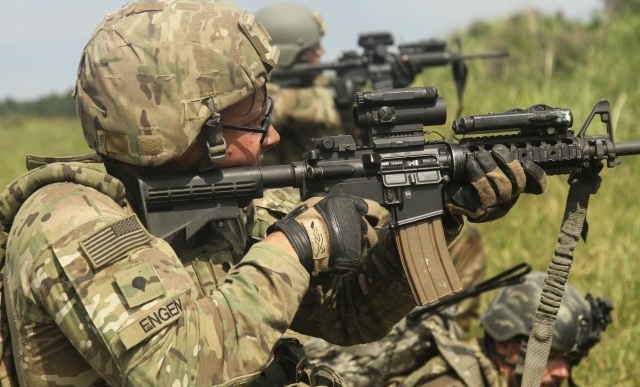
Following Iraqi Parliament’s Vote to Expel U.S. Forces, Congress Should Repeal Funding for Baghdad

Just three weeks ago, Congress voted overwhelmingly (86-8 in the Senate; 377-48 in the House) to continue shoveling hundreds of millions of dollars to the Iraqi government for security. Over the weekend, the Iraqi parliament voted to expel our forces, even as we are protecting them both from Iran and from ISIS.

We’ve needed a robust debate over our mission in Iraq for years. Yet Congress kept signing off on endless funding to maintain the chaotic, ambiguous, and conflicting status quo. Suddenly, when Trump takes useful and decisive action in killing Qassem Soleimani, members of Congress begin demanding answers about our mission. Well, almost every one of them just signed off on this mess. If they actually put their money where their collective mouths are, they would vote to repeal the National Defense Authorization Act they just passed, along with all the garbage in the bill.

Nobody read the 3,488-page NDAA conference report adopted right before Christmas as Congress was passing a 2,000-page omnibus bill they didn’t read either. That includes many of the same members, such as Senate Minority Leader Chuck Schumer, claiming outrage over the president’s authority to conducts operations in Iraq. While everyone is debating the application of the 2001 and 2003 authorizations of use of force, nobody seems to remember that in every subsequent year, Congress passed a defense authorization bill codifying all of the current missions all over the globe without any examination of what we are doing. Somehow the endless nation-building operations getting our soldiers killed weren’t worth such examination, as they all rubber-stamped this bill, chock-full of harmful provisions, but when it comes to virtue-signaling on behalf of Iran, they feign outrage over a lack of congressional involvement in the use of force.

Page 1,069 of the conference report categorically authorizes the DOD to “provide support for the stabilization activities of other Federal agencies … in Iraq, Syria, Afghanistan, and Somalia.” Nobody ever questioned what it is we are accomplishing in any of these countries and on behalf of which governments we are shedding our blood and spending our treasury. But when a man like Soleimani sacks our embassy and plots more attacks against a multitude of federal agencies in the country, Trump has no authority to act?

Not only do we spend billions propping up pro-Iranian officials in Baghdad and dubious fighting forces elsewhere, but page 1,087 of the bill authorizes the DOD to reimburse these governments for “logistical and military support provided by that nation to or in connection with United States military operations in Afghanistan, Iraq, or Syria.” On page 1,100, the bill provides authority for “(1) Defending the Syrian people from attacks by the Islamic State of Iraq and Syria. (2) Securing territory formerly controlled by the Islamic State of Iraq and Syria. (3) Protecting the United States and its partners and allies from the threats posed by the Islamic State of Iraq and Syria, al Qaeda, and associated forces in Syria.” However, the bill is ridiculously silent about who exactly we are defending. Well, now we know: We were defending Iranian-backed Shiites from the Sunnis, while both sides were killing our soldiers.

The House bill did originally contain a provision repealing the original authorization of use of force in Iraq, but the final version left that out. The final NDAA contained $4.5 billion for the Afghani government and another $845 million for the Iraqi government.

Then, in the same week, Congress passed the defense appropriations bill, which allocated roughly $1.2 billion for counter-ISIS operations in Iraq, including “training; equipment; logistics support, supplies, and services; stipends; infrastructure repair and renovation; construction for facility fortification and humane treatment; and sustainment, to foreign security forces, irregular forces, groups, or individuals participating, or preparing to participate in activities to counter the Islamic State of Iraq and Syria, and their affiliated or associated groups.”

Guess who that includes? The Shiite militias being commanded by Soleimani! After all, they were “participating in activities to counter” ISIS. For the past five years, our government has indiscriminately funded everything and anything that fights ISIS, when in fact, Iran was always the bigger strategic threat, yet Iran reaped the benefit of our efforts. Between the $26 billion we spent on training the Iraqi military through September 2012, according to the inspector general on Iraq, and another roughly $10 billion more in defense appropriations since then, authorized under the guise of fighting Sunni terrorists, that is more money than we need for our own border security that was sunk into pro-Iran militias.

Overall, the defense bill contains $71.5 billion for “overseas contingency operations,” which grants the president very general authority to use it for a number of questionable activities.

Thus, members of Congress have no leg to stand on when it comes to the president engaging in operations in those countries, particularly one that is rooted in a defensive action to protect our own personnel.

But if Congress really wants to have a debate about our vision in the Middle East, now is the time to engage in such a dialogue. It should begin with repealing the NDAA and starting anew. As I reported in December, that bill contained more visas for Iraqis and Afghans, a new paid family leave entitlement for all federal workers, a provision prohibiting federal agencies from asking about criminal records on job applications, and an amnesty for several thousand Liberian illegal aliens. Those provisions should be repealed, along with the provisions continuing our operations in Iraq and Afghanistan.

A new NDAA should define very strictly our interests in keeping open shipping lanes or protecting any other assets from Iranian aggression or from other terrorist groups. But when it comes to land battles in fractured tribal lands, the answer should be: “You’re on your own.”

Those concerned about Iran might suggest that pulling out will hand Iraq over to Iran, but that is ridiculous, because Iran already controls the Baghdad government … and we’re helping them with infrastructure and security. Were we to pull out, Iran would then have a permanent Sunni insurgency on its hands. Nobody expressed this sentiment better than Dan Caldwell of Concerned Veterans of America, who served in Iraq:

By staying out of these wars, we will actually be able to counter Iran from a position of strength. If Iraq doesn’t want to extend us the “honor” of losing thousands of soldiers, spending several trillion dollars on its nonexistent and permanently divided country, and bringing in over 200,00 of its unvetted people to our country, who loses out here? Not us.

Finally, a new defense authorization should deal with the foundation of national defense, which is homeland security. We should cut off visas from the Middle East, deploy our military to our own border to deal with the cartels, and arm our own soldiers on American military bases, not to mention refrain from bringing Middle Eastern militaries to those bases. It’s time to protect our own interests, not those who bite the hand that guards them. (For more from the author of “Following Iraqi Parliament’s Vote to Expel U.S. Forces, Congress Should Repeal Funding for Baghdad” please click HERE)

Follow Joe Miller on Twitter HERE and Facebook HERE
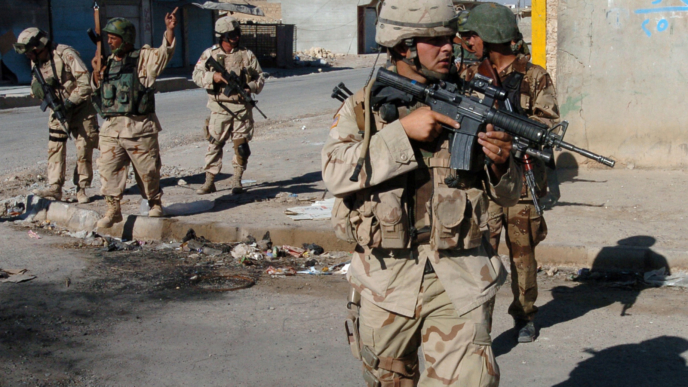
Trump’s Strike on Soleimani Is About America First, Not Reckless Interventionism

On New Year’s Eve, Iran-backed militias attempted to storm the U.S. embassy in Baghdad, engaging in an unsuccessful act of war as American forces secured the compound. In the aftermath, President Trump warned Iran that it would “be held fully responsible for lives lost, or damage incurred, at any of our facilities,” and “pay a very BIG PRICE. This is not a Warning, it is a Threat. Happy New Year!” . . .

His decision to strike Qassem Soleimani was a game-changing act with immense substantive and symbolic implications. It finally brought a modicum of justice for the hundreds of Americans murdered and thousands injured at the hands of the head of the terrorist Islamic Revolutionary Guard Corps-Quds Force, his henchmen, and their proxies. . .

It represented a decisive response to Iran’s act of war in Baghdad, as well as its repeated assaults on Iraqi coalition bases including last month’s rocket attack that killed one American and injured several others, and additional imminent strikes for which Soleimani would have been responsible. It was about putting America first. . .

Critics of the Trump administration are claiming that this operation—which also resulted in the death of Hezbollah Brigades leader and Iraq Popular Mobilization Forces deputy leader Abu Mahdi al Muhandis, and may have coincided with the rumored rolling up of other Iran-backed militia leaders—recklessly risked all-out war with Iran.

The assumption among both leftist Trump haters and anti-interventionist Trump supporters like Tucker Carlson is that the United States could well be drawn into a broader conflict that will lead to another Iraq or Afghanistan, replete with a full-scale invasion and occupation. Yet this would conflict with President Trump’s word, deed, and demonstrated instinct, and almost assuredly the desires of his supporters. (Read more from “Trump’s Strike on Soleimani Is About America First, Not Reckless Interventionism” HERE)

Follow Joe Miller on Twitter HERE and Facebook HERE