Posts

Where Does the Presidential Race Stand?

A week out from their first debate, Democratic presidential nominee Hillary Clinton is considered the winner in her initial encounter with Republican opponent Donald Trump. As reported by Politico, Clinton’s poll-confirmed victory — such as those by Fox News and The Washington Post and ABC News — has helped increase her lead over Trump in a slew of state and national polls.

But Politico also noted that while Clinton appeared to trounce Trump in the debate, her election advantage remains “a low-to-mid-single-digit” nationally and in most battleground states.

The Real Clear Politics (RCP) average of polls shows a similar story, with Clinton’s lead being just 2.5 points. Huffington Post’s trend tracker, meanwhile, shows Clinton with a 5.2-point lead, even as a Los Angeles Times poll shows Trump with a five-point lead.

While the RCP and Huffington Post methods have their strengths and drawbacks, the race as a whole has been much tighter than predicted by many political insiders.

An example of the reaction by many of those same insiders is a Monday piece by Politico’s Glenn Thrush. He is critical and mocking of Trump — describing the race as one where “the unloved candidate trumps the hated one, the polls say.” He also described Trump as “the most outrageous and detested presidential nominee in recent memory” who “still gets his 38 to 43 percent in virtually every national poll.”

But while Trump may not be liked by most of America, wrote Thrush, Clinton doesn’t fare much better:

Meantime, a vast swath of the United States still can’t stomach Clinton. In the course of one mid-September day in deep-blue Maryland, I had a doctor pull his stethoscope off my chest to declare, “I’m a life-long Democrat and I don’t know what the h*** I’m going to do” and an African-American cabbie, who idolizes Barack Obama, muse about sitting this one out.

Nate Silver’s analysis currently gives Clinton a 70 percent chance of victory right now, and while things could change, the post-debate polls make it clear that each candidate would have to do a great deal to swing the race one way or the other. Here are a couple of things that could quickly change the dynamics of the race:

Trustworthiness

Neither candidate is trusted, with Trump facing attacks on his business practices throughout his career. Clinton, meanwhile, has been hammered with scandals surrounding her family’s charitable foundation and her activities as Secretary of State, to say nothing of the baggage she carries from past Clinton scandals.

A major scandal about either candidate could swing things as the race closes. Monday’s announcement, for example, that Trump’s Foundation has been issued an order to stop fundraising because it didn’t file proper paperwork probably doesn’t rise to the occasion, and who knows what Wikileaks founder Julian Assange will be revealing about Clinton in a video announcement now set for Tuesday.

While the top groups investigating Trump’s background have liberal bents — such as The New York Times with its non-story on Trump’s taxes on Saturday, or the New York state Attorney General who issued the fundraising order against Trump — a federal investigation into the Clinton Foundation is being done by Preet Bharara. Bharara is a Democrat who worked for Senator Charles Schumer (D-NY) in Washington but has shown no qualms about targeting high-ranking state Democrats and Republicans alike.

If he was to find something of significance in his Clinton Foundation investigation, it would be hard for Clinton to claim Bharara is a partisan hack, something Trump’s campaign is claiming about the Times’ editors and the New York Attorney General.

Health

Clinton’s health has been questioned even by some Democrats, especially in light of secrecy surrounding a recent bout of what the campaign said was pneumonia and dehydration.

Clinton performed very well during the debate, appearing energetic and on point, while a sniffling Trump looked nonplussed during much of their 90 minutes onstage.

Debates

Two solid debate performances by Trump probably won’t change the equation on their own, but the echo chambers of the media could sway voters who after last week’s debate performance and subsequent attacks on a former Miss Universe winner (including a 3:00 a.m. Twitter outburst) may be hesitant to trust Trump’s decision-making capabilities.

A physical collapse by Clinton during any debate could be devastating.

The Ever-Lurking October Surprise

A Muslim terrorist attack could help Trump, as could another Dallas-style revenge attack against police. Conversely, Clinton could politically benefit from an unjust police shooting, or a racist “lone wolf” attack like the one in 2014 in Charleston.

If the economy improves, the headlines could benefit Clinton. Conversely, given the slow growth of the U.S. economy in recent years, a perceived or actual downturn could harm Clinton.

Even the weather could play a role, as Mitt Romney found out in 2012 with Hurricane Sandy. At this hour, Hurricane Matthew is set to strike Haiti, which could draw attention to the Clintons’ post-earthquake antics in that impoverished nation. Also, during Louisiana’s recent floods, Donald Trump gained much needed credibility with his visit, while Clinton stayed home. If Hurricane Matthew affects the U.S., Clinton won’t make the same mistake again. And her steadiness and experience might contrast well with the political novice.

Tracking the storm should serve as a good reminder that while statistics and historical precedent can point to the way things are likely to go, no one knows what’s going to happen until landfall — or election day. (For more from the author of “Where Does the Presidential Race Stand?” please click HERE)

Follow Joe Miller on Twitter HERE and Facebook HERE.

The TMI Election: We Know So Much About Both Candidates, so Why Are There Still So Many Undecided?

As the world waits with bated breath to hear what Julian Assange, the founder of Wikileaks, may or may not have to say about Hillary Clinton’s emails, it’s a good idea to take a step back from October Surprise Fever and think about the wisdom of basing our political decisions on big, shocking revelations that might not even exist.

I get that secrets are exciting, but both Hillary Clinton and Donald Trump have been public figures for decades. They have enough public statements between them to fill a library. And they’ve both been angling for the job of president for what seems like forever. We know so much about both of their lives, more than we know about pretty much anyone besides our close friends and family. So the question is, what could possibly emerge at this late date that would change our opinion of either of these politicians?

Since Clinton is reportedly the subject of the leaks, let’s start with her. We know that Clinton spoke lightly about defending a rapist, we know that she is a habitual liar, not to mention her private email server and its contents. We know that a U.S. ambassador was killed on her watch as secretary of state, we know that her foundation has accepted millions in donations from foreign countries and big banks, the latter which she voted to bail out under TARP. We know that she has supported wars that have claimed a million lives. And we know that she wants to raise taxes, increase regulations, and further compromise our constitutional rights.

Is this not enough information? If all of the above is not enough to convince you that Hillary Clinton is unfit to be president, then what ever would be?

Trump is scarcely better. People are making hay about his tax returns, with the implication that the discovery of tax improprieties would somehow destroy his candidacy. But we already know things about Trump that are way worse than a little tax avoidance. In fact, there is a large portion of the GOP base (myself included) who regards keeping as much of your money from the government’s grasping hands as possible as more of a virtue than a vice. But even if you do frown on taking advantage of tax loopholes, would that revelation be more shocking than Trump’s public record?

We know that Trump has advocated killing the families of terrorists, that he regards immigrants broadly as rapists and murderers, that he has advocated shutting down portions of the internet, and that he thinks the proper role of the presidency is to bully individual companies over where they decide to build factories. We know that he has a short temper and is easily provoked. We know that he brags about taking advantage of crony subsidies at the expense of the taxpayer, and that he has tried to use eminent domain to force landowners off their property for his own benefit. We know that he habitually uses demeaning and offensive language towards women, and that personal insults are his rhetorical weapon of choice. We know that he has supported gun control and universal health care before claiming not to support those things. We know that he wants to strengthen libel laws, making it effectively illegal to criticize him. We know that, if elected, he would be fickle, capricious, and unpredictable, hardly desirable qualities in a commander in chief.

Come on, America. Stop pretending some October revelation is going to be a game changer. We know who these people are. We know their weaknesses and, to the extent they exist, their strengths. We have all the information we need to make an educated, well-informed vote. It may be an unattractive decision to have to make, but nothing Julian Assange or anyone else has to say is going to make it any easier. And hey, as much as the media may try to deny it, there are always third parties. (For more from the author of “The TMI Election: We Know So Much About Both Candidates, so Why Are There Still So Many Undecided?” please click HERE)

Follow Joe Miller on Twitter HERE and Facebook HERE.
5 Times Lester Holt Came to Hillary’s Rescue in Debate Number 1

Monday night’s debate confirmed several presidential debate truisms. For example, substantive discussions of the issues tend to dissolve during these debates. That happened at Hofstra University.

Another tried and true fact of presidential debates is the mainstream media moderator will act as a praetorian guard for the Democrat. And yes, that too happened.

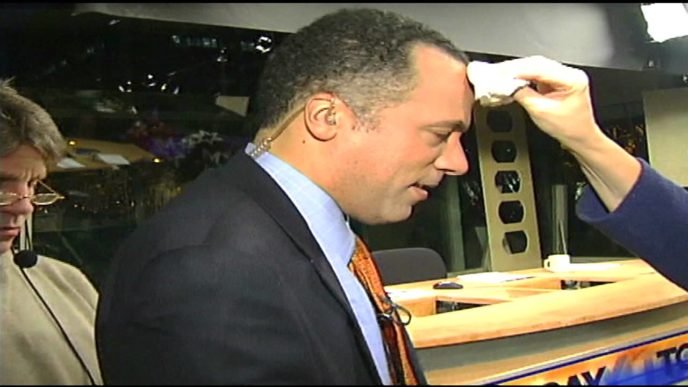
Debate moderator Lester Holt repeatedly challenged statements from Republican candidate Donald Trump while permitting Democratic candidate Hillary Clinton to slip away. The questions he asked, at times, were also completely irrelevant to the issues facing American citizens, and contributed to the lack of substance in the candidates’ policy stances.

Let’s go over just five quick points to demonstrate Holt’s biased performance.

1) The NBC News anchor interrupted Trump twice on a question on jobs.

The question was, “How are you going to bring back the industries that have left this country for cheap labor overseas?”

Trump suggested renegotiating trade deals like NAFTA and was explaining the different tax systems in the U.S. and Mexico when Holt interrupted to ask the question again that Trump had just answered. Perhaps his answer wasn’t satisfactory, but that’s a point the other candidate — not the moderator — should make.

2) Holt dragged Trump’s tax returns into a discussion on tax policy.

“Mr. Trump, we’re talking about the burden that Americans have to pay, yet you have not released your tax returns. And the reason nominees have released their returns for decades is so that voters will know if their potential president owes money to …who he owes it to and any business conflicts. Don’t Americans have a right to know if there are any conflicts of interest?”

Whether or not Donald Trump could or should release his tax returns has absolutely no bearing on the tax policies the next president will enact in office. And in the context of “American prosperity,” which was the nominal topic of this segment of the debate, it was a completely irrelevant point.

Consider that the previous question asked Hillary Clinton to spend two minutes defending raising taxes on the wealthy and Trump to spend the same amount of time defending his plan for tax cuts. Instead of digging deeper into these policy ideas and their effects on the pocketbooks of American families, we were treated to Hillary Clinton asserting Donald Trump may not be as rich as he says he is, and Trump reciting how much his real estate/buildings are worth.

3) Holt brought up the constitutionality of “stop and frisk”; he forgot to do so regarding the due process rights of Americans on the terror watch list.

In the segment on “America’s direction,” Lester Holt began a discussion on race in which both major party candidates agreed that some form of gun control was necessary to curb violence in America’s inner-cities.

As Clinton herself said: “We finally need to pass a prohibition on anyone who’s on the terrorist watch list from being able to buy a gun in our country.” If the moderator is going to challenge the candidates on some political points, this would’ve been a great time to point out the due process rights of American citizens that are threatened by banning individuals on an arbitrary government list from purchasing firearms.

Instead of a follow-up on that point, Lester Holt decided to follow up on Trump on his advocacy for a possible nationwide “stop and frisk” policy — noting that a judge in New York ruled that policy unconstitutional. Constitutional questions are crucial, but shouldn’t the moderator serve them to both sides?

4) Speaking of forgetting issues, where were the questions on the Clinton Foundation’s incestuous relationship to the Clinton State Department? What about Benghazi? Or Hillary’s email server?

When the topic turned to “America’s security,” Lester Holt asked each candidate to describe how they would protect America from cyber warfare by foreign agents like the those that are believed to have hacked the Democratic National Committee.

Unbelievably, Lester Holt did not ask Hillary Clinton about her mishandling of classified information on a private email server, despite the fact that experts have said Clinton’s private email server was likely hacked. Further, not a single question directed to Hillary Clinton regarding her multiple grievous lies.

5) Questions directed to Trump were about personality, not policy.

“Mr. Trump, for five years, you perpetuated a false claim that the nation’s first black president was not a natural-born citizen. You questioned his legitimacy. In the last couple of weeks, you acknowledged what most Americans have accepted for years: The president was born in the United States. Can you tell us what took you so long?”

“Mr. Trump, this year Secretary Clinton became the first woman nominated for president by a major party. Earlier this month, you said she doesn’t have, quote, “a presidential look.” She’s standing here right now. What did you mean by that?”

If the candidates want to have a back and forth over who is more sexist/racist/intolerant/bigoted/what-have-you, that’s the candidates’ prerogative. Should the moderator of a presidential debate, whose job is to make these two individuals running for president give the American people an idea of what they will do in office, do their work for them? (For more from the author of “5 Times Lester Holt Came to Hillary’s Rescue in Debate Number 1” please click HERE)

Follow Joe Miller on Twitter HERE and Facebook HERE.

National ICE Council Announces First-Ever Presidential Endorsement in Its History

Early Monday morning, the National Immigration and Customs Enforcement Council made a huge announcement that rocked the political world.

“We hereby endorse Donald J. Trump, and urge all Americans, especially the millions of lawful immigrants living within our country, to support Donald J. Trump, and to protect American jobs, wages and lives,” the organization’s president, Chris Crane, wrote in a statement published at DonaldJTrump.com.

What made the endorsement so stunning was that the National ICE Council had never before in its history made an endorsement for a candidate running for an elected office.

Plus, the council represented 7,600 federal immigration officers and law enforcement support staff members.

Yet this time around, the council chose to have a vote, and according to the results of that vote, GOP candidate Donald Trump received the vast majority of the council members’ support.

“This first-ever endorsement was conducted by a vote of our membership, with Hillary Clinton receiving only 5 percent of that vote,” Crane’s statement clarified.

In explaining why council members disliked Democrat candidate Clinton so much, Crane pointed to her support of “the most radical immigration proposal in U.S. history.”

He also claimed that her plan had been crafted with the assistance of “special interests and open-borders radicals.”

“Her radical plan would result in the loss of thousands of innocent American lives, mass victimization and death for many attempting to immigrate to the United States, the total gutting of interior enforcement, the handcuffing of ICE officers, and an uncontrollable flood of illegal immigrants across U.S. borders,” his statement went on.

The Democrat candidate would also expand executive amnesty, expand catch-and-release and prioritize the non-enforcement of America’s federal immigration laws, Crane wrote.

Trump’s plan, on the other hand, would “restore immigration security” by, among other things, cancelling President Barack Obama’s executive amnesty, putting an end to sanctuary cities and providing immigration agents with the tools and resources they need to effectively carry out their jobs.

“America has been lied to about every aspect of immigration in the United States,” Crane continued.

“We can fix our broken immigration system, and we can do it in a way that honors America’s legacy as a land of immigrants, but Donald Trump is the only candidate who is willing to put politics aside so that we can achieve that goal,” he concluded. (For more from the author of “National ICE Council Announces First-Ever Presidential Endorsement in Its History” please click HERE)

Follow Joe Miller on Twitter HERE and Facebook HERE.

Trump Hammers Clinton Over Racial Comments

Shifting the focus of the first presidential debate toward law enforcement, race relations and Second Amendment gun rights, Republican nominee Donald Trump took a moment Monday night to discuss an element of Democrat Hillary Clinton’s past she likely wish could have stayed buried.

“I do want to bring up the fact that you were the one that brought up the word ‘super-predator’ about young black youth,” Trump stated.

“That’s a term that I think … it’s been horribly met — as you know — I think you’ve apologized for it, but I think it was a terrible thing to say,” he continued.

The comment Trump was referring to dates back to 1996, when then first lady Hillary Clinton expressed her perceptions of young black men and their role in burgeoning crime statistics.

“They’re not just gangs of kids anymore,” she began. “They are often the kinds of kids that are called super-predators. No conscience, no empathy.”

Clinton’s remarks were made all the worse when she offered her solution to dealing with these “super-predators.”

“We can talk about why they ended up that way, but first we have to bring them to heel,” she stated emphatically.

As part of her agenda to bring young black men in line, Clinton proposed harsher sentencing laws, which resulted in mass incarcerations, including severe sentencing for children as young as 13.

Although Clinton has apologized for these comments since beginning her political career, the racial overtones and the imagery evoked of bringing young black men “to heel” has stuck with many in the African-American community.

For this reason and others, enthusiasm for Clinton among black voters has been lower than many expected.

Although she still maintains a healthy lead over Trump, his support has continued to grow. A tracking poll earlier this month showed Trump with a 16.5 percent increase in support from black voters. (For more from the author of “Trump Hammers Clinton Over Racial Comments” please click HERE)

Follow Joe Miller on Twitter HERE and Facebook HERE.

When Does Debating End and the Work Begin?

The crowd was standing and booing loud and long. The worried Secret Service hustled the speaker’s wife out of the arena as the tension and decibel level increased. The senator got off the stage.

A few weeks ago, Ted Cruz attempted a victory lap in the Republican National Convention after losing the primary fight. Cruz had refused to endorse the decision of the organization. I was sitting with a former Ohio Congressman who said, “He just ended his political life…” Commentator Charles Krauthammer said Cruz’s speech, “Was the Longest Suicide Note in US Political History.”

There are times to debate. There are times to work. Cruz didn’t know the difference. Unfortunately, most in business don’t either.

But Cruz has, in the end, taken the right action.

No Yes-Men

Your subordinates are pushing back. This is what you want — you didn’t hire yes-persons who polish apples and kiss your backside. You need a real debate to get the best recommendation to help you make the best decision. A heated discussion is needed around the conference table; the refining fire of dispute to burn away dross and all that.

The best bosses demand vigorous deliberation to vet a course of action. No unthinking rubber-stampers are on your team, right?

But sometimes the push-back pushes the manager over the edge. When is too much debate simply too much? And does the staffer understand when to stop debate and start executing?

The manager and staffers should know as a matter of policy when the debate turns from a dialogue of equals to the hierarchy of superior and subordinate.

The deliberation is over when the manager has made the decision. Or when a nominee is picked and the work pivots from Primary Debate to General Election. The political decision was made, but some who lost the debate want the argument to continue as Ted Cruz demonstrated at the GOP Convention in Cleveland.

Here, in business, the subordinate can help manage the manager. The alert staffer can clear the fog of decision-making by asking the manager a direct question, “Is the debate over and is there a ruling?” If the answer is yes and the decision has been made, then the arguing and arm-wrestling is over, and then the execution begins. A gavel pounded on a lectern is helpful.

Talented managers make decisions and are, well, decisive. There should be no doubt further down the org chart that the talking is done and action is to begin.

(In)Decision

However, if the staff does not know that the decision has (really!) been made, then confusion sets in. The push-back and the pleading will continue, followed by the whining.

We have an example of where even the Creator of the Universe was reconsidering a decision. Abraham, a good man, is arguing with God against destroying Sodom and Gomorrah. Then he said, “May the Lord not be angry, but let me speak just once more. What if only ten [righteous] can be found there?” He answered, “For the sake of ten, I will not destroy it.” (Genesis 18:32)

Those ten could not be found and the decision of God’s wrath was about to be carried out. So Abraham, you better get out.

Managers must make clear the bright line that divides debate from decision. When the boss has signaled that the line has been crossed and the decision has been made, then the debating and second-guessing is over.

After the debating is over and the decision made, the professional will support the manager even if he disagrees. The pro will get the job done as if the decision were his own.

This is where Ted Cruz missed his moment: He did not say ‘yes.’ Instead of supporting the verdict of the organization and its common goals, he did not immediately endorse the candidate of his party. We each have the option of saying ‘no’ to an organizational decision. But—

When the boss decides, then do the work. Or leave the organization.

Ted Cruz now understands that his party’s debate is over and that the decision has been made.

The planning and organizing are complete. Leading the execution is about to begin. (For more from the author of “When Does Debating End and the Work Begin?” please click HERE)

Follow Joe Miller on Twitter HERE and Facebook HERE.
How to Use Presidential Debate to Talk About Conservatism

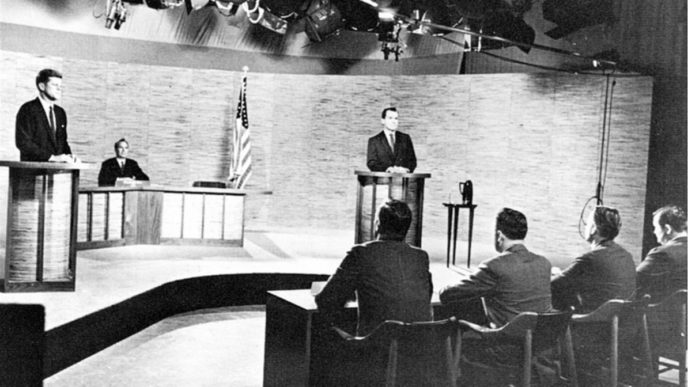
With an estimated 100 million people tuning in to watch Monday night’s presidential debate, the topic of conversation for the week will be the showdown between Hillary Clinton and Donald Trump, therefore giving you ample opportunity to talk conservative policy.

But you’ll have to be diligent in this endeavor as the memorable moments in presidential debates are rarely about policy:

1. Ronald Reagan disarmed Walter Mondale in a 1984 debate, saying, “I am not going to exploit, for political purposes, my opponent’s youth and inexperience.” The punchline not only made the audience laugh, but Mondale genuinely cracked up too.

2. In 1988, Michael Dukakis lacked every emotion when asked if he would favor the death penalty if his wife were raped and murdered. He responded without mentioning his, uh, wife: “No, I don’t … I think you know that I’ve opposed the death penalty during all of my life. I don’t see any evidence that it’s a deterrent and I think there are better and more effective ways to deal with violent crime.”

3. Most remember that Al Gore repeatedly sighed as George W. Bush spoke during a 2000 debate. “But the best moment might have been when Gore at one point stood up, seemingly to intimidate Bush, and Bush simply nodded hello at him and continued what he was saying,” writes Time’s Dan Mitchell.

These moments are brought to you by an “uh-oh,” or a laugh, or a great sound bite, not policy. But we promise the ensuing chatter around these moments and the superficial aspects highlighted by the media allows you to pivot to a substantive conversation.

Here are three ways to focus your otherwise shallow conversation on conservative policy.

Common Ground

While we want to be entertained during the 90-minute debate (no risk of being slighted this year), you want to move past the performance and instead discuss policy. Acknowledge the moments the media will obsess over, but then pivot to the candidates’ policies on your political issue of choice.

For example, if a candidate makes an exaggerated claim about income inequality that the media just can’t stop talking about, acknowledge the claim as absurd and then pivot to policy. Use common identifiers like “we both know his/her statement was absurd, but the policy behind it needs to be addressed. We can both agree that…” You recognize the absurdity of the claim (common ground) and then refocus the conversation on the substance behind the claim.

Examples

Use what the candidates say. Even if we witness in-depth policy discussions Monday night, you may disagree with the style and substance. Play off the candidates’ comments to give tangible examples. If the person you’re talking to cares about guns, or health care, or income inequality, refer back to the columns we’ve written about how to have conversations about those topics.

Remember, you win by using an example, personal anecdote, or analogy that frames the policy in a relatable way. And adding in a simple data point along with an example is always a great way to prove you’re right … because numbers, like hips, don’t lie.

Words

NEWS FLASH: Beating someone over the head with your perspective is not persuasive. You gain no ground by talking (or yelling) at someone. They will shut down and likely never want to discuss politics with you again. We know the debate will be heated Monday, but don’t let that tension influence your conversation.

A great way to resist the temptation to yell/kick/scream your way to winning is to use the right words. Talk about “choice,” what’s “fair,” “rights,” and “equality.” It’s been said many times before, but steal the words and phrases used to great effect by liberals. Doing so is disarming, but more importantly, those words accurately describe your conservative policy position too.

While fireworks are expected, remember that what the candidates do on stage won’t be worth mimicking in real life, especially if you want to persuade. Instead, find common ground, use examples, and say the right words. (For more from the author of “How to Use Presidential Debate to Talk About Conservatism” please click HERE)

Follow Joe Miller on Twitter HERE and Facebook HERE.

The Minor Candidates: The Libertarian Gary Johnson

Fiscally conservative and socially liberal, the Libertarian Party presidential candidate refers to himself as a classical liberal — but even then, he’s not a typical classical liberal. Gary Johnson is known for provocative statements, such as calling Social Security a ponzi (pyramid) scheme, but also for not knowing what Aleppo is. He favors cutting taxes and regulation and legalizing marijuana — and indeed ran a company called Cannabis Sativa Inc. He is also the only presidential candidate ever to have climbed Mt. Everest.

All that may help explain how as a Republican he twice got elected governor of New Mexico, a light blue state that has voted Democratic in five of the last six presidential elections.

His running mate did the same. Former Massachusetts Republican governor Bill Weld is known for being a very moderate Republican, fiscally conservative but pro-choice — he even opposes banning partial-birth abortion — and pro-gay marriage.

A successful businessman, Johnson started a mechanical contracting company, Big J Enterprises, and turned it into one of New Mexico’s leading construction companies worth millions. He is a triathlete and lives in a home he built himself in Taos, New Mexico. He has climbed the tallest mountains on all seven continents. A widower, he is currently engaged to a real estate agent he met at a bike race.

Johnson’s Record

As a two-term governor — he was elected in 1994 and by a bigger margin in 1998 — Johnson’s record stood out for reducing the size of government. He had run on the slogan “People Before Politics” and for him that meant reducing the size of state government. After assuming office, he halted the 10 percent annual growth in the budget and eliminated 1,200 state employee jobs. He never raised taxes and instead cut them 14 times.

Former New Mexico Republican National Committee member Mickey D. Barnett described Johnson’s style this way: “Any time someone approached him about legislation for some purpose, his first response always was to ask if government should be involved in that to begin with.”

Some of his positions are the same as or close to mainstream Republican positions. (The Johnson/Weld platform can be found here.) He supports the FairTax and if elected president would abolish the Federal Reserve. As governor he tried (unsuccessfully) to implement school vouchers statewide.

However, many of Johnson’s other positions would not resonate well with Republicans.His campaign website claims that “Legalizing and regulating marijuana will save lives and make our communities safer by eliminating crime and creating an industry that can legitimately participate in America’s economy.” In addition to his support for legalizing marijuana use, he supports same-sex marriage, and believes federal law should prohibit businesses from refusing service for same-sex weddings. He boasts of promoting “marriage equality” before any of the Democrats.

Abortion, God, and the Wall

He says that abortion is a woman’s personal choice and should not be limited by the government, although as governor he supported efforts to ban late-term abortions and his campaign website says he “believes in the sanctity of the life of the unborn.” The website summarizes his view as “Appreciate Life. Respect Choice. Stay Out of Personal Decisions.” He had been more definite in a 2012 interview, declaring “I absolutely support a woman’s right to choose.”

Johnson does not consult God for advice in politics and does not believe religion has any role in politics. In the 2012 interview, he said “I don’t seek the counsel of God. God doesn’t speak to me on what I should or shouldn’t do.” He hasn’t gone to church since being confirmed in the Lutheran church.

Johnson’s views of foreign policy are more similar to Green candidate Jill Stein’s than to either of the major candidates, condemning most foreign involvements as “our meddling in the affairs of others.” This has hurt the United States much more than it has helped, he says. He vows to cut the military’s budget by 43 percent. He does not believe Iran is a threat, and would intervene to stop Israel from attacking Iran.

Rejecting one of Donald Trump’s signature policies, Johnson would not build a wall between the U.S. border and Mexico. Instead, he wants to make entering the country legally “simpler and more efficient” and to encourage immigrants to “assimilate with our diverse society.”

Johnson’s Campaigns

He ran for president in 2012, first as a Republican but then switched to the Libertarian party and got that party’s nomination. He received .99 percent of the vote (almost 1.3 million votes) in the general election, appearing on 48 state ballots. While running as a Republican candidate, he participated in one of GOP primary debates and made the memorable statement, “My next-door neighbor’s two dogs have created more shovel-ready jobs than this administration.”

When asked in 2014 whether he would run as a Republican or Libertarian for president in 2016, he responded, “I would love running as a Libertarian because I would have the least amount of explaining to do.” (For more from the author of “The Minor Candidates: The Libertarian Gary Johnson” please click HERE)

Watch a recent interview with the author below:

Follow Joe Miller on Twitter HERE and Facebook HERE.

The Minor Candidates: The Green Jill Stein

Green Party presidential candidate Jill Stein previously ran for president in 2012, receiving 0.4 percent of the vote — her 470,000 votes only 64.4 million behind Barack Obama and more importantly, 800,000 behind her fellow third-party candidate, Libertarian Gary Johnson. But she did get seven times as many votes as the actress Roseanne Barr, who had wanted to be the Green Party candidate.

Stein and her husband are both physicians. She describes herself as an agnostic, although she attended a Reform Jewish synagogue while growing up. She is an activist on environmental issues, gaining national recognition in the late 1990s for protesting coal plants in Massachusetts, which she referred to as “The Filthy Five.” She has run for numerous political offices but never won any of them, except member of the Lexington (Massachusetts) Town Meeting.

Her running mate is human rights activist Ajamu Baraka, known for referring to NATO as “gangster states.” His website describes him as being “at the forefront of efforts to apply the international human rights framework to social justice advocacy in the U.S.” and as “a veteran grassroots organizer whose roots are in the Black Liberation Movement and anti-apartheid and Central American solidarity struggles.”

Stein’s Agenda

Stein’s agenda includes “an emergency Green New Deal,” calling climate change “the greatest threat to humanity in our history.” She wants to nationalize the Federal Reserve, increase mass transit, raise the minimum wage to $15 and legalize marijuana. Under her administration, housing will be “guaranteed,” Obamacare will be transformed into a single-payer system, college will be free, and all student loan debt cancelled.

She supports reparations for black Americans and has called for freeing police-killer Mumia Abu Jamal, a popular leftist cause. (She also calls for freeing Indian leader Leonard Pelltier, in prison for killing two FBI agents in 1975.) She opposes charter schools and computers in schools, believing that wireless internet damages children’s brains.

The Green Party candidate of course favors radical environmental policies; she wants to create 20 million green jobs to address the “national emergency” of climate change and for the U.S. to have 100 percent renewable energy by 2030.

To pay for her ambitious plans, Stein would raise taxes on the rich and cut defense spending by at least 50 percent.

Stein’s foreign policy is as radical as her domestic policy and openly anti-Israel. Her platform calls for losing all of 700+ foreign military bases and withdrawing all troops from Iraq and Afghanistan. America “must take the lead in nuclear disarmament by itself starting to disarm.” The nation must also “End the destructive US economic and military intervention into the affairs of sovereign nations,” which, her platform argues, “serves the interests of multinational corporations and global capitalism over the interests of the vast majority of the citizens of those nations.”

She has criticized the Israeli government for “apartheid, assassination, illegal settlements, blockades, building of nuclear bombs, indefinite detention, collective punishment, and defiance of international law.” She considers Prime Minister Benjamin Netanyahu a war criminal and supports a boycott of Israel.

Stein’s Arrests, the Media’s Uninterest

A warrant was put out for her arrest on Wednesday by a North Dakota county court, after she spray-painted “I approve this message” on a bulldozer during a protest of the Dakota Access pipeline. Both Stein and her running mate face charges of criminal trespass and criminal mischief.

This isn’t the first time Stein has been arrested while running for president. In August 2012, she was arrested for participating in a sit-in in a bank to protest home foreclosures. A couple of months later she was arrested for trying to force her way into the presidential debate at Hofstra University, to protest being excluded from participating. And later that month, she was arrested for criminal trespass, trying to deliver food and supplies to environmental activists camped out in trees protesting the Keystone XL pipeline.

Despite having leftist positions close to many journalists’, Stein won’t be getting any help from the media. The left-leaning Washington Post’s coverage is typical, referring to Stein’s long-shot chance as “Jill Stein’s fairy-tale candidacy.” The staff editorialized that her “policy ideas are poorly formed and wildly impractical.” Similarly, The Los Angeles Times opined, ” Stein has few executable policy plans.” (For more from the author of “The Minor Candidates: The Green Jill Stein” please click HERE)

Follow Joe Miller on Twitter HERE and Facebook HERE.

Will the Third Party Candidates Matter for Once? They Could This Year

For the first time in a while, not one but two third-party candidates are getting traction in the U.S. presidential race. Libertarian Party candidate Gary Johnson is polling from 7 to 12 points in general election polls, and Green Party candidate Jill Stein from 2 to 5 points — that’s at least one-tenth of the voters between them, and as much as one-sixth.

Although minor candidates tend to see their support shrink as the election nears, in a tight race each could take enough votes from one of the major candidates to give the election to the other.

The RealClearPolitics average gives Clinton a 2 point edge over Trump, with Johnson taking 9 points and Stein 3. If the election were held today, and Johnson’s voters went to Trump while Stein’s went to Clinton, Trump would win 49.9 to 44.8. But there are a lot of ifs.

What’s Happened Before?

In 1948, a divided Democratic party chose the unpopular Harry S. Truman, who had become president when Franklin Roosevelt died 82 days into his fourth term. One faction, upset with Truman’s support for civil rights, formed the States Rights Democratic party (the “Dixiecrats”) and nominated South Carolina senator Strom Thurmond. The other faction, upset with his Cold War policies, shifted to the recently formed Progressive party and its candidate, former vice president Henry Wallace.

Democrats worried that the two together would take enough votes from Truman to shift the electoral college to give Republican Thomas Dewey the presidency. They wouldn’t need to get many votes to tip some states to Dewey.

Thurmond drew only a little over one million votes (Truman got over 24 million and Dewey almost 22 million) and carried only four southern states and 39 electoral votes. Wallace got almost the same number of votes, but his support was spread across the country and he carried no state. Truman won with just under 50 percent of the vote and 303 electoral votes. Neither third-party candidate mattered at the end.

Most minor candidates have rarely cracked one percent of the vote, but at least a couple have tipped elections before. In 1968,the former governor of Alabama, George Wallace, who had been a lifelong Democrat, ran as the American Independent Party candidate and received 13.53 percent of the vote. It is believed he took enough votes away from Democratic candidate Hubert Humphrey to allow Republican presidential candidate Richard Nixon to win — by about 1 point.

In 1984, independent John Anderson took 6.6 percent and Libertarian Ed Clark 1.06 percent of the vote, not enough to stop Republican Ronald Reagan from winning the presidency.

Reform Party candidate Ross Perot fared the best of minor candidates in recent years, achieving 18.9 percent of the vote in 1992. He was widely perceived as having taken enough votes away from George H.W. Bush to tip the election to Bill Clinton. Perot ran again in 1996, but only received only 8.4 percent of the vote, not thought to have had an effect on the outcome.

What Will Happen This Year?

The question this year is whether come election day enough voters will be so turned off by Clinton and Trump that they’ll vote for a third-party candidate in high enough numbers to turn the election. The two major candidates have record high combined negatives.

Johnson is a somewhat conservative Libertarian, so if he were not in the race, it is possible most of his votes would go to Trump. However, he’s socially liberal on some issues, so Johnson voters are far from the GOP’s for the taking if Johnson’s support tanks in the runup to election day. Stein is a progressive, so if she were not in the race, most of her votes would probably go to Clinton. It’s also possible that if Johnson and Stein were out of the picture, many of their voters would either vote for another minor candidate or not vote at all.

The polls give different answers — and the answers are confusing. A recent Quinnipiac poll of voters in the battleground state of Florida found that including Johnson and Stein in the list of candidates did not affect the results. Without them, each of the two leading candidates got 47 percent of the vote, with only 2 percent saying they’d vote for someone else. With the two third-party candidates included in the poll, Trump and Hillary each got 43 percent.

But here’s part of what’s confusing: While only 2 percent had said they’d vote for someone else when only Trump and Clinton were included, 10% said they’d vote for someone other than Trump or Hillary when Johnson (8 percent) and Stein (2 percent) were included in the poll question. They’ll both be on the Florida ballot, but will voters consider them or focus on the two major candidates?

The same is true in two other battleground states, North Carolina and Ohio, according to the same poll. In both states Clinton wins by 4 points whether or not the other two candidates are included. In Ohio, however, the inclusion of Johnson and Stein increases Trump’s lead from one point to four — even though Johnson takes 14 percent of the vote and Stein six.

In at least one state, the two candidates may tip the balance, according to the latest polls. In normally Republican-voting Arizona, a Washington Post-SurveyMonkey poll found that Clinton edges out Trump by 46 percent to 45 percent in a two-way race. But with Johnson and Stein in the race, Trump takes the lead by two points, while Johnson comes in at 13 percent and Stein at four percent.

But The Electoral College

But the most important reality, as Cliston Brown notes in The Observer, a New York City weekly published by Trump’s nephew, is that Johnson and Stein probably won’t affect the electoral college numbers, and those are the numbers that elect presidents. Speaking of the fourteen states thought to be in play, the candidate who leads in the head-to-head vote is also leading when the two third-party candidates are included. Brown estimates that “On average, across the 14 competitive states, the third-party effect is benefitting Trump by about 0.25 percent.”

Yet that could change. A significant stumble by either major candidate could send some of their supporters to Johnson or Stein, enough to shift the vote in one of the close battleground states. Their presence allows disaffected Clinton or Trump supporters to participate in the election while feeling they’re voting on their principles, rather than just voting for the major candidate because they have to.

The third-party candidates could affect the race in another way: by changing the debate and forcing the major candidates to deal with their issues. If either minor candidate can reach 15 percent support in polling, he or she will be eligible to participate in the presidential debates. If Johnson is invited to the debates, he could become as significant a third-party candidate as Ross Perot was in 1992, due to the heightened publicity. (For more from the author of “Will the Third Party Candidates Matter for Once? They Could This Year” please click HERE)

Follow Joe Miller on Twitter HERE and Facebook HERE.