Posts

Fearing Late Action by Obama, Republicans Consider Curbing Presidential Power to Declare National Monuments

President Barack Obama is using his executive power to issue a broad swath of environmental protections during his last weeks in office, guarding himself against a successor who has vowed to roll back parts of that agenda.

As part of this effort, Obama has made historic use of a 110-year-old law signed by Theodore Roosevelt that gives a president unilateral authority to designate national monuments on land already owned by the federal government.

Some Republicans in Congress have long accused Obama of abusing the law—the 1906 Antiquities Act.

“What was created 110 years ago for the purpose of giving the president power to protect some of our natural resources and archeological treasures from imminent destruction has lost its meaning over time,” said Sen. Mike Lee, R-Utah, in an interview with The Daily Signal. “The envelope has been pushed to the point where there’s nothing left of it.”

Worried that Obama will aggressively act on his way out the door, opponents like Lee are now gearing up for a protracted fight to amend or repeal the law, and are even vowing to work with the incoming Donald Trump administration to overturn monuments already named by Obama.

They are paying special attention to Obama’s next rumored target for a national monument designation, a site known as Bears Ears in southeastern Utah, a 1.9 million-acre retreat of mesas and canyons revered by Native Americans who live by it.

“It will kick off a huge flurry of legislative activity should the president take this unfortunate step,” said Lee, who notes he and nearly every elected state and federal official in Utah opposes Obama acting alone to make Bears Ears a national monument. “He [Obama] doesn’t want to be the guy who tarnishes his legacy of reaching out to populations who have been marginalized in the past [Native Americans]—in many instances by the government itself—by further marginalizing them. If he does act, he is asking for a strong response, and this is what that will bring.”

Battle for Bears Ears

Lee and other opponents have been bracing for Obama to name Bears Ears a national monument, and this week he and other Utah political leaders and several state and local elected officials rallied at the Capitol in Salt Lake City, demanding that the president not act.

Five tribal nations have joined to ask Obama to designate Bears Ears a national monument, arguing that this is the way to best protect the site from looting, mining, and drilling.

The site is not reservation land — it is owned by the federal government and managed by the Bureau of Land Management, U.S. Forest Service, and National Park Service. But local Native Americans depend on it for sustenance, religious activity, and cultural tradition.

The tribal coalition of Navajos, Zunis, Hopis, Utes, and Ute Mountain Utes is proposing to jointly manage the land with the government.

Elected officials who serve the state say the Obama administration’s consideration of Bears Ears as a national monument shares characteristics with the president’s recent use of the Antiquities Act in that there is significant local opposition to unilateral action.

They argue that the coalition of tribes supporting the monument do not reflect the local sentiment of Native Americans, because the group is supported by major conservation groups and nature advocates.

Powerful Republicans in Congress representing the area—including Reps. Rob Bishop, who chairs the House Natural Resources Committee, and Jason Chaffetz, who chairs the House Oversight and Government Reform Committee—have introduced legislation that would protect a portion of Bears Ears while opening other parts of the state to development.

The massive public lands bill—called the Utah Public Lands Initiative—includes a provision that would conserve less of Bears Ears—1.4 million acres instead of 1.9 million acres—and also would allow energy development in certain areas.

The measure, which has not received a floor vote in the House, is opposed by environmental groups and the tribal coalition, who say it does not significantly protect natural resources.

“At the end of the day, we stayed at the table as long as anybody working with Congress and county commissioners trying to come up with a protection mechanism for this landscape,” said Barb Pahl, the senior vice president of field services at the National Trust for Historic Preservation, in an interview with The Daily Signal. “There’s an agreement that we need to protect it, but Congress hasn’t acted. We don’t think their bill provides the protection this amazing region deserves, so it’s time for the president to act.”

‘Right the Wrongs’

Naming a national monument through the Antiquities Act has historically received bipartisan support.

Eight Democratic presidents and eight Republicans have used the law in some form, according to the Wilderness Society, designating a combined 152 national monuments.

Yet Bishop and Lee argue some of Obama’s designations have been overly ambitious, and influenced by persistent advocacy from outside groups.

Only Franklin D. Roosevelt has used the Antiquities Act authority more often.

USA Today reported that over the last five years, Obama has designated national monuments for reasons that go beyond conservation. He’s recognized sites important to Latinos, labor unions, African-Americans, Japanese-Americans, and women.

“There are some special-interest groups that think they are empowered because of this act,” Bishop told The Daily Signal in an interview. “That is why the Antiquities Act needs to be reformed.”

If Obama makes Bears Ears a national monument, Bishop says he can use several tools to retaliate. He says he will “immediately” draft legislation to rescind the monument designation, reintroduce the Utah Public Lands Initiative, and aim to block funding through the appropriations process.

All of those moves would likely struggle to advance in a divided Congress, Bishop acknowledges.

To guard against that possibility, Bishop told The Daily Signal that he’s personally lobbied the Trump administration for the president-elect to act alone to overturn Obama’s potential monument designation of Bears Ears.

“If Obama and [Bill] Clinton can abuse this act so badly, I would tell Trump to give himself the ability to change that and right the wrongs that have been done,” Bishop said.

A president has never before rescinded a previous monument designation, although in a few instances, presidents have shrunk the boundaries of a previous president’s proclamations.

The Antiquities Act does not explicitly say whether a president can overturn or change a monument designation, and the concept has not been tested in court.

Bishop and Lee are confident such an action would pass legal muster.

“We are very confident that a subsequent president could at the minimum redraw the boundaries of a previously designated monument,” Lee said. “There is also a thought that what one president can create, another president can extinguish under the Antiquities Act.”

Pahl of the National Trust for Historic Preservation counters that politicians would be making a mistake by upending more than a hundred years of tradition.

“Some of our most beloved national park units and places began life as national monuments designated under the Antiquities Act,” said Pahl, who referenced the Grand Canyon as an example. “Maybe at the moment some of these decisions have seemed like mistakes, but if you look over the course of time, the American people are grateful for these protections, and to all of a sudden pull the plug from them would be wildly unpopular.”

Bishop says his resistance is about process, not substance, and that there are more holistic ways to protect vulnerable federal land.

“We will do everything that has to be done to make sure a monument at Bears Ears is not done through the Antiquities Act, but through legislation, so the people have a say on what they want to do,” he said. (For more from the author of “Fearing Late Action by Obama, Republicans Consider Curbing Presidential Power to Declare National Monuments” please click HERE)

Follow Joe Miller on Twitter HERE and Facebook HERE.

Obama Breaks Single-Day Record with 78 Pardons

President Barack Obama granted 153 commutations and 78 pardons Monday, the most individual acts of clemency granted in one day by any president in American history.

The president has now commuted the sentences of 1,176 individuals, including 395 life sentences, and he has pardoned 148 individuals.

“Today’s acts of clemency, and the mercy the president has shown his 1,324 clemency recipients, exemplify his belief that America is a nation of second chances,” Neil Eggleston, Obama’s White House counsel, said in a statement Monday afternoon.

Obama visited the El Reno Federal Correctional Institution in Oklahoma in summer 2015, becoming the first sitting president to visit a federal correctional facility.

The president commuted 46 prisoners that week, and fought for sentencing reform when it came to low-level drug offenders and nonviolent criminals.

The president has the power to commute a sentence or pardon the crime that a citizen is convicted of. A president’s decision to grant clemency is not reviewable and he (she) does not have to give a reason.

Clemency is the overall term for official forgiveness of a violation. A “pardon” wipes out the conviction while a “commutation” leaves the conviction on record, but wipes out the punishment.

“Today’s grants signify the president’s continued commitment to exercising his clemency authority through the remainder of his time in office,” Eggleston said. “I expect that the president will issue more grants of both commutations and pardons before he leaves office,” the president’s top lawyer predicted in the statement. (For more from the author of “Obama Breaks Single-Day Record with 78 Pardons” please click HERE)

Follow Joe Miller on Twitter HERE and Facebook HERE.

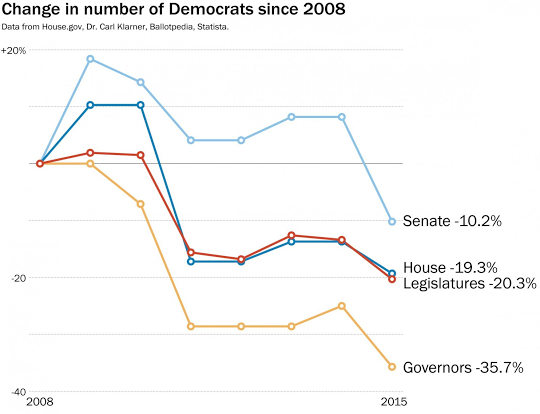
THE OBAMA LEGACY: Best Post-Election Graphic Yet

Philip Bump at The Washington Post accurately captions it “The decimation of the Democratic Party, visualized.”

As Dave Blount observes, “In 2008, the Democrat Party abandoned the last vestiges of moderation and threw itself behind the very personification of moonbattery, Barack Hussein Obama.”

While Democrats have thus far blamed James Comey, Julian Assange, Russian hackers, Fake News, and (presumably) George W. Bush for their crushing losses, there’s a much simpler explanation.

They nominated a thoroughly unlikeable, villainous harridan who pushed the party even further to the left thanks to the honorary President of Venezuela, Bernie Sanders, and President “I’ve Got a Pen and a Phone” Davis.

And while Democrats point to a popular vote victory for Hillary Clinton, that notion is also bogus:

161219-democrats-decimated

Let’s stipulate that California — even ignoring its massive population of illegal aliens — accounted for Hillary’s popular vote “victory”.

But let’s subtract out a few items from her popular vote total:

• There’s evidence of systematic Democrat vote fraud all over the country.

• There are also reputable estimates that millions of illegal aliens voted for Hillary Clinton in 2016.

• And Democrat efforts to undermine voter ID requirements, extend early voting periods, and make absentee ballots easier to obtain and forge have all contributed to the scam.

Subtract all of that Democrat criminality and it’s clear that Trump won the popular vote — and the electoral college — by a veritable landslide.

The evisceration of the Democrat Party is Obama’s real legacy. And no one tell Paul Krugman. He’s suffering from a bad case of walking butthurt. (For more from the author of “THE OBAMA LEGACY: Best Post-Election Graphic Yet” please click HERE)

Follow Joe Miller on Twitter HERE and Facebook HERE.

Here’s the Tool Congress Can Use to Curtail Obama’s Regulation Legacy

Conservatives in Congress have a plan to undo a large number of regulations from the last few months of President Barack Obama’s time in office.

The recently imposed regulations include a new rule from the Department of Health and Human Services that protects federal funding for Planned Parenthood as well as regulations from the Department of Labor instituting paid sick leave for federal contractors.

Both of these new rules, along with a host of others, may be able to be undone with the help of the Congressional Review Act.

This law was passed in 1996 as part of the Small Business Regulatory Enforcement Fairness Act and then-Speaker Newt Gingrich’s Contract with America reform agenda.

Conservatives in Congress have a plan to undo a large number of regulations from the last few months of President Barack Obama’s time in office.

The recently imposed regulations include a new rule from the Department of Health and Human Services that protects federal funding for Planned Parenthood as well as regulations from the Department of Labor instituting paid sick leave for federal contractors.

Both of these new rules, along with a host of others, may be able to be undone with the help of the Congressional Review Act.

This law was passed in 1996 as part of the Small Business Regulatory Enforcement Fairness Act and then-Speaker Newt Gingrich’s Contract with America reform agenda.

According to the Congressional Research Service, the Congressional Review Act “is an oversight tool that Congress may use to overturn a rule issued by a federal agency.”

It requires agencies to update Congress on the rules they write and “provide Congress with a special set of procedures under which to consider legislation to overturn those rules”.

For a rule to be appealed under the Congressional Review Act, those disapproving of the rule must first present a report to the House, Senate, and comptroller general.

According to the Congressional Research Service, this report must contain “a copy of the rule; concise general statement relating to the rule, including whether it is a major rule; and the proposed effective date of the rule.”

Once this report is received, the House and Senate must pass a “joint resolution of disapproval” that would go to the president for approval or veto.

If vetoed by the president, Congress still has one more shot at the resolution by voting to overturn the veto with a two-thirds vote in each chamber.

So far, the Congressional Review Act has aided in the overturning of one rule.

The Hill reported that in 2001, Congress was able to successfully repeal a rule on workplace injuries that was issued by the Occupational Safety and Health Administration (OSHA). Since then, according to the Congressional Research Service, OSHA has not tried to reinstate a similar version of this workplace injuries rule.

James Gattuso, a senior research fellow who studies regulatory issues for The Heritage Foundation, said that the Congressional Review Act has not been successful in the past because of the administration in power.

“The problem that became apparent after the [Congressional Review Act] was adopted was that the president will almost never be in a situation where he wants to disapprove of regulations from his own agencies,” Gattuso told The Daily Signal in a phone interview.

Then-Republican President George W. Bush was the reason the Congressional Review Act succeeded in repealing the OSHA rule in 2001.

Gattuso said of the law’s potential success on a larger scale:

The Democratic president [has] adopted just slews of regulations all within the past few months. So all those new rules, there are dozens of them, are eligible to be reviewed under the [Congressional Review Act]. And, when they’re submitted to the president, they’ll be submitted to a Republican president who will have no hesitancy in signing a lot of these.

According to Gattuso, conservative lawmakers are likely to have more success with using the Congressional Review Act due to incoming President-elect Donald Trump.

Constitutionally, the president has to be involved in any legislative decision meant for his possible veto. The one example where that was not a barrier was in 2001, when there was a change of administrations and a Clinton administration rule was rescinded. Now, we have that same situation for really the first time since then that there is a new Republican president coming in with an outgoing Democratic president.

According to a report released by The Heritage Foundation’s Gattuso and Daren Bakst, the Congressional Review Act will be able to address regulations handed down by Obama dating back to June 3, 2016.

With Trump, Gattuso said he believes that lawmakers will have significant success in undoing “slews” of regulations that the Obama administration has set in place. He said that the Congressional Review Act is the “most powerful tool that Congress has … it is a powerful weapon.”

Rep. Mark Meadows, R-N.C., the recently elected chairman of the House Freedom Caucus, is spearheading the effort to address regulations put in place by the Obama administration through the utilization of the Congressional Review Act.

As part of this effort, the House Freedom Caucus has released a special report, “First 100 Days: Rules, Regulations, and Executive Orders to Examine, Revoke, and Issue” that outlines the regulations that conservative lawmakers are planning to take down with the help of the Congressional Review Act and a new presidential administration.

These include regulations present in the National School Lunch Program and
School Breakfast Program, the National Organic Program, and the Animal and Plant Health Inspection Services program.

In total, the report currently lists 228 rules that the House Freedom Caucus is looking to address.

“We expect it to get to 300 rules and regulations by the time that Jan. 20 rolls around,” Meadows said.

According to Meadows, the Congressional Review Act will not apply to all of the rules listed in the report, but instead will be a significant starting place.

“The Congressional Review Act will only apply to some of those, but the ones that it does apply to actually [have] a more far-reaching and lasting impact,” Meadows said.

Meadows said that the Congressional Review Act works best when used in concert with a conservative administration.

“It only works if you have a conservative in the White House or someone of the same party or it can be deployed as well, but it has to have a two-thirds majority … So, [the Congressional Review Act] is an exciting tool that is rarely used, but as we get prepared to use it on the overtime rule and hopefully a couple of others that have been a result of executive overreach, we’ll get to see it actually used perhaps for the first time in more than a decade,” Meadows said.

Not surprisingly, efforts are being made to enact more regulations before Trump takes office.

According to the Competitive Enterprise Institute, institutions such as the Environmental Protection Agency are trying to push through more restrictive policies before the presidential inauguration. The EPA is currently attempting to pass fuel economy standards before Trump’s inauguration in January.

However, Meadows said that due to his recent discussions with the Trump transition team, the president-elect’s administration is already aware of and planning to address the regulations imposed by the Obama administration.

“I will say this,” Meadows said. “Talking to some individuals with the Trump transition team, they are taking this extremely serious, and certainly will make it a priority so that excitement on behalf of Americans from coast to coast is well placed ‘cause I know that the Trump administration will have it as a high priority,” Meadows said. (For more from the author of “Here’s the Tool Congress Can Use to Curtail Obama’s Regulation Legacy” please click HERE)

Follow Joe Miller on Twitter HERE and Facebook HERE.

Obama Says Media Helped Putin in ‘Obsession’ with Leaks That Hurt Clinton

President Barack Obama used part of his final White House press conference of the year to take shots at Russia and the media, and to argue that Ronald Reagan would disapprove of what he called Republican voters’ warming to Russian leader Vladimir Putin.

The main topic Friday afternoon was alleged Russian hacking and interference in the U.S. election, after reports that the intelligence community determined Putin’s government sought to help elect Donald Trump as president.

But aside from hacking the email of the Democratic National Committee and Hillary Clinton’s campaign chairman, John Podesta, Obama said, there was no tampering with votes in local and state election systems.

“I can assure the public that there was not a kind of tampering with the voting process that was a concern and will continue to be a concern going forward,” the president said, when asked if the election was free and fair.

“The votes that were cast were counted. They were counted appropriately. We have not seen evidence of machines being tampered with.”

Obama also said relentless coverage of the email leaks were “unfair” to Clinton.

“I’m finding it a little curious that everyone is acting surprised that this looked like it was disadvantaging Hillary Clinton, because you guys wrote about it every single day,” he said in the White House’s packed press briefing room. “This was an obsession that dominated the news coverage.”

He added:

I do think it is worth reflecting how a presidential election of such importance, of such moment, with so many big issues at stake and such a contrast between the candidates, seemed to be dominated by a bunch of these leaks.

Obama, who departed later Friday with his family for a 17-day holiday vacation in Hawaii, also appeared to put coverage of the email scandals in the category of “fake news”:

If fake news that is being released by some foreign government is almost identical to reports that are being issued by partisan news venues, then it’s not surprising that foreign propaganda will have a greater effect. It doesn’t seem that far-fetched compared to some of the other stuff folks are hearing from domestic propagandists.

Obama also suggested that Republican voters are warming to Russia’s Putin, which he said was entirely about politics.

“There was a survey from a reputable source that found 37 percent of Republican voters approved of Putin,” Obama said. “Over a third of Republican voters approved of Vladimir Putin, the former head of the KGB. Ronald Reagan would roll over in his grave.” (For more from the author of “Obama Says Media Helped Putin in ‘Obsession’ with Leaks That Hurt Clinton” please click HERE)

Follow Joe Miller on Twitter HERE and Facebook HERE.
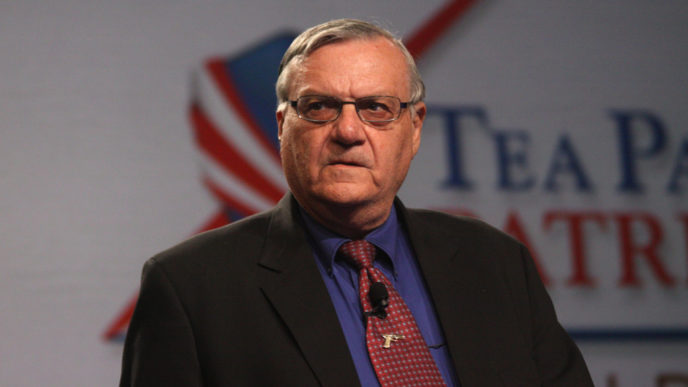
Sheriff Joe Arpaio Offers Evidence He Says Proves Obama’s Birth Certificate Is Not Real

The office of Maricopa County, Ariz., Sheriff Joe Arpaio presented what it characterized as proof that the birth certificate the White House offered as evidence of President Obama’s American birth is not real.

Arpaio began the press conference Thursday in Phoenix by assuring reporters the office had “followed the evidence” and would have been just as satisfied if it had determined the certificate was authentic.

In the hour-long presentation, Arpaio’s lead investigator, Mike Zullo, made the case that the certificate was created from a “source” document: the birth certificate of Hawaiian Johanna Ah Nee, who was born within weeks of Obama in August 1961.

The Ah Nee document was originally obtained from investigative journalist Jerome Corsi, the author of several books and a contributor to the website World Net Daily.

According to Zullo, two separate forensic expert sources from two continents — Reed Hayes from Hawaii and the For Lab team in Italy — reviewed the Obama certificate and concluded it was not authentic.

Zullo told reporters Hayes has 45 years in the field and originally did not want to take the case because he is an Obama supporter and voted for him twice.

After reviewing the Obama certificate, the court expert stated, “I can’t clear this. There is something wrong with it.”

Zullo showed a video to reporters that purported to demonstrate how the date stamp in two different boxes on Obama’s certificate had the exact angle and placement, matching one of the date stamps on the Ah Nee original.

(For more from the author of “Sheriff Joe Arpaio Offers Evidence He Says Proves Obama’s Birth Certificate Is Not Real” please click HERE)

Follow Joe Miller on Twitter HERE and Facebook HERE.

Obama Political Appointees to Continue as Career Employees Under Trump

After President Barack Obama exits office, at least 88 of his political appointees will likely remain working in the federal government under a Donald Trump administration, according to numbers from the Office of Personnel Management.

From Jan. 1, 2010, through Sept. 30, 2016, federal agencies selected 112 political appointees for career civil service jobs. Of those, the Office of Personnel Management approved 88 and rejected 24.

Unlike political appointees, federal workers in the civil service system are hired through a merit system, are difficult to fire, and carry over during administration changes, Republican or Democrat.

Political appointees are allowed to transition to career federal jobs, but under the law, they are supposed to go through the same merit-based selection process as other applicants.

“Selecting civil servants based on ideology instead of qualifications results in a less effective, more politicized bureaucracy,” Henry Kerner, assistant vice president of Cause of Action Institute, said in an email to The Daily Signal Tuesday. “Burrowing also provides the outgoing presidential administration the ability to reward its allies by stacking agencies with politically-aligned people who will be less inclined to help implement the new administration’s priorities.”

After an agency has hired a political appointment to a career position, the conversion has to face final approval by the Office of Personnel Management.

“Federal guidelines require agencies to seek approval from [the Office of Personnel Management] for such moves, but it’s unclear how often these rules are followed,” Kerner added.

Office of Personnel Management spokeswoman Laura Goulding said the number could be higher.

“It’s difficult to provide an accurate number of Obama administration employees who may be in the process of converting, since it changes by the day,” Goulding told The Daily Signal.

She added, “We don’t know how many political appointees apply for permanent federal positions; we just see the number of selectees. [The Office of Personnel Management] has checks and balances in place to ensure cases requiring pre-appointment review are submitted to OPM for approval.”

An Obama administration political employee, who converted earlier this year to a civil service job in the Department of Veterans Affairs, could be playing a role in the presidential transition.

This could at least violate the spirit of the policy on presidential transitions, which is supposed to minimize partisanship, according to the Cause of Action Institute, a conservative government watchdog group.

The organization is more broadly investigating how many political appointees are moving into career civil service positions, a practice known as “burrowing.” The watchdog has made a Freedom of Information Act request to both the Office of Personnel Management and the VA.

Obama appointed Gina Farrisee in September 2013 to serve in the political job of VA assistant human resources secretary. In May, she converted to the career civil service position of deputy chief of staff—a role she will continue in after Trump takes office.

Before serving in the VA, Farrisee was an Army veteran and was awarded several military decorations. She served as the commanding general of the U.S. human resources command at Fort Knox, Kentucky.

“According to information obtained by [Cause of Action] Institute, Gina Farrisee, the deputy chief of staff at VA, is apparently a key member of the VA White House transition team that is preparing the agency for the next administration,” wrote Lamar Echols, counsel for Cause of Action, in a FOIA request to the VA. “If true, this arrangement creates the appearance that the transition process will be managed by Obama administration political appointees because Ms. Farrisee was an Obama administration appointee until May 2016.”

That could be a problem because each federal agency is supposed to have two transition leaders, one from the political level and another from the career level.

“In this case, it appears a former political appointee will be playing the role of a nonpartisan career employee, an apparent conflict of interest,” Echols wrote.

Echols’ letter said this could also go against a May executive order by Obama, which said:

The peaceful transition of power has long been a hallmark of American democracy. It is the policy of the United States to undertake all reasonable efforts to ensure that presidential transitions are well-coordinated and effective, without regard to party affiliation.

The VA did not respond to phone and email inquiries from The Daily Signal as of post time to confirm whether Farrisee is part of the transition team.

Goulding, with the Office of Personnel Management, said, “We can’t confirm any specific members of transition teams; we don’t have that information.”

The Obama administration did not follow the rules to avoid political favoritism in hiring a quarter of all Obama administration political appointees into career civil service jobs, according to a Government Accountability Office report issued in September.

The report covered 30 federal agencies from Jan. 1, 2010, through Oct. 1, 2015. According to the report, agencies failed to get final Office of Personnel Management approval when hiring political appointees to career jobs.

“In those instances where the agency did not submit a request for pre-appointment review, [the Office of Personnel Management] informs the agencies in writing of the requirement to conduct a review of the selection post-appointment,” Goulding said, adding:

OPM also works with agencies to increase awareness and understanding of OPM policy in this area. In addition, we are required by law to report to Congress when those individuals who underwent a pre-appointment review were appointed to the career position.

(For more from the author of “Obama Political Appointees to Continue as Career Employees Under Trump” please click HERE)

Follow Joe Miller on Twitter HERE and Facebook HERE.

Obama Sent Someone to Castro’s Funeral, but Not Thatcher’s. Why It Sends the Wrong Message.

President Barack Obama sent high-level administration officials to Cuban dictator Fidel Castro’s funeral procession last week, a gesture of respect he did not offer for former British Prime Minister Margaret Thatcher’s funeral.

After Castro’s death, Obama released a statement saying: “History will record and judge the enormous impact of this singular figure on the people and the world around him.”

The carefully guarded words made no reference to the legacy of tyranny and destruction Castro left for the Cuban people, nor did it explain how much Castro’s communist ideology played a role in the half-century of humanitarian catastrophes during his regime.

As reported in Conservative Review, “Ben Rhodes, the White House deputy national security adviser and one of the president’s closest aides,” was sent to attend Castro’s funeral service along with the U.S. ambassador to Cuba, Jeffrey DeLaurentis.

Rhodes became notorious this spring when he boasted of selling a “narrative” about the U.S.-Iran nuclear deal to journalists to push the president’s agenda through Congress.

He was also a key player in opening up relations between the U.S. and Cuba in 2015, ending a long-standing American policy to isolate the communist nation.

The Obama administration failed to send high-level members to Thatcher’s funeral in 2013, which many British saw as a “snub” of their famous leader. Nor was that the first sharp elbow thrown at legendary British leaders by the Obama administration.

The words and actions of an administration, such as who a president chooses to send to a funeral, have a heightened influence on the global stage without the chief executive ever having to act officially.

As historian Richard Neustadt wrote, paraphrasing President Harry Truman, “presidential power is the power to persuade.” And as Neustadt noted, this power to persuade leads to the more tangible power to negotiate—perhaps the most important presidential role in foreign relations.

That the president seems so willing to symbolically and concretely abandon the “special relationship” the U.S. has had with Britain while going out of the way to tiptoe around the sore spots of the Cuban regime is a reversal of priorities for a nation that stood as a beacon for the free world.

Of course, Castro and Thatcher stood at opposite ends of the Cold War in the ultimate test of freedom against authoritarianism—Castro was a revolutionary communist who battled with the United States for decades and Thatcher was a legendary Cold Warrior who stood shoulder to shoulder with President Ronald Reagan against international communism in the 1980s.

When Thatcher was elected prime minister in 1979, she, along with Reagan, pursued a more confrontational approach to the Soviet Union, which she viewed as a primary global threat to human liberty.

She saw the difference between free countries like the United States and Great Britain and authoritarian regimes like under the Soviet Union and Cuba as fundamental.

Like Reagan, who called the Soviet Union an “evil empire” in a famous 1983 speech, Thatcher rhetorically undermined the tyrannical regimes and indicated that a mere détente with them was unacceptable.

When negotiating with the Soviet Union at the end of the Cold War, Reagan and Thatcher came from a position of strength.

In a 1983 television appearance, the Iron Lady, as Thatcher came to be called, explained the radically different outcomes for people living under these nearly opposite systems of government:

[Nations] that have gone for equality, like communism, have neither freedom nor justice nor equality, they’ve the greatest inequalities of all, the privileges of the politicians are far greater compared with the ordinary folk than in any other country. The nations that have gone for freedom, justice, and independence of people have still freedom and justice, and they have far more equality between their people, far more respect for each individual than the other nations.

Castro’s Cuba has been the very picture of this despotism based on a false “equality,” as Thatcher described.

“Castro’s communism has not just left Cubans economically pauperized, but politically bereft, a situation that Obama’s unilateral concessions to Castro’s little brother, the 85-year-old Raul, Cuba’s present leader, has only made worse,” Heritage Foundation senior fellow Mike Gonzalez wrote for The Daily Signal.

Cuba’s pursuit of communism under Castro crippled the island nation and pushed hundreds of thousands to risk their lives to escape. Thatcher and Reagan’s rhetorical stands against autocracy helped break the power of communism as an international threat as they pushed the Soviet Union to collapse.

But the Obama administration now has sent high-ranking officials to the funeral service of the man who pleaded with Soviet leader Nikita Khrushchev to wage nuclear war against the United States during the 1962 Cuban missile crisis. The system the now-deceased Castro created still exists after his death and continues under his brother.

The simple act of administration officials attending or not attending a state leader’s funeral service communicates a great deal to the world about what a president’s intentions are.

Signaling that free countries like the United States will back off in their condemnation of oppressive, communist regimes like the one propped up by the Castro brothers helps breathe new life into their failed ideology. (For more from the author of “Obama Sent Someone to Castro’s Funeral, but Not Thatcher’s. Why It Sends the Wrong Message.” please click HERE)

Follow Joe Miller on Twitter HERE and Facebook HERE.
Obama Administration Not Finished yet With Executive Actions, Regulations

On Monday, President Barack Obama issued his fifth executive order since the Nov. 8 election. In this case, it was to create a National Invasive Species Council to compile a report by 2020 on how to prevent such species from affecting climate change, food safety, and even military readiness.

Citing national security concerns, Obama issued another order on Friday blocking Chinese firm Fujian Grand Chip from buying Aixtron, a German company operating in California that produces crystalline layers used as semiconductors in U.S. weapons systems.

Executive orders aren’t the only means for Obama to act without Congress before he leaves office on Jan. 20.

A new policy on highly skilled immigrants, restrictions on for-profit colleges, and energy efficiency standards are among the matters that the administration wants that don’t require congressional authorization that the Obama administration is moving aggressively in the post-election to complete before Obama exits on Jan. 20.

Executive actions and administrative regulations were planned and considered before the election and not a result of Republican Donald Trump’s victory, White House press secretary Josh Earnest said at a White House press briefing, noting executive actions and regulations take “a lot of preparation.”

“I’m not going to rule out additional executive actions that the administration may take between now and January 20—after all, the president of the United States is the president of the United States until Jan. 20,” Earnest told The Daily Signal, adding:

But what I can rule out are any sort of hastily added executive actions that weren’t previously considered that would just be tacked on at the end. But are there some actions that have been in the pipeline for quite some time that could be announced between now and Jan. 20? That possibility certainly exists, but I don’t have anything to preview at this point.

Politico reported the list of Obama administration actions before leaving office includes:

A U.S. citizenship and immigration policy to make it easier for employers to sponsor highly skilled immigrants;

An Education Department policy to provide debt relief to students at for-profit colleges;

The Transportation Department is moving to ban cellphone calls on commercial flights;

The Occupational Safety and Health Administration could limit exposure to beryllium, a metal used in electronics and aerospace industries believed to pose lung cancer risks; and

The Department of Health and Human Services is seeking to change how doctors and hospitals get paid for administering drugs under Medicare Part B.

The fact that Trump could overturn much executive or administrative actions doesn’t appear to have caused pause, as the Federal Register has grown by 9,000 pages since Nov. 8, said Ryan Young, a fellow with the Competitive Enterprise Institute.

Gina McCarthy, the Environmental Protection Agency administrator, seemed eager for more action in a memo to staff sent to employees after the Nov. 8 election, which was obtained by the Washington Examiner.

“As I’ve mentioned to you before, we’re running—not walking—through the finish line of President Obama’s presidency,” McCarthy wrote. “Thank you for taking that run with me. I’m looking forward to all the progress that still lies ahead.”

Whether the regulations or executive actions are hasty shouldn’t really be the key question, said James Gattuso, a senior research fellow who studies regulatory issues for The Heritage Foundation.

“As far as I’m concerned, if it takes a long time to adopt rules or actions, or if they fly through the process, it doesn’t matter if it’s a bad rule,” Gattuso told The Daily Signal.

Regulations, he said, can be more tedious to overturn than executive orders or executive actions. However, the 1996 Congressional Review Act could be used to roll back many of those regulations, Gattuso said.

The law allows Congress, with the president’s signature, to scrap regulations it opposes, bypassing previous legal procedures in place, while forbidding bureaucrats from imposing rules that are substantially the same.

“No president is willing to sign a bill overturning their own regulation, but they are willing to overturn their predecessor’s regulations,” Gattuso said. “This is a once in a decade chance, really a once in several decades’’ opportunity, to roll back regulations.”

House Majority Leader Kevin McCarthy, R-Calif., and 21 House committee chairmen warned against a rush for regulations in a letter to agency heads, pledging to used the Congressional Review Act if need be. The Nov. 15 letter from House Republicans said:

As you are aware, such action often involves the exercise of substantial policymaking discretion and could have far-reaching impacts on the American people and the economy. Considering these potential consequences, we write to caution you against finalizing pending rules or regulations in the administration’s last days.

By refraining from acting with undue haste, you will ensure that agency staff may fully assess the costs and benefits of rules, making it less likely that unintended consequences will harm consumers and businesses.

Moreover, such forbearance is necessary to afford the recently elected administration and Congress the opportunity to review and give direction concerning pending rulemakings.

Should you ignore this counsel, please be aware that we will work with our colleagues to ensure that Congress scrutinizes your actions—and, if appropriate, overturns them—pursuant to the Congressional Review Act.

On Nov. 8, the Federal Register contained 78,300 pages, and as of Dec. 2, it had increased to 87,297 pages, Young said. Further, since Election Day, there were 144 new proposed regulations from federal agencies, and 243 regulations that were finalized.

“We could see a midnight rush the likes of which we haven’t seen before,” Young, of the Competitive Enterprise Institute, told The Daily Signal. (For more from the author of “Obama Administration Not Finished yet With Executive Actions, Regulations” please click HERE)

Follow Joe Miller on Twitter HERE and Facebook HERE.

Obama Admin Reserves Hero’s Sendoff for Castro. Thatcher? Not So Much

President Obama will send a higher-level delegation to the funeral of Cuban dictator Fidel Castro’s funeral than he did when Margaret Thatcher was laid to rest.

Ben Rhodes, the White House deputy national security advisor and one of the president’s closest aides, will attend the Castro funeral, the Obama administration announced Tuesday. He will be joined by Jeffrey DeLaurentis, the U.S. ambassador to Cuba.

Castro, imposed his tyrannical rule on the people of Cuba for half a century. Known for his firing squads, labor camps, and suppression of basic human rights, he was also fiercely anti-American, allying with the Soviet Union in hopes that one day the United States would crumble.

White House spokesman Josh Earnest told reporters on Tuesday: “The president has decided not to send a presidential delegation to attend the memorial service.” However, with the sending of Rhodes, whether or not the president sent an “official” delegation becomes more or less an issue of semantics.

The United States restored official diplomatic relations with the Cuban regime in July 2015. Rhodes, who has been on Obama’s team since 2007, was an integral member of the administration’s push to normalize relations with Havana. The New York Times previously reported on Rhodes’ efforts to advance negotiations with Cuba, claiming he “spent more than a year sneaking off to secret negotiations in Canada and finally at the Vatican.”

Rhodes has utilized the enormous influence of his position to pursue the Obama foreign policy agenda, leaving a trail of deception in his path.

The White House deputy national security advisor has bragged that he purposely misled journalists regarding the U.S. negotiations with the Islamic Republic of Iran. Rhodes boasted about his success in creating an “echo chamber” to move public opinion toward accepting a nuclear deal with the Ayatollah’s regime.

When baroness Thatcher passed away in 2013, the president did not send a SINGLE high-profile member of his administration to the funeral. Two Reagan-era secretaries of state, James Baker and George Schultz, attended on behalf of the U.S., along with the ambassador to the United Kingdom.

As the first female prime minister of the U.K., Margaret Thatcher helped end the Cold War.

“All over Europe the peace marchers demonstrated to prevent Western missiles from being installed for their defense,” President Ronald Reagan wrote in a 1989 piece for National Review, “but they were silent about the Soviet missiles targeted against them! Again, in the face of these demonstrations, Margaret (Thatcher) never wavered.”

The Soviet press nicknamed her “the Iron Lady,” a tag she embraced in showcasing her resolve against tyranny.

Lady Thatcher, a voice for liberty and freedom worldwide, and a key ally in bringing about the end of the Soviet Union, was given the cold shoulder by President Obama. Fidel Castro, the ruthless tyrant, known for mass executions and the subjugation of basic human rights, gets Ben Rhodes, an irreplaceable part of the White House foreign policy team. (For more from the author of “Obama Admin Reserves Hero’s Sendoff for Castro. Thatcher? Not So Much” please click HERE)

Follow Joe Miller on Twitter HERE and Facebook HERE.