Posts

Obama’s Last Christmas Present to America? A Boatload of New Regulations

Barack Obama’s presidency may be waning, but that isn’t stopping the administration from issuing a volley of new regulations designed to implement the departing president’s agenda.

From commodities speculation to air pollution, Medicare drug payments to protecting funding for Planned Parenthood, agencies are hard at work issuing mandates, grasping at their last opportunity to lock in rules on Obama’s legacy issues.

These actions are nothing new. In fact, “midnight regulations” are almost a permanent feature of lame-duck presidents. Midnight regulations spiked under President Bill Clinton and were also used extensively by President George W. Bush.

However, President Obama has been far more direct about using the regulatory state to impose his agenda nearly by executive fiat — or without the approval of Congress. Under Obama, regulations have exploded. According to the Heritage Foundation, the Obama Administration issued 184 major rules during its first six years in office — at a cost of almost $80 billion a year.

Though only two months remain in Obama’s term, there are thousands of rules yet to finalize. Over 1500 proposed rules and regulations are in the pipeline, including over 700 dubbed “economically significant” — meaning those that cost the economy over $100 million per year. It’s these regulations that are likely candidates to be imposed in a last-minute flurry.

Is Congress powerless to stop this power grab by the executive branch?

Yes. And no.

By law, Congress has the authority to issue a “congressional review” of regulations it finds objectionable. Congress has 60 days to hold and up or down vote on regulations it chooses to review. This is tougher than it sounds — in fact, since its enactment, the Congressional Review Act (CRA) has only been successfully used once.

So, really, Congress provided itself with a tool to challenge executive regulations that is nearly impossible to utilize. I’m not too shocked.

However, this shouldn’t stop Republicans in the new Congress from seeking every opportunity to use the CRA. President Obama has issued more regulations — and at greater cost — than any sitting president to date. It is the constitutional role of Congress to check an overly-enthusiastic executive, and to do so requires Congress to muster the will to assert itself against this regulatory excess.

There is another way in which Congress can assert a permanent check on the power of the executive, and that is by passing the Regulations in Need of Scrutiny Act, or the REINS Act. This proposed bill would require every major regulation — those costing the economy $100 million or more per year — to receive an approval vote from Congress before it can go into effect.

Such a law, if enacted, would put accountability back where it belongs — in the hands of Congress, and the members that have been elected by the people. No longer would agency bureaucrats be able to write billion dollar regulations and impose them on the voters, who lack the recourse to stop them.

Consider the regulatory burden imposed by President Obama, without the approval of Congress:

Obama’s air pollution rule would be “the most expensive regulation ever imposed on the American public,” according to the National Association of Manufacturers, who calculated the rule would cost $3.4 trillion in economic output, and 2.9 million jobs by 2040.

The Obama administration’s rules on the financial industry reach over 19,000 pages so far.

EPA’s rule on emissions for automobiles costs $2.4 billion annually, according to one estimate.

The Federal Policy for the Protection of Human Subjects, a rule co-authored by every cabinet agency, could impose more than 12.1 million paperwork hours onto the medical research industry (in addition to costing $13.3 billion).

The regulatory state now comprises a literal “fourth branch” of government — one that is unchecked, and unaccountable. It is vital that Congress reasserts its Constitutional authority as a check on the executive branch. The new Congress must act aggressively to counter Obama’s surge of midnight regulations with the Congressional Review Act, and they must pass the REINS Act to subject major regulations to Congressional scrutiny.

More than that, however, this new Congress must be cautious about giving so much authority away to federal agencies. In many cases, harmful regulations are the result of Congress giving agencies vague directions and overly broad mandates. Too often legislation is passed that is half-written; allowing unelected bureaucrats to fill in the holes. If government is going to work as the Founders intended, then Congress must stop shirking the hard work of legislating, and write bills that contain clear direction — and limits — for agency power.

Unfortunately, midnight regulations are only part of a much larger regulatory problem. Unless Congress acts quickly, America will continue to be governed by unelected bureaucrats, accountable to no one but themselves. If this new Congress is serious about “draining the swamp,” their first step will be to rein in regulatory state. (For more from the author of “Obama’s Last Christmas Present to America? A Boatload of New Regulations” please click HERE)

Follow Joe Miller on Twitter HERE and Facebook HERE.

Report: Obama Ultimately Convinced Clinton to Concede on Election Night

A new report suggests that Hillary Clinton’s concession call to Donald Trump in the early morning hours of Nov. 9 to congratulate him on winning the presidential election may not have happened if it weren’t for the urging of President Obama.

Amie Parnes, who serves as chief White House correspondent for The Hill, and Jonathan Allen are writing a book about Clinton’s defeat in the election. Among the stories they have compiled is the tale of what happened as the stunning results seemed to all but guarantee a Trump victory.

Parnes and Allen say that according to sources within the Clinton campaign and the White House, just after the Associated Press called Pennsylvania on behalf of Trump at approximately 1:30 a.m. EST, the president called Clinton.

His message was simple.

“You need to concede,” he told Clinton.

Clinton ultimately agreed to call Trump, but according to Parnes and Allen, not without hearing plenty of objections from members of her own staff, who believed there was still a chance Michigan and Wisconsin could turn into victories for Clinton.

“There was a lot of discussion about Michigan and Wisconsin and whether the numbers could flip it,” The Hill quoted one of the sources as saying.

While campaign chairman John Podesta went on stage to address supporters who had gathered to for what was anticipated to be a Clinton victory party at the Jacob Javits Center in New York City — he ultimately told them to go home for the evening because there were still votes being counted in the Rust Belt states — Clinton finally listened to what the president had suggested and decided to call Trump.

The Michigan outcome was so close — approximately 13,000 votes — that the state conducted its own recall, only to determine this week that Trump won by slightly more than 10,000 votes. The win officially gives Trump 306 electoral votes.

With Green Party candidate Jill Stein and other liberals demanding recounts in Pennsylvania and Wisconsin, there are some conservatives pointing out the irony that Trump was ridiculed for not coming out and saying during the third presidential debate that he would automatically accept the results of the election if he were to lose. And yet, more than two weeks after the election, some on the Democratic side are the ones not willing to accept the results because Clinton has lost.

Stein said Friday that her online efforts have raised more than $4.5 million to launch recounts in Michigan, Pennsylvania and Wisconsin.

Officials with the Obama administration are not among those unwilling to accept the results. In fact, the White House has tried to dissuade the financial and logistical investments necessary to challenge the final vote totals because it does not want to be seen as doing anything to disrupt the smooth transition of power between the Obama and Trump administrations.

Clinton has also not lobbied for any official examination of the results, although Podesta has reportedly been contacted by a group of data experts who claim they’ve seen circumstantial evidence of “irregularities” in some of the vote totals, particularly in certain counties in Wisconsin. (For more from the author of “Report: Obama Ultimately Convinced Clinton to Concede on Election Night” please click HERE)

Follow Joe Miller on Twitter HERE and Facebook HERE.

11 Ways President Obama Absolutely Destroyed the Democratic Party

Analysts argue that Trump won because Hillary didn’t win like Obama did, or something like that. Obama argues that he was a better campaigner than Hillary was. But across the nation, it was clear that many former Democratic voters backed Trump in key areas.

Hillary Clinton has been controversial since college, and nominating her certainly did the Democrats no good. Looking back, you can see that she didn’t promote outlandish things while on the stump. She sounded like an old-time Democrat, a God-fearing white pantsuit-wearing smiler of smilers.

It’s just, well, America wasn’t fooled.

But it wasn’t just that Hillary was so bad that Republicans won. It was that Obama was so bad, America couldn’t see how they would improve with four more years of numbskull policies that didn’t benefit regular Americans to begin with.

While Barack Obama has less than two months left in his failed presidency, let’s review why so many traditional Democratic voters have abandoned the Democratic Party.

1. Cash for Clunkers

Cash for Clunkers was a grand plan that was supposed to increase the number of cars on the road with higher fuel efficiency. To the Obama administration, this program — one of the first down the pike — was offered as a fix for the poor. The theory was these consumers could use the money they got for their clunker to buy a better, more fuel efficient car. This worked for some in the middle class, who buy new or close to new vehicles every few years. For the working poor, however, it didn’t fix anything. In fact, the program cost three times its estimate, and the unseen consequences hit them the hardest.

See, when a clunker was turned in, it was made inoperable by dealers, (per instructions from on high) by filling the engine with liquid glass — literally destroying the engine. From there, the car was parted out for up to six months and then had to be destroyed completely. The government had to be notified when each car was dead. I mean, looking back on this massive waste now it seems so ridiculous that there was ever such a program that hurt lower middle class and low income earners the most. Think of all the used cars that were removed from the market.

If you needed a car with high miles and a little rust to get to your $9.00 an hour job seven miles away, finding a cheap one after this stupid program became a lot more difficult. Clunkers still on the market were few and far in between. Thanks to Cash for Clunkers, they were also more expensive and not better in any way.

2. Made getting to our jobs harder

Gas prices during the Obama administration were so high that all the fuel-efficient cars they tried to put on the roads didn’t matter much to people’s pocketbooks. Gas prices spiked in 2008 then dropped to almost nothing the month after Obama was elected, then steadily increased and stayed high for four full years spanning both Obama’s terms. Between 2011 and 2015, Americans filled up their trucks at about $80 a tank for gas. Gas prices between $3.50 to $4.10 hurt the working men and women trying to get to their jobs.

Of course, this increase in gas prices increased the cost of shipping of food to grocery stores, thereby raising the cost of groceries. When you have bills to pay and a budget for gas and groceries as most families do — and you need gas to get to your job — there isn’t much stretch to that budget. As a result, food quality suffers.

3. He told us we didn’t build that

Part of Obama’s campaign slogan in 2012 included telling mom and pop entrepreneurs across the countryside that they would be nothing if not for the government. It was as much a slap in the face as Hillary’s “deplorables” line was, but perhaps much more.

When a president who accomplished nothing in his life, and never had to keep his business going in tough times, produces the tough times that these entrepreneurs had to react to and overcome, a slow-burning intense passion begins to fester for outlasting such a vile enemy to producers. Small businesses are the back-bone of this economy, and Obama acted a punk to people whose hands were calloused and had to scrimp and save all they had, and use creative ways to stay open during a terrible economy.

4. Claimed wind and solar power was the wave of the future

Working Americans know that wind and solar power cannot replace coal and oil. There is no possible way that using the sun and wind could produce as much energy as burning something. It’s just logic, or basic science, if you will.

But the Obama administration did one foolish and wasteful thing after another to try to prove they were right anyway, and ended up wasting billions of your tax dollars on Solyndra and other fiascos like it.

The Ivanpah Solar Plant in Nevada, for example, is the largest solar farm in the world and is producing no where near the promised amount of power. The power it is producing is on the market at about $200 a megawatt hour compared to about $35 for natural gas. Oh, and the plant and those like it are killing birds and causing airplane pilots glare issues. Recently, a computer failure at the plant caused part of the farm to burn itself up, because the mirrors were directed the wrong way.

At a solar plant, birds who fly between the mirrors and the energy towers get burnt to death, which is horrible. All the plant seems to have done is create heat in the desert. Leave it to limousine liberals to spend your money to create heat in the desert.

Wind power is a joke, but what is irritating is that they notoriously kill birds. Stories of windmills killing eagles are numerous, and your government has protected wind farms from prosecution for killing bald eagles for 30 years. If I were to kill one eagle, I’d get prison time.

5. Poisoned an entire river in Colorado

The Animas River in Colorado was turned a disgusting shade of orange-yellow when the Obama administration’s do-gooders caused a massive flood of toxic waste including arsenic and lead to enter the river flow and poison local water systems. The administration then forgave itself without penalty. It doesn’t take a genius to understand what would have happened to a group of citizens who did the same thing.

6. Made building anything or increasing our comfort more expensive

Environmental regulations increased the cost of everything needed to build, repair, or make improvement on homes, and a flood of new lower-cost pipes and compounds caused problems for homeowners. If the Obama administration had not clung to a foolish agenda of controlling how we build things, much of the headaches involved with implementing an environmental agenda could have been avoided. It seems everything involved with helping the environment, as implemented by the government, hurt the working man and woman.

7. Did not make a stand for Christians

In the lifetime of most Americans, it is hard to recall such antagonistic reproach toward Christians as President Obama and his administration has projected. From denying Christian refugees to turning a blind eye to the mass genocide in the Middle East and Africa of Christians, to the insistence of the president to downplay the role Christianity has with the founding of America, Obama has seemed to be the most anti-Christian president we’ve ever had.

8. Shut down coal production

Union members are told to vote Democrat to save their way of life. But that circle couldn’t be squared after the Obama administration systematically shut down coal production. By September, 2016, Obama had been able to shut down 400 mines and 83,000 jobs in the industry — an impossible thing to ignore for most union workers. Coal’s big sin was that it was cheap and “dirty.” But regular Americans prefer cheap energy to non-existent energy, and prefer smaller electric bills to larger ones.

9. Tried to demoralize our military

The Obama administration began an effort to use our military as a social experiment, and consistently worked to undermine its effectiveness, with insane rules of engagement. Similarly, the administration reversed the military’s main role as a force to be reckoned with simply because President Obama, as a leftist, despises it. We remember his “corpse-men” comment, and taking full credit for the death of Osama Bin Laden. This nation is proud of our military and all it has done to fight for our freedoms. Obama doesn’t know the people all over the nation whose families have sent loved ones, and his ideology showed.

After Obama was reelected in 2012, the facts swirled about Benghazi. To this day that incident remains as one huge, unforgivable sin in the minds and hearts of many Americans. The lies and cover-up it took to get Obama reelected — as well as the ongoing whiff from politicians in Congress — makes the American patriot royally ticked off. Americans just want to know just what happened, and — relying on their own powers of observation — hold both Hillary and Obama culpable for the deaths of four Americans that night.

10. Kept on golfing

President Obama didn’t work much. That is the impression he gave to millions of hardworking families all across the nation. Nobody who wishes to keep their job takes in 300 rounds of golf in eight years. That’s ten months a year, every year, every weekend. If the president worked a 9-5 job and got weekends off, it would be one thing. But he was golfing during some of the most important international and domestic crises we’ve had. Flooding in Louisiana, the beheading of James Foley, the funeral of a decorated war hero, the funeral of the Polish president and much of his government officials, are just some of the times when Obama seemed cavalier. But mostly, we are and have been at war, and President Obama didn’t seem to really care to make appearances that he was in charge of doing anything about it.

11. Obamacare

Obamacare is a fantastic and predictable failure, and Hillary would have doubled down on it if she had become president. There is no question that many American’s healthcare choices have diminished, doctor availability has dried up, and costs have skyrocketed. Even unions called out in outrage about it. Employers were put in a vice, and now, premiums and “shared responsibility” fees are going through the roof.

Obama, and all political leftists waste mountains of money and show little empathy toward the working men and women who make this country tick. All of these examples and more turned working Americans away from the Democratic Party, and the party seems to be doubling down on its losing ideology. As a regular American, it is wonderful to see that the anti-American sentiment that the Democrats insist upon holds so little political power.

The power the media had and utilized to continue promoting the Obama agenda without questioning really, any of it, has been exposed for all to see. But with a little less than two months left in his term, President Obama can still do a lot more damage. Let us make sure the Democratic Party is held responsible. (For more from the author of “11 Ways President Obama Absolutely Destroyed the Democratic Party” please click HERE)

Follow Joe Miller on Twitter HERE and Facebook HERE.

How a Federal Judge’s Last-Minute Injunction Against the Overtime Rule Will Help Workers and Businesses

Yesterday, U.S. District Judge Amos L. Mazzant, appointed by President Barack Obama, issued a nationwide injunction against the administration’s final overtime rule, which was scheduled to take effect on Dec. 1.

The temporary injunction came as the result of a consolidated legal challenge against the rule, brought by 21 states and more than 50 business groups.

The plaintiffs argued that the rule overstepped the Department of Labor’s statutory authority and that the automatic updating mechanism to the salary threshold violated the requirement that such actions undergo a formal rulemaking process.

In a 20-page ruling, Mazzant sided with the plaintiffs, stating that the Department of Labor overstepped its regulatory authority in issuing the rule, which would have doubled the salary threshold under which employees must be paid time-and-a-half for any hours over 40 that they work in a given week.

Mazzant wrote that “the department exceeds its delegated authority and ignores Congress’ intent,” which is to allow an exception to overtime pay for workers who perform executive, administrative, or professional duties.

By setting the threshold so high—at $47,476, or 40 percent of the median wage—Mazzant wrote that the final rule is “directly in conflict with Congress’ intent” because it “creates essentially a de facto salary-only test.”

Mazzant also stated that the final rule is “unlawful.”

In addressing the plaintiff’s argument that the automatic increase in the threshold violates the rulemaking procedure requirements, Mazzant wrote:

Because the final rule is unlawful, the court concludes the department also lacks the authority to implement the automatic updating mechanism. Thus, there is no need to address the state plaintiffs’ other arguments.

Mazzant’s statements suggest that a potential countermanding injunction or appeal will not succeed, meaning that anything resembling the final rule is unlikely to take effect.

That’s good news for President-elect Donald Trump because canceling a rule before it takes effect is far easier than attempting to roll it back after the fact—a process that could take years.

It’s also welcome news for businesses, workers, and families across the U.S.

According to a recent report from the nonpartisan Congressional Budget Office, over the first seven years, the overtime rule would cost businesses $6.9 billion in compliance costs, raise prices by $6.9 billion for consumers, and reduce family incomes (across all income groups) by $8.5 billion.

All these costs for only $2.7 billion in additional wages spread across less than 1 million workers (an average annual increase of $450 per affected worker).

And even those wage increases are questionable, as evidence suggests businesses would keep overall pay the same by reducing base salaries or shifting salaried workers into hourly ones.

Workers, families, and businesses should celebrate this temporary injunction, and hopefully permanent end to a rule that would create significant economic harm. (For more from the author of “How a Federal Judge’s Last-Minute Injunction Against the Overtime Rule Will Help Workers and Businesses” please click HERE)

Follow Joe Miller on Twitter HERE and Facebook HERE.

Like Obama’s First Term, Most Americans Want Trump to Address These Two Policy Areas

In many ways, incoming president Donald Trump and outgoing president Barack Obama couldn’t be more different. Trump is brash, while Obama is smooth. Trump’s worldview is more nationalist, while Obama’s is more globalist. Obama is a liberal ideologue, while Trump is a centrist pragmatist. Yet, in other ways, it’s actually kind of startling to see how similar the two men are, and by extension, how similar the country is to where we were eight years ago.

A new poll from Reuters/Ipsos finds that a plurality of voters want President-elect Trump to make health care his top priority when assuming office. In second place was a concern over jobs and the economy. Does this sound familiar to anyone?

In 2008, America had just been rocked by one of the worst financial crises in history. After two terms of George W. Bush, the voters were ready for something different, and due to economic insecurity, they rejected John McCain’s promise of a foreign policy presidency for Obama’s promise of “hope and change,” with an emphasis on health care reform and salvaging the economy from ruin.

It wasn’t at all surprising that change should win out in those troubled times over the decayed establishment. People felt vulnerable and needed new ideas to try to push the country back on the right track. What is surprising is that after eight years of “hope and change,” people still largely feel the same way.

Donald Trump’s election is undeniably a call for change, as many commentators have pointed out. What this shows is that the status quo — the things people thought they wanted in 2008 — have proven utterly unsatisfactory. Back then, there was a sense of great urgency to repair the nation’s broken health care system. And make no mistake, it was broken.

But Obamacare, Barack Obama’s signature legislative achievement, has been such an abject failure that the same sense of urgency remains undiminished today. Rising premiums, sky-high deductibles, and a malfunctioning market where insurers continue to drop out of the program are making Americans less medically secure than ever, despite the president and his cronies repeatedly assuring us that it’s working great. We know through direct experience that it isn’t.

Similarly, the economy remains in heavy focus. While it’s clear that we are not in the same desperate position we were in 2008, the recovery has been one of the slowest in history. And despite the official jobs numbers coming out of the Bureau of Labor Statistics, once again direct, personal experience tells voters that work is hard to come by, and small businesses struggle under a regulatory burden that is undeniably worse than it was before Obama took office. While again, the White House assures us that they “saved or created” millions of jobs through stimulus packages, bailouts, and quantitative easing, the results of all these policies have not inspired confidence in the electorate.

It’s hard to draw any other conclusion than that Trump’s election is serving much the same purpose as Obama’s election did in 2008, although with one important difference. While voters certainly viewed Obama as a condemnation of the Bush administration, Bush had not come into office promising to do the very things that formed the basis for Obama’s campaign. Today, we see that health care and the economy, the two policy issues Obama most aggressively tackled, remain the chief source of voter anxiety.

In other words, Obama didn’t just fail to keep the country happy, he failed at his own stated goals in such a spectacular way, that somehow Donald Trump (I still can’t believe it) is now going to be president. Eight years from now, will we once again be desperate for change? For all our sakes, I hope not. (For more from the author of “Like Obama’s First Term, Most Americans Want Trump to Address These Two Policy Areas” please click HERE)

Follow Joe Miller on Twitter HERE and Facebook HERE.

Trump Should Let the Senate Kill Obama’s Climate Treaty

When is a treaty not a treaty? According to the Obama administration, whenever the president says so. This claim is especially dubious with respect to the Paris agreement on global warming, which as Marlo Lewis of the Competitive Enterprise Institute has shown, is more ambitious than predecessor agreements that were universally accepted to be treaties.

Surely if President Obama possesses an asserted authority to declare an agreement identical in form and more ambitious in substance than previous treaties to be a non-treaty then President Trump will have the authority to reach the opposite, more plausible conclusion.

There is little doubt that the Trump administration will reject the Paris agreement, but the option of properly recognizing it as a treaty and allowing the Senate to formally reject it has several advantages.

First, it prevents the dangerous precedent of a president binding the country and his successor to international commitments without the broad support that the Constitution requires through the advice and consent process. Secondly, it sidesteps the question of whether the withdrawal provision of the Paris treaty itself forces us to wait four years before withdrawal is effective. Finally, it exposes as false the talking point that skepticism of the Paris agreement is outside the political mainstream.

John Kerry, who infamously declared global warming a greater threat to the United States than terrorism, gave his final speech on the subject this week to the UN functionaries in Marrakech, Morocco. He offered a soothing fantasy.

“No one should doubt the overwhelming majority of the citizens of the United States who know climate change is happening and who are determined to keep our commitments that were made in Paris,” Kerry said to applause.

Last week’s election emphatically showed the opposite. The Midwest delivered the White House to Trump, who dominated among the working class voters who care far more about how much they are paying to fill up the gas tank and keep their lights on than they do about what United Nations computer models predict about the climate in decades or centuries — the results of which show minimal change anyway. Appalachian voters in particular preferred Trump in a stunning 469 of 490 counties.

The Paris treaty is a magnificent example of the bad deals made for America that ultimately paved Donald Trump’s path to the White House.

Specifically, the Paris treaty effectively bans coal-fired power plants in the United States while China has 368 coal plants under construction and over 800 in the planning stage. India’s coal production under the deal is projected to double by 2020. Even Europe is allowed to build coal plants. It forces Americans to endure painful cuts while the rest of the world continues with business as usual.

Even worse, American taxpayers will be forced to cough up $100 billion in climate-related foreign aid by 2020, with the promise of much more to follow.

Which brings us to the Senate.

Trump can submit the Paris treaty in full confidence that it will not pass with the required 67 votes in a body that has just 48 Democrats. The interesting question: how low can the vote total for this rotten deal go?

With ten Senate Democrats sitting in states Trump carried, many senators will be forced to choose between their green billionaire donors out in San Francisco and the voters they need to survive in 2018. And when the Senate votes the Paris treaty down, it will send an emphatic message to the world that — despite what John Kerry told his friends in Marrakech — the American people are with Trump on this, not Obama. (For more from the author of “Trump Should Let the Senate Kill Obama’s Climate Treaty” please click HERE)

Follow Joe Miller on Twitter HERE and Facebook HERE.
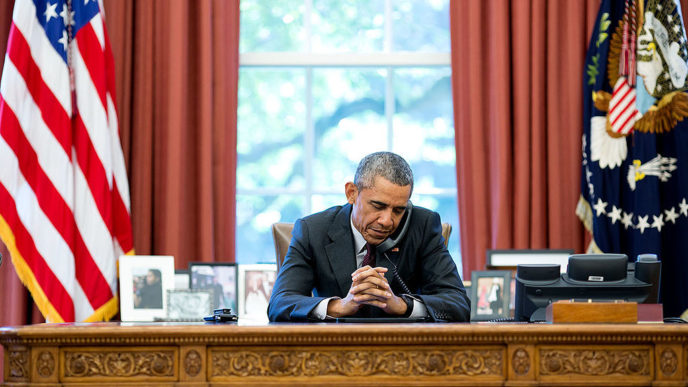
Obama Used His Pen and Phone to Endanger America; Trump Can Use Both to Protect Us

Obama has unilaterally remade this country without the consent of Congress and has induced social transformation without representation. The good news is that a newly elected President Trump can shut down those edicts with the stroke of a pen, especially as it relates to immigration and refugee resettlement. And unlike Obama’s imperial abuse of executive orders, Trump would actually be following the spirit and letter of immigration statutes duly passed by Congress in doing so. He has a mandate to shut off refugee resettlement from the Middle East and can act upon it on day one of his administration.

In general, immigration statutes were crafted to give the president broad latitude to ratchet down immigration as needed, but not to expand it beyond the baseline law. Obama has blatantly violated immigration law by refusing to enforce these statutes and by creating numerous programs that never existed in the first place or exceeded statutory authority.

One area of frustration for conservatives in Congress has been the refugee crisis. As we’ve noted before, while the 1980 Refugee Act was sold to the public as a way of granting Congress and the states more input, it left the door open for a president who doesn’t respect his nation’s concerns to unilaterally bring in as many refugees as he desires. As I warned in September, Obama is front-loading refugee resettlement to lock in as many refugees for fiscal year 2017, even after he leaves office.

According to the State Department’s refugee database, Obama has brought in 15,125 refugees in just the first six weeks of this fiscal year alone. On an annualized basis, that is a pace not seen since the inception of the modern program in 1980, even surpassing the early ‘90s when we admitted record numbers of refugees following the collapse of the Soviet Union. And unlike those coming the former Soviet Union who yearned for democracy, this influx is primarily from parts of the Middle East that not only represent a security threat, but experience has demonstrated is hard to Americanize. Those admitted so far this year include 1,940 from Syria, 1,960 from Somalia, and 1,870 from Iraq. While individuals admitted in small quantities can be assimilated, the lesson of Europe and our growing Middle Eastern immigration over the past decade has proven that importing large quantities from a culture of Sharia is suicide of a nation.

Also, notice how 20 years after the collapse of Somalia, we are still bringing in thousands of refugees every year — even topping the amount from Syria? Just this week, the first Somalis in the Minneapolis ISIS cell were sentenced on terrorism charges and the federal judge presiding over the case warned that there is a broader problem. “This community needs to understand there is a jihadist cell in this community. Its tentacles spread out,” said Judge Michael Davis during the sentencing hearing on Wednesday.

We must not wait until next fiscal year or for Congress to act in order to slow down this dangerous social transformation. Trump ran unambiguously on stopping refugees from the Middle East and the good news is that he can now use the unilateral executive authority for the right purposes. The same way Obama was able to increase refugee resettlement to 110,000 without Congress, Trump can set that number at 0. At the very least, he can immediately suspend the refugee program from countries with a dominant culture of radical Islamism, such as Syria, Somalia, and Iraq.

Also, under § 212(f) of Immigration and Nationality Act, “whenever the President finds that the entry of any aliens or of any class of aliens into the United States would be detrimental to the interests of the United States, he may by proclamation, and for such period as he shall deem necessary, suspend the entry of all aliens or any class of aliens as immigrants or nonimmigrants, or impose on the entry of aliens any restrictions he may deem to be appropriate.”

This power is universal, enforceable at the will of the president, and applies any time for any circumstance. In the coming days, I plan to outline other ways Trump can unilaterally protect American interests on immigration under existing authority. Obviously, for major transformational changes, it would be advisable to seek a permanent solution from Congress. But as it relates to refugee resettlement from the Middle East during a time of war, the voters expect Trump to fulfill his promise immediately and exercise his authority to its fullest extent.

As I outline in Stolen Sovereignty, Trump should call upon Congress to permanently reform the program so that the American people won’t be at the mercy of future Democrat presidents. Congress should set the Refugee Admissions Program to automatically sunset at least every other fiscal year so that by default there is no refugee resettlement unless Congress renews the program. Also, the House should immediately pass Rep. Scott Perry, R-Pa. (C, 77%) bill permanently requiring states to affirmatively ratify refugee resettlement before HHS can settle any refugees in their respective jurisdictions.

There are many policy initiatives that require much debate and circumspection before rushing to pass them. Shutting down refugee resettlement and preventing America from following in the footsteps of Europe is not one of them. Time is of the essence. Fortunately, Donald Trump is about to inherit Obama’s mighty pen and magic phone to promote American sovereignty. Except, this time the law will be on his side. (For more from the author of “Obama Used His Pen and Phone to Endanger America; Trump Can Use Both to Protect Us” please click HERE)

Follow Joe Miller on Twitter HERE and Facebook HERE.

Obama’s Contribution to Our Identity Politics Climate

While in Greece this week, President Barack Obama called the anxieties about national, cultural, and ethnic identities that impacted this election a “volatile mix.” He attributed this angst, though, to impersonal forces such as globalization, deindustrialization, and social media.

It wasn’t him. For eight years, the president said, he’s been working hard against approaches “that pit people against each other.”

The president is being uncharacteristically modest here. While he didn’t himself start the multicultural, identity politics process—we have a long list to blame for that—he’s done more than his share to contribute to the present climate.

As New York University professor Jonathan Haidt told Vox in an interview on Wednesday on the problems roiling the West, “the economic issues are much less than half the story … diversity, immigration, and multiculturalism are right at the heart of the problem in Western democracies.”

“Identity politics is like throwing sand in the gears … a world in which factions are based on race and ethnicity, rather than economic interests, that’s the worst possible world.”

And time and again, Obama stoked the two forces that militate against the nation state today: subnational groups and supranational threats. When speaking to ethnic groups, he hawked the victimhood that is the bonding agent of multiculturalism; when Congress stood in his way, he circumvented it by going to the United Nations.

First let’s look at what Obama said. Standing next to Prime Minister Alexis Tsipras, one of the leftist firebrands who have emerged in an anti-globalization wave in Europe, the president was asked whether he had underestimated anger and fear in America. As is his wont, Obama wasn’t brief.

“I think there are a whole range of factors involved,” the president averred. “I do think there is a common theme that we have seen in a lot of advanced economies and that we’ve seen around the world, although they manifest themselves in a number of ways.” He continued:

Globalization combined with technology, combined with social media and constant information, have disrupted people’s lives, sometimes in very concrete ways. A manufacturing plant closes and suddenly an entire town no longer has what was the primary source of employment. But also psychologically. People are less certain of their national identity, or their place in the world. It starts looking different and disorienting.

And there is no doubt that that has produced a populist moment on the left and right in many countries in Europe. When you see a Donald Trump and a Bernie Sanders, both two very unconventional candidates have considerable success, then obviously there’s something there that’s being tapped into, a suspicion of globalization. A desire to reign in its excesses, a suspicion of elites and governing institutions that people think may not be responsive to their immediate needs. That sometimes gets wrapped up in ethnic identity or religious identity or cultural identity. That can be a volatile mix. It’s important to recognize that those trends have always been there and it’s the job of leaders to address people’s real legitimate concerns and channel them in the most constructive ways possible. …

The more aggressively and effectively that we deal with those issues, the less that those fears may channel themselves into counterproductive approaches that pit people against each other. Frankly, that’s been my agenda for the last eight years.

We don’t all remember it this way. If a phrase sticks in our minds it is when during the 2010 elections Obama brazenly called on Hispanics to say, “we’re gonna punish our enemies and were gonna reward our friends who stand with us on issues that are important to us.”

There was also the time when he addressed the Congressional Hispanic Caucus and, after telling a 75-year-old story of how an L.A. cop had humiliated a Mexican-American (this while the country was reeling with anti-police agitation), he called on Hispanics to rally to the Democrats.

Obama has carried this self-serving message of “you’re a victim, vote for us” whether he was meeting with Americans of Asian background, African background, or of the Muslim faith.

Nobody denies that there are people who harbor racist or bigoted views in America—or any country. But you shouldn’t be allowed to pursue a divide and conquer, hyper-partisan strategy for eight years and then say, “Who, me?”

This has been his record with subnational groups. As for transnational threats to American sovereignty, the president has done an end-run around the elected U.S. Congress—a supposedly co-equal branch of government—by running to the United Nations on the Iran deal, nuclear testing, and a global climate deal.

Just three weeks ago, and acting entirely out of spite, he ordered our U.N. ambassador to abstain from a U.N. vote against the Cuban embargo. This is a law that was passed by the Congress, which is elected by the American people, while the U.N. includes the world’s worst dictatorships.

Americans are indeed less certain of their national identity and their place in the world, as the president said, but chalking it up to the internet and cheap jeans from China is a bit disingenuous.

Obama is rightly getting kudos everywhere for being such a class act during this transition period. But it would behoove him—and liberals in general, especially—to do some self-analysis of how exactly they have stoked popular disquiet about what’s happening to America. (For more from the author of “Obama’s Contribution to Our Identity Politics Climate” please click HERE)

Follow Joe Miller on Twitter HERE and Facebook HERE.

Obama Predicts Trump Will Maintain Iran Nuclear, Paris Climate Deals

President Barack Obama predicted Monday that his successor might keep some of his major legacy items such as the Iran nuclear deal, the Paris climate agreement, and potentially even Obamacare, stating that President-elect Donald Trump isn’t ideological.

Trump will find that “reality will assert itself,” Obama said during his first post-election press conference.

“On a lot of issues, what you’re going to see is that now comes governing, now is the hard part,” Obama said.

The president had mostly cordial words for Trump, a Republican, whom he had a war of words with during the presidential campaign as he stumped for Democratic presidential nominee Hillary Clinton.

Obama doesn’t believe Trump, a longtime New York businessman, will enter office with a particularly ideological agenda.

“He is coming to this office with fewer set hard and fast policy prescriptions than a lot of other presidents,” Obama said. “I don’t think he is ideological and ultimately he is pragmatic. That can serve him well as long as he’s got good people around him and he’s got a good sense of direction.”

Obama asserted this a day after a Trump interview on CBS’s “60 Minutes” aired, where the incoming president said he wanted to maintain some provisions of the Affordable Care Act, such as requiring coverage for pre-existing conditions and allowing people to remain on their parents’ health insurance up to age 26.

“This has been the holy grail for Republicans for the last six or seven years, we’ve got to kill Obamacare,” Obama said, later adding, “It’s one thing to characterize this as not working when it’s just an abstraction. Suddenly you’re in charge and you’re going to repeal it, well, what happens to those 20 million people that have health insurance?”

Obama also urged Trump not to reverse his 2012 Deferred Action for Childhood Arrivals, an executive action that shields the children of illegal immigrants from deportation.

The controversial Iran nuclear deal and the Paris climate agreement are matters Obama anticipates Trump might keep.

“Do I think the new administration will make some changes? Absolutely,” Obama said. “But these international agreements, the tradition has been that you carry them forward across administrations, particularly if after you examine them, you find out they are doing good for us.”

Obama defended the Iran deal as holding Iran accountable. He said:

The main argument against it was that Iran wouldn’t abide by the deal, that they would cheat. We now have over a year of evidence that they have abided by the agreement. That’s not just my opinion. That’s not just people in the administration. That’s the opinion of Israeli military intelligence officers who were part of a government that vehemently opposed the deal. So my suspicion is that when the president-elect comes in and meets with his Republican colleagues on the Hill, that they will look at the facts, because to unravel a deal that is working and preventing Iran from pursuing a nuclear weapon would be hard to explain.

Obama noted both the Iran nuclear agreement and the Paris climate agreement were multilateral deals, which will make it more difficult for the United States to withdraw unilaterally.

“Now, you’ve got 200 countries that have signed up for this thing,” Obama said. “The good news is, what we’ve been able to show over the last five, six, eight years is that it’s possible to grow the economy and possible to bring down carbon emissions as well.” (For more from the author of “Obama Predicts Trump Will Maintain Iran Nuclear, Paris Climate Deals” please click HERE)

Follow Joe Miller on Twitter HERE and Facebook HERE.

Trump Should Reverse Obama’s Executive Actions. Here Are 7 Areas to Start.

Under the U.S. Constitution, Congress, not the president, creates the laws. Article I of the Constitution grants enumerated legislative powers to Congress. The Constitution assigns the executive the duty to enforce the law, and Article II, Section 3 requires that the president “shall take Care that the Laws be faithfully executed.”

However, throughout the last eight years, we have seen the Obama administration continually abuse the power of the executive branch by issuing unconstitutional, unilateral executive actions to push its agenda. The “old days” of Congress creating our laws have become a distant memory.

President Barack Obama even went so far as to announce his unilateralism, saying, “We’re not just going to be waiting for legislation in order to make sure that we’re providing Americans the kind of help they need. I’ve got a pen and I’ve got a phone.”

Well, it appears that American voters have their own pens, too, and they’ve put them to their ballots now in a stunning and decisive way. On Tuesday, the American people elected Republican outsider Donald J. Trump to serve as the 45th president of the United States.

Now, with control of the presidency, both chambers of Congress, and soon the Supreme Court, conservatives across the country are looking forward to repairing some of the damage Obama has inflicted on our constitutional system.

As long promised, Trump should use the first 100 days of his administration to repeal every illegal executive action the Obama administration has issued while in office.

Here is a list of the seven areas with the most damaging executive actions signed during the Obama administration that must be repealed:

1. Crony Exemptions to Obamacare. While Trump works with Congress to actually repeal Obamacare, he can start by issuing an order to halt some of Obama’s executive actions that created special exemptions to Obamacare for his favored constituencies.

2. Executive Amnesty. The new president must repeal Obama’s unilateral changes to our nation’s immigration laws, which exempted certain categories of illegal aliens from being deported. (This bar on deportations was halted by a court order, but the underlying exemption still remains on the books.)

3. Environmental Protection Agency Overreaches. Trump must repeal Obama’s multiple illegitimate expansions of EPA rules. These new rules have imposed huge costs on society and are crippling the U.S. energy sector.

4. Appeasement of Iran. Trump must repeal the executive order that single-handedly removed U.S. sanctions on Iran. These sanctions provided key leverage to the U.S. in negotiations with Iran, and their removal has cleared Iran’s path in developing a nuclear weapon.

5. Climate Change Bureaucracy. Trump must repeal the executive order that purports to “prepare the United States for the impacts of climate change.” This action from Obama created manifold new justifications for government spending based on inconclusive science.

6. Life and Religious Liberty. Trump should reverse Obamacare’s unprecedented taxpayer funding of abortion. He should also direct the secretary of Health and Human Services to undertake a rulemaking process that will end the mandate for insurance to cover abortion-inducing drugs and contraception, along with “gender transition” therapies and surgeries.

7. “Gender Identity.” Trump should repeal the Obama administration’s Title IX guidance equating “gender identity” with “biological sex.” The Department of Justice and Department of Education have wielded this guidance to punish educational institutions for “discrimination” under Title IX, simply for having separate showers, locker rooms, and bathrooms for men and women.

By making the repeal of these executive actions a priority, the Trump administration will have an easy opportunity to right some of the wrongs of the past administration.

As Henry Ford once said, “Failure is simply the opportunity to begin again, this time more intelligently.” It’s been a while since conservatives have had an opportunity like this one, and it is imperative we take advantage of it. (For more from the author of “Trump Should Reverse Obama’s Executive Actions. Here Are 7 Areas to Start.” please click HERE)

Follow Joe Miller on Twitter HERE and Facebook HERE.