Stacey Crawford told WJBK-TV she’s been visiting the salon in Macy’s at the Fairlane Mall in Dearborn, Michigan, for the last decade — but her experience in a women’s restroom Friday night is one she’d prefer to forget. . .
Crawford noted to WJBK that as she was going into the restroom, another woman was in there “wrapping up” — and soon enough, things got scary.
“I’m in the stall, she’s beating on the stall [saying], ‘Ma am, ma’am.’ and I hear the urgency in her voice,” Crawford told WJBK. “I’m like, ‘What’s going on?'” . . .
Crawford then told the station when she opened the stall door, she saw a man touching himself and looking at the other woman — who became so terrified that she pulled out her gun. . .
Crawford and the other woman screamed for security and blocked one of the exit doors, but the station said the man casually took another way out of the restroom, made it through Macy’s — and into the mall.
(Read more from “Gun-Toting Woman Confronts Man Allegedly Masturbating in Women’s Restroom” HERE)
[T]he Trump department of education’s office of civil rights (OCR) reinstated the Obama transgender policy with these five instructions for public schools:
1. OCR may “assert subject matter jurisdiction” over transgenderism. OCR gave itself the power to act when a transgender student files a complaint alleging sex discrimination.
2. OCR further asserts jurisdiction when the office finds that “sexual” or “gender-based” harassment creates a “hostile environment” for transgender students. An example given in the document sets failure by a school to use the “preferred name or pronoun” of the transgender student as harassment and a reason take over for local authorities.
3. OCR requires public schools and colleges to take affirmative steps in addressing anything OCR defines as a “hostile environment” for transgender students.
4. Schools may not retaliate against a transgender student who raises a sex discrimination complaint.
5. Schools may not engage in “differential treatment” of a student based on what the document labels as “sex stereotyping,” or failure of a student to conform to common notions of masculinity and femininity.
This document quietly appeared, without fanfare, reinstating very controversial transgender policies. Once again, the federal government has removed local control over school bathroom, locker room, dorm room, and sports team policies. If parents have a problem with what is happening in the bathrooms or locker rooms of their child’s school, they will have to meet with officials in Washington. (Read more from “Department of Education Apparently Defies Trump, Reinstates Obama Transgender Policy for Schools” HERE)
When then-North Carolina Gov. Pat McCrory signed H.B. 2, the Public Facilities Privacy and Security Act (commonly known as the “bathroom bill”), into law on March 23, 2016, critics argued that corporate backlash against the measure would cost North Carolina dearly.
Now, more than a year later, the Associated Press has provided an updated estimate of the economic fallout:
The Associated Press used dozens of interviews and multiple public records requests to determine that North Carolina’s ‘bathroom bill’ will cost the state more than $3.76 billion in lost business over a dozen years.
The overwhelming majority of the reported impact, or $2.66 billion over 12 years, is attributable to PayPal’s cancellation of a planned 400-employee operations center less than two weeks after the bill was passed.
The effects of similar site location decisions by Deutsche Bank, CoStar, Voxpro, and Adidas total $912 million. The loss of sporting events, conventions, concerts, etc. totals $196 million.
The reported figures probably overstate the economic impact of each individual item. They are based on input-output models, which assume that dollars spent in initial transactions—such as by a business that decides to locate in a given area—will automatically cycle through the economy, creating a ripple effect and stimulating further economic growth.
But this ignores supply-side constraints, such as the number of available workers.
If North Carolina were still in the midst of a recession and had an unusually large number of people looking for work, this model would prove more accurate. But that is not the case.
North Carolina’s average unemployment rate fell from 5.8 percent to 5.1 percent between 2015 and 2016, when it was not significantly different from the national average.
In 2016, the national unemployment rate was only 0.2 percentage points above its underlying long-term rate, down from a gap of 4.7 percentage points in 2010. Those two rates are expected to be equal in 2017.
Across the nation, labor market slack—that is, the excess number of people out of work and available for hiring—is vanishing.
Input-output model results also depend heavily on the division of income between parties.
In the case of the PayPal expansion, the model shows that the 400 “nondepository credit intermediation and related services” jobs were expected to result in annual sales of $207 million, of which $30 million would go to employee compensation, $28 million would go to other business expenses, and the remaining $149 million would be proprietor’s income.
While the forecasted effects on the North Carolina economy result mostly from proprietor’s income, PayPal is a publicly traded company headquartered in California, so the bulk of these profits would most likely be distributed outside of North Carolina, with little further impact on the state.
Even if the reported estimates of the impact of H.B. 2 prove to be accurate, they should be considered in the context of North Carolina’s half trillion-dollar gross domestic product.
In that case, the estimated impact is actually quite modest, resulting in a loss of no more than 0.1 percent of the state’s GDP, or about $1 for every $1,000 of income earned in the state.
This cost of roughly a dollar a week for the median North Carolina household would be a small price to pay to protect the privacy and safety of women and girls. (For more from the author of “The Truth About the Economic Impact of North Carolina’s ‘Bathroom Bill'” please click HERE)
https://joemiller.us/wp-content/uploads/Gender_neutral_bathroom.jpg23404160Joe Millerhttps://joemiller.us/wp-content/uploads/logotext.pngJoe Miller2017-03-29 19:45:212017-03-29 19:45:21The Truth About the Economic Impact of North Carolina’s ‘Bathroom Bill’
School administrators trying to set common-sense bathroom safety policies received a temporary respite from the Supreme Court Monday. But the fight is far from over.
The court announced Monday morning that in the case of G.G. vs Gloucester County School Board, the judgment has been vacated and remanded to the Fourth Circuit appeals court in light of the Trump administration’s recent rescinding of the Obama-era transgender bathroom guidance.
The Supreme Court decided that it would not hear the case of biological teenage girl Gavin Grimm, who sued her local Virginia school board to use the boys’ room, citing federal discrimination law under Title IX, the 14th Amendment, and the Obama-era set of administrative guidelines.
A vacate and remand offers the parents and administrators temporary respite from complying with any court orders to the subject, as a vacated decision renders all previous judgement – which sided with Grimm – void, while allowing the competing arguments to be evaluated without Obama’s bureaucratic interpretation in the mix.
“The first duty of school districts is to protect the bodily privacy rights of all of the students who attend their schools and to respect the rights of parents who understandably don’t want their children exposed in intimate changing areas like locker rooms and showers,” reads a statement from Alliance Defending Freedom attorney Kerri Kupec, whose organization represents the school board.
“It only makes sense for the Supreme Court to vacate the 4th Circuit’s earlier decision and instruct it to reconsider this case,” Kupec said. “The 4th Circuit should affirm the plain meaning of Title IX, which protects boys’ and girls’ privacy in locker rooms, showers, and restrooms. School officials should be free to protect their students’ privacy, safety, and dignity without federal government interference.”
This development follows the news that both parties actually wanted to press forward with the case, despite the rollback of the Obama administration edict.
According to SCOTUSblog’s Amy Howe, while the parties still wanted the case heard by the high court, they differed on the when. The student’s ACLU legal team wanted the justices to hear the case and rule as planned, while the school board asked for more time.
However, the debate over who sets privacy policies in public schools – judges, bureaucrats, legislators, or educators and parents at the local level – isn’t over.
In addition to the eventual Fourth Circuit decision, there still remains the issue of the plaintiffs in the Sixth Circuit and two lower-level cases that were awaiting a ruling in Gloucester that will now be “coming out of hibernation,” ADF senior counsel Gary McCaleb explained in a phone interview.
Simply, for opponents of unconstitutionally rewriting federal discrimination law, this is more a breather than a win.
At heart, the cases raise the question of which branch writes our laws and further highlights the need for legislative or administrative language clarifying what Title IX actually means.
Title IX is the product of a 1972 law that prohibits schools receiving federal funds from discriminating “on the basis of sex.” While the law was clearly passed by Congress with biological sex in mind, there has been a concerted push from the Left in recent years to redefine that understanding to mean gender (which, of course, is based on thoughts and feelings, rather than science).
As we have previously pointed out at CR, legislation that would analogously redefine sex as gender identity in federal law has already been introduced in multiple congressional sessions, to no avail. Since Democrats have failed to get this sort of legislation through Congress thus far, that effort has now moved to the courtroom with these such cases.
Last year, Rep. Pete Olson, R-Texas (F, 58%) introduced a bill aimed at clearing up this confusion once and for all. The Civil Rights Uniformity Act of 2016 would have sought to “prevent the [Obama administration] from unilaterally rewriting Federal civil rights laws,” by barring the executive branch from interpreting Title IX’s provisions on “sex” to mean “gender.”
There may no longer be a soft mandate from the executive branch, but the ongoing nature of these cases shows that the American people have the option to answer this question via Congress, or leave it up to the federal judiciary. (For more from the author of “This Isn’t Over: SCOTUS May Have Put Its Trans-Bathroom Case on Hold, but More Are to Follow” please click HERE)
https://joemiller.us/wp-content/uploads/bathroom-510x680.jpg680510Joe Millerhttps://joemiller.us/wp-content/uploads/logotext.pngJoe Miller2017-03-06 21:11:402017-03-06 21:11:40This Isn’t Over: SCOTUS May Have Put Its Trans-Bathroom Case on Hold, but More Are to Follow
In recent years, a common refrain accompanying nearly every demand for newly invented “rights” has been: “It doesn’t affect you, so you can’t be against it.”
This claim—whether false or true, subjective or objective—has been played as the ultimate trump card.
If you could not point to a direct, immediate, and significant intrusion on your life, then your concerns—no matter how thoughtful and legitimate—were sacrificed at the altar of the New Regime.
Times change.
On Wednesday, Alliance Defending Freedom filed a federal lawsuit on behalf of high school students and parents, asking the court to strike down a Minnesota school district policy that empowers a male student to enter the girls’ locker room and disrobe.
Not surprisingly, many girls have been distressed by the actions of the male student, which include twerking, grinding, and other sexually explicit actions. The response of the district and other authorities to the concerns has been a collective yawn.
This, along with recent actions by President Barack Obama’s Department of Education and Justice Department, illustrates the evolution of the push to manufacture special privileges for a select few.
The pretense that such demands don’t affect the lives of others now has been abandoned, replaced by two options: (1) get over it and get in line; or (2) be pushed to the margins of society, losing your reputation—and possibly your career—in the process.
In version 2.0 of the New Regime, even if you can point to a direct, immediate, and significant intrusion on your life, your opinion is irrelevant (and perhaps bigoted) when compared to “social progress.”
For example, when the New Mexico Supreme Court ruled that wedding photographer Elaine Huguenin and her husband Jonathan must set aside their freedom to peacefully live according to their faith, a concurring justice stated that the pair “now are compelled by law to compromise the very religious beliefs that inspire their lives.” Chillingly, the justice added that this compulsion “is the price of citizenship.”
As the situations in Minnesota, North Carolina, and elsewhere demonstrate, the latest test sites for this theory of “social progress” are locker rooms, showers, and other private changing facilities.
In what would have been an unthinkable battleground just a few short years ago, these tile-floored, plastic-stalled, chrome-fixtured, and (formerly) sex-specific sanctuaries are now ground zero for experiments in the subjective theory of gender.
And the wisdom of the New Regime 2.0 goes like this:
The march toward true liberty requires 18 girls to squeeze into a prison cell-sized changing space or abandon their bodily privacy, and their right to safety and comfort in the most intimate and vulnerable of settings.
Why? So that a “bearded individual” can fully disrobe in the girls’ locker room at a parks department swimming pool on New York City’s Upper West Side. Empowered by the mere proclamation that he is a woman, he appropriates the entire space for himself.
Use whatever analogy you want:
The New Regime has flushed common sense down the toilet.
The New Regime has pulled back the curtain and washed away any remaining vestiges of bodily privacy.
The New Regime has transformed locker-room peepholes into doorways.
The point is, the New Regime embraces the idea that individuals can stride with impunity into any private space they choose, regardless of biology. This dismissal of biological fact in bathrooms, locker rooms, and showers reeks of irony, in what may be the best example to date of the lengths to which the New Regime will go to impose its orthodoxy.
These spaces, perhaps more than any other physical location, exist for and because of biological differences. Bathroom doors easily could have been labeled as the kid in “Kindergarten Cop” would have it, but decorum prevailed and we used “men” and “women” instead.
Separate locker rooms for men and women do not symbolize a sinister effort to force anyone’s conformity with “gender stereotypes.” They exist because men, women, and children should not be forced to encounter the opposite sex in private spaces or be viewed by the opposite sex while in various stages of undress.
There are reasonable solutions. There are ways to accommodate men and women and boys and girls who struggle to align their subjective beliefs with biological realities.
Consider the family changing room that 18 girls in New York now are forced to use to avoid encountering a man in the girls’ locker room. Indeed, one of the purposes of single-use or “family” facilities like these is to allow fathers to assist their young daughters, or mothers to assist their young sons.
It is an acknowledgement that neither the men’s or women’s restroom is an ideal solution in such circumstances. The same fact holds true for individuals who do not personally feel comfortable entering the private space that corresponds to their biology.
These accommodations protect the privacy of all individuals, not just a select few at the expense of everyone else.
Reasonable solutions are available that protect everyone from unwelcome bodily exposure. But under the New Regime, “social progress” trumps reason. (For more from the author of “When ‘Liberty’ Forces 18 Girls Into a Single-Stall Shower Room” please click HERE)
America’s restroom controversy won’t seem to go away. North Carolina has come under fire after it passed a law prohibiting city governments from passing “gender-neutral” bathroom laws.
What’s Going On?
As an earlier report at CR detailed, the city of Charlotte, N.C., moved to pass legislation that would have mandated a city-wide “gender-neutral” restroom policy for places of public accommodation. Citing safety and privacy concerns, the N.C. General Assembly passed a measure in March 2016 to prohibit local governments in the state from doing so. It was later signed by Governor McCrory.
Since then, PayPal said it is canceling plans to open an operating center in Charlotte, the National Basketball Association threatened to pull its 2017 All-Star Game from the state, and the United Kingdom issued a travel warning for LGBT Brits considering a visit to the area.
What Are the Safety Concerns?
While opponents have called North Carolina’s HB2 and South Carolina’s S.1203 “sweeping anti-LGBT” measures, proponents of the legislation have said the laws are based on safety concerns.
Some fear predators will use these gender-neutral policies to infiltrate restrooms of the opposite sex with ill intentions. Such instances have already occurred, many in places that do not have gender-neutral policies.
In 2015, a Virginia man was arrested and charged with three counts of unlawful filming of a non-consenting person and three counts of peeping after he allegedly dressed as a woman to gain access to women’s restrooms and changing rooms at local stores.
In February of 2016, a Seattle suburb was outraged after a man wearing nothing but board shorts walked into the women’s bathroom of a public pool. When she attempted to remove him from the facility, he refused, saying “the law has changed and I have the right to be here.”
Most recently, an undercover video captured by Project Veritas purportedly shows university officials at a North Carolina University ignoring undercover journalists’ claims of using such policies to peep on members of the opposite sex in multiple use facilities.
Why are People Asking to Use Different Restrooms in the First Place?
This question, the most misunderstood portion of the debate, requires a nuanced understanding of psychology, “gender dysphoria,” philosophy, and the distinction between the treatment of people and the treatment of ideas and policies.
The American Psychiatric Association defines “gender dysphoria” as having a “marked difference between [someone’s] expressed/experienced gender and the gender others would assign him or her.” Furthermore, the condition must “continue for at least six months” to reach the threshold of diagnosis.
Psychologists disagree about how to best treat this condition, which most LGBT advocates argue is a natural condition. Some say the only way to address it is to allow and encourage people to dress and act in accordance with their “expressed/experienced gender.” This includes using the restroom of the perceived gender, undergoing treatments that alter the human body, gender reassignment surgery, hormone therapy, and/or having government documents changed to indicate the expressed gender as fact.
Regardless of conservatives’ thoughts about the implications of these demands and the ongoing debate, there will continue to be people who represent themselves contrary to their biological sex in public, and they will have to use the facilities at some point.
What Does the N.C. “Bathroom Bill” Actually Do?
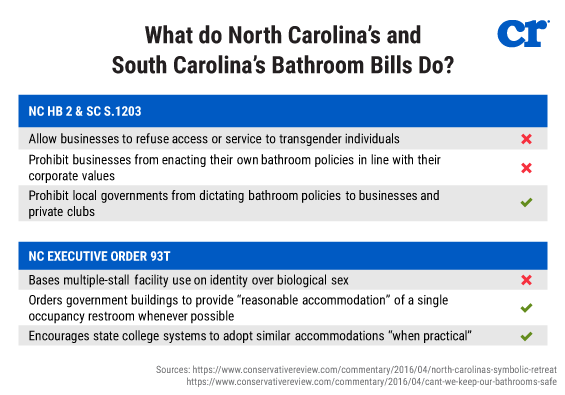
HB2 prohibits local governments in North Carolina from forcing places of public accommodation to allow people to use restrooms and changing facilities that do not align with their biological sex. Contrary to popular belief, it does not ban gender neutral facilities from private businesses, but merely puts a legislative fence around municipal governments.
An executive order issued by Gov. Pat McCrory clarifies that “when readily available and practicable in the best judgement of the agency, all cabinet agencies shall provide a reasonable accommodation of a single occupancy restroom, locker room or shower facility upon request, due to special circumstances.”
In essence, this makes a practical concession similar to the policies listed above, while still avoiding the concerns generated by removing biological sex regulations from multiple occupancy facilities.
What Does the Public Think?
A Reuters poll found a marked decline in the popularity of such policies following the recent firestorm over the issue, which includes a move to boycott Target retail stores over their self-imposed restroom policies.
Ethics and Public Policy Center’s Mona Charen—citing separate research—writes:
We’ve become so discombobulated that perfectly intelligent people will say, without noticing the contradiction, that homosexual behavior is an inborn trait, but the “male/female binary” is a socially constructed fiction.
The Fourth Circuit Court of Appeals has now ruled that a “transgender” 17-year-old must be permitted to use the bathroom of her imagined “gender identity” rather than her sex. “It’s easy to forget that these debates are about personal dignity,” scolded the New York Times.
There is nothing dignified about ratifying an unhappy person’s tragic misperception. What if the young person considered herself African American like Rachel Dolezal? Should she get preferences in college admission? Or what about Danny Almonte, who was 14 when he starred in the 2001 Little League tournament? If he felt 12, does that make it ok?
Furthermore, Kaely Triller, a rape survivor writes:
While I feel a deep sense of empathy for what must be a very difficult situation for transgender people, at the beginning and end of the day, it is nothing short of negligent to instate policies that elevate the emotional comfort of a relative few over the physical safety of a large group of vulnerable people.
Don’t they know anything about predators? Don’t they know the numbers? That out of every 100 rapes, only two rapists will spend so much as single day in jail while the other 98 walk free and hang out in our midst? Don’t they know that predators are known to intentionally seek out places where many of their preferred targets gather in groups? That perpetrators are addicts so committed to their fantasies they’ll stop at nothing to achieve them?
Do they know that more than 99 percent of single-victim incidents are committed by males? That they are experts in rationalization who minimize their number of victims? Don’t they know that insurance companies highlight locker rooms as a high-risk area for abuse that should be carefully monitored and protected?
Finally, a father of a six-year-old girl wrote of Target’s recent decision:
In response to the major retailer’s latrine call, hundreds of thousands of people pledged to boycott the store in just a few days.
Many people opposed to these policies have legitimate concerns about about how politicians are making laws about a psychological condition — especially when treatments have not been agreed upon — and the specifics of the policies.
What have other cities done?
Charlotte is far from the first American city to address the question of how people who identify and represent themselves as another sex are allowed to use public facilities. In fact, Philadelphia, Washington, D.C., West Hollywood and others have all adopted similar policies.
The approaches taken outside of Charlotte and Houston have managed to simultaneously satisfy recommendations made by both the Occupational Safety and Health Administration and the pro-LGBT Human Rights Campaign without sparking massive safety concerns that have been cited by opponents of the Charlotte/Houston model.
What’s Next?
The Charlotte/Houston model offers little benefit other than the implied societal acceptance of something that only seems to be agreed upon by LGBT activists. That being said, communities, municipalities, city councils, who are considering adopting such a public accommodation policy, might be to look and see what’s already been done in other cities to find a working model.
Either way, recent boycotts on the State of North Carolina, as well as counter-boycotts on businesses like Target will likely continue until public the issue reaches a point of “critical mass” that requires a compromise, or it will go the way of other similar controversies (remember the Chick-Fil-A boycott?) and fade into a distant memory. (For more from the author of “What You Need to Know About America’s Bathroom Controversy” please click HERE)
https://joemiller.us/wp-content/uploads/14045486678_2a249d6f86_b.jpg7681024Joe Millerhttps://joemiller.us/wp-content/uploads/logotext.pngJoe Miller2016-05-10 00:07:232016-05-10 01:32:27What You Need to Know About America’s Bathroom Controversy
Did you celebrate World Toilet Day? The recent holiday is a good reminder to rejoice as you read this article on your phone, maybe even while sitting comfortably on a modern, porcelain toilet, which flushes with water so crystalline clean you could, in hard times, drink it without too much fear of dying. (We do not recommend doing that, by the way.)
Going to the toilet wasn’t always such a pleasant, risk-free experience for everyone, and even today, many people in America still go without proper sanitation. As recently as 1990, the rural stereotype of dropping trou in a shack out back was a reality for more than 1.1 million American households. If you think that’s a lot of people, here’s a little math for you. That represented 0.04 percent of the U.S. population back in 1990. Right here in 2015, a full 13 percent of the entire world’s population are still living without access to an improved sanitation facility and are forced to defecate in the open. That’s close to a billion people.
The problem overwhelmingly affects sub-Saharan Africa and South Asia, but Census data shows 1,136,157 U.S. households were still using outhouses in 1990 because they lacked access to a public or private sewer or septic tank. In 2014, almost half a million U.S. households still did not have complete plumbing facilities, defined as having access to all of these items: hot and cold running water, a toilet that flushes, and a shower or bathtub. (Read more from “Here’s the Shocking Number of Americans Who Don’t Have a Toilet” HERE)
Editor’s note: Alaska hold the U.S. record for residents without a toilet. A whopping 12% of Alaskans go outside.
https://joemiller.us/wp-content/uploads/logotext.png00Joe Millerhttps://joemiller.us/wp-content/uploads/logotext.pngJoe Miller2015-11-24 22:36:342016-04-11 10:55:48Here’s the Shocking Number of Americans Who Don’t Have a Toilet