Independent Alaska Governor Bill Walker suspended his re-election bid on Friday, choosing instead to endorse the Democratic candidate, former Senator Mark Begich.
In an Instagram post, Walker conceded his inability to “win a three-way race” and expressed his belief that Begich would have a better shot at defeating Republican Mike Dunleavy in a two-person race. . .
Democratic Governors Association executive director Elisabeth Pearson called the move a “game-changer” that could shift the race to Begich. Before Walker’s withdrawal, Dunleavy, a former state senator, was polling ahead of both Begich and Walker, to the tune of over 40 percent to around 25 percent to the other two candidates, according to Politico.
There’s a memorable scene in the classic Christmas movie “It’s A Wonderful Life” that aptly sums up what is taking place in Juneau this year. In the scene, Jimmy Stewart passionately explains to his neighbors how the local tycoon’s offer to take over the town’s insolvent bank in exchange for their rights as stockholders really isn’t as generous as it sounds.
Alaskans today face an orchestrated campaign designed to convince them that their future is inexorably tied to the continued government takeover of our economy and that they should abandon their investment in any other future. It’s a powerful message. No doubt some reading this have already been convinced.
The message is not geared for those who work for the state. No, state employees and contractors don’t need to be convinced. Their future really IS tied up in the growth of state government. It’s all the rest of us that this campaign is directed at.
Under this campaign, threatening Alaskan veterans and seniors with fake eviction notices is A-Okay if it results in Mat-Su residents telling their legislators to pass an income tax. In fact, the greater the hysteria, the greater the effect. As with any bailout, the overarching goal boils down to one basic thing: to push consequences off of state government and onto somebody (everybody) else. State government is what must come first. It is the truly essential part of our state: “The people may come and go, but we must take care of the government.”
Do you see what is happening? Special interests rallied together to put a governor into office. That governor has now put them and the state agencies they partner with to the front of the line. Voila! Time for a government bailout! Note: Even though we have over $15 Billion in reserves, we call this a “fiscal crisis”.
Of course, it’s not a fiscal crisis (which is why we have to resort to “fiscal terrorism” of Alaska’s seniors to try to generate support for more taxes). In actuality, it’s a government crisis. But who among us is moved to action by hearing that state government has been spending more than our economy can sustain, and needs to cut back? What’s new?
Yep, that about sums up what is taking place in the capitol this year. The governor demanded more money from Alaskans last year (and more money to government), and he has now terrorized various groups of people (including seniors and vets and those who drive on KGB) into going along with it. The senate just passed a statewide tax that will take $5,000 from every family of four this year, and that’s just the PFD cut.
By convincing the legislature to redirect the dividend and the earnings of the Permanent Fund from Alaska’s private sector to state government, he has “solved the crisis” and is every bit the hero of the state public sector. And while the private sector now experiences the recession even more painfully than it otherwise would have, significant portions of state government get to celebrate that the crisis of downsizing has been averted yet again.
You ask me how this arrangement can continue? Well of course, it can’t, because there is only so much permanent fund money to go around and the appetite of government is limitless. Alaskans allowed their representatives in the State House to approve spending more than $4 Billion of the Permanent Fund
Earnings this year. Think about that. The straw has hardly been placed in the fund, and the vote was to suck out more than $4 billion in the very first swallow!
Talk about unsustainable!!!
Alaskans need to lay the smackdown and fight for a future in which we still have a permanent fund when my kids graduate high school.
Yes, as a resident of Alaska, you are a shareholder (whether you like it or not). If that makes you feel uncomfortably responsible…that’s probably a good thing. You and I each own shares in the future of Alaska, and in the Permanent Fund that has permitted Alaska’s economy to continue to be as “normal” as it is today. Without that Permanent Fund you would see a smaller state economy today, less support for local government, and an even smaller private sector. You would also see the state with a lower credit rating, higher taxes, less investment in Alaska on account of the higher taxes, and an Alaskan economy that looked a bit more like Puerto Rico’s (Note: That’s not a good thing).
You’re invested in this great state simply by living here, and a governor I know would love to take your shares in exchange for a short-term government subsidy. The existence of a “fiscal crisis” is the justification for those invested in state government to do what they’ve always wanted to do: crack the code on how to get Alaskans to redirect the Permanent Fund earnings to government and away from the private sector.
Amazingly, they’ve already convinced enough legislators to do this, in a time when Alaskans are having to lose their health insurance because they can no longer afford it. Oh, and they now tax you for that too! And while some Alaskans are trying to find the money to pay the tax for not having healthcare insurance, the State House of Representatives just voted to pass another $650 Million in new broad-based taxes on all Alaskans. Government crisis solved!!
Government isn’t shrinking in Alaska today. It’s just increasing its market share over the private sector.
Yesterday, we told you how some Democrats would do in their 2018 gubernatorial primary if it were held today. Today is the Republicans’ turn. Well, Republicans and Gov. Bill Walker.
But before we give you all the numbers, just as we did yesterday, we’ll tell you about the poll itself. The survey was conducted by Harstad Strategic Research, Inc. and sampled registered voters in Alaska between March 22 – April 2. You can see the sample breakdowns here:
The poll asked voters who say they normally vote in GOP primaries who they would vote for if their choices for Governor were former Speaker of the House Mike Chenault, former candidate for U.S. Senate Joe Miller, former gubernatorial candidate John Binkley, current State Senators Mike Dunleavy and Peter Micciche, and current Governor Bill Walker.
Walker’s inclusion in the poll is interesting. We’ve told you in recent months that we believe if at least 3-4 candidates get in the GOP primary — Alaska GOP Vice-Chairman Rick Whitbeck has said on numerous occasions he has a list of about 50 names of people who could run — then Walker would likely have a path to victory if he jumped in.
The rest of model looks like a good mix of names. There are candidates from various areas of the state including Kenai, Mat-Su, Valdez, and Fairbanks, current legislators and those who can play the “outsider” card, and a blend of business conservatives, social and fiscal conservatives, and moderates. The pollster gave Republican voters options that varied in enough ways to see where they really stand.
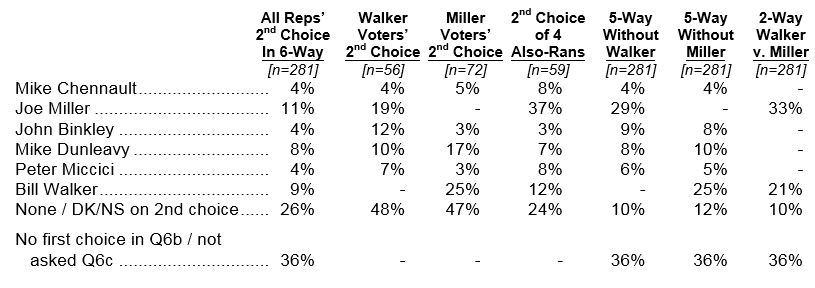
Here is how numbers came out:
Joe Miller dominates with 25% of the vote, with Walker coming in just behind him at 19%. The rest barely make a blip. That is likely because despite being well-known names in political circles most voters likely have never heard of them.
Now, here’s where things get really interesting. Look at what happens when respondents are asked their second choice, or who they would vote for if Miller or Walker (the top two picks) weren’t in the election.
Interestingly, Joe Miller is Walker voters’ top second choice (19%), and in what will come as a shock to many, Walker is the second choice of a full quarter of Miller voters. It should come as no surprise, then, that when either Walker or Miller are taken out of the race, the other takes a commanding position. Miller gets 37% without Walker, three times his closest competitor, and Walker comes in with 25% without Miller, two and half times anyone else.
Finally, if Walker and Miller went head to head, Miller would start off 12 points ahead at 33% to 21%, with a hefty 46% undecided.
The conclusion has to be that if the GOP primary attracts more than one credible candidate other than Walker, the Governor would have a plausible path to victory if he chooses to go that route for reelection. The only Republican currently positioned to disrupt such a move is everyone’s favorite beard, Joe Miller. (For more from the author of “Poll: Joe Miller Dominates among 2018 Hopefuls for Alaska’s Governorship” please click HERE)
https://joemiller.us/wp-content/uploads/Joe_Miller_Alaska_1.jpg531799Joe Millerhttps://joemiller.us/wp-content/uploads/logotext.pngJoe Miller2017-04-13 08:10:342017-04-16 01:34:26Poll: Joe Miller Dominates among 2018 Hopefuls for Alaska’s Governorship
Last month, two staunchly conservative Alaska political websites posted a 2014 letter attributed to then-candidate Bill Walker, in which he stated he’d cut spending by 16 percent, not touch Permanent Fund dividends, and other claims.
These were claims heard from Walker during his campaign and are not a surprise to those who follow politics, although the grammar in the letter leaves something to be desired. The posting of the letter was, evidently, to hold the governor accountable for his actions now that he has the power of the veto pen.
Walker, we know, has primarily made cuts in the capital budget, and he has cut Alaskans’ Permanent Fund dividends in order to preserve state programs, such as the Department of Health and Social Services, where the actual workforce has been cut by just one percent.
What was a surprise is that Donna Walker has contacted both of the blogs and has asked or strongly suggested that the letter be taken down. The letter is not from the governor, she says.
“I was just really surprised,” said David Boyle, who writes at the Alaska Policy Forum. First Lady Donna Walker showed up at the office unannounced, accompanied by her daughter, Lindsay Walker Hobson, who was the spokesperson for Walker’s campaign for governor. Both Walker and Hobson are attorneys and both were part of the Walker, Richards LLC law firm, which has since been sold to Robin Brena.
According to Boyle, Mrs. Walker said the letter is a fake and strongly suggested to him that it be removed from the website.
Boyle has reviewed the letter and says it contains the exact ideas that Walker espoused in a private meeting with United For Liberty in 2014, at the home of Dave Cuddy.
Over at the Restoring Liberty web site, Michael Chambers writes about receiving the Walker article back in 2014, and the process he used to post it:
The first week of September 2014, candidate Walker was solicited by United For Liberty to submit an article for our October 2014 newsletter. The deadline was September 22 for final submission. A member of UFL accepted the editor’s task to put together the final product. This same member was also working with the Walker team to assist in assembling a narrative to be put in the newsletter. He worked diligently and put the entire newsletter together and submitted to me the entire PFD file to publish on United For Liberty’s website. Following is a letter I sent candidate Walker on October 9th thanking him for the submitted article and asking him to consider submitting one more for a possible additional newsletter before the election (he submitted an additional article on October 15, 2014, but I did not publish it as I did not have one from incumbent Governor Parnell and I wanted to give each candidate fair coverage)
That web site, too, was contacted by Donna Walker, who said the letter is a fake. Here’s what Joe Miller’s website has to say about being contacted by Alaska’s First Lady:
“Over the past week, the governor’s wife has sent me a series of emails claiming that the article submitted to UFL in the October newsletter was not authorized by the candidate. These communications were apparently prompted because recent excerpts of Bill Walker’s quotes from this article in our newsletter have appeared in various publications online, including Joe Miller’s Restoring Liberty article: Governor Walker Steals $666 Million From Alaska’s Families, Time to Recall the Liar. She calls the article ‘bogus,’ specifically complaining about the ‘mass distribution of the bogus article that has wrongly been attributed to Bill…”‘
Was the article authorized by candidate Walker or was it authorized by his campaign?
We don’t know, but when the First Lady of Alaska shows up unannounced to attempt to have material removed from a website, she is treading on the First Amendment, which states government “shall make no law…abridging the freedom of speech, or of the press; or the right of the people peaceably to assemble, and to petition the government for a redress of grievances.”
The First Lady of Alaska may not be an official arm of the Governor’s Office, but she has her own page on the State of Alaska website, she has her own State of Alaska email address, and she has her State staff and protection detail. She is also very much a part of the Governor’s policy team.
First Lady Donna cannot separate herself, at this point, from being part of the government, nor can she separate herself from being part of the Bill Walker re-election effort, which is clearly underway.
https://joemiller.us/wp-content/uploads/Bill_and_Donna_Walker.jpg8251280Joe Millerhttps://joemiller.us/wp-content/uploads/logotext.pngJoe Miller2016-08-17 01:14:192016-08-17 13:09:07AK First Lady Donna Walker’s Heavy Hand on Bloggers
On June 29th, we witnessed something unheard of in Alaska. For the first time in state history, a sitting governor asserted the power to unilaterally determine the value of the PFD, or whether he would even permit there to be a PFD at all. If he can get away with it, it is an absolute stroke of political brilliance. For those who say, “but wait, he is only changing the PFD from $2,200 to $1,000”, just think about this a moment. If the governor will now have the power to reduce the PFD to $1,000, why not $100, why not 50¢, why not $0? Politically speaking, the power that the governor has now asserted represents a monumental shift.
The next time the governor doesn’t get his way, or doesn’t feel like the people are sufficiently supportive of his policies (wanna buy a gasline anyone?), all he has to do is ask us if we want a PFD this year. That alone should be more than sufficient to get a flurry of calls to the legislature in support of whatever proposal of his is bogged down in the legislature. And many of those calls would be from those who can least afford to have their PFD slashed or taken away; from those on fixed incomes, from the villages, from those who are barely able to make ends meet as it is. Ah, but the governor would never actually do that, would he?
I think the question is whether he would even have to. In times past we spoke of having the oil companies over a barrel. Now it would be our turn. The thing about political power is that it rarely goes unused. Even without public threats or visible demonstrations, that power is still felt and will have a profound effect on political discourse going forward. And even if one governor decides not to use the full extent of his power, that says nothing about what will happen once a governor is elected (or reelected) when that power is already on the books.
But I have reason to believe that we will not need to wait long to see how this plays out. Just yesterday I, and every other legislator and candidate, noted the formal press release from the governor, in which he threatened to bring voters against any candidate who does not support “The Governor’s New Alaska Plan” or his “Permanent Fund Restructure Plan”. He will accept no answer but support for his plan(s), and he will use every bit of his power as governor to get it, even when doing so earns him ethics complaints for threatening legislative candidates on official stationery, paid for by the taxpayers.
Our elected representatives in the legislature now have a choice to make. It’s the same choice they make every time they go down to Juneau. Are they willing to see themselves as expendable for the sake of something greater than their political careers, or is getting re-elected the box in which they live and move and find their personal meaning?
As an Army officer, when I took soldiers into a combat zone, I knew that the mission was larger than any one of us. And while I offered prayers of thanks each time we returned to Alaska from an overseas deployment, it did not change the fact that our state and our nation would have carried on if one of us had fallen.
If one of us had been taken prisoner by the Taliban, it would have been unthinkable that the President would hand the keys to the city over to terrorists in exchange for a single soldier. To be expendable does not diminish the value of your life or service, it puts it up against the lives and families of those you are fighting to protect, and says that their lives and freedom are worth your sacrifice, if it comes to that.
Alaska State Law: The Facts This year’s PFD is expected to be in the neighborhood of $2,200. That is, if the State Dept. of Revenue follows state law as set forth in AS 43.23.025. The calculation of the PFD is set in statute, and is therefore determined by state law. If the Dept. of Revenue does not follow the law, each of us will rightly be able to say that we were robbed by our own government.
When it was created by the legislature, and signed into law by Gov. Hammond, the PFD was never intended to be included as a budget item, or contingent on passage of the state budget. Initially, state budgets reflected this truth and did not pretend, symbolically or otherwise, to reauthorize distribution of the PFD each year. This is because the PFD is not an appropriation from the General Fund. By law, it is paid from the Dividend Fund, over which the governor has no authority. Even the legislature does not have the ability to alter the PFD calculation without first approving the change in each legislative chamber and then securing the approval of the governor, following the same process required of every revision to state law.
What this means is that the Governor has not “cut” anything, except the law. And if he directs the Dept. of Revenue to ignore state law in distributing less than the full amount of the dividend in October, then he should be held to account for directing a state agency to violate state law. The full amount of the PFD is owed to every eligible Alaskan, with a date set in statute by which it is to be paid (according to AS 43.23.055(2) that date is December 31, 2016).
Again, state law does not simply permit the PFD to be distributed, at the discretion of the governor. AS 43.23.055(2) declares: “The department shall annually pay permanent fund dividends from the dividend fund”. And to obstruct timely payment of that amount is no less theft than spending it for some unauthorized purpose.
If you are like my family, your PFD is included in the family budget, just as it is a significant part of the budget for the many businesses throughout our state who target sales, promotions, or loans based on the timely distribution of the PFD. Would Americans sit by if Obama told the IRS not to issue tax refunds this year “because the government needed the money”? I think not.
Such an action would be rightly seen as government theft of personal property owed to its rightful owner. An IRS promise to include it with next year’s refund, does nothing for this year’s family or company budget, or the rent, mortgage, car insurance, and other expenses that still have to come out of that budget this year. People are always hurt when government fails in its obligations. And when you have debts to pay, as many Alaskans and small businesses do, not having the money to pay them can lead to terrible consequences.
And where is our legislature in all this? Have they followed the example of America’s founders and opposed “with manly firmness his invasions on the rights of the people?” No? According to the news, the question this week is whether they will even take a vote on whether to oppose the governor’s raid on the PFD. And why is that?
I believe it is because those who have been in the legislature for the last decade or more (and specifically, the Republican Majority Caucus), know that they have voted for each and every unsustainable budget that brought us to the place in which we find ourselves today. The governor is clearly wrong today, but a nearly equal share falls on those Republican legislators who have placed their political careers over voting against the very same unsustainable budgets that they now tell us they oppose.
In recent years, Rep. Reinbold has stood alone among her Republican colleagues in voting against budgets that were clearly unsustainable. For that vote, she was removed from the majority caucus and two of her staffers were laid off. Today, her colleagues clamor about protecting the PFD, the very same PFD that they put in jeopardy by going along with, and giving their support to, budgets that they knew were unsustainable—year, after year, after year.
In the situation in which we find ourselves today, there is only one way to protect the PFD from attack. That is to hold our governor accountable for his actions, and to hold our legislators accountable for theirs. And if you vote to send them back to Juneau for another term, do so knowing that past behavior is often an excellent predictor of future behavior—only next time we won’t just be talking about a $1,000 PFD. Before too long, that discussion will shift to the permanent fund itself.
____________________________________
David Eastman is a firefighter in Wasilla, a former military police officer on JBER, and a candidate for the Alaska State House in District 10.
https://joemiller.us/wp-content/uploads/58957769_1280x960.jpg9601280Joe Millerhttps://joemiller.us/wp-content/uploads/logotext.pngJoe Miller2016-07-15 17:44:562016-07-17 01:30:36There Is Only One Way to Stop Attacks on the PFD
A KTUU investigative report shows that Governor Bill Walker is not actually implementing a hiring freeze in his own office.
Instead, he’s using high-priced consultants in pricey no-bid contracts to convince lawmakers and the public about his plans for taxes and his “sovereign wealth fund.”
One of the most interesting aspects of the report reveals the involvement in the deep workings of the Governor’s Office by Alaska Dispatch Publisher Alice Rogoff, raising the question now being asked in the halls of the Capitol: Shouldn’t Rogoff be registered as a lobbyist, considering the ongoing, documented influence she has had over the Executive branch?
Rogoff has met with the governor dozens of times in the last year, and has communicated with him by email and text, according to our sources.
She is not registered as a lobbyist, although she has been pushing for Walker’s “sovereign wealth fund” and advancing her Arctic port project with her family’s Carlyle Group connections.
Carlyle is the No. 1 private equity company in the world. Rogoff’s husband, David Rubenstein, manages a portion of the Alaska Permanent Fund through Carlyle, which he co-founded.
The laws governing lobbyists are clear. Since Rogoff has substantial financial interest in the Permanent Fund through The Carlyle Group, and since she has inserted herself into the restructuring of the fund, she has a conflict of interest. However, because she purchased a newspaper, she may have found a loophole to exclude herself from having to register as a lobbyist because of the “newspaper” clause.
“This may be something the Legislature wants to take up, because the influence of one person who owns the major media in the state, and now appears to be working extremely closely with the governor on restructuring our state’s savings account challenges the very concept of transparency that our laws seek to protect,” said Suzanne Downing, communication director of the Alaska Republican Party.
“Transparency is not something Governor Walker has become very good at,” Downing said. “Will he get there — or will he continue to try to fool all the people, all the time?”
EVERY ALASKAN OWNS A SHARE OF VAST NATURAL RESOURCES
ALL revenue from development of AK Natural resources (not just the Permanent Fund (PF)) is ultimately ‘owned’ by Alaskans who are ‘shareholders’. The legislature (not the Governor) has the sole constitutional responsibility to use, develop, and conserve natural resources for the maximum benefit of the people (Art. 8 AK Const.) This unique constitutional structure creates common property that in a socialistic government would be controlled and used for maximum benefit of whomever is politically in control of the government. Because Alaska is a constitutional republic, with all the benefits of the US Constitution, we value the inalienable right to own and protect property. “Ownership” of common property in a republic has not been thoroughly defined because the Alaska Constitution created this novel concept, and it is a product of legislation and history. The Constitution is clear the use, development and management of natural resources natural is for the “maximum benefit” of Alaskans as determined by the legislature, but “maximum benefit” could be defined as all ‘cradle to grave’ government programs on the one hand, or cash dividends on the other.
OUR BUDGET SHORTFALL IS FORCING US TO CLARIFY THE MEANING OF “OWNERSHIP”
Due to the current budget crisis, the legislature must further define the balance between socialism and personal property ownership of natural resource revenue. Constitutionally, most natural resource revenue goes directly into the General fund (GF) (the state ‘checkbook’) to be appropriated by the legislature subject to the budgetary process. This is a unique (radical?) creation. Uniquely, we also constitutionally put a smaller portion of natural resource revenue into an account that cannot be spent directly by the legislature, the Permanent Fund (PF). (Art 9 AK Cons.) The legislature, in turn has appropriated a dividend (PFD) and this becomes individual personal property with all the constitutional property ownership protections. It is important to note that the PF is created by the highest law (the Constitution) while the PFD is subsequently created by the legislature, under constitutional authority. The PFD changes common property (PF) to individually owned property where we understand better what the rights of ownership are.
DEFINITION OF ‘Taxes’
The differences between traditional taxes and ‘taxes’ on commonly owned property is also unclear. We do not commonly call the oil money going directly into the GF ‘taxes’, but rather just “oil revenue”, a habit which unfortunately clouds the source (Alaskans). In Alaska a full 90% of our GF comes from this ‘tax’ on commonly owned property. In Alaska, we do not have an array of broad base state taxes like other states because of this unique constitutionally authorized ‘tax’. Alaska has taken in about $112,825,000,000 (~113 billion) dollars from the sale of oil in the era of TAPS (Trans Alaska Pipeline) This 113 Billion dollars is comparable to the billions of tax dollars collected by other states as conventional taxes. A common fallacy is that Alaskans get a ‘free ride’ because we don’t pay a State income, sales, or property tax. In reality, our ‘tax’ contribution is collected out of our share of natural resources and is based on the success of production as opposed to, in other states, the citizen’s tolerance of taxes. We tolerate this comparatively huge ‘tax’ partly because we find it difficult to believe state residency could possibly include such a massive individual asset and responsibility. Nonetheless, it is true. Our response is similar to getting an “easy” inheritance and not believing it. We had better believe it, because we have the responsibility and the means to manage it for our children and grandchildren.
REAL RETURNS TO ALASKAN SHAREHOLDERS
Only the legislature, under authority of the Constitution, can codify the meaning of “maximum benefit” as it appropriates GF dollars each year by way of the annual budget process. Again, the only money NOT available to the legislature to appropriate is the constitutionally separate PF (Permanent Fund). The earnings from investment of the PF are not in the PF and are placed in an account in the GF (as prescribed in the constitution). That account is called the “Earnings Reserve Account” and it’s balance reflects the success of the investment board and the amount available for PFD checks. It is a very significant fact that for over 40 years, over the lifetime of the PF, the legislature has treated the Earning Reserve Savings Account with the same deference as it does other personal private property. The Earning Reserves Account has only been used to appropriate PFDs or to fatten the PF corpus. This is consistent with common sense! “Ownership” of any investment includes ownership of returns on that investment.
THE ‘HOT BUTTON’ DECISION ALASKANS MUST MAKE
The Governor’s recent budget proposal includes spending a portion of the Earnings Reserve as if it were lumped in with the revenue from the ‘taxes on common property’ (oil revenue) to be appropriated in the normal budget process. This is in the legislature’s constitutional authority, but it would be a very significant step toward defining “ownership” and “maximum benefit” that will take careful consideration. The scope of possibilities range from preference for a ‘nanny state’ on one end of the scale, to potentially huge PFD checks, limited government and free market dynamics on the other. The Governor proposes using only part of the Earnings, but the principles are the same no matter what the percentage; 0% to 100%. Trying to find an appropriate level may be a ‘fools errand’. This legislative decision on whether to spend ANY of the earnings MUST reflect a decision of Alaskans knowing their rights and responsibilities regarding their common property.
ARGUMENTS FOR THE DEFENSE OF THE PFD.
Because many reasons are being offered to support the Governor’s plan, please consider the following points favoring the historic legislative approach.
* Once a PFD check is written by the state, it is personal private property. The owner’s right to spend, invest, and protect it is defended by anyone who has sworn to uphold the constitution.
* Without a PFD, Alaska is arguably a socialistic state where the elite govern without the typical checks and balances related to the power to tax.
* The PFD is taxable, just like any other property. It is federally and would be in Alaska if we had an income tax.
* Our Alaska History has shown that when there is ample ‘common property tax’ revenue ( 75% of Alaska’s oil revenue), we overspend! Alaskans pay more per capita for state government than any other state.
* A little known fact is that in 2011 Alaska got less money back from the federal government per capita than any other state. Alaskan’s are paying our own at a level that is not generally understood or appreciated.
SHORT TERM EMERGENCY OPTIONS
We must cut spending. It is the only way out of this crisis. Simply adding revenue streams will only enable the addiction. A pilot’s analogy would be that we are not out of fuel YET, but we are not going to make it unless we jettison some cargo! (spending). If we fail to jettison spending real soon, we are not projected to make it! (“unsustainable”) It is not rational for the legislature to add more cargo (taxes) at this time. IF we ultimately have to resort to more taxes, they will make the situation even worse, and they would need to be approved by majority of Alaskans through their legislators. I believe that time is at least 2-3 years in the future with lots of jettison work to do before that time. The Governor’s spending and revenue proposal is not acceptable.
https://joemiller.us/wp-content/uploads/logotext.png00Joe Millerhttps://joemiller.us/wp-content/uploads/logotext.pngJoe Miller2015-12-24 21:37:582016-04-11 10:54:39Gov. Walker’s “Bah Humbug” Christmas Gift to Alaska’s Children: Stealing Your Permanent Fund to Permanently Fund Socialistic State Government
Last week, Alaska Governor Bill Walker announced that he will bypass the legislative process and implement Obamacare’s Medicaid expansion by executive fiat.
Walker’s announcement should be no surprise to Obamacare proponents – after all, President Obama has maltreated his executive authority dozens of times to amend his signature law. But expansion may come as a shock to Alaska’s legislative leadership, who last month brokered an informal arrangement with the governor to put Medicaid expansion on hold until 2016.
The press conference Walker held last week was heavy on promises, but light on specifics. To hear the Walker administration tell it, Obamacare’s Medicaid expansion would be an economic elixir for a state budget hit hard by declining oil prices. It would help failing hospitals become whole again, a sentiment echoed by the long line of high-paid Alaska hospital CEOs brought in to praise the decision.
But Bill Walker is no magician and Medicaid expansion is far from magic.
Gov. Walker’s Obamacare Expansion Will Shrink Alaska’s Economy
Despite promises that Medicaid expansion will jumpstart the Alaskan economy, the governor’s Obamacare plan will actually discourage work and shrink the economy.
Much of the Walker administration’s rosy claims about Medicaid expansion and the economy come from an unyielding belief in the “multiplier effect.” In short, Walker believes that Medicaid expansion money is created out of thin air and every new dollar of government spending will create income for some people – in this case, hospitals and doctors who see Medicaid patients – and that income will be spent in local communities, generating jobs, sales tax revenue, and other economic activity.
But there is no magic pot of Obamacare money and the Walker administration is only looking at one side of the ledger. In fact, when the Congressional Budget Office looked at all aspects of Obamacare and its Medicaid expansion, it found that it would actually reduce economic growth.
Alaska’s Medicaid Expansion Will Discourage Work
Gov. Walker’s Obamacare Medicaid expansion will create a massive new tax cliff, where earning a single extra dollar means that Medicaid expansion enrollees could face hundreds or even thousands of dollars of extra costs if they try and move off the program.
That new welfare cliff is sure to depress employment. Peer-reviewed research of previous Medicaid expansions to able-bodied adults shows that expanding Medicaid will diminish work, dampen earnings, reduce labor-force participation and hurt the economy. Those conclusions are supported by the independent Congressional Budget Office, which confirms that Obamacare will cause millions of working-age adults to drop out of the labor force or reduce their hours, ultimately reducing economic output.
In Alaska, nearly 4,000 able-bodied adults could drop out of the labor force entirely, with many more reducing hours to avoid the welfare cliff.
Walker’s Obamacare Medicaid Expansion Will Cost More Than Promised
Alaska policymakers can also expect Gov. Walker’s Obamacare expansion to cost far more than projected.
First, the Walker administration appears to be greatly underestimating potential enrollment, masking the true cost to taxpayers. His administration is predicting just 20,000 able-bodied adults will sign up for Medicaid expansion next year, far below the 41,000 expected by the Lewin Group.
Worse yet, it’s even lower than enrollment projected by the Urban Institute, which has consistently underestimated Medicaid expansion enrollment in other states.
In Washington state, for example, actual enrollment was more than double what the Urban Institute projected.
On Sunday, the Associated Press released a damaging review of more than a dozen states that signed up for Obamacare’s Medicaid expansion. In those states, enrollment has surged way beyond projections and lawmakers warn that added costs could mean less money available for education, pensions and other critical services.
A separate analysis of 17 Medicaid expansion states found actual enrollment exceeded states’ official projections by an average of 91 percent in 2014.
Worse yet, enrollment also exceeded states’ maximum enrollment projections in all 17 states. In several states, enrollment even exceeded the entire projected eligible population. Given the assumptions in Gov. Walker’s cost estimates, Alaska budgeters can expect a similar fate.
Gov. Walker is also predicting far lower costs to actually cover able-bodied adults than other consultants or that experience would suggest reasonable. The Lewin Group, for example, predicted these adults would cost $9,708 to cover in 2016. But Gov. Walker is promising to cover them for just $7,250.
Walker’s estimates assume that the cost to cover childless adults under Obamacare’s Medicaid expansion is similar to the cost of covering low-income parents currently in the Medicaid program. But just this month, the Obama Administration released a report showing that costs to cover these newly eligible adults are far more than expected.
This confirms earlier research commissioned by CMS, finding that childless adults under Medicaid expansion could cost up to 60 percent more than low-income parents in Medicaid today. Other Medicaid expansion states have underestimated coverage costs, and the results have proven disastrous.
Problem #1 for Walker: Obamacare’s Medicaid Expansion Is a New Program
Gov. Walker claims he can expand Medicaid under Obamacare because of a quirk in Alaska law. Walker claims that he can legally accept federal funds without legislative approval, but only if the federal funds are used for an existing program and if no additional state general funds are required.
In NFIB v. Sebelius, 26 states – including Alaska – argued that Obamacare was unduly coercive because it required states to either implement Obamacare’s Medicaid expansion or else lose all federal funding for the existing Medicaid program.
But, as the Supreme Court of the United States held in NFIB, Obamacare’s Medicaid expansion is not simply expansion of an existing program. It’s the creation of an entirely new program. The Court deliberately drew a bright line between the existing Medicaid program and the “new program” offered to the states under Obamacare. Unfortunately, Gov. Walker is ignoring this fact in his quest for unilateral Medicaid expansion.
Problem #2 for Walker: Alaska Will Likely Have to Spend More to Pay for Expansion
Gov. Walker claims that he won’t require general funds to expand Medicaid in 2016, because the federal government will cover the benefit costs of expansion and he can cover administrative costs by siphoning $1.6 million from the Alaska Mental Health Trust Authority.
But will $1.6 million really cover all of Alaska’s costs to administer Obamacare’s Medicaid expansion? It’s not likely.
Gov. Walker estimates that administrative costs will amount to just 2 percent of the total cost of Medicaid expansion, or roughly $158 per enrollee. Historically, administrative costs have averaged more than 8 percent in Alaska. According to Gov. Walker’s own Office of Management and Budget, taxpayers are spending $696 per enrollee on administrative costs for those on Medicaid today.
Gov. Walker appears to be deliberately underestimating Medicaid expansion enrollment, benefit costs, and administrative costs so he can bypass the legislature and unilaterally expand Medicaid.
There simply will not be enough money in Alaska’s Mental Health Trust Authority to pay for Medicaid expansion without going back to the legislature for more money.
Alaska’s Legislature Should Block Gov. Walker’s Unilateral Obamacare Expansion
State lawmakers already passed a budget that prohibited the governor from acting unilaterally. The legislature controls the power of the purse and legislators know that accepting Obamacare expansion today means spending cuts, higher taxes or even tapping into the Permanent Fund to pay for skyrocketing costs down the road.
The governor cannot and should not make this decision on his own. It’s time for lawmakers to remind Governor Walker that Alaska has more than one branch of government and stop him from abusing his executive authority with a unilateral Obamacare expansion.
Legislators were right to turn down Obamacare’s Medicaid expansion. Now they must prepare to do whatever it takes to block Gov. Walker from implementing a policy they rejected. (Re-posted with permission from the author, “Governor Bill Walker “Deliberately Lied” About Alaska’s Abortion-Funding Medicaid Expansion”, originally appeared HERE)
Today, the Alaska Legislature is being held over by the governor in an attempt to force our representatives to address two of his “pet projects.”
These are (1) Medicaid expansion, and (2) increased educational funding.
Regarding Medicaid funding:
At this point, Alaska has approximately 160,000 citizens who are receiving Medicaid services. The current system is inculcated with fraud and abuse throughout. One example of this abuse is at ANMC where travel expenses are covered by Medicaid reimbursement. Last year alone there were 5900+ “no shows” for medical appointments even when travel was validated and expenses were paid. This is just one example of the fraud and abuse. The system is filled with these examples.
Medicaid reimbursement is paid at a higher rate than Medicare for the elderly and Tricare for veterans. Elderly citizens have been paying into Medicare their entire employed life, and veterans have paid with their service. Medicaid recipients have paid nothing for their coverage. Why should the elderly and veterans get in line behind single, young individuals fit for work who have paid nothing?
Additionally, within 2 years, the State of Alaska will be on the hook for 10% of the cost of Medicaid expansion. Where are we going to get the additional funds for the expansion of this program when the current budget is approximately $4 billion in the red? Within 2 years, we will have depleted our entire budget reserve and will be looking at various revenue enhancement sources to maintain the largess of government. It is extremely unwise to expand a program which will force us to incorporate additional taxes and fees to maintain this expansion.
Regarding Educational funding:
Alaska currently spends more than any state in the country for educational services and certainly more than most anywhere in the world. Currently we rank 39th overall in the nation. One must ask why we are not getting a better result. For many years, the Alaska legislature’s response was to simply throw more money at the educational system with the idea that more money would surely encourage a better outcome. It has not. Currently the overhead, to include a top heavy administration is over 52% of the total cost. One would think the bulk of money expended should go directly into the classroom. This is not the case.
Today, considerable pressure is being applied to the legislature through the Alaska Democrat Party and their support associations like Great Alaskan Schools to simply advance more money to fix the “broken window” instead of evaluating the root cause for the broken window of education.
NEA and the monopoly of Public Education has a substantial stranglehold on the educational services of Alaska even when other states all over the country are developing a variety of educational options which will give Alaskan students an even more difficult time competing with students of other states. Unfortunately, this monopoly is not for the advancement of educational excellence, but simply for force and control.
The system is generating one idea that in order to fix the discrepancy of education competition, we must throw more money at the existing system and develop a robust pre-school program. At some point in time, advocates of this concept will be recruiting their future students in the maternity wards in all the hospitals. It is as if children should have limited contact with their parent units in order to progress in their new “educational model.”
What to do? Please take the time to write all your legislators immediately that they “stop the excessive bleeding.” At some point in time we must say enough is certainly enough. I would suggest that this time has come as we are OUT OF MONEY!
Michael Chambers is a political activist who is the Chair of the Alaska Libertarian Party and the Chair of United for Liberty which is the largest umbrella organization for liberty and less government citizens in Alaska.
https://joemiller.us/wp-content/uploads/logotext.png00Joe Millerhttps://joemiller.us/wp-content/uploads/logotext.pngJoe Miller2015-04-28 23:59:592015-04-28 23:59:59Alaska Legislature Being Held Over by Governor in an Attempt to Address ‘Pet Projects’